
Heather King's Blog, page 55
July 14, 2020
CHEKHOV’S BLACK MONK ON THE GARDEN
“Look at me, I do everything myself. I work from morning to night: I do all the grafting myself, the pruning myself, the planting myself. The whole secret lies in loving it–that is, in the sharp eye of the master; yes, and in the master’s hands, and in the feeling that makes one, when one goes anywhere for an hour’s visit, sit ill at ease, with one’s heart far away, afraid that something may have happened in the garden.”
–Yegor Pesotsky, the horticulturalist in Chekhov’s 1894 short story “The Black Monk”
The cancellation of the WTA (Women’s Tennis Assoc) season, I’m realizing, has had a deeply deleterious effect on my mental health. I used to chastise myself for being so immersed in the rankings, scores, tour schedule, tournaments, personal vendettas etc.
But lately I’m finding the phenomenon of lockdown unrelenting in a way I didn’t for the first couple of months. I feel I should always be reading, cleaning, writing, thinking, planning, walking, doing exercises, et cetera et cetera. I see now that tennis provided a much-needed release from my fevered brain.
Here’s the other thing: age. No-one tells you but after you’ve been around for six decades or so a whole thing starts to go on in your psyche, heart, brain and bones where you are constantly but constantly aware of your impending death. It’s not a sad thing exactly, though moments of sorrow come that are well-nigh overwhelming. Or rather the sadness isn’t at the thought of your own death but of how much remains undone. Of how you weren’t able to alleviate the suffering of others. Weren’t able to spread the Gospels to the ends of the earth, at least not remotely, not one zillionth, to the extent that you longed to.
Also you are tired. Man, take a look at those 85-year-old ladies with the styled hair and the manicure. Do you have any idea the strength of will, the character, required for a person to keep herself up like that? I’m not there yet, so I don’t know–but I’m beginning to be able to imagine. To haul your aching body and your weary heart out of bed, out the door, to be civil, cheerful and hopeful? Especially when the world barely even makes sense any more!
Okay then–courage! Self-pity not allowed! I’ve been on a Chekhov short story kick. As you may know, Anton did not tie things up neatly. He laid out a situation, usually filled with terrible sorrow, loss, suffering, nostalgia, poverty, injustice and/or heartbreak. He often gave the protagonist(s), or maybe a seemingly tangential character, a “moment” when the veil parts and they glimpse something of beauty or the eternal or the transcendent.
And then the tire falls off the wagon, the money-hungry relative pours boiling water over the newborn presumptive-heir baby (“In the Ravine”), the fortune is squandered, the would-be husband lacks the courage to propose, everyone gets old or dies, or not, and the story ends with everything uncertain and undone.
Just like life.
“The girls had set out to meet the icon in the morning in their bright, trim dresses and brought it back toward evening, in procession, and at that moment the chimes rang across the river. A huge crowd of locals and strangers choked the street; noise, dust, mob…The old man and Granny and Kiryak–all stretched their hands toward the icon, looked at it greedily and said crying: ‘Intercede for us, Little Mother, intercede!’
Everyone seemed to suddenly perceive that there is no void between heaven and earth, that the rich and strong have not seized everything yet, that there is still protection against injury, against bondage, against oppressive, unbearable want, against the frightful vodka.
‘Intercede, Little Mother!’ sobbed Marya. ‘Little Mother!’
But when they finished the Te Deum and took away the icon, everything was as before, and coarse, drunken voices rang out again from the inn.”
–Anton Chekhov, from the short story “Peasants,” trans. Barbara Makanowitzky
During Mass this morning, Father announced that LA County is again closing down the churches and that as soon as we left the doors would be locked “for the foreseeable future.”


July 10, 2020
A WALK IN THE WILDERNESS
Here’s how this week’s arts and culture column begins:
I’ve taken a long walk every day since lockdown, staying close to my Pasadena neighborhood. Last week, though, I had a dentist appointment in Glendale. And afterwards, I stopped at a place I’ve had in mind for months.
I entered the enchanted realm of the Deukmejian Wilderness.
“The Wilderness Park,” runs the official description, “occupies a rugged 709-acre site in the foothills of the San Gabriel Mountains at the northernmost extremity of the City of Glendale. The park is predominantly chaparral and sage scrub, but includes secluded streamside woodlands and scattered remnants of big-cone spruce woodland in Dunsmore and Cook’s Canyons. Trails on the site provide spectacular views of the Crescenta Valley and the Los Angeles basin.”
The Park Center area includes the parking lot, the Glendale Park Ranger Station and the historic Le Mesnager Barn. George Le Mesnager was a French emigrant, LA entrepreneur and winegrower who built the beautiful stone barn, used as a stable and for grape storage, till Prohibition put the kibosh on the wine industry.
A 1933 fire, followed by rain-season flooding, culminated in construction of the adjacent dam and debris basin.
READ THE WHOLE PIECE HERE.
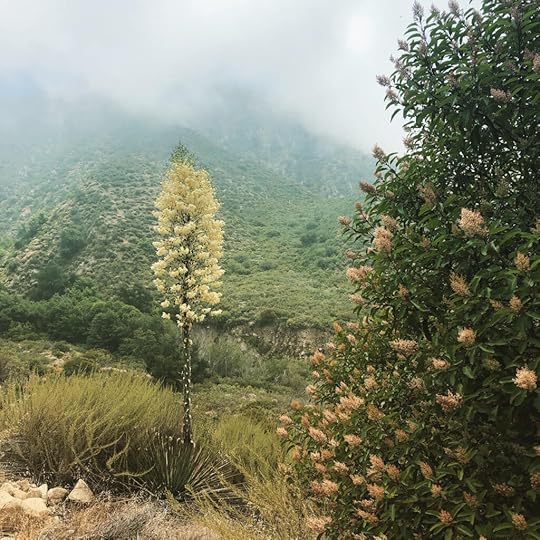 A “LORD’S CANDLE”
July 8, 2020
ÉLISABETH LESEUR: THE THÉRÈSE OF LISIEUX FOR MARRIED WOMEN
It has suddenly been borne in upon me that I have files and files of material that I can share here. Hidden in my laptop, for example, are the stories of hundreds of unsung saints. Here’s one of them.
Servant of God Élisabeth Leseur (1866-1914) was a married laywoman. Her husband, Félix, a doctor, lost his Catholic faith shortly before their 1889 wedding and became a publicly vocal atheist.
Ironically, the suffering she endured as a result invited her to a deeper exploration of her own, until that point rather conventional, faith. She came to see that enduring the anti-Catholic jibes of her husband, whom she loved deeply, and his friends, could be a hidden form of mortification. “Silence is sometimes an act of energy, and smiling, too.”
But Leseur was no retiring faux-martyr. A lively hostess, she carried out her social duties with grace and good humor. A loyal friend, she carried on a wide-ranging spiritual correspondence– mostly unbeknownst to her husband—for the duration of her marriage.
All the while, she continued to develop a rich and hidden interior life: her collected journals are now widely considered a spiritual classic. Her entry for May 3, 1904, is typical: “Has my life known any unhappier time than this?…And yet through all these trials and in spite of the lack of interior joy, there is a deep place that all these waves of sorrow cannot touch….[T]here I can feel how completely one with God I am, and I regain strength and serenity in the heart of Christ. My God, give health and happiness to those I love and give us all true light and charity.”
In frail health all her life, by July, 1913 she was bedridden by the breast cancer to which she would succumb the following year. In the silence of her heart, she made the decision to offer up all her sufferings for the conversion of her husband’s soul.
After she died, Félix found among her papers a letter she had written to him revealing her fervent prayers that he would turn to Christ and become a priest. Outraged, he set off for Lourdes in the hopes of debunking what he considered to be the crank miracles that occurred there. Instead, he had a conversion experience at the Lourdes Grotto.
Leseur is a powerful example as we walk through a world that so often despises Christ and his Church.
“We must never reject anyone who seeks to approach us spiritually; perhaps that person, consciously or unconsciously, is in quest of the “unknown God” (Acts 17: 23) and has sensed in us something that reveals his presence; perhaps he or she thirsts for truth and feels that we live by this truth.”
“Look around oneself for proud sufferers in need, find them, and give them the alms of our heart, of our time, and of our tender respect.”
“Suffering is the highest form of action, the highest expression of the wonderful Communion of Saints, and that in suffering one is sure not to make mistakes (as in action, sometimes) — sure to be useful to others and to the great causes that one longs to serve.”
As the French say, “Woman’s will, God’s will.” Félix was ordained a Dominican priest in 1923. He spent much of his last twenty-seven years promulgating the writings, and advancing the cause for beatification, of his cherished wife.
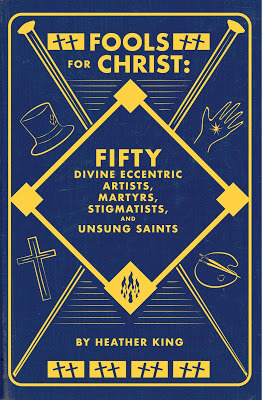
You can read this and many other such stories in my book FOOLS FOR CHRIST: FIFTY DIVINE ECCENTRIC ARTISTS, MARTYRS, STIGMATISTS AND UNSUNG SAINTS.
July 5, 2020
BUILDING ON THE CORNERSTONE
This email arrived today, written by a friend in Northern California. The tone cut through all the rhetoric and cacophony and cut straight to the heart of the matter. She has given me permission to offer her words here.
The day after Independence Day – another year in the life of our country, and if we think of our country as a house we have built, it is now rattling and shaking in a perilous storm.
I think of Psalm 127, “Unless the Lord builds the house, its builders build in vain.” Isn’t this the truth! Much of it, perhaps most of it we did build with Him, but there are foundational errors that need correcting.
I think of a line from ” America the Beautiful”, ” Confirm thy soul in self control, thy liberty in law.” What an apt prayer for this time.
When I was in my early teens I made a promise to myself that every 4th of July I would spend a few minutes that night alone outdoors by myself. I can’t recall exactly what that was about. I couldn’t quite articulate even then the desire I was feeling, but I think it was listening and thanking and connecting to what was good. Those were the years I had lost my faith in God, but the longings were still there.
Many, many people, I think, are like that today. We have so much to be praying for, that we can pray, alone and together, for all the challenges ahead. As we lean on the “cornerstone” of our “house”, which I want to remember is not just our country, but the world. And that cornerstone is more safe and sure because it is the loving heart of God. Because of that truth, we have hope.
One more Psalm,126:6, “He ( or she) who goes out weeping, carrying seed to sow, will return with songs of joy.” Think about that. We may go out weeping, but we are carrying holy seed.
One more line from one more song, written in a time when our “house” was shaking more than it is now, “… be swift my soul to answer Him, be jubilant my feet.” Think about that with faith with hope, and with love.
That last line was from “The Battle Hymn of the Republic”, Julia Ward Howe.
I have blabbed it all over but in case you missed The News of the Week, my Angelus column has won #1 Regular Arts and Culture Column 2020 from the Catholic Press Association!
So that’s really nice.
I am trying to ramp up my social media presence (which is currently at approx zero) a bit so if anyone would like to help me out, feel free to subscribe to my youtube channel and/or instagram.
THANK YOU!!
July 3, 2020
VISIO DIVINA: ARTIST MEL AHLBORN’S MADONNA ICONS
Here’s how this week’s arts and culture column begins:
San Francisco Bay area-based artist Mel Ahlborn has a history of reworking Renaissance Madonnas and pairing them with contemporary elements.
Her series “Modern Love: Intercess and Wait” comprises six Blessed Virgins in the icon style, each addressing a contemporary health concern: Addiction Madonna, Alzheimer’s and Dementia Madonna, and so on.
“As an art student, one way you learn art is by copying Old Masters. But you change something. You’re not just imitating.”
In “Addiction Madonna,” based on a 1480 work by Andrea Mantegna, the green button on the infant Christ’s tunic is actually an Oxycontin pill. In “Pandemic Madonna,” her newest offering, Mary wears a mask.
“A part of me is afraid that someone would look at the paintings and say ‘Heretic!’ Could anyone think I’m trying to parody the Blessed Mother, or trying to coopt a sacred image for a quick ‘Wow’? That’s not my intent at all.”
Instead she asks: “What might Christian iconography look like if it were drawn from a universal human vocabulary that does not depend on traditional Christian imagery?”
“The series really represents my personal desperate questioning. What can create those touchstones for people today–representations that come with an education for the faithful and point to what is beyond? The viewer’s experience as it relates to spiritual formation is what interests me and has interested me since I was a little girl.”
READ THE WHOLE PIECE HERE.
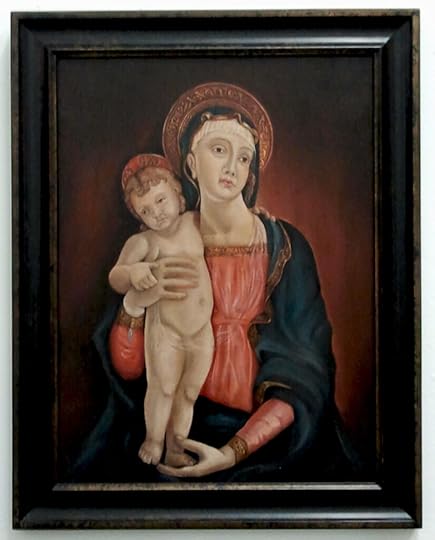 DEMENTIA MADONNA
copyright MEL AHLBORN
June 29, 2020
AS THE WORLD TURNS
I’ve been very busy as of late. having conceived of a new project: a half-day retreat, eventually to be amplified into an 8-week workshop, in which I will tell people how to think, act, and live!
Doesn’t that sound fun?
I am going to get a logo, a banner, a video, a business plan, a “download sheet” (whatever that is), and a flyer. Yes! Business cards, for ancient as I am, I still like a piece of paper with a little picture on it that you can stick in your wallet.
I mean to gather all the many strands of my experience, strength, hope and obsessions. Addiction, food, money, gardening, Film noir. BOOKS. PILGRIMAGE. VOCATION. NATURE. ART. The thin line between passion and pathology.
All underlain by my pre-Vatican II, over-emoting, curmudgeonly temperament, and I pray to the Lord above, a SENSE OF HUMOR.
Mainly I would like to get across that Catholicism, which to me is another way of saying life, is INTERESTING. It’s not sitting (or rather not only sitting) in some air-conditioned gated community discussing the relative merits of Benedict and Francis. It’s not ivory-tower poets scraping and fawning for a place in mover-and-shaker academia, nor “public intellectuals” who beautifully articulate the sanctity of the family but can’t deign to say hello when you meet them in person, nor, for us lesser soul,s sitting in front of our laptops spying upon and hurling insults at each other with the supposed motive of “evangelizing.”
It’s van Gogh saying, “I love my studio in the same way that a sailor loves his ship.” It’s Maria Callas saying, “I prepare myself for rehearsals the way I would for marriage.” It’s daring to respond to the call of the deepest desires of our hearts.
Instead…have you ever been to a Catholic conference of any kind, for example? Everyone takes an uber from the airport to an air-conditioned corporate hotel, eats bad hotel food, drinks at the hotel bar while gossiping about the various factions in the Church, stays inside for three solid days, then takes an uber back to the airport.
What about a WALK? Have we no curiosity? Do our hearts not long to venture out into the streets and see how people live in this strange city we’re visiting? This is not worthy of our Savior. Have we so little imagination that we no longer yearn to see the sky, a river, a dicey neighborhood, a hidden garden, a mom-and-pop bakery, a fistfight?
I say this of course as a member of the Ardently Faithful for whom the Church is the only real home I have or ever will have. And of course failing to venture outside of a carefully-defined bubble of comfort and security is hardly peculiar to Catholics.
I do feel, however, that we of all people–pulsatingly aware of the mystery and the glory of the Incarnation, our endlessly fascinating brothers and sisters, and the world outside our doors–should be adventurers, pilgrims and wanderers.
Speaking of which, I discovered Chaim Soutine (1893-1943) on a little trip to Philadelphia a few years ago on which I “happened” upon the world-famous Barnes Foundation. Mr. Barnes, a mega-rich collector whose statues if there are any will probably soon be ripped down, went over to Europe and basically bought up practically every painting of Soutine’s who was Jewish and at the time crabby and starving in some low Parisian garret.
He, Soutine, painted many tormented-looking women like the one above, often clutching their hands together and looking like they forgot to take their Klonopin, then died near Montparnasse of a perforated ulcer while fleeing the Gestapo.
Anyway, I hope everyone is holding steady in these unprecedented times, and being upheld by art of various kinds that reveals the complexity, depth and paradoxes of the human condition.
June 26, 2020
USE LESS, SHARE MORE
Here’s how this week’s arts and culture column begins:
Hope Jahren is a geobiologist known for her work with soil silence and fossil forests. Currently as the University of Oslo in Norway, she has won numerous prestigious awards and in 2016 published the highly-acclaimed memoir “Lab Girl.”
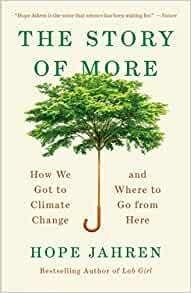
Her second book is called “The Story of More: How We Got to Climate Change and Where to Go From Here.”
But don’t start yawning. Jahren engagingly interweaves meticulously researched data with her Minnesota childhood (she was born in 1969), family history, and our own daily lives.
Early on she sets forth her central thesis: “[M]ost of the want and suffering we see in our world today originates not from earth’s inability to provide but from our own inability to share….It is because so many of us consume far beyond our needs that a great many of us are left with almost nothing.”
In succeeding chapters, she charts several unmistakable trends over the past hundred or more years: increased life span, steady urbanization, massive leap in grain yields due to genetic modification, the corresponding increase in pesticide use.
She includes fascinating pages on the human and animal production of manure, lays out why meat-eating represents a massive waste of resources (aquaculture doesn’t fare much better), delineates the dangers of the high-fructose corn syrup that permeates our food supply, and describes her life-long hatred of cars.
June 22, 2020
USE ME
“In his Voyages dans les Alpes, de Saussure wrote briefly about the chamois hunters of the Alps, men who pursued a notoriously perilous profession. The hunters were menaced by crevasses on the glaciers over which they chased their quarry, they faced death by falling from the steep slopes the chamois preferred, and death by exposure from the Alpine storms which could gather so quickly. And yet, de Saussure had written:
it is these very dangers, this alternation of hope and fear, the continued agitation kept alive by these sensations in his heart, which excite the huntsman, just as they animate the gambler, the warrior, the sailor and, even to a certain point, the naturalist among the Alps whose life resembles closely, in some respects, that of the chamois hunter.
–Robert Macfarlane, Mountains of the Mind
I would add to that list creative writer, a vocation that requires the ability to hold the tension of 24/7, in perpetuity, anxiety.
Will I meet my deadline? Will I be able to pay the rent? Will I be attacked, jeered at, relegated to lifelong failure? Most to the point, am I offering myself FULLY to God?
When the sheep are separated from the goats, will I be able to point to my pitiful little pile of books, blog posts, essays, and say, “This was my heart, Lord. I know it’s not much, but I gave all I had?”
I wouldn’t trade a single second of it. The tension gets me out of bed in the morning, urges me to prayer, gives my life purpose and meaning.
Last week a friend in recovery said something that’s been ringing in my ears ever since. This guy has been in a wheelchair for several years and suffers ongoing health problems.
He said: “I don’t say to God anymore, ‘Help me.’ I say– ‘Use me.’ “
June 20, 2020
THIS SEEMS A HOME
Here’s how this week’s arts and culture column begins:
Museum closures have had one fringe benefit: the plethora of virtual tours, podcasts, and live lectures that have sprung up in art institutions across the world.
In our own backyard for example, Santa Monica’s ROSEGALLERY is currently featuring a thought-provoking online exhibition called “This Seems A Home.”
“Where does it come from, this longing for home?” we’re invited to consider.
“As we all sit inside our respective spaces, waiting for this plague to pass, the question of home is both as apparent and as vague as ever. Even in our realms of usual comfort, an abundance of stagnant time can summon unease.”
The online space is presented as chapters (three as of this writing) in a book. Song lyrics, poems, prose extracts, and artist’s commentary augment the experience.
Chapter 1 features “Window Series,” a collection of digital collages from the Mexico City-based “young architecture office” PALMA. The goal is to explore “contrast in materiality in an abstract manner using texture.” At first glance, I thought, Right, and the result is Edward Hopper, stripped of humanity and heartbeat.
READ THE WHOLE PIECE HERE.
June 18, 2020
INCLINE THE EAR OF THY HEART
Back in 2007, lost in a dark wood at the mid-point of my life, I drove my ’96 Celica convertible from LA to the coast of NH–where I was raised–and back.
I was in mental, emotional, and spiritual anguish, to the point where I began suffering from gnarly skin ailments. The only thing I knew was to stay close to Christ. So I stayed in Motel 6s and Super 8s, and convents and monasteries, and I went to Mass every day.
I made it to the East Coast and back. I was eventually (though not right away) transformed. Here’s the thumbnail version the story.
The video is part of the Virtual Summer Conference of the Portsmouth Institute, a kind of Catholic think tank (“Exploring Catholic Thought. Restoring Christian Culture”) headquartered at beautiful Portsmouth Abbey on the coast of RI.
The Conference takes as its theme “Incline the Ear of Thy Heart: Rediscovering the Virtues and Practices of the Christian Life.”
You can also watch Fr. Augustine Wetta (on humility), Sohrab Ahmari (on play), and John Garvey (on study).
If the spirit moves, you can then register for live discussions with me and/or any of the other participants HERE.
The live discussions take place on Saturday, June 20.
I’m on from 10:00 to 10:45 am EST.
Which means I’m gonna have to set my alarm out here on the West Coast, and get up very early to first choke down my full complement of my morning coffee. Hope to see some of you there!


