
Heather King's Blog, page 54
August 15, 2020
“THE LITTLE LOCKSMITH,” A MEMOIR


THE LITTLE LOCKSMITH, A MEMOIR
Here’s how this week’s arts and culture column begins:
The Little Locksmith, a singular and mysterious memoir, was published in 1943 by a woman named Katharine Butler Hathaway.
The New York Times reported, “It is the kind of book that cannot come into being without great living and great suffering and a rare spirit behind it.”
Hathaway herself called the book a “story of the liberation of a human being.”
Born in Baltimore in 1890, she spent the better part of her youth in Salem, Massachusetts. At the age of 5, she developed spinal tuberculosis. In an effort to avert kyphosis (colloquially, hunchback), her doctors strapped her for the next 10 years to a bed pulley-rigged with iron weights. It was here that, unable to move her body or head, she honed the interior life of the imagination that would nourish and validate her later calling to be a writer.
Her family was cultured, loving, and creative (although, typically New England-ish, they were also extremely emotionally closed down, to the point that nobody once, ever, referred to her condition or uttered the word “hunchback”). She developed a deep inner life of the imagination, encompassing both beauty and terror, that paved the way for her slow, painful, yet somehow sublime spiritual awakening.
Upon release from her bed, she was kyphotic anyway, deformed though mobile: deeply sensitive, deeply intelligent. That she could feel passionately about an idea came, at 15, with the force of revelation. “Something had blazed in me, and from the blaze I discovered a new element in myself, a combustible something that would always blaze again in defense of the mystery and sacredness in things, and against the queer, blind, blaspheming streak in human nature which instead of adoring, must vulgarize and exploit and insult life.”
READ THE WHOLE PIECE HERE.
August 12, 2020
MOTHER LOVE
This week’s arts and culture column should especially endear me to the woke world.
Here’s how it begins:
Not long ago I was lunching with a group that included a widowed ex-nun who had been married to an ex-priest.
Her late husband, turned out, had been a professor of philosophy at a Catholic university. “And so,” she mentioned airily at one point, “Greg had the honor of disabusing the young girls of their notion of the Virgin Birth and other such fairy tales.”
“ Poor things,” she added with a someone-has-to-be-the-bearer-of-bad-news shrug. “They probably still haven’t gotten over it.”
I couldn’t have been more shocked if she’d casually admitted to being a cannibal.
To disown the Virgin Birth is to disown the power of sacrament, story, and the world beyond this one. It is to diminish the glory of motherhood and to reduce womanhood to a commodity. It is to be part of the cultural “movement” that increasingly threatens the very identity of the human person.
READ THE WHOLE PIECE HERE.
August 10, 2020
I’M NOT A BRAND, I’M A FRAME!
I’ve been hard at work and have come up with a kind of frame to put around my work. More on this later, but for now I’ll just say the frame is called DESIRE LINES: Arts, Divine Intoxication. Faith.
Above are my logo and banner!
You’ll be seeing more of this in the coming week and months. We’re changing the name of my column at Angelus News, I’m having a Home Page worked up for this site, and you can look at the flyer I’ve worked up for the half-day workshop that I hope will be my first offering HERE.
Also, here’s a dear little video I shot and edited in the combination bedroom-music conservatory-office that serves as my monastic cell.
I’m quite proud that I managed not only to concoct a “title card” but also to overlay, more or less, a clip of Maria Callas singing La Bohème.
This I keep the demons at bay.
Let’s all keep one another in prayer.
August 4, 2020
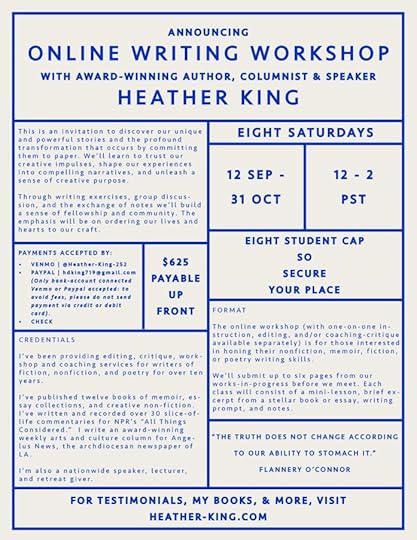
NEW WRITING WORKSHOP
Hello dear readers and writers!
I’ll be offering a new 8-week Writing Workshop on Zoom, Saturdays 12 to 2 PST, starting Sept 12 and running through Oct 31.
Our last 8-week session was stellar. We had a young opera singer who was working on a screenplay, a FAMOUS ACTOR working on a one-man show, a Catholic food writer and podcaster, a young poet from San Antonio, a couple of women who’ve raised kids and families and are finally testing their writing chops, and a dear friend and museum curator who writes with equal facility and love about his late grandmother and his own let’s say eccentric lifelong friend Paul S!
Hope to see some of you this next time around–Happy writing and happy August.
As Hans Christian Andersen observed: “Life itself is the most wonderful fairy tale.”
July 30, 2020
THE KINDNESS OF STRANGERS
Here’s how this week’s arts and culture column begins:
Since 2016, I’ve lived in a large Craftsman bungalow in Pasadena that’s been divided into eight apartments. All we residents of course have our own space, but we also constantly see and run into each other. Our property manager lives next door, the landlord also owns three more houses around the corner, and we all share a giant back yard.
This makes for an extended community of adults and children.
Recently I conducted a mental inventory and realized that together we have roots in Puerto Rico and Santa Barbara, Venezuela and New Hampshire, Indonesia and Orange County, Africa and West Virginia, Mexico and the Bay Area, El Salvador and Florida.
We’ve spent the last three months together in what basically amounts to lockdown. Harmony has reigned. The time has been marked by innumerable acts of kindness, generosity, good cheer and forbearance.
“Hey I just made a bunch of masks—do you want one?” “Hey I picked up this sunhat the other day—I thought of you in the garden.” “Hey, I made a huge batch of cauliflower-cheese soup—can I give you some?” “Hey, I just got back from Costco and bought this six-pack of antihistamine spray—I’ll never use it all, ya wanna couple bottles?”
READ THE WHOLE PIECE HERE.
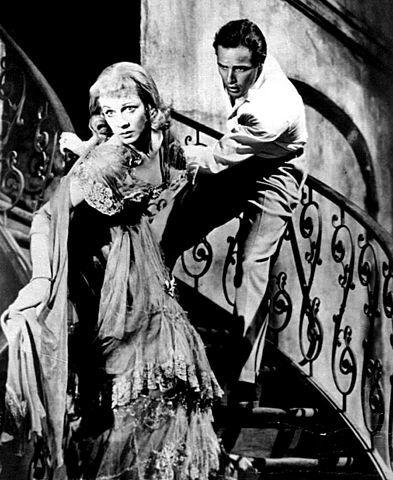 VIVIEN LEIGH AND MARLON BRANDO IN
A STREETCAR NAMED DESIRE.
BLANCHE DUBOIS WAS THE ORIGINAL DEPENDER
UPON THE KINDNESS OF STRANGERS.
July 28, 2020
TO MAKE ONESELF NEW
Here’s a link The Valyermo Chronicle, the quarterly newsletter of St. Andrew’s Benedictine Abbey where I’m in formation to become an Oblate.
The current issue (Summer 2020, No. 264) is really quite good. I thought I’d read the homily by Fr. Aelred Niespolo, OSB, from which the below is excerpted, there. But I came across it somewhere else apparently on the website, was sufficiently struck to copy and paste, and now I can’t figure out where. Don’t you hate that?
Anyway, Fr. Aelred (who’s a monk at the Abbey) observes:
“The Benedictine monk or nun, as part of a long tradition, must respect the place they have come from, but ought also have a vision of the place they are going towards, in the hope of creating the monastery as a template for the kingdom of heaven. But establishing Christ’s kingdom means not dwelling on a sometimes all too real history of failures and grievance in self and in community, but rather sharing in, recounting, focusing on the truer history of grace in both life and community: to both tell and live out this story within the community, the cenoebia, of our lives.
To make oneself new. This is all-encompassing. This action of Christ’s life, this making new, is embodied by a Jesus who daily made new his life by listening for, and doing the will of, the Father. But what happens to us when we do not do this? When we want the kingdom now, instead of when it is truly new? In modern psychology there is a term — cognitive dissonance — that gives us a hint of an answer. The term means, in its broadest sense, the interior confusion and turmoil, the interior pain and emptiness, that is caused in those who preach, and even believe in, one thing, yet live in an opposite way.
We can also use this term to designate a spiritual state, a spiritual illness, and it is this illness Benedict addresses in his Rule—by providing a cure to the disjunction between our words and our actions, our lives and our hearts, our demands upon others, and the choices we make regarding ourselves.
We see this spiritual dissonance everywhere today—grounded in hearts made for God, yet lived out by wills ordered only to themselves. It is part of the great secularizing sickness of our times. It is part of the dread we might feel, even if we are afraid to acknowledge it. It is the fear that wakens us at night, the vision of inauthenticity, of prevarication, of a selfishness that cannot be a part of the new kingdom of heaven. Of not allowing a prayerful, living truth to enliven the dried bones of preconception, prejudice, exclusion, and entitlement.
We excommunicate ourselves, we live with a sense of homelessness. In our gospel Jesus tells us that we must indeed leave all recrimination, gossip, backbiting, power ploys, and personal arrogance behind. But what does that really mean for us? I suspect, at its very basic, it means properly contextualizing, de-idolizing, all those things and people, opinions and ideas, we hold onto in a selfish, self-preserving, way. The Rule tells us what all the great wisdom literature tells us: listen, discern, seek wisdom. And remember the fear of the Lord that Benedict writes of is not servile fear nor does it end in servile love, but is rather another term in acknowledging the complex relational dynamic we have with God, with each other, and above all with ourselves.”
Oh yes! That unsettling feeling that wakes me in the middle of the night and that I can’t pinpoint: I’m a big fake! A pompous self-righteous ass! A liar in many ways, and for sure infinitely selfish. I don’t want to wallow in self-recrimination of course. But it’s bracing, grounding, and hopeful to be reminded, one more time, that I’m neither alone, nor beyond help.
And that the answer, as always, lies in silence, examination of conscience, and prayer.
Thank you, Fr. Aelred. I hope our paths cross sometime soon!
July 23, 2020
GRATITUDE VERSUS COMPLAINING
As a convert–I was received into the Church in 1996–I will forever be behind the Catholic learning and cultural curve.
I was taught in RCIA, for example, that receiving the Eucharist on either the tongue or the hand was fine. I have always received the Eucharist in my hand, and my feeling has always been I wouldn’t care if I had to receive it on my foot–who am I, that I should be worthy to receive the Body of Our Lord under ANY circumstances?!
Thus, as with so many other intra-Church arguments, I have remained somewhat oblivious of the heated emotion that the issue–tongue vs. hand–engenders.
Meanwhile, during COVID, first our local churches were closed completely here in LA–a dreadful period of a couple of months or so when we could not receive the Eucharist AT ALL.
Then they opened for a month or so. Heaven! Bottomless gratitude!
Then as of a couple of weeks ago, we were again forced to close the doors: however–and big however–we can have Mass outside!
Thus, in my local parish, daily Mass has been held in the narrow but lovely courtyard. We are all masked and appropriately distanced of course. And I, for one, have been moved near tears each time I’m able to go. Again—the abject gratitude. The cognizance of the hard work from the priest, deacons, servers, lecters, the people who set up the chairs, awnings, altar etc that go into making each Mass possible.
Several recent homilies have nonetheless been directed toward calming down and placating the apparently zillions of people who are OUTRAGED that we can’t hold Mass indoors.
I thought, My God, if this is the hardest, most “unfair” thing that’s ever happened to you, your life has been very different than mine. We’re HAVING the Mass for heaven’s sake and the sun is shining, it’s a balmy 75 degrees, the fountain is plashing, the birds are singing, we’re surrounded by Mission-style clay tile rooves and lichen-streaked pale pink stucco walls and royal palm trees and we get to pass the bas relief Madonna and child en route to the altar–I mean come on, people!
Now it appears “they” are even more up in arms because the Archbishop has instructed the priests, in light of COVID, to distribute the Eucharist only in the hand. Huge HUGE outrage, indignation, carping, complaining–again to the point that the priest had to keep us after Mass to explain that COVID IS A COMMUNICABLE DISEASE THAT HAS ASSUMED PANDEMIC PROPORTIONS, that the order had come down on high, and to placating the sensibilities of these tormented folk.
OUTRAGE: I could hear the murmuring on the sidewalk later. “I just came back from Alabama and they can receive on the tongue there.” “I’ve written five letters to Archbishop Gomez.” “Father so-and-so down at [a parish that will remain unnamed] will give on the tongue there.”
Whether receiving on the tongue or in the hand is the more ancient practice is apparently open to debate. And I of course totally get that receiving the Body and Blood of Christ is the most essential, most sacred single thing we do as Catholics. I very probably would feel the same way if I’d only ever received on the tongue since childhood.
But that’s not my point here (so please don’t “argue” it in comments). The point for me is that the Church has said receiving either way is acceptable and allowed–that we are RECEIVING THE EUCHARIST–and for me therefore, case closed.
But the deeper point is the phenomenon of complaining: how it corrupts morale; how it forfends all humility.
In fact, after I got done the other day judging those who are not HUMBLE and GRATEFUL like me, I recalled an incident closer to home that put the whole situation in its proper, as usual slightly tragicomic, perspective.
A couple of months ago I’d run into my downstairs neighbor in the back yard, a lovely young wife and the mother of a two-year-old daughter. We exchanged pleasantries and the news of the day and then I started kvetching about the construction noise that is often visited upon our often-in-need-of-repair 1920s Craftsman bungalow.
Really what I wanted, in retrospect, is what we always want when we complain: sympathy. I wanted to commandeer this poor beleaguered woman to MY way of thinking, my concerns, my league–as if fomenting dissatisfaction in my neighbor of our collective living situation was calculated to do anything but make her miserable!
Anyway, she listened patiently for a minute and didn’t much respond.
When I said, “Does the noise bother you?” she looked me in the eye and said, “I guess not as much as it does you. I have other things I worry about.”
I have other things I worry about. Is that not brilliant? For a second, I felt quite put upon and “unseen”–as usual, no-one cares about MY needs, my concerns. No-one understands that I need quiet to do my very important work. But quite quickly I realized that my complaining was actually doing active harm.
Because the thing about complaining is generally other people don’t have the same complaints as you. They have other things–their own things–to worry about, and they’re having the graciousness not to impose them on you.
So our complaining is not only a drag–our complaining also serves to divide. The other person can’t help but judge you as basically shallow (which at the moment is basically true), self-absorbed and someone to be at least a little bit avoided. I mean can you imagine the worries, given the current state of the world in particular, of the mother of a two-year-old child? And how very insignificant and beside-the-point mine must have sounded?
The deepest point is that perhaps never before in our lifetimes have we so deeply been called upon to stay the course, to strive to enter by the narrow gate, to spread the Gospel to the ends of the earth. We don’t do that by complaining. We do it with our presence, our humility, our gratitude, our patient endurance of the many points of contention we all feel at the moment, in and out of the Church.
We do it always, only and forever through the Eucharist. And next time I’m moved to kvetch, I, for one, would do well to remember the price that others have paid–without complaint–in order to receive it themselves.
Servant of God Adele Dirsyté (1919-1955), tortured and martyred in Communist Russia, wrote the prayer book “Mary, Save Us” while imprisoned in Siberia.
Born in Lithuania to parents who were farmers, Adele was the youngest of six children. At college she majored in philosophy, then worked for various youth organizations. Among them was Caritas, which served widows and orphans. She taught German at a girls’ school, leading her students in prayer and retreats.
The Soviet occupation of Lithuania began in 1940. In June 1941, Germany attacked the USSR and soon occupied the Baltic territories. During the Nazi occupation, Adele lived with a woman who was harboring a Jewish girl.
By 1944, the Soviet army had reoccupied the capital city of Vilnius. Adele began participating in a resistance movement that was organizing for Lithuanian independence.
In 1946, she was arrested for hiding a woman who had escaped from the Soviets. She was brought before a tribunal, and sentenced for “counterrevolutionary activities” to ten years in a concentration camp.
Imprisoned for a year in Vilnius, she was then transferred to what would be the first of a series of forced labor camps. She and her fellow inmates hacked trees, moved rocks, and built railways, They also endured bitter cold, poor sanitary conditions, and starvation food rations.
Adele was known for her kindness, faith, and steadfast efforts to console and comfort her fellow prisoners. At Magadan concentration camp, she managed to produce a small prayer book, hand-sewn with cloth covers. Other inmates were encouraged to add their own hand-written prayers as the book made the rounds of the barracks. Originally called: “Prayer Book for Girls Exiled in Siberia,” the little volume eventually found its way to the West and is now known as “Mary, Save Us.”
One day a priest inmate from the adjacent men’s camp arranged for the Eucharist to be brought over and distributed among the Lithuanian women. The guards noticed and, over the coming months, Adele was taken repeatedly to a cold underground cell and beaten. All her teeth were knocked out. Her fellow inmates realized she had been marked for “slow extermination.”
In the fall of 1953 she was held in the punishment cell for a week, then transferred to an unknown location for the winter. She returned to Magadan partially incoherent, with half of her hair torn out, and was moved to the mentally ill ward. Here she refused food, saying “You who work must eat.” She died on September 26, 1955. The cause for her beatification was opened on January 14, 2000.
One detail, from her time before prison, haunts. A former student remarked “She was modest and very quiet… Her lessons were a bit boring.”
Her lessons were a bit boring. How sharply we are reminded that the person marked out by Christ to share his crown is often outwardly ordinary and without special talents.
Her lessons were a bit boring. And within Servant of God Adele Dirsyté burned the heart of a martyr, a queen, a saint.
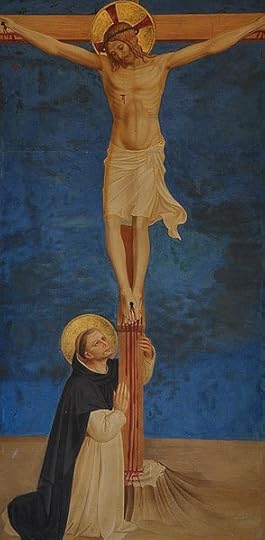 FRA ANGELICO, ST. DOMINIC AT THE FOOT OF THE CROSS
July 20, 2020
THE SCAPEGOAT
Here’s how this week’s arts and culture column begins:
I once gave a talk to a group of wealthy Catholic women. As is often the case is such situations, I was more or less the afternoon’s entertainment. The hat was passed and I ended up being given 90 bucks to open my veins and tell the story of my conversion.
That was okay except that, in case you’ve never done such a thing yourself, you have to rev up (especially if you have a story like mine), steady your heart and steel your nerves for a day or two prior, pray like hell, and prepare to be drained to the bone.
Over by the refrigerator afterwards, one of the women cornered me, narrowed her eyes, and hissed, “DID YOU VOTE FOR OBAMA?” In other words: “Speak, wretch! Are you or ARE YOU NOT the anti-Christ?!”
We used to reserve such totalitarian behavior to the Secret Police: now we willingly surveil each other. No thought–from no matter how loving a heart; no matter how innocent–is exempt from being scrutinized, pounced upon, and assigned a malign and evil motive. Now there must be public shaming, public demands for recantations, public “re-education,” public apologies.
No matter that we’re, for example, devoted, faithful fathers and husbands: Last year all males were expected to grovel for having been born male. No matter that we’re naturally appalled by the racial injustice against which every thinking person instinctively recoils: This year all Caucasians must grovel for having been born Caucausian.
The point is that both ends of the ideological spectrum are increasingly marked by bullying, “calling out,” and the imposition of a kind of martial law as to how we’re to speak, act and think.
I don’t think this is a minor point: I think the phenomenon is very, very dangerous. Let’s not forget that another name for Satan is The Accuser. And I hope everyone’s read Arthur Koestler’s Darkness at Noon.
READ THE WHOLE COLUMN HERE.
July 18, 2020
STILL FULL OF SAP, STILL GREEN
My birthday is tomorrow: 68 years of age!
I look forward to a fruitful year.
That’s my grandfather, Pa we called him, a kindly bricklayer who kept his own counsel, after retirement dozed in his armchair, and kept a tin of hard candies at all times by his side which he very generously shared.
Pa hailed from Scotland and the story goes that I was so named because while courting, my father sang to my mother at tune from the old country called “A Wee Hoose ‘Mang the Heather.”
Harry Lauder was a Scottish singer and vaudevillian–and I am proud to say we wore the same kind of cap!


