
Heather King's Blog, page 51
November 29, 2020
DESIRE LINES
Here’s how this week’s arts and culture piece begins:
“We come into this world with sealed orders.”
—Søren Kierkegaard
Desire lines or paths are the names given by urban planners to what happens when one person’s impulsive shortcut encourages others to follow, creating informal, unmapped channels through a city.
Desire lines have been called “free-will ways,” “cow paths, pirate paths, social trails, kemonomichi (beast trails), chemins de l’âne (donkey paths), Olifantenpad (elephant trails),” “Paths that have Made Themselves,” “a record of civil disobedience,” and “beautiful, poetic marks of democracy.” They “indicate [the] yearning” of those wishing to walk…of giving feedback with our feet.”
Artists make desire lines from their hearts to their easels and stages and desks. Christ’s walk to Calvary is the über Desire Line: both a “shortcut” and the road from—and to—infinity.
Our culture, by contrast, encourages us to stay within safe, strictly-prescribed lines that have a predictable beginning and a predictable end.
How many of us experience “travel,” for example, by taking an uber from the airport to an air-conditioned hotel, boarding an American-run tour bus, following a prescribed itinerary from which we depart in not the slightest particular, then taking an uber back to the airport?
What about a throw-caution-to-the-winds walk? Have we no curiosity? Do our hearts not long to venture out into the streets and see how people live in this strange city we’re visiting? Have we so little imagination that we no longer yearn to see the sky, a river, a dicey neighborhood, a hidden garden, a mom-and-pop bakery, an argument?
Of course failing to venture outside of a carefully-defined bubble of comfort and security is hardly peculiar to Catholics.
But Catholics, of all people, should be pulsatingly aware of the mystery and the glory of the Incarnation, of our endlessly fascinating brothers and sisters, and of the world outside our doors. Catholics, of all people, should be adventurers, pilgrims and wanderers.
READ THE WHOLE PIECE HERE.


November 26, 2020
CIRCLE PEOPLE
Turns out I’m spending Thanksgiving at home and I’m so grateful! What with the phone, zoom, my many neighbors, Mass, and the long walk I’ll take, I will be far from alone.
In fact, I’ve been mightily reflecting upon this past year and the many gifts it’s brought.
One of them, maybe, is the message…The Kingdom of God is at hand. It’s already here. It’s been here. It will be here without any effort on my part. I just get to tap into it…
I tend to tell myself, vis-a-vis work, that I should get together a little bit more of a “business plan.” Often when I’m spending another hour or two typing out passages from, for example, books I have read and loved, searching for an image, formatting, laying out, say just a simple blog post, I’ll think–Seriously, why are you putting forth all this effort? Maybe 100 people come to my site each day. After ten years. Thousands of dollars spent to make it beautiful; thousands of hours spent transmitting my enthusiasm.
And, as I reflected in last week’s arts and culture column, I’m overpaid. It’s all work and it’s all prayer and it’s all joy and Lord, I am not worthy.
A few of you lend financial support, a fact of which I am pulsatingly aware and for which I am undyingly grateful.
And I’m also beyond grateful for the rest of you who come and read and comment once in a while or who prefer not to, which is TOTALLY FINE. Thank you, thank you.
Because lately I’ve been realizing–this is it. This isn’t the means to a bigger, flashier, more effective end. This is the FRUIT of my life. The blog is a small part of it, but I mean the whole thing: the books, the column, the workshops, through all of which in some bizarre, miracle-of-the-loaves-and-fishes way, I have cobbled together a humane living. But more than that, the connections. The personal connections. And above and below all of that, of course, the prayer. The Sacraments. Christ.
Yesterday just for the heck of it I opened a Word doc, entitled it “Circle People” and started randomly typing the many, many names that came to mind. People who have shared their stories, conflicts, troubles and joys, asked me for prayers, offered their own, invited me to wrestle with an issue of the day, griped, laughed, enrolled in my Writing Workshops, inspired me with their own crazy fantastic art or writing or insights or blog posts. Bought my books, took the time to compose gorgeous, smart, funny notes to say what they liked about them. Sent me quotes, prayer cards, and a VERY SPECIAL print of Mary, Queen of Heaven and Earth, that hangs over my desk. YOU KNOW WHO YOU ARE!! YES, YOU!!! ALL OF YOU!!!
Some are priests; some would not step foot in a church of any kind if you paid them. Some, I’d wager, voted one way earlier this month; some voted another.
And I wonder if…this kind of small circle, available to all of us, requiring no special training, charism, gift…and thus utterly within our reach if we’re only willing to stretch a little, risk a little, leave our comfort zones…is not one way that we can and are perhaps called to evangelize. To spread the Gospels, by which I simply mean love, to the ends of the earth.
HAPPY THANKSGIVING.
November 24, 2020
UNDER STORM’S WING
I’ve been drawn lately to lots of nonfiction and memoir about walking and landscape. I recommend any of Robert Macfarlane‘s many titles. I’ve mentioned him before. He’s the type of writer that leads you to ten other artists or walkers or poets.
The Old Ways is a kind of elegy to one of his heroes, the poet Edward Thomas (1878-1917), who was a lover of nature, a depressive, and a passionate lifelong walker, especially in and around the South Downs.
Edward was married to Helen (1877-1967) and Helen has a wonderful book called Under Storm’s Wing that includes two of her shorter works, both about her life with Edward (As It Was and World Without End), as well as letters and memoirs.
The couple had three children, were more or less perpetually broke, and lived in a succession of houses in the English countryside. I can’t get enough of reading of their way of life. A small sampling:
Of a long summer holiday the family took with Robert Frost and his family (Frost and Edward Thomas were great friends) in a remote hamlet in Herefordshire:
“In the morning we were able to take stock of our surroundings and found everything very much to our satisfaction. The farmhouse stood among large orchards in which were grown thousands of dessert plums, each hanging in its own muslin bag to protect it from wasps, birds and insects. These plums had to be without blemish and of perfect shape. When they had reached perfection, they were packed for Covent Garden, each in its own cotton-wool-lined compartment. The outside of the farmhouse was hung with delicious fruit which we were allowed to pick–greengages and large golden or purple juicy plums.”
Of a visit to Edward’s Welsh relatives, in a village where most of the men were employed in the local tin-plating works. Helen is describing Mrs Hughes, the matriarch of a large and noisy family:
“In spite of her great bulk she was never idle. If she was not tackling a huge family washing-day, she was baking a batch of large crusty sweet-smelling loaves, or cutting thick rashers from the delicious home-cured bacon which was their chief food. Everything in this kitchen was on a grand scale. The long heavy table scrubbed white, the giant-sized oval frying pan always on the hob, the enormous enamel teapot, its contents black and boiling, for food and drink were always ready for the men coming off shifts. A white cloth would be spread over the table and plates of home grown food, meat and vegetables, would be put round; and to the noise of laughter and talk would be added the clatter of knives and forks and the clink of cups and saucers, for always tea accompanied every meal.
These meals used to terrify me because one was expected to eat so much. First of all the meat and vegetables, and before one had gotten halfway through that, a thick wedge of apple tart would be put alongside, and after that waiting to be eaten a plate of cake or slices of bread and home-produced honey.”
From Thomas’s daughter Myfanwy’s childhood memories:
“Mother would take me out in a wooden push-chair called a mail-cart, along the lanes or down the long hill to Steep. Sometimes we were given a ride in Mrs Dennet’s pony trap, from which she delivered pats of dewy butter wrapped in a fresh cabbage leaf, and brown eggs from a large basket. Often we would picnic on the Shoulder of Mutton among the juniper bushes and yew-trees, while [her sister] Bronwen picked bunches of harebells, milkwort and sheeps-bit scabious…The picnic knife for cutting the fruit-cake, of which my father was so fond, was cleaned by digging the blade into the springy turf, apple-cores were hidden in bushes and wrapping papers put back into the haversack.”
Edward enlisted in the British Army at the start of WWI and died in action at 39. Helen was devastated.
The point in copying all this out being…What do we love? What are we willing to suffer for?
What are we transmitting to each other in the way of hope, adventure, excitement, curiosity, new finds, each day?
For hope, adventure, excitement, and the transferral of enthusiasm are surely the essence of the “life” we Catholics so vociferously claim to promote…
A dewy pat of butter in a fresh cabbage leaf! Now that’s worth bringing a kid into the world for…
November 20, 2020
GRIEVANCE VS GRATITUDE
Here’s how this week’s art and culture column begins:
Recently I was on a friend’s podcast discussing my essay collection “RAVISHED: Notes on Womanhood.
He and I talked a bit about my former life as a Beverly Hills attorney. After several agonizing years of soul-searching I gave up that job, along with the money, benefits and prestige, in favor of the precarious existence of a creative writer.
“What would you say to the woman who works in a law firm and hits the glass ceiling?” my friend asked at one point.
My mind short-circuited. “I guess…uh…I can’t imagine wanting to move up the ladder in a law firm,” I laughingly stammered.
“That’s not a slur against lawyers,” I continued. “It’s a reflection of the fact that I absolutely was not called to be a lawyer. But I guess I’d say give it everything you have but if you can’t move up any further, look at it as a blessing in disguise. Because maybe you want to order your life to something other than power, property and prestige. And if you’re a lawyer for the right reason—which is because the law is your vocation and your way to give to the world—then you’ll figure out a way to do it no matter how much or how little money you make.”
Afterward I pondered his question for a long time. “Render unto Caesar what is Caesar’s and to God what is God’s,” said Christ. In a way, moving up the corporate ladder is a question for Caesar. Of course we’re all entitled to make a living. Of course our expertise and gifts should be equally remunerated whether we’re women or men.
READ THE WHOLE PIECE HERE.
November 16, 2020
I CHOOSE ALL!
A well-known anecdote about St. Thérèse of Lisieux has it that, when offered a basket of lace and other trimmings as a girl and told she could choose one, exclaimed, “I CHOOSE ALL!”
As an adult, she extrapolated on the concept and observed, “My God, I choose all! I don’t want to be a saint by halves; I choose all that You will!”
In a certain frame of mind, I just choose all, God’s will or no.
I often think of a friend who once described the Dr. Jekyll and Mr. Hyde psyche of an addict. The son of an old friend, a hope-to-die junkie, had arrived on her doorstep strung out, beaten-down, humble, contrite even. “Just a bed for a few hours,” he croaked. “I just need to sleep.” She fed him, let him shower, gave him a bed for the night.
The guy woke the next morning transformed. He came downstairs with his hair slicked back, a cigarette hanging from his lower lip, and his collar open to mid-chest. “You couldn’t spare a twenty?” he asked, flashing an oily smile.
I know that off-again, on-again phenomenon well. I don’t think it’s manic-depression. But I often go through long periods where I’m utterly drained and exhausted. It’s okay, I’ll think. I’m just old now. This is how people my age, feel, or worse, all the time. My days of feeling good, or whole, or zippy, or excited, are long gone.
Then I’ll actually rest for a couple of days (always the very last action it occurs to me to take) and wake on Monday morning revivified, rejuvenated, re-energized.
It’s then that, like an insect in its death throes waving one last jerky leg, I’ll get a weird burst of energy and think, I want to walk the Camino Le Puy! I want to move to Tucson and buy a house! I want to live in Croatia for a year! I want to pray from a shepherd’s hut in Ireland!
As Father Denis at Holy Family said yesterday, apropos of not burying our talents, Figure out what you want to do. Make a decision. And then start taking small steps to implement the decision.
He talked about how the main reason we don’t live out our desires and dreams is fear. “F-E-A-R: False Evidence Appearing Real.” (Recovering alcoholics have a second acronym for fear: F__ Everything and Run).
Father’s wisdom was sound. And I’ve been thinking a lot lately about how when I’m frustrated with myself–perhaps because I’ve been blocked, possibly for a long time, by my own fear–I tend to turn the anger outwards.
This morning in prayer what I heard right away was: Mind Your Own Business. Because isn’t it so much fun to catalogue the zillions of ways everyone else is wrong, blind, an ideologue, stupid, hypocritical, gullible and self-righteous? Although actually it’s not that much fun. Taking the moral inventory of “the other” in the long run leaves me drained, exhausted, frightened, weakened, hopeless, and angry.
St. Francis heard “Rebuild my Church.” St. Bernadette heard “I Am the Immaculate Conception.”
I, perpetually wanting all, heard “Mind Your Own Damn Business.”
And knowing one more time that I am loved beyond measure, snorted with laughter.
November 13, 2020
SAINTS ALIVE!
Here’s how this week’s arts and culture column begins:
Pasadena native Mary Lea Carroll has written two engaging books on saints. The first, Saint Everywhere: Travels in Search of the Lady Saints, came out in 2019. In it, she travels among other places to Siena (St. Catherine), Prague (Infant Jesus) and Medjugorje (Our Lady of Peace).
This year, just in time for Christmas, comes Somehow Saints: More Travels in Search of the Saintly. The publisher, Prospect Park Books, is based in Altadena, making this small attractive volume altogether “locally grown.”
“Somehow Saints” is no Pilgrim’s Progress. Carroll is not the type (nor am I) to undergo the three-day ordeal of fasting, walking barefoot and prayer known as St. Patrick’s Purgatory; nor to crawl two miles up a hill on her knees to the Shrine of Our Lady of Guadalupe in Mexico City.
To her great credit, in fact, she never pretends to be anything other than exactly what she is: a suburban wife and mother with a beautiful home, a husband retired from a comfortable job, three grown kids, a yard full of rosebushes, and eyelash extensions. She likes boutique hotels, good coffee, fine restaurants, and shopping.
Also to her great credit—and this is what elevates “Somehow Saints” above a mere stocking-stuffer— Carroll is a born traveler: comfortable talking to strangers, willing to follow up on possible dead-end leads, always ready for an adventure. She goes out of her way to talk to the people she meets along the way: cabbies, bartenders. She’s curious, persistent, and a genuine seeker.
READ THE WHOLE PIECE HERE.
November 9, 2020
THE DESIRE LINES HALF-DAY WORKSHOP HAS ARRIVED!
“The glory of God is a human being fully alive.”
–St. Irenaeus, second-century theologian
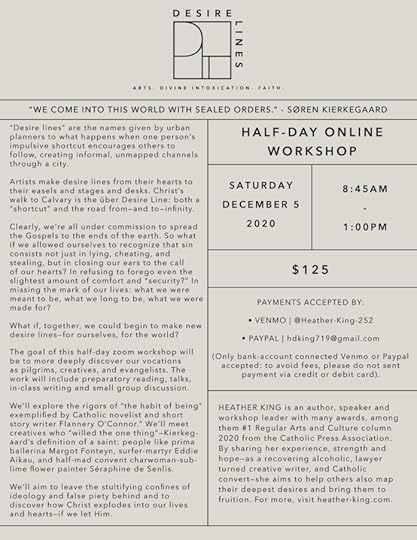
To sign up, simply pay via venmo or paypal. Feel free to email with any questions: hdking719@gmail.com.
This would make a great gift for newly-retired parents, live-at-home adult children who are unsure of their next move, lapsed or pissed-off Catholics, seekers of all stripes, and anyone whose deepest wish is to pursue an artistic vocation but is 1) terrified of not making enough money, 2) failing, 3) laboring under the misapprehension that to allow ourselves the life that we’re made for is an indulgent pipe dream.
And an introductory video!
November 6, 2020
ARCOSANTI
Here’s how this week’s arts and culture piece begins:
Arcosanti has been called an “experimental city,” ” an “urban laboratory,” a “caravanserai.”
Seventy miles north of Phoenix, the 25-acre compound, built on a 4,060-acre land preserve, rises from the desert like a mirage.
The project was the brainchild of “visionary” Paolo Soleri (1919-2013). Arcology—a concept combining architecture and ecology—was his guiding light.
Cosanti (in Italian, “against things and business”) was the name Soleri gave to his home in Paradise Valley—another 75 miles north and now a gallery, studio and shop selling ceramics and the sculptural bronze-cast windbells for which Arcosanti has come to be known.
Ground was broken in the 1970s and building continued until 1989. The goal of the project was to combine “the social interaction and accessibility of an urban environment with sound environmental principles, such as minimal resource use and access to the natural environment.”
READ THE WHOLE PIECE HERE.
November 5, 2020
G.K.CHESTERTON: I AM
Legend has it that around 1910, The Times posed the question to a selection of eminent writers and thinkers: “What’s Wong with the World?”
“Dear Sirs,” G.K. Chesterton replied: “I am.”
October 30, 2020
BLESSED ARE THE POOR IN SPIRIT
Here’s how this week’s arts and culture column begins:
During COVID, I’ve been trying to spend more time in prayer. In particular, I’ve tried to devote fifteen minutes, each day for a week, to meditating on a particular Gospel passage.
The first week the Parable of the Rich Young Man [Matthew 19:16-22] bubbled up from my subconscious. The next week: “An evil and unfaithful generation seeks a sign, but no sign will be given it except the sign of Jonah” [Matthew 16:4]. The third week, unmistakably, the verse that rose to mind was “Blessed are the poor in spirit” from the Sermon on the Mount.
You can’t be a by-the-book, neither right nor left, practicing Catholic without running up against some form of exile, in or out of the Church. Secular friends I sense are baffled by my failure to canvass door-to-door trying to drum up Democratic votes. I’ve been accused by the “woke” of being responsible for hundreds of deaths for my failure to accuse myself of white privilege. Catholic Workers feel anyone worth his or her salt should have done prison time. Right-leaning Catholics are baffled by my failure, in spite of my fidelity to the teachings of the Church on marriage and the family, to take up the “pro-life” banner.
READ THE WHOLE PIECE HERE.


