
Heather King's Blog, page 48
February 23, 2021
ACTING AS IF
“We spoke of Thérèse of Lisieux. For her, this togetherness [with God] meant a silver thread of naked trust, with the absolute minimum of feed-back. Poems which she composed during her months of inner darkness gave no hint of the seeming godlessness of it all. Explaining the brightness of her verses, she said, ‘I sing what I will to believe.’ “
–Iain Matthew, The Impact of God: Soundings from St. John of the Cross
One piece of common wisdom often heard in recovery circles is to “act as if.”
What does that mean?
One thing it doesn’t mean is being a phony.
Acting as if doesn’t mean pretending everything’s “all right” and that we’re not in terrible pain; it means not transmitting our pain to, or blaming our pain on, others. Phoniness means claiming to understand God; “acting as if” means choosing to proceed in faith in spite of our weaknesses, uncertainty and doubt. Acting as if is trying to be civil and kind, often at great effort, to people we dislike; phoniness is being nice to people to their face, and badmouthing them behind their backs.
Not long ago, a friend who hopes to enter the religious life was badmouthing someone with whom she was forced to be in relative proximity and who grated dreadfully on her nerves. “She wants to be my friend,” my friend said of this other person. “She thinks she’s going to be my friend.”
I understood all too well. I’ve had similar thoughts, many times, about people in my own life. But Christ calls us to be a “friend”–not an intimate, but a friend–to everyone. The Gospels militate against picking and choosing the people with whom we’re going to walk the road, who are going to be our teachers, to whom we’re going to be kind.
We don’t waste our time with people who don’t want what we have to offer. But if they do, one form of martyrdom is to give a listening ear or an understanding smile to all comers: the borderline-personality alcoholic who’s trying to get sober; the co-worker with a broken heart that refuses to mend; the followers of Christ and resolute non-believers and everyone in between whose sensibility doesn’t remotely jibe with ours.
We’re called to speak to people to whom we often don’t feel like speaking; to refrain from surrounding ourselves with people “just like us,” whose thoughts, ideas, and actions we can more or less manage and control; to share not just with the poor, but with the rich, the mediocre, the irritating, the Republicans, the Democrats, because we never know who the poor are. We never know whose heart is hemorrhaging. We never know who needs a consoling word, a smile, a helping hand.
Thérèse is exactly right: such a life can only be lived on “naked trust, with the absolute minimum of feed-back.” There’s no cheering squad when we go beyond our comfort zone to welcome the stranger because as servants of Christ we’re only doing our job: we don’t get extra credit.
No-one hits “like” on our social media feed when we refrain from rolling our eyes, sighing, or making the catty comment, because no-one knows. No-one writes us up in the paper when we silently ask God for help in forgiving the person who has hurt us, or wishing well the person of whom we’re jealous. Yet those are exactly the small, invisible actions that built up the Body of Christ: in us, in the Church.
Most of all, we are not recognized for our daily discipline of prayer, praise, purification of heart, and examination of conscience: all, in other words, that makes us worthy to call ourselves followers of Christ. All that makes us able, ideally, to meet man, woman, or child, old or young, rich or poor, and to say: Tell me your story.
To be open enough to receive another’s pain takes a lifetime of inner work. To be present enough to sit quietly and truly listen while another tells his or her story requires first allowing ourselves to “hear” our own story, to face our own brokenness, to forgive ourselves and each other. To consent to not know the answers and to abandon ourselves, instead, to the God of poverty and mystery is to know, like Christ, that our kingdom is not of this world.
Easier said than done—but that seems to be the road. To stumble forward “acting as if.” To sing what we will to believe.
[This is a re-print of an article published elsewhere years ago…}


February 21, 2021
I’M JUST GONNA KEEP POSTING THIS TILL THE WORKSHOP IS FULL!
HEATHER KING SPRING 2021 WRITING WORKSHOP!!
8 WEEKS, MARCH 6-APRIL 24, SATURDAYS 12-2 PST.
Eight-person max. Four slots left. Get ‘em while they last!!!
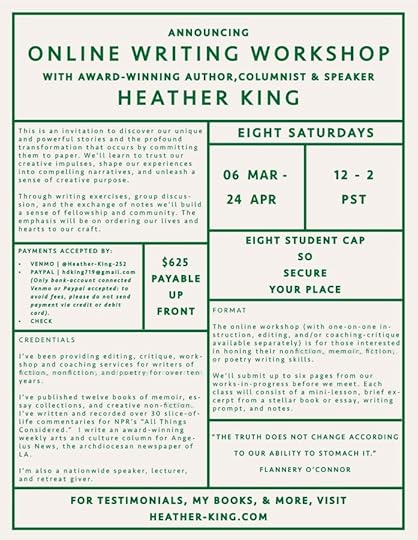
IN CASE YOU DON’T KNOW, I’m a writer with a dozen books, a former commentator for NPR’s “All Things Considered,” and an award-winning arts and culture columnist for Angelus News, the archdiocesan newspaper of LA.
The only requirement for the Workshop is a desire to learn more and to establish a more dedicated and structured way to write. The participants bring a wide range of sensibilities, approaches, demographics, and levels of expertise. Some are Catholic; many are not. Some have never seriously written before, nor shown their work to another human being. Others have been published.
The emphasis is on both the craft of writing, and on enlarging our hearts, horizons and souls.
I’ve come to love the serendipity of each group–a tightly-knit, supportive community of eight weeks in which we’re invited to stretch, explore, and grow. All are most welcome.
For testimonials and more, visit the Workshops tab above.
TO SIGN UP, OR ASK QUESTIONS, EMAIL ME AT HDKING719@GMAIL.COM.
LOOKING FORWARD!! THANKS TO ALL.
February 19, 2021
THE PROBLEM WITH CONTRIVING TO BE CONTROVERSIAL
Here’s how this week’s arts and culture column begins:
I have never much kept up with Catholic “politics,” if that’s the word. I depend upon Always Forward, from our own Angelus, for daily news of the Catholic world.
And I read one blog: Neal Obstat, faithfully maintained by the wonderful Dr. Tom Neal, husband, father, and Professor of Spiritual Theology at Notre Dame Seminary Graduate School of Theology in New Orleans.
In a recent post. Dr. Neal wrote of his conscious choice to avoid being a “controversialist.” I couldn’t agree more.
That doesn’t mean you never say things with which people disagree. It means you don’t make a career, in or out of the Church, out of being a provocateur and a hater.
READ THE WHOLE PIECE HERE.
February 16, 2021
MARDI GRAS
I hope to make a “good Lent” this year. By which I mean I hope to move closer to following Christ’s call to “Stay awake!,” “Store up your treasure in heaven,” and “Pick up your mat and walk.”
Here’s my plan, and I feel quite sure that if I can implement it even in some tiny share, the effects will flow out to areas of my life:
I would like to reform my eating habits.
I’m embarrassed to admit how truly abysmal they are. I eat standing up, hunched over the kitchen counter; or while wandering through the apartment doing ten other things; or bent over my laptop answering emails, reading the paper, watching movies, researching and/or writing.
And let’s not forget while driving.
Hard on the heels of my divorce, I attributed this to the fact that my ex-husband and I had sat down to dinner every night, and thus eating alone made me feel sad.
Here’s the thing, though: We split up in 2000.
So twenty-one years later, it’s not sadness, it’s sloth. It’s fear that I WON’T GET EVERYTHING DONE. I won’t complete all my many, many tasks (about 90% of which are nonessential) for the day.
Thus, I can count on two hands the times during the last six years in my apartment that I have laid a place, sat down with a plate, a glass, cutlery and a napkin, said grace, maybe lit a candle, and allowed myself truly to enjoy, give thanks for what I’m eating and the hundreds of pairs of hands that have gone into planting, raising, feeding, watering, harvesting (or butchering as the case my be), packing, shipping, stocking.
I often say a hurried thank you before and after eating. But that’s a far, far cry from giving my food the attention it deserves.
“Absolute attention is prayer,” said Simone Weil, and prayer is exactly my principal aim and consideration.
I’ve already started. Yesterday at lunchtime, I actually took a break from work, sat down in a chair away from my desk, and engaged in the one activity: eating.
Last night I did lay a place, with a cloth napkin and so on. Oh wow! Also I forgot to say that you pray for the dead at the end of the meal. (The whole idea, by the way, came from this post by Dr. Tom Neal (whose blog Neal Obstat I highly recommend) on monastic eating).
Already I see that committing to this one change is actually going to give me MORE time. Don’t ask me how or why this is true, but I wonder if the same phenomenon doesn’t underlie the miracle of the loaves and fishes. Or as I read in a biography of the cellist Gregor Piatigorsky recently, (said apropos of aging): “I don’t have time to be in a hurry anymore.”
Interestingly, my Lenten fast, or part of it at least, has always revolved around food. A couple of years I gave up coffee, which was disastrous and seriously, way beyond me. Sugar of course is always good to cut out or at least down on. But sitting down to eat is a “fast” of a different order altogether.
Slowing down, paying attention, surrendering my incredibly self-will-run-riot temperament implicates my mind, heart, intention, and conscience in a way that simply cutting a particular item out of my diet doesn’t.
Sitting down to eat allows me to receive…which I’m pretty sure is kind of the whole point of fasting…
Meanwhile this morning’s Magnificat had a spot-on reflection from Servant of God/convicted murderer Jacques Fesch: an excerpt from a letter to a friend who was being ordained that ends like this:
“Little brother, I imagine you must be overflowing with joy. Your last letter was a hymn of love and thanksgiving. As for me, I’m more like a snail, crawling along the path of faith, stumbling at every third step and moaning and groaning over each obstacle to be overcome. But could it be that I am better off this way?” [italics mine].
Remember we are dust, and to dust we shall return.
Blessed Lent.
February 12, 2021
COCKTAIL HOUR AT THE FRICK, COVID-STYLE
Here’s how this week’s arts and culture piece begins:
We’ve all done well but let’s face it: the COVID restrictions have truly begun to pall.
Flying is risky. Restaurants are a drag with masks and no-one wants to meet anyway lest we spark a super-spreader. Museums have been closed for almost a year!
So here’s an idea that combines virtual cross-country travel, drinks with friends, and a museum. That would be the podcast series: “Cocktails with a Curator at the Frick.”
The Frick Collection of course is the hoity-toity art museum, housed in former Pittsburgh industrialist Henry Clay Frick’s Gilded Age mansion on Manhattan’s Upper East Side. The Collection is known for its Old Master paintings, outstanding examples of European sculpture, and decorative arts.
The premise of the series is simple: “The Frick is concocting the perfect mix of cocktails and art. Every Friday at 5:00 p.m. [EST], join us for happy hour as a Frick curator (remotely) offers insights on a work of art with a complementary cocktail. Bring your own beverage to this virtual event.”
READ THE WHOLE PIECE HERE.
February 9, 2021
MARCH-APRIL SPRING 2021 WRITING WORKSHOP!!
TO SIGN UP, EMAIL ME AT HDKING719@GMAIL.COM. I’LL SEND A SHORT DEAL MEMO SETTING FORTH OUR MUTUAL COMMITMENT, THEN SIMPLY SUBMIT FEE AS INDICATED ABOVE.
TESTIMONIALS“Heather’s firm command of the tools of her trade, those practical nuts and bolts of storytelling was invaluable to me. She is eager and encouraging, and her ability to share her deep love of writing inspires me every day.”
—PATRICK KERR, actor. Noel on FRASIER and blind guy on CURB YOUR ENTHUSIASM.
Heather’s Writing Workshop dropped in my lap in such a manner that I can only describe as, Divine Providence; after years of delaying an inner prompting to write, her 8-week course gave me the confidence I needed to begin my journey as a new writer!
Ms. King’s experience and love for the craft and art of writing preceded her, but what struck me the most was the length to which she nurtured all of us for the duration of the Workshop. Heather approached each student with a profound tenderness, sensitivity, encouragement, and generosity of spirit that spilled over into each one of us, creating a safe space it seemed we all needed.
I highly recommend Heather King’s Writing Workshop to writers of all levels, and at all stages in the development of their work!
—NATALIA FERREIRO, OPERA SINGER AND ACTRESS
When I first heard of Heather’s writing workshop I thought, “I wish!” I desperately needed something, but I didn’t think Heather’s workshop would be possible for me. It was a financial commitment, but more than that, it was a time commitment. I brought it up to my wife, fully expecting her to shoot down the idea. Instead, she said she thought I should do it. I was floored… and very grateful. You see, I’m a writer who has been writing for years, but I’ve been stuck for the last two or three years. Over the last decade I’ve authored a book, contributed to other books, and have been published in various periodicals (including my own monthly column for three years), and created weekly content for podcasts and radio. But the last few years I have been in a rut. Stuck. In short, I’ve been a frustrated writer… frustrated because I wasn’t writing. One of the things I hoped to receive out of the workshop was new fire for writing, a reignited passion for writing. And on this point, Heather’s workshop did not disappoint. The experience of meeting weekly with other writers for the sole purpose of helping each other with both the art and craft of writing was… well, priceless. I am so grateful to have been a part of the workshop, and I look forward to participating again in a future workshop. Thank you, Heather, for putting your gifts at our service and for always calling us onward and higher!
The last few years I have been in a rut… I’ve been a frustrated writer… frustrated because I wasn’t writing. One of the things I hoped to receive out of the workshop was new fire for writing, a reignited passion for writing. And on this point, Heather’s workshop did not disappoint. The experience of meeting weekly with other writers for the sole purpose of helping each other with both the art and craft of writing was… well, priceless.
–JEFF YOUNG, THE CATHOLIC FOODIE
February 6, 2021
FALLOUT: THE EVIL OF NUCLEAR WEAPONS
Here’s how this week’s arts and culture column begins:
On January 22nd the Vatican-supported Treaty on the Prohibition of Nuclear Weapons entered into force, officially becoming international law.
Fake news or suppressed news or no news hardly began in the 21st century. After the 1945 decimation by atomic bombs of Hiroshima and Nagasaki, for example, the U.S. government and military immediately began a campaign to hide the horror of the devastation and the particulars of the human toll. The suppression worked—for a time.
Fallout: The Hiroshima Cover-up and the Reporter Who Revealed It to the World, by LA-based journalist Lesley M.M. Blume (Simon & Schuster, 2020), recounts the tale of how New Yorker journalist John Hersey found his way into Hiroshima, settled upon six individual victims of the bombings, and told their stories.
Hersey was a seasoned, globe-trotting journalist, no stranger to savagery and butchery. “The best chance that mankind had for survival—especially now that warfare had gone nuclear, [he] felt—was if people could be made to see the humanity in each other again.”
But when he arrived in Japan, over a year after the dropping of the bombs, he was staggered by what he found. A mother who’d clung to her dead infant daughter until the body started to decompose. Human beings who had been vaporized, leaving only shadows on the ground or walls. Residents, desperate to rebuild, who were still coming across severed limbs and charred corpses.
READ THE WHOLE PIECE HERE.
February 4, 2021
PEACE! BE STILL!
One morning last week I attended 8:15 Mass at St. Andrew’s down the street, stayed a bit afterwards to pray, then walked to my car and drove to the writing studio I’ve been renting for the past few months.
I turned on the heat, made tea, plugged in my laptop, opened the blinds and launched into the day’s work: answering emails, working on that week’s column, paying bills, updating the plug-ins on my website, responding to texts, snacking–you know how it goes.
After a few hours, I prayed the Angelus, and ate lunch, and went back to work. Doop-di-do and all was well.
Around 2:00, I glanced at my phone, noticed a Voicemail and saw the transcription: “I have your wallet at the giftshop at the church.”
My wallet! I scrounged in my purse and sure enough, the wallet was not there! But this kind person had my wallet!
While I’d been working away, completely oblivious to impending disaster, my wallet–my credit and debit cards, Medicare card, library cards, license, dogeared Act of Contrition, Sacred Hear Badge, St. Michael the Archangel prayer, and about 80 bucks in cash–had been curled up in the back of the boat taking a nap, secure in the knowledge that it would be safely returned to its rightful owner!
That some Good Samaritan had found my wallet and, without touching a thing, turned it in for safekeeping was of course in itself deeply heartening. But what really tickled me was the finessing, once again, of my perpetually-on-alert nervous system. “Stay awake!” Christ said: for us jumpy types, I always think, how about a plug for sleep?
That’s probably why I’ve always gotten a huge kick out of the parable, referenced above, where Christ is out fishing with the disciples, he takes the opportunity to snuggle up in the stern and take a nap, and a storm comes up (Matthew 8:23–27, Mark 4:35–41, and Luke 8:22-25).
“Teacher, don’t you care if we drown?” the disciples ask.
Keep your shirt on, Christ says, in so many words, then rebukes the wind by ordering the sea, “Peace! Be still!”
The disciples, of course, can hardly believe their eyes, and you get the distinct impression that Christ shook his head–Oh ye of little faith–and went back to his nap.
Anyway, I made my way down to St. Andrew’s, I was graced to meet the beneificent Maria, and best of all, I got to enter the sanctuary, sit before the Blessed Sacrament for a bit, and reflect that, without knowing it, I have probably been similarly saved from “disaster” tens of thousands of time throughout my life. (I have had my wallet stolen before and it really is pretty awful, though not a disaster).
So “Peace! Be still!”
And oh–for more trust.
February 1, 2021
MOVIES AND MORE MOVIES
While you all have been wasting your lives on Twitter and FB, I’ve been watching movies. Tons and tons of movies. I’ve been reading, too, and a bunch of other stuff.
But at night, after a hard day of people being mean, people not saying thank you, people not honoring their commitments–after a hard day, in other words, of being me–since last March when lockdown began I have watched QUITE A FEW movies.
To that end, I’ve compiled a list of pairings of some perhaps lesser-known films—or old favorites—that have entertained, consoled, and delighted, both over the years and more recently. A few of the headings need to be fleshed out; e.g. Films in Which Weaselly Playboy Marries Dying Woman So He Can Grab the Dough—but I’ll get there.
You can find the whole insane list, which goes on and on, HERE (I spent so much time compiling that I’ve made it its own separate page). You may recognize the intro, which is copied and pasted from an Angelus column I did last year.
Anyway, a tiny sampling:
Bad Babysitter Movies: The Nanny (1965) Watch out, Master Joey! Dir. Seth Holt, Bette Davis at her most over-the-top, Wendy Craig, Jill Bennett, a Hammer Film Production that teeters between camp and genuine emotion; The Innocents (1961), prod. Jack Clayton. Based on the Henry James novella The Turn of the Screw. Deborah Kerr, Michael Redgrave, and the same scary kid, Martin Stephens, who’s in Village of the Damned (an “Evil Children” movie).
Movies About Japanese Prostitutes: (there are a million of these) When A Woman Ascends the Stairs (1960), dir. Mikio Naruse, Hideko Takamine, Masayuki Mori: Keiko, a young widow and Ginza nightclub hostess tries to open her own business; Street of Shame (1956) dir. Kenji Mizoguchi; several Japanese women of various personal and socioeconomic backgrounds work together in a brothel.
Films about Priests that Portray Them as Other than Venal Dotards, Power-mad Monsters, or Child Molestors: Leon Morin, Priest (1961) dir. Jean-Pierre Melville, with Jean-Paul Belmondo and Emmanuelle Riva. In a town in the French Alps during the Occupation, a lonely, sexually frustrated lapsed-Catholic widow, living with her little girl is also a communist militant. One day she enters a church and randomly chooses a priest to confess to and, while in confessional, attempts to provoke him by criticizing Catholicism. Instead he engages her in an intellectual discussion regarding religion and the two enter into a complicated Platonic relationship; The Prisoner (1955) Alec Guinness, Jack Hawkins. “In an unnamed East European country where communist tyranny has recently replaced Nazi tyranny, a Cardinal (Guinness) is falsely accused of treason. The Cardinal had withstood torture when he opposed the Nazis, so the regime knows it will not be able to use force to get him to make a false confession. The Interrogator (Hawkins), an old associate of the Cardinal’s but now a Communist, is given the task of persuading him to make a public confession” [wiki]; Into Great Silence (2005) dir. Philip Gröning. The Grand Chartreuse, a monastery high in the French Alps, and the Carthusians who live and pray there. Possibly the greatest religious documentary ever made.
Films About Nuns That Portray Them As Other Than Repressed Nymphomaniacs Or Sadistic Lesbians: Help me out here.
Happy watching!
January 29, 2021
ON THE EXECUTION OF LISA MONTGOMERY
Here’s how this week’s arts and culture column begins:
The world revolves; the Cross stands still. I don’t know Latin, but that’s the rough translation of the motto of the Carthusian order (Stat crux dum volvitur orbis). I’ve thought of it often these past weeks.
Things are happening in our world, nation, state and city at such a dizzying pace that processing is difficult. “I protest!” I have wanted to say, at just about every turn. But to post, for example, on social media is simply to invite a firestorm of invective and argument, which moves nothing forward. Do I want to be part of the problem or part of the solution?
The execution on January 13 of Lisa Montgomery, the first woman to be put to death in federal prison since 1953 and a kind of swan song for the outgoing administration, struck me as especially emblematic of our spiritual corruption: the apotheosis of the chaos, lies, violence, God-is-country, and hate-is-love insanity that is now the sea in which we swim.
In the midst of this, I trudge to daily Mass and, partly through the example of friends who long ago incorporated a daily Holy Hour into their lives, and partly through a kind of silent inner call, have been led to sit before the Blessed Sacrament for at least a short time each day. The first day I’d been kneeling before the tabernacle for approximately three minutes when a woman came up with a rolling suitcase, began a lengthy harangue in Spanish, and when I gently replied, “No comprendo, no comprendo,” opened her pack and tried to sell me a pound of butter.
READ THE WHOLE PIECE HERE.


