
Annette Oppenlander's Blog, page 5
August 30, 2018
Something New
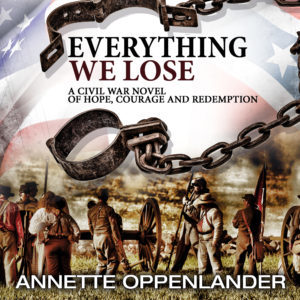 Recording of ‘Everything We Lose’ Audiobook Finished
Alan Taylor has completed narration of ‘Everything We Lose,’ my civil war adventure. Alan’s voice truly brings Adam’s and Tip’s adventurous plight to life and I can’t wait to share it with the world. Just a few more weeks until administration and distribution are complete. I’ll keep you posted and will soon share an exciting audio sample!
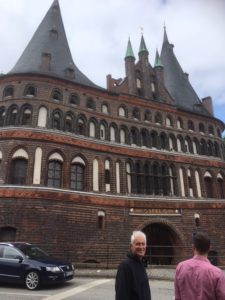
Holsten Gate, the only remaining city gate, completed in 1478
Visiting the Lübeck Dom
Lübeck, an ancient German trading town, located at the East Sea, is a beautiful place to visit. Its entire Altstadt (old city), an Unesco World Heritage site, is located on an island, surrounded by the river Trave and a canal. Many old buildings like the famous Holsten Gate still offer a medieval flavor of what life was like hundreds of years ago.
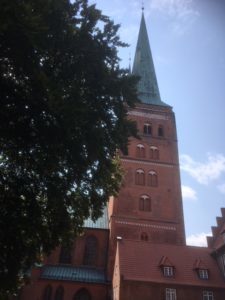
Lübeck Dom, started in 1173 by Henry the Lion
But that’s not why I visited. I actually went to the Lübeck Dom because it is said that Knight Werner von Hanstein, one of the heroes in the Escape from the Past trilogy is buried here. The Dom is giant and built entirely of red brick. Inside dozens of sarcophagi are part of the floor. I walked through the church searching for Knight Werner’s remains, but sadly was unable to because many of the stones have badly deteriorated. No wonder, if you imagine the number of people walking across them since the year 1485 (Werner von Hanstein’s burial year). I did track down the Dom’s administrator who is currently searching for a listing of all burial sites and promised to share his findings. I’m carrying his business card in a safe place.
First Draft of ‘The Italian’s Daughter’
I’m happy to report that a first draft of ‘The Italian’s Daughter’ will be completed very soon. However, a first draft is just the beginning of a lengthy process of rewriting. That is the price to pay when writing historical fiction. In order to bring a historical novel to life, in this case, the U.S. prohibition in the 1920s, every detail has to be researched. It is a slow process and to be honest, I sometimes wish I could enjoy writing a different and ‘faster’ genre. But then, I love immersing myself into a historic world, try to imagine what life was like. As always I’m interested in illuminating what it was like for the common folk because unlike the wealthy who had ways to maneuver the inhumane laws, average people were the ones suffering and dealing with a crazy world.
The post Something New appeared first on Annette Oppenlander.


July 29, 2018
Why we Need Reminders
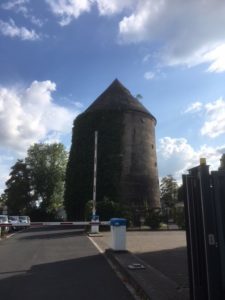
One of several WWII bunkers in Solingen
Walking through my hometown, Solingen, in Germany, you’ll come across some old structures. I don’t mean historic districts like Gräfrath, after WWII the only preserved part of town. No, I’m talking about bunkers (bomb shelters).
One could ask why there are still around? Too expensive to remove? Would we use them again? I doubt it. If there were ever another war, I think it’s pretty clear that enemy weapons would level everything including bunkers. No, I think these bunkers serve another very important function.
They remind us.
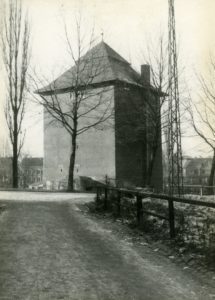
Bunker Brühl neighborhood in Solingen – Courtesy Solingen Stadtarchiv
Bunkers are Monuments
They remind us of the NS dictatorship, the war crimes of Nazis, the suffering of the common people under Hitler’s rein. They are monuments. Ugly, large and difficult to ignore. Which is a good thing. Because I feel these days, 73 years after WWII ended and the war’s children are dying out, many younger people don’t know and worse, don’t care. Right wing politics are on the upswing. In Europe and on a very large and dangerous scale in the U.S.
Under the current president, right wing propaganda is growing and supported. Many parallels can be seen to the 1930s in Germany. Why can’t we learn from past mistakes? Why is that term ‘history repeats itself’ so common?
I wish bunkers were standing all over the U.S. right now to remind people what fascism means. My mother, Helga, (picture below) spent horrific times in the bunker while the town around her was destroyed.
A Definition of Fascism by Merriam-Webster
a political philosophy, movement, or regime (such as that of the Fascisti) that exalts nation and often race above the individual and that stands for a centralized autocratic government headed by a dictatorial leader, severe economic and social regimentation, and forcible suppression of opposition
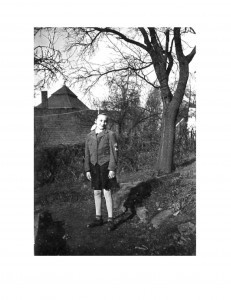
Helga, ca. 1944-1945 – in the background on the left: Bunker Brühl
Of course, there’s so much more to it, but you get my drift. I urge you to speak with your friends, neighbors, family, kids and grandkids about the worst war in human history and what led to it. Discrediting and banning the media, discrimination, fear mongering, racism, isolationism, saber-rattling, destroying alliances and more. Much more.
Here is an excellent and short explanation about WWII fascism and how Hitler came to power.
SaveSave
SaveSave
SaveSave
SaveSave
The post Why we Need Reminders appeared first on Annette Oppenlander.
July 18, 2018
‘Everything We Lose’ to Be Made into Audiobook
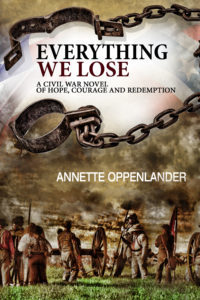 I’m super excited to announce that my American Civil War novel, ‘Everything We Lose,’ will be produced as an audiobook. I’m even more excited that Alan Taylor, a professional audiobook narrator and voiceover artist, has agreed to tell the story.
I asked for auditions via ACX and received many amazing narration samples. However, Alan’s voice immediately spoke to me. In other words, I loved the way he brought Adam and Tip, my two protagonists to life!
Please stay tuned. Expected release will be September 2018.
SaveSave
SaveSave
The post ‘Everything We Lose’ to Be Made into Audiobook appeared first on Annette Oppenlander.
June 16, 2018
Another Chapter
People might wonder what I’ve been up to since moving to Europe last fall. In some ways little has happened, in other ways a lot. My answer is a bit cryptic, so let me explain.
In September I returned to Europe, specifically to my hometown Solingen near Düsseldorf and Cologne. I’d been gone for nearly 31 years. Why? Various reasons come to mind. I wanted to be close to my elderly father, feel more secure in a nurturing society, but most of all, I wanted to become a truly bilingual author.
Capturing the German Thing
 To date all six published novels are written in English. Returning to Europe allowed me to reconnect with the German language and kindle my ability to write in German. Within months I started translating my bestselling biographical novel, Surviving the Fatherland, into German. During this process I felt like I was treading in one spot. Not advancing, not writing anything new, just plugging through 370 pages of a story I’d written and rewritten dozens of times. Often, I felt so much closer to the English language than to the German. I kept plugging, kept reading German books, kept filing and tweaking one sentence at a time. Winter stretched, became elastic and seemed to never end.
Then in May of this year something amazing happened. I finished. It felt like I’d climbed a mountain without adequate gear, but I made it through. All of a sudden I felt like I’d done a lot.
My One-Lane Mind
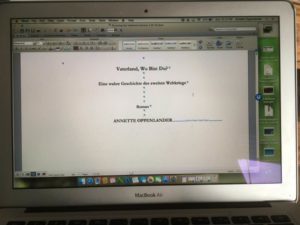 Strange, right? Well, it’s all in the perception and our own expectations. I had been wanting to write a new novel—more about that in a minute—and instead I revisited my old manuscript. It felt like I wasn’t progressing and my creative side begged for attention. I expected more from myself. Why couldn’t I write a new story AND translate the other. Sorry, impossible. I’m not a multi-tasker. I only do one thing at a time if I want to have a chance to do it well. Of course, how well shall be seen. After another review, I’m now ready to work with an editor.
Which editor will depend on whether I’ll find a literary agent here in Germany and/or a publisher. That’s the next step. And while I wait I finally get to do something different and creative again.
A New Project
I’ll be writing a story about a young woman losing her mother during the prohibition and taking off to find her missing brother, The Italian’s Daughter. Last summer I’d stopped writing because I got stuck. The story line was not progressing and I couldn’t think of how to continue. I guess my subconscious was busy while I translated and came up with new ideas.
So I’m back…in another chapter. In full swing. A new novel with a cool female protagonist: Sam…short for Samantha. I’m still curious where she leads me. As you know I’m a pantser, so I don’t outline. My characters create their own stories. So much fun!
Trust in Yourself
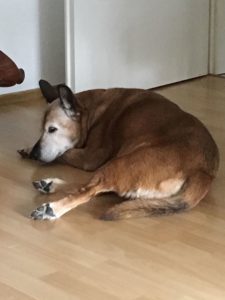 So while it sometimes appears as if we don’t progress, we often do in ways we don’t understand at that moment. Allow yourself to trust in the process, allow your mind to do its thing. Allow yourself a break. Things are moving forward. Your subconscious is powerful and extremely smart.
Believe in it! Believe in yourself!
SaveSave
The post Another Chapter appeared first on Annette Oppenlander.
April 3, 2018
Castle – Burg Hanstein Revisited
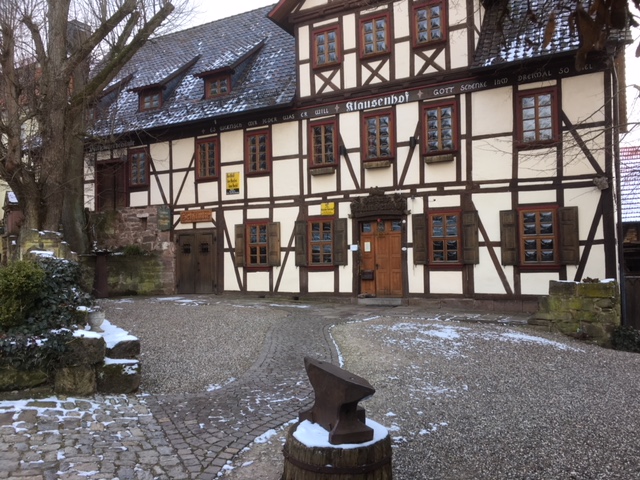
Klausenhof Inn in Winter Sleep
When I visited Burg Hanstein the first time in 2012, I was so awed that it inspired me to write the time travel trilogy, Escape from the Past.
Last month we were nearby visiting friends and the former East-West German border and I had to make another stop. It was an icy and windy day with snowflakes drifting between the old stones. Living here in medieval times must have been so cold. And dark. But oh, it makes for a great story. Unfortunately, the Klausenhof Inn which plays an important role in the novels, was closed for winter break.
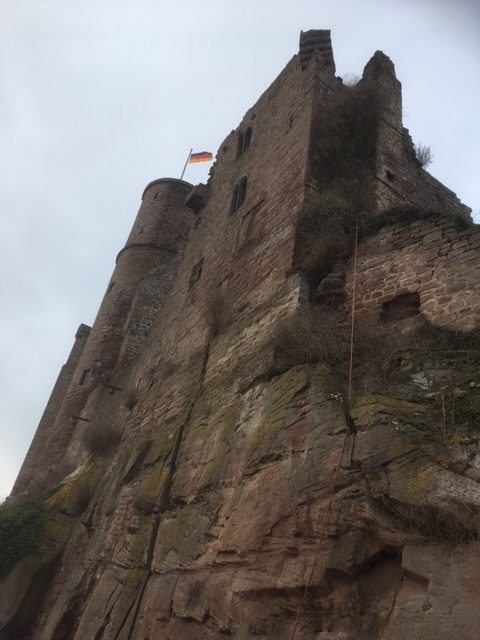
Still Fused to the Rock: Wintry Castle Hanstein
The Hanstein descendants have been repairing parts of the outer wall of the keep and tower. It must cost a fortune to rebuild the 6 to 8-foot deep walls in reddish sandstone. By the way, I found another cellar off the large hall on the right where a few torture instruments, including a rack have been set up. I don’t believe Hanstein ever had a torture chamber, but it was a nice touch. Within the large hall on the main floor—from here you can access the only intact tower, courtesy of the East-German government—the history of Hanstein is presented along one wall.
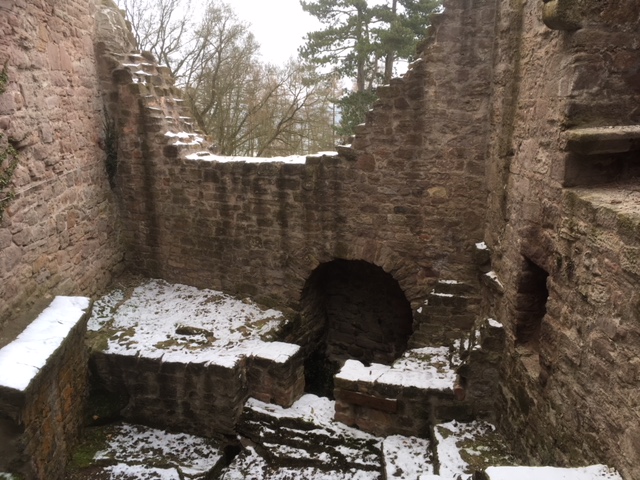
Kitchen at Castle Hanstein
Not much is told about the time, my nerdy protagonist, Max, arrives here in 1471. But Knight Werner is mentioned upstairs in one of the reconstructed rooms off the tower. That’s where I first read about him feuding with Duke Schwarzburg over a beautiful woman. In my story, that is Lady Clara.
If you love time-travel and the Middle Ages, check out the Escape from the Past trilogy. You won’t regret it. For me I don’t think I’ll ever grow tired of visiting Hanstein.
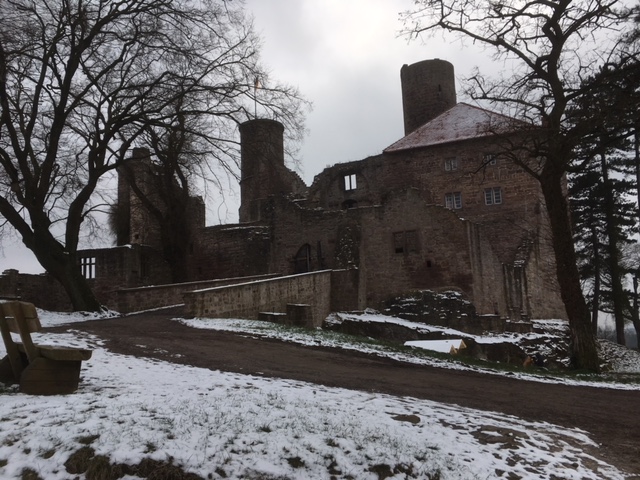
Pathway to the Inner Bailey
SaveSave
SaveSave
SaveSave
SaveSave
SaveSave
SaveSave
SaveSave
The post Castle – Burg Hanstein Revisited appeared first on Annette Oppenlander.
February 12, 2018
On the Path of German-German History
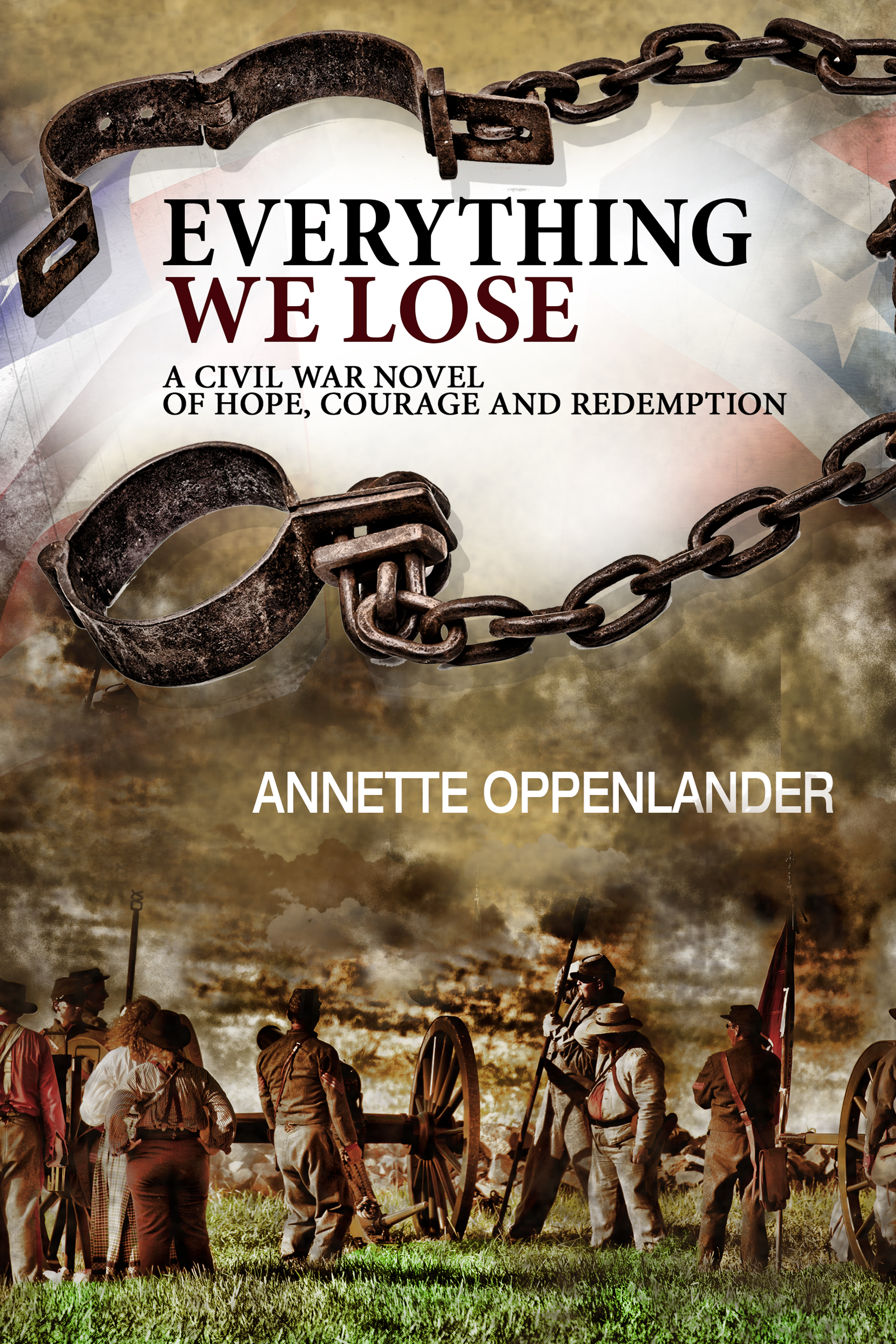 ***New Release This Week***
Get your copy of ‘Everything we Lose’ now!
Visiting the German-German Border Museum
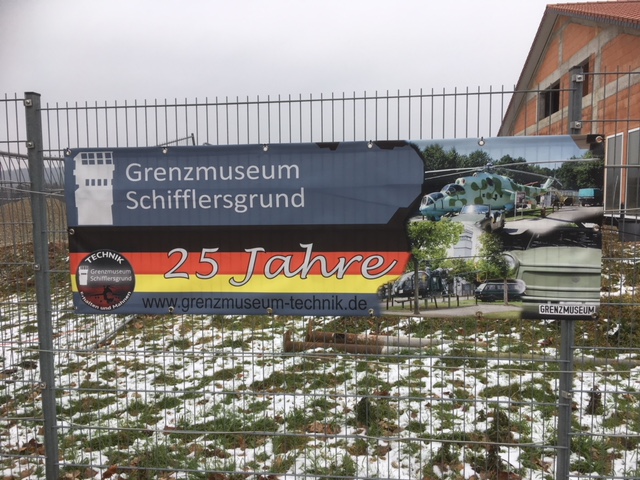 The other weekend while visiting friends, we took a road trip to the former east-west boarder between Hessia (west) and Thuringia (east). Near Bad Sooden Allendorf, right on the original border, lies the first border museum of Germany, Schifflersgrund. The wind blew and it was freezing cold, making it easy to imagine how dreary life must have been, when the two Germanys were still fenced off against each other.
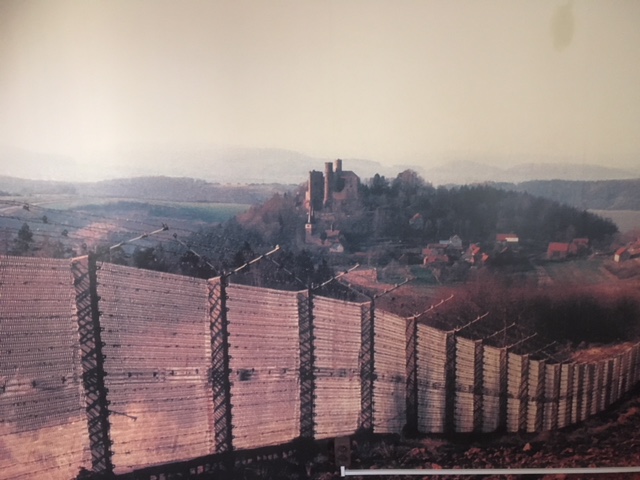 East Germans were told that West Germans wanted to invade the country and therefore the fence was necessary to keep them out. Of course, it was the other way around. The fence held its East German people captive in a giant prison. The entire boarder was fortified with an eight-foot fence, mine fields, automatic shooting machines, no-mans land, soldiers and observation towers. The East German government spared no expense and resource to protect its sick communist regime.
Just five years before the wall crumbled, a east German man who’d been working on the boarder fortifications for years drove his earthmover to the fence, climbed across and was shot dead a few feet from reaching West German ground.
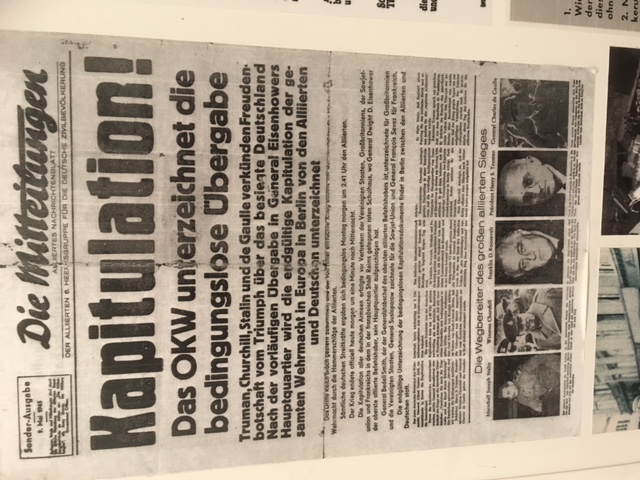
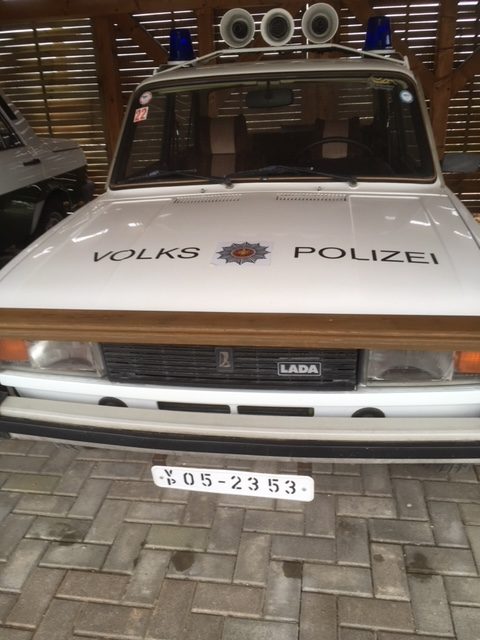
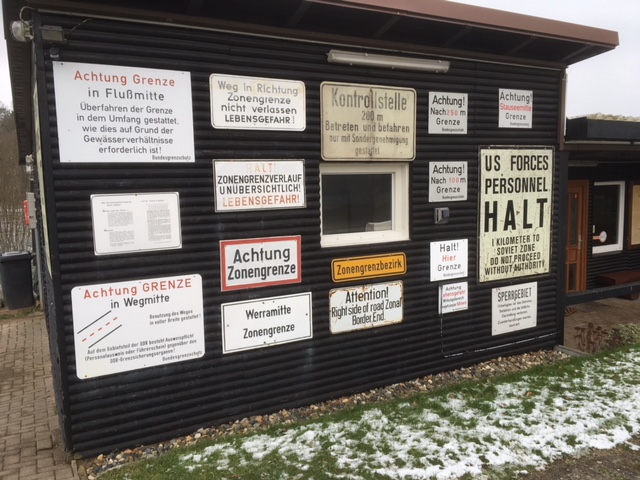 The displays at the museum include photos of politicians deciding the fate of Germany after the war, of men in uniform patrolling the border, but more importantly of every-day Germans whose world was divided over night, Germans in handcuffs for trying to escape to freedom. Even two months before the wall was built, the East German government assured its people, there wouldn’t be a wall. That was just one of many giant lies. You’ll also see a lot of equipment used to enforce the ‘prison,’ including cars, trucks, helicopters. Along the entire wall ran a stone path suitable armored tanks.
 Old folders and newspaper articles, postage and signage show some of the propaganda fed to the East Germans. In a separate hangar are pieces of the Berlin wall and a political timeline about the former East and West German leaders in meetings and then in 1989 at last, reunification. The formerly cordoned-off Brandenburg Gate in Berlin overrun by globs of happy Germans. It must have been amazing to be part of this history. Sadly, at that time, I was already in the U.S. and watched this momentous event from afar.
If you visit Germany, I’d recommend visiting one of the boarder museums for a taste of German-German history.
Next time:
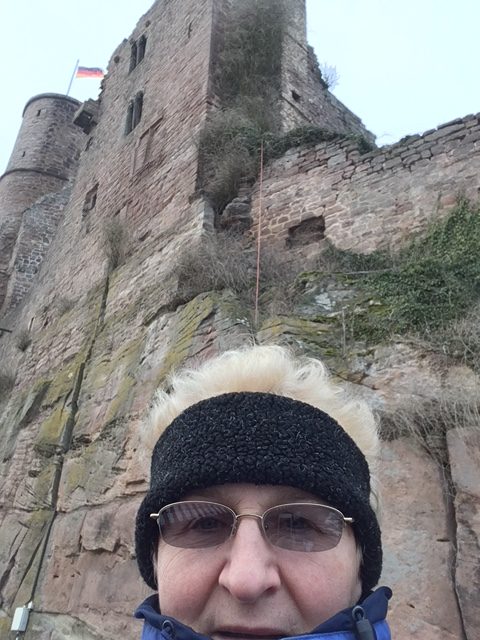 Revisiting Castle Hanstein
Remember my time-travel adventure, Escape from the Past, based on the history of Castle Hanstein in Thuringia? Well, I was nearby and couldn’t resist visiting the amazing ruins again.
SaveSave
SaveSave
SaveSave
SaveSave
SaveSave
SaveSave
SaveSave
SaveSave
The post On the Path of German-German History appeared first on Annette Oppenlander.
January 1, 2018
What I Truly Wish for in the New Year
Had you asked me a year ago whether I’d expect a lot of surprises in 2017, I would’ve said no. However, last year brought a lot of change, some fun, some difficult and some shocking. Let’s do the fun part first. My new novel, Surviving the Fatherland, received several awards and became a #1 bestseller in the Amazon historical category. But it’s just a category, not the NY or USA Today bestseller list, you say. Correct, though this particular category is large and contains many famous writers. In any case, I was humbled to be in such company.
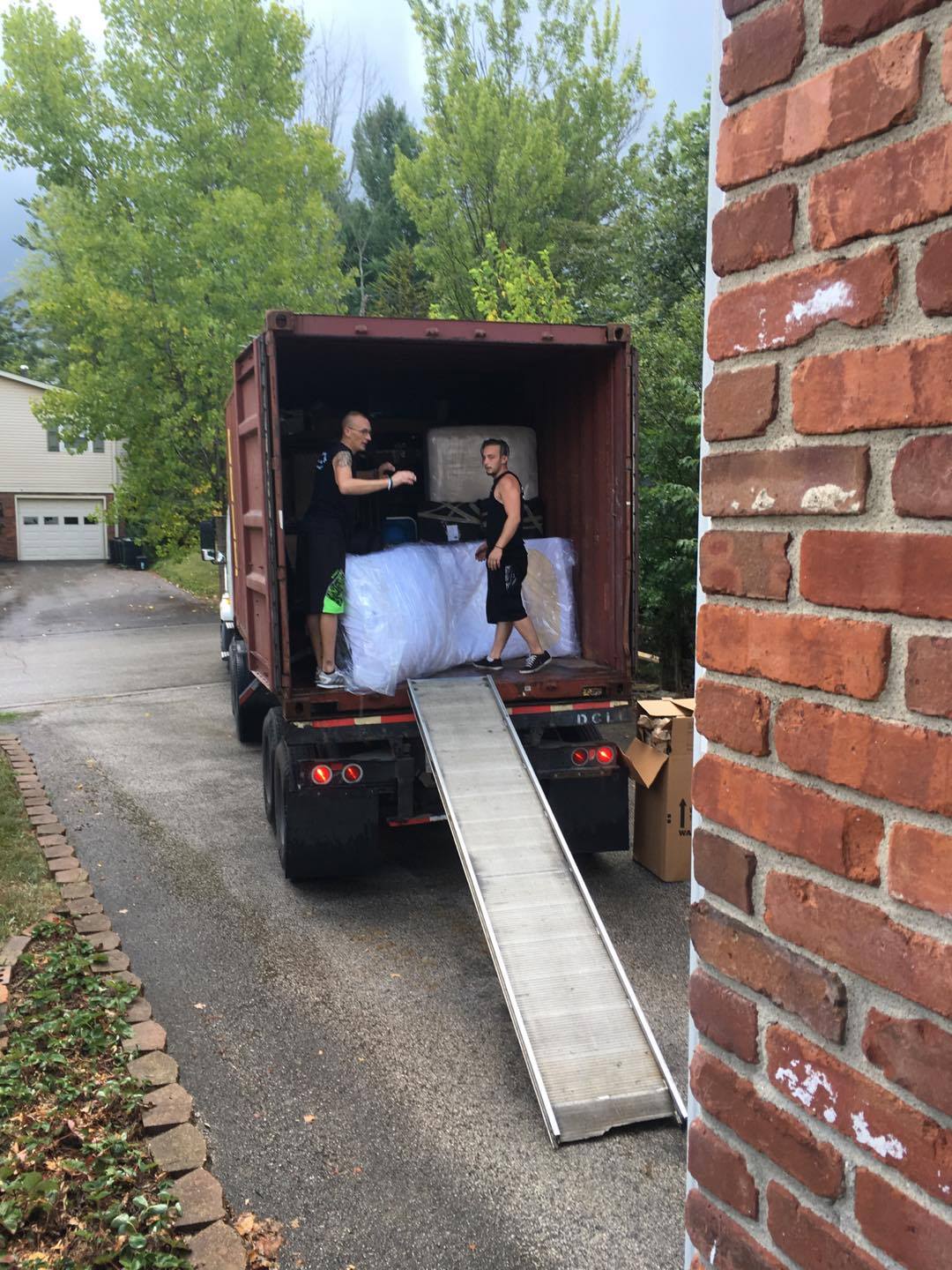
Our container before take-off in the U.S.
The difficult part was our move to Germany. After spending 30 years in the U.S., my American husband, daughter and I reduced the contents of a four-bedroom house to fit into a 20-foot container. This project lasted several months as we agonized over what to keep and what to give away. Luckily, we sold our house in a day. When the sale fell through because of financial issues of the buyer, we sold it again—in a day. Finally, at the end of August we took a one-way flight to my hometown, Solingen.
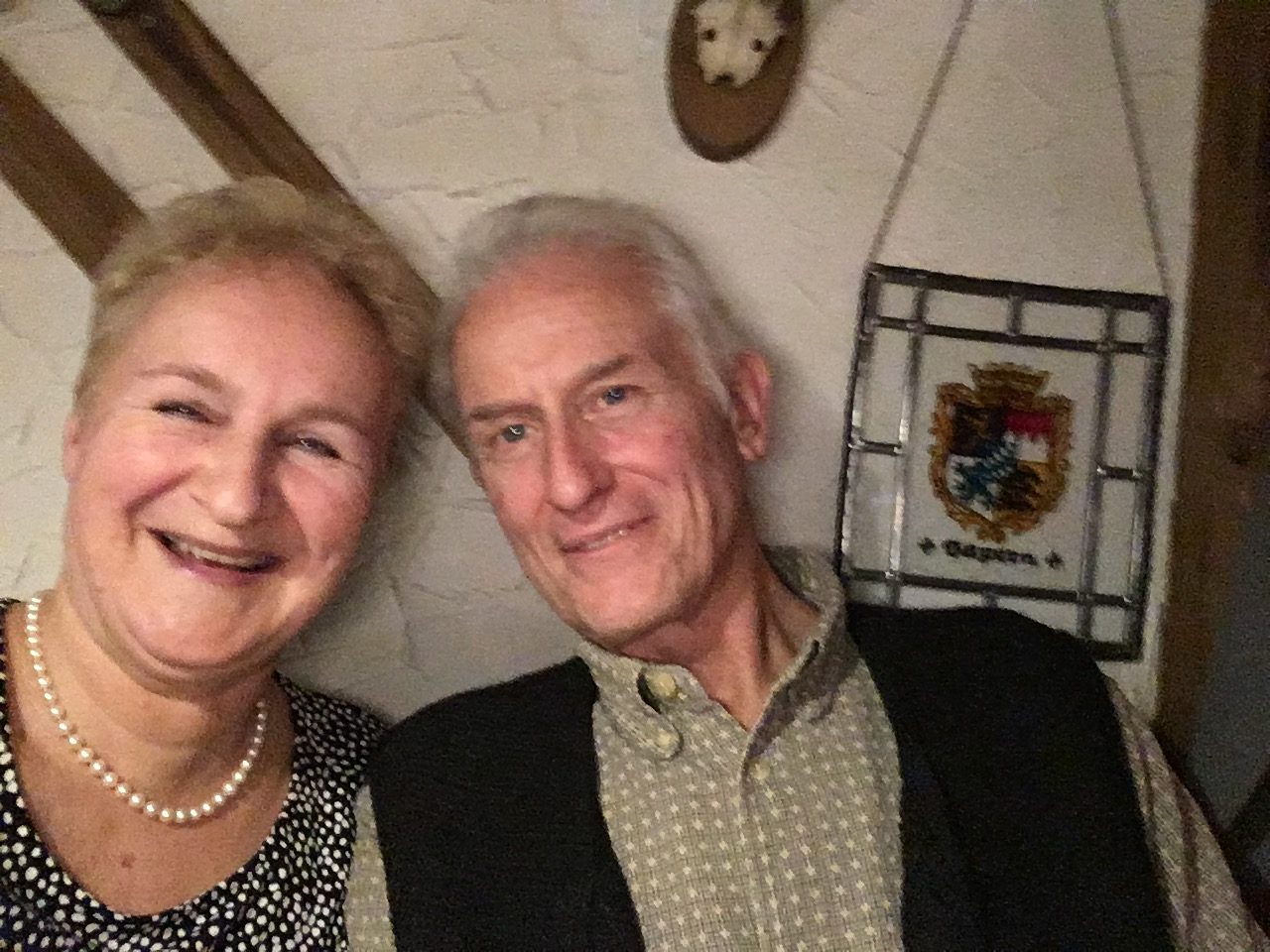
Celebrating New Year’s Eve
The initial move-in, German bureaucracy and arranging technology was trying, but we managed to get settled into our new apartment without too much fuss. Then came the shock. In early November, my husband suffered a stroke. He was not a candidate but a fit, normal-weight man who loves riding bicycles in the mountains and has blood values, most people would kill for. With this new diagnosis, our well-laid plans evaporated. Within three weeks my 88-year old father also suffered a stroke and I moved into the twilight zone.
Mocha waiting for her man to return from the hospital
I realized I had been very lucky until now, our family mostly being spared serious illness. This new reality made me face our fragility as a couple and a family and pose the question, what would be next. It was uncomfortable to say the least. As I drove to the hospital every day, my moods swung between anger, sadness and worry.
I’m happy to report that as of the New Year, both men are doing quite well and are back on their feet, albeit with lingering numbness. We hope that the continued rehab will speed up their recoveries. For me, I’m grateful—grateful that the strokes weren’t worse. Grateful, I had friends and family close to support me. But I’m also hopeful that 2018 will offer a chance to settle into our new lives, but more importantly health and peace.
And that’s what I wish you, dear readers, for the New Year: health and peace and that you accomplish what you set out to do. Finally, I want to express a heartfelt thank you for reading my books and supporting me!
The post What I Truly Wish for in the New Year appeared first on Annette Oppenlander.
December 6, 2017
Holiday Season in Germany
One thing people who’ve traveled around Europe this time of year comment about are Christmas markets in Germany. I have to admit there’s something magical about the twinkle-lit booths, the festive smells of roasted almonds, bratwurst and Glühwein, the Christmas music and artisan offerings.
Even I hadn’t realized that almost every town, small or large has one. Actually, large cities like Cologne host three distinct markets and expect six million visitors. Unlike the past 30 years when I watched the spectacle from afar with a slightly green tinge of envy on my cheeks, I’ll be right in the middle of things this year.
One thing that is different though is the gift giving or should I say the lack thereof. Since my husband suddenly became ill—he is a lot better now—my focus shifted. What does it matter how many gifts are under the tree? The presen(ts)ce of our loved ones, family and friends, is what counts. The time we share in meaningful conversation enriches our souls. I’m thankful for the gift of love and friends. I’m thankful for you, my lovely readers and fans who choose my stories, or even comment and share your own personal experience with me.
This year why not abstain from rushing around in the mall, spending hours online and draining wallets and accounts in the process. Why not try to relax and enjoy this time of year, create a personal holiday season, see the beauty in small things like a pretty candle or a piece of gingerbread. Do we really need another gadget or set of dishes? Do our kids really need ten different gifts?
I’m ready to enjoy my newly regained German family and friends and wish you a peaceful and meaningful holiday season.
New Civil War Novel Will Arrive Soon
I’m super excited about my upcoming new novel, Everything We Lose: A Civil War Story of Hope, Courage and Redemption. Estimated release date is February 2018.
Radio RSG Solingen Interview
I’d like to thank our local radio station, RSG Solingen, for inviting me to an interview which aired last Sunday, December 3rd. The interview was conducted in German by Clara Pieck.
Interview Part I – Returning Home
http://www.annetteoppenlander.com/wp-content/uploads/2017/12/Oppenlander_1.mp3
Interview Part II – Books and More
http://www.annetteoppenlander.com/wp-content/uploads/2017/12/Oppenlander_2.mp3
The post Holiday Season in Germany appeared first on Annette Oppenlander.
October 20, 2017
On the Path of History – Germany, Month Two
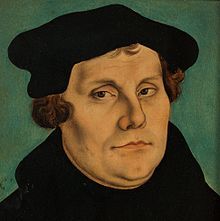
Martin Luther in 1529
Well, my friends, it’s been a busy month. Aside from attempting to tame the German bureaucracy or what Germans call the ‘Amtsschimmel,’ I’ve been working hard on prepping for the publication of my Civil War novel. ‘Broken Journey: A Civil War Adventure’ is in editing which means I’m working on wording for the back cover and all online sales outlets. A first look at what that sounds like so far can be found on my upcoming novels page.
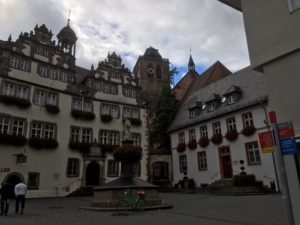
Bishop and St. Lullus in Bad Hersfeld, Germany
Of course, that isn’t all. Early in 2017 I began a story set during prohibition. I find this period of U.S. history absolutely fascinating. It is one of those examples of total governmental failure, opening the way to career criminals like Al Capone and George Remus. I decided I’d try a female protagonist this time and give the story a more romantic twist. Thus this is not going to be Young Adult, but historical fiction with a heavy dose of romance.
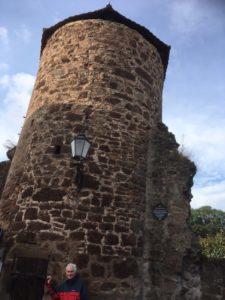
Witches Tower in Rotenburg (Fulda)
On another front I’m attempting to settle into the German language and my role as a German-speaking and -writing author. Part of that process is to teach again. Just a few days ago, I was able to schedule new writing workshops with the local VHS, a learning community which one could best characterize as a blend of community college and Parks and Recreation program. I also scheduled my first reading—albeit in English—from my bestselling novel, Surviving the Fatherland.
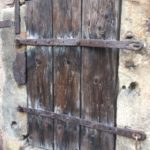
The door to the Witches Tower
I was also fortunate to visit the historic town of Bad Hersfeld and Rotenburg south of Kassel. Both towns have long histories, in fact, Bad Hersfeld dates back to the year 769 when Lullus, who later became a bishop and saint, reestablished an abbey here. On one of our wanderings to the remains of a nearby castle tower, we learned that Martin Luther passed by here in 1521 and held a service at the abbey. Martin Luther celebrates his 500-year anniversary this year because he published his 95 theses in 1517 and many credit him with ending the Middle Ages.
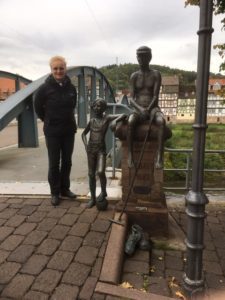
WWII memorial about war children – in Rotenburg
Well, I could go on, but suffice it to say that I collected new ideas for future books. I’m even thinking about a series of non-fiction children’s books about important figures not often mentioned. For instance, Bad Hersfeld is home to two prominent men: Konrad Zuse who is credited worldwide with the invention of the computer and Konrad Duden, a man we can thank for unifying the German language and whose name permanently adorns German dictionaries.
Enough said. Now I must figure out a way to pack more hours into each day.
SaveSave
SaveSave
The post On the Path of History – Germany, Month Two appeared first on Annette Oppenlander.
October 3, 2017
Moving to Germany: One Month Report
More than a month ago I set foot in my home country, Germany, in particular I returned to the town I grew up in: Solingen. I have since discovered that if you leave your home for 30 years, you don’t fit into Germany’s neatly organized bureaucracy any longer.
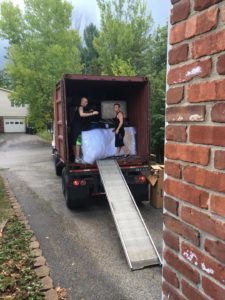
Our container before take-off in the U.S.
All Germans have to report to the city they intend to live in. The ‘Einwohnermeldeamt,’ a city’s reporting agency was one of the first places I visited because without an official address it is impossible to buy cellphone service or Internet or pretty much anything else. Thank the stricter terrorism laws for that. A visit that takes most Germans a few minutes turned into an hour. Apparently according to the official records, I had lived in Cologne (not the U.S.) for 30 years and had a secondary place of residence in Solingen. Neither were correct because paperwork had gotten lost in 1986 and it took the very helpful employee patience and expertise to set my records straight. With the new paper in hand, I was able to get a new cellphone. But Internet? Not so fast. Actually, most things aren’t so fast. Internet service requires about a three-week wait. Not convenient when you need to research everything that makes life easier online.
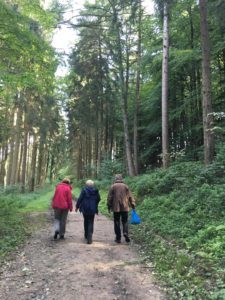
Hiking the ‘Hilly Land’ near my home.
During the week I continued by applying for health insurance, trying to move some money from the U.S. to Germany to buy a car and getting electricity for our apartment. Americans are used to dealing with utility monopolies. Not so in Germany. You can choose between different power operators who channel electricity through the local network. As a result I found one that will save me more than $200/year over the established regional supplier. Not bad.
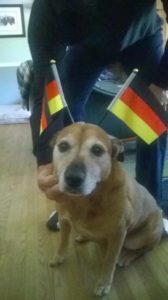
Mocha feeling patriotic.
Getting furniture is another issue. I’m used to walking into a store and buying what I like. I either take it with me or arrange delivery within a day. German furniture stores operate on a two-month ordering system. Because of the many choices, i.e. a bedframe is available in beech, oak, cherry, etc., the store shows samples only. Right now we’re waiting on a bed I ordered in July even before we arrived here. Our clothes are stacked in boxes and bags along the walls of our bedroom until the wardrobe and dresser arrive. German apartments and homes don’t have built-in closets and every German lugs around his/her own closets when moving. A decent quality wardrobe is a real investment, setting you back the cost of your next vacation.
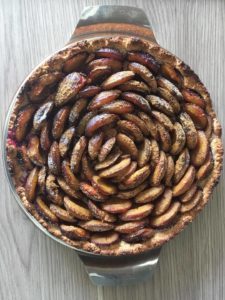
My first plum cake baked in Germany.
On the upside, I’m enjoying breakfast in the company of a huge Nutella jar. It’s cheap and delicious, just like the selection of rolls and fresh breads from one of the dozens of bakeries in the area. Just this morning, I read that Germany produces more than 3,100 types of bread. I plan on trying as many as I can. Then there are the amazing cheeses from Austria, France, the Netherlands and Germany. A high quality Brie costs less than one Euro. Compare that with prices at my local Kroger store where a decent piece of cheese sets you back $7 plus.
We’ve already been in the woods a few times hunting mushrooms and hiking. Last week we spent three entire days exploring new forests. There also the very enjoyable visits with friends and family. This time, we can welcome them in our own home. We’ve attended several parties, eaten Italian, Greek and German food, tried a few new beers, and begun stocking our wine shelves. The only thing we’re still struggling with is the weather. It’s mostly cool and quite damp with many cloudy days.
In Other News
 I’m excited to report that my novel, Surviving the Fatherland, is a finalist in the 2017 Kindle Book Awards. Winners will be announced in November.
SaveSave
SaveSave
SaveSave
The post Moving to Germany: One Month Report appeared first on Annette Oppenlander.


