Linda Watson's Blog, page 4
June 29, 2020
Teach Thrifty, Plant-Based Cooking!
Would you like to help your circle learn to save money, eat well, and make a difference. Consider volunteering to teach cooking classes using my videos, slides, and scripts!
What are the classes?
Cooking While Broke. Learn how to cook tasty, healthy food even on a very tight budget.
Zero-Waste Cooking. Learn how to reduce food waste and packaging, making the best use of your resources.
Why Eat Plant-Based? Learn how what you eat can help create a healthy, just, and sustainable world.
Getting Organized: Menus and Shopping Lists. Plan ahead to streamline cooking, shop less, and reduce your stress.
Tell me more about teaching cooking classes!
It’s easy. You’ll get access to my gorgeous slides and research-based scripts.
It can be even easier. Show my videos and then host a discussion afterward.
Customize sessions to fit your group. The scripts have optional prompts for you to add your own story and tips about your community if you want. Connect with people by sharing how you got involved with this movement. Share information about local recycling practices, farmers’ markets, zero-waste businesses, and more.
Mix and match. Each class runs about 20 minutes, not counting Q&A, so you can use the free level of Zoom for your gathering. You could also choose to do two or more classes in the same session. For example, Cooking While Broke and Zero-Waste Cooking make a tasty combo.
Join a community of volunteers. Come to a free, live Zoom call on how to get started. Take the material for a test drive, then come back the next week for a support question, where you can ask questions and share your experiences. Stay in touch with other teachers online, so we can all grow together.
What does it cost?
I’m offering these classes, slides, scripts, basic support, and community access on an optional donation basis. This program is funded by Cook for Good supporters.
If you benefit from the program and can afford to help keep it going, please consider joining Cook for Good or making a one-time donation. You’ll get bonus recipes, ebooks, and my deep gratitude. But lots of people are hurting right now. We have a chance to end a lot of suffering for people, animals, and the planet. Your time can be your contribution!
How do I get started?
Watch the first video. If it seems like a good fit, scroll down to register.
Click here to get started >>


June 21, 2020
Cook for Good is Anti-Racist
I want to listen more than talk right now, but this must be said: Cook for Good is anti-racist. Black lives matter. Police should protect and serve, not do harm.
The Cook for Good motto is “Save money. Eat well. Make a difference.” The differences I want to make include helping to end hunger and malnutrition, reduce pollution, support local farmers and economies, and help heal our climate crisis. I hope Cook for Good helps you learn recipes and skills that let you thrive, so you can do great work on your own projects. Together, we can build a fair, kind, and just world.

The photo above shows the North Carolina Environmental Justice Network Summit last year. At the end of the summit, we held hands and pledged that the chain of justice and support would not be broken by any of us. I’ll say it again, the chain will not break with me!
Where to Listen and Support
Here are some groups I support. Please consider them if you want to make a donation, buy something, or show some internet love. (Linking to a site helps boost its position in Google and other search engines.) Vote with your vote and with your wallet!
Please consider joining me in donating to:
Black Lives Matter
Reclaim the Block
The Poor People’s Campaign
The North Carolina Environmental Justice Network
Your local community bail fund for protesters, such as the North Carolina Community Bail Fund of Durham
Let’s also support Black businesses and artists, particularly local ones. Here in the Triangle, I’m a fan of:
The Black Farmers’ Market. Support local Black-owned businesses, Black-owned restaurants, and Black farmers at this new market happening second Sundays in Durham and fourth Sundays in Raleigh.
Vegan Flava Cafe. Healthy, organic or non-GMO food with terrific flavor. I’m craving their chickpea “tuna” salad right now.
Zweli’s Cuisine. It’s hard to find Zimbabwean cooking, even in a big city. I get the vegetable plate, with chakalaka and Zimbabwean peanut-butter spiced collard greens. Craving this too!
The Black Oak Society Zine. Check out the marvelous cover of their first issue. Can’t wait to read it!
Geek Chic Clothing. Lysandra Weber designs and makes fun knit clothing that supports body positivity and women in STEM.
Stay Safe and Vote
Make sure you have a plan to vote in November. If your primary is still ahead of you, make a plan for that too. I strongly recommend voting by mail if you can. Here in North Carolina, any voter can request an absentee ballot to vote by mail.
If you go out to protest, please be careful. Wear a mask to protect yourself and others. Maintain social distancing as much as you can. Let’s live to vote the racists out of office. We need other changes too, but changing leaders is essential.
May you be happy, safe, well, and at ease.
Candy Bar Brownie Pie
Candy Bar Brownie Pie looks like a fancy dessert, especially when paired with a tasty nicecream like So Delicious Cashewmilk Salted Caramel Cluster or Very Vanilla. This recipe shows a few tricks for adapting to our current ingredient shortages. I chopped up a candy bar because I couldn’t find chocolate chips. I also used whole wheat pastry flour instead of white whole wheat flour. If you can’t find that either, use a mix of all-purpose and whole wheat flour, or just one or the other.
This recipe is a riff on my favorite Vegan Chocolate Brownies. The new recipe keeps the extra nutrition compared to the brownies I grew up with by replacing some oil with a banana, an egg with aquafaba, and all-purpose flour with whole wheat flour. No preservatives or weird chemicals either, of course.
Candy Bar Brownie Pie
Brownies with flecks of chocolate bar that are a bit healthier than usual. No one will know but you. Bake in a round pan and cut in wedges for a fancy look, or bake in a standard 8x8-inch brownie pan for a more casual dessert. Note: this recipe makes 8 servings, but my recipe widget evidently thinks you should always have seconds.
Coursedessert
CuisineAmerican
Servings 8 servings
Prep Time20 minutes
Cook Time32 minutes
Passive Time10 minutes
Ingredients
1cup
whole-wheat pastry flour120 grams. Or half all-purpose and half whole-wheat flour.
1cup
sugar200 grams
1/2cup
naturalunsweetened cacao or cocoa powder (36 grams)
1teaspoon
baking soda
1/2teaspoon
salt
3ounce
chocolate bar85 grams. I use a 365 Organic Dark Chocolate Bar.
1/4cup
well-mashed ripe bananaabout 1/2 banana
1/4cup
olive oilplus a little for the pan
1/2cup
water
2tablespoons
black-bean or chickpea aquafaba
2teaspoons
apple-cider vinegar
1teaspoon
vanilla
Instructions
Make sure there is an oven rack in the center position and heat oven to 350°F. Oil a 9-inch round cake pan. If you want to take the cake out of the pan to cut, then also line it with a circle of parchment paper, oil the paper, and flour the paper and the inside wall of the pan.
In a large bowl, combine flour, sugar, cocoa, baking soda, and salt. Stir with a fork to mix and break up any lumps. Cut chocolate bar into pieces about the size of a flattened chocolate chip. Stir in chocolate chunks.
Add remaining ingredients and stir with a large spoon or spatula just enough to combine, about 50 strokes.
Pour batter into oiled pan and pop it in the oven. Bake for 32 minutes for a fudgy cake or 35 minutes for a lighter but more brittle one. Cool in the pan for at least 10 minutes before cutting. If you want to remove the cake from the pan, let it cool completely, about 90 minutes. Then run a knife around the outside edge of the cake to loosen. Put a dinner plate over the cake pan, hold them together, and flip them over. When the brownie cake falls onto the plate, remove the cake pan and peel off the parchment. Put another plate on the brownies' bottom, hold both plates together, and flip the "sandwich." Remove the top plate.
Cut into wedges and serve warm or at room temperature, with plant-based ice cream if desired. (I use So Delicious Cashewmilk Salted Caramel Cluster) The chocolate flavor deepens as the brownies cool. Store any extra covered at room temperature.
May 1, 2020
Broccoli in your Smoothie!
What do you do with the middle part of a broccoli stalk? It’s devoid of attractive florets, too complicated to peel, and a bit too tough to chew.
This week, I found the perfect answer: put it in your smoothie! Just chop it up into pieces that are up to two inches across, so your blender doesn’t have to work up a sweat. Toss in any broccoli leaves you have too.
Use broccoli in place of greens my Strong-Bones Smoothie recipe. Doing so makes the smoothie a Something for Nothing recipe.
Check out these recipes for other ways to use broccoli, a tasty nutritional powerhouse:
Creamy Orange Broccoli Soup with Ginger
Orange Broccoli Bowl with Cashews and Ginger
Stir-Fry Template
Help choose Zoom class topics
If you could come to a Cook for Good Zoom session, what would you like to learn? I’ve had such a blast this week doing sessions for Toward Zero Waste and NC State University’s continuing education program that I want to offer sessions directly to the Cook for Good community. I’m considering offering four weekly sessions on Thursdays, starting May 14th.
Best Zoom Class TopicsWhat topics would you most like to see for the upcoming Zoom class series? Please rank your up to four choices or suggest your own below.Cooking While BrokeFirst ChoiceSecond ChoiceThird ChoiceFourth ChoiceNo thanksLearn how to cook tasty, healthy food even on a very tight budget. Zero Waste CookingFirst ChoiceSecond ChoiceThird ChoiceFourth ChoiceNo thank youLearn how to reduce food waste and packaging, making the best use of your resources.Getting Organized: Menus and Shopping ListsFirst ChoiceSecond ChoiceThird ChoiceFourth ChoiceNo thank youLearn to plan meals and create shopping lists to reduce the number of shopping trips and your stress levels.Getting Organized: Well-Stocked PantryFirst ChoiceSecond ChoiceThird ChoiceFourth ChoiceNo thanksWhat ingredients should you have on hand to make delicious, healthy meals a snap?Why Eat Plant-Based Meals? First ChoiceSecond ChoiceThird ChoiceFourth ChoiceNo ThanksLearn how what you eat can help create a healthy, just, and sustainable world.Other Class SuggestionsDescribe the classes you'd like to take or add any comments.When Could You Participate? (All times EST)10 to 10:30 AM Thursdays3 to 3:30 Thursdays3 to 3:30 SundaysPlease check all times that work for you. Recordings will be available too.Would you be willing to volunteer as a Zoom helper?YesNoI'm looking for two or three people with Zoom experience to help with each class. You'd be asking questions from the chat, running surveys, and in general making the sessions go smoothly.NameFirstLastEmailEmailClick to Vote
April 26, 2020
Template Recipe: Stir-Fry
There are at least eight reasons to learn to stir-fry. Stir-fries are quick, easy, delicious, healthy, can be filling without being fattening, require little fuel to cook, and …. drum roll please … showcase seasonal vegetables. If your CSA box came stuffed with greens or you stocked up on what seems to be too many fresh vegetables at the store, then get out your wok.
Number 8? Stir-fries are handy make-ahead, ready-in-a-minute meals. You can whip up a stir-fry in less than thirty minutes, and do most of that work ahead of time if you want. Measure and chop ingredients between Zoom calls. When it’s time to eat, heat up the wok and put dinner on the table under ten minutes.
How to Get Ready to Stir-Fry
French chefs and culinary schools talk about the benefit of mise en place: having everything in place. This translates well to the need for speed in cooking a stir-fry. Have your spices, veg, and sauce ready to add boom boom boom. A hot wok makes cooking time fly.
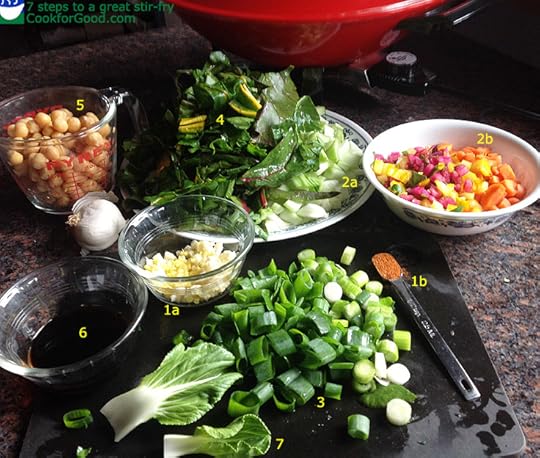
Here’s what I do before turning on the heat. The numbers and letters in parentheses refer to the picture above.
Cook rice, quinoa, or other barley to serve under your stir-fry if desired.
Put oil in your electric wok if you have one or in a small bowl. (The e-wok heats up so quickly that you don’t need to preheat the pan.) I use peanut oil saved from mixing up natural-style peanut butter.
Put minced garlic and ginger in one bowl (1a). You can also add the red-pepper flakes or chipotle (1b) to this bowl. These flavorings are the first things to hit the hot oil.
Chop sturdy vegetables, such as bok choy stems (2a) and rainbow chard stems and carrots (2b) and put them in a bowl.
Keep the spring onions separate from the other greens (3). They go in next to flavor the oil.
Heap a plate with other chopped greens or delicate vegetables such as snow peas or pea shoots (4).
Measure out beans, cubed tofu, or any other precooked food such as steamed eggplant (5). Legumes that work well in a stir-fry include chickpeas, adzuki beans, and mung beans.
Measure soy sauce and miso into a small bowl (6). Use a small jar instead if you are adding a thickener such as cornstarch. Add other liquid flavorings to this container, such as sherry, mirin, or apple-cider vinegar. Stir or shake until smooth.
Set aside a garnish (7). It can be a fancy edible flower or simply a pretty leaf or few circles of spring onion. It’s a no-cost way to make your meal more appealing.
Stir-Fry Template Recipe
Mix and match to make endless stir-fry combinations for tasty, quick meals. Prep and cook time do not include the optional rice or whole grain for serving. Vegan and vegetarian. Gluten-free with gluten-free soy sauce.
CourseMain Dish
CuisineAsian
Servings2 people
Prep Time20 minutes
Cook Time10 minutes
Ingredients
2teaspoons
peanut oilor other vegetable oil
2cloves
garlic, mincedabout two teaspoons
2teaspoons
minced ginger
1/2teaspoon
red-pepper flakesor ground chipotle (optional)
2each
spring onionschopped
1cup
chopped sturdy vegetablessuch as carrots, greens stems, broccoli, bell peppers
3cups
greens and delicate vegetablessuch as shredded cabbage, chopped kale or bok choy, or snow peas
1cup
beans, tofu, or steamed chopped eggplant
1tablespoon
cornstarchor tapioca powder (optional)
3tablespoons
waterif using cornstarch or other thickener (optional)
2tablespoons
soy sauce
1tablespoon
miso
garnishbasil leaves, edible flowers, spring onion slices (optional)
1 1/2cups
hot cooked brown rice or other whole grainoptional
Instructions
Prepare ingredients as described above. Turn your electric wok on to 350°F or heat a skillet on medium high heat, then add oil. When oil is so hot that a drop of water skitters when you drop it in, add garlic, ginger, and red-pepper flakes. Stir and cook until fragrant, about 20 seconds. Stir in spring onions.
Add sturdy vegetables such as carrots, chopped greens stems, and broccoli, stirring them constantly for about one minute. Add remaining greens. Stir vegetables for about two minutes until greens are wilted. Add beans, tofu, and any precooked ingredients.
Pour soy sauce into wok and stir briefly to coat vegetables, then cover to capture steam. Turn heat to low and let vegetables cook for about two minutes until crisp tender. Cut basil leaves into ribbons, if using. Serve at once over hot brown rice or other grain, topped with garnish if desired. Serve at once.
April 11, 2020
Coronavirus: Food Safety from an Expert
Food-safety expert Ben Chapman of North Carolina State University (go Wolfpack!) shares his tips for avoiding coronavirus and other foodborne pathogens in this great interview by Rebecca Jennings on Vox.
Bottom line: smart behavior may not feel like much, but it’s the best approach. You don’t need to sanitize your Doritos. (Sorry, William Gibson. You’re an awesome sci-fi writer but are overzealous here.)
Dr. Chapman says the trick is to:
Wash your hands
Stay home
Use contactless delivery and tip generously
If you do go to a store, wear a mask and stay at least six feet away from other people
Follow good food-handling practices: clean hands, clean surfaces, safe temperatures
Key quotes from Dr. Ben Chapman
The impact of not being a jerk to the people in the long chain of how your food ends up in your kitchen is much more significant than the potential threat of you getting the coronavirus from a box of cereal.
If I can order a pizza and someone drops it off on my doorstep, and then sends me a text and says it’s here and we don’t have to talk to each other, that’s great.
We see about 48 million cases of foodborne illness a year. That’s 3,000 deaths, 125,000 hospitalizations. . . . If we are able to impact food safety a little bit with adding some more hand-washing and using thermometers, that would really reduce those illnesses.
For more information
Dr. Chapman’s BarfBlog: Food Safety from Farm to Fork. Thanks for the post on Don’t Eat Dogs: China Finally Agrees.
CDC’s Fruit and Vegetable Safety Tips
Carrot Cake with Tangy Frosting
I’ve updated my carrot cake recipe by adding a tangy frosting that tastes like a cream-cheese frosting, but with ingredients that may be easier to get. The cake is moist and spicy, with flecks of orange carrot. The healthy ingredients include plenty of carrots (surprise!), fresh ginger, white whole wheat flour, and very little oil. When I had a piece for breakfast, I felt almost virtuous!
This classic carrot cake costs just $1.09 a serving using organic ingredients or $13.04 for the whole recipe.
The inspiration for the frosting came when my expensive vegan cream cheese turned black with mold just before baking day. I was also out of lemon juice. With the coronavirus lockdown, going out for more wasn’t an option. What to do?
I rustled around my pantry and came up with a small bottle of lemon extract and a big bottle of apple-cider vinegar. Together, these two flavorings turned a regular sweet-but-boring buttercream frosting into a light, bright partner for the pleasantly dense cake.
This recipe suggests making a single-layer sheet cake. That’s so much easier than a layer cake, but you could bake the batter in two nine-inch round pans and cut the baking time by 10 minutes if you want a more glamorous cake. For Easter, consider baking the batter in a greased and floured pan shaped like a bunny.
If you do make this cake, please let me know how it goes in the comments below or on social media. Tag @cookforgood on Twitter or Instagram or post on my Facebook page. Happy baking!
Carrot Cake with Tangy Frosting
This fragrant, rich carrot cake is surprisingly healthy. The spices bring out the sweet carroty flavor, and the tangy frosting provides a bright contrast. It's satisfying without the frosting, too, making it a good choice for a low-fat dessert. Vegan and vegetarian.
Coursedessert
CuisineAmerican
Servings12 servings
Prep Time35 minutes
Cook Time45 minutes
Passive Time1 hour
Ingredients
3cups
white whole wheat flour360 grams
2teaspoons
baking soda
1teaspoon
cardamom
1teaspoon
cinnamon
1/2teaspoon
nutmeg
1teaspoon
salt
2cups
brown sugar440 grams
1/4cup
canola oilor other neutral vegetable oil
3cups
grated carrots150 grams
2tablespoons
minced ginger
2tablespoons
apple-cider vinegar
2teaspoons
vanilla
1 3/4cups
water
shortening for the cake pan
4ounces
vegan buttersoftened (225 grams)
2tablespoons
aquafabaor plant-based milk
2 3/4cups
powdered sugar350 grams
2teaspoons
apple-cider vinegar
1/4teaspoon
lemon extract
1pinch
salt
Instructions
Heat oven to 350°F with a rack in the center position. Grease a 9x13-inch baking dish.
Whisk flour, baking soda, spices, and salt together in a medium bowl. Stir in brown sugar, using the back of a spoon to break up lumps if needed.
Pour remaining ingredients into flour mixture and stir just until well combined. Pour into the pan and bake for 45 to 50 minutes, until top is firm and tiny air bubbles appear in the center as well as on the edges. Cool cake thoroughly before frosting.
Put all frosting ingredients in a mixing bowl. Beat slowly until powdered sugar is mostly blended with butter, then beat on medium-high for a minute or two until fluff. Taste and adjust ingredients as needed. (At this point, I always ask my Taster to give it the official taste test.)
Spread frosting on cooled cake. Serve within two hours or refrigerate for up to five days.
Recipe Notes
For speedy baking, I use my food processor to mince the ginger and grate the carrots. Here's how: peel the ginger and cut crossways into thin slices. Put the stainless steel blade into your food processor, turn it on, and drop in the ginger slices through the feeding tube. Let the machine run until the ginger stops bouncing around. Replace the blade with a small-hole grater and grate the unpeeled carrots on top of the ginger.
For speedy eating, cut a piece or two while the cake is still a bit warm and frost them separately. Carpe diem!
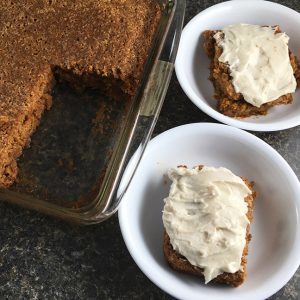
If you don't have lemon extract for the frosting, use a scant tablespoon of lemon juice instead of the vinegar and lemon extract or replace half the vegan butter with vegan cream cheese.
Nutritional Information for Carrot Cake
Per serving (1/12th recipe), this cake has 465 calories, 22% of calories from fat, 74% from carbohydrates, and 4% from protein.
It has 4 grams protein, 5 grams fiber, no cholesterol and 12 grams of fat (6 saturated, 3 unsaturated, and 3 polyunsaturated. It's high in vitamin A, vitamin B1, iron, niacin, potassium, and zinc.
March 31, 2020
Coronavirus: How to Plan Menus
“How do I plan menus during the coronavirus pandemic?” asked alert reader Anne M. I’m using a mix of my normal, low-waste methods with a touch of hurricane prep. This post starts with my general rules of thumb, then goes on to menu ideas.
1) Eat whatever would go bad otherwise
Don’t waste any food. If you can’t eat it, then consider cooking it to kill off the bacteria so you can eat it in a few days or freezing it so you can eat it in a few weeks or months.
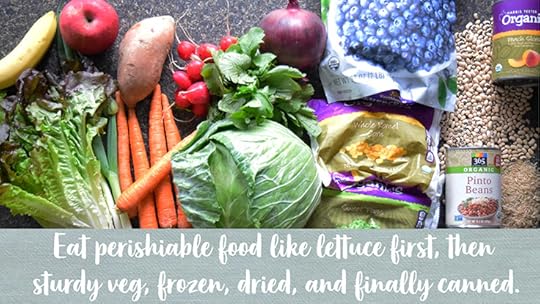
2) Eat the most perishable food first
It seems like weeks ago because it was, but just after my last in-person trip to the grocery store, I made asparagus in lemon-cashew sauce with pasta for dinner.
Eat fresh asparagus, eggplant, mushrooms, and berries within a few days of getting them.
Eat loose-leaf lettuce before romaine.
Eat relatively relaxed chard and kale before tightly furled cabbage.
Don’t be fooled by cauliflower’s rugged appearance. It loses its flavor quickly and then turns brown on the tips. You can cut that part off and use the rest, but it’s a waste of food and time.
Rely on sturdy, pioneer vegetables such as carrots, potatoes, sweet potatoes, cabbage, onions, garlic, lemons, and apples.
Eat refrigerated food before frozen food.
Eat frozen food before canned or dried food in case your power goes out.
3) Eat the scraps
I have a whole class on this, but in short, think twice before throwing anything away:
Use all the edible parts, including citrus zest and stems from kale and other greens.
Make apple cider vinegar from apple cores and peels.
When you cook dried beans, eat the broth too, as in aromatic Cold-Nix Soup recipe.
Use bean broth instead of eggs and milk in some recipes. Known as aquafaba, the protein-rich liquid whips up into meringues and makes cakes tender.
Keep a Stoup container to make tasty stew/soup from leftovers and edible scraps.
On the other hand, don’t eat food that has spoiled. Follow good food safety practices.
4) Develop a menu pattern
If it helps you deal with the stress, by all means make Instagram-worthy appetizers for every meal and a unicorn cake for dessert. But we’re sticking with our regular meal rhythm, with an emphasis on healthy comfort food.
Here’s my default menu, kept fresh by the dozens of ways to make these basic dishes. Check out my free recipes for ideas.
Peanut butter on homemade toasted bread and a smoothie for breakfast.
Beans, greens, and grains for lunch, plus dessert.
Pasta with a big salad for dinner, plus fruit. Usually I make a tomato-sauce variation, sometimes spicy peanut or a creamy cashew sauce. On Fridays, we celebrate by splitting a Field Roast sausage. Live large!
Sometimes Stoup or a stir-fry replaces the pasta. Sometimes, I confess, we have dessert for dinner too. I went through my month’s supply of Escazu sea salt bars in two weeks. (One bar a week! What was I thinking?) For my birthday a few days ago, we feasted thanks to Che Empanadas, who delivered tasty frozen hand-pies that I baked at home. In short, plenty of wholesome variety with some shortcuts and treats. For more ideas, see my post 4 Whole-Day Menus under $7.
5) Eat healthy
Do your best to stay healthy. Seriously. Making good food choices now can help save your own life, shows compassion for others, and is a way you can contribute to fighting the pandemic. Let the medical professionals focus on others.
One of the scariest charts I’ve seen, in this period of terrifying charts, shows the number of hospitalized patients predicted compared to the number of ICU beds. It clearly shows that most patients who need intensive care won’t be able to get it. This is not the time to have a heart attack, stroke, or cancer if you can avoid it.
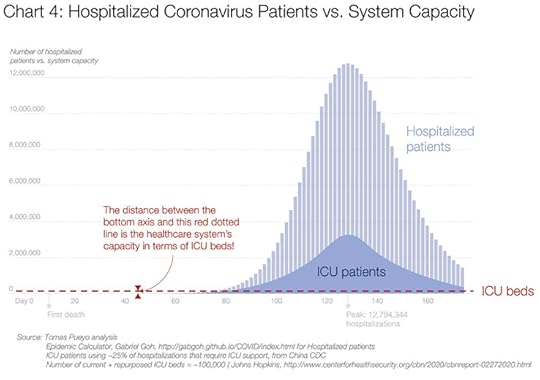
Well, Linda, you might say. I never want to have those chronic diseases.
Good! Then eat a whole-foods, plant-based diet. Aim for balanced, with includes about 9% of your calories in protein. That’s much less than most Americans eat. A major study published in Cell Metabolism found that “high levels of animal proteins promote mortality,” leading to a 75% higher death rate. And that’s without a shortage of ICU beds!
A concise and trustworthy resource that I keep going back to is Dr. Michael Gregor’s book How Not to Die. (He admits that we’re all going to die. He wants to help us avoid shuffling off our mortal coils any sooner or more miserably than needed.) Learn how to stave off cancer, heart disease, lung disease, diabetes, and even suicidal depression. I’m glad I got it as an ebook to make searching easy. You’ll also find useful, research-based videos on his website Nutritional Facts.
If you’d rather watch than read or if you want to persuade a family member to take better care of themselves, stream a lively documentary. Start with the athletic and often funny Game Changers, then watch Forks Over Knives for a more medical approach.
Sending you my best wishes
I realize that I’m lucky to be writing about menus and looking forward to dinner while others worry about masks and hope for access to a ventilator. May you and yours come through the pandemic healthy, safe, housed, and employed if you want to be. May our society learn from this disaster and take steps to improve.
March 30, 2020
Kale and Cabbage 7 Ways
I cooked up a big pot of basic kale and cabbage, then heated it up through the week with different additions for variety. My Taster appreciated the mild flavor of the cabbage. I like the cook-ahead aspect and how healthy this is, with no added fat and loads of fiber and phytonutrients. The basic kale and cabbage mixture costs about 64 cents a serving using organic ingredients.
Top with or mix in:
Sriracha sauce
Salsa
Barbecue sauce
Chopped walnuts and raisins (about a tablespoon each per serving)
Mashed potatoes (about half and half)
Cooked white beans and a squirt of lemon juice
Number 7? Layer a well-drained spoonful with peanut butter on toasted bread for an adult sandwich, sriracha optional.
This recipe helps prevent food waste. Cabbage lasts for a long time, but kale can go bad in just a few days. Cooking it kills off any harmful bacteria and makes it last longer. Cooked kale and cabbage freezes well too. Use fresh mushrooms or my Mushroom and Garlic Cubes as a shortcut.
Kale and Cabbage 3 Ways
Flavorful but bitter, this tasty mix of kale and cabbage provides a perfect blank canvas for your mix-ins or toppings. Try salsa, sriracha, raisins and chopped walnuts, or mashed potatoes.
Courseside dish
Servings8 servings
Prep Time30 minutes
Cook Time10 minutes
Ingredients
1medium
red onion
2tablespoons
water
12ounces
kale
12ounces
green cabbage
1/2teaspoon
saltor to taste
4medium
mushroomsor 4 Mushroom and Garlic Cubes
2cloves
garlicomit if using M&G Cubes
1/2teaspoon
dried ground chipotle powderor smoked paprika (optional)
Instructions
Chop red onion and add to a large pot with two tablespoons water. Cook over medium-low heat until tender, about five minutes. Separate kale stems and leaves. Chop stems and stir into chopped onion.
Chop kale leaves and cabbage, then stir into onions with remaining ingredients. Cover and cook until tender, about 10 minutes. Taste and adjust seasonings. Serve hot with mix-ins as desired.
Recipe Notes
Nutritional Information for Kale and Cabbage
The nutrition label is for one serving without toppings or mix-ins. Nutritional information is for supporting members and donors. If you don't see it below, log in or join today! Log in to comment, too. This content is for members only.