Jamie Parsley's Blog, page 70
September 13, 2015
Dedication Sunday
 September 13, 2015
1 Peter 2.1-5,
+ Seven years ago tomorrow—September 14, 2008—I sat down with the congregation of St. Stephen’s to be interviewed to be their new Priest-in-Charge. On that Sunday, for that congregational meeting, we had 25 people in church, which was just above the Average Sunday Attendance of 24. Our church membership on that Sunday in 2008 was 55 members. We actually have well over the total membership number then this morning here in church.
At that meeting, I sat down to answer questions about what I would do as Priest-in-Charge of St. Stephen’s. I remember one of the questions I was asked was: “Do you call before you make a visit or do you just show up?”
I said, “I always call and make an appointment first.”
Which seemed to be the right answer.
At the end of the meeting, I then asked the congregation a question. I asked, “If you agree to have me, what do you want as a congregation? What are your goals?”
There was some very serious thought before someone offered, “We want to grow.” And someone else added, “We want families.” And someone else, “And children.”
And I said, “We all can do those things together.”
Well, here we are, almost exactly seven years later. Today is of course Dedication Sunday—this Sunday in which we celebrate and remind ourselves who we are and where we’ve been. It’s also a kind of a State of the Union today. It important to look at where we are right now, at this time.
So, where are we, on this Dedication Sunday in 2015? Well, in comparison to where we were seven years, we look at the numbers: Our membership, as of today, with our 19 new members, two earlier new members and a few people that have
 been re-added from the inactive list, is
 172
(we were 153 last year)
And that was even with the loss of four long-time members this year to death, as well as a few people who have been added to the inactive list. Those we lost to death this year were:
Rick Holbrook
Sharon Brekke
Pat Butler
and Georgia Patneaude
Those deaths were hard on all of us. Coming as they did in rapid succession—we lost both Sharon and Pat in one day—there was a moment of maybe slight despair. The fact is, we are going to lose parishioners to death, or to inactivity, or they will move away, or whatever. But that is what being a congregation means. Of course, numbers are numbers. We can delight and rejoice in those numbers. We can proudly hold those numbers and gauge where we are with those numbers.
But ultimately numbers and numbers. Numbers change. Numbers are faceless and person-less ultimately. What matters here is much more than numbers.
What matters here is what we do and how we do it and why we do it. What matters here is what are we doing to make this world better, to making the Kingdom of God more and more of a reality in this world. It’s important for us on this Dedication Sunday to be reminded of those things that make us a bit different than other congregations. I don’t mean that in a smug, self-congratulatory way. Celebrating our growth and all the things God has granted to us does not allow us to be arrogant or full of ourselves. It is a time to be humble and to humbly thank God for these many, wonderful things. And it is important to examine ourselves in a humble way, a way in which we all find ourselves grateful to God and to each other for bringing us here, to this place, in this time and in this wonderful, holy moment.
As followers of Jesus, we have found something in this congregation that we haven’t necessarily found elsewhere—at least in this particular way. For us, who call ourselves members of St. Stephen’s, we know that something unique and wonderful is happening here and has been happening for some time—fifty-nine years, in fact. And all we can do in the face of that happening is give thank God and to continue to do what we are called to do as followers of Jesus. And we do those things well.
For example, our radical hospitality to those who come to us. Our amazing sense of welcoming all people as beloved and accepted children of God within this congregation—no matter who they are or what they are. Our commitment to service beyond these walls. Our commitment to the sacraments and to the Word. Our strong sense that our collective lives as followers of Jesus are centered on the celebration each week of the Holy Eucharist and the hearing of the Word of God in scripture.
These are all things that make us who we are as a congregation here at St. Stephen’s. And they are things that, together, are, sadly, rare in many churches. This is why people are finding us. This is why people are seeking us out.
The Holy Spirit dwells here. I have heard so many people who come in those doors say to me, “Yes, we feel it! We feel that Spirit dwelling here.” That Spirit is here, permeating these pews, these walls, but most of all, permeating us. That Spirit is here dwelling within us.
As we all know—as we all strive and continue to work to make the Kingdom of God a reality in our midst—it is not easy to do anything we have done together as a congregation. It has not been easy to get to this point in our collective lives here at St. Stephen’s. There have been set-backs. There have been trip-ups. There have been frustrations. But, that’s all part of the journey.
We, as followers of Jesus and more specifically, as members of St. Stephen’s, are called here to be, in the words of St. Peter from our epistle this morning, “living stones.” We are called to be living stones—living stones that can be built into a true spiritual home, a royal priesthood of not just believers but do-ers. We are called here at St. Stephen’s to proclaim all that God has done for us here and in our lives. We, as living stones, are called to be building up a new church. We are, by our very existence, showing that something is about to change. The Church—capital C—the larger Church—is changing.
That Church that was a close-minded ivory tower of repressive views regarding such issues as misogyny and homophobia and special privilege, is dying rapidly. And we all know it. We are all sensing it. God is letting us know that a Church built on anything other than love and acceptance is not the Church of Christ.
Essentially that dying Church turned away from the Gospel of Jesus. That Church turned away from Jesus, who commanded his followers to love and love radically and to accept and accept radically.
We are the prophets to the larger Church. We are the ones who are saying, THIS is the future of the Church. We are the living stones building up that new Church.
Royce today in baptism is being commissioned and called to be a living stone in the Church. All of us, by our baptisms, were and are commissioned to do the same thing. We are called to be the Church—a Church in which love and acceptance prevail. This is the Church in which Jesus’ message of love and acceptance is held up and lived out. This is the Church that is striving pave the way for that Kingdom of God in which radical love and full-acceptance reigns, to break through into our midst
It is not easy to do. It is daunting. And it is frightening at times.
But those words of St. Peter are ringing in our ears. You are God’s people. You are receiving mercy. And we are turn are sharing that mercy with others.
So, let us be those living stones building up a new and powerful church. Let us, on this Dedication Sunday, do what we have been doing for 59 years. Let us embody that Jesus whom we follow. Let us continue to spread that Gospel of all-encompassing, all-embracing love and acceptance in all we do here.
The future for us is bright. It is unlimited. But we have to make it a reality. We have to strive forward. We have to labor on. We have to break down those barriers of hatred, and fear and isolation and marginalization so that Christ’s Kingdom can bloom in our midst.
We see it happening, here at St. Stephen’s. We see what the future of St. Stephen’s and the larger Church really is. We see it when we live into that calling of Jesus.
So, let us be living, breathing, strong stones. That is the future. And, let me tell you, it is glorious.
Now, as we celebrate and move forward into that future, I’d like to invite Royce and his family to come forward…


September 6, 2015
15 Pentecost
 Confession, Repentance, and Commitment to end Racism Sunday
September 6, 2015
Mark 7.24-37
+ A week from tomorrow, I will be commemorating a hard anniversary. It will be the fifth anniversary of my father’s death. Five years. It’s been a long, hard five years. Many of you have traveled with me on this journey. I thank you for your patience.
Now, some of you might remember my father. And the last thing anyone who knew my father would have guessed about him was that he could get angry at times. Not angry in the conventional sense. Not anger like I preached about last week when I talked about how angry I get when I drive a car. He got angry in the way that I called last week “righteous anger.” He would get angry at things he saw as wrong.
One of the first times I ever heard of this anger in my father was one time, many times years ago, when I was headed to the South. My father was not a fan of “The South.” He lived there at a time when things were a bit crazy there. In the early 1960s, when my father was working for the Air Force, he was stationed in two places in the South—Tampa, Florida and Greensboro, North Carolina.
I could never understand why. I LOVE Tampa. And every visit I’ve ever made it to North Carolina has been wonderful. But of course I wasn’t visiting them in 1961 either.
When I pressed my father about why he disliked these places, he told me of the prejudice and racism he saw firsthand those places. He shared the story of how, as he and a group of friends were walking along the street, in Greensboro, one of the guys in his group made a pair of black men walk in the gutter while they passed. My father was shocked by this. But he said, “I didn’t know what to do. I didn’t know what to say. I had never seen anything like that in my life and didn’t know how to react.” But it stuck with him and he soon found himself resenting the “friend” who did it and refused to do anything with him again.
Also, while in Greensboro, he saw the lunch counter sit-ins, and saw white people pouring sugar on the protesters’ heads. Again, he said, he didn’t know what to do.
In Tampa, he and a group of friends attempted to enter a bar. Because one of his friends was Native American, the bar tender refused to serve him and told him to get out. This time, my father got so angry, he raised a huff, and was himself thrown out of the bar.
He was then stationed in Texas and as he was driving from Tampa to Dallas, he passed through New Orleans, where he witnessed another lunch counter sit-in with unpleasant results.
To his dying day, those incidents haunted my father. When he would see those events reenacted in movies (I remember going to see Mississippi Burningwith him), he would tense up and become very uncomfortable.
And he would to say: “I should’ve done more.”
This past week, the Presiding Bishop of the Episcopal Church, Katharine Jefferts Schori, issued a letter. In it she called on Episcopal congregations to participate in “Confession, Repentance, and Commitment to end Racism Sunday.” Which is today.
Now I think such a Sunday is an important Sunday. And I’m disappointed that we were not given more time prepare and build up such an important Sunday. But the intention is right.
As followers of Jesus, this is what we should be doing in response to the racism we find in the world. Hopefully, one day, we will not feel like my father. Hopefully we not come to a point in our lives when we realize we should’ve done more to stop racism. And yes, it is noble and wonderful to have a Sunday wherein we all get together, admit to the terrible things people have done and to promise to end it.
But…ultimate we must actually be doing something in our own lives. We ourselves, as individuals, must be actively trying to make changes. And unless we do, one such Sunday on occasion is not going to ultimately do much. This is not an issue we do on one Sunday of the year. This is not something we only do when there is a tragedy like the massacre at Mother Emanuel AME Church in Charleston. If it is, then we’re really not doing much. If that is all we’re doing, then, let me tell you, there will be a day when it will happen again and we will say to ourselves and our loved ones, “I should’ve done more.”
For us, as followers of Jesus, as people who are striving to live out the promises of the Baptismal Covenant, we don’t get to make that excuse. For us, we ARE doing this—all the time.
For us, we are like the deaf man in our gospel reading for today. Racism and our response to it is like being that deaf man. The easier thing to do is to allow our ears to be plugged when we experience such inequality in our lives. It is so much easier to walk around not reallyhearing. Because when we really hear, we must look around and see. When we really hear, we must react. When we really hear, we can no longer be complacent. When we no longer have a speech impediment, we must actually speak out.
Well, Jesus is touching our ears and our tongues. As followers of Jesus, we don’t get to be deaf and have speech impediments when it comes to issues like racism. We, as followers of Jesus, as people who strive to live out the Baptismal Covenant, we can’t be like deaf people, but we must be like people whose hearing has been restored.
The Presiding Bishop, in her letter, cites a resolution made at our General Convention:
“The Church understands and affirms that the call to pray and act for racial reconciliation is integral to our witness to the Gospel of Jesus Christ and to our living into the demands of our Baptismal Covenant,”
It IS integral to our witness of the Gospel and our living out of the Baptismal Covenant. Our Baptismal Covenant, which you can find beginning on Page 304 of the Book of Common Prayer, is clear and emphatic about issues like this. On page 305, the last question asked of us is,
“Will you strive for justice and peace among all people, and respect the worth and dignity of every human person.”
To which we respond, “I will, with God’s help.”
Will you strive for justice and peace among all people? Justice. Righteousness. Just treatment. Among all people. Will you respect the worth and dignity of every human person? The WORTH and DIGNITY of every one. Not just the nice ones. Not just the ones who are easy to like.
But everyone. The person who bugs us. The person who irritates us. The person who we innately just don’t like. Your priest….
Everyone.
And we respond with, “I will, with God’s help.”
We can’t do these things without God’s help. But with God’s help, we are able. That means that we must strive to do these things ALL the time, not just on one particular Sunday of the year. That means living it out in our daily lives, in our minute to minute, hour to hour lives. That means we don’t just get to have our hearing and speech restored to us on one occasion, but then we get to go back and be deaf and speechless the rest of the time. It means respecting the worth and dignity of all people, all the time. It means actively working and proclaiming and speaking out for peace and justice for all people all the time.
And for us who do this, we know what it feels like when we fail to do this, or when we see others blatantly deny people of justice and dignity.
When we do, we ask forgiveness of our God, of those we have wronged and we speak out when we see others doing it. This is a daily, moment to moment issue in our lives as Christians.
So, let us allow Jesus to touch our ears so we can truly hear. Let us allow Jesus to touch our tongue so we can truly speak out. Let us be a follower of Jesus with all our senses of justice and peace. Let us work hard, not just here in church, not just now on this particular Sunday, but all the time, for the worth and dignity of all human beings. When we do that, that is truly when the Kingdom of God comes in our midst and is uniquely present.
Let us pray.
Grant, O God, that your holy and life-giving Spirit may so move every human heart and especially the hearts of the people of this land, that barriers which divide us may crumble, suspicions disappear, and hatreds cease; that our divisions being healed, we may live in justice and peace; through Jesus Christ our Lord. Amen.
September 4, 2015
Vegan Diary: 20 months...
 After “coming out” as a teetotaler recently, I have had a few people ask how my veganism is going since I haven’t shared much about that recently (see, not all vegans let people know they’re vegan ALL the time).
 The answer is: it is going GREAT. I’ve been vegan now for some 20 months and I’m going stronger than ever. My health has never been better. I feel great. I’m told I look good and healthy. My weight is now some 30 pounds less than when I started. My blood pressure just keeps getting better and better each time I check it.
I’ve said it before, I’ll no doubt say it again and again: going vegan was one of the very best decisions I’ve ever made.
I remember reading somewhere in the early days of my veganism about how one really does have to give one’s own veganism time. I believe in one of the books I read the author said give it a good five years to really start feeling the benefits. I am a big believer in five year marks. It’s often takes five years to truly get beyond some of the traumatic events in one’s life and it also takes that long to test how good the things in one’s life are really going. I am looking forward to that five year mark for my veganism.
I also have come to believe that the healthier lifestyle I’ve been living has been the basis for my inability to drink alcohol. I think being healthy really does make me sensitive to some issues. That whole “broken glass in my stomach” feeling I was getting after drinking alcohol was all a part of living healthy. I can’t help but believe my body was sending me a very clear message.
So, almost two years in, I am still a very proud and very healthy vegan.
Someone recently asked me which books have been particularly helpful to me in my journey. Here’s a short list:
Skinny Bitch/Bastard by Rory Freedman and Barnouin was the book that pushed me over the vegan edge and helped me to make change. Truly one of the best.
Vegan Freak by Bob Torres and Jenna Torres. I just recently read this book and LOVED it! The Torres’ were able to nail this crazy vegan experience perfectly.
The Heretic’s Feast: a History of Vegetarianism by Colin Spencer. Because I am a kind of amateur historian, a book like this is priceless to me. I’ve re-read over and over again over the last ten
Mad Cowboy by Howard F. Lyman. I originally read this book sometime after my cancer diagnosis and resisted it. It all seemed too good to be true, I thought then. Well, here I am after all these years.
The Engine Number 2 Diet and My Beef with Meat by Rip Essylstyn. I read both books right after going vegan and enjoyed them but didn’t take to heart everything Essylstyn was saying about “low fat” veganism. In those early days when I had given up so much, it made no sense that I had to give up things like olive oil! But now, as I’ve settled into the lifestyle, I have re-read his books and they speak so loudly to me about how to maintain health and keep weight off. After a lifetime of struggling with my weight, I can say in all honesty that I now know where the issues were. These books were vitally important in helping me come to that conclusion. My only issue with the books however is using the term “diet.” It seems so faddish. For me, this is not diet. It truly is a lifestyle.
Main Street Vegan by Victoria Moran. Just a good, down-to-earth book of about veganism with no preaching or moralizing.
Veganist by Kathy Preston. Another one of those straightforward books on the benefits of veganism, but with an added spiritual side that I really appreciated.
I am very honest about the fact that I am no cook and do NO cooking at all for myself. However, some vegan cookbooks that have been helpful to me in what little cooking I do have been:
Any of the books by Sarah Kramer. I remember when my first shipment of Kramer’s books came after going vegan. They were so entertaining and helpful and she was such an inspiration to me at that time. And as a cancer survivor myself, I was amazed and impressed as I followed Kramer’s struggle and ultimate victory over breast cancer.
Isa Chandra Moshkowitz’s cookbooks have been extremely helpful. And another colorful and inspiration person.
Betty Goes Vegan by Annie and Dan Shannon. This the Betty Crocker cookbook done vegan. It’s truly one of the most comprehensive cookbooks I’ve ever encountered and makes for some great bedtime reading. My only issue with the book is that it seems almost ever recipe in the book calls for “pink Himalayan salt.” I still don’t know what pink Himalayan salt is!
August 30, 2015
14 Pentecost
 August 30, 2015
James 1.17-27; Mark 7.1-8, 14-15, 21-23
I had hoped—honestly—that now, in our Gospel readings, we had moved away from all that bread imagery we’ve been hearing over the last several weeks, that we would get a break this morning. Maybe some nice, sweet Gospel reading about lambs or miracles. But…no.
Instead, we get this reading from the Gospel of Mark. One of those finger-shaking scriptures. That list Jesus lays out at the end of the reading for today is a pretty strong and straightforward one. And most of us can feel pretty confident we’re free and clear for the most part.
After all, most of don’t steal, don’t murder, don’t commit adultery, aren’t purposely wicked, are deceitful, don’t slander A few we might not really understand:
avarice (which is just another word for greed)?
licentiousness (which just means immorality, being immoral)?
And folly? What’s so horrible about folly? I’m guilty of that all the time.
But then, there are a few we find might actually hit home a bit, such as Envy and Pride. All right. Yup. I stumble with those. I do.
What it is especially apt about this morning’s Gospel reading is that Jesus takes these ugly things we are capable of doing and uses them to engage fully the Pharisees and the scribes. He takes their condemnation of him about cleanliness and keeps the conversation going regarding cleanliness. He simply takes the conversation up a notch.
You are worried about what defiles the hands. I am concerned with what defiles the heart.
The heart, for Jewish people of Jesus’ day, was truly the center of one’s being. From the heart everything emanated. The heart directed the mind. It directed our thoughts. If your heart was pure, then you were pure. If your heart was evil, then you did evil. If your heart is full of darkness, you live in darkness. Because where your heart leads, your actions follow.
But one we could easily add to this list is one we might not want to admit to. And the only reason I even consider it in this context is because of our reading from the Epistle of James today.
“Anger.”
Now, if we did add this to the list, then this would win the prize with me. Now most of you know me as a pretty laid-back kind of person for the most part. I don’t seem to fly off the handle very often. Except when I drive. Luckily, few of you have ever driven with me. And those few of you who have, you don’t anymore.
I am an impatient and grouchy driver. And the things I say—well, let’s just say, it’s best left between me and Jesus.
But I don’t think there have been too many people who have actually seen me completely lose it with anger. Once or twice. But we all live with anger and every so often I am forced to confront my own.
When I do, I find myself experiencing anger in all its force. Anger can be all consuming. When it boils up from within, all other senses seem to shut off. I see red. Like, glaring red. It rages and roils and knocks me—and anyone else around me—around, and in the midst of it, I find I am not only angry, but almost scared by my own anger. Because it can be powerful.
Now, there is such thing as a kind of righteous anger. By righteous here, I’m not talking about self-righteous. I’m not talking about superior kind of anger. I’m talking about “right anger.” And there really is such a thing.
Anger at injustice. Anger at oppression and racism and sexism and homophobia and all the other ugly things out there. Such anger can motivate us and move us forward toward seeing justice and equality.
But…in such cases, we need to be very, very careful with our anger. I need to be careful with my anger Because anger can be a powder keg. It can become something more—and something uncontrollable.
Which only, of course, leads me back to our reading from St. James for this morning. This past week, our reading from James been a special scripture that I have lived with:
“…be quick to listen, slow to speak, slow to anger.”
He’s not saying you can’t be angry. Just be careful with your anger. By being slow with our anger, we kind of control it. Anger is something that needs to be confronted and dealt with.
But uncontrolled anger needs to be systematically slowed, because it is like poison in our systems. Anger can destroy us and those around us. And, as St. James says, “anger does not produce God’s righteousness.” If we think that by acting out in anger we will gain something, we won’t. The anger may motivate it, but it cannot guide us or sustain us. If we think about our heart as the center of our being—as the center of ourselves, we find that anger truly can poison the heart and therefore the whole system.
When we continue to harbor anger in our hearts, we become a slave to anger. And if we are slave to anger, we can let love flourish. And if we cannot let love flourish, God cannot come and dwell within us. We block out God and we block out the Kingdom of God.
Anger does not help the Kingdom break through into our midst. We are not helping build up the Kingdom when anger rules us. So, these words of James speak strongly to us this morning.
“Be quick to listen, be slow to speak”
We know how speaking sows the seeds of anger. And if we’re speaking, we are not listening. And sometimes, when we listen—truly listen—we find that anger can be defused.
“Be slow to anger”.
I have come to conclusion that it is simply impossible to love God and to love our neighbor as ourselves when we allow anger to rule and flourish, when the storms of anger are raging within us. Anger prevents love. It stifles love. It kills love.
Yes, we can be angry at injustice, but we can’t let it kill love. We can angry at wrongness, but we can’t let it dominate our lives and come between us and our relationship with God and one another.
One of the best books I’ve ever read about anger was a book called Angerby the Vietnamese Zen Buddhist monk, Thich Nhat Hanh. There are so many incredible nuggets of his wisdom in his book, but one of the best is one in which explains that we do allow, at times, the seeds of anger to be watered within us and that when we do that, our anger will grow into unruly weeds.
 He also goes on to say that essentially each of us have a wounded child within us. And it is this wounded child, with her or his unhealed wounds, that often feed our adult anger. Because when we’re angry, and we’ve seen this happen, we do often act like wounded children. We cross our arms We get grumpy. We stomp our feet. We throw a tantrum. I love that image!
 Another wonderful image he uses is that when we allow anger to fester and grow, our very selves become battlefields between good and evil.
Thay’s advice to us is that we must work hard at now allowing the seeds of our anger to be watered. We must strive, he says, to cultivate the seeds of peacefulness and love within ourselves. We must nurture our wounded child and help her or him to grow up. And we most definitely must not let war rage within us. Because when it does, we are the ones who continue to be hurt the most by our own anger. We are the ones who are most hurt by our anger.
So, in addition to Thich Nhat Hanh, let us listen to St. James from our epistle reading today. Let us use his words as our own personal motto. Let his words speak in us. Let love squeeze out those festering seeds of anger within us. And let us banish from our hearts—the center of our very beings—anything that prevents love from reigning there. Let us banish from it those vices—both easy to banish and difficult to banish—so that the pureness and holiness and wholeness of Christ can reign within us. And if we do, God’s love will settle upon the very center of our being and give us a peace that no anger can destroy.
August 25, 2015
Going Teetotaler...
 So, I have been weirdly reluctant in sharing something about my life recently. I have shared it with a select number—those who are directly affected by it. But it was a big decision on my part. The secret? Several months ago I stopped… drinking alcohol.
 I don’t know why I have been so reluctant about sharing this. I had no problem proclaiming from the hilltops when I went vegan. And when I did I received a strange backlash from people who thought I was not only insane but endangering my health. (I’m not certain about the insanity issue, but my health has certainly blossomed since going vegan almost two years ago). Such criticism didn’t hinder my decision of course, nor did they even register on my emotional radar screen. But for some bizarre reason, I have been very reluctant about sharing the fact that I have gone teetotaler with…well, anyone, really.
I should probably examine a bit WHY I stopped drinking. Now that some time has gone by and I can examine somewhat objectively the situation, I would pinpoint three major issues. The first was the accident in December of Heather Cook, the former Episcopal bishop of Maryland. On December 27, Cook, while driving drunk, struck and killed a cyclist in Baltimore. The maelstrom which ensued was predictably intense and I followed the story with horror, apprehension and profound interest.
In many ways, Cook represented an antiquated view many of us Episcopalians held regarding alcohol. How many times have we heard the joke, “Where there are three or four Episcopalians, there’s a fifth,” or “How many Episcopalians does it take to screw in a lightbulb? Three; one to screw in the lightbulb, one to hold the ladder and one to mix the martinis,” or, of course, “Cocktails: the eighth sacrament.”
I’ve been guilty of all of these stereotypes. After all, I was featured in an article in the local paper with my vintage drink cart and my vintage martini shakers.
To be clear and honest, I want to make clear that I am not an alcoholic nor was I dependent on alcohol despite my abuses of it. I do think, however, that it was becoming habitual. And I have little doubt that it could very easily, with time, have become an issue of addiction.
When I say “habitual,” I mean this: one of my biggest issues in giving up alcohol was not craving it, but was simply an issue of having a drink in my hand. I was so used to having a beer with supper, or a cocktail at the bar that when I didn’t order those particular things in the same atmosphere, I felt like something was missing. And I missed them. I felt deprived of them.
The second issue was that I no longer liked myself when I was drinking. I did not like how verbose I became when I had a few drinks in me. My loose lips often caused me to regret things I said the day after. I certainly didn’t like the feeling of not being in control of my life. And worst of all, I hated, hated, hated how depressed I was becoming while drinking. I found myself feeling a certain, strange despair the “day after.” And that despair would often last for a good period of time. The remedy, more often than not? Drinking. It was becoming a vicious, ugly circle.
But even Heather Cook’s accident and my self-esteem were not the main reasons I quit drinking. The biggest issue I had was an issue of health. To put it simply, I started feeling sick while drinking alcohol. Alcohol literally made me sick. Whenever I drank I felt like there was broken glass in my stomach. At first, I tried to ignore it. But as time wore on, the feeling got worse. And the inevitable “morning after” started to involve more than just despair. It also involved physical illness of a flu-like variety.
Giving alcohol was a slow process. And it was a hard one, though not so much because I eliminated alcohol from my life. The harder issue was telling people I didn’t drink anymore. I would find myself devising ways in which I could order a virgin drink without others knowing. I would sometimes try to get to the bar before anyone arrived and order a tonic or club soda. Sometimes it worked. Often it didn’t. Even hosting events in my house, I had no problem mixing cocktails for others or opening a bottle of wine, as I sipped my tonic and lime. But I was unable to come clean on this issue.
I think I am still simply uncomfortable to give up a type of social life to which I had become accustomed. I still very much enjoy spending time in bars. I enjoy being with friends who enjoy cocktails and wine. I very much enjoy hosting cocktail parties at my home.
More importantly, I am certainly the last person to judge others for drinking. Despite all of the comments I’ve just made, I don’t think drinking is morally and inherently wrong.
The biggest issue, when I strip it down to the basics, is this: I really, really liked the “edge” drinking brought to my life. I liked doing something that was slightly “wrong,” at least in my own estimation of myself.
When I told one close friend that I gave up drinking, she said to me: “So, you don’t drink, you don’t smoke, you don’t do drugs, you don’t eat meat or dairy. Even Jesus drank wine and ate fish. What are you trying to do: walk on water?”
I certainly have not made any of the choices I have to make me feel self-righteous, “pure,” or better than anyone else. But I think that’s what my biggest fear is about all of this: I do care what others think—at least what my friends and close family think. And it would hurt me greatly to know that they would think I am making the choices I do with the intent of feeling morally superior.
Ultimately, though, as I tell others all the time, I can only live my life for myself. I am the only one I am responsible to at the end of that day (outside of God, of course). I am the only one who suffers the consequences of decisions that affect me adversely at the end of the day. And as much as I care what my loved ones think, when all is said and done, I ultimately have only myself to answer to (again, outside of God).
So, all I can do is be honest to those I care for. I also can rejoice in a renewed feeling of health and self-control. I never thought in a million years that I would become some kind of middle-aged StraightEdger. But if that’s what I am, then so be it. I embrace it, gladly and proudly.
Oh, and I still love my vintage drink cart, shakers and decanters.
Giving up alcohol
 So, I have been weirdly reluctant in sharing something about my life recently. I have shared it with a select number—those who are directly affected by it. But it was a big decision on my part. The secret? Several months ago I stopped… drinking alcohol.
 I don’t know why I have been so reluctant about sharing this. I had no problem proclaiming from the hilltops when I went vegan. And when I did I received a strange backlash from people who thought I was not only insane but endangering my health. (I’m not certain about the insanity issue, but my health has certainly blossomed since going vegan almost two years ago). Such criticism didn’t hinder my decision of course, nor did they even register on my emotional radar screen. But for some bizarre reason, I have been very reluctant about sharing the fact that I have gone teetotaler with…well, anyone, really.
I should probably examine a bit WHY I stopped drinking. Now that some time has gone by and I can examine somewhat objectively the situation, I would pinpoint three major issues. The first was the accident in December of Heather Cook, the former Episcopal bishop of Maryland. On December 27, Cook, while driving drunk, struck and killed a cyclist in Baltimore. The maelstrom which ensued was predictably intense and I followed the story with horror, apprehension and profound interest.
In many ways, Cook represented an antiquated view many of us Episcopalians held regarding alcohol. How many times have we heard the joke, “Where there are three or four Episcopalians, there’s a fifth,” or “How many Episcopalians does it take to screw in a lightbulb? Three; one to screw in the lightbulb, one to hold the ladder and one to mix the martinis,” or, of course, “Cocktails: the eighth sacrament.”
I’ve been guilty of all of these stereotypes. After all, I was featured in an article in the local paper with my vintage drink cart and my vintage martini shakers.
To be clear and honest, I want to make clear that I am not an alcoholic nor was I dependent on alcohol despite my abuses of it. I do think, however, that it was becoming habitual. And I have little doubt that it could very easily, with time, have become an issue of addiction.
When I say “habitual,” I mean this: one of my biggest issues in giving up alcohol was not craving it, but was simply an issue of having a drink in my hand. I was so used to having a beer with supper, or a cocktail at the bar that when I didn’t order those particular things in the same atmosphere, I felt like something was missing. And I missed them. I felt deprived of them.
The second issue was that I no longer liked myself when I was drinking. I did not like how verbose I became when I had a few drinks in me. My loose lips often caused me to regret things I said the day after. I certainly didn’t like the feeling of not being in control of my life. And worst of all, I hated, hated, hated how depressed I was becoming while drinking. I found myself feeling a certain, strange despair the “day after.” And that despair would often last for a good period of time. The remedy, more often than not? Drinking. It was becoming a vicious, ugly circle.
But even Heather Cook’s accident and my self-esteem were not the main reasons I quit drinking. The biggest issue I had was an issue of health. To put it simply, I started feeling sick while drinking alcohol. Alcohol literally made me sick. Whenever I drank I felt like there was broken glass in my stomach. At first, I tried to ignore it. But as time wore on, the feeling got worse. And the inevitable “morning after” started to involve more than just despair. It also involved physical illness of a flu-like variety.
Giving alcohol was a slow process. And it was a hard one, though not so much because I eliminated alcohol from my life. The harder issue was telling people I didn’t drink anymore. I would find myself devising ways in which I could order a virgin drink without others knowing. I would sometimes try to get to the bar before anyone arrived and order a tonic or club soda. Sometimes it worked. Often it didn’t. Even hosting events in my house, I had no problem mixing cocktails for others or opening a bottle of wine, as I sipped my tonic and lime. But I was unable to come clean on this issue.
I think I am still simply uncomfortable to give up a type of social life to which I had become accustomed. I still very much enjoy spending time in bars. I enjoy being with friends who enjoy cocktails and wine. I very much enjoy hosting cocktail parties at my home.
More importantly, I am certainly the last person to judge others for drinking. Despite all of the comments I’ve just made, I don’t think drinking is morally and inherently wrong.
The biggest issue, when I strip it down to the basics, is this: I really, really liked the “edge” drinking brought to my life. I liked doing something that was slightly “wrong,” at least in my own estimation of myself.
When I told one close friend that I gave up drinking, she said to me: “So, you don’t drink, you don’t smoke, you don’t do drugs, you don’t eat meat or dairy. You’re celibate. Even Jesus drank wine and ate fish. What are you trying to do: walk on water?”
I certainly have not made any of the choices I have to make me feel self-righteous, “pure,” or better than anyone else. But I think that’s what my biggest fear is about all of this: I do care what others think—at least what my friends and close family think. And it would hurt me greatly to know that they would think I am making the choices I do with the intent of feeling morally superior.
Ultimately, though, as I tell others all the time, I can only live my life for myself. I am the only one I am responsible to at the end of that day (outside of God, of course). I am the only one who suffers the consequences of decisions that affect me adversely at the end of the day. And as much as I care what my loved ones think, when all is said and done, I ultimately have only myself to answer to (again, outside of God).
So, all I can do is be honest to those I care for. I also can rejoice in a renewed feeling of health and self-control. I never thought in a million years that I would become some kind of middle-aged StraightEdger. But if that’s what I am, then so be it. I embrace it, gladly and proudly.
Oh, and I still love my vintage drink cart, shakers and decanters.
August 23, 2015
13 Pentecost
 August 26, 2012
Ephesians 43.15-22; John 6.56-69
+ This is a very fortunate time to be at St. Stephen’s. For the first time in our almost sixty year history, we have a great thing happening at this moment No, I’m not talking about our memorial garden being installed this coming week. At this moment, we have three people—three!—who are heeding and discerning the call to ordained ministry.
Of course, William Weightman is well into his seminary education and will soon be taking chaplains’ training. William, as we know, is seeking ordination as a priest and will, hopefully—and God willing—be ordained and serve a congregation.
And of course, John Anderson and Jessica Zdenek are beginning the very early process of those tentative early steps toward—God willing—ordination as deacons to serve St. Stephen’s. Of course, for John, who was ordained in the United Methodist Church, this isn’t all that strange of a calling, though it is different.
Such discernment is never easy and we need to remember to keep all three of these brave people in our prayers. As an ordained minister myself, I commend them and, at times, I pity them. Ordained ministry is NOT easy. It is not for the light-hearted.
I can’t help but use the analogy of these beginning steps toward ordained ministry of newly hatched turtles. You know those turtles whose mothers bury the eggs in the sand. The babies hatch and then make a mad dash for the sea. But to get from where they hatched to the water, they have to overcome exhaustion and seagulls swooping down on them and all kinds of other sorts of difficulties. Not all of those baby turtles make it to the water. And those that do, still have another set of issues in the water—sharks and whatever else is waiting for them there.
Sorry for William, John and Jessica for being a bit dark about this. But as one of those baby turtles who also made a mad dash for the sea, I speak with some experience.
Now, should these three people make it to ordained ministry, on that wonderful day when they are ordained, they will be making some promises. On that day, they will kneel before a bishop in a church, and will say before God, the Bishop and the Church, this promise:
“…I solemnly declare that I do believe the holy Scriptures of the Old and New Testaments to be the Word of God, and to contain all things necessary to salvation…”
That vow is good for all of us who are ministers, not just ordained ministers. And, if you really listen, it’s a statement packed with meaning.
I believe the scriptures to be the Word of God, and to contain all things necessary for salvation.
All of it? you may wonder. However they—and each of you—may interpret that statement, what we are really professing here is that through the scriptures God does speak to us. God’s very Word comes to us through these scriptures. Which makes these scriptures incredibly powerful.
We get an echo of this importance of the Word of God in our Gospel reading for today. In it, we find Simon Peter answering that question of Jesus, “Do you wish to go away?” with strangely poetic and vibrant words.
Peter asks, “Lord, to whom can we go? You have the words of eternal life.”
For all of us as followers of Jesus, the Word (which we find contained in scripture) is essential. And powerful. It not only directs our lives, it sustains us, and feeds us and keeps us buoyant in the floods and tempests that rage about us. The Word is the place to which we go when we need direction, when we need comfort, when we need hope as followers of Jesus. The Word is essential to us because, through it, God speaks to us. The Word is essential to us because it is there that we hear God’s Spirit directing us and leading us forward.
The irony for me, however, is most poignant when I listen to those detractors who use the Word in cutting ways. We of course hear them all the time. People who use scripture to support their homophobia or their political beliefs or their condemnation of others. Because scripture is so powerful, people who do so are playing with fire. Or maybe dynamite might be the better image.
I have always warned parishioners and students to be careful of using Scripture as a sword, because, I say: remember. It is a two-edged sword. If you use the Word to cut others, trust me: it will come back and it cut you as well. It is just that powerful. And frightening. It can destroy, not just those the one who wields it wants to destroy, but it can also destroy the one who wields it.
However—and this is a big however—if we use the Word to affirm, to build up the Kingdom of God, if we allow the Word to be, in our lives, the voice of Christ, then we in turn are affirmed. As Paul says in his letter to the Ephesians that we heard this morning: “take…the sword of the Spirit, which is the word of God.”
That sword of the Spirit is an amazing weapon. That sword of the Spirit is essential for all of us who are ministers. It is a powerful device that carries more strength and influence than any of us probably fully realize. And because it is so powerful, we need to use very, very carefully. It like handling a loaded, sensitive machine gun.
We need to use it not in anger, not in hatred, not in oppression, but in love. When we wield this sword of the Spirit in love, we find love being sown. When we wield this sword in compassion, we spread compassion. When we wield this sword to shatter injustice and oppression, we find justice and freedom. When we wield this sword as a way to clear the way for the Kingdom of God, we find that we too become a part of that building up of the Kingdom.
We too are able to clearly hear Jesus’ voice in our lives. Those words of eternal life that Jesus speaks to us again and again in scripture truly do break down barriers, build up those marginalized and shunned and, in doing so, we find the Kingdom of God in our midst.
When a Benedictine monk or nun makes a profession of vows they pray a wonderful prayer. Their prayer is:
“Accept me, Lord, according to your word, and I shall live. Do not disappoint me in my expectation.”
I love that.
“Do not disappoint me in my expectation.”
This is our prayer as well as followers of Jesus. This is the prayer of all of who are called to be ministers—whether as lay people or as clergy.
“Accept me, Lord, according to your word, and I shall live. Do not disappoint me in my expectation.”
We too have prayed to be accepted according to God’s Word. The sword of the Spirit has swiped the veil of separation from us and has made us one. And none of us, in this oneness, in this kingdom of God in our midst, is disappointed in our expectation.
When all are seen as one, when all are accepted, then our expectation will be fulfilled. But we need to keep listening, to keep straining our ears for Jesus’ words to us. We need to keep listening so God can speak to us—so the Word can speak to us and through us. When God speaks to us, we respond. When the Word comes to us, we then need to engage it. This is what prayer is—holy conversation. And as the Word is spoken to us, as we hear it and feel it, our response is the same as those who heard the Word spoken to them by Jesus.
“Yes, Lord, you have the words of eternal life. We have come to believe and know that you are the Holy One of God.”
So let us hear those words of eternal life. Let us embody that Word in our lives. Let us share that Word through the good we do in this world. And when we do, people will know. People will know who we follow. People will know that the Word we embody in our very lives is the Word of that Holy One of God.
August 14, 2015
A Prayer on the Feast of Jonathan Myrick Daniels
50 years ago, Episcopal seminarian Jonathan Myrick Daniels was shot in killed was shot and killed in Hayneville, Alabama, while saving the life of another civil rights worker. The Episcopal Church commemorates him on this day. Here is a prayer I wrote over ten years that appeared in the anthology, Race and Prayer: Collected Voices, Many Dreams.
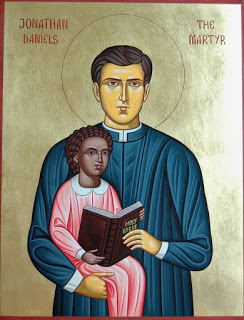 A Prayer on the Feast of Jonathan Myrick Daniels
Holy and loving God,
help us to see ourselves
as You see us—
these people we are
beneath our colored flesh.
Burn away
with a purifying fire
the cataracts of ignorance
and prejudice
Take from us
our small-mindedness,
our sometimes inbred need
to see with human eyes
and not with our true sight—
that vision you have set within us.
Replace the violence that grows within us
when we are frightened
and challenged
with the peacefulness
and the love you have shown to us
in Jesus, our brother and our friend.
Help us to embrace color—
to see, in our various tints,
the holiness of our flesh.
Love us in all the colors of our skin—
in our reds,
in our blackness,
in our yellows
in our browns
and in our whiteness.
Love us for the fire
of compassion and truth
that burns within us—
stronger than all flesh.
Love us for the life within us—
for the frail breath that is with us today
and gone, in an instant, tomorrow.
Love us for the blood that courses
through all our veins—
the same-colored blood
that was drained from Jesus’ veins.
We ask this of You—
most holy
and loving God—
whose very presence in our lives
is one of light
and life
and, yes, of color—
who, in Jesus, was one of us.
In the Spirit
You have given us,
make us, truly,
One.
“A Prayer on the Feast of Jonathan Myrick Daniels” originally appeared in the anthology, Race and Prayer: Collected Voices, Many Dreams, edited by Malcolm Boyd and Bishop Chester L. Talton. Published in March 2003 by Morehouse Publishing.
 A Prayer on the Feast of Jonathan Myrick Daniels
 Holy and loving God,
help us to see ourselves
as You see us—
these people we are
beneath our colored flesh.
Burn away
with a purifying fire
the cataracts of ignorance
and prejudice
Take from us
our small-mindedness,
our sometimes inbred need
to see with human eyes
and not with our true sight—
that vision you have set within us.
Replace the violence that grows within us
when we are frightened
and challenged
with the peacefulness
and the love you have shown to us
in Jesus, our brother and our friend.
Help us to embrace color—
to see, in our various tints,
the holiness of our flesh.
Love us in all the colors of our skin—
in our reds,
in our blackness,
in our yellows
in our browns
and in our whiteness.
Love us for the fire
of compassion and truth
that burns within us—
stronger than all flesh.
Love us for the life within us—
for the frail breath that is with us today
and gone, in an instant, tomorrow.
Love us for the blood that courses
through all our veins—
the same-colored blood
that was drained from Jesus’ veins.
We ask this of You—
most holy
and loving God—
whose very presence in our lives
is one of light
and life
and, yes, of color—
who, in Jesus, was one of us.
In the Spirit
You have given us,
make us, truly,
One.
“A Prayer on the Feast of Jonathan Myrick Daniels” originally appeared in the anthology, Race and Prayer: Collected Voices, Many Dreams, edited by Malcolm Boyd and Bishop Chester L. Talton. Published in March 2003 by Morehouse Publishing.
August 13, 2015
Promoting my book The Downstairs Tenant
 I was subtly reminded this week that I dropped the ball in my promotion of my book of short stories, The Downstairs Tenant. To be honest, when the book came out earlier this year, I was dealing with some other issues as well being a bit overworked, so, very sadly, I did not do much to promote it. However, please do purchase a copy (or copies), give copies to friends and family, consider it as a Christmas gift. Because it is a book of fiction, it is a bit different than my books of poetry, but that even makes a bit more unique. https://epayment.ndus.nodak.edu/C22800_ustores/web/product_detail.jsp?PRODUCTID=5983&SINGLESTORE=true
August 9, 2015
11 Pentecost
 August 9, 2015
Ephesians 4.25-5.2
+ This past week there were two very important historical anniversaries. On Thursday, of course, was the 70th anniversary of the bombing of Hiroshima. We commemorated that event as part of the Eve of the Transfiguration Mass here at St. Stephen’s on Wednesday evening. And today, of course, is the 70thanniversary of the bombing of Nagasaki.
Not very people know this, but I actually wrote a book about the bombing of Hiroshima. As in, it was actually published. The book, Cloud, was actually a two act, full-length play, based on the Japanese dramatic style called Noh, and was published in 1997. I think two people read it. I don’t think it’s in print, though I did see that copies of it are being offered for sale for a couple of hundred dollars. (I don’t get to see any of that money, since someone already bought the book at some point.)
But my book came out of the fact that I have been a life-long pacifist. Now, I’m always careful to say that. In some places, my saying I am a pacifist does not win me many friends. But, luckily, I am very fortunate to serve at a congregation that prides itself on its commitment to the cause of peace. And, as we all know, St. Stephen’s is known as the sort of token, “Peace and Justice” congregation in the Episcopal Diocese of North Dakota. That Peace Pole outside is not just for show.
I know that many of us here this morning are pacifist. And I know that many of us are not. And I actually empathize with those who are not. I think there is a valid argument for “just war.”
 My reasons for being a pacifist are personal—they are very similar to the reasons I am vegan. I simply feel morally apprehensive about killing anyone, even in self-defense. For me, being a pacifist is a fine thing to be when nations rage and we are at war with each other.
 Being a pacifist for me is easy when it means standing up against what I view as unfair wars. However, I have discovered, being a pacifist means more than just striving for peace in the larger world—the world “out there.” Being a pacifist, means striving for peace in my own life and in my own relationships.
And here is the area in which I will confess I have failed as a pacifist at times. As you know—I know this is a surprise—I am a headstrong person. And one of the things I have had to work hard not to do is to curb what my tongue says. I have a “gift” at being able to strike hard with my words. And I can say that, again and again in my life, every single time I have gotten in trouble with church authorities or parishioners or fellow priests, it has been as a result of my tongue.
It is the words I have said that have consistently gotten my in trouble. The fact is there are people out there who do not like me or do not accept me for who I am and what I am and what I represent to them. And I have not always been kind to those people. Many people here this morning have felt that same way—whether it be because they are GLBT, liberal, conservative, agnostic, catholic, or whatever….
What I have learned for myself is that in those situations, that I am called on the most profoundly to be a pacifist. Being a pacifist for me means being a pacifist in all aspects of my life. Being a pacifist means seeking and striving for peace in every area of my existence. Which, let me tell you, is much harder than it sounds or one can even imagine. It is difficult for any of us to admit that there are people out there who do not like us, who hate us, who want the worst to happen to us. And it’s even more difficult when we realize they hate us either for who we are or for who they perceive we are. And let’s not even get started on those friends or family who we feel have betrayed us or turned their backs on us, or now ignore us. Sadly, that’s just a fact of life.
More likely than not, there will always be people out there who simply don’t like us. There will always be friends who just don’t want to be friends with us anymore. What matters most is how we—as individuals, as Christians, as followers of Jesus—deal with those situations. Do we deal with them with peace in our hearts? Probably not. We most likely deal with them in anger. And I can tell you, countering anger and hatred with anger and hatred never, ever works. It simply involves two walls going up against one another. And nothing gets resolved.
In my own life, I have found that sometimes peace and kindness and legitimate caring for that person who hates me does make all the difference. Peace and kindness and legitimate caring. Not acceptance, mind you. Not acceptance of their hatred or small mindedness. Not acceptance of their prejudices. Not acceptance of the fact that they have turned away the gift of friendship.
But love of them, as a fellow human being, a fallible human being, a broken human being, just like me, just like all of us. And, more often than not in my life, that counter offense of love and kindness does more to break down barriers than anything else.
It certainly does much more than a counter offense of anger and hatred and negativeness. Of course, it doesn’t happen in an instant. Sometimes it takes years and years. But it does, more often than not, win out. Peace always wins out in the end.
And peace is our prerogative as Christians. We, as followers of Jesus, do not have a choice in this matter. As followers of Jesus, we are agents of peace in this world. We are agents of love and kindness to our enemies—to those who hate us, to those who refuse to love us or show kindness to us. We are called by Jesus to love, and when we love, there can be no room in our hearts for anger or hatred.
Now, I will say this, our reading from Paul’s Letter to the Ephesians, is one of the most difficult scriptures I have ever had to deal with in my life as a Christian. Every time I heard or read it, I feel myself convicted. In the mirror of this scripture, I feel inadequate. I see my own guilt staring back at me. St. Paul lays it on the line:
“Be angry,” he says. “But do not sin.”
OK. Yes, I can do that.
“Let no evil talk come out of your mouth...”
Shoot! I was doing so well. This is hard.
“Do not grieve the Holy Spirit…”
We grieve the Holy Spirit when we let those negative, war-like words out of our mouths. When we backbite and complain. When we bash others when others aren’t there. What harm can it do? we wonder. They can’t hear it. But the Holy Spirit hears it. And those negative words do make a difference. Those words make war.
“Put away from you all bitterness and wrath and anger and wrangling and slander, together with all malice” Paul writes, “and be kind to one another, tenderhearted, forgiving one another, as God in Christ has forgiven you.”
But, then, as though to drive home his point, he puts before us a challenge like few other challenges.
“Therefore be imitators of God, as beloved children, and live in love, as Christ loved us and gave himself for us, a fragrant offering and sacrifice to God.”
“Be imitators of God,” Paul says to us.
Be imitators of the God of love we worship. Be imitators of the God of love who loves each of us fully and completely. Be imitators of the God of love who loves us for who we are, just as we are, even when we lash out with our angry words at others.
For me, this has to be the most difficult thing about being a follower of Jesus. There are days when I want to be angry at those people who have wronged me and hurt me. There are days when I want to get revenge on them and “show them.” There are days when it feels almost pleasurable to think about “getting even” with those people and “putting them in their place.” It’s so easy and it feels so good. And it makes the pain of betrayal less. That is certainly the easier thing to do—at least for me. But driving that anger and hatred and frustration from me is so much harder.
Being an imitator of God—a God of radical acceptance—is much harder, much more difficult. To be an imitator of the God of love takes work. Hard, concentrated work. But, in the end, it’s better.
Life is just so much better when the darkness of anger is gone from it. Life seems so much less dangerous when we realize everyone is not our enemy. Life is so much sweeter when we refuse to see a person as an enemy who sees us as their enemy. Life is just always so much better when peace and love reign.
Yes, I know. It seems so Pollyannaish. It seems so naïve. It seems as though we are deceiving ourselves. But, the fact is, it takes a much stronger person to love. It takes a very strong person to act in peace and love and not in anger and fear. It takes a person of radical strength to be an imitator of a God of radical love. The strength it takes to maintain peace in a time of strife is more incredible than anything we can even imagine.
I have had more than one former enemy become my friend, or at least my acquaintance, because of the effort to maintain peace rather than to antagonize. Not always. But a few times, peace has changed people’s hearts.
Peace can do that. It can change people. But it has to change us first.
We, as followers of Jesus, as imitators of God, need to rid ourselves of the thorns and brambles of hatred and anger so we can let the flowers of peace blossom in our lives.
But it begins with us. It begins with us seeing ourselves for who are—loved children of God attempting to imitate that God of love.
So, let us be true followers of Jesus in all aspects of our lives. Let us strive to imitate our God of peace and love in everything we do. Let us let peace and love reign in our hearts and in our lives. Let that peace and love overcome all that anger, the hatred, the frustration that seems to reign in most of the world. And when we let peace and love reign, we will find that it permeates through us.
Everything we do is an act of peace, is an act of love to others. And that is what being a follower of Jesus in this world is. That is the sermon we preach to others. That is the message of Christ’s love that we proclaim in our very lives. That is true evangelism. And that is what each of is not only called to do by Jesus, but commanded to do by him.
“Live in love as Christ loved us,” Paul says to each of us.
When we do, that love will change the world.