
Rod Dreher's Blog, page 657
October 20, 2015
Electric Pain
You might recall that I threw my back out when I went to Connecticut in early September. It was so bad my doctor had to phone muscle relaxers and anti-inflammatory scrips to a CVS in Litchfield. I have had periodic back pain over the years, but nothing like this. When I got back to St. Francisville, I went to see our local sports medicine therapist, who got me back into shape.
Last evening, reaching into the freezer for something, I was at just the wrong angle, and boom, back went out again. This afternoon I went back to the sports med guy, who did the usual stretching therapy. But this time, something was different. When they finished, the pain was so bad I could not get off the table. I’ve been a very lucky man in my life; I’ve never felt pain like that before. When the doc and his nurse were finally able to help me stand, I was in so much pain that I would have collapsed if they had not been holding me. There was very nearly a sense of panic that came over me. What do you mean it hurts so bad I can’t even stand up?!
They got me into another room, and onto another table, where they started ice packs, and after that, a heating pad. That did no good. When they finally got me up and standing, it felt like my entire upper body was stacked on a block that was about to topple.
The doc said it was a tear in the something something around the disc. I had to wait for my wife to come get me (I was incapable of driving), and after a very slow and agonizing walk to the car, she drove me to my physician’s office, where they gave me two big, bad shots in the back. That helped somewhat, enough for me to be able to walk without feeling that I was going to topple over.
“This could become an emergent situation,” Dr. Tim said. “If you lose control of your bowels, or get to where you can’t feel your feet, you call me, even if it’s at two in the morning, because you have to get to the hospital right away.”
Wait … what?! This kind of thing does not happen to me. But there it was, happening to me. I swear to you, the pain was so intense that I would have taken anything, and confessed to anything, to make it stop.
Dr. Tim said there’s no way I can travel in this shape, so it’s looking like I’m going to have to postpone my trip to UNC-Chapel Hill. I’m not ready to accept this yet, so I’m hoping tomorrow I’ll wake up feeling a lot better, and all will be well. I am now taking the Hydrocodone Option, and on all kinds of heavy-duty muscle relaxants and steroids. And I am bound to my bed.
So if there’s not a lot of blogging tomorrow, you’ll know why. My wife has degenerative disc problems in her neck, and I’ve seen her in extreme pain before from it, but I honestly could not have imagined how bad it was until this afternoon. Pain so bad I shuddered to think about taking a step forward. Lucky, lucky man, getting nearly to 50 without having to contend with pain like this. Well, that’s over with. I’ll decide in the morning, when I see how I feel, if I can risk the trip to NC. I’ll be crushed if I have to postpone; I am so looking forward to it, and I even have an appointment to meet the great Stanley Hauerwas on Friday. Believe me, if I can come, I’m damn sure going to come. If not, I’m going to get out there as soon as I can reschedule it.
I did not plan for this. All because I reached down into the freezer at just the wrong angle.


It’s A Small World, After All
Christopher Caldwell on the migrant mess in Europe:
Citizens of all the tiny countries that lie between the Middle East and Germany were witnessing a migration far too big for Germany to handle. They knew Germany would eventually realize this, too. Once Germany lost its nerve, the huge human chain of testosterone and poverty would be stuck where it was. And if your country was smaller than Germany—Austria, for instance, is a tenth Germany’s size—you could wind up in a situation where the majority of fighting-age men in your country were foreigners with a grievance.
Well, that’s one way to look at it. A scary way. More:
There is not much willingness to acknowledge the civilizational complexity of the situation into which Germany has now dragged all of its Central European neighbors. Cant rules. How often Merkel’s representatives say: “Barbed wire is no solution.” And how wrong they are. Do you wonder why Bulgaria, which built a border fence this year, has no migrants? Or why 92 percent of asylum-seekers have settled in just 10 EU states? Former foreign minister Joschka Fischer has warned that Europe “must not sacrifice its basic values.” By this he means it must remain vigilant against ancient forms of intolerance. New forms of intolerance and complacency escape his gaze. The opening of the New York Times’s run-up to the Vienna elections was a doozy:
As befits the city of Sigmund Freud, Vienna has two faces—one sweet, one sinister. Behind the schnitzel and strudel, Mozart and the opera, lurks the legacy of the Nazis who forced Jews to clean sidewalks with toothbrushes. . . . Now, to the astonishment of many and the alarm of some, the burning question in Vienna’s elegant cafes is, Which face will prevail in the city’s bellwether elections on October 11?
And there you have the consensus reading of Europe’s migration crisis in all its moral complexity: It’s not just that those uneasy about migration are as bad as Hitler. Those happy about it are as sweet as strudel.
None dare mention Islam. One young Syrian-Austrian religion professor told the daily Der Standard that five of her students had gone off to join ISIS. “But Islam is not the problem,” she insists. Germanness is not mentioned, either. The Germans are often referred to in German-language accounts as die einheimische Bevölkerung—the native population. Nor do Austrians give the impression of having great resources of self-knowledge. There was a pretty young woman standing in front of an escalator in the Westbahnhof collecting money for refugees a few weeks ago. She was wearing a T-shirt bearing the Gloria Steinem slogan “A woman without a man is like a fish without a bicycle.” What did she think she was doing? Attacking men? Or summoning the kind of men who won’t be spoken to that way?
Read the whole thing. You’ve got to see the withering last line of the piece.
The Great Oprahstasy
Oprah Winfrey’s OWN network is about to air a seven-night documentary series called Belief, designed to promote religion as a global force for good. Diana Butler Bass, an Episcopalian, historian, and leading voice among liberal Christians, can’t say enough good things about it in today’s Washington Post. Excerpts:
“Belief” is not a standard world religions course that teaches the great global faiths by focusing on religious leaders, institutions, dogma or customary religious practices and rituals. Instead, the show delves into the territory of spiritual experience by telling the stories of people within various religious communities, presenting contemporary religion from the perspective of on-the-ground faith.
The show reveals how religion itself is shifting, how we are living through a period of intense spiritual democratization. In all the world’s religions, older forms of remote and hierarchical authority — not to mention the very idea of a distant and monarch-like God — are being challenged by ordinary people as they pray, worship, walk pilgrimages and seek the divine in nature and neighborhoods.
Across the planet, people are taking responsibility for their own versions of meaning and, in the process, are remaking faith in ways that are more inclusive, more personal, more connected to the natural world and more attentive to their community.
More:
“Belief” narrates this often-ignored but startling story: The age of top-down religion is over. That age is being replaced by an age in which even people who faithfully maintain distinctive religious identities are engaging in do-it-yourself spiritual journeys that often lead in remarkably similar directions of love, healing and justice toward a God (or gods) close at hand.
The shift is outpacing conventional religious institutions. For generations, religious belief has been understood as teaching, doctrine or ritual defined by and passed on through credentialed authorities such as priests, clergy, shamans or learned teachers. Those bodies of knowledge were codified into systems, structures and institutions to preserve particular beliefs and practices.
Religious organizations and authorities served as mediators of truth to the faithful, whose primary responsibility was to assent to these affirmations and shape their lives around the rituals and practices of their ancestors. With the move toward democratized faith, people now find meaning without deferring to once-powerful authorities.
Read the whole thing. No doubt Oprah, known for her New Age spirituality, believes this is true, and a great thing. Obviously Diana Butler Bass does too. Not having seen the show, I cannot say to what extent Bass’s take fairly represents the show’s content. I’ve seen where a couple of conservative Evangelicals who have screened it called the series fair to Evangelicalism, and well executed.
The take on world religion endorsed by DBB, and imputed by her to Oprah, is, of course, apostasy. It is the seductive self-worship of Moralistic Therapeutic Deism gone global. It is a greater enemy to authentic Christianity than anything the State may conceivably concoct. If you want to know what the fiercest foe of orthodox religion sounds like, don’t read Richard Dawkins or the New Atheists; instead, read that Diana Butler Bass column.
The Benedict Option will help Christian communities find the strength to withstand whatever the State and Big Business throw at it, but it will be useless if it cannot also provide a place of powerful resistance to MTD, also known as the Great Oprahstasy.
Educating for Helplessness
Davis, 19, was about to graduate from one of the poorest-performing schools in a region of America that offers the bleakest landscape for the young, and the moment came with equal parts excitement and dread: As he entered adulthood, there was no telling when or how all the combustible parts of his life might now blow up.
Davis’s senior year had doubled as a reminder about all the hazards. He barely had a stable place to live and had moved months earlier to the far edge of town, taking over a dim unit paid for by his aunt after he grew sick of sleeping on a love seat at his grandmother’s cramped place. Davis had little family support; he’d fought with his mother so furiously several years back, his solution now was to simply not see her. He also was graduating with a debt — $1,200, the fine for driving his aunt’s car without insurance and then skipping a court date.
Toughest of all, graduation meant stepping into a place providing few examples of something better. His street in Drew consisted of a rusting cotton gin and a row of boarded-up storefronts. His neighborhood had a thriving drug trade that took place near an abandoned building with “For Colored” painted atop a doorway. His county had a poverty rate nearly three times the national average, at 36 percent. His state had the lowest median income in the nation and the second-highest incarceration rates. He could drive for two hours in any direction without finding a local jobless rate resembling anything near the national average.
More:
The Deep South’s paralyzing intergenerational poverty is the devastating sum of problems both historical and emergent — ones that, in the life of a young man, can build in childhood and then erupt in early adulthood. Students such as Davis deal with traumas at home and dysfunction at school — only to find themselves, as graduates, searching for low-paying jobs in states that have been reluctant to fund programs that help the poor. That cycle carries implications not only for the current generation, but also for the ones to come, and holds back a region that has fallen further behind the rest of the nation.
If you read the whole thing, you’ll notice that Jadareous Davis will not keep to a schedule. He is late to his graduation ceremony, even though he had been told to be there by nine. Later, he loses a job because he shows up late. It doesn’t seem to occur to him that if you want to get ahead, you have to be on time. It’s a small thing, but small things count for a lot.
Last weekend, at a party, I ran into a friend who was back in town visiting our town, which is close to Mississippi. My friend teaches in one of these redominantly black schools like the one profiled in the WaPo piece. I hadn’t seen him for a year and a half or so, and was dismayed to see how downcast he was. He had been seriously injured in a classroom scuffle with a high schooler taller than he is, a confrontation initiated by the student, who didn’t appreciate being instructed to sit down and stop talking during class.
He was feeling very grim about his job. When I last saw him, he was full of stories about how difficult it was teaching in that school, but he had high hopes. No more.
“If I had just one kid who cared about learning, it would make it worthwhile,” he said. “But I don’t.”
He described an overwhelming culture of indifference within the school and the student body. The school’s leadership are proponents of “culturally appropriate education,” which means, in practice, that teachers may not expect African-American students not to talk in class during the lesson, or to avoid talking over each other. This is their culture, and must be respected, goes the theory.
The weary teacher listed a few more examples of this kind of thing, and how it makes teaching and learning in that school next to impossible. And in his telling, the culture these kids come from at home is as fragmented and as chaotic as the one Jadareous Davis was raised in. Both the culture of the home and the culture of the school are failing these kids. Both are forming and educating them for helplessness.
“Sounds like that school is graduating kids who will be incapable of working in the real world,” I said.
He shrugged, signaling agreement.
“But what do we do with kids like that?” I pressed. “If they can’t hold a job … what?”
He said nothing. Because there was nothing to say.
Love and Tradition
I’ve been thinking about the writing of Caleb Stegall in the past day, as we talk about preserving our religion, and the forms, and institutions, required to do that. In this 2009 reflection on dispossession, Stegall addresses a point Jody Bottum had made critical of localism, namely, that it usually requires some out-group towards whom it turns its back. Stegall said the deeper problem is dispossession: people feel something beloved was taken from them. Acknowledging Bottum’s point that people only seem to get in touch with their localist feelings when it’s too late to do anything about it, Stegall says that when the localist impulse becomes “over-articulated,” it can turn against itself. He goes on:
I do not have a high degree of hope for any version of movement conservatism, towards which I remain skeptical. I put much more stock in what amounts to monasticism, in the broadest sense, which includes all of the crunchy virtues Rod discusses and more, though in a very natural and inarticulate way. This would include the many lay movements in the Church, local economic coalitions, and various traditional cultures that do much more doing than speaking and theorizing. One does not need to theorize how to view and engage secular modernity if one daily concentrates on self-sacrifice, prayer, and simply doing the work of God and disciplining the body and mind to order themselves according to their place and heritage.
There’s a Benedict Option for you. Stegall goes on to say that, to use the title of Wendell Berry’s Jefferson lecture, it all turns on affection:
Repossession requires love above all—I have said this before—and no amount of anger or stumbling about trying to recover a lost identity will forge a lasting “localism” if it has not love. At best, such efforts will lead to a “lifestyle” choice that capitulates to the same forces of consumption which lead to dispossession (the danger of “crunchy cons”) and at worst they will lead to bitter, diseased ghettos of pathetic victims with delusions of vengeance. But many many localist movements, most I would venture, love. Love is their existential engine, after all. Most difficult is the preservation of this love across the divide as localist reactions to dispossession break out into political and social movements.
Before I talk about how this relates to religion, let me quote a passage from Berry’s Jefferson Lecture:
The argument of Howards End has its beginning in a manifesto against materialism:
It is the vice of a vulgar mind to be thrilled by bigness, to think that a thousand square miles are a thousand times more wonderful than one square mile . . . That is not imagination. No, it kills it. . . . Your universities? Oh, yes, you have learned men who collect . . . facts, and facts, and empires of facts. But which of them will rekindle the light within?
“The light within,” I think, means affection, affection as motive and guide. Knowledge without affection leads us astray every time. Affection leads, by way of good work, to authentic hope. The factual knowledge, in which we seem more and more to be placing our trust, leads only to hope of the discovery, endlessly deferrable, of an ultimate fact or smallest particle that at last will explain everything.
The climactic scene of Forster’s novel is the confrontation between its heroine, Margaret Schlegel, and her husband, the self-described “plain man of business,” Henry Wilcox. The issue is Henry’s determination to deal, as he thinks, “realistically” with a situation that calls for imagination, for affection, and then forgiveness. Margaret feels at the start of their confrontation that she is “fighting for women against men.” But she is not a feminist in the popular or political sense. What she opposes with all her might is Henry’s hardness of mind and heart that is “realistic” only because it is expedient and because it subtracts from reality the life of imagination and affection, of living souls. She opposes his refusal to see the practicality of the life of the soul.
Margaret’s premise, as she puts it to Henry, is the balance point of the book: “It all turns on affection now . . . Affection. Don’t you see?”
In a speech delivered in 2006, “Revitalizing Rural Communities,” Frederick Kirschenmann quoted his friend Constance Falk, an economist: “There is a new vision emerging demonstrating how we can solve problems and at the same time create a better world, and it all depends on collaboration, love, respect, beauty, and fairness.”
Those two women, almost a century apart, speak for human wholeness against fragmentation, disorder, and heartbreak. The English philosopher and geometer, Keith Critchlow, brings his own light to the same point: “The human mind takes apart with its analytic habits of reasoning but the human heart puts things together because it loves them . . .”
Now, it seems to me that both Stegall and Berry offer us insights into the problem of how to hold on to faith traditions in a fast-changing world.
The first question to answer is, “Why should we care?” If a tradition is no longer useful to us, why shouldn’t we discard it? This is a characteristically American way of thinking, instrumentalizing the world. We come to a tradition seeking to bend it to our will, rarely thinking that there may be wisdom within it that we need, and should be bent by, so to speak. The problem is that we do not feel naturally bound by anything from the past; that is what it means to be modern. If we are going to affirm a tradition, it cannot help but be by choice, because as Charles Taylor has said, we cannot un-know the fact that we do not have to choose it. Yet the fact that it is inescapably a choice means that a tradition has far less power to bind us and our descendants.
Tradition ought to matter more to us than it does. I was talking the other night with some Southern Baptist friends, and asking why it is that so many Southern Baptist congregations no longer call themselves “Baptist,” even though they are. My friends said that it’s because “Baptist” is a tarnished brand in this culture, for whatever reason, and because so much church growth among Evangelicals has occurred in non-denominational “Bible churches,” who have benefited from the decline in Southern Baptist numbers. I don’t have a dog in this hunt, obviously, but it still made me a little sad to think of this, because it means something to be a Southern Baptist. Is it that people don’t want to be pinned down to a denominational identity?
What’s so troubling about this is the sense that American Christians don’t believe it is important to articulate certain theological distinctives as authoritative, and hold to them across the generations. How do you guarantee that your grandchildren will believe the same core truths about God and the Bible that you do? Surely this must be important to anyone who takes their faith seriously. It cannot be a matter of indifference, and if it does become a matter of indifference, then your grandchildren will likely end up in another church, or no church at all.
A key, maybe the key, to holding on to tradition is, as Stegall says, love. That is, we have to teach ourselves and our children to love our traditions, not just to affirm them intellectually. In America, we are conditioned to think of the past as a foreign country to which nobody goes, except maybe as a sometime tourist. We do not love the past; we love the future. Does anybody in your congregation cherish the liturgy, or order of service in your church? Does anybody cherish your church’s traditions? Do you and your children view them not as machinery you use to induce or express religious feeling, but as something organic, like a venerable oak, or a beloved grandfather?
People who view religious traditions and the knowledge they convey as machinery for living religiously will discard the machine as soon as it quits working for them. People who view them as a beloved grandfather will love them even when they break down, and will try to nurture them back to life. You cannot browbeat someone into loving a tradition. You have to show them what it means to love it, and to care for it.
Stegall has a rewarding essay about the decline of the a cappella psalmody among Scottish Covenanter emigrants to the United States. As a Reformation people, and hardcore iconoclasts, the Covenanters in Scotland developed their own new rituals to bind themselves to each other and across the generations. A central one was singing the Psalms a cappella, which, for reasons Stegall explains, articulated and embodied the identity of Covenanters as a persecuted rural people. But then:
During the 18th Century, as Covenanters began to emigrate in large numbers to America and the New World, their historic identity began to be tested and strained in new ways. In short, the Covenanters—like many traditional European groups—ran headlong into the ethos and pathos of America, what one commentator has called a desire for endless fresh starts. America was the Protestant principle writ large, and whether Old World Protestant communities could survive in the New World they had begat was very much in question.
The point of the problem was that much sharper in the Covenanter context because their symbols and social markers were so perfectly attuned to and representative of their Old World experience. During the slow transition which occurred between, say, 1800 and the 1940s, as the Covenanters went from a poor, rural, agrarian, politically and socially outcast people to increasingly mercantile, middle class, (sub)urban, and politically and socially connected people, the symbols of Covenanter identity began to “leak.” That is to say, the symbolic significance of Covenanter psalmody and indeed its entire function as a symbol illuminating the community’s corporate identity became opaque over time. Like a darkening pane of glass, the meaning of and beyond Covenanter psalmody grew harder and harder to see as each passing generation became further removed from the original experiences that had engendered the ritual—both its meaning and authority—in the first place.
For example, communal worship through a cappella spirituals loses its capacity as a compact carrier of social identity when its context shifts from the fields to the factory, or, even worse, the office. Key to understanding the “bleeding out” of Covenanter identity is understanding that this is not mere nostalgia for a bygone era. It is no coincidence that the fallout from this transition over the last seventy-five years has been a decline in the Covenanter church: fewer congregations, fewer members, fewer missionaries, and most dramatically, fewer Covenanter adults who were once Covenanter children. This is because as vitally important social symbols such as a cappella psalmody leak truth, they likewise leak authority. In other words, they lose their stickiness; their ability to bind the allegiance of successive generations to the truth, identity, and memory they carry. This is the way peoples die.
So, in Stegall’s account, Covenanter psalmody died (and with it the Covenanter tradition) because a central ritual no longer spoke to the experience of its people. Psalmody ceased to be a sign saying “this is who we are.” Stegall indicates that the reasons that Psalmody became foreign to Covenanters is because it emerged out of a specific historical and social context that passed away. Did the Psalmody die out because the Covenanters were losing a sense of themselves as a theologically and socially distinct community in America? Might there have been a way to have preserved the Psalmody? Or is it the case that once one becomes aware of a tradition as tradition in need of preserving, it is already too late to preserve it?
Was there a way for the last generation of Covenanters to convey love for their tradition to the young, but they did not follow it? Or is it more the case that their thinking was conditioned by being American, and they didn’t expect their children to hold on to this relic of the past?
Modernity is the universal solvent. If there is to be any resistance, it cannot be based in fear, but rather in love. If we are to turn away from something, we have to turn toward something we love more. In any case, all turns — away from tradition or toward it — turn on affection.
UPDATE: The Orthodox priest Fr. Stephen Freeman, on tradition and modernity. Excerpt:
The rationality of the modern project did not stop with armies. It gradually came into almost every area of life, including the Churches. One manifestation of this standardization was the production of catechisms. The Reformers wrote small tracts with detailed organization of doctrine, capable of memorization and rapid reproduction. They were extremely effective and efficient tools for the instruction of the population. The Catholic Church responded with its first Catechism after the Council of Trent. The Orthodox eventually developed one of their own as well. (I personally feel that the Catechisms represent a low-point in the “Western Captivity” of Orthodoxy).
These developments might seem to be innocuous or even as real improvements. But they represent a shift in the center of gravity for human life. Traditional ways of thinking, living and interacting are organic rather than purely rational. Just as the standardization of human size and shape would actually diminish humanity and human experience, so the rationalization of every area of life does the same. A catechism tends to state succinctly things that should be stated at great length, or not even stated at all. They produce a form of knowledge, but not the form that is called Tradition. We do not learn Tradition; we areformed in Tradition. In the West, generations of children were drilled in their catechisms. Completion of the catechism was then greeted with the sacrament of Confirmation. The result was a rational Christian. The unintended result was a dull, moralistic, overly rational Church (sermons became dry treatises that often lasted two hours). A predictable reaction occurred. Deeply emotional revivals such as the First and Second Great Awakenings in America, the Methodist movement, and various Pietist groups on the Continent, all sought a return to something that was actually felt and not simply thought. There is no catechism that could capture or communicate the fervor of a Methodist brush arbor revival. Of course, those emotional reactions (precursors of modern Evangelicalism) were often accompanied with a decline in doctrinal instruction. Western Christianity was fractured.
Traditional forms of living are simply human forms of living. We are capable of assimilating highly rationalized life-styles and customs. But we love what is truly human. Who hasn’t quietly rejoiced when a bureaucrat at a counter bends a rule for their convenience and simply makes something work? Or who hasn’t cursed when greeted by a computer-generated list of choices and responses in a service call and simply begged for a human being at the other end of the line? These are components of our lives that indicate that, though we are capable of the rational, we transcend it and prefer to live above it.
October 19, 2015
Get Back, Honky Cow!
So, a student at Brown University wrote a column for the student newspaper raising the question of whether peoples of the ancient Near East, and later Europe, came to dominate the world because they developed agricultural methods, including animal domestication, that fed their people better, and led them to evolve, in time, into stronger, more resilient people. He wrote:
Regardless of whether or not fiscal economy actually arose with the advent of agriculture, the jaw-dropping complexity of the early civilizations of the Near East (with their writing, numerical system, codes of law, urban social stratification, royalty and careful records of transactions) must give a modern historian pause. Non-farming specialists began to work with local metals, manufacture weapons (forged ever better under the pressures of social conflict), produce technological elements of science, art and music and sow the seeds of philosophy, organized religion and government. It is amazing what ancient humans could accomplish once they were consistently able to feed themselves energy-rich food.
Where is all this going? It is the strong who trample the weak, the rich who trample the poor. Societies that can produce the most food of the highest quality in the widest variety of situations can logically field a military, support a monarchy or sail around the world. Colonialism simply allows those who come from a history of being well-fed enough to let experimentation happen, conquering those who have not had that luck.
Thus, whenever I see a white college student, reeking of privilege, I recall the coincidence (or causal relationship) between white physical features and animal agriculture. It is still a question whether or not evolution endowed Eurasians with skills utilized to capitalize on the good luck of livestock animals, or whether Eurasian features just happen to be a poor man’s clue to agricultural history.
Not felicitously phrased, but the point is certainly debatable. Unless you are at Brown University. Look what happened next:
A trio of Brown University leaders are urging an informed campus discussion of issues raised by the publication of two racially charged opinion columns in the Brown Daily Herald.
In a letter to the faculty, Provost Richard M. Locke, President Christina Paxson and Executive Vice President Russell Carey said “many members” of the university community found the columns “deeply offensive.”
Locke, Paxson and Carey called for conversations on race, gender, campus culture and climate and related topics guided by academic leaders of an institution “committed to research, education and service.”
In an editor’s note in the Wednesday newspaper, the Herald apologized for having published opinion columns by Brown student M. Dzhali Maier.
The Herald said “The white privilege of cows,” published Oct. 5, relied on the incorrect notion that biological differences exist between races. And “Columbian Exchange Day,” published Oct. 6, said Native Americans should be thankful for colonialism, according to the editor’s note.
The newspaper said it would review the editorial processes that allowed the publication of “deeply hurtful” and “racist” material.
Fourteen organizations and 81 individuals wrote a letter of objection to the newspaper editorial board.
Is this a university, or a game park for neurotics and people on the verge of a nervous breakdown? When a column in a student newspaper sparks a campus freakout of this magnitude, something is very, very wrong. How can any kind of open inquiry happen in that kind of atmosphere?
Here’s an evolutionary thought for you: I wish bears would eat these morons. One day, historians will look back on this era of American intellectual history and puzzle intensely.
UPDATE: Reason magazine reports that the campus newspaper at Wesleyan has seen its funding slashed after it published a column from a conservative student mildly critical of the Black Lives Matter movement. Campus SJWs demanded that the student government defund the paper, and said they were going to destroy copies of it. More:
These activities were an explicit threat to The Argus: run different material—material that doesn’t offend the sensibilities of liberals—or else.
Now, it appears the student government is taking action. On Sunday, the Wesleyan Student Assembly affirmed a resolution to restructure how The Argus is funded. The resolution is complicated, but it would substantially decrease The Argus’s printing budget; money saved this way would be put toward stipends for writers at various campus publications that don’t publish as frequently as The Argus. The WSA claims the purpose of the resolution is to “reduce paper waste,” by printing The Argus less frequently.
The exact details haven’t been hammered out yet, but Argus editors expect their funding to be cut by $15,000.
Isn’t that perfect? They mask their sniveling cowardice by calling it an act of environmental consciousness.
Liberal Catholicism Rains On Douthat’s Leg
Ross Douthat explains why conservative/orthodox Catholics do not trust liberal Catholics when they say that Pope Francis and the liberal Synod fathers are not going to change doctrine, only pastoral practice. He says that liberal Catholics have a Catholicism problem. Using an essay by the liberal Jesuit Father Jim Martin, who favors liberalizing the Church’s practices on communion for the sake of inclusion, Douthat says that this cannot be other than a change in doctrine of the Eucharist, which is a pretty big deal. Excerpt:
So treating the eucharist as a form of outreach instead would represent a revolution, not a mere pastoral tweak, in the way the church thinks about that sacrament (and not only that one). That’s because there’s no clear way to confine Father Martin’s logic to the narrow cases at issue in this debate. If community precedes conversion in the reception of communion, why should only remarried Catholics (or gay Catholics, or polygamous Catholics) have the benefits of being welcomed at the altar? The same welcoming logic would surely apply to any unshriven sinner in need of conversion. And not just any sinner who happened to be baptized Catholic: If the template is Jesus’s meals with the unconverted, then it would apply to any human being, period, since who wouldn’t Jesus have dined with? Why should Protestants not be welcomed to communion? Why shouldn’t Jews? (We know Jesus liked to dine with Jews!) Why shouldn’t Muslims and Mormons, agnostics and atheists? If the eucharist is basically a form of food-based Christian fellowship, a means to outreach and welcome and hospitality rather than a sacred mystery for believers to approach with reverence and not a little fear, then forget the divorced and remarried; barring anyone from receiving makes no sense at all.
And indeed there are many Christian churches that take exactly this attitude toward communion. But they are also, not coincidentally, generally churches that don’t have Catholicism’s view of transsubstantiation, confession, or the sacramental economy writ large. They are always Protestant, frequently liberal, and emphatically not the Roman Catholic Church in which both myself and Father Martin were confirmed.
Which is, in the end, the crucial issue here. Of course Catholicism changes; of course Catholic teaching has altered in various ways across the centuries and millennia. But the changes that are being bruited about right now, in Rome and in the public writings of liberal Catholic writers, need to have their implications clearly stated. Their underlying logic would gradually usher in, not some sort of meatless-Friday pastoral change or a rhetorical shift toward mercy rather than condemnation, but a significant Protestantization of the church. They would open a new chapter in the post-1960s iconoclasm of Catholic memory, the very modern erasure of the Catholic Christian past.
On his Twitter feed, Douthat offers a 19-point argument about why devolving power to local synods would invite into the Roman Catholic Church the same mess now tearing global Anglicanism apart, but add some special new ones:
And unlike Canterbury, Rome will retain power to reimpose uniformity. So Vatican/papal politics will be *more* contested, not less. (13/X)
— Ross Douthat (@DouthatNYT) October 19, 2015
John L. Allen breaks down the decentralization issues here.
I think Douthat is entirely right about the ecclesial disaster that decentralization would bring. Every American Catholic who pays attention knows that there is a de facto schism in the Church in this country. People know where the liberal Catholic parishes are, and where the conservative ones are. Liberal Catholics have their favorite magazines, bishops, and figures, and so do conservatives. To talk to those engaged on both sides is to wonder how they manage to stay in the same church. To devolve power down to the national level would highlight the differences and intensify these fights and, as Douthat foresees, you will end up having orthodox Catholic parishes petitioning to go under the authority of orthodox African Catholic bishops when they lose confidence in the orthodoxy of their local ordinary, as has happened with some Episcopal churches in this country.
Is this really necessary?
Mysteries of Religious Authority
Recent discussions here, and in the news, raise three questions for me. I don’t know the answers, but I bet some of you have informed theories. I’m going to toss the questions out there and see what you have to say:
1. Why does the Orthodox Church, which lacks the centralized office of the papacy, and lacks magisterial offices, hold to historical, orthodox Christianity better than the Roman Catholic Church, which has these offices, and in theory ought to have a firmer hold on these things?
2. Why do the Evangelical churches in America, which have no set form of worship, and no authoritative teaching office, do a better job of holding on to many of the moral teachings of normative, historical Christianity than Catholic churches in America? That is, why is a Catholic who believes in the Roman church’s moral teaching more likely to find Christians who agree with him in the average Evangelical church than in the average Catholic parish?
3. What do these facts tell us about culture and the nature of religious authority?
Thoughts?
UPDATE: People, please do not get your backs up here. I am not attacking Catholicism. I welcome you questioning the premises of my queries above, and teasing out these thoughts. It’s helpful to me; if I had the answers to these questions, I would have written them down here. According to my way of viewing the world, Catholicism (and Orthodoxy) are supposed to work better than Evangelicalism does at resisting liberalizing morality. But they don’t, not really. (It’s hard to say with Orthodoxy, because there are so few of us.) Also, according to my way of seeing the world, Catholicism should work better at holding on to the Christian tradition than Orthodoxy, because it is centralized, and has lots of explicit rules. But this (very generally) isn’t the case. Why not?
Irenist, below, a Catholic, says that it’s more a matter of the Catholic Church, as the Church in the West, endured the shocks of modernity, which spared the Christian East. That makes sense to me. That’s the kind of comments that are helpful. Please make them, and make them without assuming the worst about me.
A Religion of the Body
You really should subscribe to Micah Mattix’s daily e-mail digest Prufrock. There’s always something worth reading. Today there are two related pieces. The first is a New Yorker review of Laurus, a new novel about medieval Russia. Excerpt:
A new novel by the Russian medievalist Eugene Vodolazkin, “Laurus,” recreates this fervent landscape and suggests why the era, its holy men, and the forests and fields of Muscovy retain such a grip on the Russian imagination. Vodolazkin’s hero-mystic Arseny is a protagonist extrapolated from the little that is known about the lives and deeds of the famous holy men. Born in 1440, he’s raised by his herbalist grandfather Christofer near the grounds of the Kirillov Monastery, about three hundred miles north of Moscow. He becomes a renowned medicine man, faith healer, and prophet who “pelted demons with stones and conversed with angels.” He makes a pilgrimage to Jerusalem. He takes on new names, depending on how he will next serve God. The people venerate his humble spirituality. In “Laurus,” Vodolazkin aims directly at the heart of the Russian religious experience and perhaps even at that maddeningly elusive concept that is cherished to the point of cliché: the Russian soul.
So much of that soul seems to be wrapped up in Russia’s relationship with the natural world: intimate but wary, occult but practical. Arseny’s initial renown comes from his success as an herbalist and healer as he employs what he learned from his beloved grandfather. For wart removal, the best treatment is a sprinkling of ground cornflower seeds. For burns, apply linen with ground cabbage and egg white. The white root of a plant called hare’s ear cures erectile dysfunction. (“The drawback to this method was that the white root had to be held in the mouth at the crucial moment.”) At least some of Arseny’s remedies are suspect. (Translator Lisa C. Hayden warns, “Please don’t try these at home.”)
The remedies invoke an idea of nature as essentially friendly, or at least potentially helpful. Folk medicine remains popular in Russia to this day. Whether or not it’s effective, it connects an overwhelmingly urbanized population to the scythed fields and profound, spirit-dwelling forests of its antiquity. And Vodolazkin takes his holy fools seriously, offering a view of medieval Christianity that goes well beyond the appropriation of home remedies for religious purposes. Although Arseny cherishes Christofer’s birch-bark pharmaceutical texts, he doesn’t believe the herbs are responsible when the ill recover. (Often, they don’t.) The keys are prayer and faith. He bows to icons on a shelf. Incense burns. A vitalizing current runs from his hands into the core of the patient’s suffering. In “Laurus,” the depiction of faith is presented entirely without irony—a strategy that has become unusual among literary writers, but which is central to Vodolazkin’s effort to excavate what was meaningful from Russia’s distant past.
Read more about this novel here. I have just ordered it. Before I comment further, let me draw your attention to this short Atlantic piece about the revival of paganism in Iceland, which I also found through Prufrock. Excerpt:
Next year, for the first time in a millennium, a pagan temple will welcome Reykjavik’s faithful. The heathen house of worship, vaguely resembling a misshapen meringue, will be aligned with the sun’s path and burrowed into a hill near the city’s airport. There, like the Vikings of old, members of Iceland’s neo-pagan Ásatrú movement will be able to feast on horse meat, swig from goblets of mead, and praise deities such as Thor, the god of thunder, and Freyja, the goddess of love.
At first glance, the scene might appear bizarrely anachronistic. But although Iceland officially adopted Christianity around a.d. 1000, paganism never really disappeared from the Nordic island. The religious traditions of the Norsemen lived on—in mythology and poetry, in popular Icelandic names like Thorstein, in widespread belief in invisible elves and nature spirits. Eygló Svala Arnarsdóttir, an Icelandic journalist and a self-described atheist who has attended Ásatrú ceremonies, told me, “Icelanders have never really been strictly Christian,” noting that when they accepted Christianity, they did so under the condition that they be permitted to quietly practice paganism. “It’s not that people necessarily believe in the old Norse gods or have secret ceremonies in their basement,” she said. Instead, she explained, pagan values are “ingrained into our culture.”
You see in the piece that the neo-pagans have conformed to contemporary liberal mores on gay marriage (an Icelandic journalist concedes that she is “not sure” that their Viking pagan ancestors celebrated diversity). The interesting point to me is that paganism is an embodied religion, and a religion of story, and of mysticism — all things that we Westerners have pushed aside in modernity. Our faith has become cerebral, de-ritualized, disembodied, rationalistic. When the mystical does reassert itself, as in Pentecostalism, it is wild and untamed, like a river bursting its narrow, man-made levees in flood.
One of the things I have grown to love about Orthodoxy is how profoundly embodied and mystical it is. You might say, well, how pagan it is — and this is something it had in common with old-fashioned Catholicism. No, we don’t have herbalists in our tiny mission parish, but we do celebrate the Divine Liturgy of St. John Chrysostom, which is overwhelmingly mystical, and we do live in an imaginative world that’s markedly different from Western Christianity. The New Yorker reviewer Ken Kalfus captures some of this here:
We live in an age in which the pre-modern frequently

Ancient Christianity in the Deep South
comes flush up against the modern and the post-. But Russia and Russian life seem to be especially prone to existing on several planes of time at once. Occasionally, certain Russians cry out that they can see the future. Others dwell in the Byzantine. They may pass you on a Moscow street, robed and bearded. On an autumn walk through the countryside, you may get five bars on your phone while a distant onion dome rises above a stand of birches, a kerchiefed woman on the side of the road sells a kilo of pickles, other women scout for mushrooms in the woods, and in the fields there is a humming swish!, accompanied by the quick gray blur of a long, curving blade on a stick.
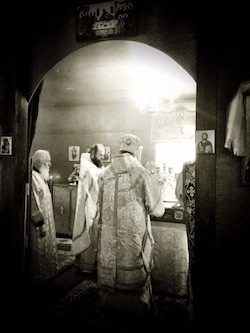
I smiled at that, because that’s exactly the experience I have, living in the modern world but worshiping within the timelessness of Russian Orthodoxy. When I returned from my trip to the East Coast, I learned that our parish had obtained a relic, a bone fragment, of St. Geneviève, the patron saint of Paris. She was a fifth-century Gaul, a nun who was a wonderworker. I learned of her when I was in Paris three autumns ago, and went several times to her tomb inside a church atop a hill that bears her name, to venerate her relics, and to ask her prayers. Since then, I have had a private devotion to her, often asking her prayers. When I went to vespers on Saturday night, I stood by her relic, awed to think that a piece of the body of this holy woman of late antiquity, this sister in Christ, was at my right side, and had come to me across the ocean and the sea of time. We Orthodox believe in the communion of saints, which means we hold that every time we gather to worship, all the saints of heaven are mystically present with us (that’s why you see so many icons in our churches). Still, there is something extraordinary about having a piece of the holy woman’s bone present.
This only seems pagan, I think, to modern Christians, who find all of this superstitious, and a relic, so to speak, of our past. I think this is quite wrong. When I was back East last week, I startled myself by talking a lot about Orthodoxy, and the traditional Orthodox spiritual disciplines I have learned from my priest, Father Matthew. I didn’t mean to get on a soapbox for Orthodoxy, but when I had to give examples of the kinds of spiritually formative practices I’m talking about in the Benedict Option … there was Orthodoxy.
It really does work! By “work,” I mean that faithfully going to liturgy, doing the prayers, observing the fasts, and giving yourself over to the tradition truly does de-center yourself from your Self, and re-centers it around God — and it does this because it draws in the imagination and the body in ways that Western Christianity does not. That doesn’t make it true, of course, but I would encourage Catholics and Protestants to study Orthodox worship and learn what they can from it, about how to embody a sense of holiness and otherworldliness. Without that strong sense of God’s reality, and of God “everywhere present and filling all things,” as we pray, I don’t know how people withstand the world. I strongly feel, because I have lived it, that only Orthodoxy purifies my vision and my heart, and opens to me the experience that Dante describes in the Commedia. I could not have understood this outside of Orthodoxy, and I couldn’t have understood it in my first years as an Orthodox Christian. But you absorb the ritual, the colors, the smells, the bells, the bending of the knee and the crossing of the breast, and combined with prayer, confession, and the Eucharist, it all points you — it points all of you — to Him.
I cannot imagine today being anything but Orthodox, because for me, only Orthodoxy gives me the thickness required to stay rooted in historical Christianity, and to resist the disorders of modernity, especially my own disordered heart. When we enter our temple, we don’t find a seat to hear a lecture; we bow before the presence of the Almighty (and bow, and bow, and on certain high holy days, prostrate ourselves fully, head touching floor). This doesn’t symbolize submission to the All-Holy; this is submission to Him, and if we are doing it right, we take that disposition out of the temple with us and into the world.
I say “for me, only Orthodoxy gives me this,” but I really do think it’s true for everybody. It is not something that is easy to explain in print (though if you’d like to know more, my friend Frederica Mathewes-Green’s latest book, Welcome To the Orthodox Church, is a great introduction). You really do have to come and see, not expecting to understand it at first, or even at second. It is not something that you can contain in rationalistic, easily bounded categories. Here’s a short video clip in which Frederica takes you on a tour of her parish, explaining why Orthodox Christians organize their worship space as they do:
My point is that I have a strong sense that if it is going to survive, the Christianity of the future is going to have to be marked by a return to medievalism, in the sense of being strongly sacramental, marked by a sense of enchantment. The Russian Orthodox philosopher Nikolai Berdyaev, nearly a century ago, called for a new medievalism — by which he means a time in which the spiritual life to precedence over the material life. I believe that Orthodoxy will grow in the West once Christians realize more completely the nature of our common predicament in post-Christianity, and if they investigate how Orthodox Christian spirituality and practice stands so powerfully against modernity, not only in what it teaches, but also — and even moreso — in what it does. All those prayers, all that incense, all those praises and prostrations — they are a progressive unveiling, a cleansing of the vision and purification of the heart. It’s hard, but it’s real. But you have to see this for yourself.
Catholic and Protestant readers, is there any sense in which you can be faithful to your own traditions, and still be “medieval” in the sense Berdyaev means? I know it can be done in Catholicism, though that form of Catholicism is thin on the ground here in America, in the modern era. Thoughts?
UPDATE: I want to ask you please not to read this post as proselytizing. I don’t do that here. If you don’t believe the truth claims of the Orthodox Church, then all the beautiful liturgy in the world doesn’t make it appealing. I would like the discussion thread to focus on the role that ritual and bodily practice plays in the experience of religion, and of Christianity in particular.
UPDATE.2: James C. says the American Catholic answer to this is found in Jody Bottum’s 2006 essay about the swallows and Capistrano. It starts like this:
The swallows would swirl through San Juan Capistrano, rising like a mist from the sea every March 19. Or so the legend goes. In fact, the blue-feathered birds sometimes reached California as early as mid-February, and when they arrived at the end of their long trek from Argentina, they would infest the place like happy locusts, plastering their gourd-shaped nests among the crossbeams and crannies, the nooks and corners—anywhere they could get their colonies to stick to the old stucco and adobe of the mission founded by Father Junipero Serra in 1776.
They were cliff swallows, Hirundo pyrrhonota, the woman from the local Audubon Society explained, speaking in the rapid, inflectionless voice of someone reading, for the sixth time that day, from a memo stuck to her desk with yellowing strips of cellophane tape. Lacking the deeply forked tail of the better-known barn swallow, Hirundo rustica, cliff swallows are known by their white forehead, buff rump, and short, squared-off tail feathers. They gather in large flocks, fluttering their wings above their heads in a characteristic motion while gathering mud for their nests. And they haven’t returned to the Mission San Juan Capistrano—darting past the old Serra Chapel and flitting through the ruins of the Great Stone Church—for nearly twenty years.
Not that the mission hasn’t tried to win them back. What’s Capistrano without its swallows? All the mission bells will ring, / The chapel choir will sing, / When the swallows come back to Capistrano, the most popular song of 1939 told the nation, and for years after the swallows disappeared, you could see the groundskeepers out making artificial mud puddles with their green plastic hoses. In the 1990s, someone had the notion of hiring a local potter to fool the birds, and the mission is still dotted with clay nests: ceramic lures that failed to bring the square-tailed nest builders, Hirundo pyrrhonota, back to hear the bells.
There’s a figure in all this—a metaphor, perhaps, or a synecdoche—for the condition of American Catholicism. Its long history, certainly, from the Spanish colonial beginnings on. But, most of all, San Juan Capistrano seems an image for recent decades—because sometime around 1970, the leaders of the Catholic Church in America took a stick and knocked down all the swallows’ nests.
They had their reasons. What was anyone to make of those endless 1950s sodalities and perpetual-adoration societies, the Mary Day processions, the distracting rosaries shouted out during the mumbled Latin Masses? The tangle and confusion of all the discalced, oblated, friar-minored, Salesianed, Benedictined, Cistercianed communities of monks and nuns?
The arcanery of decorations on albs and chasubles, the processions of Holy Water blessings, the grottos with their precarious rows of fire-hazard candles flickering away in little red cups, the colored seams and peculiar buttons that identified monsignors, the wimpled school sisters, the tiny Spanish grandmothers muttering prayers in their black mantillas, the First Communion girls wrapped up in white like prepubescent brides, the mumbled Irish prejudices, the loud Italian festivals, the Holy Door indulgences, the pocket guides to Thomistic philosophy, the Knights of Columbus with their cocked hats and comic-opera swords, the tinny mission bells, the melismatic chapel choirs—none of this was the Church, some of it actually obscured the Church, and the decision to clear out the mess was not unintelligent or uninformed or unintended.
It was merely insane. An entire culture nested in the crossbeams and crannies, the nooks and corners, of the Catholic Church. And it wasn’t until the swallows had been chased away that anyone seemed to realize how much the Church itself needed them, darting around the chapels and flitting through the cathedrals. They provided beauty, and eccentricity, and life. What they did, really, was provide Catholicism to the Catholic Church in America, and none of the multimedia Masses and liturgical extravaganzas in the years since—none of the decoy nests and artificial puddles—has managed to call them home. All the mission bells will ring, / The chapel choir will sing, / When the swallows come back to Capistrano.
It’s a Shame About the Middle East
Daniel Gordis reflects on the intractability of the Israeli-Palestinian struggle:
We have a young language instructor at Shalem College in Jerusalem, where I work. She’s a religious Muslim who wears a hijab, lives in one of the Arab neighborhoods of Jerusalem and is a graduate student at Hebrew University. She’s fun and warm, and a great teacher — the students like her a lot.
Late last spring, when things here were quiet, some of the students mentioned to the department chair that as much as they’d spoken with her over the past couple of years, they’d never discussed politics. They were curious what someone like her thought about the conflict in this region, especially now that she was teaching at an unabashedly Zionist college, had come to know so many Jewish students and had developed such warm relationships with them. How does someone like her see things here? How did she think we would one day be able to settle this conflict?
“So ask her,” the department chair said. “As long as you speak to her in Arabic (she’s on staff to help our students master the language), you can talk about anything you want.”
They did. They told her that since they’d never discussed the “situation” (as we metaphorically call it here in Israel), they were curious how she thought we might someday resolve it.
“It’s our land,” she responded rather matter-of-factly. Stunned, they weren’t sure that they’d heard her correctly. So they waited. But that was all she had to say. “It’s our land. You’re just here for now.”
What upset those students more than anything was not that a Palestinian might believe that the Jews are simply the latest wave of Crusaders in this region, and that we, like the Crusaders of old, will one day be forced out. We all know that there are many Palestinians who believe that.
What upset them was that she — an educated woman, getting a graduate degree (which would never happen in a Muslim country) at a world class university (only Israel has those — none of Israel’s neighbors has a single highly rated university) and working at a college filled with Jews who admire her, like her and treat her as they would any other colleague — still believes that when it’s all over, the situation will get resolved by our being tossed out of here once again.
Even she, who lives a life filled with opportunities that she would never have in an Arab country, still thinks at the end of the day the Jews are nothing but colonialists. And colonialists, she believes, don’t last here. The British got rid of the Ottomans, the Jews got rid of the British — and one day, she believes, the Arabs will get rid of the Jews.
Read the whole thing. Gordis writes in sadness, as if having to face the resilience of Palestinian irredentism falsifies a cherished belief. Which, of course, it does: there can never be peace if Arabs believe that Jews have no right under any circumstance to be on the land.
I think there’s a lesson in this for all of us in the West, whatever we think of the Israel vs. Palestine divide. We love to think that the modernity — liberty, equality, capitalism and the material comfort it generates — erodes instincts we find atavistic. Why would you want to carry on a tribal dispute about land when you could live in peace and we could all get rich together, and be happy? The answer, it would appear, is that to the non-Western culture of the Middle East, the greatest poverty is the dishonor of acquiescing in your defeat. We keep missing this about the Middle East.
I have a sense of what this means, because I too come from a shame-honor culture, in the Deep South. It’s not nearly as strong as that of the Middle East, heaven knows, but having experienced it from the inside gives me at least an inkling of how infinitely stronger it must be among Arabs there. To be frank, my father was willing to preside over the breakup of our family system rather than admit error, or to compromise in any way. It was a matter of honor. Last week, I ran into an acquaintance in town, who asked how my mom was doing in the wake of my father’s death. “Your daddy was the kind of man who would do anything in the world for you, but if you crossed him once, that was it,” the man said, making a chopping motion with his hand.
I laughed at that, but it was true, and in the end, it was tragic. In the South, despite our Christian pretensions, many of us know who we are by the grudges we hold. Pushed to the extreme, this ethic is about preferring to reign in Hell than serve in Heaven (Milton). But from another point of view, it’s the ethic of the Christian martyrs, who would rather die than bow down to a false god.
Whether you think the Palestinian language instructor is a slave to self-destructive pride, or is a heroic example of fidelity to ideals uncompromised by material gain, depends on what you think of the end to which she is pledged. Has she sold her soul to irredentism and Jew-hatred? Or is she refusing to sell her soul to the occupiers of her land, no matter how easy they make her life?
What is the soul? Which god does it serve? Those are the real questions, and the answers to them define how the Palestinians deal with their dispossession, and how all of us deal with our own dispossession and exile, which may not be literal, as it is for the Palestinians, but which is real all the same (see How Dante Can Save Your Life for more on this point). My father dealt with his dispossession — seeing his son adopting a way of life somewhat different from his own — by doubling down on grudge-holding, and refusing to compromise, because in his mind, if he compromised, it would amount to accepting his dispossession. But it very nearly succeeded in destroying the very thing he wanted to pass on. See how that works?
(Readers, I’m happy to host a wide-ranging discussion, but I’m not going to publish tiresome polemics about evil Zionists and suchlike. If you don’t have something new to add to the discussion, in the conceptual framework I’ve introduced here, better not to waste your time writing it.)
Rod Dreher's Blog

- Rod Dreher's profile
- 508 followers

