
Rod Dreher's Blog, page 660
October 12, 2015
The Evil Genius of Sesame Credit
This is evil, and this is brilliant. China has introduced a system allowing people to manage their credit rating. But there’s a catch — lots of them:
In the West, our credit score is simple. It’s our ability to pay. It’s measured from our assets, our income, and if we have bought on credit in the past and managed it well. That’s it. In China, the situation is… more nuanced. It’s not just that you have bought things, it’s also what you buy that contribute to your credit score, in either direction. If you’re buying things that the regime appreciates, like dishwashers and baby supplies, your credit score increases. If you’re buying videogames, your score takes a negative hit.
In theory, Sesame Credit (and its benefits) is optional. So far. For the time being. But China has already announced that it, or something very like it, will become mandatory from 2020. It has also announced that while there are benefits today for obedient people, it intends to add various sanctions for people who don’t behave, like limited Internet connectivity. Such people will also be barred from serving in certain high-status and influential positions, like government official, reporter, CEO, statistician, and similar.
Things that will make your score deteriorate include posting political opinions without prior permission, talking about or describing a different history than the official one, or even publishing accurate up-to-date news from the Shanghai stock market collapse (which was and is embarrassing to the Chinese regime).
But the kicker is that if any of your friends do this — publish opinions without prior permission, or report accurate but embarrassing news — your score will also deteriorate. And this will have a direct impact on your quality of life.
This is pretty close to a perfect totalitarian system. If you don’t conform to the state’s ideology, people will have to shun you or they will be economically ruined. The state doesn’t have to do anything; every member of the community becomes a secret policeman by default.
Could you imagine such a system coming to the US? If so, how?


October 11, 2015
The Trip So Far
Hey, look who Mr. Bigtime Needs A Haircut had lunch with on Saturday in Georgetown: the mighty Ken Myers, of the Mars Hill Audio Journal. This selfie taken after our talk onstage at the university. We had dinner again tonight, this time in Charlottesville, Va., closer to his home. I have decided to commit my mighty powers to conjuring up MarsHillapalooza, a festival of all things Ken Myers. We will gather in Charlottesville, and it will feature talks by Journal greats like Alan Jacobs, Ralph C. Wood, James K.A. Smith, and many others. It’ll be like a Walker Percy Weekend of the upper South. We will find the funding for this thing and make it happen!
I am in C’ville tonight, and am about to go to sleep, so no time for a long entry. Quick notes from meetings and conservatives on the DC-C’ville trip so far:
1. Religious conservatives aren’t going to get any help from Republicans. Not on religious liberty, or anything else. The Left in Congress is in no mood to compromise, because they’re on a roll. There’s no stomach on the Right in Congress to fight, because business doesn’t want anything to do with it, and because if members say one thing wrong, they’ll be crucified as bigots in the media, and on social media. We’re on our own. Best thing to do, I’m learning, is vote Republican in hopes that better policies will be made from the executive branch, and better judges will be nominated. That’s about it.
2. A law professor told me that the kinds of things that go out on legal listservs he reads gives you an idea of what’s going to be mainstream 20 years from now. “Some of it is so horrifying I don’t feel right talking about it,” he said. Oh come on, I said, what? “Legalizing bestiality,” he said.
3. In a discussion of the problem of authority and the Benedict Option, a young DC lawyer told me about her bad experience with it. She was raised in a severely restrictive homeschool community that followed the teachings of Bill Gothard and Vision Forum. Really far-out-there groups and ways of thinking. Both were later disgraced by sex scandals. After a related blow-up at Patrick Henry college, her faith was shattered. She got it back together, and is a lot wiser today. She said one of the most important things I heard all weekend:
“Whenever you go looking for strong, clear, unbending authority, you’re going to find Bill Gothard.”
4. Some intriguing Ben Op stuff going on at Trinity Presbyterian in C’ville. Will learn more tomorrow.
October 9, 2015
The Joy of the Benedict Option
Forgive me for posting so much about the Ben Op. I’m really excited about today’s (Sat Oct 10) meeting at Georgetown, not least because at long last I’ll meet Leah Libresco, the Catholic convert and devotee of the Dominican House of Studies, who thrills me with posts like this. Excerpt:
When Rod Dreher profiled model Benedict Optioners, he wasn’t focused on the monks in the monastery, but the people who had deliberately settled in the shadow of the monastery, so that they could lean on the brothers while engaging with the world. I find myself living in a similar situation as a Washington D.C. resident, living within the orbit of the Dominican House of Studies — only a short metro ride away from my home and my office.
My parish hosts two Dominican brothers, who assist at Mass and run an Adult Sunday School, where they give excellent weekly talks on matters of faith. They’re so integrated in to the parish that, when our RCIA director was choosing sponsors for my class of converts, she had a Dominican step in to be my godfather. Once a month, I go to the “Christopolis” lecture, where a Dominican father introduces a speaker (not infrequently a Dominican) to speak on the underpinnings of our religion and how to live them out. When I had a free afternoon, I stopped by the House of Studies to join the friars and their guests for Evening Prayer (and used to do it a lot more often, when I had a job with “summer hours”). A Dominican friar has stopped by the monthly debates I host, chatted with my friends, and helped us consider the question “R: Send Your Kids to Public School” (which touched on Benedict Option themes). And, just a couple months ago, I saw a lot of my friends when we all gathered at the priory for theDominicans’ Vigil of All Saints.
Living supported by the Dominicans does more for me than cultivating piety on my own or even being involved in my church. The brothers (and the sisters studying at their school) offer infusions both of knowledge and of joy for us. They open up the faith so we can study in in greater detail, not just in order to amass more knowledge, but so that we can delight in beauty. They also clear out space for us to experience this delight. And they serve as a Schelling Point where we can find people we can share philia bonds with (“You, too? I thought I was the only one!”). I even went so far as to recommend to one Catholic friend (currently in law school) that he might want to prioritize finding a summer job in DC, so he could have the experience of being in such a rich and lively Catholic community, so he could decide if he wanted to prioritize living here, or someplace like it, when he did longer-term career planning.
Man oh man, I think about how different my life would have been in DC, back in the early 1990s, if I had had what Leah and those like her have with the Dominicans. Such joy, in community and orthodoxy.
(If you’re reading this on Saturday morning, please come see us and meet Leah at Gaston Hall @ Georgetown, 37th and O, NW, Washington. Event starts at 10 am — and you’ll get to hear and meet Ken Myers, which, I’m telling you, will change you life.)
Conflict Between Neo-Benedictines
(Did you see Part I of the dialogue between New Monastic leader Jonathan Wilson-Hartgrove and Your Working Boy? Read it, then you’ll be ready for Part II, here:)
Rod Dreher: Well, hang on. I don’t agree that the most important commitment of any religious movement must be to not further fracture the Church. It’s not that I think division is a good thing, but rather that I think unity that is not based on shared belief is superficial and unsustainable. You indicate that the members of Rutba House worship at local congregations. Do you mind saying which ones? Are there serious theological divisions among the congregations represented in the Rutba House community, and if so, how do you resolve them?
Along these lines, I don’t believe that it is dangerous to retreat with “those who share our bias about the world”; in fact, that is largely (but not entirely) the point of the Benedict Option, in my view. One man’s “bias about the world” is another man’s creed. I would see a red flag in a community that insisted that everyone agree in lock-step on every single issue. But it’s clear to me that there must be a substantial and fundamental unity among a community’s members about what constitutes truth, and what our authority for discovering that truth is. For example, it strikes me as a recipe for fragmentation and disaster if you put small-o orthodox Catholics in the same community with committed progressive Catholics; it is hard to get them to agree on a lot of things, not because one side is better than the other, but because in practice, they lack agreement on a common authority. You are right back to MacIntyre’s square one. I know this from my years as a Catholic, engaging in debates both friendly and unfriendly with progressive Catholics, most of whom, in my experience, did not believe that the Church’s Magisterium (teaching authority) was binding on their individual consciences.
About “other-ing,” I don’t like the term, especially used in context of the Ben Op. It strikes me as politically loaded. True, all Christians have to be very careful about drawing lines between us and others, lest we fall prey to the temptation to see them as less than human. That said, to be a member of any community is to draw lines around that community, so that we can know what it means to be part of it. The sociologist Philip Rieff said that a culture is defined by its “remissions” — that is, it’s “thou shalt nots”. That’s a simple but useful definition, I think. Every community has them. What are Rutba House’s thou shalt nots? Where do you draw the line and tell someone, in charity, “Sorry, brother, but you can’t live among us if you hold that belief”? If a sincere fundamentalist Christian presented himself at Rutba House’s door and asked to join the community, could you afford to let him in? Maybe you could; I don’t know how your community is constituted. But I’m betting there would come a point at which you all asked him to leave, not because you are nasty people or because he is a nasty person, but because the gap between his beliefs and the community’s is simply too great to overcome, and the lack of fundamental unity is impairing the community’s ability to function.
As you know, the Christian response to LGBT folks is a point of sharp division among contemporary Christians. I know where you Red Letter Christians stand; small-o orthodox Christians (including us big-o Orthodox Christians) stand with the older belief — which we do not feel we have the liberty to reject. If your community is fundamentally committed to LGBT equality, you can’t afford to have one of us in your community — and vice versa. There are other baseline issues too, but I think you and I can agree that the moral and theological status of LGBT is the most heated one in our time and place. Churches are dividing over it, and for good reasons on both sides of the controversy. It is not a minor issue, not at all. Though division is not to be sought or celebrated, it is inevitable in our fragmented world, don’t you think? We ought to own that. If we consider our communities — New Monastic or something less intensive than that — to be in some way “schools for the Lord’s service,” we have to have a basic agreement on the ends to which we are headed. To return again to the sharpest source of division in the contemporary church, what does serving the Lord require of us in terms of governing our sexual lives? Can there be morally licit sexual activity between unmarried people? Between people of the same sex? How can we know the right answer? These are not issues on which a community can simply agree to disagree, it seems to me.
Wilson-Hartgrove: Let me tell you a story. Some years ago, a man named Roy was living at Rutba House who’d come home to the neighborhood from prison—mid 40s, African-American, gregarious. He had a lot of experience in sales… most of it illegal. But he was a changed man. He’d met Jesus and turned over a new leaf. A life of praying and eating regularly with other people helped him stay focused, he said. So he stayed.
Like Benedict says, community life is mostly praying and eating. And meeting. Roy came to meetings and participated. He was intrigued by our process of building consensus.
I’ll never forget the evening I brought a request from Tim to come live with us. Tim wanted to come from San Francisco to live here for a couple years while he studied at the seminary in town. He wanted everyone to know that he hadn’t been in school for over a decade, so the transition might be hard for him. And he wanted us to know that he was gay.
Well, Roy was kind of like you: he said you have to draw the line somewhere, and given his experience, this was it. “I done dealt with homosexuals in prison,” he said. “I ain’t living with a gay man.” This is what we call “blocking consensus.” It felt like an impasse.
But Roy agreed to talk to Tim, then agreed to try life in community with him, “as long as we’re not living in the same house.” They prayed together and ate together. Eventually, they learned that they both liked pool, so they played an occasional game together. I don’t know that Roy ever “changed his mind” about homosexuality, but I do know that when Tim moved back to San Francisco, Roy was the first person from our community to go visit him. They’re still good friends today.
The main reason I believe in the Benedict Option is that I know from experience that it creates conditions in which we can gain a new perspective on the language and categories of our age. Sure, the church must always remain committed to both truth and unity. You know the line attributed to Augustine: “In essentials unity, in non-essentials liberty…” The rub, of course, is that we have to figure out what’s essential—and do it, as all things, “in love.”
And this is precisely where I think much of American Christianity has become captive to the spirit of our age. For two millennia the Church has blessed the marriage of man and woman (as well as man and Jesus or woman and Jesus—let’s not forget the monastics!). For a few decades, the Church has had members asking it to bless the marriage of man and man or woman and woman. I completely understand that a fragmented Church would have differences of opinion on how to respond to this change. But who told Christians in America (liberal or conservative) that who the government allows to marry is an essential of our faith?
This is where I’m grateful to have mentors in the black church tradition (and where I think you’ve misunderstood the assumed “Red Letter” position on gay marriage). When a Constitutional Amendment against gay marriage was proposed here in North Carolina, Rev. William Barber—a mentor with whom I’ve written a book on moral witness—came out against it. But he was very clear that his opposition was neither an affirmation nor a condemnation of the morality of gay marriage, but rather a moral defense of equal protection under the law. He looked back to the NAACP’s position on marriage between black and white people in the 1960’s. For liberal Christians at the time, it was morally wrong to bar people from marriage based on race. For conservative Christians, it was morally wrong to mix races which, as they said over and again, God had separated. Rev. Barber pointed out that the NAACP had never declared a position on the morality of interracial marriage. That was not the purview of a public moral witness. What they had said clearly—and he insisted that this applied to gay marriage as well—was that whether citizens in this country can enjoy the legal benefits of marriage in public life is a matter of equal protection under the law. The moral obligation of a Christian public witness is not to legislate one community’s understanding of marriage but to ensure, to the best of our fallible ability, equal protection under the law.
This is where I worry that a Benedict Option, uncritically applied, could further exacerbate the Church’s captivity to a left vs. right, conservative vs. liberal framework. You asked what congregations members of Rutba House have joined. Most of us are at two, which are both in walking distance of our houses. One is the classically liberal white Baptist church in town—welcoming and affirming. The other is a traditional, conservative black Baptist church in Walltown—neither affirming nor very welcoming of homosexuals, to tell the truth. I’m a minister at the latter, so the fears that are stirred up among conservatives on this issue are familiar to me. But I have watched how the Republican party has tried to manipulate our people, using “moral” values to win votes while immorally suppressing the minority vote here in North Carolina. If a Benedict Option is to lead us toward the gospel way in our time, I think it has find a way to resist precisely those divisive powers.
Rod Dreher: I’m with you on the question of depoliticizing Christianity. I am a cultural conservative but a registered Independent. I tend to vote Republican for national offices, but if I thought the Democrats had a place for people like me — socially conservative, but economically moderate to liberal — I would be much more likely to vote for them. I do not understand why the Democrats are so resolutely pro-choice, calling the extermination of the lives of unborn children “freedom.” I don’t believe either political party is blameless, from a Christian point of view. In any case, I don’t like the idea of the church being a political party at prayer. I was surprised back in 2010 to learn from reading Bob Putnam and David Campbell’s book “American Grace” that research finds religiously liberal churches are even more politicized than religiously conservative ones. It’s unhealthy for the church either way.
That said, I see no necessary conflict between being charitable towards a gay man, and holding to Biblical teaching about the meaning of sexuality. I don’t want to be part of a church that tells gays to stay out, or tells me that I cannot be friends with gays. On the other hand, I do not want to be in a church that compromises on truth for the sake of unity, which would in that case come at too high a price. I think one reason I feel so strongly about this is because it was my own disordered love — my refusal to sacrifice my sexual liberty — that kept me away from Christianity for years as a young adult. I wanted to be a Christian, but I didn’t want to obey the teaching about keeping sexual expression inside marriage. I briefly attended a church that didn’t care what I did with my sex life, but I knew that was dishonest. Eventually I yielded, and I’m grateful for the unfashionable witness of the Catholic Church on this point. The four years of chastity between my conversion and my marriage were a desert, but I thank God for them, because the ascetic practice rightly ordered my heart.
Anyway, I don’t see how the gay question can be resolved to the satisfaction of both sides within the church, because it doesn’t strictly have to do with homosexuality, but with the meaning of human sexuality and the human person. You and I don’t need to go deeply into this here, but I do think — and I bet you do as well — that this is not one of those issues on which we can agree to disagree within the bounds of a community. Sexuality is so foundational to Christian anthropology. A Christian community that affirms homosexuality is going to seek different ends in some respects than a Christian community that does not. The division is based on something real, and consequential. Could you be part of a church or an intentional community in which the group was committed to living out the traditional Christian teachings on sexuality (hetero and homo)? Or would that strike you as compromising on a fundamental matter of justice? For us on the traditionalist side, it is a matter of justice too, “justice” being the right ordering of things. Noncelibate gay partnerships and gay marriage doesn’t make sense within our Christian conception of order, and I’m guessing that for your Christian conception of order, denying gays the moral right to partner and the legal right to marry is irrational and unjust.
We get right back to MacIntyre again, don’t we?
Wilson-Hartgrove: Nicholas Wolterstorff taught me that there’s a basic difference between understanding justice as the “right ordering of things” (i.e. “justice from above”) and understanding justice as a systemic effort to listen to the oppressed (i.e. “justice from below). His Reformed colleagues in South Africa justified apartheid as “the right ordering of things.” They forced him to reimagine justice biblically as God hearing the cry of Israel in Egypt.
I like Cornel West’s way of putting it: “justice is what love looks like in public.” I’m glad you wouldn’t be part of a church that tells you you can’t befriend a gay man. But when I listen to my gay friends—when I try to love them not just as friends, but as fellow neighbors in society—I find myself saying, “Of course you should be able to speak with your kids’ teacher at school. Of course you should be the one talking to the doctor at the hospital when your partner is in a car accident.”
I have enough friends who think they are conservative to know that this is not what they’re thinking about when they say Kim Davis is right to conscientiously object to signing marriage certificates for gay folks. People who think themselves conservative think about tradition and the normative function of law. If we change the “traditional” definition of marriage, it will change our culture, they say. And they are right.
But if we’re honest, we know very little about how Christianity will be affected by a culture that recognizes the legal right of homo and heterosexual people to enjoy the benefits of marriage. Your question about how a biblical anthropology helps us to imagine what our bodies are for is precisely the question I wish Christians were talking about, whether we imagine ourselves conservative or liberal.
But that’s not the conversation we’re having—neither in public nor in many of our churches. What I’m trying to say is that our cultural captivity isn’t to the “liberals” who’ve gone and messed up traditional marriage but to an ideology that says liberals and conservatives could never be Christian together. You said you thought I would agree that this is not one of those issues where we can agree to disagree. But, as I was saying earlier, I live in community—daily shared prayers, meals, meetings, and money, etc.—with people who have radically different views on this—and are all Christian. Indeed, I think this is one of the most important ways a new monasticism can bear witness to the gospel.
Whatever its form, if the Ben Op doesn’t help us imagine something new, then it will inevitably become a fortress of the left or the right. I’m not interested in new monastics as “special forces” to perpetuate the culture wars.
Rod Dreher: I don’t agree with your thinking on justice, but we are both running out of time, so I’ll pass on that. I do agree with you on the need to imagine and live out a Christianity that is not captive to the culture war. Our problem is not so much with liberals (= Democrats and their fellow travelers) as it is with liberalism as an individualist mode of thought and politics that emerged from the Enlightenment. Conservatives — that is to say, Republicans and their fellow travelers — are as captive to liberalism, in this sense, as are their political opponents. That said, religious conservatives like me may not be interested in the culture wars, but the culture wars are definitely interested in us. I am certain that both the state and corporate interests will do what they can to make life harder for traditional Christians, both individually and with our institutions, who dissent from the new consensus on homosexuality. Sex is not the whole of the Gospel, of course, but fidelity to Scripture on sexual purity is precisely the area on which the world will push hardest against us. The Benedict Option must do many things, but one thing I hope it will do is teach us traditionalists how to endure without losing our faith or our peace, and without returning hatred for hatred. My hope is that our Christian brothers and sisters on your side of the divide recognize our right to be wrong, and stand by us when things get hard.
(Cross-posted at Red Letter Christians.)
Reading Wendell Berry at Costco
So, it was a busy day in Washington, talking about the Benedict Option, and
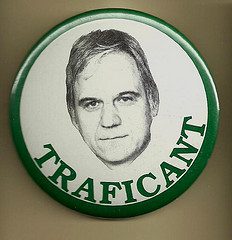
Our Leader (Mpls55408/Shutterstock)
launching my long-shot bid to be Speaker of the House as a Traficant Whig. Somebody has to represent the Marsupial-Haired-American community on the Hill, yes?
I spoke to the Faith & Law group today, and realized a couple of things after the talk. For one, I met a man whose writing I deeply admire, and with whom I had corresponded over the years, but had never met. (I won’t embarrass him by naming him.) He said he agrees with much of what I say regarding the Benedict Option, but thinks I’m too gloomy and defensive about it. He believes that there is a more positive vision to be articulated here, a vision that’s about a turning-inward towards community as more than an escape, but an actual embrace of liberty. His words reminded me once again that I have a bad habit of coming across as more apocalyptic than I am. Sort of.
I mean, I really do think things are going to get increasingly more difficult for us traditionalist types, both in terms of law and culture, and I find that, to paraphrase Flannery O’Connor, for people who are deaf, you have to shout. That said, anybody who has spent 10 minutes around me knows that I am very far from calling for the Amos Starkadder Option. As a native of south Louisiana, when the hurricane is coming, my instinctive response is to get out the gumbo pot, make a roux, ice down some beer, and invite everybody over to eat. I need to find some way to bring some of that joie de vivre to this dire topic, because I really do feel it.
Second — and I can’t learn this often enough — I really need to articulate better this whole withdrawal thing. People keep hearing me say, “Head for the hills!”, though I don’t believe that. The road to the Benedict Option goes through the Christian philosopher James K.A. Smith, so let me quote from him on the topic. This is from my own notebook. I think this is from his Desiring the Kingdom. Here, Jamie explains what he means by the term “liturgy,” and by “cultural liturgy”:
Liturgies, then, are a certain species of practice. More specifically, I want to distinguish liturgies as ‘rituals of ultimate concern': rituals that are formative for identity, that inculcate particular visions of the good life, and do so in a way that means to trump other ritual formations. Admittedly this might include rituals not associated with traditional religions (e.g., rituals of Nazi fascism or other rituals of totalizing nationalism); indeed, expanding our conception of what counts as ‘worship’ is precisely the point. Our thickest practices — which are not necessarily linked to institutional religion — have liturgical function insofar as they are a certain species of ritual practice that aim to do nothing less than shape our identity by shaping our desire for what we envision as the Kingdom — the ideal of human flourishing.
Liturgies are the most loaded form of human practice because they are after nothing less than our hearts. They want to determine what we love ultimately. By ‘ultimately,’ I mean what we love ‘above all,’ that to which we pledge allegiance, that to which we are devoted in a way that overrules other concerns and interests. Our ultimate love is what defines us, what makes us the kind of people we are. In short, it is what we worship. Another way of putting this, in terms we’ve used before, is to say that liturgies are ritual practices that function as pedagogies of ultimate desire.
The Benedict Option may be understood as deepening our commitment to Christian “liturgies,” as Jamie uses the word: not only the formal practice of religion, but the practices of everyday life, in family and community, to orient ourselves more thoroughly to God and His service. Jamie contends that we have to stop paying so much attention to what we say and think, and more to what we do, because practices are the way these cultural liturgies sink down into our marrow. The Benedict Option is the liturgization of our lives — and that requires a withdrawal from the liturgies we now inhabit.
But what does that withdrawal mean? Does it require us to move to the countryside? I don’t think it does. Jamie’s sequel, Imagining the Kingdom, sheds more light on the subject. In it, he writes of conversion (or, if you prefer, discipleship) as not simply about processing information, but about formation. True conversion is not simply an intellectual assent to theological propositions, but the instantiation of those propositions into our lives, such that we emerge over time with new habits, desires, and virtues.
The imagination shapes our identity and governs our orientation to the world. “Education is also about formation (‘aiming’) of our love and desire,” he writes, and “such formation happens through embodied, communal rituals we call liturgies — including a range of ‘secular’ liturgies that are pedagogies of desire.”
More, on the limits of merely adjusting your worldview:
A worldview approach would assume that the proper response to a disordered mindless eating is mindful eating, as if simply getting the right perspective on eating is sufficient. … We have a tendency … to overestimate the importance of thinking.
… The driving center of human action and behavior is a nexus of loves, longings, and habits that hums along under the hood without needing to be thought about.
More:
A way of life becomes habitual for us such that we pursue that way of life — we act in that way of life — without thinking about it, because we’ve absorbed the habitus that is oriented to a corresponding vision of “the good life.” Indeed, because this becomes sedimented into my background, I can’t even see the world otherwise; this way of seeing it just seems “obvious,” and I don’t even feel the call to be otherwise. I fail to resist temptation, not because I’ve made a bad decision, but because I’ve failed to recognize that I’m being malformed by a constellation of cultural “disciplines” that are disciplining me otherwise.
The Benedict Option requires us to embrace what Jamie calls “intentionally decentering practices” — that is, practices that release us from centering around the Self, as all the secular liturgies of our time do, and re-center us around God.
Here’s the key: if we are going to serve God as we are called to do, we have to be decentered from our Selves. And that requires entering into the life of the community that teaches us, through its practices, to do that. Here’s the heart of it:
We worship for mission; we gather for sending; we center ourselves in the practices of the body of Christ for the sake of the world; we are reformed in the cathedral to undertake an image-bearing commission to reform the city.
It’s like what Marco the Lombard tells the pilgrim Dante in Purgatorio: If you want to reform the world, start by re-forming your own heart.
One more thing from Jamie. He says that if we Christians are going to be in the world but not of it, we have to practice a form of withdrawal. Jamie, writing out of the Reformed tradition, cites Calvin:
So while Calvin does not advocate a retreat from “the world” to the desert, he still emphasizes the set-apart-ness of the Christian life. As Boulton so well summarizes it, “For Calvin, Christian life does involved being set apart, not via a geographical, social retreat to a monastic campus, but rather via a moral, existential brand of practical withdrawal from “the world” and “the depravity of disposition.” That is, Calvin envisions a reformed way of life robustly engaged in ordinary affairs that is nevertheless unconformed to the prevailing patterns and protocols, in effect a dispositional deflection from the world while remaining ensconced within it.
I get that. That’s what I believe the Benedict Option calls for. Yet we will need time in the desert, metaphorically speaking, for contemplation, so we can be recharged and re-centered for our action in the world. If, however, being in the world in a particular way proves to be a separation from God, then we have to physically withdraw. It will be very easy to lie to ourselves about this. Jamie:
It is not enough to convince our intellects; our imaginations need to be caught by — and caught up into — the Story of God’s restorative, reconciling grace for all of creation. It won’t be enough for us to be convinced; we need to be moved. Otherwise we’ll just be reading Wendell Berry in Costco; we’ll be convinced but not transformed.
Hey folks, come out on Saturday October 10 to Gaston Hall at Georgetown University (37th and O St., NW) to talk with Ken Myers and me and a bunch of your nascent Ben Oppers about the Benedict Option. 10 am till 12:30.
Eros and the Everlasting Now
In a few carefully argued pages in his recently translated The Crisis of Modernity, the Italian Catholic philosopher Augusto del Noce explains the “ascendance of eroticism.” Del Noce died in 1989, but his account could have been written yesterday. He illumines why Fifty Shades of Grey strikes a cultural chord, why same-sex marriage became the cutting edge of radical politics, and why virtually no Democrat dares to oppose abortion rights. It’s a little tour de force of philosophical and political analysis.
The sexual revolution, del Noce argues, was a radical change in Western metaphysics and views of human nature. Wilhelm Reich’s manifesto, The Sexual Revolution, began from the unargued assumption that there is no “order of ends, no meta-empirical authority of values.” In a world without purposes, “all that is left is vital energy, which can be identified with sexuality.”
This worldview is partly a product of a deliberate war against Christianity, especially Catholicism, but Del Noce sees it as the fruit of the elevation of science into a metaphysics. Modern science eliminates Aristotelian-Thomist teleology and deals only with efficient causes and natural forces. Sexuality becomes nothing more than a play of drives, without purpose or ultimate value. “The sexual revolution is . . . the point of arrival of ‘scientism.’” Any limit on our drives is an assault on our dignity. Sexual inhibitions are unnatural, every prohibition a threat to human freedom.
This is why the Sexual Revolution was really a cosmological one. More Del Noce, via Leithart:
The sexual revolution transforms the past into “what has to be surpassed,” what Reich calls “the dead trying to suffocate the living.” The past is “what must be negated to find psychological balance.” We are not free unless we are free to couple and decouple at will, without faithfulness or future. As del Noce puts it, “the domain of free sexuality is the pure present.”
Isn’t that what it means to be a fully modern Westerner: to live in the pure present, with nothing but possibility laid out before us, and only our desires to carry us forward?
October 8, 2015
Now That’s Hospitality

View from the guest bedroom at my DC area hosts Joe and Melanie Hartman. They went to the trouble to research my tastes and to lay in a bottle of this hard to find French aged plum brandy. I was flabbergasted when I saw it. What a special gift! This is one of the most thoughtful welcomes anyone has ever given me. If this is how the DC trip starts…
Our Lord of the Electric Blanket
Met a number of Christians in Washington, DC, today, and talked about the Benedict Option with most of them. Overheard today by me in one of those conversations:
“So many of the families in our church just want their kids to be happy and successful.”
Well, doesn’t every parent? Yes. But that’s not the point here. In context, the speaker meant that this is their telos, that they want nothing more for their kids than that they be happy and successful, and that the mothers and fathers are not prepared to hear anything contrary to this gospel of worldly success.
Hate to say it, but that attitude is going to be the death of Christianity in those families, in the younger generation. We are going to have to prepare a church that is capable of suffering, and suffering without losing its joy. This is an unpopular message, but it happens to be the truth. As Flannery O’Connor put it:
What people don’t realize is how much religion costs. They think faith is a big electric blanket, when of course it is the cross.
Hey, please consider coming out to Georgetown on Saturday morning to the Benedict Option event with Ken Myers and me. It will be a great opportunity to meet Christians (and others?) who can read the signs of the times, and who want to build communities of joyful resilience. Here’s the Facebook page, and details from it:
How should Christians meet the challenge of living faithfully in a post-Christian America? Inspired by the cultural diagnosis of Alasdair MacIntyre, Pope Benedict XVI, and other contemporary critics of modernity, Rod Dreher contends that the most important work orthodox believers can do is to construct local forms of community within which traditional Christianity can thrive in what he sees as a new Dark Age. The sixth-century Rule of St. Benedict and the monastic spirituality that emerged from it can inspire Christians today to be a countercultural, creative minority.
Please join us on Saturday morning, October 10 at Gaston Hall on the campus of Georgetown University for what promises to be a fascinating discussion of what Dreher, inspired by the cultural diagnosis of philosopher Alasdair MacIntyre, has termed the “Benedict Option.”
When: Saturday, October 10, 2015, 10:00 a.m. – 12:30 p.m.
Where: Gaston Hall, Georgetown University 3700 O St. NW
Go to the Facebook page and let us know if you’re coming. Not strictly required, but it would be nice of you. I predict that after you hear Ken Myers speak, you will subscribe to his Mars Hill Audio Journal, which, if you ask me, is the aural companion to the Benedict Option. In my experience, there are two kinds of Christian intellectuals: Journal subscribers, and those who have not yet heard the Journal.
By the way, Father Raphael Barberg has started a Facebook discussion group about the Benedict Option.
The Loss of Islamic Asceticism
Fantastic comment by a Muslim reader who posts under the name “Jones.” He begins by quoting a Russian Orthodox bishop from a previous post of mine:
“The last Glinsk elders were dying—those spiritual giants with enormous experience and priceless treasures that they wanted to pass on to us. But we, he says, were not able to receive it; because of our feebleness we couldn’t take it on.2
People have become weaker, they can’t receive this rich spiritual experience, because it is a cross—a very heavy cross.
This break between elders and novices can be seen now: Why are there practically no elders left? Because there are no obedient disciples, no people who are capable of receiving this wealth of experience.”
This is exactly what I was talking about earlier, when I was talking about my concerns about the next generation being unable to receive the wisdom of the previous one. Of course if I understand correctly, “elders” is here being used in a specific religious sense, but our “elders” are still our best reserve of spiritual wisdom and experience.
This means a lot to me right now. The whole idea that we are increasingly incapable of asceticism feels like a personal call to action for me. I’ve been increasingly struggling, in recent weeks, with my own failures in this regard. I’ve been noticing the failures only because I’m now trying to do better.
For my entire life I’ve been concerned about how to maintain an ascetic perspective in a deeply hedonistic society. For a long time I’ve lamented the spiritual vacuousness of secular liberal society. The evidence used to be all around me — God, you couldn’t do anything to get me to go back to high school and college and be around that again.
Now I’m around a different kind of person, guilty of a slightly different kind of sin. These are some of the smartest and most talented people the US produces. They radiate success, and they are utterly steadfast in their discipline. So base hedonism is not at all their sin. Their characteristic sin is idolatry. Their morality is typified by what Plato called the “oligarchic soul.” Their god lives in the world, among them. I’m not sure what, exactly, it is. I’m not sure that they know. Some form of socially dispensed prestige and status, which gets defined by different authority figures at different times. But if the world is all you have, then when you lose something materially, you stand to lose everything. I’ve realized that, for them, the quest of career success is aimed at a religious verdict on their moral worth, which is the only way to account for the zeal with which career success is pursued. I can’t make that conflation, because I think it’s idolatrous. But as a result I am not as invested in worldly success as they are. I can only infer that many of these people have had an upbringing that conflated moral worth with worldly success in a way that my upbringing did not.
As I grow older my life has become more comfortable. When I was young I was poor, surrounded by the children of the rich. It was easy to see that wealth and status would never be paths to happiness for me. Now the difference between me and those people is not so easy to see. I don’t get the easy reminders. I also don’t feel the day-to-day struggle against a recalcitrant world constantly decaying into disorder. And I no longer have easy access to that world of working class immigrants at the mosque, the pious, humble crowd I could quietly slip into, stand shoulder to shoulder with, and become just another humble worshipper.
Jones, how I wish you lived in my town so we could be friends and talk about these things! I am passing through the Charlotte airport now, but I will add more to this later. I wanted to get it out to you readers first.
Leftists, the Pope, and Child Abuse
Here’s something shocking mentioned in a John Allen column about Pope Francis and the Synod. Allen is making a point about how this pope benefits from having a certain narrative associated with him. Allen begins by talking about what an international scandal it was when Pope Benedict XVI lifted the excommunications of four traditionalist bishops, including one who was a Holocaust denier. Benedict had to apologize. Here’s Allen:
Flash forward to 2015, when Pope Francis named a new bishop for the diocese of Osorno in Chile who critics believe covered up crimes by his country’s most notorious abuser priest. The appointment triggered protests in Chile and objections from some of the pontiff’s own advisors on anti-abuse efforts, but has had little echo anywhere else.
Francis hasn’t responded with a heartfelt mea culpa like Benedict, but with defiance.
In a five-month-old video, Francis is heard telling an employee of the Chilean bishops’ conference that people criticizing his move are being “led around by the nose by leftists,” and that the country has “lost its head.”
While the substance of the two situations may be very different, the potential for backlash is eerily similar. Just imagine what the reaction would have been had Benedict blamed his own woes on “leftists,” and you’ll understand the difference between the narratives the two pontiffs carry around.
It’s striking that outside the Spanish-speaking media, there’s been relatively little reaction to the Barros affair, certainly nothing like the firestorm Benedict faced six years ago.
When Bishop Barros was installed, most of his own priests boycotted the ceremony. Some 650 people tried to prevent him from entering his own cathedral. The accusation is that Barros covered up for a popular priest who mentored him, but who was later found guilty by the Vatican itself of child molestation.
Here’s the video, in Spanish:
I knew that the Pope backed Barros, but I had no idea that he dismissed those protesting him as nothing but a pack of leftists. Yes, just imagine what would have happened had Benedict done this. Lucky man, Pope Francis. Lucky man.
Rod Dreher's Blog

- Rod Dreher's profile
- 508 followers

