
Rod Dreher's Blog, page 554
July 29, 2016
Ben Op Book Update
You readers have been very patient with me these past two weeks as I’ve been getting ready for our move to Baton Rouge, and facing this August 5 deadline to have the manuscript for The Benedict Option finalized. I have some news to share, and a favor to ask.
My publisher has decided to delay publication till March, for various reasons. This is good for me because it gives me another week or two to work on the manuscript. And I’ll need it, because my editor has asked me to add a chapter about Work in the Benedict Option. That is, she wants me to do some reporting to find out what conservative Christians who find themselves unable to work in their chosen professions because of the emerging social situation can do to support themselves, and each other.
A friend is a theologian at a Catholic college. What happens if the college loses its accreditation because it won’t submit to federal requirements on LGBT matters, out of religious conscience? He’s got advanced degrees in religion — what does he do for a living? And what can the community of orthodox Christians do to help him find meaningful work?
Another friend works in the finance industry. He is a devout Christian who doesn’t advertise that fact at work. But the atmosphere within his company is becoming such that he believes he will be forced to participate in pro-LGBT activities that have nothing to do with his job, but which are effectively used to weed out “bigots.” He has a reasonable fear that he will be fired or asked to resign eventually, or violate his conscience. What will he do if that happens? What can he do? What will the rest of us help him do?
What about small businesses?
What will faithful Christians do when whole fields or business areas are closed to them because of conscience issues? What does someone who wants to be a doctor do should the day come when medical school training requires them to learn to do abortions, and to participate in abortions?
All these questions are coming. I had put the Work and Economics chapter aside, because I didn’t have space for it, and the other chapters seemed more pressing. I’m glad that we’re going to make space for it.
But I need your help. Please post your ideas here or send them to me at rod – at – amconmag – dot -com . Please include as much detail as you can, including names and contacts. (Caleb Bernacchio, where y’at? I need you stat!) Please indicate in the subject line of your e-mail that you’re responding to this Ben Op Work bleg. I’m getting tons of e-mail now, and I can’t keep up with it. I don’t want to miss your e-mail.


Trump & Religious Conservatives
So, here we are in the cold light of day, after both parties’ conventions, and from my point of view as a religious conservative, I see nothing good.
The things most important to me this year — religious liberty, and the protection of life — are things Hillary Clinton and the Democratic Party are firmly, even militantly, against. Aside from their platform positions and HRC’s convention speech, take a look at these findings in the recent WikiLeaks document dump. Excerpt:
Leaked emails from the Democratic National Committee show efforts to arrange a meeting with a key NGO working to end religious liberty protections.
The emails were among thousands that surfaced on the website WikiLeaks July 22. The leak included emails to and from several DNC lead staffers during the period from January 2015 to May 25, 2016.
Two May 16 emails from DNC lead staffers, titled “Who do you want at the religious exemption research meeting?”, discuss a presentation from the Movement Advancement Project, an LGBT advocacy group which has challenged religious freedom protections as harmful.
The emails follow up on an April 11 email from Mike Gehrke, vice president of the Benenson Strategy Group consulting firm, to DNC communications director Luis Miranda and Mark Paustenbach, the DNC’s deputy communications director and national press secretary.
Gehrke said his colleague Amy Levin has been working with the Movement Advancement Project “over the past couple years” to develop “messaging and creative executions around religious exemptions laws” such as Religious Freedom Restoration Acts.
Religious Freedom Restoration Acts and other provisions have provided key protections for Catholics and other religious organizations against laws that would otherwise require them to violate their religious and moral beliefs.
This is not exactly news to people who have been following the religious liberty issue closely. Democrats see it as a code phrase for anti-gay bigotry, which they are determined to stamp out, no matter what. The Democratic Party is the enemy of religious conservatives. I wish it weren’t the case, but there’s no getting around it. Religious conservatives now find ourselves in the same relationship to the GOP as gays were to the Democrats in the Clinton era: they’re not really our friends, but they’re not our enemies either, so we’ll take what we can.
But … Trump? I am not going to recite again the litany of reasons why he is unacceptable to religious conservatives like me. You’ve heard it all before. Let it suffice to say that I don’t feel that I can vote for either one, but my mind is open to change. If I vote, I would vote for a lesser evil to stop a greater evil, and whichever way I decided on election day, I would be so disgusted with my vote that I would never tell a soul how I voted. That’s how strongly I feel about this.
Political scientist Carson Holloway has a good short piece at First Things talking about the death of Reaganism, and asking about the future of religious conservatives in politics. As you know if you’ve been following this blog, I’m in the final stages of finishing my book on the Benedict Option. A friend and reader of this blog who was kind enough to read the most recent draft of the book and offer critical commentary told me yesterday that he thinks the politics chapter is the best one. What I propose in it is nothing like anything on the table today, but I think it’s realistic. I’m not going to lay it out here, because hey, I want to save something for the book, and besides, it has very little to do with politics as statecraft — and therefore, is not relevant to the decision facing religious conservatives this fall.
Carson’s piece does, however. He says that there is no question that religious conservatism is a greatly diminished force in American public life, and that if religious conservatives want to have any hope at all of their (our) views being respected, and our interests being protected, in law and policy, we have to enter into some kind of coalition. Excerpts:
In judging whether to enter into such a political coalition, politically responsible and politically astute religious conservatives must ask themselves three questions. First, are the other issues and interests that go into the coalition themselves conducive to the common good? Second, are those other issues and interests friendly, or at least not hostile, to the core principles that religious conservatives cherish? Third, is the coalition politically viable—that is, can it wield enough political influence to win elections and shape public policy?
Holloway says — and I completely agree with him, that “an alliance with the left is out of the question, since the American left regards religious conservatism as a form of bigotry.”
Do not dismiss the seriousness of that point. If you want to know how traditional Christians are going to be treated in law and policy under Democratic rule, consider that they believe we are no different from racists. All of society is moving this way, of course, but Republicans more slowly than Democrats. More:
Accordingly, religious conservatives must ask themselves whether they can fruitfully and conscientiously enter into a political coalition such as Donald Trump is trying to build. That means asking the three questions identified above. Is there anything in the new populist nationalism that is intrinsically hostile to religious conservatism? Are its issues—its concerns about immigration, trade, and foreign policy—consistent with the common good? And does it plausibly point the way to the creation of a governing coalition in which religious conservatives might play a helpful role?
Religious conservatives have a responsibility to think through these questions without their minds being clouded by either nostalgia for Ronald Reagan or disdain for Donald Trump. Reagan should still be admired for his qualities as a statesman, even if Reaganism is no longer a viable political program. And the issues Trump has raised deserve careful consideration, even if one find’s Trump’s private life or his demeanor as a candidate troubling.
I let go of Reaganism a long time ago, because it really does have very little to do with the world we live in now, and the challenges facing us. Religious conservatives who allow their thinking to be conditioned by Reagan nostalgia are doing themselves no favors. He left office nearly 30 years ago! The world has changed. One big reason the GOP finds itself in the terrible mess it does with Trump is that the Republican establishment could not bring itself to think beyond Reaganism, which had degenerated into platitudes.
Let’s set aside Trump’s character for the sake of this thought experiment proposed by Holloway. Mind you, I’m thinking through all this in public. I don’t know the answers. Let’s think through it together.
1. Is there anything in the new populist nationalism that is intrinsically hostile to religious conservatism?
Yes, but mostly no. To the extent that the New Populist Nationalism (NPN) rejects wars to spread democracy abroad, I find that consonant with a traditionalist understanding of religion and how it works. In fact, as we have seen with Obama, and as we will see with Hillary, wherever American governmental influence expands in the Third World, so does liberal ideologies bent on undermining traditional religious and moral belief in those countries. If the NPN will stop the State Department from exporting secular liberalism and the Sexual Revolution abroad, it will actually help religious conservatism, generally speaking.
But I find the white nationalist aspects of NPN to be deeply undermining of Christian conservatism. Christianity is not White People At Prayer. To the extent NPN defines America as Us = White People, Them = Non-White People, then yes, it does undermine traditional Christianity.
2. Are its issues—its concerns about immigration, trade, and foreign policy—consistent with the common good?
I think so. I see no intrinsic problem with NPN’s stances on these issues. NPN might be wrong on any of these issues, but I don’t see that their position one way or the other has to do with religious conservatism. I happen to think more favorably about NPN’s general positions on these issues than many of my religious conservative friends, but that’s for reasons not related to religious conservatism. If I were a political neoconservative, that would complicate matters. But I’m not.
3. And does it plausibly point the way to the creation of a governing coalition in which religious conservatives might play a helpful role?
I wish I thought it did, but I’m very skeptical. If there were more to the movement than Trump, this would be a more live question. Trump is not one of us, and doesn’t understand us. That is clear. But unlike Hillary, he is not actively hostile to us. Even before Trump, the GOP was fast moving away from us. If Marco Rubio were the nominee right now, or even Ted Cruz, the days in which religious conservatives played a helpful role in the right-of-center coalition are numbered, and in fact may have come to an end already. This is because Big Business funds the GOP, and Big Business is opposed to religious conservatism and religious liberty. Period. The end. The Indiana RFRA collapse and all that followed is all you need to know. And, as I’ve told you before, meeting with key Christian conservatives on Capitol Hill last fall, I learned that the GOP has no legislative plans to protect religious liberty. Things may have changed since then, but I’m telling you, we aren’t going to get anything we want out of the Republicans going forward. The best we can hope for is that the inevitable will be delayed.
The core problem is that we are the Out Group now. I mean, we always were, but we really are now. And if you know the slightest thing about the emerging demographic picture in America, you know that religious conservatism is over as a meaningful political force. The only reason for Republicans to support us is because it’s the right thing to do. Even at the state level, GOP legislators are getting hammered hard on the religious liberty issue by lobbyists for industry. That’s where it hurts.
So, here’s where I stand regarding the election this fall, as a religious conservative:
Neither candidate is good for religious conservatives. It’s only a matter of which one is less bad.
The best we can hope for from Trump is that his judicial nominees and administrative appoints might not think we’re nasty bigots who need to be crushed. Trump cannot be counted on to advance our interests, only to keep those that despise us more or less at bay. I say “more or less” because Trump is so mercurial.
Hillary is not mercurial. A Hillary presidency would guarantee the rapid advancement of abortion rights, gay rights, and the contraction of the religious liberties we depend on.
Neither one would be for the common good, in my judgment, but Trump’s thin skin and lack of principle rattles me to the core as a conservative. There is no sense of stability in that guy. I don’t look forward to waking up every day wondering what the president has said next, and what the fallout could be, both domestically and internationally.
Because of her principles, Hillary is more likely to get us into a war. That’s one view. Another is: because of his character and lack of self-discipline, Trump is more likely to get us into a war. Which one is more dangerous? I honestly don’t know.
I had a long conversation with a black friend in Baton Rouge this morning, about the race situation in the city. He lives in the neighborhood not far from where Sterling was shot. It’s a violent place, he said. He also said the feeling on the streets is that if that cop who shot Sterling walks, people are ready to fight. It worries him a lot. Me, I’m thinking that with Trump in the White House, a bad situation across the US is going to get worse. Even if Trump is right about this or that particular incident, he is so provocative and incendiary that he’s going to blow it up instead of defuse it, because that’s his way. So while I am certain that Hillary will be worse on the specific issues I care about as a religious conservative, I also believe Trump will be worse for social peace and cohesion. That’s important too. That’s really important. When I look at Donald Trump, I see not one bit of love towards neighbor, or charity towards anybody. The thing is, I don’t see it in Hillary either, but she’s a lot more in control of herself about it, which is not nothing in such a volatile situation as we find ourselves in as a nation.
My attitude until now has been that I cannot bring myself to vote for either one. I genuinely believe that we religious conservatives are a spent force in politics as statecraft, and will have to massively rethink our position. I do not believe that we can disengage from the public square. Rather, we have to think creatively, and change the terms of our engagement. If a religious conservative I know votes for Trump, I will regret that, but I won’t necessarily blame them. Same if they vote Hillary. But I leave open the possibility that one of these two candidates will do something so terrible this fall that I feel compelled to vote for the other, either to protect my interests (in which case, vote for Trump) or to protect the common good (in which case, vote for Hillary). The thing is, I don’t see my interests (pro-life, pro-religious liberty) as contradicting the common good, but rather as part of the common good. Trump would have to convince me that he’s a clear and present danger to the national security or basic civil peace of the nation for me to vote against him. To get me to vote for him, Trump would have to prove to me that as bad as he is, it’s better to take a chance on him than to go with the devil we know.
As a conservative, I am deeply suspicious of the “Let’s blow it up and see what happens next, because it can’t get any worse than this” line, which I’m hearing from some Trump supporters. Oh yeah? It can always get a lot worse. On the other hand, the neoliberal order can’t keep going like this, and shouldn’t. The idea of four more years of the same stuff, even if it were from a GOP president, is enervating. In many ways this feels like the late 1970s, when people were just fed up with the stagnancy of our politics and our economy. That’s why they took a chance on Reagan. But Trump is no Reagan.
Bottom line: there are no good options for religious conservatives this fall, and no bad options either. There are only terrible options. As I said, my inclination is to wash my hands of the whole thing, but I’m going to try to do what Carson Holloway says, and think through this more clearly. What he’s really saying is that religious conservatives have to decide if they can stand to do a deal with Trump. I have good friends whose views I respect on both sides of the issue. My stance now is no, we cannot make that deal. But I am open to persuasion.
But hey, religious conservative, understand this: whether you vote for Trump or not, you had better get it straight in your mind that it’s over for us in mainstream politics. It really is. We will still vote (and we should), and we will still take an interest — an active one, I hope — in public affairs. Henceforth, though, we will be voting defensively, for the candidates that are least likely to throw us under the bus. Any Christian leader who tells you we can bring back the old days when our kind had real influence among the Republican Party is trying to pick your pocket for a donation. In April 2015, when Republican Gov. Mike Pence of the red state of Indiana and Republican Gov. Asa Hutchinson of the red state of Arkansas chose Big Business over the mildest expression of protecting religious liberty, that told you exactly where the GOP was going, and who it was leaving behind.
That’s where my thinking is this morning. What about you?
July 28, 2016
Hillary Speech Live Blog
Hi everybody, I’m going to liveblog Hillary Clinton’s speech. I’m in a weird position. I don’t have wifi yet in my house (coming on Friday!) and the nearby coffeeshops close early. So I’m in a nearby gym. They have CNN on mute, but I’m following the audio feed online. It’s delayed by about 40 seconds for some reason. I’m going to put a timestamp on my rolling posts here, in Central time, but they won’t be accurate. Just letting you know. I’ll approve your comments as fast as I can.
9:18 — I like Ross Douthat’s pre-speech comment. People are saying that HRC can’t top Obama’s optimism last night. Ross says she shouldn’t try to, but instead should go a little dark. Excerpts:
The cold reality of American politics in the year 2016 is that most people don’t seem to share President Obama’s sweeping optimism about the country’s future. When Ronald Reagan gave his own “morning in America” ad in 1984, half the country was satisfied with the country’s direction. Today the same number, from Gallup’s polling, is 17 percent.
This isn’t just a Trumpista phenomenon, and it isn’t just a reaction to Trump’s rise. Fear of his demagogy may have pushed the “wrong track” numbers somewhat higher, but a general dissatisfaction with the American trajectory has been a hallmark of the Obama era. The last time more than 40 percent of Americans said the country was on the right track was a month after the president’s re-election, and the wrong track number was stuck above 60 percent well before Trump’s primary-season ascent.
More:
True, electing Trump to deal with these problems seems far more likely hasten any unraveling than to reverse it. But President Obama and his party, in the course of defending his legacy this week, have struggled to acknowledge the legitimacy of American anxiety, the depth of disappointment and discontent.
If there’s anything that Hillary Clinton can try to do that Obama did not, it’s to show that she understands these fears as something more than atavism or paranoia, to promise something more than just a continuation of this administration’s approach to leadership, to demonstrate that she’s prepared to lead a country that many, many people feel is somehow out of joint.
9:28 I’ve not been able to watch the convention this week, but I have to say, these images of Hillary coming onto stage to start her speech are really powerful. She looks genuinely overwhelmed by what’s happening to her — very human. The mood set by these images and the music is such a stunning contrast to the Trump speech. Really a lot of energy here. Very, very well staged.
9:31: But boy, does Bubba look old and worn out.
9:36 Nice lines making peace with Bernie.
9:38 — “We are stronger together.” Leaving aside how divisive the Democrats have been, as a rhetorical strategy, she’s doing a good job drawing a strong contrast between herself and Trump. It’s striking — it’s really striking — how things have changed. It’s the Democratic Party talking about optimism and faith in America now. Wow.
9:45 — You know, of course, that I find this kind of rhetoric grating, especially coming from a liberal Democrat, and especially coming from a liberal Democrat as divisive as HRC. But the image she’s creating for herself, and the contrast with Trump, is winning.
“Don’t believe anyone who says ‘I alone can fix it.'” Isn’t he forgetting troops, nurses, firefighters, teachers, et al.? she says. This is good stuff, making Trump out to seem selfish, unpatriotic, a strongman in the making.
9:48: Again, talking rhetorical effect, not policy, this is so much more attractive than Trump’s affect. How in the hell did the Republicans allow Hillary Clinton — Hillary Clinton! — to be in the position to come across as Reaganesque?!
9:51: Powerful contrasts with Trump. HRC talking about how her mother suffered as a poor girl, and how a teacher helped her, resonates with me. That’s exactly what happened to my mom. Look, I cannot imagine voting for a social radical like Hillary, but this speech makes her incomparably more attractive than Trump. It’s killing the conservative in me that this is happening. The Republican Party is dead at the national level.
9:55 — The thing is, I’m much more of a nationalist than a globalist. HRC is a total globalist. This speech is not really who she is. If the Republicans had a candidate this year who was a nationalist, but who seemed confident and normal, not a blustering bully, they would beat her. She’s owning the middle. The suburbs are going to go for her if she keeps this up through the fall. Saying she’s going to be a president for all Americans, even those who don’t vote for her, is potent, and is another strong contrast with Trump. Do I believe her? Not at all! But it doesn’t matter. Image is everything. Michael Deaver had this all figured out in the early 1980s, serving Reagan.
10:02 —
Clinton's white garb reflects her transformation into an even more powerful wizard, a la Gandalf.
— Jeffrey Young (@JeffYoung) July 29, 2016
10:03 — “I believe that Wall Street can never, ever be allowed to wreck Main Street again.” Oh, please! The Goldman Sachs candidate? The one paid skrillions for giving Wall Street speeches?
10:06 — When HRC starts talking about what she believes, that’s when reality kicks in. Militant liberalism, delivered by a hectorer. That’s the Hillary we know. How very, very lucky she is that her opponent is even more painful to listen to than she is.
10:08 — College tuition free for the middle class? I know that’s something Bernie pushed on her, but good grief, they’re going to spend us into oblivion if given the chance. Great line about Trump ignoring his debts, though.
10:09 — I wonder how many people at home know how bloody rich the Clintons have become since the left office. This economic populism of hers is phony. She’s the Davos candidate. She really is.
10:11 —
Hillary Clinton calls for overturning of 'Citizens United,' which overruled gov't censorship of a film critical of…Hillary Clinton.
— Guy Benson (@guypbenson) July 29, 2016
10:12: I think this is good stuff, pointing out how Trump screwed over working people, and how Trump’s a hypocrite on having his branded stuff made overseas. But I’ve gotta say, when Hillary descended from her boffo opening to Democratic boilerplate, she lost a lot of steam.
10:15:
Foreign policy section of speech includes nothing about anything Clinton did as SoS. It's telling that she doesn't cite her own record
— Daniel Larison (@DanielLarison) July 29, 2016
10:16 — This speech is turning into a Democratic kitchen sink. Losing focus.
10:18 — Good point. Trump is a poor person’s idea of a rich person:
Trump licenses his name for stuff made elsewhere because American manufacturing is expensive & high-quality, and Trump's a downscale brand.
— Will Wilkinson (@willwilkinson) July 29, 2016
10:18: “A man you can bait with a tweet is not a man we can trust with nuclear weapons.” She should say this every time she gives a speech. This is the thing that scares people about Trump. OK, it’s what scares me most about Trump.
10:22: I agree with her strongly about what a cruel pig Trump can be with his language. “Here’s the sad truth: there is no other Donald Trump. This is it.” Good line.
10:25 — This.
Trump allows Hillary to say, essentially, "Sure, there's 100 things you don't like about me. But, come on, really?" Value of this: it's true
— alexmassie (@alexmassie) July 29, 2016
10:27: Not a great speech, but a solid one, and I think she helped herself with this speech. Strong contrast with Trump. Listening to this as a conservative was incredibly depressing, for the reason Alex Massie identifies. Who would have thought that the Republicans would have allowed Hillary Clinton to occupy the sensible, sane middle in American politics? I’m not talking policy; she’s going to be the most left-wing president America has ever had, and she is going to be a very divisive president too. But she is likely to be the next president because come on, really.
I need a drink. Of hemlock. Over and out, folks. I’ll be back online in the morning.
Cheering For Abortion
Because I’m in the middle of a move, and rushing like mad to finish my next book by the August 5 deadline, I have been very fortunate not to have had the opportunity to watch the Democratic National Convention this week, and to have learned about it only by reading accounts when I have free moments. What I was able to watch last week of the Trumptastic GOP convention was hard enough to take, but as the GOP is the conservative party (or so I read), I felt obliged. The Democrats? No.
I really don’t know how I would have reacted had I seen the ghoulish speeches from Planned Parenthood’s Cecile Richards, whose organization harvests unborn baby parts and sells them, and NARAL’s Ilyse Hogue. Follow that link to Hogue’s brief speech. There’s a video embedded, and you can see her, around the 40-second mark, talking about her own abortion. The Democratic crowd cheers her when she first mentions having aborted her unborn child!
They cheered for abortion.
Honestly, I can understand perfectly well people who believe that abortion is a necessary evil that must be protected under law. I don’t agree with them, but I can see where they’re coming from. They see abortion as a tragedy.
But people who cheer abortion, and are proud of it? That is morally grotesque. And Tim Kaine, a Roman Catholic, is running as a vice presidential nominee for a party of people who cheer the extermination of unborn children in the womb.
Donald Trump won’t do a thing to stop or limit abortion. We know this. But whatever their sins, and they are many, Republicans don’t cheer for abortion. And please don’t insult my intelligence by saying that Democrats want abortion to be “safe, legal, and rare.” No party that cheers for abortion wants it to be rare. Hillary Clinton and the party she represents are hardcore abortion extremists. There’s no escaping that.
What a country we have become. Donald Trump’s supporters cheer when he praises torture, Hillary Clinton’s supporters cheer when her surrogates praise abortion. The culture of death rules us. We have chosen this.
Freddie Gray’s Fate
Freddie Gray did not sever his own spine in the back of that Baltimore police van. But no police officer who held him in custody will face legal penalty for what happened to Gray. From the NYT:
The state’s attorney here dropped all remaining charges Wednesday against three city police officers awaiting trial in the death of Freddie Gray, closing the book on one of the most closely watched police prosecutions in the nation without a single conviction — and few answers about precisely how the young man died.
More:
The exchanges showed that even in a majority-black city, with a black mayor and a black prosecutor, there are no easy answers to questions involving race and policing. The case featured a black victim and had a black judge. And three of the six officers are black, as is the defense lawyer who spoke on their behalf Wednesday.
No easy answers? Well, NYT columnist Charles Blow has found one:
No one need ask me anymore about how to heal the racial divide in America. No one need inquire about the path forward beyond racial strife. You will not be put at ease by my response.
… I deserve to be angry. I deserve to survey the system that thrusts so many officers and black and brown people into contact in the first place, and be disgusted. I deserve to examine the biases that are exposed in officer/citizen encounters, and be disgusted. I deserve to take account of an utterly racially biased criminal justice system, and be disgusted.
America’s streets are filled with cries of “black lives matter,” and America continues to insist through its actions in these cases that they don’t, that that is a lamentation of hopeful ideals rather than a recitation of a national reality.
As Steve Sailer points out:
Black district attorney, black mayor, black judge, black cops, black corpse, black rioters, black Attorney General, black President … white people to blame.
To be fair to Blow, he didn’t say explicitly that it’s white people’s fault, but that’s a fair reading of Blow’s lede. And you know, I am somewhat sympathetic to him. Was nobody to blame for Freddie Gray’s death? Nobody?
Maybe the prosecutor overcharged the cops. This matters a lot. The police officers might have been guilty of something, but the prosecutors were unable to prove their case. I don’t know, but it’s possible. Remember how certain people were that Michael Brown was an innocent victim of a trigger-happy white cop, but a careful Justice Department investigation proved that narrative false, and showed that the police officer had behaved reasonably, given that Brown had tried to grab his gun?
This week I was talking to a friend with a law enforcement background who has been a strong critic of the way police have been handling these situations. He surprised me, though, by saying that he would be surprised if either of the two Baton Rouge police officers in the Alton Sterling shooting face charges. He took me through the events we all saw on the video, step by step, and explained why everything the police did was defensible and reasonable. The only thing he would have seen them do differently, he said, is to have taken out their sticks to try to subdue Sterling instead of tackling him.
The important things to keep in mind, said my friend, is that those officers were summoned on a gun call — that is, they had been told that the suspect was armed. Sterling refused their lawful orders when they arrived on the scene. They tased him, but he still did not comply. That’s when they tackled him.
This explanation of why the officers likely won’t face charges is exactly what my friend told me. Excerpt:
Sterling appears to be offering passive non-compliance to the officers during what we’ve seen of the encounter up until this point. He’s clearly refusing to listen to either officer, but he did not try to run away or throw punches. He clearly starts offering resistance, however when the officers attempted to gain control over his arms. The “taser” officer is clearly working very hard and having to use both arms to try to bring Sterling’s left arm under control.
Of very real importance is the fact that we can’t see Sterling’s right arm, due to a combination of the low-quality camera, shaky camerawork, and the camera angle/position of Sterling in relation to the front bumper, which he’s right up against and perhaps slighting under. The “tackle” officer can barely be seen as he seeks control of Sterling’s body and right arm.
Please keep in mind that officers tend to key on two things: overall suspect demeanor and their hands. Sterling is clearly non-compliant, his passive non-compliance is now turning into active resistance.
“Tackle” officer is still mostly obscured as he seeks to control Sterling’s right arm. “Taser” officer has managed to pin Sterling’s left arm under his knees. Sterling continues trying to raise his head and upper body as he resists. One of the officers, presumably, “Tackle,” yells, “He’s got a gun!”
“Taser,” who has Sterling’s left arm pinned under his knees, immediately grabs his gun as shown in the screen capture above. He then points the gun at Sterling’s chest in an awkward but reasonable effective retention position where he can fire the gun, but where Sterling can’t easily jostle or control it, as shown below.
One of the officers—it’s impossible to tell which—yells a warning. “Hey bra! You f*cking move, I swear to God.” It’s clearly a warning that the officers, who have their guns on Sterling, who is now known to be armed and actively resisting arrest, and are preparing to use them if he doesn’t immediately comply with officer commands.
Sterling does not obviously move at this moment,but we then hear the first shot fired and our cameraperson once again yanks the camera away.
There are more shots, then yelling inside the car from people who are incredulous that the just saw the shooting before the video ends.
A firearm was then recovered from Sterling’s body, who was dead at the scene.
Read the whole thing, and notice especially the video in higher resolution showing that when the cops had him down, Sterling’s right arm was still free and at his side. Sterling’s pistol was in his right pocket.
The fact of the matter is that if Alton Sterling had done what the police ordered him to when they arrived, he would almost certainly be alive today.
Baton Rouge authorities wisely turned the investigation over to federal authorities, and will decide whether or not to file charges against the officers based on what the feds find. If there is no cause for charges, there will no doubt be loud and passionate voices saying justice has not been done. It appears — appears — that they will be wrong.
Still, Freddie Gray died violently while in police custody, and nobody will be made to answer for it. Why is that? It cannot be racism, because half the cops involved are black, and everybody involved in the prosecution and adjudication are black.
Christian Parents Are The Problem
Carl Trueman, in praising Resurrecting the Idea of a Christian Society, R.R. Reno’s new book (which deserves it!), hits on something important I found in doing research for the Benedict Option book:
[P]arents need to teach their children that church is vital. But these are parents who have been shaped in the broader culture of psychology, hedonism, and anti-authoritarianism. I still remember the words of Archbishop Chaput in the 2014 Erasmus Lecture: Young people have abandoned the Roman Catholic Church because their parents’ generation never taught them that it was important in the first place. Chaput also commented that the most vigorous opposition to catechesis in parochial schools in Philadelphia comes from the parents. Parents must care about church and faith before they will influence their children to do the same.
You should read that entire Erasmus Lecture. Here’s the passage Trueman’s referring to:
But the biggest failure, the biggest sadness, of so many people of my generation, including parents, educators, and leaders in the Church, is our failure to pass along our faith in a compelling way to the generation now taking our place.
We can blame this on the confusion of the times. We can blame it on our own mistakes in pedagogy. But the real reason faith doesn’t matter to so many of our young adults and teens is that—too often—it didn’t really matter to us. Not enough to shape our lives. Not enough for us to suffer for it.
I know there are tens of thousands of exceptions to this, but it is still true. A man can’t give what he doesn’t have. If we want to change the culture of a nation, we need to begin by taking a hard look at the thing we call our own faith. If we don’t radiate the love of God with passion and courage in the example of our daily lives, nobody else will—least of all the young people who see us most clearly and know us most intimately. The theme of this essay is “strangers in a strange land.” But the real problem in America today isn’t that we believers are foreigners. It’s that our children and grandchildren aren’t.
This is so, so true. I cannot tell you the number of people I’ve talked to — pastors and Christian teachers — who have told me, usually on background (meaning they don’t want to be quoted), that the biggest problem they face is parents. Parents who want their children to be Christian, but not if they (the parents) have to sacrifice in any way greater than writing a tuition check, and not if being a Christian interferes with the plans the parents have for the way the family lives, and the life they have mapped out for their children.
It’s not only parents. It’s crappy formation in both churches and religious schools. But parents are the prime religious educators of our children. We have to do better. If we don’t do our job, the chain will be broken more completely than any other failure to pass on the faith. Psychological researcher Judith Rich Harris says it only takes one generation to lose a habit or a belief that has been in the family for generations. On the up side, it also takes only one generation to restore something. But mothers and fathers have to care, really care, and care sacrificially. The family is the nucleus of society, and if it does not carry within it a living faith, there will be no such thing as a Christian society.
(By the way, I’m on the last chapter of the Ben Op book revision. That will go out by noon today, then I have to go to St. Francisville to help Julie do some last-minute moving. Tomorrow begins the third — and, I think, final — revision of the book. It looks like I will make the August 5 deadline after all. Thanks for your patience with the light posting here, and for my being slow to approve comments. Man comes to install wifi at my new place in the morning. Let joy be unconfined!)
July 27, 2016
Pope: ‘All Religions Want Peace’
Pope Francis gotta Pope-Francis:
Pope Francis said Wednesday the world was at war but argued that religion was not the cause, as he arrived in Poland a day after jihadists murdered a priest in France.
“We must not be afraid to say the truth, the world is at war because it has lost peace,” the pontiff told journalists aboard a flight from the Rome to Krakow.
“When I speak of war I speak of wars over interests, money, resources, not religion. All religions want peace, it’s the others who want war.”
This is absurd. No, it’s not absurd: this is a lie. It may not be a conscious lie — I presume it isn’t; he’s the Pope, after all — but it is a dangerous untruth. He is misleading the Christian people. One shouldn’t expect the Pope to speak like King Jan Sobieski, the “savior of Christendom” from the Ottoman invaders at Vienna. But I hope that some of the fighting Polish monarchs contemporary descendants have a few words with Francis in Poland this week.
Jean Raspail, a traditionalist French Catholic, has the number of Pope Francis and religious leaders like him, who out of their mindless, see-no-evil “compassion” open the door for horror. The martyr Père Jacques Hymel was slaughtered like an animal at mass yesterday by two Muslims shouting “Allahu akbar,” yet the Bishop of Rome is afraid to speak the truth, even as he pretends otherwise.
Trump Has A Point On Russia Hack
Evergreen headline: ‘Media Freaking Out Over Trump Statement.’ Today, as ever, it’s valid:
Donald J. Trump said Wednesday that he hoped Russia had hacked Hillary Clinton’s email, essentially sanctioning a foreign power’s cyberspying of a secretary of state’s correspondence.
“Russia, if you’re listening, I hope you’re able to find the 30,000 emails that are missing,” Mr. Trump said, staring directly into the cameras. “I think you will probably be rewarded mightily by our press.”
Mr. Trump’s call was an extraordinary moment at a time when Russia is being accused of meddling in the U.S. presidential election. His comments came amid questions about the hacking of the Democratic National Committee’s computer servers, which researchers have concluded was likely the work of two Russian intelligence agencies.
Shocking? Sure. But Trump’s statement draws a bead on how completely reckless Secretary of State Clinton was with her private e-mail server. I am quite sure that Russia already has those e-mails, and will see to it that any juicy items in them will be released at opportune times in the fall campaign.
Maybe I’ve been watching too much of The Americans, but I am also not particularly outraged by this behavior. I wish Russia hadn’t done it, but come on, we would do the same thing to them if we had the chance. In 2014, the Russians intercepted a phone call between senior US diplomat Victoria Nuland and another American diplomat, in which they discussed American efforts behind the scenes to influence Ukrainian politics in an anti-Moscow direction. Here’s a transcript of that discussion. None of this should surprise us. In fact, I would be surprised to learn that hackers in the employ of the CIA and the NSA are not doing the same thing to the Russians right now.
Should Americans care that Putin is trying to influence the US presidential election? Yeah, I guess. I don’t like the thought of any foreign government meddling in our national politics. But we do it to other countries all the time. This is how the game is played. I think it’s a more important issue that the Democratic candidate was so careless with top-secret communications that she left herself open to hackers working for the Russians, the Chinese, and any other foreign government. It’s sheer, reckless incompetence. And if there’s anything we know about the Clintons, it’s that they’re reckless.
My colleague Noah Millman says in his post pretty much everything I say here about this fiasco, except he thinks it’s outrageous that Trump failed to denounce Russia for interfering in US affairs. All things considered, I greatly wish Trump had done as Noah wishes he had done. Does it really need pointing out that Trump is also reckless as hell? But after Trump talked about his penis size in a GOP presidential candidate’s debate, I ceased to be shocked by anything that comes out of that short-fingered vulgarian’s mouth.
Please don’t “whatabout” me regarding Trump. I believe he is a menace. But the fact that he is a menace does not obviate the fact that HRC is too. Trump’s outrageous statement today only confirms that. There is almost certainly no question but that the Russians have those e-mails already. The only questions are what’s in them, and when are the Russians going to drop that particular propaganda bomb.
UPDATE: This:
Just want to point out that Donald Trump got Hillary's deleted emails to the top of the front page of the New York Times site this morning.
— Aaron G. (@AJG_LA) July 27, 2016
And:
Trump is awful & his Russia ties are worrisome but this is completely overwrought. It was a joke to make a point. https://t.co/lmLmznZZxd
— Virginia Postrel (@vpostrel) July 27, 2016
Peter Thiel Was Wrong
Please forgive me for spotty posting and comment-approving this week. We are still in process of moving, and don’t yet have wifi at our new place. I have to leave to go somewhere else to read the Internet, to write for this site, and to approve comments. It’s cumbersome. Internet will be hooked up on Friday. Again, thanks for your patience.
I meant to write about this last week, during the RNC, but forget. Here’s a part of the speech of Silicon Valley gay transhumanist uberrich genius Peter Thiel that I wanted to highlight:
When I was a kid, the great debate was about how to defeat the Soviet Union. And we won. Now we are told that the great debate is about who gets to use which bathroom.
This is a distraction from our real problems. Who cares?
Of course, every American has a unique identity.
I am proud to be gay.
I am proud to be a Republican.
But most of all I am proud to be an American.
I don’t pretend to agree with every plank in our party’s platform. But fake culture wars only distract us from our economic decline.
Well, look, for all I know, Thiel meant this as a shot to both liberal and conservative culture warriors. But I think it more likely that he meant it at conservatives. Whatever the case, he’s wrong. I will answer his point assuming that he meant it as a criticism of conservatives.
You hear this kind of thing a lot from social liberals who genuinely believe that nothing serious is at stake in the culture war. If conservatives would just roll over and accept that the liberal view is naturally, obviously correct, we could get back to our “real” problems. Thiel is the sort of person who looks at pro-Brexit voters and cannot imagine why they didn’t understand that their material interests were with the Remain side. What people like Thiel — really intelligent people, let us stipulate! — don’t understand is that not everybody values the things they do. Real, important things are being struggled over.
Let me try to explain the sense of siege cultural conservatives are undergoing by referring you to a terrific London Review of Books piece by John Lanchester, explaining the Brexit vote. It’s the best thing I’ve read about it hands-down, and for the discerning American reader, there are things in it to learn about our own situation. Take a look at these excerpts:
To be born in many places in Britain is to suffer an irreversible lifelong defeat – a truncation of opportunity, of education, of access to power, of life expectancy. The people who grow up in these places come from a cultural background which equipped them for reasonably well-paid manual labour, un- and semi- and skilled. Children left school as soon as they could and went to work in the same industries that had employed their parents. The academically able kids used to go to grammar school and be educated into the middle class. All that has now gone, the jobs and the grammar schools, and the vista instead is a landscape where there is often work – there are pockets of unemployment, but in general there’s no shortage of jobs and the labour force participation rate is the highest it has ever been, a full 15 points higher than in the US – but it’s unsatisfying, insecure and low-paid. This new work doesn’t do what the old work did: it doesn’t offer a sense of identity or community or self-worth. The word ‘precarious’ has as its underlying sense ‘depending on the favour of another person’. Somebody can take away the things you have whenever they feel like it. The precariat, as the new class is called, might not know the etymology, but it doesn’t need to: the reality is all too familiar.
More:
One of the most important ideas to emerge from micro-economics – or at least, the one with the most consequences for democratic politics – is ‘loss aversion’. People hate to have things taken away from them. But whole swathes of the UK have spent the last decades feeling that things are being taken away from them: their jobs, their sense that they are heard, their understanding of how the world works and their place in it. The gaps in our society have just grown too big.
Now, Lanchester is talking about economics. But let’s take the same point and use it to think about the US culture war. Culturally speaking, to be born in many places in the US is to suffer an irreversible lifelong defeat. If you come from a culturally conservative region, or family, you understand that the people who make the decisions in this culture are on the other side. At best they regard you as irrelevant. At worst, they hate you, and want to grind your nose in the dirt. Whatever the case, the things you value, that are important to your identity, and your sense of how the world is supposed to work, are either fading away or being taken from you — and you can’t do anything about it.
Consider the bathroom debate that Thiel finds so irrelevant. Thiel lives in the San Francisco Bay area. Perhaps he genuinely cannot understand the sense of violation that many of his fellow Americans feel when they are told that men dressed like women must be allowed to use the women’s bathroom in public places. But it’s real. And maybe he doesn’t get the utter hypocrisy of corporate elites on this issue, captured by one North Carolina Congressman:
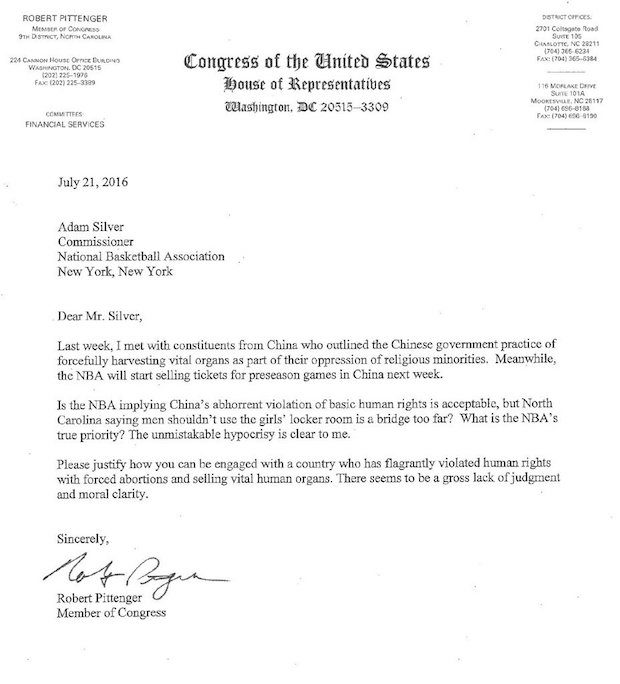
Believe me, a lot of us notice. Ordinary people who have never had a thought about theory in their lives see the world they took as normal, as stable, as comprehensible, disappearing in front of their eyes, driven by forces they cannot understand, much less control. Some of the more thoughtful conservatives see the deeper problems at issue. Here’s theologian Carl Trueman on the new mandated LGBT history standards in California schools:
Yuval Levin has written recently that the ethic of modern America is that of expressive individualism. Herein lies the problem: Taken absolutely, expressive individualism has no specific content and thus is subject to those identities which society considers authentic and to which it has thus granted legitimacy. But who decides which identities are authentic? Have you ever wondered why some minorities make it and others do not? Why, say, LGBTQers have pride of place on the California curriculum but foot fetishists, redheads, and people with allergies to latex do not? It is because the latter currently lack the cultural cachet that comes with the imprimatur of the entertainment industry, with the public sympathy arising from publicized marginalization and victimhood, and with the influence of organized lobby groups.
Thus, the California curriculum is a symptomatic codification of the aesthetic preferences of the current political culture. As such, it raises question far beyond whether schools rather than parents should teach children sexual morality. For years, the in-house question for historians has been whether history can survive as a discipline despite the proliferation of micro-narratives and the collapse of the possibility of grand theory. But now that academic question has more immediate real-world consequences: Can the nation state, or maybe society in general in the democratic form with which we are familiar, survive in anything like its current shape, when history—which is vital to the nation-state’s legitimation—is fracturing into the myriad identities to which expressive individualism is ultimately vulnerable? When you add to this the other forces militating against social unity—immigration, globalization, etc.—the institutions and processes built on a deep sense of social unity and cohesion look profoundly vulnerable.
The action of the State of California may well be driven by the trendy politics of the day, but it represents a phenomenon of comprehensive social and political importance, not just the ascendancy of a particular political stance. The new curriculum represents the confusion that lies at the very heart of modern Western identity; it is far more significant than merely putting the name of Harvey Milk into the minds of the young. It is part of an ongoing and perhaps largely unwitting challenge to what it means to be human, and thus to the way the world is currently organized. But, as George Orwell once commented, “So much of left-wing thought is a kind of playing with fire by people who don’t even know that fire is hot.” Indeed it is. And we may all be about to be burned.
It’s about identity. And it goes even deeper than that, as Trueman explains in a subsequent post:
The Civil Rights movement was built on the egalitarian assumption that African Americans shared with those of European ancestry a common humanity which transcended and ultimately undermined racial categories; by contrast, LGBTQ politics assumes that self-determined individual sexual identity trumps everything. It is thus built not on the foundation of a common humanity but on the priority of the individual’s will.
This is not a stance unique to LGBTQ activists. In fact, it is one of the major assumptions in the contemporary political climate. Much of modern politics—right and left—operates with an impoverished, solipsistic definition of selfhood. The result is that we have lost the classic liberal balance between the constraints rooted in the concept of a shared humanity and the rights of the individual. The late modern self would seem to be understood primarily as a self-determining agent whose desires are curbed only by the principle of consent when brought into relationship with the desires of another self-determining agent.
The idea here is that there is no such thing as a shared human nature, that human beings are defined not by nature, but by their own wills. More:
This demolition of the concept of human nature started centuries ago and is now firmly ensconced in art, in literature, in social and material relations, and in legal and political institutions and the standard news and entertainment media narratives. It thus has tremendous momentum. Anyone wishing to defend the unborn or traditional marriage has a much greater task on their hands than that faced by those who oppose them on these issues.
Assuming that he is a conservative, the man sitting across from me in the coffee shop where I’m writing this post probably wouldn’t be able to discuss the culture war as a fight over human nature itself. But it is, and however inarticulate he may be, even in explaining this to himself, he dimly senses that this is what is happening.
Of course, Peter Thiel is a transhumanist, and by definition he believes that human nature is determined by our own wills. Of course the culture wars are “fake” to him. He believes culture warriors are contending over something that doesn’t exist.
There is a widespread sense that the way the socially liberal globalist perceives the world is the end of history, as opposed to something constructed and particular to this time and place. In a typically prolix and brilliant post on Slate Star Codex, Scott Alexander defends what he calls “universal culture.” I can’t possibly do justice to the scope of his post with a few excerpts, but I’ll try:
I am pretty sure there was, at one point, such a thing as western civilization. I think it involved things like dancing around maypoles and copying Latin manuscripts. At some point Thor might have been involved. That civilization is dead. It summoned an alien entity from beyond the void which devoured its summoner and is proceeding to eat the rest of the world.
An analogy: naturopaths like to use the term “western medicine” to refer to the evidence-based medicine of drugs and surgeries you would get at your local hospital. They contrast this with traditional Chinese medicine and Ayurvedic medicine, which it has somewhat replaced, apparently a symptom of the “westernization” of Chinese and Indian societies.
But “western medicine” is just medicine that works. It happens to be western because the West had a technological head start, and so discovered most of the medicine that works first. But there’s nothing culturally western about it; there’s nothing Christian or Greco-Roman about using penicillin to deal with a bacterial infection. Indeed, “western medicine” replaced the traditional medicine of Europe – Hippocrates’ four humors – before it started threatening the traditional medicines of China or India. So-called “western medicine” is an inhuman perfect construct from beyond the void, summoned by Westerners, which ate traditional Western medicine first and is now proceeding to eat the rest of the world.
“Western culture” is no more related to the geographical west than western medicine. People who complain about western culture taking over their country always manage to bring up Coca-Cola. But in what sense is Coca-Cola culturally western? It’s an Ethiopian bean mixed with a Colombian leaf mixed with carbonated water and lots and lots of sugar. An American was the first person to discover that this combination tasted really good – our technological/economic head start ensured that. But in a world where America never existed, eventually some Japanese or Arabian chemist would have found that sugar-filled fizzy drinks were really tasty. It was a discovery waiting to be plucked out of the void, like penicillin. America summoned it but did not create it. If western medicine is just medicine that works, soda pop is just refreshment that works.
The same is true of more intellectual “products”. Caplan notes that foreigners consume western gender norms, but these certainly aren’t gender norms that would have been recognizable to Cicero, St. Augustine, Henry VIII, or even Voltaire. They’re gender norms that sprung up in the aftermath of the Industrial Revolution and its turbulent intermixing of the domestic and public economies. They arose because they worked. The West was the first region to industrialize and realize those were the gender norms that worked for industrial societies, and as China and Arabia industrialize they’re going to find the same thing.
Can ideas be likened to material products? Alexander again:
Universal culture is the collection of the most competitive ideas and products. Coca-Cola spreads because it tastes better than whatever people were drinking before. Egalitarian gender norms spread because they’re more popular and likeable than their predecessors. If there was something that outcompeted Coca-Cola, then that would be the official soda of universal culture and Coca-Cola would be consigned to the scrapheap of history.
The only reason universal culture doesn’t outcompete everything else instantly and achieve fixation around the globe is barriers to communication. Some of those barriers are natural – Tibet survived universalization for a long time because nobody could get to it. Sometimes the barrier is time – universal culture can’t assimilate every little valley hill and valley instantly. Other times there are no natural barriers, and then your choice is to either accept assimilation into universal culture, or put up some form of censorship.
Imagine that Tibet wants to protect its traditional drink of yak’s milk. The Dalai Lama requests that everyone continue to drink yak’s milk. But Coca-Cola tastes much better than yak’s milk, and everyone knows this. So it becomes a coordination problem: even if individual Tibetans would prefer that their neighbors all drink yak’s milk to preserve the culture, they want to drink Coca-Cola. The only way yak’s milk stays popular is if the Dalai Lama bans Coca-Cola from the country.
But westerners aren’t banning yak’s milk to “protect” their cultures. They don’t have to. Universal culture is high-entropy; it’s already in its ground state and will survive and spread without help. All other cultures are low-entropy; they survive only if someone keeps pushing energy into the system to protect them.
Hold on. This is circular. “Universal culture” is whatever is dominant in a given moment? That’s hardly a culture, is it? A useful digression: Amelia Sims discusses the relationship of cult to culture:
Culture comes from the cult: people joining together for worship. From this primary association, the body of worshipers can cultivate community.
According the the great historian of Western Civilization, Christopher Dawson, “A social culture is an organized way of life which is based on a common tradition and conditioned by a common environment. . . . It is clear that a common way of life involves a common view of life, common standards of behavior and common standards of value, and consequently a culture is a spiritual community…Therefore from the beginning the social way of life which is culture has been deliberately ordered and directed in accordance with the higher laws of life which are religion.”
Taking the cult out of culture leaves a residual set of customs and ideas that no longer tie people together because they lack the unifying center. A culture that has lost the cult becomes a culture with many cults. Today the fragmentation of culture has lead to a narrow mass culture only united on the surface, but really fragmented.
Without this religious center, every aspect of culture has its own version of a cult, usually of personality. There is no longer unification between worship, art, sport, and beauty, but a great divide- celebrity vs. celebrity, cult vs. cult.
We’re getting close to an answer here. Back to Alexander one more time:
I think universal culture has done a really good job adapting to this through a strategy of social atomization; everybody does their own thing in their own home, and the community exists to protect them and perform some lowest common denominator functions that everyone can agree on. This is a really good way to run a multicultural society without causing any conflict, but it requires a very specific set of cultural norms and social technologies to work properly, and only universal culture has developed these enough to pull it off.
So: the ‘cult’ of universal culture is the sovereign individual. It is the worship of the Self. Alexander, who is a physician (Alexander is not his real name) identifies as a liberal. I assume he is an atheist, though I could be wrong about that. If you are an atheist, you are a materialist; you believe there is no such thing as transcendent meaning, that things only “mean” what we decide they mean. To someone like that, so-called “universal culture” seems rational. But to someone who believes in God — the God of the Jews, or the God of the Christians, or the God of the Muslims, and on and on — “universal culture” is … untrue. Why should anybody believe that “universal culture” is true? Alexander answers: because it works. Well, what is “works”? Alexander calls universal culture an engine of “progress.” To assert that, you have to have an idea of what constitutes progress. Alexander is smuggling teleology into his argument. What he considers to be progress sometimes looks to people like me as regress. By what standard does he call it progress?
What he probably considers to be progress is the liberation of the choosing individual from constraints on his choice. OK, fine. In this conception, there is no good and no evil, only choices that “work” and choices that don’t. But you can only decide which choices (and the values that inform them) “work” if you have an idea of what it means to “work.” You see what I’m getting at here? What looks like cosmopolitan universalism to the Alexanders and Thiels of the world is really a form of advanced parochialism, one that conceals its own cultic preferences from itself.
Alexander admits in his essay that he has more in common with readers of his blog in Finland than he does with his neighbor, who he has never met. That kind of ethic “works” as long as we remain a rich, stable, technologically advanced society. But if the power goes out for any length of time (literally and metaphorically), the real differences between Alexander’s house and Finland will assert themselves fiercely.
Back to Thiel’s assertion that the culture wars are not real. They are certainly real, in that they define what it means to be human, what it means to be a member of society, how we are to live together, and so on. I doubt a gay man in 1980s rural Alabama would say the culture wars aren’t real. Similarly, a traditionalist Catholic living in San Francisco in 2016 wouldn’t say the culture wars aren’t real. “Universal culture” only seems so to people who live in its artificial bubble.
One last point: social and religious conservatives should understand clearly that the culture wars are over in the Republican Party. It has nominated a man who doesn’t care about the culture wars. The only culture war that counts is the one orthodox religious communities and their members are going to wage privately against the “universal culture.” This is what my Benedict Option project is about. But I’ve gone on too long here.
July 26, 2016
Decline & Fall Of Poor Country People
Terry Teachout has been reading J.D. Vance’s Hillbilly Elegy, and reflecting on his own Depression-era ancestors, who came from the same kind of material poverty Vance documents, but who were morally courageous and solid. Excerpt:
What happened to the full-fledged hillbillies my grandparents left behind in Appalachia? Why did their great-grandchildren exchange their unselfconscious faith for self-ravaging hopelessness? I leave it to others to plumb the moral disintegration of America’s rural working class, for I know nothing of it at first hand. The small Missouri town in which I grew up, though far from wealthy, was nothing like Breathitt County, Kentucky. All I know is that Gracie and Albert lived at a time when the behavior chronicled in Hillbilly Elegy was, quite literally, unthinkable. I weep to imagine what they would have thought of it.
Yes, that’s right. My own late grandparents were more or less the same generation as Terry’s Gracie and Albert, and equally humbled by circumstance. But they had dignity and self-discipline and character. The only thing they lacked was money, and opportunity.
How is it that when America had far less in the way of material wealth, and families of the poor — black and white both — had far more pressures on them, they did not succumb to self-degradation as so many of the poor do today? There was never a Golden Age, but when I think about how so few people today, whatever their material lack, knew the poverty that my grandparents’ generation of country people did, yet they still held it together — well, to think about their history is to realize that the idea that social breakdown and dysfunction is entirely a matter of material causation is radically insufficient. It is absolutely part of the picture, but it doesn’t tell the whole story. Not even close.
Here’s an earlier Teachout reflection on the character of his grandparents, and of the small Missouri town from which he comes.
By the way, the reason you’ve had trouble accessing this site in the past few days is because the response to my interview with J.D. Vance has been absolutely overwhelming. We’ve been struggling to keep the site up. Vance struck a deep nerve. In the wake of the interview going viral, Hillbilly Elegy has rocketed up the Amazon.com chart, such that Amazon is having trouble now fulfilling orders. If you want the book so badly, go to your local bookseller to buy a copy. They would appreciate your business. Otherwise, Barnes & Noble’s online store has it ready to ship today.
Rod Dreher's Blog

- Rod Dreher's profile
- 509 followers

