
Rod Dreher's Blog, page 552
August 6, 2016
The Right-Wing Media Bubble
In a different thread, a reader remarked to a Trump fan:
The conservative media bubble is giving people on the right a distorted sense of reality. I keep hearing conservatives praying that Wikileaks will finally reveal something devastating about Hillary Clinton, but it’s clear to me that more people are willing to hold their noses and vote for Clinton than for Trump. That’s just how it’s going to go, and all the populist anger in the world isn’t going to change it much.
I don’t know about that, because I don’t pay much attention to the ideological media. Well, scratch that, if you pay attention to the media at all, you are facing an ideology. The most infuriating part of the the liberalism of the mainstream media is that they cloak it from themselves. Anyway, point here is that I don’t spend much time inside the “conservative media bubble,” so I don’t know the extent to which the reader’s claim is true.
But it does give me a reason to post conservative writer and sometime TAC contributor Matthew Sheffield’s recent piece about how the conservative media has brought conservatives to this miserable place in which we find ourselves. Using a wallop of data, Sheffield shows that yes, the mainstream media is very powerful and quite biased to the left. No surprise there, at least not for conservatives. But he also shows that the conservative media is much smaller and weaker than many conservatives think. What’s more, the habits and practices of conservative media serve to tell its audience what it wants to hear, which often results in a false picture of the world — a false picture that has real-life impact. The fact that Donald Trump is the Republican nominee this year, and that the GOP Establishment class didn’t see him coming, is the leading example. Sheffield:
[T]he Right’s media monoculture has created negative feedback loops whereby people with little political acumen like Mark Levin, Michael Savage, and Glenn Beck are able to fill Republican voters’ heads with nonsensical ideas like planning to shut down the government with no backup plan or electing fewer GOP officeholders in pursuit of more “pure” ones, primarily because they grossly overestimate the number of conservatives in America. It is poetic justice that many of the same people who pushed these naive positions and strategies saw their own imbecilic noise machine turned against their preferred presidential candidate, Ted Cruz, in this year’s Republican primaries.
More center-right media outlets could also have been able to detect that the GOP’s economically libertarian message has little to no popularity among average Americans. Since these journalistic structures did not exist, however, the popularity of Donald Trump’s abandonment of that orthodoxy took the Republican elite completely by surprise. It shouldn’t have.
News institutions also serve a very valuable role for the left in providing a place for people who have similar values to remain connected to the larger movement while still maintaining the independence from parties and advocacy groups that they desire. Due to conservatives’ current willingness to spend only on elections and think tanks, people who lean rightward but do not like partisan politics have nowhere to go.
Conservatives and America as a whole are poorer intellectually because of this. While center-right individuals might not always fall in line for a policy battle, having large numbers of journalists who are willing to be skeptical of all sides would be a very good thing as both Left and Right need close scrutiny. Republican elites are now paying the price for refusing to subject the consultants who advise them to the skepticism they deserved.
The seeming success of Fox News and talk radio has made many conservatives think they now have a massive media empire. In truth, they have constructed an intellectual ghetto that no one else wants to visit.
It is demonstrably true that many Americans — conservative and liberal both — have had no understanding why Trump appeals to massive numbers of their fellow citizens. We know that now. Boy, do we. Back in February, as a thought experiment, I posted “A Social Conservative Case For Donald Trump,” putting forth a brief argument for why social conservatives may believe a vote for Trump is justified. You would have thought I had put a Lucifer For President sign in my yard by the way some conservatives reacted. I plainly wasn’t endorsing Trump (you will never see a TAC writer endorse a candidate on this site), but trying to get inside the head of social conservatives who were considering voting for him. Even that was intolerable to some on the Right. The refusal to attempt to empathize is part of why we have Trump today. The thinking was: If Trump is popular with GOP primary voters, then many of the things we Republicans think are true about conservatism in America are not true. Therefore, Trump’s popularity must be ephemeral.
Then Trump said, “Ha!”
That said, Trump boosters are now in a similar situation regarding their candidate versus Hillary. Many of them cannot see why any conservative would find Trump’s behavior over the past 10 days or so revealing of personality characteristics they fear in a president. It’s as if Trump really could do anything, and people would vote for him, because he’s Not Hillary. There are tens of millions of people like that in America, but not enough to give Trump a victory in November. I encourage my fellow conservatives who have declared for Trump to consider whether or not they have created the same pro-Trump epistemic bubble for themselves that the anti-Trump GOP Establishment created for itself. Polls show that most Americans do not trust Hillary Clinton. But I don’t think most Americans regard her as so beyond-the-pale horrible that it justifies voting for someone as unstable and weird as Donald Trump.
Somebody on the Left, can’t remember who, came up with this sardonic and insightful line to describe the mental habits of Republicans: “Conservatism cannot fail; it can only be failed.” This is how the ideological mind works. Losses mean that we have failed to be sufficiently pure in our beliefs, or to work hard enough to articulate them persuasively. It rarely if ever occurs to the ideological mind that maybe those beliefs are wrong, or at least not persuasive to others for reasons having nothing to do with the quality of the case made for them or the character of those making the case.
Among my tribe — conservative Christians — we are faced with bitter-enders who believe against the evidence that America Can Be Reclaimed For Christ if only we double down on what we’ve been doing, and get more Republicans elected. It’s simply untrue. I mean, we can never say that America cannot be converted; that’s not what I mean. What I mean is that many of us do not have a realistic sense of who we are, what America has become, and the distance between those two things. A Lutheran pastor wrote me this week to encourage me about the Benedict Option, and to say that he struggles to get his congregation to understand the world that we’re all living in now, and the one that we are soon going to be living in. They prefer their comfortable illusions to unsettling truths.
We all do. It’s human nature. But we have to try all the time to discern what we are missing. We all have ideals, but if we want to have a realistic hope of seeing those ideals achieved, we have to start with a clear understanding of the world as it is, not as we would like it to be.


August 5, 2016
NYT Best-Selling Author J.D. Vance
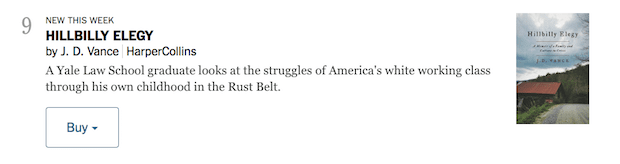
Screen shot
That’s a screen shot of the latest New York Times Bestseller List (Hardcover Fiction). Mr. J.D. Vance debuts on the list at No. 9. Woo-hoo!
If you haven’t read the interview yet, here it is. Thanks again to Surly Temple for her part in making this happen for him. It’s great when good guys win, for once.
The Closing Of Trump’s Door
Elsewhere on TAC, Pat Buchanan insists that Trump still has a path to victory this fall. Excerpt:
In August 1964, Barry was 36 points behind LBJ. As of today, Trump is 10 points behind Clinton. From Harry Truman to George H.W. Bush, many presidential candidates have been able to close a 10-point gap and win.
What does Trump need to do? In the words of Dr. Martin Luther King, “Keep your eyes on the prize”—the presidency. And between Trump and the presidency today stands not Paul Ryan, but Hillary Clinton.
The Donald, his campaign, and the party need to cease attacking one another to the elation of a hostile media, and redirect all their fire on the sole obstacle between them and a Republican sweep.
Nor is it all that complex or difficult a task.
Buchanan is right, but he’s also too late. Trump has spent the last week or two demonstrating to everyone that he has no self-discipline, even when the presidency is on the line. Peggy Noonan writes the obit for a suicidal campaign. Excerpts:
All the damage done to him this week was self-inflicted. The arrows he’s taken are arrows he shot. We have in seven days witnessed his undignified and ungrateful reaction to a Gold Star family; the odd moment with the crying baby; the one-on-one interviews, which are starting to look like something he does in the grip of a compulsion, in which Mr. Trump expresses himself thoughtlessly, carelessly, on such issues as Russia, Ukraine and sexual harassment; the relitigating of his vulgar Megyn Kelly comments from a year ago; and, as his fortunes fell, his statement that he “would not be surprised” if the November election were “rigged.” Subject to an unprecedented assault by a sitting president who called him intellectually and characterologically unfit for the presidency, Mr Trump fired back—at Paul Ryan and John McCain.
The mad scatterbrained-ness of it was captured in a Washington Post interview with Philip Rucker in which five times by my count—again, the compulsion—Mr. Trump departed the meat of the interview to turn his head and stare at the television. On seeing himself on the screen: “Lot of energy. We got a lot of energy.” Minutes later: “Look at this. It’s all Trump all day long. That’s why their ratings are through the roof.” He’s all about screens, like a toddler hooked on iPad.
Mr. Trump spent all his time doing these things instead of doing his job: making the case for his policies, expanding on his stands, and taking the battle to Hillary Clinton.
More:
Here is a truth of life. When you act as if you’re insane, people are liable to think you’re insane. That’s what happened this week. People started to become convinced he was nuts, a total flake. … This is what became obvious, probably fatally so: Mr. Trump is not going to get serious about running for president. He does not have a second act, there are no hidden depths, there will be no “pivot.” It is not that he is willful or stubborn, though he may be, it’s that he doesn’t have the skill set needed now—discretion, carefulness, generosity, judgment.
Meanwhile, says Noonan, Hillary continues her public mendacity. Republicans ought to be mopping the floor with her right now. Instead, they’re stuck with this narcissistic head case called Trump. Read the whole thing.
Serious question for the room: is there anything Trump can do to turn this around? I mean, yeah, there might be some things he can do on paper to refocus his campaign, but it’s agonizingly obvious that he does not have what it takes inside him to win this thing. You can’t fix crazy. Trump can’t keep his eyes on the prize because he can’t keep his eyes off of TV, and his own self-image. The question now is whether or not the GOP can save the House and/or the Senate.
And the question to come is, Can populism survive Trump’s implosion? That is, which aspects of the Trump agenda — immigration restriction, non-intervention, economic populism — can be salvaged and made part of the GOP, and how?
Why Liberals Love ‘Hillbilly Elegy’
My friend Matt Sitman tweets:
So I finished Hillbilly Elegy. Gonna write a long review. I was right about why conservatives like it so much
— Matthew Sitman (@matthew_sitman) August 5, 2016
Yes, but the more interesting question, at least to me, is why so many liberals like it — or at least why they are writing to me in droves saying how the interview J.D. Vance did with me deeply resonated with them, and inspired them to buy the book. (By the way, that interview was published two weeks ago today, and it’s still drawing so much web traffic to this site that our servers are struggling to handle it.) I’ll give you a sample below of the kind of correspondence I’m getting (with a couple of tweaks to protect privacy). There’s lots of it just like these below:
Mr. Dreher, this article was fantastic.
I grew up in rural Alabama, proudly declared myself “politically somewhere to the right of Attila the Hun”, and enlisted when I was 17. I had a difficult time getting out at 23 years old, several states away from my family, with a grownup’s bills to pay but an MOS that didn’t match the career I was suited for or needed as a civilian. I spent the next several years desperately poor but “self-sufficient” – as far as I knew, anyway.
In reality, of course, I had zero understanding of how taxes work. I saw about a 28% bite taken out of my paycheck, and didn’t understand that FICA/SS didn’t ultimately go to anybody but me, myself, and I, and that I wasn’t actually paying any income tax. I also had heard of but didn’t really understand or care about things like “every federal tax dollar that leaves SC has three federal tax dollars pass by it coming in.”
Truth be told, I wasn’t just unaware, I actively disbelieved that I wasn’t “self sufficient” at all, and I naively thought that I was paying for the “welfare” that the tiny, tiny portion of the population “poorer than me” was getting. I was also completely unaware that I was “desperately poor” at all. I was making $6/hr and I thought I was middle class! I knew people who made $10/hr, and I thought they were on the low end of upper class!
Eventually I made a real career for myself, started my own business, and spent less time scratching and kicking and fighting just to stay alive. The more time and resources I had, the more I learned about how the world, and politics, worked, and the more progressive I became. I am not, today, someone who would normally read articles from a site called “American Conservative”.
But I read yours, and I’m glad I did. What you and J.D. Vance had to say in that article are exactly what I want to hear from the conservative wing of American politics. Speaking candidly, I’m unlikely to be a “conservative” again – I’m a progressive, and likely to stay that way. But what you and Vance said was thoughtful, and reasonable, and – like I try to very publicly be myself, having “been there and done that” – understanding of the realities of the working poor. It’s the real and sensible ballast that even the best of real and sensible balloons (if you’ll permit the analogy between conservative and progressive, and we can both agree to handwave away the fact that the current DNC is neither as real or as sensible as it should be) needs.
That’s probably way too much to slog through, but seriously: thank you.
Another one:
I thoroughly enjoyed this article! The conversation is not one that I have witnessed anyone else having. It is so easy to dismiss people as racist without ever considering from where their views and positions are derived. I am certainly going to read Hillbilly Elegy and look forward to reading more of your articles, By the way I am black, liberal, I most often vote Democrat and I don’t like Trump (for Reasons too high in number to state). I enjoy intelligent conversation and debate and have learned to carefully listen to and understand those who I may disagree with, so I might be educated fully on the issue not just entrenched in my beliefs.
Thank you for a refreshing read in a sea partisan sludge.
Another one, this from a reader who mistakenly believed that J.D. Vance’s experiences were mine. Still, his letter is fascinating:
I wandered in on this article today… and couldn’t stop reading. I’m Californian, a progressive and a Sanders supporter, a former Nader supporter, a former UAW organizer, currently a medical
devices engineer in [state], and have a Ph.D. in engineering. I grew up in a town 5 miles north of the Mexican border in south San Diego, and grew up among Mexican immigrants, many of whom were undocumented… they were my neighbors, my friends, my elders. I myself am an immigrant, came here as a kid with my parents, who were liberals who wanted something better than that right-wing dictatorship in [another country].
But I did grow up around the poverty line. My parents fought hard to
stay out of welfare, to stay together, and to teach us the value of
work. At 43, I have always worked since I was 14, and have always
associated these traits with working-class liberal values… and was
quite surprised many election cycles ago to hear silver-spooned class enemies in the GOP pick that up. What did these bastards know about real work? But it also pains me to see the elites, especially the East Coast elites, take over the Democratic Party.
I’m sorry to hear about your experiences at Yale Law. And I’m glad that I didn’t go to a private school, or a school in the East Coast. After moving to [my current state] 3 years ago I’ve found that liberals “out east” (east of the Sierra Nevadas) seem to come from privilege, are more dogmatic, disconnected from the working class, and can be super competitive and vindictive. I even remember starting out as an undergrad and scholarship kid at UC San Diego, how I felt the sting of class. I felt disconnected culturally from the liberals. It wasn’t until friends from high school began shipping back from Desert Storm all crazy and screwed up that I found common cause with these liberals.
As with the folks of Appalachia (I was a member of the Southern Baptist Church… it was a big military town), the defense of our neighborhoods was also paramount to us. What south San Diegans were seeing during the 90s was an entire generation deployed to guard oil fields in Iraq while the princelings of Kuwait lived it up in night clubs, and folks in Sacramento setting up laws that attack immigrants as a cheap shot to get elected. Everything was fine at the border until these demagogues (Republicans in this case) started showing up in our town in staged photo-ops.
Trump does have that appeal of at least pretending to listen to the
broken and forgotten. But just as we were about to forget the vengeance we swore against those who hurt our town, Trump comes by and reopens all the wounds, reminding us that while we might hold some conservative values, Republicans will always see us as sub-human.
I do think dialog and empathy are something of a short supply in
American politics today. The neoliberal policies and unfair trade pacts supported by both parties have been crushing our respective beloved hometowns. And we have a lot more in common than what these entrenched political entities say that we do. I’ve read “Rivethead” and “Deer Hunting with Jesus” and felt this familiarity. I will look for your book.
And here’s another one:
I just wanted to write and tell you that I was fascinated by your interview with the author JD Vance, and I speak as a socialist, agnostic, gay white male who’s never voted Republican in all his years! As a lifelong resident of the suburbs of Houston, Texas, it’s long occurred to me how insulated I am from the struggles of poor and working-class folks today; however my family started out poor, with my parents divorcing when I was six. Luckily our mother was strong enough to help us make it out of the hole by excelling in her profession as a nurse. I remember her telling me that in the days when my sister and I were very young, for Christmas she’d spend $20 on each of us at the dollar store, and she always hoped that we enjoyed our presents. That made me love my mom so much more, and I realized how lucky we’d been to have her, given how things might have turned out. In Houston as you probably know there is a staggering number of people of every imaginable type, and my school years were spent among kids from every walk of life, of every ethnicity and persuasion you can imagine. As an outsider myself, being gay and openly agnostic in an environment where neither was considered acceptable (high school was in the late 90s), I can identify with the feeling of seeming hopelessness, isolation, and fear for the future that Mr Vance describes, though certainly on a different level and for different reasons. I also feel a greater understanding now of the appeal of Trump to certain strata within our society…along with a renewed sense of how dangerous he really is to all of us (not to mention the rest of the world)! I would like to feel as hopeful for the future as Mr Vance seems to, but I’m afraid that until November (though hopefully not after!) I’ll be suffering a case of non-stop indigestion. Maybe we could all use a touch of that hillbilly idealism in our lives.
Anyway, that’s enough rambling out of me. Cheers for an excellent interview, and congratulations for gaining a new reader of the blue persuasion!
I could go on and on. I’m getting so many e-mails like these above that I can’t begin to respond to them all. I’m passing every one of them on to J.D. Vance, though. Interestingly, if I’ve received a single e-mail from a conservative about the interview, I can’t remember it.
I’m genuinely surprised and grateful for all these generous e-mails, and I’m sure J.D. is too. What I find so hopeful about it is that someone has finally found a voice with which to talk substantively about an important economic and cultural issue, but without antagonizing the other side. JDV identifies as a conservative, but his story challenges right-wing free-market pieties. And I’ve gotten plenty of e-mails from liberals who either come from poverty or who work with poor people for a living, who praise JDV’s points about the poor needing to understand that whatever structural problems they face, they retain moral agency.
What do you think, readers? Do you think the runaway success of Hillbilly Elegy, and the powerfully positive response from liberals to a book about class written by a conservative, bodes well for the possibility of constructive engagement around issues of class and poverty? To be sure, I’ve received a handful of letters from angry liberal readers who reject the idea that there’s anything wrong with poor and working class white people that government action can’t solve. I believe, and so does J.D., that government really does have a meaningful role to play in ameliorating the problems of the poor. But there will never be a government program capable of compensating for the loss of stable family structures, the loss of community, the loss of a sense of moral agency, and the loss of a sense of meaning in the lives of the poor. The solution, insofar as there is a “solution,” is not an either-or (that is, either culture or government), but a both-and. From a Washington Post review of the book:
The wounds are partly self-inflicted. The working class, he argues, has lost its sense of agency and taste for hard work. In one illuminating anecdote, he writes about his summer job at the local tile factory, lugging 60-pound pallets around. It paid $13 an hour with good benefits and opportunities for advancement. A full-time employee could earn a salary well above the poverty line.
That should have made the gig an easy sell. Yet the factory’s owner had trouble filling jobs. During Vance’s summer stint, three people left, including a man he calls Bob, a 19-year-old with a pregnant girlfriend. Bob was chronically late to work, when he showed up at all. He frequently took 45-minute bathroom breaks. Still, when he got fired, he raged against the managers who did it, refusing to acknowledge the impact of his own bad choices.
“He thought something had been done to him,” Vance writes. “There is a lack of agency here — a feeling that you have little control over your life and a willingness to blame everyone but yourself.”
Perhaps Vance’s key to success is a simple one: that he just powered through his difficulties instead of giving up or blaming someone else.
“I believe we hillbillies are the toughest god—-ed people on this earth,” he concludes. “But are we tough enough to look ourselves in the mirror and admit that our conduct harms our children? Public policy can help, but there is no government that can fix these problems for us. . . . I don’t know what the answer is precisely, but I know it starts when we stop blaming Obama or Bush or faceless companies and ask ourselves what we can do to make things better.”
The loss of industrial jobs plays a big role in the catastrophe. J.D. Vance acknowledges that plainly in his book. But it’s not the whole story. Anybody who comes to Hillbilly Elegy thinking that it’s going to tell a story that affirms the pre-conceived beliefs of mainstream conservatives or liberals is going to be surprised and challenged — in a good way.
By the way, the viral nature of the TAC interview with J.D. Vance has pushed Hillbilly Elegy onto the bestseller list (more details of which will be available shortly). It’s No. 4 on Amazon’s own list as of this morning. They can barely keep enough in stock. It really is that good, folks. All this success could not have happened to a nicer man. Credit for this spark goes to reader Surly Temple, who gave me my copy of Hillbilly Elegy.
UPDATE: A reader writes to point out:
The Washington Post review you quote states, Perhaps Vance’s key to success is a simple one: that he just powered through his difficulties instead of giving up or blaming someone else.” I think that misses the point of the book. J.D. fully acknowledges the importance of his Mamaw, Marine Corps drill instructors, and wife in changing his outcomes.
My takeaway from the book is that we can help these communities and people, but not from a distance. It takes unconditional, sacrificial love.
He’s right about that, and I shouldn’t have posted that WaPo review without commenting. JDV openly credits his Mamaw and the Marine Corps with making him the man he is today. He does not claim he got there entirely on his own, by bootstrapping it.
August 3, 2016
‘The Stalingrad Of Irish Catholicism’
Michael Brendan Dougherty bait! Last week I had a post in which I asked conservative Christians who live outside of the US to talk about what the situation is like in their country. This fascinating comment just came in from a reader in Ireland.
I’m not a Christian but I am an ally.
The situation in (Republic of) Ireland is mixed for Christians. The process of secularisation and the discrediting of the church is perhaps familiar to many around the world but the difference in Ireland is the speed by which it happened. As late as 1995 divorce was not allowed and it was only barely legalised in a referendum. The aggressiveness of the left shifted into higher gear following the financial crisis. The labour party came to power and to balance its support for austerity it has forced the government to be aggressively anti-catholic. I didn’t see this coming before the 2011 election when they came to power but it’s important to understand that we in Ireland and the UK are heavily influenced by American politics. Whatever political fads the american left thinks up spread like a virus here eventually. For example the media increasingly uses the word undocumented to describe illegal immigrants and we’re told we have a rape culture in our universities.
Whenever the government faced a choice it sided against the Church. It closed the Vatican embassy and singled out Catholic service organisations such as the marriage organisation accord for cuts. The pretext was austerity but given its lavish funding for secular left organisations this is nonsense and understood to be nonsense.
The other major agenda is schools and hospitals. Most schools and hospitals in Ireland are church organised. In hospitals this has minimal consequence and schools rarely have clergy as staff members. The government goal was to secularise half the Catholic schools.
The interesting thing has been the response. The closure of the Vatican embassy and prime minister Enda Kenny’s (he leads a David Cameron type centre-right party that is in coalition with Labour) hysterical damnation of the church’s response to the child abuse investigation clearly meant they were further than their voters. The Vatican embassy was re-opened in 2014 when money was still tight. There school agenda has also largely hit the buffers. They have made barely any progress secularising schools because of parental opposition. I think this cost the centre right votes but there has been no significant organised pushback. The election in 2016 led to the collapse of the Labour party (yippee) and the new minority centre right seems to be changing tack. Instead of secularising schools they are trying to de-catholicize Catholic schools. I think they will be more successful here. This is where Irish people are. Less religion but not none (yet).
A gay marriage referendum in 2015 was one cry-bully extravaganza but in reality a side-show. Abortion is where the action is. The Irish establishment dearly wants legal abortion. They view the right to life as an embarrassment and a symbol of catholicism. This is the Stalingrad of Irish catholicism. There will likely be a referendum in the next few years. If the religious segment win and enter the political process more assertively thereafter there is a real chance Ireland will not go the way of the rest of Europe. I go to two masses a year when members of my family are commemorated and it doesn’t skew radically older than the rest of the population and the pews are reasonably full but there is a dire shortage of priests. My mother who is a regular at mass says people start to go again when they have kids(a sure sign of vitality). We have touches of the human rights culture but their progress is patchy and the same people who would gladly legalise abortion are turning against them because of their increasingly strident economic leftism. Ordinary people do not think less of people for their faithfulness so I think this is a major plus for Ireland relative to peer countries.
In Northern Ireland the peace agreement was used by the UK labour government as an excuse to use NI as a guinea pig for every left wing rights culture that can be thought of. But religious society nonetheless is stronger there than in GB or ROI. I suspect Derry to be the most religious christian city in Europe.
By the way, Michael Brendan Dougherty, the Catholic trad and noted Hibernophile, has been tweeting insightfully but dyspeptically about the old sod today. For example:
The horrible truth Ireland can’t face. It wasn’t Catholicism that made the Irish miserable. It was the Irish that made Catholicism miserable
— Michael B Dougherty (@michaelbd) August 3, 2016
Trump Nukes Himself
Did you see Gen. Michael Hayden’s interview on Morning Joe this a.m.? In it, the former director of the CIA and the NSA talks in general about nuclear command and the presidency, emphasizing that the system is built for speed, not for deliberation. Message: you had better be able to trust the judgment of the Commander in Chief.
Here’s the interview:
Go to the 6:00 mark in it. Harold Ford asks Gen. Hayden which of the national security experts he knows and trusts is advising Trump. Hayden’s simple answer: “No one.”
Think about it: the retired four-star general who ran the CIA and the NSA, and who surely knows everybody worth knowing in the national security field, can’t think of a single person he respects who is advising Trump.
At that, Joe Scarborough looked taken aback. Then he said, “A foreign policy expert on the international level went to advise Donald Trump.” He chose his words very, very carefully, plainly trying to protect the expert’s privacy. Scarborough said that three times in this one-hour briefing, Trump asked about nuclear weapons. Trump reportedly asked, “If we have them, why can’t we use them?”
If that is true, then that is reason right there not only to withhold one’s vote from Trump, but to vote against him this fall. Everything else fades in the face of the possibility of a man like that gaining control of nuclear weaponry.
Earlier in the interview, before that exchange, Hayden spoke gingerly about the constitutional crisis that would result if the military refused orders from President Trump. If what Scarborough said is true, I think it’s entirely within the realm of possibility that the military might act to prevent Trump from taking office. You know what that means.
I don’t know if what Scarborough says is true, but based on Trump’s behavior, I find it very easy to believe that Trump said this.
Here it is only early August, and Trump has us talking like this.
You have to read John Noonan’s tweetstorm about this. He once served in a nuclear missile silo, and has been through the drills. The Scarborough thing unnerved him. Excerpts:
17. Simply signaling that you’re open to using strategic weapons as a tactical solution rewrites the rule book. Russia, China, others will
— John Noonan (@noonanjo) August 3, 2016
18. respond. Nuclear deterrence is about balance. Trump is an elephant jumping up and down on one side of the scale. So damn dangerous.
— John Noonan (@noonanjo) August 3, 2016
19. But geopolitics aside, I can’t get my mind off the young officers on nuke alert right now. Wondering if they’ll soon answer to a madman.
— John Noonan (@noonanjo) August 3, 2016
Did I mention that it’s only August 3?
Is there anything the Republican Party can do to un-nominate Trump? Asking for a friend.
Trump’s Temperament
This is a big reason why it is unnerving to think about this man in the Oval Office:
Donald J. Trump’s unabashed and continuing hostility toward the parents of a slain Muslim American soldier, and his attacks on Republican leaders who have rebuked him for it, threaten to shatter his uneasy alliance with the Republican Party at the outset of the general election campaign.
Ignoring the pleas of his advisers and entreaties from party leaders in Washington, Mr. Trump only dug in further on Tuesday. He told a Virginia television station that he had no regrets about his clash with Khizr and Ghazala Khan, the parents of an Army captain killed in Iraq. And in an extraordinarily provocative interview with The Washington Post, Mr. Trump declined to endorse for re-election several Republicans who had criticized him, including the House speaker, Paul D. Ryan of Wisconsin, and Senator John McCain of Arizona, who both face primaries this month.
He also belittled Senator Kelly Ayotte of New Hampshire, who had criticized his treatment of the Khans, for not being supportive of his campaign.
For days, Mr. Trump’s top advisers and allies have urged him to move on from the feud, which erupted when Mr. Khan criticized him at the Democratic convention, and focus instead on the economy and the national security record of his Democratic opponent, Hillary Clinton. Yet, facing outcry on the left and right, Mr. Trump has insisted to associates that he has been treated unfairly by Mr. Khan, the news media and some Republicans, said people familiar with the campaign’s deliberations who insisted on anonymity to discuss them.
Such is Donald Trump’s vanity and sense of grievance that he cannot help himself, even when his actions are demonstrably damaging his campaign — and even when the people closest to him are warning him to knock it off and get back on course criticizing Hillary. If he can’t stifle it for the sake of advancing his own political interests, how is he going to control himself when the national interests are at stake?
The other night, I had to have a talk with my 12-year-old son about not letting his emotions get the best of him when somebody or something makes him angry. He’s struggling with this, as adolescents do. I hope that by the time he’s 70, he’s mastered his passions — especially if he runs for president.
What happens when there’s an international crisis because some foreign leader insults Trump’s honor (such as it is)? A man with this kind of temperament in charge of the world’s biggest and most advanced fighting force is terrifying. If Khizr Khan and John McCain can get under his skin and into his head like that, how in the heck would he manage Hassan Rouhani and Kim Jong Un — to say nothing of Vladimir Putin and Xi Jinping?
This is not the behavior of a strong, mature man. This is the behavior of a weak, childish one. The Republicans ought to be steamrollering Hillary Clinton right about now. Instead, its nominee is defeating himself without Hillary having to lay a glove on him.
ISIS Schools Pope Francis
The other day, Pope Francis blamed poverty and economics for Islamic radicalism and terrorism. In the latest edition of its English language magazine, Dabiq, ISIS sets him and others straight. Excerpts (emphases are mine):
We hate you, first and foremost, because you are disbelievers; you reject the oneness of Allah – whether you realize it or not – by making partners for Him in worship, you blaspheme against Him, claiming that He has a son, you fabricate lies against His prophets and messengers, and you indulge in all manner of devilish practices. It is for this reason that we were commanded to openly declare our hatred for you and our enmity towards you. “There has already been for you an excellent example in Abraham and those with him, when they said to their people, ‘Indeed, we are disassociated from you and from whatever you worship other than Allah. We have rejected you, and there has arisen, between us and you, enmity and hatred forever until you believe in Allah alone’” (Al-Mumtahanah 4).
Furthermore, just as your disbelief is the primary reason we hate you, your disbelief is the primary reason we fight you, as we have been commanded to fight the disbelievers until they submit to the authority of Islam, either by becoming Muslims, or by paying jizyah – for those afforded this option – and living in humiliation under the rule of the Muslims. Thus, even if you were to stop fighting us, your best-case scenario in a state of war would be that we would suspend our attacks against you – if we deemed it necessary – in order to focus on the closer and more immediate threats, before eventually resuming our campaigns against you. Apart from the option of a temporary truce, this is the only likely scenario that would bring you fleeting respite from our attacks. So in the end, you cannot bring an indefinite halt to our war against you. At most, you could only delay it temporarily. “And fight them until there is no fitnah [paganism] and [until] the religion, all of it, is for Allah” (Al-Baqarah 193).
More:
What’s important to understand here is that although some might argue that your foreign policies are the extent of what drives our hatred, this particular reason for hating you is secondary, hence the reason we addressed it at the end of the above list. The fact is, even if you were to stop bombing us, imprisoning us, torturing us, vilifying us, and usurping our lands, we would continue to hate you because our primary reason for hating you will not cease to exist until you embrace Islam. The fact is, even if you were to stop bombing us, imprisoning us, torturing us, vilifying us, and usurping our lands, we would continue to hate you because our primary reason for hating you will not cease to exist until you embrace Islam. Even if you were to pay jizyah and live under the authority of Islam in humiliation, we would continue to hate you. No doubt, we would stop fighting you then as we would stop fighting any disbelievers who enter into a covenant with us, but we would not stop hating you.
What’s equally if not more important to understand is that we fight you, not simply to punish and deter you, but to bring you true freedom in this life and salvation in the Hereafter, freedom from being enslaved to your whims and desires as well as those of your clergy and legislatures, and salvation by worshiping your Creator alone and following His messenger. We fight you in order to bring you out from the darkness of disbelief and into the light of Islam, and to liberate you from the constraints of living for the sake of the worldly life alone so that you may enjoy both the blessings of the worldly life and the bliss of the Hereafter. The gist of the matter is that there is indeed a rhyme to our terrorism, warfare, ruthlessness, and brutality. As much as some liberal journalist would like you to believe that we do what we do because we’re simply monsters with no logic behind our course of action, the fact is that we continue to wage – and escalate – a calculated war that the West thought it had ended several years ago. We continue dragging you further and further into a swamp you thought you’d already escaped only to realize that you’re stuck even deeper within its murky waters… And we do so while offering you a way out on our terms. So you can continue to believe that those “despicable terrorists” hate you because of your lattes and your Timberlands, and continue spending ridiculous amounts of money to try to prevail in an unwinnable war, or you can accept reality and recognize that we will never stop hating you until you embrace Islam, and will never stop fighting you until you’re ready to leave the swamp of warfare and terrorism through the exits we provide, the very exits put forth by our Lord for the People of the Scripture: Islam, jizyah, or – as a last means of fleeting respite – a temporary truce.
Here, from a long article against Christianity, is this conclusion, addressed to Jews and Christians:
Know well that our fight will continue until you are defeated and submit to the rule of your Creator, or until we achieve martyrdom. Allah has made our mission to wage war against disbelief until it ceases to exist, as he has ordered us to kill all pagans wherever they are found. He said, “Then kill the pagans wherever you find them” (At-Tawbah 5). In His eternal wisdom, He made an exception to only one group of disbelievers. He said, “Fight those who neither believe in Allah and the Last Day, nor do they forbid what Allah and His Messenger forbade, nor do they follow the religion of truth, of those who were given the Scripture, until they give the jizyah willingly while they are humbled” (At-Tawbah 29).
So those who have been sent the Scripture before the Quran, namely the Jews and Christians, shall be spared if they pay the jizyah and accept its terms [dhimmitude]. These terms are based on elevating the true believers – the Muslims – over the disbelieving People of the Scripture who arrogantly reject the Lord’s message. These terms can be found in authentic texts relating to when the Caliph ‘Umar Ibn al-Khattab, made a covenant with the Christians of the Levant, namely that they do not build new monasteries, churches, or shrines in or around their cities; that they do not mend what was damaged thereof; that they do not restrict traveling Muslims from using their buildings for refuge; that they do not harbor spies or other enemies; that they do not conceal when a Muslim is being cheated or betrayed; that they neither display their pagan practices nor invite anyone to them; that they do not prevent any of their relatives from accepting Islam; that they make room for the Muslims and stand for them when they want to sit; that they do not wear weapons or bear arms; that they do not sell wines; that they do not display the cross atop their churches or in sight of the Muslims; that they do not raise their voices in their churches; and so forth. Any Christian or Jew who accepts the jizyah and then breaks any of the agreed upon stipulations shall find no security, and their blood thus becomes lawful to spill and wealth permissible to seize. For indeed, “Honor belongs to Allah, His Messenger, and to the believers, but the hypocrites do not know” (Al-Munafiqun 8).
Finally, ISIS criticizes Pope Francis specifically for denying that Islam is violent:
Despite the clarity of past and perished popes regarding their enmity for Islam and its teachings, the current pope, Francis, has struggled against reality to advertise the apostate’s perversion of Islamic teachings as the actual religion of Muslims. So while Benedict and many before him emphasized the enmity between the pagan Christians and monotheistic Muslims, Francis’ work is notably more subtle, steering clear of confrontational words that would offend those who falsely claim Islam, those apostates whom the Crusaders
found played the perfect role for their infiltration into Muslim lands. While Benedict XVI met public disapproval for quoting a centuries-old Byzantine emperor, Francis continues to hide behind a deceptive veil of “good will,” covering his actual intentions of pacifying the Muslim nation. This is exemplified in Francis’ statement that “our respect for true followers of Islam should lead us to avoid hateful generalizations, for authentic Islam and the proper reading of the Quran are opposed to every form of violence”
(The Joy of the Gospel).
Here is a link to the PDF of Dabiq. It makes for fascinating, if completely chilling, reading. But be warned — there are some photos in it of terrorist actions, including a beheading.
Note well that the point is not that ISIS represents “true Islam.” There are millions of Muslims who do not follow ISIS. The point is that those who follow ISIS believe that they are following True Islam, and will act on those beliefs — and in fact they do. That is why Father Jacques Hamel, and many, many others, are dead today. And ISIS does not make up its doctrines out of whole cloth. There is precedent.
If Francis cannot speak truthfully about this for whatever reason, he should maintain silence. And not just Francis. These people, this ISIS, they’re telling the West to our faces exactly what they believe and why they’re murdering us — but we refuse to believe them.
August 2, 2016
Ideas Have Consequences 2016
A reader is diving once again into the 1948 conservative classic Ideas Have Consequences, by Richard Weaver. This paragraph from Chapter Three jumped out at him:
The [Southern] gentleman was left to walk the stage an impecunious eccentric, protected by a certain sentimentality but no longer understood. Europe, after the agony of the first World War, turned to the opposite type for leadership, to gangsters, who, though they are often good entrepreneurs, are without codes and without inhibitions. Such leaders in Europe have given us a preview of what the collapse of values and the reign of specialization will produce.
Adds the reader: “Welcome Trump. Welcome Hillary for that matter.”
Total pseud that I am, this morning I was on the treadmill and watching Kenneth Clark’s Civilisation on YouTube. Ever seen it? It’s fantastic. You can watch it with your kids, though young ones will be bored. I’m on Episode 6, which covers the Reformation. At around the 30:00 point in the episode, Clark — not a religious man himself, but a high aesthete — discusses how the Reformation unleashed destructive passions that devastated religious images. As the camera pans over defaced images of saints in the Lady Chapel at Ely Cathedral, Clark says:
There wasn’t much religious about it. It was an instinct, an instinct to destroy anything comely, anything that reflected a state of mind that ignorant people couldn’t share. The very existence of these incomprehensible values enraged them.
In that episode, which I’ve embedded below, Clark uses concepts invented by H.G. Wells to explain the clashing worldviews in the Reformation. He says that Wells believed early history involved a clash of “communities of faith and obedience” and “communities of will.” Wells distinguishes them like this:
For thousands of years the settled civilized peoples, who were originally in most cases dark-white Caucasians, or Dravidian or Southern Mongolian peoples, seem to have developed their ideas and habits along the line of worship and personal subjection, and the nomadic peoples theirs along the line of personal self-reliance and self-assertion.
Clark brings up the Wells categories to assert that the Reformation unleashed the passions of the “communities of will” of Germanic Northern Europe, against the “communities of faith and obedience” of Latin Southern Europe.
(Interestingly, Clark leaves out the words “faith and” in his mention of Wells’s categories. As Joseph Pearce points out in his critical review of Civilisation, Clark at the time of the program was a highly cultured unbeliever, and that greatly influenced his take on civilization. Then again, the subtitle of the series is “A Personal View.” Anyway, Clark was received into the Roman Catholic Church on his deathbed, Pearce reports.)
I’ll need to look more into what Wells meant, but these categories may be useful to us today to make sense of our own time. We are plainly and overwhelmingly a community of will — and that’s why we are destroying the possibility for civilization to endure. The Benedict Option is about a return to a community of faith and obedience — faith in and obedience to a religious and metaphysical order independent of ourselves. It would have been news to the Reformers, of course, that they were inaugurating a community of will over and against a community of faith and obedience. But the seeds of voluntarism had been planted at the end of the Middle Ages by Scotus, Ockham, and other Catholics. What we are living through now is the final outworking of those ideas.
Trump & The God Vote
Noah Millman calls the religious conservative case for Trump “incoherent.” Excerpt:
Finally, I have to ask a serious question of folks like Rod Dreher who are seriously considering voting for Donald Trump because of judges. If you really believe that traditional Christian conservatives are on the brink of suffering real and substantial persecution, and you believe that electing Donald Trump so that he’ll appoint some right-leaning judges will prevent that from happening, then it seems to me you believe two contradictory things.
This country has had Democratic and Republican Presidents in recent memory. The pendulum swings this way and that. Each side periodically gets to pick a bunch of judges, and some of those judges vote more or less the way you want them to on some of your pet issues. Meanwhile, the country continues to change — and the judges often change their views along with it. Frankly, in the face of a real popular movement to stifle traditional Christian witness, a handful of additional judges would prove largely impotent. And if a handful of judges really could sway things, then how much more so could a real and substantial movement of public engagement, civil disobedience, etc.
If the political tide is running strongly against you, that’s not a reason for apocalypticism. It’s a reason to rethink your political strategy — which is the exact opposite of what a vote for Trump would represent.
After all, Donald Trump’s primary victory is the final proof that even the religiously conservative base of the GOP doesn’t really care about things like abortion and gay rights, because Trump manifestly didn’t care about these questions or was actively on the other side from religious conservatives, and yet he won plenty of evangelical Christian votes in the primaries. So voting for Trump out of religious conservative conviction sends a clear-as-day message that Republicans need do absolutely nothing on those issues in order to win religious conservative votes. It is a statement of abject surrender.
Look: there is nobody running in this election in whom religious conservatives should put the slightest sliver of hope with regard to their issues. If you really care overwhelmingly about those issues, you have a practical obligation not to vote for President. Large scale abstentions by religious conservatives would make it abundantly clear that attention must be paid to their concerns, in a way that voting for Trump never could do.
Or, if issues like abortion are just one of a complex of issues that have to be weighed in any election, then vote for the person who you think is best on balance, and fight for those other issues on another front. Maybe that means voting for Trump — in which case you’ll still need to be doing that fighting on other fronts, because trust me, Trump is not going to have your back. Regardless, don’t kid yourself that a vote for Trump will advance the cause of religious conservatism one iota. You know full well it won’t.
Well, look, I cannot claim to speak for all religious conservatives, so my opinion is only my opinion. At this time, I find it impossible to imagine voting for either Hillary or Trump — a fate that I am spared because I live in a state that should go pretty comfortably to Trump. But I accept that there’s the possibility that something might happen between now and Election Day that might cause me to vote for one or the other candidates, though I honestly cannot imagine what that thing might be. In either case, it would be fear of the Other Candidate taking office. I would cast my vote with immeasurable disgust, and never tell a soul for whom I voted. That’s how revolted I am by both candidates, though for different reasons.
For the record, I would happily vote for a candidate who stood for many of Trump’s positions (versus an Establishment Republican), if he were not Donald Trump, who is a volatile, thin-skinned narcissist without convictions or principles, in my view. The only unambiguously good thing Donald Trump has done with his presidential run is destroy the GOP Establishment.
That said, let me answer Noah’s points.
1. As a political force, Christian conservatives are done. Republicans have proven that they care more about what Big Business thinks than they do about what religious conservatives think. Christians should be under no illusion about this.
2. Christian conservatives are a declining political force because we are a declining force, period. We have lost the culture. In my forthcoming book, I will be making this argument using detailed studies, but the unavoidable conclusion is that we are going to become a small minority within the lifetimes of the Millennials. Why? Because most of them are either rejecting religion outright, or affiliating with it so loosely, and with such a generic version of it, that they may as well not be Christian at all. Religious progressive triumphalists ought to be careful not to gloat too much. When Millennials reject conservative Christianity, most of them don’t join a progressive church. They leave church altogether.
3. Trump doesn’t give a fig about the issues that we care about. He’s not one of us, and can’t even fake it very well. Those who believe that Trump had an authentic come-to-Jesus moment recently are fooling themselves. Whenever I see Trump talk about religion (which is rare), I’m reminded of an interview I did in the mid-1990s with Charlie Sheen, who had washed out in some awful scandal, and then declared that he had found God. When we talked face to face, it was clear to me that the “I got saved” business was a publicity ploy, not a conversion. And of course I was correct.
4. Again, I can’t speak for all religious conservatives, but I would not expect a President Trump to advocate for causes important to religious conservatives. That’s not who he is, and that’s not what will have gotten him elected. The best we can hope for is that he will appoint judges to the federal bench, especially to SCOTUS, who will interpret the law so as to give maximal protection to religious liberty. There are still some Japanese-soldier Religious Rightists hiding out on a desert island in the South Pacific, thinking that if we just elect the right people, we can overturn Obergefell. I don’t know any serious political Christian who believes that, or who expects that to happen in any plausible scenario. We just want to be left alone to run our institutions.
5. Which brings us to the only religious conservative case for Trump that makes any sense to me. Trump may not care about our issues, but that also means he doesn’t care to fight against them. There is a chance that if elected president, he would defer to his advisers on picking judges, especially for SCOTUS, and give us judges that understand the vital importance of the First Amendment. There is no chance that Hillary Clinton will do this, in my view, and an overwhelming chance that she will appoint judges and advocate policies that drive orthodox Christians further out of the public square. She will consider it a virtue to bankrupt small businesses that resist the LGBT steamroller, and consider it a good deed to unmask and exile “bigots” wherever they are — and smash their institutions. Pepperdine’s choice the other day to give up its Title IX exemptions in the wake of pressure from the State of California is a sign of things to come. Government under progressive leadership will compel Christian institutions to capitulate or die. (In the case of progressives leading Mainline Protestant churches, they are compelling their own institutions to capitulate to social liberalism and die at the same time. Progressive religion is a suicide cult.)
This is going to happen under President Clinton. It might not happen under President Trump. For some religious conservatives, this is reason enough to vote for him. Think of it this way. If you are a Jewish American whose most important issue is the survival of Israel, and you had to choose between a presidential candidate of very low character who was indifferent to Israel but not actively hostile to it, and a presidential candidate who wanted to see it weakened, and even destroyed, would the choice be so difficult? This is what it looks like to conservative Christians.
6. If Trump becomes president and judges he appoints rule favorably on religious liberty issues, this does nothing to prevent the decline of conservative religion. Why would Noah think that we believe that? We are simply trying to hold what ground me have around our institutions. We live in a post-Christian nation, and barring divine intervention, that’s not going to change anytime soon. We are fighting now to be left alone.
7. If I believed that there was a political solution to our nation’s problems in general, and to the political and cultural dilemma of conservative Christians in specific, I wouldn’t be busy at work on The Benedict Option, a book that is about how we small-o orthodox Christians should live as an increasingly despised minority. All a Trump presidency could possibly do is buy us time by protecting our right to run our own institutions, for now. I doubt this would last beyond a Trump presidency, but I could be wrong.
8. The problem with focusing laser-like on religious liberty is that you have to exclude many other things that are deeply worrying about Trump, and even offensive. I know some conservative Christians who despise Trump’s stance on immigration (for the record, I personally am an immigration restrictionist). Me, the thing I worry most about with Trump is his lack of core principles, his volatility, and his lack of self-discipline — qualities that are terrifying in a US president.
That’s not nothing. We are citizens of the City of God first, but that doesn’t mean we cease to be citizens of the USA. People who tell themselves that Trump is less likely to get us into a war than hawkish Hillary are betting that he has the inner strength of character to resist being baited by foreign leaders. I wouldn’t take that bet.
9. Furthermore, there is strong reason to believe that Trump is scamming his religious conservative backers like he scams everybody else. Michael Brendan Dougherty has a good piece up today on this point. Excerpts:
One of Trump’s few proven and consistent traits is making whatever outlandish promises he has to make to close the sale, and then leaving his creditors and business partners in the lurch later. He creates scam businesses, and he does so by selling his marks on a fantasy. Come to Trump University and become a real-estate billionaire. Finance Trump Taj Majal with junk bonds, and I’ll save Atlantic City. I’ll sign your pledge, but I won’t be held by it. Make me president, you’ll get four more Scalias. Subject to terms and conditions, of course.
[Pro-Trump Reformed theologian Wayne] Grudem’s argument for Trump only makes sense if you make a strong effort to avoid the evidence about what kind of man Trump is. Trump has been serially unfaithful to his wedding vows, to his creditors, to his political personas. He doesn’t just back away from extreme positions, he runs away from his campaign promises even during the campaign. The one believable statement Trump has made about himself is that he “doesn’t bring God” into his life such that he would ask for forgiveness for his sins.
MBD, talking about a public statement Grudem signed in 1998, during the Clinton impeachment scandal, saying that character in our political leaders counts, and that’s why Bill Clinton must be made to answer for his immoral behavior, including lying under oath:
And what does it say about the quality of our convictions if we argue in 1998 that “the moral character of a people is more important than the tenure of a particular politician or the protection of a particular political agenda,” but then, as soon as our political agendas are threatened, find a handy excuse for installing a “flawed” man in the same office? It says that our convictions come with a political out-clause.
But I’m not an expert. I suppose it takes a celebrated systematic theologian to construct an argument so dizzying that you temporarily forget the words that are printed in red letters: By their fruits, you shall know them.
So, in conclusion, the religious conservative case for Trump comes down to gambling. That Hillary would be a disaster for religious conservatives is one of the safest bets you can make in American politics. Betting on Trump is a long-shot gamble, but as I tell myself when I buy lottery tickets, hey, you never know. Even if Trump were to come through on religious liberty protections, voting for him is still taking an incredible gamble on so many other things, both domestically and internationally.
Still, it might be worth it to some. If a religious conservative takes all of this into consideration and still chooses to vote for Trump, I won’t judge him. I suppose it is possible that I may be that man come November. I don’t see how, but maybe I will be. (I also might be the man who votes for Hillary Clinton, though it’s even more unlikely.) But I do not understand religious conservatives who enthusiastically support Trump, as opposed to supporting him in fear and trembling, knowing what a bad man he is. They are no better than the feminists who rallied to Bill Clinton’s side during the Lewinsky scandal because no matter how much Bill’s actions and character went against the things they believe in, it was more important to deny the Right a victory than to stand on principle. Similarly, many conservative Christians involved in politics this fall are not covering themselves with glory, to put it charitably.
Rod Dreher's Blog

- Rod Dreher's profile
- 509 followers

