
Rod Dreher's Blog, page 17
March 29, 2022
Big Tech, Big Brother
BW: You have been making the case better than anyone else that, despite the fact that we live in a liberal democracy with a Bill of Rights and a Constitution and a First Amendment, whether most Americans are aware of it or not we also are living inside a soft version of a social credit system. So for the people who hear that and think: ‘That’s ridiculous. This isn’t China.’ I want you to make the case.
DS: Let’s start by defining what a social credit system is. A social credit system is a system that pretends to give you civil liberties and freedom. It doesn’t overtly send you to the gulag for expressing dissent. Rather, it conditions the benefits of society—economic benefits, the ability to spend your money—on having the correct opinions. If you don’t, then your ability to participate in online platforms is diminished or curtailed entirely. That’s the situation that we are gradually heading towards.
Back in the days when we were creating PayPal, in the early 2000s and late ‘90s, there was really a sense that technology and the internet would expand people’s ability to engage in speech and commerce. And for the first two decades of the internet, it really did. But for the last half-dozen years or so, we’ve really been restricting that access and trying to curtail it. The power of restricting people in both speech and commerce has taken on a life of its own. Those restrictions keep growing.
I’m not the one who’s changed. Big Tech changed. I didn’t leave Big Tech. Big Tech left me.
BW: When did you start to see the change?
DS: If you go back to the Arab Spring and the Green Revolution there was generally a sense of triumphalism. Back then, the CEO of Twitter said that we are the free speech wing of the free speech party. That’s how Silicon Valley saw itself. Ten years later, you have the widespread view that Silicon Valley needs to restrict and regulate disinformation and prevent free speech on its platform. You’d have to say that the turning point was 2016, when Trump got elected against the wishes of pretty much everyone in Silicon Valley. That was a little too much populism for them. And they saw social media as being complicit in Trump’s election.
BW: So the populism of the Arab Spring or in the Green Revolution was good. But the populism of Trump was not.
DS: Yes. It was a message they very much didn’t want to hear. So they began to believe that the message was somehow inauthentic. That it was engineered by Russian disinformation, and that their platforms had contributed to it and that they needed to crack down and restrict free speech so that it never happened again.
Regardless of what you think about Trump, I think that was just the wrong message to draw from that election. I think Trump won because, quite frankly, the Democrats fielded a horrible candidate. He narrowly won—it was less than a hundred thousand votes in a few key swing states in which Hillary Clinton barely campaigned. But rather than blame her or her campaign managers for running a bad campaign, they blamed social media and themselves for what happened and how. Since then, they have been backpedaling on the idea of free speech.
About debanking:
BW: It used to be that we’d hear a lot about deplatforming. Now, increasingly, we are hearing about debanking. What does it mean?
DS: It means that you are denied access to a financial service—your access to your money or to your ability to conduct a transaction or to pay people—based on your political views. All of that gets restricted because your views are deemed unacceptable by the people who run these services.
BW: Give us an example. Maybe we can use the company you helped build, PayPal, and its creation of what you’ve called their no-buy list, a play on the idea of a no-fly list.
DS: Back in the early days, we believed that our mission was to expand access to the financial system. Today PayPal, under new management, is working to deny people access. They’ve actually partnered with a couple of left-wing partisan groups, including the Anti-Defamation League and the Southern Poverty Law Center, to create lists of users and groups to ban from the platform. They’ve actually announced this. They’re proud of this.
Now, these are groups with a storied history. I think they did very good work historically in the past.
BW: It’s the same phrase you used before. I didn’t leave the ADL, the ADL left me.
DS: Right, exactly. They used to be fairly bipartisan or nonpartisan in their denunciation of antisemitism. But the ADL has changed. It’s under new management, and they’ve broadened their portfolio from antisemitism to cover anything they consider to be hateful or extremist. And their definition of extremism is basically anything that disagrees with conventional Democratic Party politics or orthodoxy. So the ADL opposed the Supreme Court nomination of Brett Kavanaugh. It basically partnered with Al Sharpton to boycott Facebook for allowing hate speech on their platform, which is pretty amazing given Al Sharpton’s history. The point is that the ADL now is using their historical capital and applying it to all these fairly conventional political debates. So when they partner with PayPal to create a list of banned groups or accounts, they’ve massively expanded the list of people who can be thrown off these services. If you just express a political opinion that dissents from the orthodoxy you can now be kicked off these platforms.
BW: I want to explain how we went, in such a short time, from people getting booted off of PayPal, for example, to governments wielding this power. A few weeks ago we saw massive protests in Canada of truckers who gathered in Ottawa and also at critical junctures of the border to protest Canada’s Covid mandates. What Prime Minister Justin Trudeau did is that he invoked something called the Emergencies Act, which allowed the Canadian government to issue a directive that required all kinds of financial institutions—banks, credit unions, even crypto wallets—to stop providing any financial or related services to anyone associated with the protests, even if they were nonviolent, which the vast majority of the protests were. So it didn’t matter if you were a protest leader or if you contributed $15 via GoFundMe, or even if you had sold a protestor a cup of coffee. Their accounts were frozen. Their money was stranded. They couldn’t use their credit cards. This is exactly what you have been warning us about, right?
DS: One of the most indefensible aspects of what Trudeau did is that the freezing of accounts was done retroactively. Meaning: at the time that the protesters engaged in their civil disobedience or the people donated to them, it was a perfectly legal activity. And yet their accounts were frozen based on having contributed in the past, again, at a time when it was completely legal. So what you had was not just the fact that you had this unprecedented expansion of aiding and abetting liability to anyone who contributed to the cause, but that that liability was being retroactively determined. In other words: anybody who had views that Justin Trudeau believed were unacceptable could be retroactively subjected to this punishment.
That precedent must have a chilling effect on speech moving forward. If, today, you are a citizen in Canada contemplating making a contribution to a political cause that you believe that Justin Trudeau doesn’t like, the precedent has been set that, at some point in the future, Trudeau could look back at that contribution and basically freeze your account for having made it in the past, even though it’s completely legal at the time that you do it. That’s one of the worst aspects of this whole thing. That’s going to have a chilling effect on people’s willingness to contribute to causes that Justin Trudeau doesn’t like.
More, from Sacks:
I think that the next Republican who’s going to be successful has to take a page out of TR’s playbook here and say: we do not represent the interests of these oligarchs and these big, powerful companies. We represent the interests of the working man and woman trying to have the right to free speech, to make a living, to conduct payments. And it should not be up to tech oligarchs to decide who has those rights.
Read it all. I can’t urge you strongly enough to read it all. There’s so much more there than what I’ve quoted, and it all has to do with our liberty, and how it is being very quickly taken from us. And if you click through, you can hear the whole podcast interview, which takes in a lot more stuff.
Of course this is Live Not By Lies stuff. You don’t have to believe the conservative Christian guy who is telling you this stuff. Believe David Sacks, a Silicon Valley venture capitalist who helped build PayPal, Facebook, Twitter, and so many other tech giants. He knows. Elsewhere in the interview, Sacks points out how tech suppressed discussion of the China lab leak theory (which is now recognized as plausible), and the Hunter Biden laptop story (which, now that Uncle Joe is safely installed as president, they all now concede is true). “It starts with censoring somebody who’s widely hated saying outrageous things, but eventually it gets used on somebody who you yourself like,” Sacks says. “That’s what we’ve seen over the last several years. Censorship power keeps growing. It keeps getting applied to more and more cases.”
I’m writing this from a train in Hungary, going to the southern city of Szeged, where I’m giving a talk to students about Live Not By Lies and culture war. The acceleration of this conflict is palpable. The young people here are about five to ten years behind America, I think. Many of them are liberal, but they are pre-woke liberals, pre-Trump liberals. They have to be convinced of the danger, and to fight for liberties like free speech, and against cancel culture. There are still places in the West that have not yet been conquered. But they are few, and the hour is growing late.
One more thing: this Sacks interview and excerpts are one example of why I remain 100 percent behind Bari Weiss, even though we disagree on a lot, and even though she published that crappy Antonio Garcia Martinez essay attacking me and others on shallow grounds. She’s one of the bravest and most effective public voices we have now for liberty and against wokeness. I can’t repeat often enough what Kamila Bendova, the Catholic conservative anti-communist Czech activist whose husband was taken to jail, and whose apartment was bugged, told me: that courage is the rarest quality to find when standing up to totalitarianism, and you cannot afford the luxury of falling out with brave allies over relatively small things. And that AGM column was a relatively small thing. Hell, I’m not even mad at AGM over it.
UPDATE: Reader Dana Johnson comments:
Rod, let me repeat here a comment I made on another of your posts from some time ago:
I am in the tech (and in fact AI) space, and often find your views apocalyptic, but not in this instance.
The original vision of computer systems was of large, centralized machines that controlled information flow and storage, and would be used by the state to inform hard instruments of control. The PC revolution changed that image to that of a quasi-countercultural force. Data storage and processing moved onto your personal device, and privacy was inherent to the technological system. Cloud computing, the web, and the set of technologies that have become dominant in the last 20 years have moved us back to a system of centralized data storage in huge facilities and processing by central entities.
Networks + low cost data storage + low-cost electronic components + AI = distributed surveillance technology naturally embedded into the network, with a nearly infinite number of cameras, listening devices and text monitoring tools so widely distributed that even for someone who mostly avoids these technologies, where you go, who you see and what you do is captured and stored centrally. Low-cost data storage, processing and transmission means that economic transactions can be much more efficiently executed through this infrastructure. Again, even for someone who still uses cash or checks for some things (which is increasingly eccentric), what books, movies, food and clothes you buy, where you travel and with whom, what assets you have and where you have them and so on is also known centrally, and the medium of exchange itself is controlled centrally. It’s the old-time vision for information technology, just using new words.
A very small number of companies, that are exquisitely sensitive to political pressure, know where you are at almost all times (via your cell phone), who you are with (via their cell phones), what words you write or say (other than face-to-face), what books and newspapers you read, what websites you visit, what clothes you wear, and what movies you watch.
Money now exists for most people only as electronic entries in a register. Think of your bank account, 401K etc. They are numbers on a screen. The only reason you can trade them for clothes, dinners out, or a house is because of a set of agreements between payment processors. A mid-level bureaucrat at the Department of Treasury can prevent you from accessing “your money” almost immediately. Any one of a very short list of companies can make it almost impossible for you to trade “your money” for any goods or services. I don’t think most people have really confronted the implications of this. (This is of course one of the drivers of crypto as a movement, and I think there is a real role for crypto, but it is overblown as work-around for this problem.)
All of this makes control by a centralized authority an all-but-irresistible temptation to those with political power. Political leaders have always wanted to control the people. What has changed is that these technologies make it feasible to a much greater degree than has ever been true at this scale.
The post Big Tech, Big Brother appeared first on The American Conservative.


March 28, 2022
Disney Goes Groomer
The pervy Walt Disney Company, folks:
Statement from The Walt Disney Company on signing of Florida legislation: pic.twitter.com/UVI7Ko3aKS
— Walt Disney Company (@WaltDisneyCo) March 28, 2022
Do you want to know what the bill Gov. Ron DeSantis signed does? Here is the text itself.
Basically, it forbids schools from withholding from parents knowledge of their minor child’s sexual or gender identification, unless there is good reason to fear that disclosing this information would subject the child to abuse. This is to override local school board policies that allowed schools to hide from parents when their kids were coming out as trans in schools, even as the schools were supporting those kids in their chosen trans identities.
What’s wrong with that? Do most people, liberal or conservative, really want the schools to hide this information about their children from them? And at the same time that these schools are pushing LGBT information on kids?
This is the alleged “don’t say gay” part:
Classroom instruction by school personnel or third parties on sexual orientation or gender identity may not occur in kindergarten through grade 3 or in a manner that is not age appropriate or developmentally appropriate for students in accordance with state standards.
That’s it. Don’t teach kids aged five through nine about sexual orientation or gender identity, except within defined standards. This is because in many schools, little kids were being exposed to all kinds of information that their parents believe they aren’t ready for.
This is common sense legislation that protects children and the rights of parents. If you ever wondered whether or not the Walt Disney Company was on the side of parents and families, wonder no more: they aren’t. They are Woke Capitalists. More cynically, they know they have more to fear from angry LGBT employees, allies, and their many allies in the media than they do from America’s parents and families, who are going to keep consuming Disney products no matter what.
Jeremy Carl has a good piece praising Gov. DeSantis for having the guts to stand up to Big Trans, but lambasting other GOP governors who surrendered to it. He begins by praising DeSantis for this hugely popular tweet:

Carl goes on:
That same day, however, the Republican governors of Indiana and Utah announced they had joined the GOP’s transgender surrender caucus.
The informal caucus, started by the GOP governors in North and South Dakota last year, exists to snatch defeat from the jaws of victory by vetoing bills that would have kept transgender competitors out of girls’ high school sports. (Though South Dakota Governor Kristi Noem, stung by the conservative backlash, temporarily suspended her membership in this group by banning transgender competitors through a weaker executive order.)
Unfortunately, as the unpopularity and dangerousness of the Democrats’ radical gender ideology keep making themselves manifest, the GOP’s transgender surrender caucus inexplicably keeps growing.
Barring transgender “females” from participating in girls’ and women’s sports should be an easy call for any politician even vaguely claiming the conservative mantle. It’s the equivalent of a layup or a wide-open touchdown catch. And the overwhelming response to DeSantis’ tweet shows that this is not just a “base” issue, but one that animates independents and even many Democrats. And yet, inexplicably, the GOP seems insistent upon, well, being the GOP.
Notably, DeSantis did not mince words in his tweet, using nonsensical language about allowing Thomas to “live her truth” to mollify the radical transgender activists. He instead spoke the truth. Thomas is not a biological woman and has no business competing against biological women in a sex-categorized sporting event. End of story.
DeSantis’ tweet was pure intellectual clarity. “By allowing men to compete in women’s sports, the NCAA is destroying opportunities for women, making a mockery of its championships, and perpetuating a fraud.”
Read it all. Carl is correct, especially here:
We must not give a single inch to our opponents, who are at war with reality and biology. We must defeat the radical transgender ideology at its root and remove any Republican politicians who enable it.
Yes, absolutely. If Republicans can’t even stand against this, and what Disney backs, what are they even for, other than being Woke Capitalism’s whores?
The Australian commentator Gray Connolly pulls no punches:
Reason that the Florida bill attracts such attention is it shines a light on the liberal pipeline of “but no one is talking to children about sex” which runs to “but if we are it is a good thing” … parallels past dealing esp in 1970s with pedophilia & CSA as not quite crimes
— Gray Connolly (@GrayConnolly) March 28, 2022
It’s worth reading the whole thread on Twitter. It ends like this:

As to the trans and childhood thing, what Florida is doing is taking a tiny step to preserve the psychological stability of the youngest schoolchildren. I would go much farther, but at least this is something. What we are allowing to be done to minors is Mengelesque. I highly recommend this horrific thread from a 22-year-old detransitioner, an autistic woman who at 15 told her parents that she thought she was a trans male, and who was shunted into the pipeline.
At 15 years old, I told my parents I thought I might be trans and was referred to a psychologist once my PCP was informed.
Then, at 16 years old, after only 5 months of therapy, I underwent a double mastectomy for gender dysphoria.
I started hormones after the surgery.
— Athena (@mothergender) March 20, 2022


The Florida law would not have helped this woman, but again, we have to start somewhere.
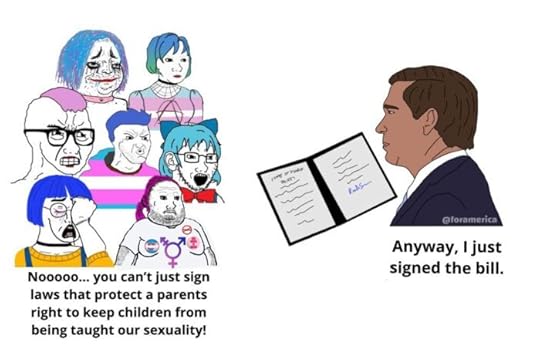
I rarely post memes, but this is a good one. Yay DeSantis! Disney can go to hell. And so can the GOP Transgender Surrender Caucus.
UPDATE:
GSA clubs, usually known as “Gay Straight Alliance” is now referred to as “Gender, Sexuality Alliance” in many schools. Seeing more and more of this.
This is where teachers have secret conversations with students about gender and sexuality. Massive red flag
pic.twitter.com/LluLv89HQx
— Libs of Tik Tok (@libsoftiktok) March 28, 2022
The post Disney Goes Groomer appeared first on The American Conservative.
Orban: A Hungarian For Hungarians
Election Day here in Hungary is on Sunday. Today I had coffee with a Hungarian, and asked him how it was going to go, in his view. He’s not sure. Fidesz (Viktor Orban’s party) is up by seven points in the polls, but he said they were predicted to win (according to the polls) in the 2020 elections, but ended up losing seats in all the major cities. I can’t find any Fidesz supporters who think this is a sure thing. That’s probably good, from a conservative point of view. Don’t want to be overconfident.
I mentioned an AP story I had seen today faulting Orban for not joining the European chorus of maximalist condemnation of Russia. The story said, in part:
Widely seen as Russian President Vladimir Putin’s closest ally in the European Union, Hungarian Prime Minister Viktor Orban has sought to assert Hungary’s neutrality in the war in Ukraine, even as his allies in the EU and NATO assist the embattled country and punish Russia for launching the largest armed conflict in Europe since World War II.
Orban, who faces a difficult election on April 3, has refused to supply Ukraine with military aid — alone among Ukraine’s EU neighbors — and has not allowed lethal weapons to be shipped to Ukraine across Hungary’s borders.
Arguing that providing such assistance to Ukraine would draw Hungary into the war, Orban — while avoiding ever mentioning Putin by name — has portrayed himself as the defender of his country’s peace and security while insisting that EU sanctions against Russia not be extended to its energy sector, of which Hungary is a major beneficiary.
“The answer to the question of which side Hungary is on is that Hungary is on Hungary’s side,” Orban wrote Saturday on social media.
While his approach has gained traction among many of his supporters, Orban’s reluctance to act unambiguously in support of Ukraine and his insistence on maintaining his Russian economic interests has led to frustration and outrage among other European leaders — not least the Ukrainian president himself.
Orban’s position is actually popular here in Hungary. Imagine that: a leader who puts the best interests of his own people first. Hungarians overwhelmingly sympathize with Ukraine, but they adamantly do not want to be drawn into a wider war. With their Polish neighbors champing at the bit to confront Russia, and with the US president idiotically shooting off his mouth about regime change in a nuclear-armed superpower, the Hungarians are quite anxious.
My interlocutor said that Viktor Orban’s greatest gift, one not matched by any other politician in Hungary, is that he knows how ordinary Hungarians think, and he knows how to communicate with them. “He’s a sophisticated guy, but he can go to a market in any small town in the country, and talk to people,” said this man. Orban, as you may not know, comes from the countryside, and that’s where his base of support is. The election is very much a city-vs-country thing.
The man pulled out his smartphone and showed me a formal photo of the leaders of Austria, Poland, Czechia, Slovakia, and Hungary standing side by side at a conference. Orban stood out as slovenly, wearing a wrinkled, ill-fitting suit. “This picture was a big deal for the Left in Budapest,” he said. “They thought Orban looked like a hick compared to the others. And they were right. But I know for a fact that Orban has expensive suits. He wore that bad suit that day because he knew this would be the picture that made the papers, and he wanted to send a message to his voters that he was one of them.”
I recalled a famous story about Orban from early in his political career. The firebrand orator who had stood up to the ruling Communists was trying to build a name for himself. He appeared onstage at a political event in Budapest, and one of the older liberal politicians went over to Orban and straightened his tie. It was a humiliating gesture, one meant to put the country boy in his place. Orban never forgot it.
My new friend said that there’s a reason why Orban has never had a personal scandal attached to him. He has allowed those in his circles to get rich, but he is careful about managing his own money (Orban is a lawyer, by the way). He’s not a wealthy guy, said this man. But he has deliberately tried to build up a base of conservative rich people to help keep conservatism alive in Hungary when the day comes that Fidesz loses power.
“You have to understand that until the last ten years, Hungary has never had a political base of wealthy conservatives,” he said. “There’s something about Hungarian culture that makes most of us not very good with money. So we never had many rich people to begin with,” he said. “The Nazi occupation killed off wealthy Jews who were establishment conservatives, and forty years of Communism did the same with the old aristocracy and industrialists. Orban has made sure that we now have a class of wealthy conservative donors to continue his work. Will he succeed? I don’t know. Some of these guys will flip to the Left when power changes, because they aren’t really conservatives. But that’s what he has been trying to do.”
The rich Left here in Hungary are mostly people who were Communist insiders who used their connections to get wealthy in the immediate aftermath of Communism’s fall. Ryszard Legutko tells this story well about his own country, Poland, in his must-read The Demon in Democracy. When opportunities opened up for Western investment in the 1990s, the former Communists were the ones who had the networks in place, and knew how things worked. They easily made the transition to progressive Eurocrats. This is a story that is barely known in the West, but it really happened. The former Socialist Prime Minister Ferenc Gyurcsany, whom Orban defeated in 2010, is one of those people. From his Wikipedia biography:
In 1981, he assumed function in the KISZ, the Organisation of Young Communists, where he mostly handled organizing student programs at the beginning. Between 1984 and 1988, he was the vice president of the organisation’s committee in Pécs. Then between 1988 and 1989, he was the president of the central KISZ committee of universities and colleges. After the political change in 1989, he became vice-president of the organisation’s short-lived quasi successor, the Hungarian Democratic Youth Association (DEMISZ).
From 1990 onwards, he transferred from the public to the private sector, working for CREDITUM Financial Consultant Ltd. until 1992, serving as director of EUROCORP International Finance Inc. in 1992. Gyurcsány then took the position of CEO at Altus Ltd., a holding company of which he was owner, from 1992 to 2002 and thereafter as chairman of the board. By 2002, he was listed as the fiftieth-richest person in Hungary.
Within two decades, Gyurcsany went from being a leader in the Communist youth league to being one of the richest men in Hungary. Four years later, he was prime minister. How did that happen? This country is full of stories like that. One Hungarian friend whose parents fled to the West, where he was born, tells me that the Buda hills are full of villas owned by rich ex-Communists, expropriated from their original owners under Communism. These are the people who are Orban’s political enemies, and who are hated by country people who were the losers under Communist rule. If you want to understand why Orban remains popular here after so many years in power, and why so many ordinary Hungarians appreciate his hardball tactics with the Left, you have to understand that the past isn’t yet past in Hungary.
Anyway, it is only a shock to western Europeans and to Americans that Viktor Orban, while generally supporting EU sanctions against Russia, granting humanitarian assistance to Ukraine, and opening the borders to hundreds of thousands of Ukrainian refugees, has not joined the militant anti-Russian bandwagon. If you don’t like it, your argument is not only with Viktor Orban, but with a majority of the Hungarian people, who don’t understand why this has to be their war too. They’re right. Orban is right.
Take a look at Michael Lind’s great essay in Tablet, talking about how strange it is that so many people in the US and Europe have become Ukrainian hyperpatriots. Excerpts:
As war fever swept America, progressives and conservatives joined in denouncing not only the enemy government but also the enemy people and their enemy music, enemy literature, and enemy cuisine. Americans displayed the national flag in every imaginable form and pledged undying hatred of the nation’s foes.
The nation that Americans celebrated was not their own, but rather Ukraine, following the brutal Russian invasion of the former Soviet republic. Liberal Americans who would have thought it vulgar if not fascist to wave the Stars and Stripes took selfies with the blue and gold of Ukraine’s national flag. Democrats and Republicans who routinely demonize the leaders of the rival American party engaged in a kind of sentimental, uncritical hero worship of Ukraine’s president, Volodomyr Zelensky, which would have been mocked had its object been Joe Biden or Donald Trump. Neoconservatives and centrist liberals used the Ukraine war as an opportunity to settle scores by accusing opponents in the rival party and rivals in their own parties of moral if not legal treason for less than total and uncritical support of a foreign country with which the United States does not even have an alliance.
Whether the war in Ukraine is a final aftershock of the first Cold War or the first major proxy war in Cold War II remains to be seen. The sudden outburst of vicarious Ukrainian patriotism on the part of many Americans—as well as people in similar North Atlantic democracies—seems like a Freudian “return of the repressed.” Taught that celebrating their own national traditions is racist and xenophobic, and deprived of opportunities to play a meaningful role in national defense, many Americans and Western Europeans have found an outlet for a lost sense of belonging by borrowing the national pride of another nation.
Lind goes on to talk about how the idea of national citizenship has disintegrated in the West today, to where it has been reduced to little more than being eligible for government benefits:
But even this is unsatisfactory to ethical cosmopolitan thinkers. After all, a purely national system of government-guaranteed health care or other national welfare programs benefit only those who happen to be citizens of particular nation-states. In a world characterized by extreme inequality among nations, and not merely within them, this seems unfair. Why should being born on one side of the southwestern border of the United States entitle you to a much better life than being born on the other side?
The classic nationalist answer is that national citizens either belong to, or aspire to belong to, a single people (if you approve of nationalism) or a single tribe (if you don’t approve of nationalism). Note that this is the answer of modern, post-18th-century nationalism, which holds out legal and political if not economic equality within the nation as an ideal. It was not the answer of the premodern city-state republics, in which the citizens were often a privileged minority or aristocracy within a population consisting mostly of peasants, serfs, or slaves, and had to earn their special civic privileges by special civic duties. Without any obligation on the part of citizens to earn their legal privileges or welfare benefits by serving the political community, the modern nation-state based on common culture or ethnicity becomes a tribal trust fund, rather like those managed by the U.S. federal government on behalf of Native American nations.
Lind says that goosed by our left-wing media, which, in its discussions of immigration, deliberately blurs the clear legal distinction between illegal immigrants and citizens, we are creating an idea of the State as a charitable organization whose purpose is to help worthy people in need anywhere. Thus have American elites betrayed the nation.
This is not a problem Hungary has with its prime minister and governing party.
Read the whole thing. You want to know why American conservatives like me are interested in Viktor Orban? Because he cares about his own people, and puts their interests first. Not the interests of the European Union, or the international financial class, or the World Economic Forum, or the media, or foreigners who claim the right to live in Hungary. The European Union and the media are trying to compel Hungary to open its children up to indoctrination in LGBT culture and gender ideology, but he fights for the rights of parents to decide for themselves how to raise their kids. Crazy, isn’t it? With the very honorable exception of Florida Gov. Ron DeSantis, the Republican Party in the US is led by people who are happy to throw children and families under the bus to appease the media and Woke Capitalism (read Jeremy Carl’s great piece on this).
Viktor Orban is one of the few elected politicians of the Right on the world stage today who actually understands that we are at war, and what the nature of that war is: to defend sovereignty, nationhood, faith, and family. No wonder they hate him. He gives less than total and uncritical support of a foreign country with which Hungary does not even have an alliance, and whose leader is trying to drag NATO into a shooting war with Russia. It is in Volodymyr Zelensky’s interest to have Hungary, and every other NATO country, enter the war on his nation’s behalf. But it is not in the interest of Hungary. This is one reason Viktor Orban, who is running as the candidate of peace and stability, will probably win a fourth term on Sunday.
The post Orban: A Hungarian For Hungarians appeared first on The American Conservative.
March 27, 2022
Sorry, But Chris Rock Had It Coming
Good on Will Smith and Chris Rock, I guess, for enlivening a failing institution (Hollywood) last night, but … that was something. Here’s what it was. NSFW warning: Will Smith drops two F-bombs:
In case you don’t watch it, Rock, the Oscars host, had made a tasteless joke referring to Jada Pinkett Smith’s bald head. She suffers from alopecia, an autoimmune condition in which your hair falls out. She was visibly bothered by the crack. Here’s the thing, though: Will Smith laughed at it when the camera was on him. Look at these two reactions to the joke:

He probably realized a second later, after looking at her, that she was hurt, hence his violent gesture.
I appreciate a man standing up for the soiled honor of his wife. But it’s also the case that in showbiz, you have to be prepared to be insulted by comedians. It comes with the territory. I don’t think Will Smith had a problem with this until he realized that he was going to be in trouble when he got home for not standing up for her.
Nobody’s wife (or husband) should be considered off-limits for criticism and joking, but the Jester has to know what’s too far. Chris Rock crossed a line in insulting Jada Pinkett Smith over a medical condition. What if she were disabled and couldn’t walk, and Rock made fun of her for being in a wheelchair? Same thing. Had JPS chosen to shave her head as a fashion statement, à la Sinead O’Connor, she would have been fair game. But she shaved her head because her hair was falling out because of a disease over which she has no control. You don’t pick on somebody who is suffering from a chronic and incurable disease. You just don’t.
It would have been better had both Jada Pinkett Smith and her husband been able to laugh it off, but I understand why she couldn’t, and why he, as her husband, felt duty-bound to defend her against insult. I know everybody is mad at Will Smith today (“everybody” = Twitter), but count me as halfheartedly on Team Will. This is once again an opportunity for me to remind you that I am from the South, and ours is a shame/honor culture.
The post Sorry, But Chris Rock Had It Coming appeared first on The American Conservative.
Laywoman To Anglican Leaders: ‘Find Your Spines’
Writing in the UK Christian magazine Premier Christianity, “Mary Wren” (a pseudonym chosen by the wife of an Anglican vicar-in-training) laments that the Church of England won’t teach on pressing moral issues of the day. Excerpts:
I am the wife of an Anglican vicar in training and, sometimes, I bitterly miss the Catholic Church. But it’s not for the reasons you might think; it’s got nothing to do with theology or cathedrals. It’s got everything to do with moral courage and spiritual leadership.
When I was asked where I stood on an issue (for example, abortion) I could explain that, as a Catholic, I followed the teachings of the Catholic Church. It did not excuse me from doing my own thinking, but it did mean that my views were not taken as personal. To an abortion advocate, their disagreement was not with me as an individual but with the teachings of the Catholic Church, a global institution with over 1.3 billion members. I was protected.
When I moved to the Church of England, my experience changed completely. I found that when these questions came up, the tone of the conversation was much more vicious and personal. It took me a while to figure out why, but I understand now. Where the Catholic Church teaches clearly on what it believes, the Church of England stays silent.
I bet the faithful Catholics left in Cardinal Marx’s diocese would like to have a word with Mary Wren:

More:
Well, the issue is no longer that I am a Catholic. Now the issue is me. I must be against abortion because I have internalised misogyny or some other personal bigotry that I’m using my religion to justify. The Church stays silent, protecting itself from attack, and I am expected to absorb the blows of culture. That is a heavy burden to place on one soul. I’m writing under a pseudonym precisely because I know this could compromise my husband’s career.
I want the Church to shield me, but instead it uses me as a human shield.
The Church of England refuses to teach me on the key moral and spiritual matters of today. I am begging you for guidance but you will not provide it. I am left fumbling on a thousand issues and I am frequently overwhelmed. I am trying my best but there are too many questions, and even if I did nothing but read for the rest of my life, I would still run out of time.
And as I am trying to learn about gender and sexuality and abortion and race and Anglicanism, I have the added pressure of knowing that I alone will be under attack if the position I come to doesn’t align with the world’s teaching. Because you, the Church, have provided no teaching, you cannot be blamed for where I’ve landed. It is a neat little circle. Very convenient for you.
Maybe the truth is that the Church of England, as an institution, doesn’t teach what Mary Wren rightly wants them to teach because its leadership class no longer believes in Biblical truth. You mustn’t think that all Anglicans are so cowardly. I have friends, clergy and academic, in the C of E who are fighting for the faith, but struggle against clerical officials in their own Church who at best embarrassed by them, and at worst consider them to be menaces.
I am more pessimistic than Mary Wren is. It’s not just the C of E, or their American branch, the Episcopal Church. In my American experience, even churches that do have clear moral and doctrinal teaching rarely teach and disciple. I am thinking right now of my Catholic friend who has to deprogram his sons from the heretical teaching of their Catholic high school. I am thinking of Catholic and Orthodox friends who complain that their pastors avoid the difficult topics because they are afraid of being “divisive”. There is a good reason that the sociologist Christian Smith found that the overwhelming majority of American young people (who are now two decades older than when he first published this research) are actually believers in Moralistic Therapeutic Deism. Whereas the broader culture and its institutions know where it stands on issues like gender ideology, abortion, race, and so forth, and does not hesitate to catechize, far too many priests, pastors, and teachers either stay silent, or teach what the culture teaches (even when it contradicts authoritative Church teaching).
I remember a conversation nearly twenty years ago with a Catholic friend who considered himself to be conservative. He went to mass every Sunday, and voted Republican faithfully. When we talked one day about same-sex marriage, he told me he was in favor of it, and said so with startling vehemence. I asked him how he reconciled this stance with Catholic teaching, and he angrily told me that the Catholic Church had no right to tell him what to believe. He was not a stupid man; he genuinely believed that the Church in which he was baptized and confirmed, and whose liturgies he faithfully attended, had no moral authority over him.
In my experience, this is the norm, not the exception. Longtime readers will remember my story about the Catholic priest friend back in the year 2001 or thereabouts who told me and another Catholic layman who were griping about the failure of the Church to teach that yes, we were right about that, but we needed to understand that this was just how it is. Better to take the responsibility to teach yourselves and your children onto yourself, he counseled. His parents understood this truth back in the 1970s, amid the post-Vatican II collapse. Result: he became a priest, and his sister remained a faithful orthodox Catholic.
In my speech last week at the National Conservatism conference in Brussels (I’ll post the video when it’s available), I channeled that Brooklyn priest from 2001. I urged Europeans to embrace their ancestral Christian faith with all their hearts, and not to wait on their bishops, priests, pastors, and religious leaders to find the courage to lead. I appreciate Mary Wren calling out the spineless leadership of her own church, but I doubt there is a single church body (denomination, etc) in the West in which a majority of its clergy, especially the upper clergy, are doing what Mary Wren calls for. If I’m wrong about this, then please share the good news in the comments section.
Note well that simply having strong teaching written down on paper doesn’t really matter. I was a Catholic for thirteen years, and only heard one sermon in which Catholic teaching on sex and chastity was proclaimed and explained. The general teaching I’ve heard in Orthodox parishes in the sixteen years I’ve been Orthodox is much stronger than what I had in Catholic parishes, but still I rarely hear the church’s teaching proclaimed about specific issues, like gender ideology, which is tearing through society and families. Decades ago, I asked a conservative Episcopal priest I knew if he ever preached on abortion. No, he said, because it was important not to divide the congregation before communion. I thought then that he was simply afraid of being judged by his congregation, and came up with a rationalization to avoid having to say hard things.
After some private conversations I had in Brussels, especially with European lawyers who explained to me the next moves against “hate speech” (which, if implemented, will lay the groundwork across the EU for persecution of Christians who dissent from the progressive party line), I am more convinced than ever that we are in a Live Not By Lies moment, and that now is the time for courage. We need courage to say what we mean and mean what we say. We need courage to withstand the hatred of others for the sake of the truth. And we need the courage to stand up to ourselves, to the compromiser within, to the coward who tells himself that everything will come right again if only we sit still and wait.
We who are in a stronger position to speak the truth without having to worry about our jobs have a greater responsibility to do so. If you are a priest, pastor, or religious teacher, and you are afraid to do this, what is the point of your vocation? To be sure, prudence has to factor into our decisions; it is not wise to rush forward at every opportunity to say what you think. But if you are theologically orthodox/conservative, and rarely if ever take a stand that could be called controversial, why don’t you? Liberals don’t hold back, because they know they’ve got the Zeitgeist filling their sails. What’s your excuse?
UPDATE: I want to add a link to this anonymously authored memo going around Vatican circles, according to the Vatican journalist Sandro Magister, expressing concerns about the next papal conclave. Magister speculates that the author is a cardinal. Excerpts:
Commentators of every school, if for different reasons, with the possible exception of Father Spadaro, SJ, agree that this pontificate is a disaster in many or most respects; a catastrophe.
1. The Successor of St. Peter is the rock on which the Church is built, a major source and cause of worldwide unity. Historically (St. Irenaeus), the Pope and the Church of Rome have a unique role in preserving the apostolic tradition, the rule of faith, in ensuring that the Churches continue to teach what Christ and the apostles taught. Previously it was: “Roma locuta. Causa finita est.” Today it is: “Roma loquitur. Confusio augetur.”
(A) The German synod speaks on homosexuality, women priests, communion for the divorced. The Papacy is silent.
(B) Cardinal Hollerich rejects the Christian teaching on sexuality. The Papacy is silent. This is doubly significant because the Cardinal is explicitly heretical; he does not use code or hints. If the Cardinal were to continue without Roman correction, this would represent another deeper breakdown of discipline, with few (any?) precedents in history. The Congregation for the Doctrine of the Faith must act and speak.
(C) The silence is emphasised when contrasted with the active persecution of the Traditionalists and the contemplative convents.
2. The Christo-centricity of teaching is being weakened; Christ is being moved from the centre. Sometimes Rome even seems to be confused about the importance of a strict monotheism, hinting at some wider concept of divinity; not quite pantheism, but like a Hindu panentheism variant.
(A) Pachamama is idolatrous; perhaps it was not intended as such initially.
(B) The contemplative nuns are being persecuted and attempts are being made to change the teachings of the charismatics.
(C) The Christo-centric legacy of St. John Paul II in faith and morals is under systematic attack. Many of the staff of the Roman Institute for the Family have been dismissed; most students have left. The Academy for Life is gravely damaged, e.g., some members recently supported assisted suicide. The Pontifical Academies have members and visiting speakers who support abortion.
More:
The Next Conclave
1. The College of Cardinals has been weakened by eccentric nominations and has not been reconvened after the rejection of Cardinal Kasper’s views in the 2014 consistory. Many Cardinals are unknown to one another, adding a new dimension of unpredictability to the next conclave.
2. After Vatican II, Catholic authorities often underestimated the hostile power of secularization, the world, flesh, and the devil, especially in the Western world and overestimated the influence and strength of the Catholic Church.
We are weaker than 50 years ago and many factors are beyond our control, in the short term at least, e.g. the decline in the number of believers, the frequency of Mass attendance, the demise or extinction of many religious orders.
3. The Pope does not need to be the world’s best evangelist, nor a political force. The successor of Peter, as head of the College of Bishops, also successors of the Apostles, has a foundational role for unity and doctrine. The new pope must understand that the secret of Christian and Catholic vitality comes from fidelity to the teachings of Christ and Catholic practices. It does not come from adapting to the world or from money.
4. The first tasks of the new pope will be to restore normality, restore doctrinal clarity in faith and morals, restore a proper respect for the law and ensure that the first criterion for the nomination of bishops is acceptance of the apostolic tradition. Theological expertise and learning are an advantage, not a hinderance for all bishops and especially archbishops.
These are necessary foundations for living and preaching the Gospel.
The post Laywoman To Anglican Leaders: ‘Find Your Spines’ appeared first on The American Conservative.
March 26, 2022
‘Woman,’ Man, And The Fight Against Evil
The usual media suspects are mocking Tennessee Sen. Marsha Blackburn for asking Supreme Court nominee Ketanji Brown Jackson to define “woman.” Haha, that stupid Republican culture warrior! Judge Brown responded, infamously, “I’m not a biologist” — as if you had to be specially trained as a scientist to say what a woman is. Judge Jackson is a jurist who, if confirmed to the Supreme Court, would be passing judgment on questions like, “What is a woman, under the law?”
This matters. The fact that Ketanji Brown Jackson would not define “woman” in her hearing is, for me, reason enough to reject her — and any other nominee that comes before the Senate seeking confirmation, and who will not commit to a definition of woman. We are facing an existential crisis in the West, one in which our elites — and Jackson is a straight-out-of-central-casting exemplar of our corrupt elites — are tearing down the entire edifice of our civilization. They must be stopped. I don’t care if Judge Jackson is the second coming of King Solomon, if she will not specify what a woman is (and is not), then she has no place on the High Court, any more than a judge who refused to specify what a human being is (more on which in a moment).
Of course she is going to be confirmed, and of course we are going to continue our slide into insanity. You have to take a look at what USA Today had to say about all this in a news story. It will tell you how crazy we have become. Excerpts:
Scientists, gender law scholars and philosophers of biology said Jackson’s response was commendable, though perhaps misleading. It’s useful, they say, that Jackson suggested science could help answer Blackburn’s question, but they note that a competent biologist would not be able to offer a definitive answer either. Scientists agree there is no sufficient way to clearly define what makes someone a woman, and with billions of women on the planet, there is much variation.
More:
But Jordan-Young said she sees Jackson’s answer, particularly the second half, reflecting the necessity of nuance. While traditional notions of sex and gender suggest a simple binary – if you are born with a penis, you are male and identify as a man and if you are born with a vagina, you are female and identify as a woman – the reality, gender experts say, is more complex.
“There isn’t one single ‘biological’ answer to the definition of a woman. There’s not even a singular biological answer to the question of ‘what is a female,'” Jordan-Young said.
There are at least six different biological markers of “sex” in the body: genitals, chromosomes, gonads, internal reproductive structures, hormone ratios and secondary sex characteristics. None of the six is strictly dichotomous, Jordan-Young said, and the different markers don’t always align.
Sarah Richardson, a Harvard scholar, historian and philosopher of biology who focuses on the sciences of sex and gender and their policy dimensions, said Jackson’s answer accurately reflects legal practice. While U.S. law remains an unsettled arena for the conceptualization and definition of sex, it frequently grounds sex categorization in biological evidence and reasoning.
But like Jordan-Young, Richardson emphasized that biology does not offer a simple or singular answer to the question of what defines a woman.
“As is so often the case, science cannot settle what are really social questions,” she said. “In any particular case of sex categorization, whether in law or in science, it is necessary to build a definition of sex particular to context.”
Read it all.The “experts” to which USA Today defers are lying to themselves. Twenty years ago — and every year before that — few people would have had trouble with this question, least of all scientists. There are clear genetic markers that distinguish males from females. The social construction of womanhood is a different question — but not a scientific one. Cultural politics have so captured science that now “experts” are talking nonsense, and one of the biggest papers in the country is repeating it as if it were true.
This matters more than many of you think. You are by now accustomed to the rapid acceleration of the culture of inversion, in which everything we thought was true the day before yesterday is now thought to be false, and vice versa. You might simply roll your eyes as a coping mechanism, and sit back waiting for sanity to return. This is a foolish, dangerous strategy. To decouple womanhood and manhood from biology is an extremely perilous move. I remind you that one argument the 19th century abolitionists used to fight slavery was the Darwinian claim that all of us descended from common ancestors, and that whatever our racial characteristics, we are all human beings. Now Western elites, for the sake of “liberating” transgender and genderfluid people, are convincing themselves that actually, science can’t say what a man and a woman are.
Don’t you see what’s coming next? Science is not going to be able to say what a child is — and because we privilege science as a way of knowing, the law will follow. How can we really say when childhood ends? they will ask. I mentioned in this space recently a chilling conversation I had with someone from Britain who has been involved in high-level meetings about educational policy, and who said that the educational establishment is militantly on board with the idea that children are autonomous from their parents, and that the state must defend the autonomy of children. My interlocutor said that he is certain that the next frontier in abolition will be taboos against sex with minors, and then children.
And then science is not going to be able to say what a human being is. The law will follow. Tara Ann Thieke, one of the best people to follow on Twitter, writes:
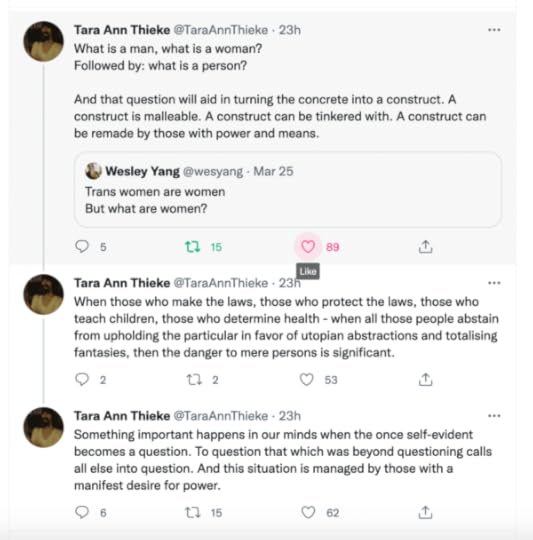
She sees it. She sees what’s being prepared by those in power. We are all being groomed for our exploitation. Our passivity in the face of it ensures our enslavement.
The only more important legal question in 2022, in a time of collapsing standards and definitions, than, “What is a woman?” is “What is a human being?” Rapidly advancing biotechnology is issuing in an age of transhumanism. Judges will have to rule on these matters. If, in the first half of the nineteenth century, when black men and women were held in bondage in half of the United States, would you have thought it silly for a Senator to ask a Supreme Court nominee to define human being? That’s what we are living in right now. Wake up!
We are being sent prophets — and some of the most stirring of them are women.
I rode the train from Amsterdam to Brussels with my friend Eva Vlaardingerbroek, a Dutch activist who was slated to speak at NatCon Brussels. On the journey, I asked her about her speech. She told me that she planned to talk about the coming transhumanism (her explanation of Elon Musk’s Neuralink project chilled me to the bone), and the urgent need for people to stand up against it — and for Christians to stop being afraid to speak openly about God. We really are in a fight for the future of the human race, she said. Now is not the time for timidity. Well, I heard her give the speech, and I can’t wait for it to go up on the NatCon YouTube channel, because it was galvanizing. I love Dutch people, but I have never heard a Dutch person, especially one only 25 years old, give such a rousing Christian address. It was a moment of real hope, from a young woman who has been extremely courageous in her anti-vax activism. I don’t share all her convictions about vaccines, but I have no doubt that she’s brave, and will not be intimidated.
Anyway, Eva’s call to all of us to wake up to the perils facing us inspired me to strengthen my own NatCon speech. I’ll post that video too when it’s available. Here’s a brief clip of her talk:
@EvaVlaar at #NatCon #NatConBrussels pic.twitter.com/NrxRKd39V8
— National Conservatism (@NatConTalk) March 23, 2022
Another great speech came from Alex Kaschuta, a Romanian of Hungarian descent (again, as soon as her talk is available, I’ll post the video).
 Alex Kaschuta
I only recently learned who she is, via my Claremont Institute pal Jeremy Carl, who told me her “Subversive” podcast (available on Spotify) is a must-listen. Alex is terrific — more people should know her. From her NatCon Brussels speech, in which she talked about how late liberalism must destroy the concept of female and male to fulfill its nature. She began by talking about how the leading men’s and women’s magazines acculturate their readers to finding their “authentic selves” and ultimate meaning through consuming a wider variety of sexual experiences. What this does, she points out, is sets up a power hierarchy that dispossesses the “losers” — and to conceal this fact, the powerful use this ideology to train people to distrust their eyes and ears (Orwell, in Nineteen Eighty-Four: “The Party told you to reject the evidence of your eyes and ears. It was their final, most essential command.”)
The glaring differences between men and women are an artefact of your lying eyes. Women, like men, like anyone, need a sex bucket list and need tips to manage their threesomes. They are interchangeable producer/consumers first and they are badass at it.
So, to make sure we keep up the appearance that society is composed of a cast of diverse but absolutely equal rational choice machines, every friction caused by the inescapability of nature must be instead caused by society. Every instance of entrenched inequality which a century’s worth of exorbitant interventions hasn’t made one dent in, is more proof that the ills of society are even more pernicious than we thought.
Liberalism cannot stop this ratchet, because it grows out of its founding myth. The one thing that the system cannot admit, the one straining card at the heart of this wobbling edifice, is that people are not equal in the dimensions that liberalism prizes – and they are not utility maximizing rational individuals shopping around freely for the best choice. They are not inherently liberal creatures.
And that some are less liberal than others. The gay careerist is more fit to be a denizen of the liberal order than the mother of three. This is simply a fact. He is less constrained by unchosen bonds, he is more free to produce and consume and contribute to the ratchet toward a society with ever more choices.
The trans woman, a relatively new addition, is a supremely liberal specimen – what a shedder of unchosen bonds! Especially the newly minted ladies who disproportionately populate C-suite roles and the military, they are liberalism’s avant garde. Even their most basic identity is affirmed through an act of consumption and smashing of unchosen bonds with the added benefit of breaking open spaces which were formerly off limits to the rational chooser beneath the petticoat.
For now, it doesn’t get more liberal than that. The next frontier is very likely the liberation of the rational agent in children. The machine is already in motion for that.
Here’s Alex’s point, summarized by someone who was a guest for a great recent episode of Alex’s podcast:
If you don’t share a core value structure there are no self-evident truths
If there are no self-evident truths then you can’t reach consensus
If you can’t reach consensus resolution can only be obtained through power
Our civilization can’t agree on what a women is
— Auron MacIntyre (@AuronMacintyre) March 25, 2022
You, reader, should understand that figures like Ketanji Brown Jackson — and again, she is utterly typical of her class — exist to impress upon the rest of us, via the exercise of raw power veiled by legal and scientific sophistries, their core value structure. Among those values: women can have penises, and men can have vaginas. And: people should be punished or rewarded on the basis of race.
I see this morning that Sen. Joe Manchin, the conservative Democrat, has signaled his intention to vote for Judge Jackson’s nomination. No surprise there. I expect most Republican senators to vote for her too. She’s a radical who is now a perfectly ordinary member of her class — because of how far to the Left the norms have moved. There is no real opposition to the Machine from Republicans, or organized conservatism. In my own case, I have been trying hard to cling to some form of classical liberalism, not only because I want to live in a society that values free speech, free expression, and freedom of religion, but I also believe that liberalism is the only way that a radically pluralistic society like ours can live in peace.
But I am at the end of these efforts, because I don’t think it’s possible to live in peace with people who believe these things — nor do they believe it’s possible to live with us. We are facing something that is truly evil. I mean spiritually evil — and I’m not talking about metaphorically either. (By the way, Alex Kaschuta says now that she was once a hardcore atheist, but now that she has become a mother, she believes that there is something real to the demonic claims.) Last weekend I had dinner in Budapest with a visiting American who said he abandoned his lifelong liberalism five years ago because he saw how impotent liberalism was to resist wokeness. Now the near-vertical slippery slope about our culture, he told me, is driving him toward religion. It seems to him (he told me) that there simply has to be some deep, dark, destructive intelligence behind what’s happening.
The destruction of the gender binary, which is so fundamental to civilization, is a sign. The contempt for generativity — the giving of biological life — is a sign. Look at this wicked woman who is celebrating the extraction of the organs through which she was meant to produce life:
Graphic warning: Medical professionals are causing irreversible damage to young confused women. This is what gender ideology does and it’s celebrated by the left. Horrific. pic.twitter.com/BYkF3VRXgr
— Libs of Tik Tok (@libsoftiktok) March 25, 2022
This is evil. It shouldn’t even be up for debate. If we can’t articulate this forcefully enough in purely secular terms, then fine, as Eva says, let’s not be ashamed to say God, and to mean it. Clarity of mind is the rarest thing these days — that, and courage to speak the truth. We have to understand — we have to get it very clear in our heads — that wokeness is a pseudo-religion, and that we are in a religious war. Judge Jackson and her cohort are on one side of it. She pretends to neutrality, but she is not neutral. There is no neutrality anymore. In my case, I have reached the point where I will not debate whether or not men are men and women are women, or whether or not children should be experimented on medically to purportedly change his or her sex. I will not debate whether or not people should be treated differently on the basis of race. I will not debate whether or not it should be legal for Christians to proclaim their faith in the public square. These are the red lines. These are basic values that are not up for debate.
You may have seen the Baphomet statue produced in the US by the Satanic temple:

They like to pretend that they don’t really mean it, that they’re just trolling right-wing Christians, but I don’t buy it. They do mean it. This philosophy is being mainstreamed now by powerful people who would probably just roll their eyes at this statue.
The original Baphomet was a creation of 19th century occultists:

Notice its transsexual qualities: the breasts, plus the phallic symbol in its lap. The words on its inner forearms are “Solution” and “Coagulate” — meaning that you break things down to their smaller parts, and reassemble them into something you prefer. This is exactly what transgenderism does to the human person. No wonder that the Baphomet has been adopted as a trans symbol by some. This comes from (where else) Tumblr:

We are in a religious war, even though most of those on the woke Left would deny it — and probably with total honesty, as they don’t recognize that they actually believe in an ideology that gives them meaning, purpose, and solidarity, and proffers dogmas that cannot be questioned. In this religious war, traditional Christianity is blasphemous, and if it can’t be tamed (see the ridiculous German Cardinal Reinhard Marx at a recent queer mass in Munich), then it must be eliminated:
Europe is a bit ahead of us. We still have the First Amendment to protect us Americans, but in Europe, traditional Christians and other social conservatives are in real trouble. We will discover next week if the Finnish member of Parliament Päivi Räsänen is guilty of hate crimes for stating publicly her conviction, as a Lutheran laywoman, her belief that homosexuality is immoral, and that gay marriage is wrong. Meanwhile, the European Union is now considering legislation that will raise hate speech and hate crimes to trans-European criminal status, meaning that they are considered to be so serious that they are not reserved to local rule, but trans-European standards. Only the worst crimes become trans-European. Here is a document from the European Commission explaining what it’s up to:

I talked to a couple of lawyers in Brussels, who explained to me that if the EU Parliament goes through with this, then an EU citizen in, say, France can file hate speech charges against an EU citizen in Hungary. You see what’s happening? A gay French transgender activist could file hate speech charges against a Hungarian pastor, who would be considered a criminal on the same level as a terrorist, arms trafficker, mafioso, or pimp.
This is not a joke. This is happening. Here is a link to the EU document explaining it. Excerpt:
Indeed, any form of discrimination – be it based on sex, racial or ethnic origin, religion or belief, disability, age or sexual orientation, as laid down in Article 19 of the Treaty on the Functioning of the European Union (‘TFEU’) – is prohibited. At the same time, freedom of expression is one of the pillars of a democratic and pluralist society and must be strongly protected. Furthermore, as set out in Article 67 of the TFEU, the EU must constitute an area of freedom, security and justice with respect for fundamental right. Through measures, it must ensure a high level of security to prevent and combat crime, racism and xenophobia. Hate speech and hate crime affect not only the individual victims and their communities, causing them sufferance and limiting their fundamental rights and freedoms, but also society at large. Hate undermines the very foundations of our society. It weakens mutual understanding and respect for diversity on which pluralistic and democratic societies are built.
It is hard to see how any form of religion that stigmatizes homosexuality or transgenderism would be able to survive these new blasphemy laws. Europeans would also be intimidated into silence in the face of crimes committed by migrants and members of favored minority groups. This is what liberalism has become: an ideology that dispossess people of their religion, their identity, and their right to decide how to live in their own country.
To return to Judge Jackson’s answer, and the propaganda campaign undertaken by our elites, our media, and our educational institutions: any society in which the definition of “woman” is up for debate is one in which the definition of “human” will soon be up for debate. We are very quickly becoming a satanic order — “satanic” in the sense that all that was once bad is now good, and there is no law other than will to power. If you missed it last year, read the English novelist Paul Kingsnorth’s account of his recent conversion to Christianity, and how it grew out of his environmental activism. Excerpts:
I realized that a crisis of limits is a crisis of culture, and a crisis of culture is a crisis of spirit. Every living culture in history, from the smallest tribe to the largest civilization, has been built around a spiritual core: a central claim about the relationship between human culture, nonhuman nature, and divinity. Every culture that lasts, I suspect, understands that living within limits—limits set by natural law, by cultural tradition, by ecological boundaries—is a cultural necessity and a spiritual imperative. There seems to be only one culture in history that has held none of this to be true, and it happens to be the one we’re living in.
Now I started to dimly see something I ought to have seen years before: that the great spiritual pathways, the teachings of the saints and gurus and mystics, and the vessels built to hold them—vessels we call “religions”—might have been there for a reason. They might even have been telling us something urgent about human nature, and what happens when our reach exceeds our grasp. G. K. Chesterton once declared, contra Marx, that it was irreligion that was the opium of the people. “Wherever the people do not believe in something beyond the world,” he explained, “they will worship the world. But above all, they will worship the strongest thing in the world.” Here we were.
He went through Zen Buddhism, then Wicca, before finally finding Orthodox Christianity, and accepting baptism in January 2021:
In Orthodoxy I had found the answers I had sought, in the one place I never thought to look. I found a Christianity that had retained its ancient heart—a faith with living saints and a central ritual of deep and inexplicable power. I found a faith that, unlike the one I had seen as a boy, was not a dusty moral template but a mystical path, an ancient and rooted thing, pointing to a world in which the divine is not absent but everywhere present, moving in the mountains and the waters. The story I had heard a thousand times turned out to be a story I had never heard at all.
Out in the world, the rebellion against God has become a rebellion against everything: roots, culture, community, families, biology itself. Machine progress—the triumph of the Nietzschean will—dissolves the glue that once held us. Fires are set around the supporting pillars of the culture by those charged with guarding it, urged on by an ascendant faction determined to erase the past, abuse their ancestors, and dynamite their cultural inheritance, the better to build their earthly paradise on terra nullius. Massing against them are the new Defenders of the West, some calling for a return to the atomized liberalism that got us here in the first place, others defending a remnant Christendom that seems to have precious little to do with Christ and forgets Christopher Lasch’s warning that “God, not culture, is the only appropriate object of unconditional reverence and wonder.” Two profane visions going head-to-head, when what we are surely crying out for is the only thing that can heal us: a return to the sacred center around which any real culture is built.
There is something so telling about Judge Jackson’s refusal to answer the woman question. She is either a liar or a moral lunatic — and again, she is no different from her social class, which is the ruling class in the US and Europe. No, I don’t think she’s a secret occultist, or anything like that. I think that she, like most others in her social and professional class, are caught in the mouth of a beast that they don’t understand. Realizing that nobody is going to stop her nomination, and nobody is going to stop any of this, and listening to those brave women Eva and Alex at NatCon, and talking to people who work in the EU Parliament, and also European lawyers, about what’s coming down the pike very fast … I have pretty much given up on the last vestiges of liberalism within me. It’s not that I want to be illiberal. It’s just that I can’t pretend anymore that the kind of liberalism that I value exists any more, at least not in a form strong enough to fight the evil that has metastasized on the Left. It is more important to me to stand firm against this evil, and to help those who are fighting it, than it is to be a proper classical liberal.
This is beyond Left and Right. This is spiritual. This is metaphysical. This is about Truth.
What this means for me personally, I don’t know. I am not eager to sign up for an ideology at all, and I see no viable alternative on the Right. Still, we have to fight as hard as we can against this with what we have; we don’t have to have a fully thought out alternative in order to say no to these lies. I am no longer willing to entertain the false hope that anything other than a real revival of the Christian faith will save the West from its suicide. And I am no longer willing to pretend that this is anything other than a religious war, and that what undergirds these battles over the definition of male and female, as well as the attempts by the ruling class to colonize the minds of children, is anything but satanic. There is no negotiating with this stuff.
Which side are you on? You will soon find that neutrality is not an option.
The post ‘Woman,’ Man, And The Fight Against Evil appeared first on The American Conservative.
March 25, 2022
Viktor Orban Defends Hungary, Not Ukraine
I see that this clip is making the social media rounds. In this address to those gathered at the NATO summit, President Zelensky thanks every country in Europe by name, but singles out Hungary and its PM Viktor Orban for opprobrium:
This really is quite something. Wait for the total admonishment of Hungary’s Viktor Orban. pic.twitter.com/zVrkwNY1eL
— Jack Parrock (@jackeparrock) March 25, 2022
I get it — though it does sound pretty ungrateful to me. As a frontline state bordering Ukraine, Hungary has taken in hundreds of thousands of refugees. The Hungarians have said, correctly, that it’s easy to tell the difference between a refugee and an asylum seeker — and they’re helping refugees. Orban’s government also supported EU sanctions against Russia — as head of an EU member state, he had the power to veto them — and has criticized the invasion. But Zelensky here faults Orban for being more concerned about his own country than Ukraine, and for representing the interests of his own people instead of Zelensky’s.
The fact is, Hungary gets 80 percent of its natural gas from Russia. Eighty percent! Orban doesn’t want his people to freeze in the dark next winter. Hungary is not a wealthy country, and is less equipped than many western European countries to withstand material shocks from the war. Viktor Orban has to answer to the Hungarian people, not to Volodymyr Zelensky and the western media. Besides, once food and energy shortages start rolling across Europe, we will see how committed European publics are to holding the hard line against Russia. Same in the United States.
In any case, Zelensky is not being entirely honest by singling out Hungary in this way (and playing the Holocaust card too — that’s what his reference to the shoes by the Danube means). The New York Times reported on Zelensky’s remarks, and said, in part:
Hungary has resisted some sanctions, especially against Russian energy, but it has not been alone. Germany and other countries are resisting such a move on the grounds that it would hurt European economies disproportionately. [Emphasis mine — RD]
In a video posted to social media on Friday morning, Mr. Orban rejected supporting sanctions on Russian energy.
Given Hungary’s dependence on Russian energy, the prime minister said, “sanctions would mean Hungary’s economy would quickly slow down and stop.”
“This is unacceptable. It is contrary to the interests of Hungarians,” Mr. Orban said.
Yes, it is. And say, what do the Hungarian people think? According to this opinion poll shortly after the war started, almost none of them support Russia, but by a nearly three-to-one margin, they want Hungary to stay out of this war, keeping itself equidistant from both Russia and Ukraine. Look:
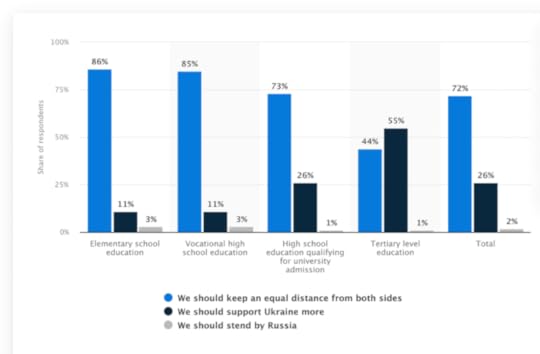
I’m trying to find more recent polling, but I would be very surprised if the numbers changed. Notice that the only demographic group in which a majority believe that Hungary should be more pro-Ukraine are university-educated professionals — precisely the social class that would be best prepared to withstand material pain from a cutoff of Russian gas. The Orban government has said that it would continue to send humanitarian aid, and would allow humanitarian aid to enter Ukraine through Hungary, but that it would not allow weapons to enter Ukraine from this country. If this stance is hurting the Orban government, you wouldn’t know it from the election polls, which show Fidesz, the governing party, with a widening seven-point lead only ten days before the election.
By the way, last weekend a Hungarian was listening to a visiting Englishman and me praise the beauty of Budapest. He told us that the city did not look like this 25 years ago. Budapest was badly damaged in the Second World War, and as it had a Communist puppet regime after the war, it did not have the money to do much rebuilding. What we visitors see and admire, he said, much of it only came about in this century — in particular after Viktor Orban rescued the Hungarian economy from the near-collapse to which the ruling Socialist government had led it from 2002-2010.
My Hungarian friend said that this accounts for the extreme reluctance of most Hungarians to get involved in the Russia-Ukraine war. They had right in front of them until pretty much the day before yesterday the cost of war written on their cityscape. They know how fragile everything is, and how much you can lose in war. They would rather avoid it if they could.
I expect you American and western European readers will be reading, hearing, or seeing reporting talking about how Zelensky gave Orban hell in this address. You should know, though, that on Ukraine war policy, Orban represents the interests not of the Ukrainian people, but his own. Imagine that.
By contrast, this video is just out:
Biden tells the 82nd Airborne they’re going to Ukraine:
“You’re going to see when you’re there, you’re going to see women, young people standing in the middle, in the front of a damn tank saying ‘I’m not leaving.'” pic.twitter.com/M2nu77yUw7
— RNC Research (@RNCResearch) March 25, 2022
Biden just concluded a NATO summit in Brussels. Did he just telegraph a NATO decision to invade Ukraine to support the Zelensky government? Or was he just misspeaking in senile fashion? Assuming he really does intend to order US troops into Ukraine, shouldn’t the US Congress be consulted before American soldiers enter a combat zone in which they may well be shot at, or shoot, Russian soldiers? This really could be the start of World War III. How on earth would inserting US soldiers into this war zone be in the vital strategic interest of the United States? I understand why it is in the interest of President Zelensky, but he doesn’t answer to the American people. Joe Biden does. Or so we are informed.
The post Viktor Orban Defends Hungary, Not Ukraine appeared first on The American Conservative.
Why The Spanish Civil War Matters
The scholar Nathan Pinkoski, writing in The Claremont Review of Books, considers the take on the Spanish Civil War by the venerable historian of Spain, Stanley Payne. Excerpts:
The Second Spanish Republic (1931–1939) suffered one of the most accelerated cases of democratic decline in European history. In 1931, Spain established a liberal, republican, democratic constitution on a wide basis of popular and elite support. In just a few years, the constitution was in ruins and Spain was at war with itself. How did this happen? Too often, Americans are taught a simpleminded morality tale about this period: the fascists destroyed democracy. But the true story of Spain’s troubled republic is much more interesting and instructive. It shows how democratic regimes can die from self-inflicted wounds.
He’s right about this. People who are worried that the US could descend into civil war ought to be studying the Spanish conflict. Stanley Payne is probably the foremost living historian of that event writing in the English language. According to Pinkoski, Payne finds the origin of the civil war “in the eruption of revolutionary politics.” More:
In the 20th century a new, revolutionary kind of civil war arose in Europe, pitting irreconcilable conceptions of state, society, and culture against each other. In these conflicts, revolutionaries and counterrevolutionaries aimed to establish radically different regimes. Payne is fond of quoting Joseph de Maistre’s dictum: “the counterrevolution is not the opposite of a revolution, but is an opposing revolution.” Once the revolutionary process begins, the old regime is finished. Both revolutionaries and counterrevolutionaries—who are ostensibly interested in restoring the status quo ante—must found a new regime. As Carl Schmitt observes in Ex Captivitate Salus (1950), the determination of both sides to establish a new regime is the reason why revolutionary civil wars bring unprecedented levels of violence. The goal is to overturn the whole legal and political order associated with the enemy, leading to the call for the enemy’s absolute elimination.
According to Pinkoski, you can’t really blame the Spanish civil war on the usual motivators of radical politics in Europe of the era. Spain had stayed out of World War I, and wasn’t badly damaged by the Great Depression. And Spain had a history of a liberal and parliamentary tradition going back to the early 19th century. No, this was a war that the Spanish chose. Pinkoski again:
Though a variety of parties helped set the revolution going, Payne argues that the chief culprits were the Spanish socialists. Unlike Bolsheviks, who seek to overthrow liberal constitutionalism by direct means, revolutionary socialists use the constitutional system to provide cover for their plan to dismantle it. They don’t overthrow the legal system, they exploit it. Legalists of the center and the Right struggle to respond to this tactic. In Spain, their failure was particularly acute. In The Collapse of the Spanish Republic, 1933–1936 (2005) and The Spanish Civil War (2012), Payne describes Spain’s descent into a brutal three-year war as the result of the socialist Left’s brazenness meeting the center’s carelessness and the Right’s pusillanimity.
Other European socialist movements began with revolutionary ambitions but mellowed as they grew older and came to respect constitutionalism and parliamentary norms. Over time, Spanish socialists became more radical. The most important leftist leader in Spain, Manuel Azaña (prime minister from 1931 to 1933 and again in 1936), contended that liberalism failed because it was too willing to compromise. He regarded the republican constitution as the beginning of a radical reform project—even calling it a “revolution.” Politicians who didn’t equate constitutionalism with leftism were ipso facto illegitimate.
I don’t want to quote too much, though I regret that the article is paywalled. Pinkoski says the Left could not accept the 1933 election results — won by the Right — because they believed history was on their side. So the Socialists did their best to undermine it. To support the Republic came to mean that the Right could never be legitimately elected.
Second, the center-left — the faction corresponding to our liberals — would not stand up to the Socialists:
In Spain, it excused the violence of young socialists. Centrist authorities were unable or unwilling to stop attacks on private property, businesses, churches, convents, and clergy. Instead, they blamed the victims, arresting not the actual perpetrators but scapegoating monarchists and conservatives. As cultural theorist René Girard understood, this scapegoating does not break the cycle of violence, but intensifies it. When revolutionaries attempt to purify a corrupt state and society through scapegoating, those whom they kill become martyrs, whose sacrifice becomes redemptive for nascent counterrevolutionaries. In Spain, scapegoating monarchists and conservatives converted large sections of the population from apathy to anger. By letting murders go unpunished and unjustly punishing innocents, the Left created martyrs throughout Spain—galvanizing the counterrevolution and turning the conflict into a religious war.
This sounds familiar. We know all too well that the liberals who run most American institutions won’t stand up to the radical Left. Do not be surprised, then, if the Left goes too far, and creates martyrs of the Right — and then, should a leader arise who can galvanize rightist people sick of the double standards, it all goes off.
Pinkoski, reading Payne, points to a third factor, one of which I was unaware: “the centrist endorsement of unconstitutional action in the name of saving the so-called liberal consensus—what French political theorist Pierre Manent has called ‘the fanaticism of the center.'” He says that the Spanish president of the era engaged in anti-constitutional maneuvering to make sure the centrists stayed in power. Soon neither the Left nor the Right came to believe that the constitution was meaningless, and no matter how many votes they got, they would never be allowed to take power.
In the 1936 elections, says Payne (via Pinkoski), the Left won, but “the revolutionary Left used violent coercion, especially during the second round of voting. The center-Left also made last-minute and ex post facto changes to election laws to give their side disproportionate influence.”
The fix was in. When the next parliament took their seats, the Left impeached the center-left president Zamora, and installed a hard leftist president who proposed “mass confiscation of property, seizure of churches and schools, reparations to sanctioned leftists, and court packing.”
I bet many of you don’t know this: the spark that ignited the Spanish Civil War was the arrest and murder of a member of Parliament, the head of the monarchist party, by socialist members of the police force. How did the government respond to this outrage? By oppressing the Right. Pinkoski:
Yet the impartiality of the state was fatally compromised; it was now seen to be openly aiding and abetting partisan murder. The constitution was broken. At that point, Payne writes, not rebelling appeared more dangerous for many than rebelling.
The murder of the MP was what tipped Gen. Francisco Franco into joining the rebellion against the government. And that would have failed if not for the idiocy of the leftist Republican government. More Pinkoski:
There was no coup d’etat. The rebels knew that the political elites and most of the military’s active commanders would remain loyal to the republic. What they hoped for was a revolt of the captains. They bet on a general military insurrection taking place across the entire country that would take the capital within a month. But they lost this bet. By the end of the first week, all major cities were solidly in Republican—that is, leftist—hands. Most of the navy and air force, as well as half the army, remained with the republic. The Republicans controlled the arms and munitions deposits, the major industrial areas, and all of Spain’s gold reserves.
But instead of using existing security forces to restore stability, the Republican government armed popular militias. This unleashed an orgy of violence and destruction—mass murders of nuns and priests and others became the order of the day across the nearly two thirds of Spain that the Republicans controlled. These horrors swung the sympathies of Catholics and the middle class toward the rebels, giving them a wide base of support. The rebellion was saved.
Pinkoski explains that Franco’s coalition included factions that were completely opposed to each other. The Falangists were actual fascists who hated the royalists, who repaid the compliment. The fascists wanted an anti-clerical, anti-traditionalist revolution of the Right. Franco ended up siding with the Catholic traditionalists, though he managed to keep the entire Right united during the war years. He says that Franco did govern as an authoritarian during the postwar decades, with people “deprived of many public liberties” but retaining private ones (this is the classic difference between an authoritarian regime and a totalitarian one). It is arguable that only a strong authoritarian government could have prevented a return of the savage civil war. Payne believes that Franco’s success in bringing peace and relative prosperity to postwar Spain laid the groundwork for the collapse of Francoism after his 1975 death.
Pinkoski concludes that Stanley Payne’s work on Spain is worth reading because it shows how a liberal democracy can fall to revolution from within. As difficult as it is to imagine how a civil war could happen in the US today, watching the cycle of radicalization happening on the Left and the Right, and the growing distrust of democracy, and seeing especially how the center-left, which controls most US institutions, sees no enemies to the Left, thus alienating the Right from democratic institutions — well, it’s not as hard to imagine as it ought to be. The emerging reality that forces on the Left are empowering the State to come after our children — in schools, in popular culture, and in the law — is, for me, an “all bets are off” moment. I hope and pray that this gender ideology cancer does not metastasize.
Read the whole thing, if you can (it’s behind a paywall).
The post Why The Spanish Civil War Matters appeared first on The American Conservative.
March 24, 2022
Barstool Jingoism In Our Time
I like Antonio Garcia Martinez personally, and I usually like his writing, but his new piece for Bari Weiss’s Substack, titled, “Why Does Tucker Carlson Sound Like A Berkeley Leftist?”, is just shallow and silly, and way beneath the high standards of that blog. It starts like this:
In the Before Times, prior to Twitter and #BLM and Critical Race Theory, the one wing of the political spectrum that was reliably “America, love it or leave it!” levels of patriotic was the right. The most traditional and curmudgeonly conservatives, grumps like William F. Buckley and George F. Will who harrumphed glumly about the world in National Review, were also the most absolutely pie-eyed patriots. America was an exceptional and indispensable nation—in the words of Ronald Reagan, “the last, best hope of humanity . . . a light unto the nations.”
One of the post-woke political realignments that’s happened in the United States is the emergence of a New Right. This new movement—Trumpian in its isolationist America First attitude and deeply cynical about the country’s ability to act competently in the world—spans everyone from Steve Bannon and Tucker Carlson to religious conservatives like Harvard’s Adrian Vermeule and the author Rod Dreher. Either more overtly (in the case of Bannon), or more implicitly in the case of religious conservatives who hold up countries like Hungary or Russia as aspirational, this emergent ideology breaks with the Reagan-style, small-government conservatism of the past 40 years.
One fascinating aspect of this New Right is that it shares a worldview with, of all things, the old hippie left. Two core tenets of New Right ideology are now:
The United States is incapable of doing good in the world, and historically has been a force for evil worldwide.
Everything that happens in the world is the direct result or responsibility of the United States.
The Ukraine situation makes this unlikely contradiction even more evident. The Putin fans among the New Right—in temporary retreat, currently sublimating their views as Ukraine skepticism—really think Russia some anti-woke exemplar worthy of imitation. Never mind that the church-attendance rate in Russia is far lower than the U.S., their birth-rate as low as any childless European country, and their abortion rate one of the highest in the world. Seen from the “trad” conservative perspective at least, Russia suffers from all the ills of post-modernity even more than the supposedly degenerate West.
AGM goes on to say that he went to the Poland-Ukraine border and stood with refugees, and that convinced him that people like his imaginary “New Right” America-haters are wrong and ought to shut up.
Where to even start with this? I don’t read Vermeule, and I don’t know what Steve Bannon believes, but I’m pretty sure that Tucker does not believe that the US is incapable of doing good in the world, and historically has been a force for evil worldwide, or that America is at fault for everything that happens in the world. I know I don’t. This is college-newspaper and talk-radio level dopiness that doesn’t even begin to deal with the actual critiques that some of us on the Right have made of the US in this situation. He went all the way to Ukraine to write that?
Again, I can’t and won’t speak for Vermeule or Bannon, and can’t really speak for Carlson, because I don’t watch him every night, but I’ll speak for myself and generally for the viewpoint AGM lazily attempts to criticize here.
Who are these Putin fans on the “New Right”? Certainly not me. As I recall, the only time I’ve praised him is for his entirely sensible take on gender ideology. Nearly every time I’ve written about Russia’s war on Ukraine, I have condemned it, and expressed the hope that Ukraine will repel the Russian invaders. It is true that there are some people on the Right who have been more enthusiastic about Putin — Italy’s Matteo Salvini for one — but I can’t come up with any right-wing Americans, with the possible exception of Bannon, who have praised him in general.
And nobody has held up Russia as a model for America. Where is he getting this? I’m a big proponent of Hungary, as you know, but I have said clearly that Hungary is a very different country from the US, demographically and historically, and all the things that work in Hungary aren’t suited for the United States. I have praised certain aspects of PM Viktor Orban’s governance — both in style and in policy — and have said that the GOP should take a look at them and figure out how to make them work in an American context. But it’s half-ass and inaccurate to claim that I or anyone else wants to create a carbon copy of Hungary in the United States. This is as lazy as conservatives who claim that people on the American Left who find things to admire about Scandinavian social democracy want to import it entirely to America.
AGM seems shocked that Reagan-style conservatism is outdated on the Right. Where has he been the last five years? And what is this business about claiming that the New Right believes these two things?:
The United States is incapable of doing good in the world, and historically has been a force for evil worldwide.
Everything that happens in the world is the direct result or responsibility of the United States.
Nobody believes either thing. They really don’t. This is a low-rent way of dismissing substantive criticism about America’s mistakes in Eastern Europe (and elsewhere), and its role in the world today. If AGM thinks that the United States’ policy towards Ukraine since the fall of Soviet communism has been sensible and correct, fine; he should defend it. This seems, though, like a layabout’s attempt to shoot down the Mearsheimer argument. It reminds me of an argument I had back in my college days in the 1980s, with the elderly left-wing mother of a friend. The old woman had recently returned from a “peace cruise” in the Soviet Union, and was full of praise for the Russian regime. At the time I was involved with my campus chapter of Amnesty International, and had been advocating on behalf of Russian political prisoners. When I brought their cases up with her, the old woman became instantly exasperated, and said, “I think you just hate the Soviet people.” Case closed.
This is the line that chaps my backside:
The Putin fans among the New Right—in temporary retreat, currently sublimating their views as Ukraine skepticism…
The cheapest shot in a piece full of cheap shots. This is a classic example of the kind of thing I’ve heard lots of people at NatCon Brussels complaining about: that Russia ultra-hawks make it impossible to have any kind of nuanced discussion about the complexities of the Ukraine situation, because they denounce anything short of maximalism as closet pro-Putinism, or, as here, sublimated Putinophilia. I mentioned in an earlier post today a conversation one friend here had with a Pole who said, in all seriousness, that maybe nuclear war would be tolerable if Russia could once and for all be put in its place. Totally serious about this. I haven’t met a single person at this conference who has taken Russia’s side in this conflict. Everyone here, as far as I can tell, supports Ukraine. But boy, are people tired of being told that they’re letting down the side because they don’t want to expand the war, or get NATO involved.
It’s hard to believe that AGM, who is usually a much better thinker than this, went all the way to Ukraine to write this shoddy piece. He could have just moseyed down to his local barstool. Seems like he traveled over there, came to admire the Ukrainians and to identify with their cause, and now feels entitled to smear anyone who doesn’t share his enthusiasm. This longer reported piece of his from Ukraine is truer to his customarily good form. I can’t account for why Bari Weiss published such a flimsy piece on her usually-excellent site. The war sure has done a number on a lot of people’s minds.
UPDATE: AGM has responded via Twitter. I’ll reproduce his response below. Let me start out by saying that I don’t regard this as a personal dispute. I continue to like and admire AGM! It shouldn’t be necessary to say this, but it is, because many people assume that if you fall out on Twitter, you must HATE the other person. Pffft!
Anyway, here we go:
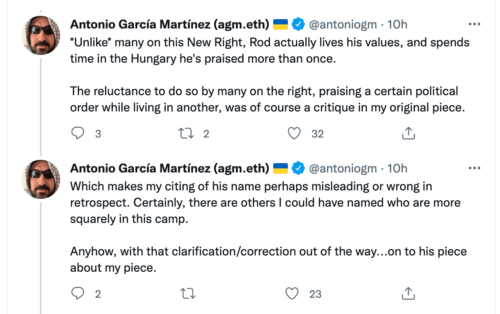
For the record, I don’t think one has to live in another country to admire it, its people, and the policies of its government. I am a huge Francophile, for example, but I have never lived in France.
Huh? I praised Putin’s take on pronouns long before the war started. If Xi Jinping praised mom and apple pie, I would credit him for that too. I only brought the Putin/pronouns thing up in the context of war to acknowledge that I have found things about Putin praiseworthy in the past, and don’t walk away from those things. The fact that Putin has launched a cruel and unjust war on Ukraine does not negate his common sense about gender ideology. That fact that Putin is right about gender ideology, and Joe Biden (say) is wrong, does not justify Russia’s war. Only in the frazzled minds of partisans does any of that make sense.
Oh, come on. You can’t falsely call a guy an America-hating Putin lover, and publish it on a huge online platform, then say, “Hey, it was just a short piece based on a Twitter thread, what’s the big deal?”

But AGM’s original allegation was not that I call the US foreign policy response “deeply flawed.” It was this:
The United States is incapable of doing good in the world, and historically has been a force for evil worldwide.
Everything that happens in the world is the direct result or responsibility of the United States.
Words mean things. In fact, I believe the US has been on balance a force for good in the world, but in recent decades — at least since 9/11 — has done bad things, probably inadvertently. Over and over again, in writing in this space about the Ukraine war, I have said that the US and NATO bear some responsibility for what has happened, but that ultimately, it was Russia’s decision to send Russian forces across the border. Again, it is possible to hold Russia responsible for its criminal action, but at the same time to recognize that strategic foreign policy blunders on our part played a role in bringing this situation about. I could be wrong about that, but surely it is not illegitimate to explore these possibilities, if only so we can learn from our mistakes. This is called thinking, not emoting. I would like to think that AGM doesn’t hold the converse to be true: that the US is incapable of doing wrong in the world, and that the US bears no responsibility for events in the world (unless, of course, things turn out for the best, and the US gets to take credit).
Well, I agree. Ukraine is not a holy innocent among the nations, but it is the victim of Russian aggression. Russian troops ought to turn around and go home. But I have always said that, from the first day of the war. Maybe AGM did not read my writing before he slammed me as an America-Hating Putin Lover (AHPL). It’s no crime not to read what I write, but if you are going to make that kind of slanderous claim about someone, especially a friend, you need to understand what you are talking about. If AGM agrees that “there is an absolutely valid debate to be had about to what degree the US/West should aid the Ukrainians,” why did he include me in his sweeping denunciations of AHPLs? To repeat, it seems to me that a number of pro-Ukraine partisans are very quick to condemn as Russian stooges people who don’t share their rabid enthusiasm for expanding the war. This is not only factually incorrect, it’s morally wrong.
“Suddenly so isolationist”? Dude, The American Conservative, the magazine for which I write, was founded in opposition to the Iraq War! TAC has been publishing essays for twenty years arguing for realism and restraint in foreign policy. We’re not “isolationist” (another smear that neocons and neolibs use to dismiss our arguments), but we do believe that the US has been far too quick to rush into war, and that the interests of the US would be better served by realism and restraint in foreign and defense policy matters. AGM doesn’t seem to understand the factions on the Right very well. We on the Realism & Restraint Right cheered when Donald Trump denounced the Iraq War as a mistake from the stage of the 2016 GOP primary debate in South Carolina. The audience booed him, but we thought it was great that a major GOP candidate (read: not Ron Paul) finally admitted publicly what was obviously true to any but the most diehard neocons.
But even assuming that AGM’s claim here is true, wouldn’t the answer be obvious? Russia has nuclear weapons. Russia is not Iraq, Afghanistan, or Libya. One doesn’t charge mindlessly into war with a nuclear-armed nation, because the costs could be annihilation of the entire human race.
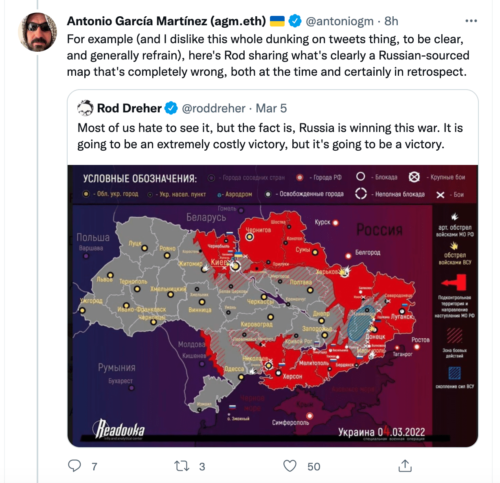
The map was indeed too optimistic (from a Russian point of view), but it had been shared with me by a foreign-policy expert who is not pro-Russian. Nevertheless, I wish I hadn’t shared it, just as I wish I hadn’t shared Ukraine propaganda (the Snake Island story). I decided a couple of weeks ago to stop sharing stories that I wasn’t confident were true, because I don’t want to inadvertently share propaganda. Both sides are engaged in propaganda. It is more pleasant to believe Ukrainian propaganda, but doing so makes the US more vulnerable to making mistakes.

Oh boy. Once again, I can’t speak for everyone who falls under AGM’s umbrella of condemnation, but I have repeatedly said that World War III would start if NATO declared a no-fly zone over Ukraine. Why? Because it would involve NATO and Russian aircraft firing on each other. Also, for those who keep bleating, “What’s going to be enough for you people to stop Russia? If not in Ukraine, then where?!” Well, if Russia attacked a NATO country, that would be a clear red line. Ukraine is not in NATO. Treaties matter. I know war enthusiasts don’t like to hear it, but they do.
Second, the point of my snarky remark was that AGM really did travel to Ukraine, but came away with a take that was worthy of a barstool (“Those people who are against joining this war against Russia are a bunch of America-hating Putin lovers!”). Having traveled to the refugee zone is commendable and maybe even brave — but it doesn’t make one’s judgments correct.
To pick an area where I am vulnerable to being driven by my emotions: if I spent time with survivors of child sexual abuse (clerical and otherwise), I would favor raising a vigilante mob to go in, grab the abusers by the scruff of their necks, take them out to a field, and shoot them. This is precisely why you should never put someone like me on a jury judging a case involving the sexual abuse (or any abuse) of children. I sympathize far too strongly to be able to render a prudent judgment on these cases. This is not to say that abusers of children deserve sympathy; I don’t believe they do. But it is to say that my passions in these cases — my rage at the abuse and abusers — clouds my judgment. I don’t want to live in a society in which vigilante justice overtakes the rule of law, nor do I want to live in a society that has the death penalty (despite believing with every fiber of my being that child abusers deserve death). I don’t want to live in that kind of society because I know how flawed human judgment can be, especially when it is driven by emotion. AGM should watch Twelve Angry Men, and reflect on how its lesson can be applied to discussions of war and peace.
That’s because I believe he went to Ukraine, felt sorry for its people (as he should have done!), and now wants to defend them. That is at some level admirable; we should in most cases want to defend the weak against the strong. But this Russia-Ukraine situation is not so simple, and mostly (but not only) because Russia has nuclear weapons. People who diminish this fact are behaving recklessly. No, this doesn’t give Russia carte blanche to do what it wants to do to its neighbors, and yes, if Russia attacks a NATO country, we are treaty-bound to defend it, despite the risk of nuclear war. But Ukraine is not in NATO! Russia’s abuse of Ukraine is wretched, but given the nuclear weapons factor, it is too risky to go to war with Russia to repel its troops. That’s simply an unhappy fact of life.
As others have pointed out, Hungarians were really angry at the West for not coming to their aid when they rebelled against Soviet occupation in 1956. I am quite sure that had I been on the streets of Budapest then, I would have been writing dispatches urging Western military involvement to defend the Hungarian freedom fighters. So it pains me to say that in retrospect, Eisenhower was correct not to risk nuclear war then. Because he didn’t, there is a Hungary today, and an America too. Again, there are times when we have no choice but to take that risk; the Cuban Missile Crisis was one of those times. But these instances must be rare, exceedingly rare, because of the potential costs to the world. The US had a vital national interest in preventing the Soviets from putting missiles in Cuba. At this point, I do not think we have a vital national interest in entering the war to protect Ukraine from unjust Russian aggression. And it doesn’t make me an America-hating Putin lover to say so. In fact, because I love my country, I am sick and tired of seeing her soldiers committed to overseas conflicts by war-loving Washington politicians and the media class that encourage them.
The post Barstool Jingoism In Our Time appeared first on The American Conservative.
Postcard from NatCon Brussels
Good morning from Brussels, where I’m at the second and final day of the National Conservatism Brussels conference. I was struck yesterday by how the Russia-Ukraine war consumed the first sessions here. There was a lot of passion from the stage, especially from Polish speakers. So intense was the discourse that I retired to the bar to get coffee, because frankly it was boring to hear over and over how horrible Russia is, and how terrible this was is. Yes, yes, we all agree — but there seems to be nothing new to be said about it, so many people are re-stating what most people already believe, but with more passion this time. A lot more passion.
In conversations I had over coffee (and later, beer — this is Belgium, after all), I heard complaints from conference attendees that it is almost impossible to dissent from anti-Russian maximalism, even in national conservative circles. In mid-afternoon, NatCon guru Yoram Hazony mentioned in his talk from the stage that it ought to be possible to be both against Russia and against expanding the war. He’s right, and it was encouraging to hear this sentiment voiced. The fact that it seemed a bit risky to say lets you know how fierce the anti-Russian opinion is among this crowd. One person told me over breakfast this morning that she was shocked to hear a Polish friend here yesterday say that it might be worth nuclear war if it meant that Russia could finally be put in its place.
I recommend this account of Day One from Sebastian Milbank, writing for the UK publication The Critic. He writes:
I asked my fellow guests what they made of it — and I encountered a surprising consensus. Though I found some classical liberals milling about, the majority of the people I spoke to saw the Anglo-American speakers as an old guard; what had really drawn many of the younger guests I spoke to was a sense that in Eastern and Central Europe, especially Poland and Hungary, a different, non-liberal, model of modern statehood was taking shape.
Especially in America, a growing section of the populist right see in Europe a form of conservatism they feel has been lost in America, where libertarianism has long dominated Republican politics. Though the Europeans all declared their support for NATO, you could sense the current of pragmatism. These were countries that had emerged from behind the Iron Curtain. Clearly they want to keep American military support in place, but they’re also keenly aware that 70 years ago their national sovereignty was signed away by Britain and America at Yalta and Potsdam. No doubt there were few other options, but one can easily see that they’re hedging their bets and keen to see European-based security frameworks, as well as resisting America’s cultural hegemony.
At one level you could see the realist alliance in play — a European East keeping the Western right sweet and in favour of the military and economic transfers they rely on. But something more idealistic is also clearly at work. A US right is recentring itself as an intellectually and culturally European project, and a European right is drawing on Western thinkers (one thinks of the Scruton Café in Budapest) to reconstruct their nationhood following the trauma of communism and amidst the chaos of global capitalism and liberalism.
Sebastian found the late afternoon panel on culture lively, and also my subsequent address on Christianity, culture, and European life. Writes Sebastian, “Here one felt was what we had actually come to see.”
Father Benedict Kiely, a Catholic priest and founder of Christian anti-persecution charity Nasarean gave probably the most interesting talk, however, posing a question that I have often found myself asking, especially in my previous role covering religious freedom issues for the Tablet. Why does nobody seem to care about persecuted Christians? The answer he suggested was that we had “lost our roots”, that we are part of a “dysfunctional family” that has lost its identity. It was hard to disagree.
Rod Dreher seemed to carry the hopeful heart of the movement, saying: “I owe my Christian faith to Europe.” [Because I first met God in the Chartres cathedral in 1984– RD] However he disagreed with Catholic integralism “it would corrupt the Church itself”, and pointed to Patriarch Kirill as “prostrate before Putin”. Rod focused on questions of faith, and spoke in the style of an American preacher, reflecting his native country’s rhetorical and religious traditions even as he spoke on behalf of Europe.
“Cultural Christianity is not enough…to defend and restore Christian civilisation” — amidst all the calls for the revival of Christian culture and civilisation, this was the most persuasive.
But still, as I reflected on all I had heard, and as heartening it was to hear the sort of call silenced in most modern forums, I could sense something missing. Everyone was furiously willing the end, but who was willing the means?
That’s a great question, and the biggest challenge facing us. It’s hard to know at this point how to go about it. In my talk, I said that we can’t wait for our leaders to take the initiative. Many of them are too weak or compromised to recognize the signs of the times, and/or to act in the face of crisis. But what do we do? This is something I have struggled with for at least five years, since The Benedict Option was published. I am often asked why I haven’t “built a Benedict Option,” or somesuch thing. As if I had to not only make the diagnosis and the prescription, but to do the thing that I’m worst at, which is to create structures and what Sebastian Milbank calls “means”!
We national conservatives — a catchall term that includes people on the Right who believe in the importance of national sovereignty — really do need to develop means of resistance. By “resistance,” I mean not just rejecting what is bad, but affirming what is good, and making those affirmations concrete. These ideas, convictions, and intuitions must be made incarnate somehow — but how? In my talk, I mentioned some good examples: the Tipi Loschi in Italy, and the European Fraternity project led by Imre de Habsbourg-Lorraine. We do need more — much more — and we need it now.
Last night over beer, I heard from a Catholic who works in the European Parliament that the things going on now — proposed legislation, bills that are actually moving through the legislative process — beggar belief. He was talking about restrictions on free speech (via “hate speech” legislation), and the digitalization of European life, giving more control over individuals to the bureaucracy. At one point I stopped my interlocutor and asked him if this was some dystopian fantasy, or if this was really happening. He and two others at the table leapt to say that no, this is really happening right now, and indeed is accelerating.
The things going on now sound like something out of science fiction, or one of the Evangelical Left Behind novels. How are we going to resist this? We Americans have no real idea about this stuff; it just doesn’t get reported in our media. I’m realizing now that we had better start paying more attention, and making contacts with European conservatives who are fighting this stuff. My Belgian interlocutor last night said that Americans were protected in two fundamental ways that Europeans are not: “You have the First and Second Amendments,” he said, referring to constitutional guarantees of free speech and the right to bear arms.
Added a Dutch woman at the table, “You Americans understand that the state is not necessarily your friend. We Europeans have no way to stand against the state when it threatens us.”
True enough, but with the law schools having become so woke (see Aaron Sibarium’s shock report), there is real doubt as to how long we can maintain those protections. After all, the Constitution only says what the courts say that it says. We Americans need to know what’s happening in Europe with the digitization of daily life and the rollback of fundamental rights and liberties for the cause of “safety,” “antiracism,” and so forth.
At breakfast this morning, I heard a woman who lives in Brussels and who works at the European Parliament talk about how bad crime is here. She herself was a victim recently. It is almost entirely crime committed by Arab migrants, she said. Another woman who until recently lived in Stockholm added that outside the center city, in areas dominated by migrant populations, you can’t really go, because the crime is so bad.
“Wait, the media tell us that ‘no-go zones’ is a right-wing fiction?” I said, with slight sarcasm.
All the Europeans at the table rolled their eyes. The ex-Swede said, “Stockholm has been lost to Europe. It’s gone.”
The Europeans then began talking about how all this can be reversed. None are hopeful. Their view is that at the national and transnational level, European leaders — the Hungarians and the Poles excepted (and they are hated for this within official EU circles) — have no will to face the challenges and roll back the migration and related crime wave. Later, when we were talking about the upcoming election in Hungary, everyone said they expect that if Viktor Orban’s party wins, the media and the NGO class will claim somehow that the election was sabotaged, and that the result was illegitimate.
Just now, at a coffee break between conference sessions, I spoke to a couple of Catholic conservatives living here in Belgium. They were talking about how difficult it is to be faithfully Christian in this country. One of the men, a Flemish, said that he has given The Benedict Option out many times. Listening to these men talk about their everyday lives as believers living in a militantly post-Christian society and culture helped me to understand why The Benedict Option, though it sold well in the US, has really impacted the conversation in European Christian circles. The book speaks directly to the reality they are living right now. It will take another generation, maybe two, for the same reality to hit America. US Christians really don’t understand what is happening to us. The Europeans do.
After that, I talked to an African professor standing by a doorway drinking coffee. He told me that he liked my speech the day before, but that he didn’t see a lot of hope in Europe, or even in the US. “You are dying,” he said, referring to the declining populations. He said that the only way we could pull out of the demographic death spiral is by recovering our religion.
This is not something most Westerners want, at least not at this point. Later, thinking about the African’s claim, I recalled Father Ben Kiely’s remarks about the puzzling fact that Westerners simply don’t want to hear stories about the vicious persecution of Christians in other countries (e.g. Nigeria, where Muslim militants are literally slaughtering Christians). Father Ben thinks the core of the problem is that we have forgotten our roots. He believes that Western publics shove these suffering Christians out of mind because we don’t want to be reminded that we too were once Christians. The suffering and martyred Christians of Africa, the Middle East, and Asia lean on our bad collective conscience — therefore, we ignore them.
Well, guess what: we are going to join their ranks soon. Last night at dinner, I met Päivi Räsänen, the heroic Finnish MP who just endured a trial over so-called “hate speech” back home. Her crimes? Tweeting a Bible verse critical of homosexuality, making comments critical of LGBT Pride marches in a radio debate, and nearly twenty years ago, writing a pamphlet defending traditional marriage against arguments for same-sex marriage. What an honor it was to meet a true contemporary hero of the faith. She told me that the verdict is expected next week. If a Christian can be convicted in a European court for criminal speech simply for stating belief in the Bible’s teachings, Europe will have entered into a dark era. The fact that she was even brought to trial is terrible enough.
Someone said to me yesterday that the most important things that get said at conferences like this are in the lobbies between sessions, as people get to know each other and exchange e-mail addresses. I think that must be true. From my experiences at each of the last three NatCon conferences, I’ve observed, and participated in, the building of networks of resistance. That sounds a bit sinister, maybe, or at least melodramatic, but I assure you it isn’t — not after talking to people involved in the work of the European Union bureaucracies, and hearing their warnings about the things coming down the pike at us.
The post Postcard from NatCon Brussels appeared first on The American Conservative.
Rod Dreher's Blog

- Rod Dreher's profile
- 508 followers

