
Rod Dreher's Blog, page 19
March 17, 2022
Bono Zelensky Ultra-Cringe
Oh dear Lord, this is a thing. This is a thing that exists in the world. Via Bono and Nancy Pelosi:
Ireland’s sorrow and pain
Is now the Ukraine
And Saint Patrick’s name
Is now Zelensky
great stuff Bono thank youpic.twitter.com/aOVjbHY4Qq
— ℮oin Higgins (@EoinHiggins_) March 17, 2022
Here’s the poem Bono wrote:
Oh Saint Patrick he drove out the snakes
With his prayers but that’s not all it takes
For the snake symbolizes
An evil that rises
And hides in your heart
As it breaks
And the evil has risen my friends
From the darkness that lives in some men
But in sorrow and fear
That’s when saints can appear
To drive out those old snakes once again
And they struggle for us to be free
From the psycho in this human family Ireland’s sorrow and pain
Is now the Ukraine
And Saint Patrick’s name now Zelensky
I have favored Ukraine in this war, and hoped that they drive back the Russian forces. But thanks to Bono, and his ultra-cringe St. Patrick’s Day poem, maybe I was wrong.
Lord, Bono. I was at a U2 concert in Philadelphia in either 2010 or 2011, can’t remember. He made us all sing happy birthday to Nelson Mandela. I thought, and do think, that Mandela was a hero, but man, how I hated Bono’s moral preening. “Am I buggin’ ya? Am I buggin’ ya? Wouldn’t want to bug ya.” Just shut up and sing, ya dope.
Poor Zelensky, caught between Vladimir Putin and Bono.
The post Bono Zelensky Ultra-Cringe appeared first on The American Conservative.


DEI Will Cause People To DIE
In the comments to the crackpot Yale Law students post, my good friend JonF suggests that this is not a big deal, really, that the protesters will grow up to mature into normalcy, and pose no threat to common sense. I pushed back, saying that may have been true in our generation (we’re the same age, Gen X), but that pattern changed with the Millennials, who marched through the institutions and changed them.
Here’s a chilling — seriously, chilling — example from the medical profession. John Sailer, on the National Association of Scholars website, writes:
In October 2021, the Association of American Medical Colleges (AAMC) and the American Medical Association jointly released its 54-page Advancing Health Equity: A Guide to Language, Narratives and Concepts, which received widespread criticism for its ideologically-charged language and recommendations. The guide suggested physicians update their language using “equity-focused alternatives,” trading terms such as “vulnerable” for “oppressed” and “disadvantaged” for “historically and intentionally excluded.”
The AAMC now plans to release “diversity, equity, and inclusion competencies.” The National Association of Scholars has acquired the pre-publication version of these competencies (see below). Drawing from Advancing Health Equity, these competencies encode the watchwords of identity politics as official standards, for both students and medical professors. If medical schools adopt these competencies, they will establish social justice activism, along with a controversial set of political beliefs, as de facto professional requirements for students and faculty.
Under development for more than a year, the competencies take the form of educational standards, different skill benchmarks for distinct stages of a physician’s education, designed to facilitate “curricular and professional development” and “formative performance assessment.” They come at an opportune moment, as medical schools around the country have promised extensive training and curricula in diversity, equity, inclusion, and “anti-racism.”
Sailor cites numerous examples of DEI already being absorbed into medical school curricula, and says this new document means it will be more prevalent. More:
While they might satisfy accreditors, these competencies will deal a blow to medical education. They will force students and physicians to embrace social justice activism, prompt schools to evaluate students and faculty based on their adherence to a controversial set of beliefs, and ensure the violation of academic freedom.
Read it all — and check out the primary source documents embedded in the presentation. We are creating a system of medical education in which scientific facts are understood through the framework of rigid political doctrine. This is a sham. This is a betrayal of science. Look at some excerpts from the proposed standards, taken from the primary documents:
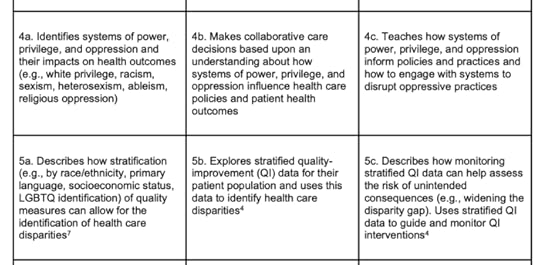


“Belonginess”? Right. Anyone sitting in a medical school classroom, whether faculty or student, who questions any of this ideological claptrap and its relevance to the practice of medicine is going to understand perfectly well the cost to them of speaking out against it. This is classic totalitarian practice: labeling slavery as freedom, and repeating it so often that people come to believe it.
Because of DEI, a lot of people are going to DIE, or suffer. From Live Not By Lies:
A Soviet-born US physician told me—after I agreed not to use his name—that he never posts anything remotely controversial on social media, because he knows that the human resources department at his hospital monitors employee accounts for evidence of disloyalty to the progressive “diversity and inclusion” creed.
That same doctor disclosed that social justice ideology is forcing physicians like him to ignore their medical training and judgment when it comes to transgender health. He said it is not permissible within his institution to advise gender dysphoric patients against treatments they desire, even when a physician believes it is not in that particular patient’s health interest.
How long will physicians be able to counsel people to lose weight for the sake of health, without being condemned as “fatphobic” thought criminals? You laugh, but this is coming. The United States built one of the best and most advanced health care systems in the world. We have problems with it, for sure — but now, ideologues are going to tear it apart to advance a political religion. This is not theoretical; this is actually happening. And who dares to stand up to it?
The post DEI Will Cause People To DIE appeared first on The American Conservative.
Bill Deresiewicz’s Escape To America
A reader recommends this great Unherd piece by the liberal writer William Deresiewicz, who originally wrote it for an unnamed magazine that is “politically neutral in theory,” but had been drifting Left, like the rest of the media, and which ultimately, therefore, rejected it. It’s about “escaping American tribalism,” and it begins in a way that speaks directly to my experience:
One summer afternoon when I was 23 — this was in 1987 — I was twiddling the dial on the radio in the apartment I was subletting on 114th St. when I stumbled on a station that was unlike anything that I had ever heard before. They were in the middle of a story about the Appalachian Trail, profiling some of the people who were hiking its two thousand miles that year. The reporting was calm, patient, intelligent, allowing the subject to find its own shape, unfolding slowly, minute after minute, like the trail itself.
What is this, I thought? What portal had I fallen through? I’d been raised on 1010 WINS, “all news all the time,” blaring the same rotation of headlines, weather, traffic, and trivia, in 40-second increments, for hours at a stretch. The piece that I had happened on that day went on, improbably, for over 20 minutes.
The program I was listening to was called All Things Considered, on a network with the unfamiliar name of NPR, short for National Public Radio. I was immediately hooked. In no time flat, I’d put it on whenever I was home. Morning Edition as soon as I opened my eyes, All Things Considered when I got back in the afternoon, Fresh Air during dinner. I fell in love with Robert Siegel’s wit, Renée Montagne’s voice, Scott Simon’s charm. These people got me. They shared my interests, my outlook, my sensibilities. For the first time, I felt myself reflected in the public sphere. “NPR,” I put it to a friend a few years later, “is my home in America.”
And that’s the way it was for over 30 years, through the advent of Talk of the Nation and This American Life, of On the Media and Here & Now. NPR became the soundtrack of my life — when I drove, cooked, ate, exercised, did laundry — three or four hours a day, every day.
I’m about the same age as WD, and though I found NPR in high school, a bit earlier than he did, my reaction was the same. I was more liberal back then, but I didn’t listen to NPR because of its gently liberal politics. I listened for its sensibility — because I felt like I was being invited to a conversation with smart and kind people who read books, and who noticed interesting things. It was the soundtrack to my life, even through the 1990s and first decade of this century, as I became more and more conservative. I tried listening to conservative talk radio, but it said nothing to me. I would rather listen to, and disagree with, the liberals of NPR, because there was usually something interesting going on there, and they didn’t insult my intelligence.
Boy, is that over — for WD too. He writes about how the network has surrendered to progressive propaganda and advocacy, such that it has become unlistenable. This is really true. The only time I can bear to listen to it now is when I’m in the car, and can’t put on a podcast. And even then I can only take it in small doses. Inevitably the sob story about the plight of wheelchair-bound trans lesbian immigrants of color being erased by Republican evildoers comes on, and off goes the radio. It is hard to explain to younger people how good NPR used to be, and how far it has fallen into leftist propaganda. As WD writes:
Overnight, the network’s entire orientation had changed. Every segment was about race, and when it wasn’t about race, it was about gender. The stories were no longer reports but morality plays, with predictable bad guys and good guys. Scepticism was banished. Divergent opinions were banished. The pronouncements of activists, the arguments of ideologically motivated academics, were accepted without question. The tone became smug, certain, self-righteous. To turn on the network was to be subjected to a program of ideological force-feeding. I was used to the idiocies of the academic Left — I had been dealing with them ever since I started graduate school — but now they were leaking out of my radio.
I write about NPR maybe more than I should, but it is from a position of a spurned lover. Funny, but the friend who first introduced me to NPR back in the early 1980s ended our forty-year friendship because though I publicly supported Trump’s second impeachment (the post 1/6 one), in so doing I said that Trump had done some good things as president. That was enough to cause her to trash four decades of friendship, which she ended by sending me a text. She is a faithful NPR listener still, and is the kind of fanatic to which that network’s programming caters. Wokeness has ruined NPR as surely at is has ruined the mind of my former friend.
WD explains that he started listening to various podcasters, Left and Right, because they were interesting. More:
But I didn’t start listening to them because I felt I had a civic duty to expose myself to opinions I disagree with. I started listening to them because I couldn’t stand the bullshit anymore. Because I needed to let in some air. They make me think. They introduce me to perspectives that I hadn’t entertained. They teach me things, and they are usually things the Times or NPR won’t tell you.
I have learned about the lab-leak hypothesis before it became an acceptable topic of discourse. About the lunacy of transgender orthodoxy (“affirmative therapy” for small children, the “cotton ceiling”). About the real statistics on police killings of unarmed black people (according to a Washington Post database, the number shot to death came to 18 in 2020, 6 in 2021). About the truth about Matthew Shepard (who was murdered, by a sometime lover and another acquaintance, over drugs), Jacob Blake (who was shot while stealing his girlfriend’s car, kidnapping her children, resisting arrest, and trying to stab a cop), and Kyle Rittenhouse (who worked in Kenosha, had a father who lived there, and was out that night, however misguidedly, to protect property and provide medical assistance).
More broadly, I have learned of the emergence of an alternative ecosystem of independent-minded journalists, experts, and thinkers, many of them exiles, voluntary or otherwise, from the established media. They are free of institutional allegiances. They are unintimidated by the Twitter mob. They are committed to free inquiry and free speech. They are unafraid of debate. For the first time in a good long while, I feel myself reflected in the public sphere. I have a home, once again, in America.
Read the whole thing — there’s a lot more to it, all of it good. I am not much of a podcast listener, but I know that I am in the minority in that way, in my social circles. How about you? Who are the voices you listen to now as relief from the predictable “Four legs good! Two legs bad!” bullshit?
It’s telling that of the people that Deresiewicz recommends, only John McWhorter gets published regularly in a mainstream media source. All the rest are too independent-minded, too unpredictable to be placed among the herd animals of the MSM.
The post Bill Deresiewicz’s Escape To America appeared first on The American Conservative.
Jussie Smollett Released
A black law professor at Georgetown wrote in the Washington Post that Jussie Smollett, the felonious hoaxer, should not go to jail? Why not? Excerpts:
I don’t believe Jussie Smollett but I recognize when a Black man gets railroaded through a justice system that is out to get him. A rich entitled actor is hardly the most sympathetic face of reform. Still, Smollett’s case demonstrates that when powerful elites decide they want a Black man locked up, nothing and nobody — not even the elected prosecutor — will stop them.
Butler believes Smollett committed the crime, but thinks he shouldn’t pay for it because he’s black? Really? Really. More:
Sending a Black gay man to jail for lying about being attacked will not encourage hate crime victims to come forward. Instead, it sends the message that they, rather than their assailants, are subject to being incarcerated if authorities don’t believe their stories. The most victim-sympathetic response would have been for the police to express disappointment in Smollett’s false report, but to let the community know that other allegations would receive the same intense response that Smollett’s had.
Butler’s argument is that they singled out poor gay black famous Jussie to be made an example of. Nowhere does Butler acknowledge why that might be. It’s because Smollett made the rounds of national talk shows to discuss how he had been beaten by two mysterious MAGA supporters, and how he was the face of the victims of white supremacy. He exploited his celebrity and the nation’s racial sensitivity to boost himself and to gin up hatred of Trump supporters. That’s why he had to be made an example of.
Well, it looks like Georgetown law professor and self-appointed tribune of the celebrity oppressed Paul Butler has received his fondest wish:
Convicted felon Jussie Smollett was ordered to be released from jail on Wednesday pending appeal of his 150-day sentence that went into effect last week for staging a hate crime hoax against himself and lying to law enforcement about it.
“The one-page order issued by the Illinois Appellate Court on Wednesday afternoon stated that Smollett was to be released from the Cook County Jail after signing a $150,000 recognizance bond, which would not require him to post any money,” the Chicago Tribune reported. “The only explanation offered in the order was that Smollett has never been convicted of a violent offense and would have completed his sentence of incarceration well before his appeal is decided.”
Smollett was sentenced on Thursday of last week to 150 days in jail, followed by 30 months on probation, and ordered to pay $120,000 in restitution and $25,000 in fines during his sentencing.
The Chicago Tribune writes:
His attorneys, however, had much to say: They were “very elated” that an Illinois appeals court had ordered Smollett released pending his appeal, were eager to try to overturn his conviction, and were adamant that sensational media attention and political machinations thwarted Smollett’s chance at a fair trial.
“We’ve been complaining about the disparate treatment of African Americans in the judicial system,” attorney Nenye Uche said. “Regardless of what you think about this case … the real question is, should Black men be walked into jail for a Class 4 felony? Shame on you if you think they should, that’s a disgrace.”
The “sensational media attention” that Smollett himself generated! And yes, they played the race card. They want Jussie out of jail because he’s black.
Why did the judge in his trial sentence Smollett to 150 days in jail? Saith the Tribune:
Smollett’s attorneys tried in vain to get Linn to stay the sentence pending appeal, but the judge declined, saying that while the wheels of justice turn slowly, “sometimes the hammer of justice has to fall.”
Yes, it does. Go back and watch the archived coverage of Smollett’s hate hoax. The media initially believed his ridiculous story without question, no doubt because if confirmed their prejudices. They boosted this creep Smollett, who lied about all of it. This wasn’t just a local story, but a national one, precisely as Smollett knew it would be, owing to his celebrity. You bet an example had to be made of him. Read the timeline of this case to remind yourself of how far he took this lie.
I suppose he could ultimately be compelled to serve his sentence, but I find it impossible to believe that if he were a normal man, and not a black gay celebrity, that he would receive such kid gloves treatment by the Illinois appeals court. To be a black gay liberal celebrity, though, is to hit the ruling-class trifecta in sacredness, though. If Jussie were trans, the state would have sent a Rolls-Royce limo to pick him up at the jailhouse.
Ask yourself: if Smollett were a straight white celebrity who pulled a hate-crime hoax falsely accusing unnamed black men of attacking him because of his race, and making the rounds of national TV to bemoan hatred in this country, is there any chance an Illinois court would be so soft on him? Hell no — and it shouldn’t be! It doesn’t take much imagination to come up with the column Georgetown Law professor Paul Butler would write about such a figure. But see, our ruling class has certain priorities. I’m old enough to remember the case of Rigoberta Menchu, the Guatemalan indigenous activist and 1992 Nobel Peace laureate, who was exposed as a liar. Though she disputed the allegations, it’s almost certain that Menchu had not suffered the oppression she claimed in the biography that made her famous (she later claimed, “It’s a testimony, not a biography”). I remember at the time her fraud was exposed, some left-wing commentators said that even if Menchu’s story wasn’t factual, many Guatemalan women suffered oppression, so the story should be accepted as a different order of truth.
Similarly with Jussie, it appears, he might not have been telling the truth, but black and gay men, and black gay men, are oppressed somewhere, so we should go easy on him, because of white supremacy.
This is how our ruling class sees it.
The post Jussie Smollett Released appeared first on The American Conservative.
March 16, 2022
Oikophobia & The Machine
I never watch TV in my Budapest apartment because the set only gets Hungarian channels … or so I thought. I found CNN on it, and decided to watch some of its war coverage. I turned it off after watching an interview with a retired US military officer who now is part of a think tank. It was stunningly bad journalism. The think-tanker offered nothing but rah-rah for the Ukraine resistance, and claimed that by not losing, Ukraine was winning. The interviewer never challenged any of it, not in the least, and boosted the guest’s point by quoting statements from Russian POWs — a mistake I regrettably made a couple of weeks ago, forgetting that promoting propaganda statements made by a POW is a violation of the Geneva Convention, and should never be taken as truthful, given that they are likely made under duress. But the narrative being sold in this segment was: Ukraine is winning this war, and we just need to believe more in their cause.
Maybe Ukraine is winning this war, but that is by no means obvious to anyone who looks at the battlefield map. I want a media that does its best to tell me what is actually going on in the world, not one that manufactures consent. That’s what Russian state media does, right? Why do you need state media when our private media in America are happy to take a party line without being told.
Take a look at this from a White House press conference:
This is wild pic.twitter.com/CNZZ1wVzcz
— Ryan Grim (@ryangrim) March 16, 2022
These reporters are not interested in the news; they are interested in goading the White House to get more involved in the war on behalf of Ukraine.
I turned the TV off after that. It made me furious. This is bad, warmongering, propagandistic journalism. I posted about it on Twitter, and one of my followers there said that Fox News is the same way, except when Tucker Carlson is on. I wonder if this is what the paleocons and the antiwar leftists thought back in 2002 and 2003, during the march-up to the Iraq War and its early stages. I recall hearing back then from a friend of mine, a longtime journalist and a military vet, furious over what he regarded as the media’s surrender to the urge to propagandize on behalf of the war. I thought of him at the time as an eccentric middle-aged liberal. Now I’m an eccentric middle-aged conservative, in the same sense.
Ross Douthat explains why populism is in philosophical disarray in the wake of the Putin invasion (the reversion of normie conservatives to pre-Trump hawkishness is a sign, he says), but warns liberals that they would be fools to think that Russia’s invasion solves the problems of our decadent society. Excerpt:
Last week, for instance, the Russia scholar Stephen Kotkin told The New Yorker’s David Remnick that Putin’s invasion disproves “all the nonsense about how the West is decadent, the West is over, the West is in decline, how it’s a multipolar world and the rise of China.” With the West rallying to a resilient Ukraine, “all of that turned out to be bunk.”
What was bunk was the idea that Putin’s Russia represents some kind of efficient postliberal or traditionalist alternative to the problems of the West, and one whose military could simply steamroller Eastern Europe. But all those Western problems remain: American power is in relative decline, China’s power has dramatically increased, and none of what I, as a self-appointed expert on the subject, would classify as the key problems of American decadence — demographic decline, economic disappointment and stagnation, a social fabric increasingly shadowed by drugs and depression and suicide — have somehow gone away just because Moscow’s military is failing outside Kyiv.
Since those problems are crucial to understanding where populism came from in the first place, it’s reckless for liberals to declare victory based on shifts in the international order while simply waving domestic discontents away. Populism’s poor fit for this particular moment has given an opportunity to its enemies and critics. But they will squander the opportunity if they convince themselves that the external challenge has somehow made the internal crisis go away.
Once the copium and the hopium blasts from TV, and the happy bellyfeels they give the American public, go away after this war ends, we will still be left with all the problems we had before Putin sent his tanks across the border. What has changed over the last three weeks is that our collective attention has been redirected and focused on an easy enemy to hate. That won’t last.
If you are one of those, liberal or conservative, who is comforted by the West’s response to Putin, let me dispel it by showing you something that should horrify anybody who cares about the future of free speech in this country. It’s a clip from a Yale Law School event, sponsored by the Federalist Society, in which a conservative Christian lawyer, Kristin Waggoner, and a liberal atheist lawyer, Monica Miller, came together to discuss areas of common ground in defending First Amendment rights. It degenerated into a debacle because, get this, Yale Law School students. In its story, the Washington Free Beacon has video of a student mob trying to disrupt the event inside the room. After they were thrown out by a law school professor who told them to “grow up”:
The protesters proceeded to exit the event—one of them yelled “Fuck you, FedSoc” on his way out—but congregated in the hall just outside. Then they began to stomp, shout, clap, sing, and pound the walls, making it difficult to hear the panel. Chants of “protect trans kids” and “shame, shame” reverberated throughout the law school. The din was so loud that it disrupted nearby classes, exams, and faculty meetings, according to students and a professor who spoke on the condition of anonymity.
Ellen Cosgrove, the associate dean of the law school, was present at the panel the entire time. Though the cacophony clearly violated Yale’s free speech policies, she did not confront any of the protesters.
At times, things seemed in danger of getting physical. The protesters were blocking the only exit from the event, and two members of the Federalist Society said they were grabbed and jostled as they attempted to leave.
“It was disturbing to witness law students whipped into a mindless frenzy,” Waggoner said. “I did not feel it was safe to get out of the room without security.”
As the panel concluded, police officers arrived to escort Waggoner and Miller out of the building. Three members of the Federalist Society say they were told that the Dean of Yale Law School, Heather Gerken, called the police, though the law school declined to comment on who asked for extra security. The Federalist Society did not call the police, the group’s president confirmed.
Lest you think this was a small, disruptive minority, the WFB goes on:
In the two days following the panel, more than 60 percent of the law school’s student body signed an open letter supporting the “peaceful student protesters,” who they claimed had been imperiled by the presence of police.
“The danger of police violence in this country is intensified against Black LGBTQ people, and particularly Black trans people,” the letter read. “Police-related trauma includes, but is certainly not limited to, physical harm. Even with all of the privilege afforded to us at YLS, the decision to allow police officers in as a response to the protest put YLS’s queer student body at risk of harm.”
Signed by 417 students, the letter also condemned Stith for telling the protesters to “grow up,” and the Federalist Society for hosting the event, which “profoundly undermined our community’s values of equity and inclusivity.”
Monica Miller, the progressive lawyer targeted by the mob, responded:
Miller told the Free Beacon she was taken aback by the email—not least because the Supreme Court case she was speaking about had been hailed as a victory for civil rights groups.
The case, Uzuegbunam v. Preczewski, involved a public college in Georgia that prevented a Christian student, Chike Uzuegbunam, from proselytizing on campus. After he graduated, Uzuegbunam sued, saying his First Amendment rights had been violated.
At stake in the case was whether plaintiffs could sue over past constitutional violations that did not result in any economic harm. The 11th Circuit had answered no, setting a precedent that could foreclose a wide range of lawsuits—not just those related to free speech and free exercise, but also to civil rights.
“A lot of our clients are LGBT,” Miller said. “If that ruling stood, and LGBT rights were violated in the South, we wouldn’t be able to help them.”
For her part, Kristin Waggoner pointed out that these students are future federal judges (a vastly disproportionate number of federal judges, including Supreme Court justices, come from either Harvard or Yale law schools), and that this is a very bad sign for the First Amendment. I remind you of what a closeted Christian law professor in an Ivy League law school told me back in this 2015 interview:
I spent a long time on the phone last night with a law professor at one of the country’s elite law schools. This professor is a practicing Christian, deeply closeted in the workplace; he is convinced that if his colleagues in academia knew of his faith, they would make it very hard for him. We made contact initially by e-mail — he is a reader of this blog — and last night, by phone. He agreed to speak with me about the Indiana situation on condition that I not identify him by name or by institution. I do know his identity, and when he tells me that he is “well-informed about the academy and the Supreme Court,” I assure you that from where he sits, and teaches, and from his CV, he is telling the truth.
I will call him Prof. Kingsfield, after the law professor in The Paper Chase.
What prompted his reaching out to me? “I’m very worried,” he said, of events of the last week. “The constituency for religious liberty just isn’t there anymore.”
Like me, what unnerved Prof. Kingsfield is not so much the details of the Indiana law, but the way the overculture treated the law. “When a perfectly decent, pro-gay marriage religious liberty scholar like Doug Laycock, who is one of the best in the country — when what he says is distorted, you know how crazy it is.”
“Alasdair Macintyre is right,” he said. “It’s like a nuclear bomb went off, but in slow motion.” What he meant by this is that our culture has lost the ability to reason together, because too many of us want and believe radically incompatible things.
But only one side has the power. When I asked Kingsfield what most people outside elite legal and academic circles don’t understand about the way elites think, he said “there’s this radical incomprehension of religion.”
“They think religion is all about being happy-clappy and nice, or should be, so they don’t see any legitimate grounds for the clash,” he said. “They make so many errors, but they don’t want to listen.”
To elites in his circles, Kingsfield continued, “at best religion is something consenting adult should do behind closed doors. They don’t really understand that there’s a link between Sister Helen Prejean’s faith and the work she does on the death penalty. There’s a lot of looking down on flyover country, one middle America.
“The sad thing,” he said, “is that the old ways of aspiring to truth, seeing all knowledge as part of learning about the nature of reality, they don’t hold. It’s all about power. They’ve got cultural power, and think they should use it for good, but their idea of good is not anchored in anything. They’ve got a lot of power in courts and in politics and in education. Their job is to challenge people to think critically, but thinking critically means thinking like them. They really do think that they know so much more than anybody did before, and there is no point in listening to anybody else, because they have all the answers, and believe that they are good.”
On the conservative side, said Kingsfield, Republican politicians are abysmal at making a public case for why religious liberty is fundamental to American life.
“The fact that Mike Pence can’t articulate it, and Asa Hutchinson doesn’t care and can’t articulate it, is shocking,” Kingsfield said. “Huckabee gets it and Santorum gets it, but they’re marginal figures. Why can’t Republicans articulate this? We don’t have anybody who gets it and who can unite us. Barring that, the craven business community will drag the Republican Party along wherever the culture is leading, and lawyers, academics, and media will cheer because they can’t imagine that they might be wrong about any of it.”
He went on to say:
There is a bitter irony in the fact that gays coming out of the closet coincides with traditional religious people going back into the closet.
“Gays have legitimately said that it’s a big deal to have laws and a culture in which they have been forced to lie about who they are, which is what you do when you put them in the position of not being able to be open about their sexuality,” Kingsfield said.
“‘Don’t ask, don’t tell’ forced them to segment off a part of their lives in a way that was wrong. What they don’t realize today is that the very same criticism they had about ‘don’t ask, don’t tell’ can be applied to what is happening now to Christians: you can do what you like in private, but don’t bring who you are into the public square, or you can be punished for it.”
On the political side, Kingsfield said it’s important to “surrender political hope” — that is, that things can be solved through political power. Republicans can be counted on to block the worst of what the Democrats attempt – which is a pretty weak thing to rely on, but it’s not nothing. “But a lot of things can be done by administrative order,” he said. “I’m really worried about that.”
Read it all. I hadn’t even started writing The Benedict Optionat that point, but the professor told me in that conversation that I needed to get busy on it, because the idea is important to Christian survival in the world now being born.
Anyway, the key point here is that the way the abhorrent Yale Law students behaved in a protest supported by a strong majority of Yale Law students, is a sign of steep decline. These hateful people are tomorrow’s ruling class. You may never meet any of them, but once they ascend into the ruling-class institutions, they are going to affect the lives of all of us.
If you’ve never read the Substack newsletter of the English novelist and essayist Paul Kingsnorth, The Abbey of Misrule, do yourself a favor and buy a subscription. I’m not sure how much of his latest essay is behind the paywall, so I’m not going to quote it at length. Kingsnorth is a recent Christian convert who has spent his career writing in defense of small, local places, and environmental protection; it’s no accident that he was chosen to write the introduction to a recent collection of Wendell Berry essays. Most of his writing could fit comfortably on the non-ideological Left. But he writes that a few years ago, when he praised a film that celebrated the lost old England of village life, he was widely denounced as a racist and a Nazi by people who had once been his champions. It staggered him, and it took him a long time to recover. Kingsnorth writes:
The more I dug into this, the more something else became clear: the Internet mobsters resisting these new demons, though they presented themselves as champions of the marginalised and overlooked, just happened to have interests which aligned with those of the Machine.
It had become clear enough on my travels as a young writer, just as it had in my environmental and political activism at home, that the one thing that really put a spoke in the wheels of the rolling globoculture of consumer capitalism was a connection to place. People who dwelt in strong communities, who lived non-consumerist lives outside the market system: these were the Machine’s greatest enemies. These were the people and communities that the Black Ships of globalisation had dedicated nearly two centuries to uprooting, enclosing, scattering and corralling within the bounds of the market system. Now though, just as they were supposed to have been defeated, they seemed to be rearing their heads again, opposing the culture of inversion and the economics of transnational capital that lay behind it.
The kind of mob that came after me was not what it declared itself to be. It was not the righteous fury of the Wretched of the Earth rising up against reaction and prejudice. It was the beneficiary class of the age of the Machine defending its turf, and it had the language now to do it: a jargon-heavy lectionary of wokespeak which posed as liberatory rhetoric, but which actually oppressed and colonised anyone, of any colour, in any place, who so much as questioned the new status quo. The laptop class; the PMCs; the new puritans; the urban elites: whatever you called them, the culture of inversion was not rising from the bottom of society, but being directed from the top.
Kingsnorth says that these elites really do think the rest of us are, well, deplorable. This, he says, is class warfare, and it is being carried out on behalf of global capital. This is why we have Woke Capitalism. One more:
Amongst the growing and increasingly baroque list of cultural codes we are instructed to adhere to today, it is oikophobia – a performative and often racialised self-loathing – that is the central signature of the cultural elites. ‘Strategic white-bashing’ by a largely white haute-bourgeoisie is one of the weirdest manifestations of the new order, but it is not as irrational as it might look. Rather, it is a signal. Just as the promoters of the new anti-racism declare that ‘not being racist’ is not enough, so the same people can never be content with simply ‘not belonging’. We must demonstrate that we are anti-belonging if we want to show that we reside among the Good People. Only a declaration of independence from our own place, history and culture will mark us out as true children of the Machine.
If all modernity’s revolutions haved acted, as I’ve previously rashly claimed, as ground-clearance operations for the Machine, then the ‘culture war’ is the latest iteration, the revolt of the elites is its proximate cause, and the clumsy and divisive pseudo-ideology of ‘wokeness’ is the mask that the Machine wears as it eats us. Globalised, top-down and universalist, waging war against all limits, borders and traditions, the West’s new ideology is a perfect fit with the needs of capital. This is why it is promoted, funded and disseminated by universities, NGOs, think tanks and transnational corporations. This is why you will hear the same language being parroted around the world, as American, British, French or Irish elites talk about ‘whiteness’ and ‘decolonisation’ and ‘diversity’ in identical vocabulary transmitted to them through their identical corporate smartphones.
Not sure if you have to be a subscriber or not, but read the whole thing if you can — and if you can’t, subscribe; you won’t regret it.
Whatever America once was, it no longer is. You watch that Intercept collage of White House reporters attempting to drive the president towards war, and you dip into CNN and watch a network following the same line, and you ask: who does this benefit? Not ordinary people — the kind whose sons and even daughters will be sent to fight Russia, if we get involved. They will be putting their lives on a line to defend a regime increasingly directed by people like the privileged brats of Yale Law School, who will be moving in the years to come into positions of real power, which they will use to push around and to crush anybody who gets in their way.
The British conservative writer Ed West writes today about what he calls “the oikophobia of the Right” — that is, the hostility to their home countries some people on the Right have developed. He writes:
They don’t hate their inheritance like the radical Left, but they hate what their home has become, where progressives wearing the skin of the civilisation they have killed, like a zombie western civilisation. They also feel that any victory will only further strengthen those in charge.
That perhaps explains why so many populists have badly misjudged this conflict. As Eric Kaufmann wrote this week: ‘I watched as Tucker Carlson and J.D. Vance defended Putin, or adopted the Kremlin’s critique of Ukraine’, Carlson calling it a ‘pure client state of the United States State Department’. While there are claims for a realist case ‘tempering Ukrainian demands and accommodating reasonable Russian security concerns, the inability of some to reject the moral equivalence of Ukraine and Russia was glaring.’
Like oikophobes in times gone by, some on the Right have created an imaginary foreign country to reflect on their own society’s shortcomings. ‘The perception that Russia is a masculine, white, Christian country unafraid to stand up for its traditions forms part of its appeal to conservative populist thinkers,’ Kaufmann writes: ‘“Putin ain’t woke,” Steve Bannon said last month. “He’s anti-woke.” The Russian President’s 2019 interview with the Financial Times, when he declared that liberalism has “become obsolete” clearly impressed many Western conservative populists. Against Drag Queen Story Hour and self-flagellation about the sins of the past could be set Putin’s macho, Christian, nationalist Russia. Clearly, some populist elites took the bait.’
Well, I was never pro-Putin, in the sense that I saw him and his government as any kind of model for Americans, though when he said something of which I approved, I praised him. In this case, I have said that his invasion was wicked, and that I hope he loses — but that I also expect Putin’s loss to rally illiberal leftism in Europe and North America. Though Ed West doesn’t bring my name up, I am fairly oikophobic in a narrower sense. He writes:
Fear of progressive hegemony is not unreasonable. What conservatives (and some liberals) worry about western society is not just that it’s decadent, but that its decadence is inherently intolerant. In this pink police state it is ‘forbidden to forbid’ — sometimes on pain of imprisonment, or at the very least loss of employment.
While the MI6 head’s comments about LGBT rights seem inane at worst, far more telling was the defence made by one member of the intelligence agency, who said: ‘Racism, sexism, transphobia, homophobia and other forms of bigotry are some of the biggest drivers of nationalist and fascist behaviour which directly lead to wars of aggression. People miss the bigger picture by trying to compartmentalise these issues, it’s all connected.’
‘It’s all connected.’ Those are not heartening words, especially if we enter a new cold war with Putinism as the opposition ideology, perhaps treated with more hostility than even communism, because communism was at least credited with beating Hitler (and given a pass for its noble intentions). Already, there is even a hint of the 1950s in the search for alleged Russian assets within.
Western sanctions against Russia have been compared to ‘cancelling’, a disturbing analogy because, as well as losing their job or facing public humiliation, some people in the West viewed as extremists have already had their bank accounts taken away. The global online economy gives the powers-that-be tremendous power to unperson people, or whole states. Woke capital has been weaponised by the Ukrainian war; and while for now we mostly agree it is on the side of the angels, we can’t always be sure in future.
Read the whole thing. I cannot pretend to believe that whatever my country, the country I love, does is right, simply because it is my country. The wickedness of Vladimir Putin or Xi Jinping doesn’t make America automatically good. We Christians must be very careful not to be idolaters. I grieve over what America is becoming, but I see no point in sitting back rending our garments, as opposed to reading the signs of the times and preparing for what’s coming. You know what’s coming? Yale Law students on the federal bench, interpreting the Constitution to dismantle free speech and religious liberty. More sexualizing of children, more woke racism, more Woke Capitalism, more using financial instruments to punish dissenters, more concentration of power in the tech industry and its deployment to control people and compel them to be compliant to the Machine. More war. More porn. More manufactured moral outrage and hatred of dissent. More living by lies.
The post Oikophobia & The Machine appeared first on The American Conservative.
Mark Galli Accused Of Sexual Harassment
I was genuinely shocked and distressed when I saw this news today, in Christianity Today:
For more than a dozen years, Christianity Today failed to hold two ministry leaders accountable for sexual harassment at its Carol Stream, Illinois, office.
A number of women reported demeaning, inappropriate, and offensive behavior by former editor in chief Mark Galli and former advertising director Olatokunbo Olawoye. But their behavior was not checked and the men were not disciplined, according to an external assessment of the ministry’s culture released Tuesday.
The report identified a pair of problems at the flagship magazine of American evangelicalism: a poor process for “reporting, investigating, and resolving harassment allegations” and a culture of unconscious sexism that can be “inhospitable to women.” CT has made the assessment public.
“We want to practice the transparency and accountability we preach,” said CT president Timothy Dalrymple. “It’s imperative we be above reproach on these matters. If we’re falling short of what love requires of us, we want to know, and we want to do better.”
In separate, independent reporting, the CT news editor interviewed more than two dozen current and former employees and heard 12 firsthand accounts of sexual harassment.
Women at CT were touched at work in ways that made them uncomfortable. They heard men with authority over their careers make comments about the sexual desirability of their bodies. And in at least two cases, they heard department heads hint at openness to an affair.
More than half a dozen employees reported harassment from Galli or Olawoye to a manager or HR between the mid-2000s and 2019. But neither leader was written up, formally warned about their inappropriate behavior, suspended, or otherwise punished. There is no record that Christianity Today took any corrective action, even after repeated complaints of nearly identical offenses.
“The culture when I was there was to protect the institution at all costs,” said Amy Jackson, an associate publisher who left what she said had become a hostile work environment in 2018. “No one was ever held accountable. Mark Galli was certainly protected.”
In a written response, Galli denies most of this. Excerpt:
Some parts of the story are, therefore, accurate, and I’m troubled that I distressed any women, or men for that matter, by anything I said or did. But the fact of the matter is that I never in 30 years ever approached a women with the intent of sexually harassing, intimidating, or “hitting” on her. Never. But some women believe I had done that, and for that I’m regretful.
As anyone who has read this newsletter knows, I am sometimes apt to write something that I later recognize was confusing or misleading, and I am forced to retrace my steps to clarify. This has also been a character flaw in my interactions with people that crops up now and then, as anyone who has worked with me can testify. So that point in the article is fair as far as it goes.
But I was stunned to read the piece and discover that there were a number of incidents reported that either never happened or the context in which they happened was left out. Just three examples among many: It is said that I lingered over a woman’s bra clip and that my hand got caught in her bra. Never happened. It is said that I “felt up” a woman. Never happened. It is said that I said aloud that I like to watch women golfers bend over. Never said it. So amidst the stories in which I can see I genuinely offended or confused some women, there were allegations that just mystify me.
I don’t know what the full truth is, though even giving Galli the benefit of the doubt, it is hard to deny the large numbers of current and former CT women employees making the same allegations. I would prefer to pass this story by, in part because I slightly know Mark Galli, and like him, but it would be hypocritical for me to do that, given that I have praised Galli in this space in the not-too-distant past. It was about an essay he wrote as an ex-Evangelical (he’s now Catholic), about how elite Evangelicals have sold out to the world. I cited in my blog post Galli’s saying that when he was at CT, the magazine often shied away from taking positions that might encourage fundamentalist Christians, therefore embarrassing its staffers in front of the secular world. Then I cited this passage from Galli’s essay:
Another example was [CT‘s] accommodation to a more radical feminist worldview. Once I wrote a draft of an editorial arguing that traditional traits associated with masculinity (like competition, aggressiveness, etc.) were not intrinsically toxic but needed in every human community (and, yes needed to be moderated!). The reactions of three key staffers (one male and two females) was shock and fear; they assumed I was justifying such things as wife abuse, even though in my draft I twice condemned the phenomenon. I put the editorial aside for the time being because it was not worth the staff dynamics I would have had to navigate at the time, since I sensed their anxiety would be shared by many other staffers. I hadn’t recognized how much fear and suspicion of masculinity pervaded the hallways.
I cited that as a jumping-off point to discuss how Evangelicals and Catholics who come to visit our Orthodox parish often say that they are drawn to its unfeminized liturgy and spirituality. It’s a hard thing to explain, even to myself, but Orthodoxy manages to be masculine without being macho. I’m not quite sure how that works, but this is something widely observed by American converts to Orthodoxy. I think a big part of it is that the Orthodox Church does not exist to make you feel good in your okayness. Its approach is therapeutic, but in the sense of, “pray, fast, confess, repent — this is the sure way to healing handed down from the Fathers.”
Anyway, re-reading that passage from Galli’s October 2021 essay in light of today’s news is jarring. I hadn’t recognized how much fear and suspicion of masculinity pervaded the hallways he wrote back then. I took that at face value, because I’ve seen the same thing in environments where educated young women are present. But now I wonder if the “shock and fear” on the faces of the female CT editorial employees was not so much fear of masculinity as shock that Galli would be saying those things, if they believed he was a serial sexual harasser.
If Evangelicalism has a problem with being overly feminized, then the accusations against Mark Galli do not make it go away. But they do make it harder to take masculinist critics seriously. When the Catholic Church went through its reckoning with pervasive sexual abuse by the clergy, and cover-up by the bishops and others running the institutions of the Church, it did not negate the Church’s moral teachings about sexuality, including homosexuality. But it did blow up the credibility of those proclaiming the teachings, making it much harder to hear them and take them seriously. Nobody wants to hear a Catholic bishop who looked the other way while gay priests were molesting boys talk about the importance of chastity. Similarly, nobody wants to hear a high-profile former Evangelical talk about the hostility to masculinity within elite Evangelical culture when he stands accused of sexually intimidating women in the workplace, and repeatedly.
I have a couple of male Christian friends who, in their private lives, are dealing with epic cases of what you might call “toxic femininity.” It happens. Because all people are sinners, there is no reason to think that women are less likely to sin, and to sin in ways that are more characteristic of female temperaments, than men are to sin, and to sin in ways that are more typically masculine. I find that the older I get, the less I understand about men and women and what makes them treat each other in particular ways. It’s weird, because usually the more wisdom you gain, the clearer things are. But assuming that Mark Galli is guilty of the allegations laid against him (and remember, he denies some of it), then why would a man — especially a married Christian man — behave that way? Even if you had those desires for women, surely a mature older Christian knows better than to act on them. Similarly in the two private cases I reference earlier, it is exceedingly difficult to understand why Christian women would say and do the things these women are saying and doing to damage the men in their lives? In all these cases, everybody professes Christ, but that profession seems to restrain no one from causing sexualized distress and pain to others.
I have no answer for any of this. But I’m grateful that we can talk about it, instead of sweeping it all under the rug for the sake of protecting institutions. I hope you will read CT president and CEO Tim Dalrymple’s apologetic editorial about the situation. It strikes me as exemplary, both in terms of disclosure, and in how the institution under his leadership (he came aboard in 2019) handled the matter.
UPDATE: There’s some interesting pushback in the comments section against the idea that Galli is guilty of anything other than offending the too-delicate sensibilities (they say) of certain women at CT. A characteristic comment:
“More than half a dozen employees” and “12 firsthand accounts” do not equal “large numbers of current and former CT women employees”. How many women worked at the place over those 10+ years?
Several years ago I noticed that the harassment training at my large company changed: it went from harassment being defined as something objectively offensive to whatever a particular woman might get upset about. Given that this is the standard, everyone is bound to say something that upsets someone else eventually. I’ve never read CT and I know nothing of Mark Galli. I’m just a suspicious middle aged attorney who thinks this is more than likely a bunch of horses!t. Not that it will turn out that way; accusing someone is 95% of the battle in the current climate. Accused = guilty to a large number of people in 2022. As for me, call me when these women have proven what happened in court and been awarded damages, and then I’ll believe them – not before. I’m old fashioned that way.
The post Mark Galli Accused Of Sexual Harassment appeared first on The American Conservative.
Leftism Does Not Mean Weakness
A characteristically interesting and provocative comment from Matt in VA, left on the West, Still Declining comments thread:
One of the mistakes that American conservatives make most often and most consistently is confusing liberalism and leftism with weakness. That conservatives continue to make this mistake over and over again even when liberals are grinding them into the dust and tossing them in the ashcan of history just shows how important it is to conservatives, how it undergirds their entire worldview, to believe this, I would say, very un-Christian idea that right makes might.
Even today in the year of our Lord 2022, when small minorities like gays have stomped sexually traditional American Christians in to the ground politically, we get these assertions that a nonbinary and trans army is a weak and feeble army, that pajama boy leftists are pushovers, etc. We also see claims that “traditional” rural and exurban communities are safe and Orderly, while liberal/Democratic areas are unsafe, with the implication being that the people of those areas are too weak or compromised to create conditions of order.
But something that I have seen borne out for my whole life is that liberalism and leftism are stronger than conservatism and traditionalism, and generally win any contest, at least sooner or later. One *must* abandon this idea that the correct or the truer Way is the stronger way, at least in this life. The conservative or traditional position on the purpose of marriage may be the best one, the most honest, the most tested, the most rational and the most beautiful, but like many beautiful things, it is quite delicate in itself as a *force* in our world. The degree to which it must be shored up, promoted, protected, ingrained in children nearly from birth, normalized, etc is quite astonishing. Yet conservatives seem to have this impression that such ideas or values can “win in the marketplace of ideas” simply by being baldly stated over and over, without any sort of real power or force being brought to bear, when all of the venal worldly benefits and sticks and carrots are on the other side.
The US military could devote fully 40% of its training to inculcating the deconstruction of the gender binary and the promotion of Kendian anti-racism, and it would not necessarily make the military “weak,” not so long as America continued to have the incredible amounts of $$$ it has. Now, I know, movement conservatives will reply that we have all this money because we have the best values (free enterprise, free trade, freedom to do business), and so our hugely dominant financial position demonstrates our moral superiority. This really is how movement conservatives think! The line in the Bible about camels passing through needles’ eyes is one that American conservative Christians just absolutely have no interest in whatsoever even as they accuse liberal Christians of being selective in their readings of the Gospels. But the reality is that atomizing, commodifying, annihilating consumer capitalism, or whatever you want to call it, leads to worldly power that few can resist, and that power is *real*, and it is certainly not Christian, nor is it “rational” in a secular sense, to continue to insist on this idea that that sort of worldly power is really “weakness.”
Conservatives are very attached, emotionally attached, to the idea that their values are the values of strength, manliness, forthrightness, the John Wayne values. They are attached to the values of the frontier, the sphere in which every man may need to be the law unto themselves; they are attached to the values of a space in which women are not a serious or viable force. Thus we see the *incredible* weakness of conservatives: they have NO skills or abilities to resist forms of power or aggression or coercion that, absent from frontier conditions, are nevertheless very present in the city/in civilization. What might work in frontier conditions will not work in conditions of domestication or in conditions where the space in which one moves is *owned.*
The world in which one operates, if one is a wolf, is very different from the world in which one operates, if one is a domesticated dog. The wolf’s life may be nasty, brutish, and short, and the domesticated dog’s life may be significantly longer and significantly easier, but there is an entire transmutation and reversal of all values (so to speak) here — is what the domesticated dog has obtained worth what has been lost? The conservative looks at the wolf, and compares it to the French bulldog, and says, here is no contest at all. But if enough French bulldogs are harmed, and their owners pass a law legalizing the shooting of wolves from aircraft, traps, homing devices so that the wolf dens can be found and the wolf pups massacred, etc., perhaps in fact it is no contest at all, in the other direction. Perhaps another way of putting this is that the conservative still believes in the “silent majority” and thinks he has the masses on his side. There so often seems to be little or no understanding of what it means when you cannot count on that or assume that, when you have to operate in a hostile information environment or under a *regime* that is hostile. Again, this fantasy that the values and tactics of the frontier are the only applicable or important ones; but this just does not pertain most of the time for most people.
I am very convinced by arguments that the West is in moral and — especially — aesthetic decline, but over and over again I see conservatives taking this intellectual shortcut or falling into this intellectual trap and asserting that that means the West is *weak* or about to collapse or at least to falter, and I do not see that at all. Moral and aesthetic decline, increasing dishonesty and vapidity, etc., do not mean worldly power is about to drop or disappear. Where on earth is it promised that right will make might? Don’t people understand the self-flattery and indulgent thinking that is amply demonstrated by the idea that the United States is rich and powerful due to having the right beliefs and values and ideals? Perhaps our dominant position in the world is in fact evidence that the opposite might be true? OK –one hears it — this sounds like Leftism, and conservatives and the Right wing are by definition not Leftists, so of course they don’t see things this way. It is Leftists who say the USA is powerful and therefore bad — exploitative, unjust, greedy, etc. To which I would say, it is just as great an error to automatically ascribe power to desert, as it is to ascribe power to greed or megalomaniacal dominance. To be sure, there is something annoyingly ungrateful about the leftist who sneers at his own homeland and preens over his attachment to the alien and distant; but there is something off putting about the smug bourgeois too. The fact that it’s gross to see the leftist indulge in conspicuous telescopic philanthropy does not mean that it’s not also gross to have to listen to the self-congratulation of the soft-handed middle class — épater les bourgeoises may be tiresome but there’s a reason it’s also effective.
The truth of the world, I think, is that there are always dangers on both sides; there is always a Scylla AND a Charybdis. There is the danger of Communism on one side, but there are the dangers of out-of-control financialization and commodification as well. There is the danger of narrow and bigoted provincialism, and the danger of cosmopolitan atomization and disintegration. The danger of rigidity so inflexible the whole system breaks, and the danger of flexibility that preserves and sustains nothing at all.
Again, it is possible to imagine a US military that gives over ten or twenty times the amount of time and resources to promoting the Democratic Party platform to its members, without it necessarily being the case that this “weakens” the military or the standing of the US in the world. The question is whether the $$$$ is there or not, and how others stand or compare in regards to that money. Evolution and survival of the fittest are *amoral.* That which is good and noble and beautiful may go extinct, while that which is horrible may survive or even thrive. Beautiful, noble, exotic species of birds and beasts may disappear in huge numbers, yet the virus persists. The horrible, poisonous “marketplace of ideas” god that American conservatives worship (or, at least, assume) is a false god–the “best idea” does not necessarily win, the most cursory look at the history of the world tells us that. “All that is required for evil to triumph is for good men to do nothing.” The nearly total capture of all American institutions by the progressive worldview and mindset does not automatically or necessarily mean that these institutions will weaken, only that they will transform. This transformation can indeed come with even greater strength, as the progressive worldview is optimized for making money and is indeed fanatically devoted to the worldly and venal values of money and vulgar status. It would be strange indeed for an ideology that is structured around promoting the interests of multinational corporations and international capital over all else (including real differences of religion, tradition, sex, etc.) to lead directly to *weakness* — one might expect the internal contradictions of such an ideology or its disintegrating and atomizing qualities might eventually lead to problems, but not that it would immediately bring about weakness!
Thoughts? As ever, remember that my citing someone’s comments does not mean I agree with them all, only that I find them interesting and worth considering.
The post Leftism Does Not Mean Weakness appeared first on The American Conservative.
Russia And Wrath
Last night in Budapest, I went to a small dinner arranged for visiting American students. There I saw a grand Hungarian lady I know stand and raise a glass in tribute to “the Russians”. This high-spirited lady comes from an aristocratic family who had been completely dispossessed by the Soviets and their Hungarian and Czechoslovak lackeys. She suffered exile for many years, and after returning, spent many years and enormous resources (whatever she had left) reclaiming and restoring the family house that the Russians stole from her parents. Yet here she was, drinking to Russians. Why? Because she is a woman of the world, and recognizes that the greatness of Russian culture is not the same thing as the cruelty of the Russian state. And because, as she explained, even in exile she gained some good things. She ended by raising her glass, and saying, “Na Zdrovie!”
I thought: that is what it means to be cultured. This woman has all the right in the world to be consumed by hatred for all things Russian, but there she is, pointing out by example to these young Americans the value of not allowing hate to consume your understanding. The courage it took to stand at a table in these times, in front of strangers, and pay tribute to the Russian people is no small thing. But then, the immense suffering her family endured at the hands of the Russians and their Magyar and Czechoslovak servants earned her the right.
I thought about her this morning when I read Prof. Gary Saul Morson’s impassioned condemnation of those in American and European life who have lost their heads in spasms of anti-Russian bigotry. Excerpts from the Russia scholar’s essay in First Things:
There is another way to silence opponents today: Claim an issue is one of “moral clarity,” a phrase that signals the question is “settled” and allows for no further discussion. In such cases, facts don’t give rise to a narrative, the narrative determines the facts. When an issue is declared “morally clear” in this way, the implication is that only the immoral could entertain the slightest doubt. The world divides neatly into good and evil. There can be no conscientious skeptics. And when people are unqualifiedly evil, anything one says about them or does to them becomes justified.
As a specialist in Russian literature and thought, I am more than familiar with this way of thinking. It is how the Soviet Union operated. Once the Party ruled on a topic, gray areas vanished. That is why every vote of the Soviet parliament was unanimous and elections offered only one candidate. The very idea of disputable questions was a bourgeois mystification, designed to keep the working class from acting decisively in its interest. By the same token, all issues became zero-sum games. In first-year economics, one learns that in any unforced transaction both sides benefit or they would not make the exchange, but in Marxist-Leninist thinking, one side’s gain is necessarily the other side’s loss.
Yes, this is how it works under our soft totalitarianism. More:
But as with the cancel culture of recent years, the further one goes, the more virtuous one feels. Whatever assertion favors the right side must be accepted and whatever action harms opponents must be justified. True enough, official Russian propaganda transmits outrageous lies and the regime suppresses dissenting voices. Does it follow that everything said by the Ukrainian government and sympathetic observers must be true—or that anyone who calls for the skepticism normally applied to all partisan sources must be a Putin supporter? Should we, too, banish dissenting voices?
In the spirit of moral clarity, anything “Russian” has become immoral. … Some Russian performers and public figures now must publicly declare opposition to Putin in order to perform. How long before Jewish performers and academics will have to declare their opposition to Israel, or Muslim ones to whatever Muslim land we are presently fighting?
Oh, it’s coming. Morson lists a number of cancel-Russia initiatives, and outright attacks on innocent Russians in the West, of which I had not heard. One more quote:
If Russian history teaches anything, it is that such “moral clarity” has no limits. If all right is on one side, then anything—literally anything—one says or does is justified. Indeed, to stop short of the most extreme measures is to indulge evil, which means risking the charge of complicity. When Stalin sent local officials quotas of people to be arrested, they responded by demanding still higher quotas. It was the safest thing to do to prove one’s loyalty. No one ever secured his position by calling for less severity to enemies. When everything is black and white, sooner or later everyone is at risk.
It is a savage irony that the same totalitarian spirit that animated the Soviet Union, and which has been adopted by the postliberal Western left to serve its ends, is now being used against all things Russian — and people here are so busy enjoying the pleasure of hate that they don’t even see the hypocrisy. Again and again, I warn you that the kinds of things identified in Live Not By Lies are going to become more general in the wake of this Russian invasion. When I was a kid, we had an actually liberal Left that pushed back against these primitive instincts to hate indiscriminately those we identified as enemies. Now the Left leads the charge — now against Russians and their culture, but before that against races, religions, classes of people, and others they deem evil — and too many on the Right, at least in the case of Russia, are going right along.
I can anticipate what some of you will say: “Why are you spending so much time defending Russians when Ukrainians are dying under Russian bombs?” The answer is simple: because very few people need to be convinced that Russia’s war on Ukraine is wicked, and deserves condemnation. A distressingly large number of people need to be convinced that it’s not okay to demonize all Russians, and all things Russian, in reaction to Putin’s unjust war.
Morson ends by quoting Solzhenitsyn’s warning that the line between good and evil runs not between peoples, cultures, or anything like that. The line between good and evil runs down the center of every human heart.
I saw this horrifying statement today in which a Ukrainian broadcaster, upon finding out that a friend of his in the army had been killed, wept and quoted Adolf Eichmann favorably, saying that the children of one’s enemies — in this case, Russian children — must be murdered.
fakhrudin sharafmal on ukrainian channel 24 quoting adolf eichmann & calling for the killing of russian children, translation in next tweet pic.twitter.com/WbPQYRpm9g
— Russians With Attitude (@RWApodcast) March 15, 2022
— Russians With Attitude (@RWApodcast) March 15, 2022
It’s horrifying, and nothing justifies that. One reason Russian troops are now in Ukraine, with the majority support of the Russian people, is because the Putin government has spent years propagandizing ordinary Russians to hate Ukrainians. Hatred breeds hatred. Yet watching the clip, and reading the translation, I thought about how I would feel in that situation. I remembered once sitting at my desk at National Review, back in 2002, months into writing about the Catholic sex abuse scandal. I wasn’t much older than that Ukrainian guy appears to be (which is to say, I had much less self control back then). I read about a particularly horrible case, and found myself wishing that someone would shoot the abusive priest dead. And then I let my mind drift into fantasizing about how a vigilante squad could start kneecapping clerical pederasts. That would stop the abuse, surely, and deliver justice for victims.
Then I caught myself, and repented of my evil thoughts. I was wrong to entertain those kinds of thoughts, though even from this distance in time the impulse to vengeance is not alien to me. You have read me saying here in this space since the Russian war on Ukraine began how bitterly I regret allowing my vengeful passions to overtake my judgment back in 2002-03, and therefore backing the Iraq War. Being civilized requires us to go to the utmost to restrain ourselves. In Dante’s Purgatorio, the pilgrim Dante finds himself on the terrace of Wrath as he makes his way up the mountain. There the Wrathful are purged of their tendency to indulge themselves in anger. The terrace is a ledge on the mountain where the Wrathful dwell in heavy smoke and a shower of sparks — this to mimic the effect of anger (e.g., it clouds our ability to see clearly). I wrote about it here. In this canto of his Purgatorio, Dante blames the unchecked wrathful passions of his fellow Tuscans for the war and calamity that has befallen his native land. Marco the Lombard, one of the Wrathful suffering purgation there, tells Dante that if we would restore peace and order to the world, we have to begin by restoring peace and order to our own hearts.
This is a lesson that I, personally, cannot learn often enough. I am in no position to lecture anybody about unbound wrath, because it is one of my besetting sins. All I can tell you is what I have learned from my mistakes, and what I have learned from the wisdom of literature, and the Christian religious tradition.
That tradition includes, above all, Orthodox Christianity. It has been in Orthodoxy, which I’ve practiced for almost 17 years now, where I first learned about battling sin as an exercise in restraining the passions. (To be clear, all forms of Christianity teach the concept of sin, but in my experience, Orthodoxy has the most articulated model of sinfulness coming from disordered passions.) I first encountered it in reading the Kyriacos Markides book The Mountain Of Silence, an introductory book about Orthodox spirituality that played a key role in my own conversion. The key figure in the book is “Father Maximos,” the name Markides gave to an Athonite priest-monk who went on to become Metropolitan Athanasios of Limassol, Cyprus. Father Maximos explains that sin begins with negative thoughts (logismoi) that attack us, and tempt us. If we allow them to penetrate, they will plant a seed that will blossom as sin. From the book:


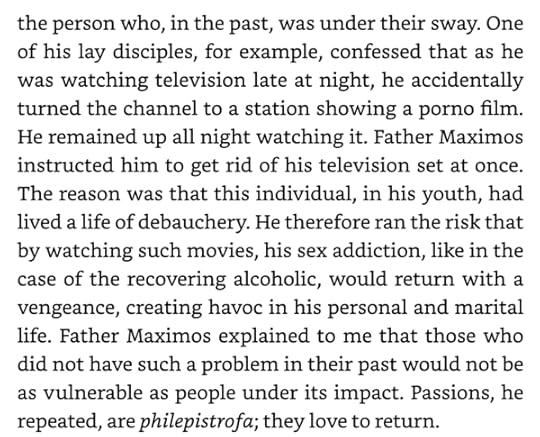
It’s sad for me to quote “Father Maximos” this morning. I headed out for the Budapest airport to catch a flight to Cyprus, connecting through Munich, to go interview him tomorrow. But there was an epic traffic jam as we neared the airport, and I sat in traffic for an hour, in the taxi. I missed my flight, and it wasn’t possible to rebook for today. I have missed my chance to meet and interview the great spiritual teacher. I was feeling pretty angry and disappointed over it, but then sitting down to write about the Russia thing when I got home, and going back to Father Maxime’s teaching on logismoi, set me straight. And thinking too about how the Hungarian lady paid tribute to the Russians, even though the Soviet government made her and her family suffer, because even in exile they found good things, turned me around, and now has me trying to find the blessing hidden in my botched journey to Cyprus. Though Orthodoxy is not exclusively a Russian thing — the overwhelming majority of American Orthodox are in the Greek tradition — I came to it via the Slavic path. The great gift of Orthodox spirituality, including Russian Orthodox spirituality, would have been lost to me had I chosen to demonize all things Russian.
Look, I’m not going to say that we should look for the good side of Russia’s war. That would be cruel and inhuman. (And I’m certainly not comparing frustration over a missed flight to rage over friends and family lost in a war, except in the most general way!) But I am going to say that we must somehow try to bear the grief and suffering coming from it without losing our humanity. We must do what we can to allow the Holy Spirit to transform our rage into good, as grace did in the heart of the great Hungarian lady. This is not humanly possible, but with God, all things are possible.
The post Russia And Wrath appeared first on The American Conservative.
March 15, 2022
The West, Still Declining
A reader pointed me to this deeply informative interview with Russia scholar Stephen Kotkin, conducted by the New Yorker‘s David Remnick. Kotkin is one of the most informed Russia experts in the world. The conversation is wide-ranging, and I strongly recommend you read it all. Kotkin takes the view that NATO’s expansion did not trigger Russian hostility, but rather that Russia is just reverting to historical type: an militaristic, expansionist autocracy trying to expand, and, because weaker than it thinks, biting off more than it can chew.
Kotkin cautions that nobody really knows what is going on in Putin’s mind, because he is so self-isolated, but it seems clear now that he did not expect the Ukrainians to resist as they have. Zelensky, says Kotkin, was a weak leader who had only 25 percent approval at the moment of invasion because he couldn’t govern. But now his approval rating is at 91 percent because he has shown himself to be very brave. Kotkin makes an important point that it is not very good to have a TV actor and his crew running your country in peacetime, but in this kind of war, it’s a secret weapon.
Nevertheless, says Kotkin, Ukraine is winning the war only on Twitter. In reality, it’s losing. As a military veteran pointed out to me last week, the US needed three weeks to take Baghdad. Wars don’t run on TV schedules. There’s no doubt that Russia can conquer Ukraine in war if it wants to, says Kotkin, but there is every doubt that it can keep the peace. The Ukrainians will make it impossible to occupy.
Do read it all — there’s a lot here, including talk of the oligarch class, the possibility of a palace coup against Putin, and the things that the US is doing that nobody is talking about.
I want to take issue, sort of, with this passage:
[Kotkin:] The biggest surprise for Putin, of course, was the West. All the nonsense about how the West is decadent, the West is over, the West is in decline, how it’s a multipolar world and the rise of China, et cetera: all of that turned out to be bunk. The courage of the Ukrainian people and the bravery and smarts of the Ukrainian government, and its President, Zelensky, galvanized the West to remember who it was. And that shocked Putin! That’s the miscalculation.
How do you define “the West”?
The West is a series of institutions and values. The West is not a geographical place. Russia is European, but not Western. Japan is Western, but not European. “Western” means rule of law, democracy, private property, open markets, respect for the individual, diversity, pluralism of opinion, and all the other freedoms that we enjoy, which we sometimes take for granted. We sometimes forget where they came from. But that’s what the West is. And that West, which we expanded in the nineties, in my view properly, through the expansion of the European Union and NATO, is revived now, and it has stood up to Vladimir Putin in a way that neither he nor Xi Jinping expected.
I’m not sure. I mean, yes, it seems obviously right that Putin thought the West would fold, and he was wrong about that, though it remains to be seen how long the appetite for sanctions remains with Western publics once the second-order effects begin to hurt them. Winter is ending now, but if there is no Russian gas to heat European homes next winter, that will be another story. Similarly, if the economic price Americans have to pay to punish Putin is taken out of our pockets at the gas pump, how much pain will we be willing to take?
And yes, we have indeed seen that the economic power of the West is staggering once corporations all get aboard with a cause and a narrative. But does that mean that the West isn’t decadent? If decadence is a synonym for impotence, then yes, it means that the West still has the power to make its collective will felt in the world.
In my view, however, impotence is only one facet of decadence. I do believe that the West is decadent, but I also believe — see Live Not By Lies — that the forces that defend a morally decadent order are very strong, and will use that strength to punish dissidents from that order. This is why I watch the crushing economic pain the West is bringing to Russia to punish it for its Ukraine invasion, and I think on the one hand good, Putin deserves it, but on the other hand recognize that the same force will be brought down eventually on people who believe the things that I do.
Some on the Right have seen in Putin a counter-example to Western decadence — this, because he promotes religion, and stands against wokeness (e.g., “antiracism,” gender ideology). I get the temptation, and I have praised Putin in this space before for things he has said about wokeness. Some things are true even if Vladimir Putin says them. That said, you don’t measure decadence only by whether or not a leader says the right things about religion, family, and sexual morality. As Kotkin points out, Putin created an economic and political system that does not operate in a strong, healthy way. It is despotic and exploitative. Nobody looks to Russia and thinks, “That’s a great model for how to run a country and a society.” It is decadent. Putin has tried to shore up the Russian Orthodox Church in part to fight the deep decadence in his country that was the result of seven decades of Bolshevik demoralization of the peoples. But he has doubled down on a different kind of decadence.
The West is doing a victory lap now over its standing up to Putin — Kotkin’s rhetoric is an example of this triumphalism — but I think this is wildly premature. We have a bad habit of only being able to direct our attention to one story at a time. The Russian invasion has dominated the headlines for the past three weeks, understandably, but all the things that were going on when the Russian tanks crossed the border are still with us. The likelihood that American liberals will take Putin as a proxy for all the conservatives they don’t like at home is quite high. They will use the Ukraine war, and the West’s response, as a reason to ramp up the culture war against dissident conservatives at home.
Last week, the European Parliament voted overwhelmingly to cut off funds to Poland and Hungary over so-called “rule of law” violations, including failing to be sufficiently woke on LGBT issues. It’s an incredible thing: both countries are on the front lines of the refugee crisis, having taken in over a million fleeing Ukrainians. You would think that maintaining European solidarity in the face of a warmongering Russia would take pre-eminence over everything else. Wrong. The EU is going to find a way to punish the populist governments of Poland and Hungary, no matter what — even in a time of war.
This does not suggest that the West is remembering who it is. This suggests that the war is going to promote progressivist triumphalism. We are going to see this at home in the US too.
Here is a small but telling example:
This is so deranged. The View calling for Tucker and Tulsi to be investigated by DOJ and suggest prison. pic.twitter.com/t96QRUVKrb
— Watchdog (@LibWatchdog) March 14, 2022
Does this suggest that Americans are remembering who we are, or who we are supposed to be: a country where we respect free speech and the right of peaceful dissent? The US is not at war with Russia, but here, on a popular TV show, two co-hosts say that an American opinion journalist and a former member of Congress should be investigated and perhaps jailed for dissenting from the anti-Russian narrative. It’s insane. Again: we are not at war with Russia, but here you have popular media figures calling for prominent people who challenge the dominant narrative to be investigated and punished by the State. Like they do in Putin’s Russia!
This is the next phase of soft totalitarianism in America, I believe. Liberals and progressives in charge of institutions will use Putin’s evil war as a pretext to advance their own culture war on traditional Christians and anti-woke dissidents.
If the loss of the ability to speak freely without fear of repercussions in terms of job loss or in some other way being made a pariah is a sign of decadence, then yes, we Americans are decadent. Putin is decadent because he has to rely on force to suppress dissident opinion. We too are decadent because our ruling class no longer believes in the fundamental liberal values that makes the West, especially the United States, exceptional. Stephen Kotkin says that the Ukraine war makes the conservative case for the West’s decline “bunk,” but I don’t believe it for a second. The fact that the West has mustered a united front to punish aggressive Russia says nothing about the internal problems we face in the West — especially given that almost nobody believed that Russia was any kind of model for the West to follow.
We are still in the grips of a left-wing illiberal ideology — wokeness — that promotes racial identity at the expense of individual dignity and liberty.
We are still a civilization that is working overtime to destroy a fundamental aspect of civilization, the gender binary. Similarly, we are busy destroying the family, the bedrock institution of any civilization. In Florida, the state passed a law forbidding teachers from talking about sexuality and gender to children up through third grade — that’s nine years old — in response to widespread reports of indoctrination aimed at small children, without the knowledge or permission of parents. This is denounced by our propagandistic media as the “Don’t Say Gay” law, and Disney is now seeking to punish Florida politicians for defending parental rights in this way. Gov. Ron DeSantis makes the necessary point — one far too rarely made by Republican politicians — that the interest of parents has to be more important than the desires of woke corporations like Disney:
In a video exclusively obtained by @FoxNews Digital. @GovRonDeSantis slams #Disney saying “In Florida, our policies got to be based on the best interest of Florida citizens, not on the musing of woke corporations.” pic.twitter.com/Op87xgsLzB
— Kelly Laco (@kelly_laco) March 10, 2022
Is a society whose teachers, whose Democratic politicians, and whose corporate leaders believe it is morally urgent to teach little children that their bodies might be lying to them, and that they might be the opposite sex, or no sex at all, a healthy society? I say no — and Vladimir Putin’s foreign adventurism does not negate that fact. A society in which parents are fighting a David vs. Goliath battle to prevent schools from telling its kindergarten-age children that they might be the opposite sex, and catechizing them in sexual deviance, is far advanced into decadence.
The entire West is suffering from a fertility crisis. We are not replacing ourselves. It’s not just the West; this is a global phenomenon (Russia too), except for Africa. A society that cannot do the most basic function of any society — reproduce itself — is decadent. If it’s not decadent, then what is it?
We are rapidly falling away from the Christian faith, which has been for over one thousand years the unifying principle of Western civilization, and the ground of liberal democracy (read historian Tom Holland’s great book Dominion: How The Christian Revolution Remade The World for an accessible account of how what makes the West distinct comes from Christianity). The French novelist Michel Houellebecq, a superb diagnostician of Western decadence, is not a religious believer, but he illustrates the decline of the West with chilling precision.
Our university system was once the envy of the world. But we are destroying it for the sake of “diversity, equity, and inclusivity.” Rather than passing on the collective knowledge of our civilization, our universities are teaching that the West is nothing more than a long historical pageant of racism, bigotry, and the rest — that there is nothing worth valuing in it. And we have cast out competence and achievement for the sake of social engineering according to woke principles. If this isn’t decadence, what is?
Our elites — that is, those who run the government, corporations, universities, the media, the military, and other basic institutions — are at war with those within the country who oppose any of this. They are also presiding over a country where income inequality is exacerbating divisions within society. And they are willing to use technology to punish dissenters. In Canada, for example, just before the Russian invasion, the Trudeau government set out to seize the bank accounts of protesting truckers, and those who supported them. Russia’s invasion pushed this off the media’s radar, but it still happened. This is why I say that the immense collective power that the State and Big Business mustered to punish Russia will eventually be used against domestic dissidents. What will change is that these same elites will recognize the power they have to inflict ruin upon those they identify as evil can and should be used against their own dissenting populations.
The media and corporate elites are demonizing all things Russian, manufacturing a moral panic. Once again, let me say unequivocally that I believe Russia’s invasion was wrong, and that I hope Putin loses this unjust war. But Putin’s wickedness does not give Americans the right to abandon our own supposed beliefs in liberal democracy and its core principles. But this is what is happening. It was happening before Putin invaded, and it is going to accelerate from here on out. Having enjoyed the pleasure of demonizing the Other all out of proportion to their sins, we will not soon give that up.
Europe, the core of Western civilization, has over the past few decades opened its doors to migrants from other civilizations. Many European nations — Hungary and Poland are notable exceptions — have lost the will to defend themselves. I mentioned recently in this space a dinner I had with a Western European academic who took a big salary cut to move with his wife and kids to Poland, where they felt more secure. He told me about how Muslim immigration had all but destroyed his home city, largely because the ruling class there refused to take a stand against the violent aggression of these immigrants. When the adult son of a local imam called on social media for the murder of Jews and Christians, and nobody stood up to it, he and his wife decided it was time to leave. He told me — and I’ve heard this from many others in my visits to Europe in recent years — that the media in western European countries deliberately downplay these stories, because they don’t fit the multicultural globalist narrative.
Is that not decadence? Being unwilling to defend your borders and your people? The United States is a nation of immigrants, which means we have a different way of handling these issues. But we still haven’t gained control of our southern border. A nation that is unwilling or unable to control who enters it to live is … something other than strong. You might even call it decadent.
Many of our major cities are overrun with violent crime and homelessness, a phenomenon exacerbated by woke elites who refuse to act to stop it, because they are afraid to reckon with the causes of this crisis. They cannot free themselves from the woke narrative, and face reality. Kotkin says Putin probably went into Ukraine because he believed the stories he wanted to believe, and surrounded himself with people who reinforced his own prejudices. This is not a problem unique to Putin and the Russian elites.
The United States launched two major wars this century: on Afghanistan, and on Iraq. We lost both. The Taliban is back in power in Afghanistan, and Iraq, though free of Saddam Hussein, has been turned into a de facto puppet state of Iran. Our costly (in blood and treasure) plans to turn both countries into liberal democracies failed. We know too (from the Afghanistan Papers) that in Afghanistan, our generals lied to themselves, to Congress, and to the American people about the prospects for victory there, and kept throwing more and more money and bodies into the maw of an unwinnable war. Despite its terrible execution, Joe Biden’s withdrawal from Afghanistan was the right thing to do. But we are a country that is incapable of holding its military responsible for the failure there. How is this not decadent?
Our military is now administered by people who wish to bring the benefits of wokeness to warfighting preparation. Now we are confronted with stories about this kind of agony, via Military.com:
Navy Petty Officer 2nd Class Sam Rodriguez’s unit was in Norway for an exercise, but there was a basic issue the service hadn’t worked out beforehand.
Where should Rodriguez sleep?
Norwegian service members share coed dorms, but the U.S. Navy segregates its sailors by gender.
For Rodriguez, who identifies as nonbinary transgender, the Navy policy meant sleeping in what was little more than a “broom closet,” separate from everyone else in the unit a floor away. Rodriguez was the only U.S. sailor on the deployment who didn’t fit into the Navy’s traditional gender divide.
“I felt like Harry Potter,” Rodriguez said in a recent interview with Military.com, referring to the fictional wizard whose abusive aunt and uncle made him sleep in a closet. “They’re able to interact with each other; I’m basically just in this isolation.”
After a week, Rodriguez was moved to the same floor as everyone else, but was still secluded in a different room.
“It made me feel shitty having to be separated from my guys,” Rodriguez said.
The U.S. military has made strides in recent years to be more inclusive for different genders, gender identities and sexualities.
The “Don’t Ask, Don’t Tell” policy, which banned open service by gay, lesbian and bisexual troops, was repealed just over a decade ago. All combat jobs were opened to women in late 2015. And after a roller coaster few years of whiplashing policy, transgender service members have been able to serve openly since last year.
Nonbinary service is a frontier the military hasn’t grappled with yet.
That could change soon, as the Pentagon has quietly been researching how it could allow nonbinary troops to serve more openly.
Of course. Russia’s decidedly non-woke military has struggled in Ukraine, but only in the minds of propagandists and liberals getting high on their own supply does that mean that whatever the US military does to wokify itself must be a good idea.
As Kotkin points out, one of the deep faults of the Putin regime is that it is almost certainly impossible there to question the despot, to bring him news he doesn’t want to hear. If we cannot or will not hold our generals accountable for failure, is this not decadence? Similarly in 2008, with the economic crash, none of the Wall Street Masters of the Universe were ultimately held accountable for their failures.
We live in a society in which the young are addicted to electronic stimulation, including hardcore pornography. Nobody knows how to stop it. Pornography is tearing us apart. But it’s not just the content we watch on our devices that is driving us into decadence; it’s how they are formatting our brains and commanding our attention. Michael Crichton wrote back in 1999:
Today, everybody expects to be entertained, and they expect to be entertained all the time. . . . [E]veryone must be amused, or they will switch: switch brands, switch channels, switch parties, switch loyalties. This is the intellectual reality of Western society at the end of the century. In other centuries, human beings wanted to be saved, or improved, or freed, or educated. But in our century, they want to be entertained.The great fear is not of disease or death, but of boredom. A sense of time is on our hands, a sense of nothing to do. A sense that we are not amused.
As you know if you have been reading me for a while, Philip Rieff got there long before the rest of us, with his concept of the therapeutic society and “Psychological Man”.
This is what it means to be decadent. Another definition of decadence is to be able to see what is wrong with your institution, or society, or even yourself, but to be unable to muster the will to act to reform them. Along those lines, the Roman historian Livy said, of his era, “We can endure neither our vices nor their cure.”
I could go on, but you get the idea. As encouraging as it may be that the West has stood united against Russian aggression in this instance, it would be crazy to assume that all is well with us. Russia’s own particular form of decadence does not negate our own. Putin works to distract his people from Russia’s severe problems, including his problematic governance, by ginning up hatred of Ukrainians, and of the West. It is no more accurate or justifiable when our leaders and propagandists do the same thing.
Besides, Russia, though a nuclear power, is relatively poor and weak. If rich, muscular, technologically advanced China chooses to confront the West militarily — say, by invading Taiwan — we will have a much better sense of how strong America and the rest of the West is.
The bottom line here is that Putin’s present and future quagmire in Ukraine, and the sense of solidarity his invasion has called up in the West, does not cure us from our deep cultural, moral, and spiritual sickness. Don’t buy the hype and get strung out on hopium. As I see it, family and religion are the core of any civilization; ours in the West is no different. In 1994, the geopolitical journalist Robert D. Kaplan wrote an influential article in The Atlantic Monthly, titled “The Coming Anarchy”. Nearly thirty years later, this passage has stuck with me:
Built on steep, muddy hills, the shantytowns of Ankara, the Turkish capital, exude visual drama. Altindag, or “Golden Mountain,” is a pyramid of dreams, fashioned from cinder blocks and corrugated iron, rising as though each shack were built on top of another, all reaching awkwardly and painfully toward heaven—the heaven of wealthier Turks who live elsewhere in the city. Nowhere else on the planet have I found such a poignant architectural symbol of man’s striving, with gaps in house walls plugged with rusted cans, and leeks and onions growing on verandas assembled from planks of rotting wood. For reasons that I will explain, the Turkish shacktown is a psychological universe away from the African one.
To see the twenty-first century truly, one’s eyes must learn a different set of aesthetics. One must reject the overly stylized images of travel magazines, with their inviting photographs of exotic villages and glamorous downtowns. There are far too many millions whose dreams are more vulgar, more real—whose raw energies and desires will overwhelm the visions of the elites, remaking the future into something frighteningly new. But in Turkey I learned that shantytowns are not all bad.
Slum quarters in Abidjan terrify and repel the outsider. In Turkey it is the opposite. The closer I got to Golden Mountain the better it looked, and the safer I felt. I had $1,500 worth of Turkish lira in one pocket and $1,000 in traveler’s checks in the other, yet I felt no fear. Golden Mountain was a real neighborhood. The inside of one house told the story: The architectural bedlam of cinder block and sheet metal and cardboard walls was deceiving. Inside was a home—order, that is, bespeaking dignity. I saw a working refrigerator, a television, a wall cabinet with a few books and lots of family pictures, a few plants by a window, and a stove. Though the streets become rivers of mud when it rains, the floors inside this house were spotless.
Other houses were like this too. Schoolchildren ran along with briefcases strapped to their backs, trucks delivered cooking gas, a few men sat inside a cafe sipping tea. One man sipped beer. Alcohol is easy to obtain in Turkey, a secular state where 99 percent of the population is Muslim. Yet there is little problem of alcoholism. Crime against persons is infinitesimal. Poverty and illiteracy are watered-down versions of what obtains in Algeria and Egypt (to say nothing of West Africa), making it that much harder for religious extremists to gain a foothold.
My point in bringing up a rather wholesome, crime-free slum is this: its existence demonstrates how formidable is the fabric of which Turkish Muslim culture is made. A culture this strong has the potential to dominate the Middle East once again. Slums are litmus tests for innate cultural strengths and weaknesses. Those peoples whose cultures can harbor extensive slum life without decomposing will be, relatively speaking, the future’s winners. Those whose cultures cannot will be the future’s victims. [Emphasis mine — RD] Slums—in the sociological sense—do not exist in Turkish cities. The mortar between people and family groups is stronger here than in Africa. Resurgent Islam and Turkic cultural identity have produced a civilization with natural muscle tone. Turks, history’s perennial nomads, take disruption in stride.
The future of the Middle East is quietly being written inside the heads of Golden Mountain’s inhabitants.
The future of the West is being written inside the heads of our poor too — and of our shrinking middle class, who, thanks to technology, consumerism, radical individualism, and the militancy of woke elites and the institutions they control, are being weaned off of the fundamental values that made America great. We are not going to vote ourselves out of this crisis — a pseudo-solution in which decadent American conservatives like to believe. Despite what many decadent American Christians believe, we are not going to evangelize our way out of this crisis, not without an even greater emphasis on discipleship (this is what The Benedict Option is about).
Cast your eyes towards Ukraine, and take pleasure in a decadent Russia’s folly and failure there (though don’t let yourself believe that Ukraine is winning this war; even Kotkin admits that this is not true). I will join you in hoping that Russia loses its imperialistic gambit. But I will not join you in believing that all is well with the West now, that the supposed spell that had sapped our self-confidence has been broken. The facts do not bear this out. I expect Western elites to draw — groundlessly — more confidence from Putin’s failure, and to ramp up wokeness and policies that are leading to our decline and decadence.
What would prove me wrong? A return to liberal democratic principles of free speech, tolerance, and judging people by their individual qualities, not as bearers of collective identities. Reclaiming the Civil Rights era’s liberal defense of individual dignity, and a refutation of neoracism. Universities returning to their core mission of education, not politicization or social engineering. A rediscovery of religion, not as a therapeutic adjunct to consumerism and hedonism, but as a binding creed. A defense of the importance of the gender binary, and the normative importance of the traditional family, even as we recognize that we live in a society that is more tolerant of sexual difference. A society in which elites are held responsible for their failures, and our politicians recognize that a society in which the rich get richer while more and more people fall into poverty and hopelessness is not a society worth defending.
The few Western conservatives who looked to Putin’s Russia as a solution for our own decadence have now been relieved of their illusions. The much more powerful, and far more numerous, liberals, progressives, and neocons who look to Putin’s Ukraine invasion as the nullification of claims of Western decadence are not going to be easily relieved of their illusions, if they ever are. E pur si muove.
The post The West, Still Declining appeared first on The American Conservative.
March 14, 2022
The Benedict Option At Five
Five years ago today, The Benedict Option was published. What has changed in that time? And what has not?
Nothing that has happened in the past five years negates the thesis. In fact, I firmly believe it is more relevant than ever — but then, I expected that when it was published. When I finished the first draft, I assumed, like nearly everybody else, that Hillary Clinton would be president. We got Donald Trump instead — but for all the good that Donald Trump was able to do as president, it made very little difference in the decline of the Christian faith in the West. In fact, Trump’s presidency, if anything, accelerated wokeness. This is something that is very hard for many conservative Christians to accept. But it’s true. I’m not saying that you shouldn’t have voted for Trump, but only that the four years of the Trump presidency should have made it crystal clear that we are not going to vote ourselves out of this crisis.
It is far clearer now that traditional, small-o orthodox Christians, are a minority in America, and an increasingly despised one. I anticipated this. The Benedict Option has in some ways been overtaken by Live Not By Lies, which is about how to live as a faithful Christian (or someone who refuses the lies of wokeness, even if not a Christian). But the two books are complementary, in fact. Live Not By Lies is more or less an intensification of The Benedict Option — but the more general point of The Benedict Option still holds firm: that Christians who expect to make it through the storm that has overtaken our culture had better form resilient, strong, disciplined communities of formation and practice.
Two things surprise me, five years on. First, that I’m still having to argue with people that I’m not saying that Christians should head for the hills. Actually, I’m probably more open to the “head for the hills” strategy than I was when the book was first published, but I really don’t think that anybody is going to be able to escape these trials by geographically situating themselves. I believe that this accusation is part of a coping strategy on the part of Christians who don’t want to accept that things are as bad as they are. If they can write The Benedict Option off as a crackpot bunker strategy, they don’t have to face the hard questions it poses. If The Benedict Option is wrong in its diagnosis, then fine: what do you propose we do about the collapse of the faith among the young (and the not-so-young)? My prescription might be off-base, I dunno, but I don’t see how any reasonable Christian can deny the severity of this challenge.
Second, I am surprised that The Benedict Option has done so well in Europe. It took me some experience over here in Europe to figure this out. The people who read the book and take it to heart on this side of the Atlantic are mostly Millennials and Generation Z believers. If you are aged 40 and under and still go to church, you know all too well how isolated you are. You don’t have to be convinced, as American Christians do. You have already lived through the de-Christianization of your society and culture, and you are looking for ways to live out the faith in a post-Christian culture. This book helps in some ways, if only by telling the truth about where we are.
The greatest moment in this book’s life for me came on September 11, 2018, in Rome, when Archbishop Georg Gänswein, the private secretary to Pope Benedict XVI, delivered this speech lauding the book (read down in the item). Italian journalist friends before the speech told me that whatever Gänswein said, I could be confident that Benedict approved every syllable. I was very nervous before his talk, but if you read it, you can understand why it nearly reduced me to tears.
Since the book was published, more people have come to know the Tipi Loschi, the beautiful and God-loving Catholic community in San Benedetto del Tronto, Italy. Giovanni Zennaro and his friends have established a Ben Op community near the monastery in Norcia, where Catholic families can live together. In France, some young Catholics started a business called Monasphère, that puts families together with communities living near monasteries. There may have been more initiatives that I haven’t yet heard of; if so, please let me know in the comments section.
I am grateful to all of you who have bought the book and who have had good things to say about it. I pray that it will continue to bless people, and inspire those who have the gifts that I lack — for example, the gift of building things — to get busy. We are all in this together.
Today is the feast day (in the Orthodox Church) of St. Benedict. My publisher did not know that when they assigned March 14 as the publication date. I took that as a sign from God that His will was behind this book. I give glory to Him for any good that this book has done in the world, and I thank St. Benedict of Nursia for his prayers — and, I give thanks for the community of Catholic monks in Norcia, still living out their patron’s vision.
Did you read the book? What does it look like to you, five years later? What did it get right? What did it get wrong? Did it make a difference to you?
The post The Benedict Option At Five appeared first on The American Conservative.
Rod Dreher's Blog

- Rod Dreher's profile
- 508 followers

