Rod Dreher's Blog, page 14
April 18, 2022
Jerusalem Diary
Hello from the Old City of Jerusalem, where I arrived yesterday to spend Orthodox Holy Week. I am here first to pray, but also to gather material for my book on re-enchantment.
After I checked in to my hotel, I sent straight to the Church of the Holy Sepulcher to pray at the chapel over Golgotha. I received some truly grievous news from back home on Saturday morning (sorry, I have to protect the privacy of others), and wanted to rush to pray for those dear to my heart who are suffering. The Golgotha chapel is on the second level of the Holy Sepulcher church. It really is built over the hill where Jesus was crucified. How do we know this? Because the place on which the HS church was built, and where Golgotha was identified, fits the Biblical description of the place of the Crucifixion. And the Romans built a temple to Venus on the site encompassing both Golgotha and what is believed to be Christ’s tomb, which now constitutes the HS church. Why did they do that, given that it was in a strange place outside the city? Some theorize that it was to discourage Christians of the early church from gathering at these places to pray. So when Helena, the mother of Emperor Constantine, came on pilgrimage to the Holy Land, her son’s predecessor on the imperial throne had inadvertently marked the spot.
Here is the altar built over the rocky hillock itself:

There is a pilgrim under the altar. If you bend down and go underneath the table, you can put your hand through a hole in the floor and touch Golgotha yourself. Here’s what the rock looks like, beneath this glass sheet to the side of the altar:

That was the altar upon which the Lamb Of God Who Takes Away The Sin Of The World was sacrificed.
That rock, and no other. This is what it means to be in Jerusalem.
I prayed half my prayer rope at Golgotha, asking Christ’s mercy on my suffering loved ones. Then I went downstairs to the edicule, the little house built over the spot where Christ’s Tomb was. I prayed the rest of my prayer rope there. It is inside the edicule that the Greek Orthodox Patriarch goes on Holy Saturday for the miracle of the Holy Fire. Orthodox Christians believe that when the Patriarch says prayers in there on Holy Saturday, a mysterious light descends from heaven and lights the candles he holds in his hands.
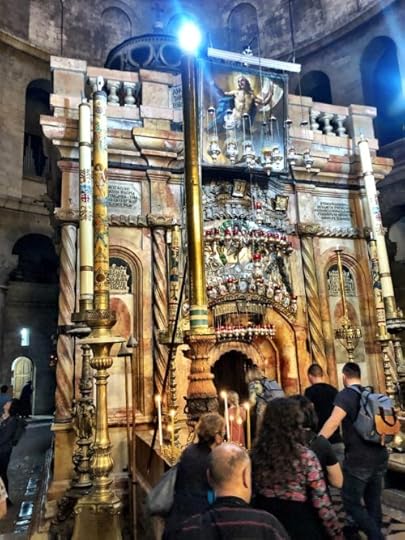
Here, from a website dedicated to the miracle, is a description from a previous Greek Patriarch about what happens:
“I enter the tomb and kneel in holy fear in front of the place where Christ lay after His death and where He rose again from the dead… I find my way through the darkness towards the inner chamber in which I fall on my knees.Miracle of God. At a certain point the light rises and forms a column in which the fire is of a different nature… Here I say certain prayers that have been handed down to us through the centuries and, having said them, I wait. Sometimes I may wait a few minutes, but normally the miracle happens immediately after I have said the prayers. From the core of the very stone on which Jesus lay an indefinable light pours forth. It usually has a blue tint, but the colour may change and take many different hues. It cannot be described in human terms. The light rises out of the stone as mist may rise out of a lake — it almost looks as if the stone is covered by a moist cloud, but it is light.
This light each year behaves differently. Sometimes it covers just the stone, while other times it gives light to the whole sepulchre, so that people who stand outside the tomb and look into it will see it filled with light.
The light does not burn — I have never had my beard burnt in all the sixteen years I have been Patriarch in Jerusalem and have received the Holy Fire. The light is of a different consistency than normal fire that burns in an oil lamp… At a certain point the light rises and forms a column in which the fire is of a different nature, so that I am able to light my candles from it. When I thus have received the flame on my candles, I go out and give the fire first to the Armenian Patriarch and then to the Coptic. Hereafter I give the flame to all people present in the Church.”
In a 2021 interview with L’Osservatore Romano, Patriarch Theophilos said:
The ceremony of the Holy Fire has its origins in the early years of the Church when the liturgical practices of the Church were developed and it is one of the most ancient experiences in our tradition in the Church of Jerusalem. We have evidence of this from the itineraries of early pilgrims, like Egeria. Year after year both local Christians and pilgrims gather for this moment when we have a foretaste of the resurrection, which we call in our tradition the “First Resurrection.” This represents the light that shone from the tomb which the myrrh-bearing women experienced. As we read in the Gospel of Saint Matthew:
After the sabbath, as the first day of the week was dawning, Mary Magdalene and the other Maty went to see the tomb. And suddenly there was a great earthquake; for an angel of the Lord, descending from heaven, came and rolled back the stone and sat on it. His appearance was like lightning, and his clothing white as snow (Mat 28:1-3).
This is an experience of the Uncreated Light that shines from the Holy Tomb and that is symbolised in the lighted candles that spread light not only throughout the church, but throughout the world. In every Orthodox church at the beginning of the Easter liturgy the people come forward to receive the light from a candle held by the priest and this custom came to them from Jerusalem. Even in times of persecution and difficulty for the Church of Jerusalem in ages past, the witness of the Holy Fire has continued.
Some say, of course, that the miracle must be a fraud. We have records of it happening going back to the first centuries of the church, though, back to a time when it was very hard to light a fire (that is, before the creation of matches). Plus, in modern times, the Patriarch is searched by police before he goes into the edicule for the ceremony, to make sure he doesn’t have any ignition sources. Anyway, I will be present this Saturday for the Holy Fire ceremony, and see what I can see with my own eyes.
I found out last night that my friend Father Dwight Longenecker, a US Catholic priest, is in Jerusalem doing Biblical studies. He came over to my hotel this morning, and we had coffee.
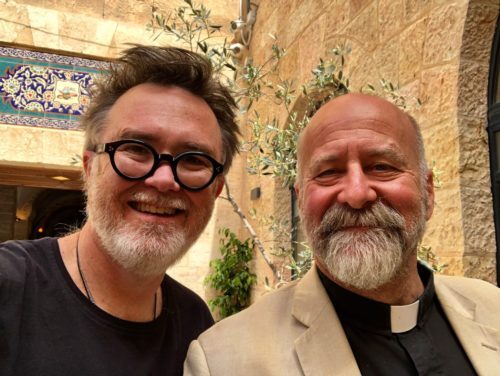
Father Dwight’s newest book is called Beheading Hydra: A Radical Plan For Christians In An Atheistic Age, in which he talks about how extremely fringe in history contemporary Western culture is, with our rejection of transcendence. I thought that since here we were in Jerusalem (our last meeting was in Lafayette, Louisiana), I might as well interview him for my book on re-enchantment.
“The divide between what I call the sacramental vision and the modern world began in the 16th century, when Western man basically took the idea — one that not only had been part of Christianity but part of humanity since the beginning — that the invisible realm was integrated into the physical realm,” he said. “For us Catholics and you Orthodox, through the sacraments, through the physical realm, we access the invisible realm.”
Father Dwight said that the theological revolution of the 16th century (the Reformation) led to the Scientific Revolution of the 17th century, which built on the rejection of metaphysics. In the 18th century this led to the Enlightenment, then the Industrial Revolution, and eventually the Sexual Revolution. The Catholic and Orthodox churches still teach the sacramental vision, the priest said, “but so many Catholics today have forgotten it, and are held hostage by the modern age, with its absence of spirituality.”
The priest’s first steps towards the sacramental vision came when he was a student at fundamentalist Protestant Bob Jones University. He became an Anglican, and ended up later at Oxford studying theology, after which he was ordained in the Church of England.
“After that, in 1987, I made a pilgrimage from England to Jerusalem, hitchhiking, and stayed at Benedictine monasteries all across France and Italy. It was a great adventure. I was every day on my own, praying my way to Jerusalem. It was a real immersion into the sacramental vision, into the Catholic life,” he said.
“Of course coming to England from America, it was like I stepped back 500 years, to the Anglican church. But then walking through France, and Italy, and finally Greece and the Holy Land, it was an even deeper immersion in the historic faith.”
“You were literally walking back through history, to the geographical source of Christianity,” I said.
“Yes, in France it was like walking through the Middle Ages,” Father Dwight said. “In one village, I stopped in a medieval church open for prayer. High in the tower there was a carving of a monk, and he was standing with his hands folded over his belly, and his eyes, which were carved larger than life, were closed. He was a picture of the contemplative life – the discipline of your physical appetites, with his hands folded over his belly, but with his closed eyes larger than life, indicating that this is how you really see things.”
When he reached the 8th century Benedictine monastery of Novalesa, on the Italian side of the Alps, he had a jarring experience.
“The monks showed me around a series of little chapels in the monastery grounds,” he began. “‘And this chapel,’ a monk said, ‘was built on the foundation of a chapel established by St. Paul.’ And I’m like, get out! I’m an American! You must be kidding me. And then I remembered that the Book of Acts says that St. Paul went to the uttermost parts of the West. Certainly he came to Rome. He could have gone to northern Italy. And of course Rome, with the relics of St. Peter and St. Paul, but that didn’t really register with me at the time. In Greece you see road signs to Thessalonika, to Ephesus. It’s overwhelming.”
I tell my friend how shocked I was the first time I was in Jerusalem, in the year 2000, to encounter all these places and names that I had grown up with in Southern Christian culture. They were real. It’s such a strange and wonderful feeling.
“The ‘myth’ of the Gospels, which have been demythologized by the liberal scholars – actually, you come to Jerusalem, to the Holy Land, and you realize that it’s not a myth,” said Father Dwight. “That it really happened here. That’s why they call the Holy Land ‘the fifth Gospel’.”
We have to lean hard into beauty to re-evangelize the world today, said the Catholic priest.
“We built a beautiful new church in my parish in South Carolina,” he said. “We built it in a typical Romanesque style. We salvaged stained glass windows from a church that was closing in Massachusetts. One of the amazing things about our church is that anybody who steps back into the nave immediately falls silent, and says, ‘It’s beautiful.’ These are schoolchildren, people with PhDs in art history, plumbers, electricians, everybody. The apprehension of beauty is universal.”
Father Dwight, 65, is on sabbatical in Jerusalem living with the Dominican fathers at the École Biblique. He said that being here now, as an older man and indeed a Catholic priest, opens the holy city’s meaning up to him even more.
“Yesterday, as a Catholic priest, I concelebrated Mass with the Latin Patriarch at the Catholic-controlled area of the Church of the Holy Sepulcher, which is the chapel of St. Mary Magdalene,” he said. “So I was standing virtually at the place where St. Mary Magdalene met the risen Lord on Easter morning. It’s just phenomenal.
“On Palm Sunday, thousands of us walked down the Mount of Olives into Jerusalem. On Holy Thursday, we met in the Church of All Nations, which was packed, for a prayer service, in the Garden of Gethsemane. And then there was a torchlit prayer procession down the Kidron Valley and up to the Church of St. Peter in Gallicantu, which was where Jesus was tried before the Sanhedrin.”
I told him that the first time I visited the Garden of Gethsemane, and gazed across the Kidron Valley up at the Old City of Jerusalem, it hit me for the first time that it really was a mountain of sacrifice — an altar. I might have understood that in the abstract, but there was nothing like being in Gethsemane, looking out at the very path Jesus took when then Romans arrested him and took him into custody — it’s overwhelming.
Father Dwight began talking about the tragedy of how modern Catholics have lost so much of the mystical spirit inherent to their faith.
“It saddens me that we have sacrificed all this mysticism for relevant practicality – like, how can we be nicer people in the world?” he said. “Of course we need to feed the hungry and house the homeless, and work to make the world a better place. But this is a consequence of our faith. It’s not the faith. It’s what Christians do; it’s not what Christians are. The liturgy is what we are. We are supposed to be there in body, mind, and spirit in the love and worship of God, and the liturgy is how we make that connection. That’s what gives us the power to do that other stuff in the world. If we reduce it all to Girl Scouts selling cookies, we do ourselves a great disservice.
“And this is why churches are emptying,” he continued. “People go to church and find out that it’s no more than the Rotary Club at prayer, and they say, ‘I don’t need to go to church to be a good person’ – and they’re absolutely right.”
“Some of the [Catholic] Traditionalists say that it was because the liturgy was debased,” the priest continues. “I say uh-uh, it goes way deeper than that. The problem is a crisis in belief in historic Christianity. The liturgy being debased is a symptom of that.”
We said goodbye so I could go meet the Greek Patriarch, Theophilos, the unbroken successor of St. James, the first bishop of Jerusalem.
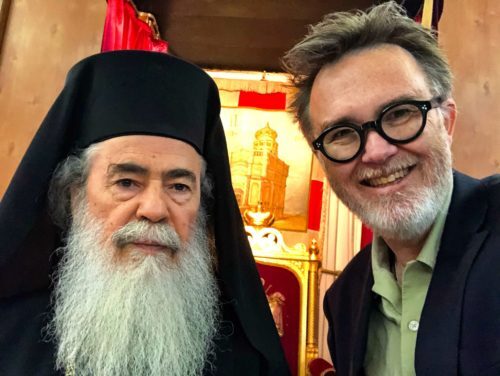
Of course I asked him about the Holy Fire, as he is the one who receives it. He was clearly weary of talking about that subject with a journalist, and referred me to the L’Osservatore Romano interview I quoted above. The Patriarch went on to say:
The thing is that the Holy Land is the land of the human-divine encounter, correct? Which means this part of the earth has the unique privilege to have been blessed, and therefore sanctified, by the blood of the Righteous One, Our Lord Jesus Christ. So it is the blood of Jesus Christ that has made this place to be holy. Which means to be a place where divine energy emanates from. This is what makes Jerusalem specifically to be a place of purpose for every human being who visits this part of the earth. I’ve been here for 68 years, and my experience is that I have not seen so far anyone who left Jerusalem without being touched. You can’t remain indifferent.
Inside the Tomb of Jesus Christ is full of energy. This has been confirmed and verified not by myself, but by the engineers and architects who were in charge with the restoration of the Edicule of the Holy Tomb. You can see it in the National Geographic narrative. The narrative of the Holy Tomb is that it is full of energy. When the architects and specialists were about to remove the marble to discover the tomb, they put very special instruments there, in order to measure the quantity of energy, all those sensitive instruments were totally destroyed.
I didn’t find that information in the National Geographic article, but I did find it in a 2016 report in Aleteia. Excerpt:
But the journalist is much less hesitant regarding the electromagnetic disturbances recorded by the scientists’ instruments. The phenomenon was confirmed by one of the scientists authorized to access the tomb. Later, one of the heads of the building and construction team, Antonia Moropoulou, indicated that it is really hard to imagine that someone would be willing to put in danger his or her reputation just because of a “publicity stunt.” Moreover, the journalist testifies to the scientists’ surprise during the opening of the slab: they hoped that the grave would be much lower than it was. Their conclusion: previously performed analyses with the instruments seemed to have been distorted by an electromagnetic disturbance.
It seems, lacking any other explanatory element, the tomb of Christ indeed affected instruments sensitive to electromagnetic disturbances.
This Catholic website speculated:
The observation of these unusual electromagnetic anomalies at the tomb of Jesus may lend credence to a scientific hypothesis on the creation of the ghostly image on the Shroud of Turin. Italy’s National Agency for New Technologies, Energy and Sustainable Economic Development [ENEA] concluded during a five-year-long study that the Shroud of Turin could not be a ‘medieval fake’. The findings of ENEA study hypothesized that the image may have been created by an intense source of light, stronger than could be created by any technology currently available to man. The results of ENEA “show that a short and intense burst of VUV directional radiation can color a linen cloth so as to reproduce many of the peculiar characteristics of the body image on the Shroud of Turin, including shades of color, the surface color of the fibrils of the outer linen fabric, and the absence of fluorescence”.
The study noted “that the total power of VUV radiations required to instantly color the surface of linen that corresponds to a human of average height, body surface area equal to = 2000 MW/cm2 17000 cm2 = 34 thousand billion watts makes it impractical today to reproduce the entire Shroud image using a single laser excimer, since this power cannot be produced by any VUV light source built to date (the most powerful available on the market come to several billion watts )”.
Back to my talk with the Patriarch, who spoke of the special view that the Orthodox Church brings to Christianity. He talked of the purity of the Orthodox approach, not endeavoring to explain mystery, but rather to accept it and to live it out:
The Orthodox Church is represented by the Greek mind — not the Greeks, please! but the Greek mind — and you know, the Greek mind has two ways of thinking. One is the mind of inventiveness, which means speculation; and the other is revelation. So the Greek [Orthodox] mind gave up inventiveness, which implies idolatry of human inventiveness. When the Greek mind met with the prophetic divine, it endorsed the prophetic divine. Sacred history — the history of revelation — is taken seriously.
In the Orthodox Church, there is nothing that is not substantiated in the Bible, in the history of revelation. If you take all the great Church fathers and Orthodox saints, they say nothing that is not established in the Bible. What the Church fathers do is try to understand the Bible. This is why there is a very special word in Greek. It is said that the Church fathers do not ‘invent’. Rather, they go all around [what already exists].
So, in order to understand the mystery of God is to go through a three-stage process. One is purification. The next is illumination. And the final stage is deification (theosis). This is what the Orthodox Church is all about. The sacraments of our church are helping us to purify ourselves, to clean ourselves so the Holy Spirit will dwell within us. Then enlightenment comes. This is why the great fathers of the church became luminaries.
The Patriarch went on to say that today, scientists are discovering things that validate observations made during the Patristic era by Basil the Great, Gregory of Nyssa, John Chrysostom, and other Church fathers. I have been reading a bit about that this spring, in fact, and will need to go more deeply into it.
The Patriarch gave me two icons, a hand cross, and a prayer rope — but the greatest gift was of his time, on what for him is the busiest week of the year.
After that meeting, I headed back over to the Church of the Holy Sepulcher, and had another look around. I saw in the Catholikon (the central part of the crazy-quilt church), an odd structure. Look:

Is that a delicious Cornish pastie? No, it’s an omphalos, or navel, stone, marking the center of the world. It is exactly halfway between Golgotha and the Tomb of the Resurrection. That is, at precisely the midpoint of the two sites on this earth where the eternal cosmic destiny of humankind was worked out.
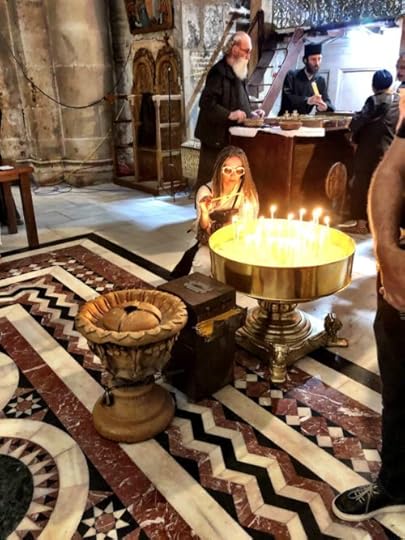
If you stand near the omphalos stone and look up into the dome of the church, this is who you see:
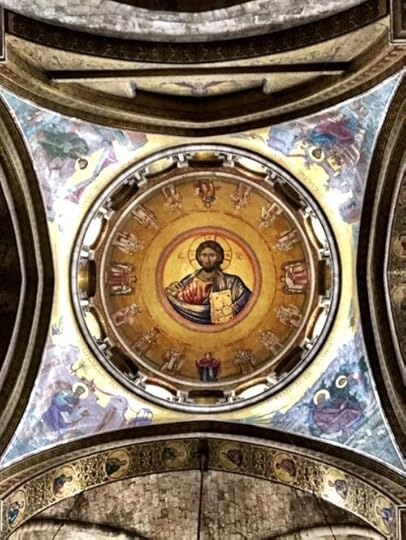
Christos Pantokrator — Christ, the Ruler of All, the God-Man, looking down on the site of his death and resurrection.
There, in that church. In this city. Nowhere else in the world.
It’s almost too much to take in.
At the omphalos stone I fell into conversation with a Palestinian Christian, who, as it turns out, is Orthodox. Most Palestinian Christians are. I enjoyed talking to her about Christian life in the Holy City, and ended up inviting her to lunch. It turns out that she had done graduate work in the United States, at an elite institution, and had not been favorably impressed. I won’t quote her directly because it wasn’t an interview, but she basically said that she was struck very hard by the cluelessness of her fellow American students. They didn’t know anything about the world beyond their own, and they were impossible to educate, because they thought they knew it all. She said she ended up getting really mad at them sometimes, because America is so powerful in the world, and affects her world in particular. But we just stumble through the world ignorantly, and can’t understand why people hate us.
A second thing that she took from her time in America is how insane it is over what we call “wokeness” (she knew the word). She said that it was absolutely shocking to her, as a Palestinian, to have to deal with LGBT ideology in US academia. She said it was not only shocking in itself, but the inability to say anything critical about it really knocked her for a loop. She learned very quickly to keep her mouth shut about what she really believed. She did not fail to notice that her fellow students prided themselves on being supremely open-minded and tolerant, but instead she found them to be rich, culturally illiterate liberal bumpkins.
She talked further about how resentful her people are of US cultural imperialism, by which she meant the spread of LGBT ideology. I mentioned to her that it is very hard for conservative Americans like me to accept that our country, which we love, has now become responsible for bringing so much corruption into the world.
“This is new for you, maybe, but we have always seen you Americans that way,” she said sharply. “Sorry, I’m very direct.”
I thanked her for her honesty.
When we parted, I went over to see Wassim Razzouk at his tattoo shop in the Old City. Maybe you read about it in The New York Times the other day. Excerpts:
But during Holy Week and the days leading up to it, Wassim Razzouk’s tattoo parlor in Jerusalem’s Old City is packed with some of his most reliable customers: Easter visitors who, seeking an indelible reminder of their time in Jerusalem, “want a tattoo as a certificate of pilgrimage,” Mr. Razzouk said.
More:
While tattoos may have moved into the global mainstream only in the last few decades, the Razzouk family has been practicing the art form a little bit longer: 700 years, or 27 generations, he said. He’s the scion of a long-venerated family of tattoo artists, Coptic Christians who, as family lore has it, came on a pilgrimage from Egypt to the Holy Land hundreds of years ago, and decided to stay in Jerusalem and set up shop.
Mr. Razzouk — with his long hair, Harley-Davidson biker’s jacket and passion for motorcycles — decided to follow in the family tradition at the age of 33. His two sisters and the cousins of his generation were not interested in becoming tattoo artists, he said, adding, “I knew that if it wasn’t for me the tradition would disappear.”
His father, Anton, 82, taught him the craft, having learned it from his father, Jacob, or Yaqoub.
Here’s a link to a short film clip about Wassim and his work.
I went to see Wassim because I was interested in the phenomenon of why certain religious pilgrims feel the need to mark their visit to the Holy City with a tattoo. We had a great interview, but honestly, it’s 1:25 am here in Jerusalem, and I’m too tired to transcribe it now. I will tell you, though, that I decided to get a tattoo. I am no fan of tattoo culture, but there is no other city like Jerusalem, and no other place like Razzouk’s. Besides, standing at the site of Christ’s death on the Cross the night before, and praying for my loved ones caught up in this terrible situation back home, I found that I wanted somehow to feel in my skin, for all the days left of my life, the truth that JESUS CHRIST CONQUERS. That nothing we have to suffer today is the final word. That the Lion of the Tribe of Judah, the Root of David has triumphed.
So I chose the medieval Greek cross with the symbols that mean IX (Jesus) XC (Christ) NIKA (Conquers):

Wassim and me, in a selfie:
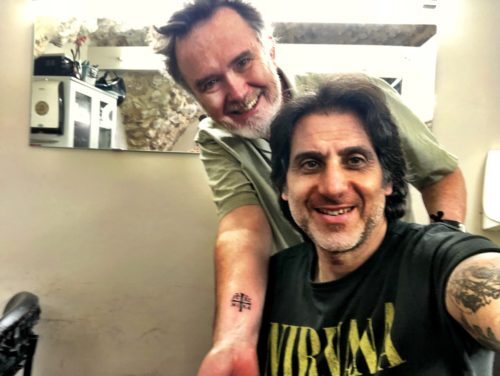
Next time you’re in Jerusalem, go see Wassim at Razzouk Tattoo. You’ll have a great conversation with him, and his work is varied and beautiful. He’s known for tattoos made from Coptic stamps hundreds of years old, that had been passed down by his family. They were quite striking, but as I am a middle-aged fogey, I decided to have my one and only tattoo be something more modest, and personally meaningful to me.

The post Jerusalem Diary appeared first on The American Conservative.


April 17, 2022
Conservatism & Cultural Antibodies
Disney has always been an explicitly morally instructive company; its characters were used as propaganda during World War II. Walt Disney’s original vision for Walt Disney World in Orlando was a model for a healthy civic society, among many other examples. Conservatives now simply disapprove of the corporation’s chosen morality, which includes commonly accepted progressive ideas about multiculturalism and personal identity.
The story of fighting back against that gradual, seemingly inevitable leftward cultural creep is more or less the story of conservatism itself. The incentives and pressures that have led conservatives on this particular quest, however — one that’s not only almost certainly hopeless, but that has led them into sinister rhetorical territory in referring to opponents of the law as “groomers,” or manipulative pedophiles — are quite modern, and reveal how much both our cultural and political landscape have shifted over just the past decade of American life.
“Sinister rhetorical territory” — right. The real problem is with people who call this stuff out for what it is. Anyway, let’s move on:
They now accuse notionally LGBT-friendly companies like Disney of “grooming” children — an astonishingly cynical rhetorical flourish that, by misappropriating a term used to describe pedophiles, manages to conflate homosexuality and pedophilia, profoundly disrespect actual survivors of child sex abuse by using their experience as a political cudgel, and invoke the specter of far-right conspiracy theories like “Pizzagate” all at once. (The backlash has also predictably and depressingly caught sex education in its blast radius, which has been repeatedly proven as the most effective tactic to prevent sexual abuse.)
Oh for pity’s sake, really? Nobody is conflating homosexuality with pedophilia. Nobody thinks Douglas Murray, Andrew Sullivan, or Camille Paglia are a danger to children. What we’re talking about is the grooming of little children to accept radical sexual and gender identities (e.g., “pansexual”) at a time when these kids are putty in the hands of teachers and other authority figures. It teaches them to think of themselves as sexual beings, and their every desire as constitutive of their identity. Both gays and straights doing this are grooming kids into a highly sexualized culture — one that seems obvious to many of us to be headed straight for the literal sexualization of children, as in turning them into objects of sexual desire.
To pretend that objecting to this is being Anita Bryant is rhetorically dishonest, and maybe even sinister. But anyway, let’s go on. Author Derek Robertson has a point here, though:
Embedded in that effort is the recognition that when it comes to the core issues at hand — support for the racial justice movement and LGBTQ rights — the ship has sailed leftward and has been doing so since the 1960s, if not before.
Why does he have a point? Because the ship of American culture really has been sailing leftward for a long time. That is not always a bad thing. No morally aware conservative could possibly want to return to the days of 1950s Jim Crow, for example, or to the days when homosexuals were hounded out of employment for being gay. But Robertson’s piece is part of progressive mythology, claiming that the Grand March of History is inevitable, and conservatives can’t stop it. In fact, what the Robertson piece points to, whether he realizes it or not, is the power of culture-creating institutions like Disney to direct the culture in certain ways. Disney is a marker of the mainstream, but it has also created the mainstream. Watch those videos that Chris Rufo posted of all the senior Disney executives talking about how they’ve been quietly inserting LGBT ideas and characters into children’s movies and TV programming, and how they’re going to ramp that up. They understand the power they wield to guide culture in certain ways. It is absurd for Derek Robertson to claim that this all just sort of happened.
Nevertheless, Robertson also gets to a reason that I wrote The Benedict Option (and now, Live Not By Lies). We on the cultural and religious right really have lost this war. We absolutely have to wage guerrilla warfare when we can — that’s what Rufo is doing — but the deeper currents of American culture are moving strongly to the left. This is not something we can vote ourselves out of. Unless American conservatives can make these groomer woke capitalists afraid of us, nothing will change. Are there enough of us to do that? I hope so, and maybe there is right now. But it won’t be forever. As Eric Kaufmann warned, based on his research, the Millennials and Generation Z are the wokest generations ever.
Most Americans, I fear, are not even aware that there is something to resist in all this. There are almost no cultural antibodies left with which to fight the invader. Religion ought to have been leading the charge against the corporate colonization of our minds, but of course most American religion is Moralistic Therapeutic Deism. Few American churches are in any sense enemies of Mickey Mouse. Nevertheless, there are lots of people — Christians, Jews, Muslims, even some secular folks — who despise what is happening, and who just want to build communal structures in which moral sanity can thrive, and in which they can learn resiliency, and pass it on to their kids.
I like to think that I’ve identified this need. But I have no idea how to build. Do you?
The post Conservatism & Cultural Antibodies appeared first on The American Conservative.
April 15, 2022
Can You Normalize Queerness Without Pedophilia?
You know how when you point out that they’re teaching Critical Race Theory in schools, but liberals protest that they’re doing no such thing — but this is deception by technicality? The truth is that they are teaching all kinds of things based on CRT, but not the direct thing itself. It’s like teaching an art class how to paint the light as it strikes the surface of a lake, but denying that you’re teaching anything about the sun.
Queer Theory is like that too. Defenders of the groomer status quo — that is, grooming children to embrace genderfluidity and non-standard sexual identities — may protest that they’re not teaching Queer Theory, but this is a dodge. Whenever you teach about, say, the Genderbread Person, you are teaching Queer Theory. This insanity has been quite popular in schools for years, to break down little children:

People like me have received a lot of criticism for using the word “groomer,” on the grounds that we are allegedly saying that teachers who instruct their students in this deranged ideology want to have sex with them. That’s not really what we’re saying (well, some might be saying that, but I don’t). Rather, it’s about grooming them in the same sense that an Islamic terrorist recruiter uses the Internet to groom impressionable young people to join the cult. But after reading the 1984 essay “Thinking Sex: Notes For A Radical Theory of the Politics of Sexuality,” by Gayle S. Rubin, any twinge of doubt I felt about the double entendre with “groomer” evaporated.
From the Wikipedia entry on “Thinking Sex”:
In her 1984 essay “Thinking Sex”, Rubin interrogated the value system that social groups—whether left- or right-wing, feminist or patriarchal—attribute to sexuality which defines some behaviours as good/natural and others (such as pedophilia) as bad/unnatural. In this essay she introduced the idea of the “Charmed Circle” of sexuality, that sexuality that was privileged by society was inside of it, while all other sexuality was outside of, and in opposition to it. The binaries of this “charmed circle” include couple/alone or in groups, monogamous/promiscuous, same generation/cross-generational, and bodies only/with manufactured objects. The “Charmed Circle” speaks to the idea that there is a hierarchical valuation of sex acts. In this essay, Rubin also discusses a number of ideological formations that permeate sexual views. The most important is sex negativity, in which Western cultures consider sex to be a dangerous, destructive force. If marriage, reproduction, or love are not involved, almost all sexual behavior is considered bad. Related to sex negativity is the fallacy of the misplaced scale. Rubin explains how sex acts are troubled by an excess of significance.
Rubin’s discussion of all of these models assumes a domino theory of sexual peril. People feel a need to draw a line between good and bad sex as they see it standing between sexual order and chaos. There is a fear that if certain aspects of “bad” sex are allowed to move across the line, unspeakable acts will move across as well. One of the most prevalent ideas about sex is that there is one proper way to do it. Society lacks a concept of benign sexual variation. People fail to recognize that just because they do not like to do something does not make it repulsive. Rubin points out that we have learned to value other cultures as unique without seeing them as inferior, and we need to adopt a similar understanding of different sexual cultures as well.[citation needed]
Legacy of “Thinking Sex”Rubin’s 1984 essay “Thinking Sex” is widely regarded as a founding text of gay and lesbian studies, sexuality studies, and queer theory.
A founding text. Okay, what does it say? Well, like I did, you can read it here. Excerpts:

Here we go. I think all of us can agree that it’s a good thing that “the more gruesome techniques have been abandoned,” don’t we also believe that it’s a good thing to insulate minors from some forms of sexual knowledge, and certainly from sexual experience? Not Gayle Rubin, one of the founding mothers of Queer Theory. Note in this passage she celebrates that we don’t do bad things to the bodies of children to keep them from being sexual, but laments the persistence of the attitudes that stigmatized child sexuality. Just read on.
Rubin lists various forms of persecutions of homosexuals in the postwar period. It’s hard to disagree with her that these were bad things, and we are all better off without them. But note these lines:
For over a century, no tactic for stirring up erotic hysteria has been as reliable as the appeal to protect children. The current wave of erotic terror has reached deepest into those areas bordered in some way, if only symbolically, by the sexuality of the young.
This can be both true and, in context, sinister. I think it is both. Why? Well, Rubin thinks laws against child pornography are too punitive. She complains:
Although the Supreme Court has also ruled that it is a constitutional right to possess obscene material for private use, some child pornography laws prohibit even the private possession of any sexual material involving minors.
More:
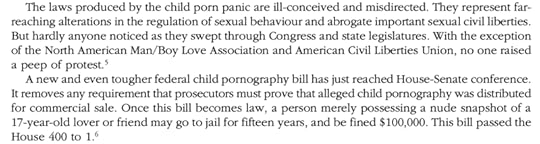
She goes on to lament that
The experiences of art photographer Jacqueline Livingston exemplify the climate created by the child porn panic. An assistant professor of photography at Cornell University, Livingston was fired in 1978 after exhibiting pictures of male nudes which included photographs of her seven-year-old son
Wow, that’s terrible! A mom’s photo of her naked little boy — they call that child porn? What kind of dirty minds to they have?
Oh wait, I left off the final word in Rubin’s sentence:
… masturbating.
That’s right: Rubin takes it as given that her readers will find it outrageous that an art professor mother would face harsh criticism for taking and distributing photos of her seven year old son masturbating.
Here Rubin shows pity to pedophiles:
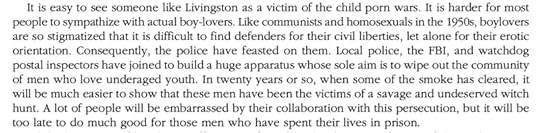
Rubin goes on to say that the time has come for “radical” theorizing about sex. Here’s what she means:

Rubin begins by saying that we must come to understand that all rules repressing sexual desire are socially constructed. That is, there is nothing essential to any of this. To say that certain behavior of “natural” and other behavior “unnatural” is false, and reflects nothing more than a politicized framework around desire.
The most difficult obstacle to overcome, she says, is the “sex negativity” of Western culture. More:

Remember, this was first published in 1984. My, how far we have come. The only figure in Rubin’s list that still faces stigma are the pedophiles. For now, anyway.
Now we’re getting close to the heart of the Marxist analysis on which Queer Theory depends:

The “sexual rabble” must therefore be exalted. Which pretty much describes what has happened in our popular culture over the last thirty years.
More:


Note again: almost 40 years after the publication of Rubin’s essay, the only perversion on that list that does not now have mainstream approval is pederasty.
And yet, we are told that what’s happening in schools, and in society more broadly (via Disney, et al.), is not grooming.
More Rubin:

“Innocence” in quotation marks. Lamenting the fact that we don’t “provide for” underage sex “in a caring and responsible manner.”
Groomers.
Rubin writes at length to criticize anti-porn feminists as traitors. She demands that all sexual nonconformists be affirmed.

If you are a progressive on these matters, but feel that the line should be drawn somewhere, Gayle Rubin wants you to know that you are a sellout.
Rubin concludes thus:
They have also been a time of ferment and new possibility. It is up to all of us to try to prevent more barbarism and to encourage erotic creativity. Those who consider themselves progressive need to examine their preconceptions, update their sexual educations, and acquaint themselves with the existence and operation of sexual hierarchy. It is time to recognize the political dimensions of erotic life.
Reading her paper — as you can here — is like opening a time capsule. I was in high school when it was published. The world she describes in it seems as far away as the days of powdered wigs. Gayle Rubin and her vision have prevailed. The only thing this founding mother of Queer Theory has not won is legitimation for pedophilia.
The treatment of small children as sexual beings by schools is part of the process of breaking them down. According to forensic psychiatrist Dr. Michael Welner, sexual grooming of children contains these stages.Excerpt:
Stage 4: Isolating the child
The grooming sex offender uses the developing special relationship with the child to create situations in which they are alone together. This isolation further reinforces a special connection. Babysitting, tutoring, coaching and special trips all enable this isolation.
A special relationship can be even more reinforced when an offender cultivates a sense in the child that he is loved or appreciated in a way that others, not even parents, provide. Parents may unwittingly feed into this through their own appreciation for the unique relationship.
Hmm:
High school staff member in Eau Claire, WI displays poster that tells students, “I’m Your Mom Now.”https://t.co/SeWL30jrM6 pic.twitter.com/xuDAMDtznw
— Parents Defending Education (@DefendingEd) March 7, 2022
“If your parents don’t accept you for who you are, f*** them. I’m your parents now” – Oklahoma middle school teacher
This teacher was let go last week after complaints of grooming and this tiktok others containing questionable content were brought to the principal’s attention. pic.twitter.com/eBgAWCW3K7
— Libs of Tik Tok (@libsoftiktok) April 11, 2022
Illinois State Board of Education guidelines say staff cannot disclose information about a student’s gender to anyone without the student’s consent. So a 12 year old kid can decide he is trans and the school won’t tell the parents. This is insane pic.twitter.com/yG7SXLHtqS
— Libs of Tik Tok (@libsoftiktok) April 13, 2022
More from Dr. Welner:
Stage 5: Sexualizing the relationship
At a stage of sufficient emotional dependence and trust, the offender progressively sexualizes the relationship. Desensitization occurs through talking, pictures, even creating situations (like going swimming) in which both offender and victim are naked. At that point, the adult exploits a child’s natural curiosity, using feelings of stimulation to advance the sexuality of the relationship.
When teaching a child, the grooming sex offender has the opportunity to shape the child’s sexual preferences [emphasis mine — RD] and can manipulate what a child finds exciting and extend the relationship in this way. The child comes to see himself as a more sexual being and to define the relationship with the offender in more sexual and special terms.
“Diversity is my favorite thing to teach” says non-binary preschool teacher who also makes 4 year olds pick a pronoun pin every day to wear pic.twitter.com/6IRmh4v8Co
— Libs of Tik Tok (@libsoftiktok) April 12, 2022
Kindergarten teacher brags about using the game ‘playing with pronouns’ so 4 year old students can practice using they/them which “sparks conversations” pic.twitter.com/kwUgLzzGQe
— Libs of Tik Tok (@libsoftiktok) April 12, 2022
According to the nation’s leading expert on school sexual abuse, “red flag grooming behaviors” include “personal disclosure of adult sexual activity and preferences, and questions to students about their sexual lives.”
This is what parents want to stop.https://t.co/orFRUEF9Bx pic.twitter.com/6zOQipj7ks
— Christopher F. Rufo
(@realchrisrufo) April 11, 2022
Trans non-binary elementary teacher says 3 year olds are old enough to learn about gender identity, sexual orientation, and pronouns. These are the people teaching your kids. pic.twitter.com/fylE9jCQrF
— Libs of Tik Tok (@libsoftiktok) April 10, 2022
Last from Dr. Welner:
Stage 6: Maintaining control
Once the sex abuse is occurring, offenders commonly use secrecy and blame to maintain the child’s continued participation and silence—particularly because the sexual activity may cause the child to withdraw from the relationship.
Children in these entangled relationships—and at this point they are entangled—confront threats to blame them, to end the relationship and to end the emotional and material needs they associate with the relationship, whether it be the dirt bikes the child gets to ride, the coaching one receives, special outings or other gifts. The child may feel that the loss of the relationship and the consequences of exposing it will humiliate and render them even more unwanted.
Ask yourself: in the current atmosphere these activists and their media allies have created, how likely is it that a kid who feels weird and uncomfortable with all this will speak out? The fear of losing the relationship with their teachers, and with their friends who have all bought into the ideology, could well bind them to it.
Did we have to end up here? Does Queer Theory mandate the sexualization of children? I have no doubt at all that most gays and lesbians strongly reject pederasty. I would even suppose that many of them are concerned about the rapid spread of gender ideology in schools, especially in the lower grades (though I suspect they are afraid to say it out loud, for fear of professional and personal consequences). Reading Gayle Rubin’s seminal essay, though, and seeing that most of what she advocated for came to pass in the four decades since she published it, and that there is currently a massive push by activist educators, media allies, and the Democratic Party to sexualize children by introducing this aspect of Queer Theory into schools — I’m wondering exactly how we are supposed to stop the final barrier (that is, the stigmatization of adult-child sex) from falling. Rubin understands the situation as an unjust privileging of certain sexual norms over others, and regards the prohibition of cross-generational sexual activity as wrong. If you accept Rubin’s basic model of how this works — that is, that rules about sexuality express nothing more than a hierarchy of social privilege — and you accept her belief that radical sexual theory ought to “liberate” all forms of consensual sexual expression, then how do you stop the momentum of this freight train at the boundaries of pedophilia?
You will say: Consent! But do you really think that is enough? You cannot possibly think that. And in any case, Rubin posits that all sexual rules are constructed to privilege someone, or some class of people. That there is no intrinsic reason why sex between minors and adults is wrong. In her paper, she renders all those who object to her radical position as far-right loonies and fanatics.
If queer activists in the schools, media, and Democratic Party have their way, why would we not be seeing a movement in the near future to “empower” young people (the existence of whose sexuality as little children we have already established) to “make choices” about their own sexual expression? After all, if it is the state’s role to protect children’s autonomy, why do they not have sexual autonomy? Why is Rubin wrong to include pederasts in her list of sexual outsiders who, after the Revolution, should be accepted and affirmed? She really does believe that “boylovers” are an unjustly persecuted fringe minority. Most people do not believe that now — but after being indoctrinated with these products of Queer Theory from their first days in school, and in the media (via Disney and other purveyors of kids’ programming), what will this coming generation be prepared to accept?
Were they always eventually going to get around to the kids, these activists?
Put another way: can you normalize sexual queerness without eventually normalizing pedophilia? Queer activists and their allies had better figure out an answer to this question, because even though it is forbidden to be asked in public, more and more parents are asking it. Let me repeat: I believe that many, and maybe even most, gays and lesbians find this kind of thing repulsive. What I hope they will recognize is that the trans activists and their allies going after children is bringing their entire project into disrepute. They need to jettison these groomers as soon as they can, and as forcefully as they can.
UPDATE: Groomers:
BELLINGHAM, Wash. – Word of a drag show at Bellingham’s Whatcom Middle School has raised some eyebrows, but the district says it’s not what some have portrayed it as.
The Drop Dead Gorgeous Drag Show was conceived by Whatcom’s GSA student organization as part of Bellingham Schools’ Think BIG Challenge.
It’s one of seven student clubs that are receiving grants of $1,000 to $2,500 for ideas ranging from science, the environment, student transportation, even crochet.
The money is not coming from the district but is a grant from the Bellingham Public Schools Foundation, the district’s non-profit partner.
The event hasn’t been scheduled yet but will be extracurricular and will happen outside of school hours.
The district says similar events have been held in the past and have included fashion, personal expression, musical performances and more.
It stresses that school policies ensure that the drag/talent show will be behaviorally appropriate.
GSA – or Gender Sexuality Alliance – clubs have been shown by research to enhance school safety and positive student development.
Bullshit. Unadulterated bullshit. Come on, parents, don’t you see what they’re doing?
The post Can You Normalize Queerness Without Pedophilia? appeared first on The American Conservative.
The Vass Wing-Tips Conspiracy
(Yes, I know those aren’t wing tips, but loafers in the photo. I couldn’t resist a reference to Hillary Clinton’s famous line about a “vast right-wing conspiracy”. I realized after posting this that Millennial and Gen Z readers wouldn’t get it.)
A blessed Good Friday to Christians of the West celebrating today. Orthodox Good Friday is next week. This morning, let me off you a commentary that is relatively frivolous, in a time of war, but it’s important to me, and I want to share it with you. It’s a story about beautiful things — things you might call useful works of art.
When I was packing to come to Budapest in the late winter, I found a not-small stash of euros that I had saved from a trip a few years back. I brought them with me, and six weeks ago, decided that I would spend them on a special souvenir from Budapest: a pair of handmade bespoke loafers from Vass Shoes.

Some background: my feet are exceptionally short, and exceptionally wide. I think my biological father must have been a hobbit. I don’t buy shoes often because it is so difficult to find shoes that fit properly, and the experience of going from store to store looking for them (I can’t reliably buy them online) is drudgery. Bespoke footwear, though — that is, shoes made to measure — is outrageously expensive in the United States. I would never consider it there.
But it is not so in Budapest. Vass Shoes is a family business, started in 1978 by Laszlo Vass, and is still owned and operated by the Vass family. Their shoes aren’t cheap — the start at 700 euros — but given the quality, they are affordable, especially if, like me, you rarely buy dress shoes, and spend most of your time in ankle boots (fall, winter) or Birkenstocks (spring, summer). The shoes I just picked up this week from Vass are timelessly beautiful, and will be with me for the rest of my life. I bought a pair of dress shoes from Vass last summer, and love them so much that after discovering the secret stash of euros, I returned to Vass for a pair of loafers.
Now, I will never need to buy another pair of dress casual shoes, but if I need one, my last — the model of my foot from which the shoemakers craft these shoes — is in storage at Vass, and I can simply e-mail them and tell them what style shoe I would like, and they can make it and mail it to me. They have a customer for life. The quality of the shoes speaks for themselves. I have received compliments on the dress shoes I bought last summer, but the best thing about them is that they fit perfectly — something that is very rare for me, and why I have all my life hated shopping for shoes. But at Vass, it’s a great pleasure.
The selection Vass offers is quite diverse, but for me, not a shoes guy, a basic pair of loafers was what I needed. I have a pair of black dress boots, and two pairs of dress lace-ups (one brown, one black). All I needed was a dress casual shoe. It took six weeks from the day Gabor (see photo) measured my feet, until I picked them up at the store. I wore them for the first time last night. If you are like most people, wearing a perfectly fitting shoe is an ordinary experience. It’s not that way for me. How great it feels to wear a pair of shoes that fits perfectly. My closet is littered with much less expensive dress shoes, made by machine, that I’ve bought in the past, but never wear anymore because they don’t really fit. If you collected them, they would easily cost more than that pair of bespoke loafers I bought from Vass, which are very well made, which fit perfectly, and which will last forever.
On the day I went in to be measured for the shoes, I was with an English friend who was visiting Budapest. He was absolutely astonished by how inexpensive these well-made bespoke shoes are, compared with what getting the same would cost in London. He said they are about 80 to 90 percent cheaper at Vass than at a similar shoemaker’s in London. He is planning to be back in Budapest next month, and is headed straight to Vass. Good man. Buying quality handmade shoes, beautiful artifacts from a small family business, is a worthy thing.
Here is Gabor presenting me my loafers. If in Budapest, go see him at Vass Shoes, Haris köz 6, in the center of downtown Pest. You will not regret it.

The post The Vass Wing-Tips Conspiracy appeared first on The American Conservative.
April 14, 2022
Biden’s Late Brezhnev Period
Well, this is disturbing:
The president attempted to shake hands with someone who isn’t there, then stumbled around confused before finding his way off the stage. Take a look at this clip from Barack Obama’s recent visit to the White House. President Biden wandered around disoriented, and again tried to give a greeting with his hands to someone who wasn’t there.
This is not funny. This man is the Commander in Chief, and he is clearly not in full control of his faculties. The other day he called Russian war crimes in Ukraine “genocide” — a term that has specific meaning in international law, and that commits the US to certain acts in its face. As horrible as what Russia is doing is, it’s not genocide, and it cheapens the term for the sake of scoring political points against the Russians. The point is that the President of the United States is not in control of his mental faculties enough to stop himself from running off at the mouth in a time of war. You’ll remember how in Poland, he called for regime change in Russia — a radical statement that White House aides had to walk back.
I’ve been thinking about Biden as a Jimmy Carter, in terms of his weakness at the polls. But he is also late-period Leonid Brezhnev.
He’s not the only possibly senile politician in Washington:
Some colleagues of Sen. Dianne Feinstein (D-Calif.) are concerned she’s no longer fit to serve in Congress, according to a new report.
Four senators, a California Democratic member of Congress, and three former staffers of Feinstein told the San Francisco Chroniclethat “her memory is rapidly deteriorating.”
According to the report, Feinstein, 88, at times “does not seem to fully recognize even longtime colleagues,” and one lawmaker described an instance in which they had a conversation with her in which they had to repeatedly reintroduce themselves and she raised the same questions multiple times, apparently unaware they had previously discussed them.
“It’s bad, and it’s getting worse,” an anonymous Democratic senator said.
This follows a similar report from The New Yorker in 2020, which said Feinstein’s “short-term memory has grown so poor that she often forgets she has been briefed on a topic.” That report also said Senate Majority Leader Chuck Schumer (D-N.Y.) “wanted her to step aside on her own terms.” Her term ends after 2024.
America does not need to be a gerontocracy. If he runs for the presidency in 2024, and wins, Donald Trump would turn 79 on the year he is inaugurated — the same age Biden is right now. If Biden runs and wins — no, really, imagine it happening — he will be 82 on inauguration day, and turn 83 the first November of his second term.
This is too much.
The post Biden’s Late Brezhnev Period appeared first on The American Conservative.
‘Ты потопил мой линкор!’ (‘You Sank My Battleship!’)
“Ты потопил мой линкор!” which is Russian for, “You sank my battleship!”:
The Russian Defense Ministry said its damaged naval flagship Moskva had sunk in the Black Sea while being towed in a storm. Ukraine had claimed it hit the cruiser with two missiles. Moscow has denied that the ship was struck, but acknowledged it was on fire.
The sinking of the warship is a blow to Russian forces that could also have strategic consequences.
The flagship of the Black Sea fleet! Humiliating. Here’s a Daily Mail story with a great graphic explaining how the Ukrainians tricked the Russian ship’s defenses. (They used decoy drones to fool the ship’s defense system while sending Neptune missiles skimming over the waves.)
Meanwhile, an ominous warning:
The director of the C.I.A. said on Thursday that Vladimir V. Putin’s “potential desperation” to extract the semblance of a victory in Ukraine might tempt him to order the use of a tactical or low-yield nuclear weapon, publicly discussing for the first time a concern that has coursed through the White House during the seven weeks of conflict.
The director, William J. Burns, served as American ambassador to Russia and is the member of the administration who has dealt most often with Mr. Putin. He said the potential detonation of a limited nuclear weapon — even as a warning shot — was a possibility that the United States remained “very concerned” about. But Mr. Burns quickly cautioned that so far, despite Mr. Putin’s frequent invocation of nuclear threats, he had seen no “practical evidence” of the kinds of military deployments or movement of weapons that would suggest such a development was imminent.
Matt Taibbi has helped launch Russian Dissent, a new online platform for essays by dissidents unable to publish in Russia. Here’s an essay on it by Boris Kagarlitsky. Excerpts:
The Blitzkrieg failed, and Russia finds itself in a tough confrontation not only with the united West, but practically with the whole world. Even China, whose help some perhaps naively hoped for, does not show us the slightest pity, and instead, cynically profits off our difficulties.
It is significant that the hostilities, which began under the pretext of the need to move NATO away from our borders, have already led to the opposite result: two of our neighboring countries – Sweden and Finland – have decided to abandon their neutral status. Moreover, in Finland this happened at the request of the people. Now NATO can, if desired, deploy missiles a few tens of kilometers from St. Petersburg. The requirements regarding the neutrality of Ukraine have lost all meaning. NATO has already come closer to Russia than it would be even if Kyiv joined; from the Finnish border to St. Petersburg, the distance is several times less than from Kharkiv to Moscow.
And note that in the case of Ukraine, before February 24th, the fear was of the “potential possibility” of the country joining the North Atlantic Alliance, a possibility that could still be counteracted by diplomatic and political measures. In the case of Finland and Sweden, this, against the backdrop of hostilities in Ukraine, has already become fact. Both countries, who carefully guarded their neutral status for decades, decided to abandon it after the strikes on Ukraine. A worthy “result” of the special operation!
How about that: Finland joining NATO out of fear of Russia means that Ukraine’s status — neutral or not — no longer matters. More:
There are only two options for getting out of this situation: negotiate or cause a nuclear apocalypse. And even if some part of humanity has a chance of survival, most Russians will not. Not everyone will die. But we shouldn’t delude ourselves about a paradise either. First, there will be hell.
The stunning defeat of the Tsar’s forces in the Russo-Japanese War of 1903 was a catalyst for the 1905 revolution. The catastrophic loss of the First World War led to the overthrow of the monarchy entirely. As Kagarlitsky points out elsewhere in his essay, even if Russia prevails on the battlefield, there is no way Russian forces can successfully occupy a hostile Ukraine. I can see why the Hungarians and the Romanians I’ve been talking to are still very, very concerned about this war going wider. It’s not that they fear that Putin actually wants to take their territory. It’s fear that a cornered wolverine might do something insane.
The post ‘Ты потопил мой линкор!’ (‘You Sank My Battleship!’) appeared first on The American Conservative.
We May Never Know Who Frank James Hates
Police caught Frank James, the suspect in the Brooklyn subway attack. Excerpts:
The suspect in Tuesday’s subway attack in Brooklyn appears to have posted dozens of videos on social media in recent years — lengthy rants in which he expressed a range of harshly bigoted views and, more recently, criticized the policies of New York City’s mayor, Eric Adams.
“Harshly bigoted views”? Like what? Who did he hate? More:
The police also released a screenshot of Mr. James taken from a YouTube video posted by a channel belonging to the username prophetoftruth88.
The videos featured a man — who appeared to be the same man in a picture released by the police — delivering extended tirades, many of them overtly concerned with race and violence, often tying those subjects in with current events, including the Russian invasion of Ukraine and the policies of Mr. Adams. Two law enforcement officials said that Mr. James was the person featured in the channel’s videos.
“Many of them overtly concerned with race and violence”? What did he say? Who were the targets of his hateful tirades?
You can’t see the videos because YouTube has taken them down. I think we can be pretty confident about who it was that Frank James hates, if only because the Times is protecting a black violent bigot. It’s almost like if they said what James raged about, we would make a connection between that and the sophisticated anti-white bigotry that the Times and other liberal elites traffick in constantly.
Fortunately, Miranda Devine of the New York Post had a look at James’s videos:
The social media rants of the 62-year-old suspect reveal a man consumed with hatred of white people and convinced of a looming race war.
“O black Jesus, please kill all the whiteys,” was one meme he posted.
He’s not too complimentary about Hispanics, Asians and his own race, for that matter, and claims to have had long-term mental health problems. The 29 victims of Tuesday’s shooting were a multicultural mix, as you would expect in a crowded rush-hour subway train. Police say James detonated a smoke grenade before firing 33 shots on the Manhattan-bound N train. Police found a hatchet, three ammunition magazines, fireworks and gasoline. It’s a miracle no one was killed.
But whatever his psychiatric issues, James sounds very much like other ideologically fixated, identity-obsessed killers who have emerged since the BLM-Antifa racial movement of 2020 and the hate speech it unleashed.
James posted material on social media linked to black identity extremist ideologies, including the Nation of Islam, Black Panthers, Black Liberation Army, BLM and an image of black nationalist cop-killer Micah Johnson.
“White people and black people, as we call ourselves, should not have any contact with each other,” James rants in one of hundreds of YouTube videos posted to a channel under the user name “prophetoftruth88,” from which police took a screenshot to identify him as a suspect, and which was removed from YouTube Wednesday.
In another video, he weeps over the news that new Supreme Court Justice Ketanji Brown Jackson is married to a “white man,” whom he described as the “enemy.”
If you read the Post story, you can see that the paper embedded an excerpt from James’s racist rants.
Do you think for one hot second that if the terrorism suspect had been a white nationalist, that the Times would be downplaying the nature of his online hatred? Please. We are not allowed to notice reality.
Look at this:
Every item in this SF Walgreens is under lock and key.
There’s practically nothing you can buy without having to call an associate to unlock something.
I’ve never been in a country that lives this way. pic.twitter.com/omFdoqH2CL
— Antonio García Martínez (agm.eth)
(@antoniogm) April 13, 2022
I have seen lots of videos of thieves stealing from stores. If you are on social media, so have you. There is a racial angle there, undeniably — at least on evidence of the videos. What does it mean? Certainly not that “all black people are thieves” — that would genuinely be racist. But contrast the evidence of your eyes with the discourse in the liberal media about race, in which all the race-based evil in the world is the fault of white supremacy.
A white friend in America told me recently that she and her husband are moving out of their majority-black city, because they are afraid of the strong upsurge in black crime, including violent shootings now happening in their own part of the city. She’s afraid to admit why, and doesn’t even want to admit it to herself. But she’s afraid — and she’s pissed off that nobody is permitted to talk about it publicly. She told me that she’s sick of the dishonesty of media discourse around race, and the anti-white hatred. I asked her what she could possibly do about it. “I told you,” she said.”We’re moving. We want to live in peace and order.”
She added, “The liberals can blame us [white people] all they want for this, but I don’t care. At the end of the day, we have to think about our families. If they think we’re racist, so what?”
She told me that she and her husband, though conservatives, stayed in their majority black city even though a lot of their white friends moved to the predominantly white suburbs because they wanted to vote with confidence for a multiracial future for their city. They’ve lost that confidence now, and are getting out before the stampede starts, while they can still get a good price for their house.
We finished our text exchange with her saying that between the sharply rising violent crime (all caused by young black men in her city), and the unreality of public discourse about race in America, she and her husband no longer believe they have a future in their city. She said that she and her husband are more afraid of being robbed or shot than they are of having white liberals think badly of them.
You watch: a year from now, if there is any sort of measurable exodus of whites from crime-ridden cities, The New York Times is going to agonize over white flight. An American white liberal in 2022 is someone who blames themselves for their own mugging.
UPDATE: Wow. It’s almost like actual black Americans don’t care so much about what white and black media elites think they should care about:
Based on the media and social media, what do you think Black adults in the United States rate as the most important issue(s) facing the community that they live in?
Here is what new survey data shows: pic.twitter.com/l79PfnREkm
— Conor Friedersdorf (@conor64) April 14, 2022
UPDATE.2: Charles Fain Lehman, in the Washington Free Beacon. Excerpts:
Frank James, the man arrested for Tuesday’s New York City subway shooting, is a black nationalist and outspoken racist who railed against whites, Jews, and Hispanics. A careful reader of the New York Times could be forgiven for overlooking that. In a nearly 2,000-word article on the attack, James’s race is not mentioned. The same is true for the coverage offered up by Reuters; the Washington Post only mentioned James’s race in relation to his condemnation of training programs for “low-income Black youths.”
Media critics on the right say that the conspicuous omission of James’s race from these news reports illustrates a trend among prestige papers, which deemphasize or omit the race of non-white criminals while playing up the race of white offenders. But is it a real pattern?
Yes. A Washington Free Beacon review of hundreds of articles published by major papers over a span of two years finds that papers downplay the race of non-white offenders, mentioning their race much later in articles than they do for white offenders. These papers are also three to four times more likely to mention an offender’s race at all if he is white, a disparity that grew in the wake of George Floyd’s death in 2020 and the protests that followed.
The Free Beacon collected data on nearly 1,100 articles about homicides from six major papers, all written between 2019 and 2021. Those papers included the Chicago Tribune, Los Angeles Times, New York Times, Philadelphia Inquirer, San Francisco Chronicle, and Minneapolis’s Star-Tribune—representatives of each paper did not return requests for comment for this article. For each article, we collected the offender’s and victim’s name and race, and noted where in the article the offender’s race was mentioned, if at all.
The data suggest an alarming editorial trend in which major papers routinely omit information from news reports, presenting readers with a skewed picture of who does and doesn’t commit crime. These editorial choices are part and parcel with the “racial reckoning” that swept newsrooms in the wake of Floyd’s murder, which saw journalists dramatically overhauling crime coverage to emphasize the view that the criminal justice system is racist at the root—perhaps at the expense of honesty about individual offenders’ crimes.
Read it all. The WFB documents what Steve Sailer has called the War On Noticing.
The post We May Never Know Who Frank James Hates appeared first on The American Conservative.
A Time Of Gifts
I spent the past few days in Romania, most of that time visiting Orthodox monasteries in the Bukovina region, just south of the Ukraine border. Bukovina is the heart of Romanian monastery life; my friends from Bucharest wanted me to go to the source to do interviews for my upcoming book on re-enchantment. For me, it was a life-changing trip. I wrote about it in three installments on my subscription-only Substack newsletter, which focuses on spiritual and aesthetic things, and strives to present reasons for hope (you can subscribe here). My Substack readers got the whole story, but I do want to share highlights with you here. It was a trip that gave me a lot of hope and confidence.
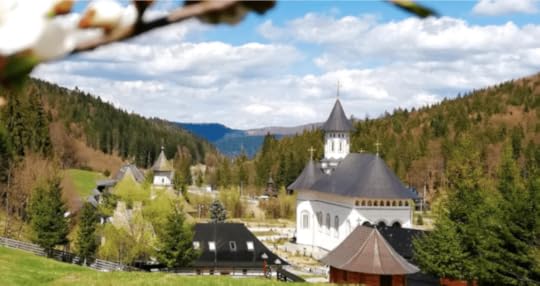
I stayed in the guest house of the Sihastria Putnei monastery, which is near the Putna monastery, the oldest and most important of all the monasteries of Romania. “Sihastria Putnei” means “hermitage of Putna” — it was founded by Putna monks who wanted a more remote monastery. On this trip, I was based at Sihastria Putnei (henceforth, SP), but also visited Putna, as well as the smaller women’s monasteries of Voronet and Sucevita (famous for their painted exterior walls). As soon as we arrived in SP, in the Carpathians, I stepped out of the car and knew I was in a sacred place. Yes, the mountain air was clear and bracing, but more than that, the sense of holiness was profound. I knew that I had arrived at a “thin” place.
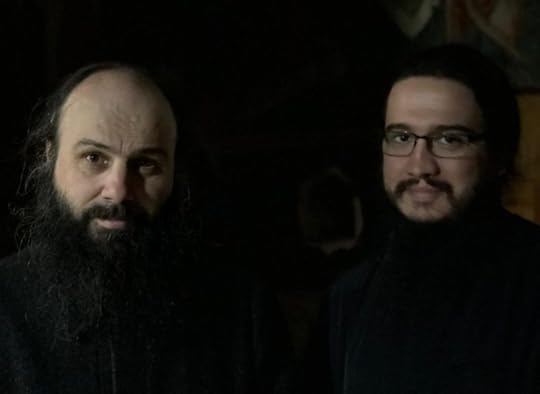
After settling in my room, I came downstairs to meet the monks Father Efrem and Father Chrysostom. Efrem is a young monk who serves as the secretary to His Holiness Damascin, the bishop of Suceava, the diocese in which the monasteries are. He was brought into the monastic priesthood by Father Chrysostom, and they are very close. Here is a photo I took of them inside a church. Chrysostom is on the left, Efrem on the right:
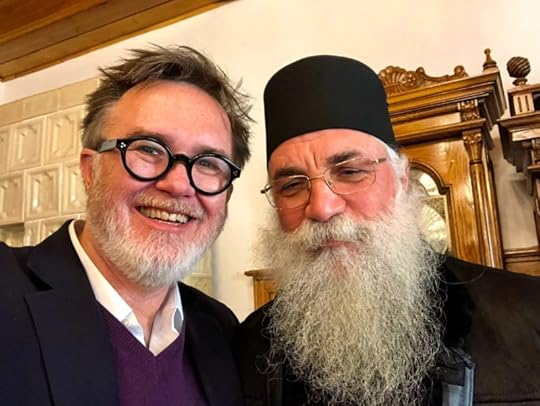
In our conversation, I shared with him a particularly painful cross that I have been carrying for some time — having to do with the nostalgia for the happy family I thought I was returning to when I moved back to Louisiana in 2011, and the acute sense of exile I have had since all that collapsed in 2012. He encouraged me to stand strong under its weight, and never to doubt that God can work through my sacrifice for the good of many. He said, “Brother Benedict, do you really think that you can do the kind of work you do in this world, and not attract the attention of the Devil?”
His point was that in the mystery of our life in Christ, God sometimes allows suffering for the sake of overcoming evil. If God himself was beaten, humiliated, and nailed to a Cross for our salvation, we who follow Him should expect no less — and we should follow His example, and bear up under the weight.
Later, I thought back to the opening sequence of Tarkovsky’s Nostalghia , (if you click on this, turn on the captions) which has had such a powerful effect on my spirituality. The cosmopolitan Roman translator Eugenia visits a rural Tuscan church, where Christian women are coming to pray for fertility. The old sacristan asks her if she is there to petition God for a baby too. No, she says, I’m just looking.
The sacristan says that those who are mere observers will experience nothing. She responds by asking what she can expect to receive if she sacrifices? He says:
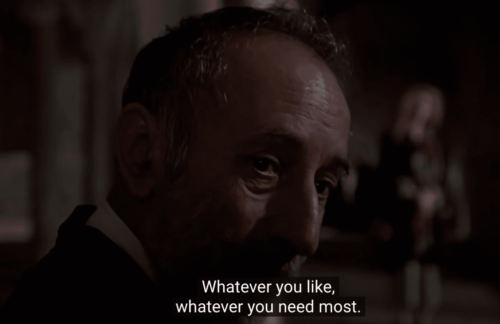
The lesson is that unless you are willing to humble yourself, to make a sacrifice, you will receive nothing in return. This, in turn, reminds me of the part of Malick’s A Hidden Life, in which the artist painting the church says that most people admire Jesus, but Jesus didn’t call admirers; he called followers (disciples). You can tell the difference when it comes to suffering. Admirers run away when following Jesus costs them something; disciples remain at His side. This is what Kierkegaard said; Malick, the screenwriter, took the point from Kierkegaard’s work.
“Christ’s life is a demand,” the old artist says. “We don’t want to be reminded of it, because we don’t want to see what happens to the Truth. A darker time is coming. Men will be more clever: they won’t fight the Truth, they’ll just ignore it.”
The scene shifts to the artist painting the exterior of the church. He says
I paint their comfortable Christ, with a halo over his head. How can I show what I haven’t lived? Some day I might have the courage to venture; not yet. Some day, I’ll paint the true Christ.
Watch this three minute clip here. It’s worth it:
To bear suffering faithfully is to live the truth of Christ. That’s what Abbot Melchisidek told me, in his way. This is not a new revelation, but coming to me from the mouth of a wise old monk, with such force, and in such a setting, made it live anew within me.
Then we piled into the church van, and Father Efrem drove us to the Sucevita monastery. I sat next to Father Chyrsostom, and asked him about how he came to monastic life. He is 42 now, but when all this happened, he was in his mid-twenties. He said:
I was a theologian. I was a very nice Christian, so to speak. I was fasting, going to church, I was working in the radio station of the church. I was somehow well-behaved. At a certain point, I think it was in 2005, I felt that there was something missing. The missing stuff was huge, because I was not able to feel God. I entered into what I call a depression — it was clinically diagnosed. I didn’t take any medicine, but as a theologian, I was trying to solve my problems theologically, but it didn’t work. I exhausted all the possibilities in the practice of my faith, but not inside my soul. I remember it very well.
I remember it very well. I was inside a cathedral. I had to make a small radio story of the divine liturgy. It was St. Demetrius’ feast day. I was talking about God, but I was empty on the inside. I was at the point where I didn’t think God existed. I was talking to Him, but he was rather absent. He was not doing the things I expected him to do. It was my last chance. I made a decision that was a radical one. I said to God, “If you exist, please do something, because I’m going to lose myself.”
Then it was like in The Matrix, when everything stopped. Then I heard something like a voice — not in my ears, not in my brain, not in my heart. It was filling the whole universe, and consumed my entire existence. It told me to go to a particular spiritual father.
That spiritual father told me how to meet the living God. Because I was meeting an idea, a ritual. I do believe that these things are important – knowing things about God, and being together in a ritual. We need ritual to meet the other. But I was only on there. But this spiritual father helped me to meet the living God. And it was … simple.
What did he do? I asked.
The usual thing, making confession. And he was telling me how to make things interior. For example, I was going to the services of the church, and doing my prayers. I told the spiritual father that I was going through a tough period. I mean, this experience didn’t solve things. It was nothing magical. That spiritual father told me, okay, you’re telling me these things, like a normal person, but what are you telling God? Are you talking to him like a living person, as a You. I asked him what’s the use of the akathists [a kind of formal prayer], then? He said those are training exercises, but they’re not the real thing. He taught me how to pray, and how to meet God.
The other important thing he taught me is that I don’t have to get rid of the state I was in. God is not solving things, but he is somehow giving value to them. I discovered that depression might be a very good friend of mine. It helped me see in a straightforward way the reality of the world.
I had lucidity. From that moment on, I was no longer impressed by anything, unless it had something significant to say to me. So I became a monk.
You made that sacrifice, I said.
I don’t consider this a sacrifice. I’m embarrassed to say this, but I was forced, somehow, into this. You know the saying of St. Maximus, that God has three wills: the good will, the will when he’s trying to help you solve things, and the third will is when he’s leaving you alone. That’s terrible, because you are there with your will all alone. God somehow put me in front of a mirror and said, ‘OK, this is who you are.’ It was terrible because I went to the theological school because I loved God. Since childhood I had wanted to be a priest. So it wasn’t a sacrifice, but I did accept somehow that there is a message, a meaning in all this. Being in a bad state of mental health is somehow a blessing. It was a blessing, and it is still a blessing, because my depression is still there. But it can be a friend.
I’m a spiritual father, and I’ve noticed something very strange. The vast majority of young men and women coming to me for advice are struggling with the same things I was struggling with a long time ago: depression and a lack of meaning. When we are 24 and 25, we finish college, and don’t know what to do. A lot of them are seeking direction for their life, and it’s very easy for me, because I have been there. I tell them what happened with me: that I searched for spiritual guidance, and was on that path in a very strict way when, I’m convinced, God sent me to that particular person.
A second thing that happened to me: I was in Jerusalem, and in the morning I was at the Holy Liturgy in the Church of the Holy Sepulchre. I am not a good friend of the early morning, but it was very early. There were Russians, Greeks, Romanians, Muslims, Catholics, Copts, and all the people in there. And I was judging God: if we are the right faith, the right confession, why couldn’t you give to us this sacred place? One of the consequences of my conversion was that I was becoming very strict. God told me, in the same way as the first time, ‘I’ve been struggling for many years to bring them together, and you’re judging me?’ I realized it was the only place on earth where everybody is in there together around God, even if they’re fighting each other, they are there with God. So I’ve learned nuance.
After that visit, when I came back home, I received a spiritual gift of guidance, which is not something you ask for. It’s important when you have people coming to you not to be very strict with them, but to understand them, and help them to become more than they are when they come to you.
It’s up to God to change them. We have to help them. They’re coming to us, and waiting for us to say you’re okay like that. They like that very much. But when you say to them that they can be more than that through God, they pull back.
This is especially true with the young men. When you first meet them, they’re somehow excited to meet the living God. But then they get frightened. They somehow feel that God is pushing on them, is taking away something from them. It’s important for us, the guides, to be with them, even on this path.
Do you think that mysticism plays an important role in helping people believe that God is real? I asked. I brought up the sociologist Christian Smith’s view that young Americans will never be re-converted through moralism. Or, I would say, rational argumentation.
“The mystical theology of the Church of the East,” he said. “Our theology is mystical. It’s about meeting God. It’s not about performing the sacred.” He went on:
There are three temptations Christ had at the beginning of his mission, from the Devil. And at the end of his mission He had three temptations, which are still our temptations in the Church today. In the first one, they asked if we are allowed to give money to Caesar. Christ says, “Give to Caesar what is Caesar’s, and to God what is God’s.” This is important, because in the Church, we tend to be too close to Caesar, not to God.
The second temptation came from the Sadducees, from the woman who had seven husbands. The question was, who will be this woman’s husband in the end? Christ said you don’t know God. You don’t know the Scriptures. God is beyond the law.
The third is when the Pharisees say, “Which is the greatest commandment?” Christ tells them, and then tells them to go do it.
So the three temptations of today’s church are: the law — formalism, you know, incense, colors, which are important, but not the main thing. The second is thinking that you are saved because you know a lot of things. And the third is when the Church is too involved in politics.
We have our mind connected to Christ — our nous, not our analytical mind — so for us it should be simple to see where society is making bad choices. The Church should be like a prophet. The prophet is the one who sees the will of God beyond everything else. The young people are coming to the Church to see this spirit of prophecy, which is giving this mystical way. We don’t have that spirit in the Church today, because we are too caught up in formalism; we know things. The spirit of prophecy gives you this mystical way. It’s not an intellectual way, and it’s not even an aesthetic way.
The holy hermits who lived their lives in the forest didn’t have a Byzantine icon to venerate. We have to be careful not to make idols of everything that is beautiful. We even make an idol of mysticism.
The most threatening thing to the modern mind is the Person of God. He’s not a force that we can manipulate by magic. The Holy Eucharist is sometimes seen as a magical thing, through which we can manipulate God. He refuses to go there. He is a person as I am, and He decides when He will meet us. He is a Person too, just like we are. It’s not the case that we can perform some sacred rites, and God will come because He is impressed.
Why are people unable to sense God’s presence today? I asked. What can they do to open their eyes.
Because they are afraid. God’s presence is something terrible. Something special. It’s not something easy to cope with. When you meet God, you know you can no longer be as you were. Father Nicolae Steinhardt was a Jew who converted in prison. He talked about how after his baptism, he had a vision. He said that after his vision, he could no longer think evil about others. That’s what the presence of God does. It’s something very difficult to cope with, because you have to change, and people really don’t want to change.
It’s typical also for our relationships. We meet somebody, and we like them, but we want them to change, not us. We don’t want to create the world together. Loving each other is not looking at each other, but to look outward in the same direction. To love each other is to create something from the same experience. It’s the same way with God. To live with God is to look in the same direction, and to create together.
We don’t do this because we are held by our sins, but mostly by fear. We don’t like God as He really is. We prefer God to be like an idol. When I was studying theology, I used to wonder why the God of Israel was always so bothered by idols. Idols are the things that are keeping us away from who God really is. It’s not the statues; it’s the concept. It’s the things that I think about, the things that I revere. My way of seeing the world. But when I have to sacrifice this to see the world as God sees it — that’s very difficult.
I asked Father Chrysostom if he ever experienced a miracle, aside from the one that led to his deeper conversion.
After that experience, everything looked like a miracle. I would be eating, and it seemed like a miracle. I could sleep, which was very rare — for more than four or five months prior to this, I couldn’t sleep properly. I had eating disorders, things like that. It’s hard to say. For example, I had an accident with my foot, and I was reading a book about the spiritual fathers, and asked the Romanian St. Paisius to heal my foot. I woke up in the morning and it was healed. I went to the doctor, and he said this was a very serious injury, how were you healed? I told him it happened during the night. But I’m not making a big deal about this, because miracles are less about outer things, and more about inner things. If a miracle doesn’t transform you, it is still objectively a miracle, but to me, it’s not really a miracle.
In fact, it’s something normally to avoid, because it could create in you the sense that you are special, that you somehow deserve it. If the Lord is a Person, and he gives me a gift, it’s not because I deserve it, but because He is showing me love. So the perspective is somehow different. So I’m not looking for miracles. If they are coming, then I’m thankful for them. It’s a miracle that I’m at this monastery, that I met Father Efrem, and Father Lucian [a young priest who was with us that day].
Do you think that Western people today have barriers that keep them from seeing things of the spirit? I asked. He told me a story about a mother who overheard Father Chrysostom talking about his struggle with depression in a conference. Later, she brought her adult son to see him. The young man had been suicidal, and none of the priests she had brought him to before, and none of the prayers they had said, had any effect.
But after talking to Father Chrysostom for fifteen minutes, the young man started on the road to recovery. That’s all it took. The monk added:
If you need something, search for it. This mom was not searching for me because I was the giver of solutions. I was a patient who was struggling, just like her son. We became friends. I didn’t promise him anything. I didn’t tell him that he would be healed. In fact, this is the healing process. He met the Christ who was not a judge, but a healer.
We arrived at the 15th century Sucevitsa monastery, which includes a jewel box church behind its thick walls. (It’s spelled “Sucevita,” but the t is a special character in Romanian, with a “ts” sound.) On the drive to SP, we stopped at the Voronet monastery, another of the painted monasteries of Bukovina. The entire building was aflame with color. Here is the famous Last Judgment wall at Voronet:
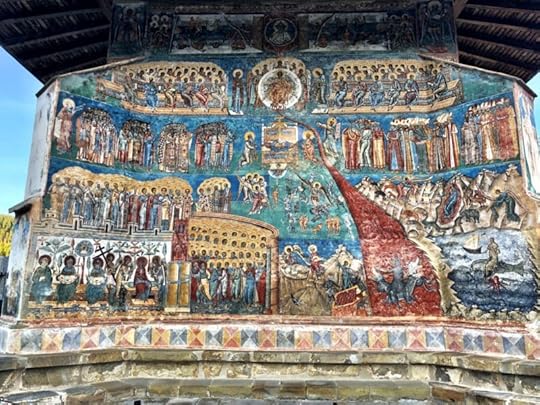
I remind you, this is an exterior wall. It was painted in the 15th century, and is still so vivid today. It’s like the whole thing is on fire. Here’s a comparison between the Last Judgment wall, and an adjoining wall that was more exposed to the elements:
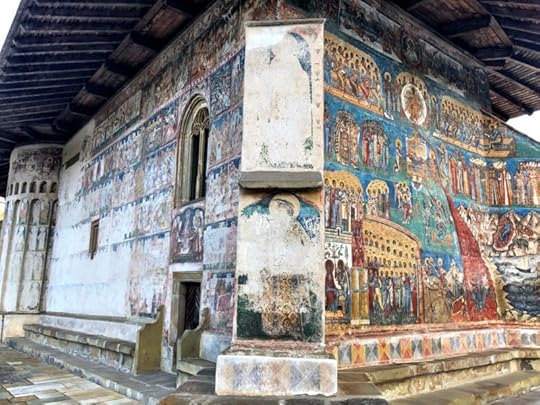
Sucevitsa is even more beautiful, because, I think, it has been entirely preserved. Here is Father Chrysostom explaining the meaning of the Jacob’s Ladder iconography on one wall of the Sucevitsa monastery:
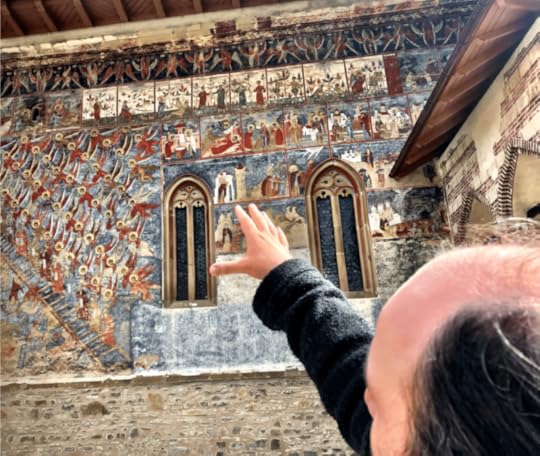
The important thing to know about these places is that none of these images are done for mere decoration. Every single image is catechetical — that is, it teaches an important lesson about the faith. Father Chrysostom pointed out a series of panels at the top of this wall:

The ones with the white background are of Adam and Eve in Eden before the fall. The whiteness everywhere symbolizes God’s palpable presence, which our ancestors felt because they had perfect communion with Him. After they sinned, and were cast out of the Garden, the background colors changed.
Father Chrysostom, who is a trained theologian, gave me a fascinating tour of the church’s interior, explaining all the iconography. The effect was overwhelming. It was as if this little late medieval church was a book conveying information about God and the cosmos in a way that can be received more directly than with the abstractions of language. I could have stayed there all afternoon. It is hard to describe the effect of the vividness of these colors. Look at this image of the Gospel verse in which Jesus tells his disciples “I am the Vine, and you are the branches.”
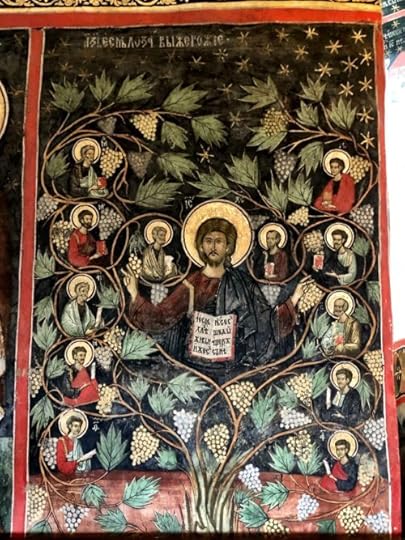
Imagine every square inch of the church’s interior covered with images so intense with color and meaning.
I like the way the sunlight comes through the window by the altar:
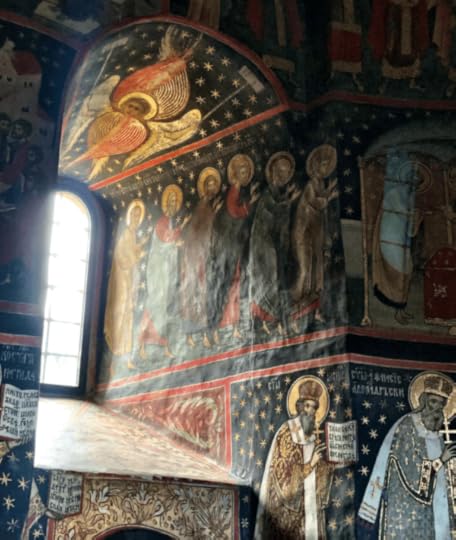
For me, this was the highlight. This is the exterior wall of the apse:
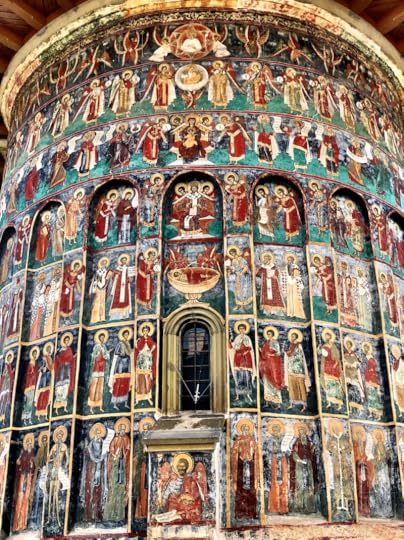
Notice the central line, from top to bottom, taking in the window. Father Chrysostom explained that this tells the story of the Cosmos, and how God condescended to us to bring us back to Himself. These are the various embodiments of the Logos.
The the very top level shows God, the Ancient of Days, inside an eight-pointed image indicating the six days of creation, the seventh day of rest, and the eighth day indicating eternity, and the cycle of time. It is a symbol of all of creation. (It occurred to me that this is an image of whatever existed at the moment of the Big Bang.)
Then we see Christ Emmanuel — the Logos among the Archangels, who first saw Christ (remember, St. Gabriel the Archangel brought news of Christ to Mary, who announced that she would call the child “Emmanuel” — God with us). Below that, Christ the Child, and then Christ the King and Emperor of all. Then we see the Eucharistic Christ. On the level of the window, we see the martyrs, who saw the Light. Then, at the bottom, are the monks, and at the center, St. John the Baptist, the Forerunner, a prophet who tells us about the King. It is painted on the buttress. John the Baptist is a forerunner of the Second Coming too. The monks are the prophetic voice of the Church, according to this image.
Hearkening back to Jacob’s Ladder on the other side of the church, Father Chrysostom said, “We can only climb the ladder because the Logos chose to come down to us. We can do nothing without Christ.”
Father Chrysostom told me that he sometimes has sophisticated people come to see him, seeking Truth, and reconciliation with God. Yet they tend to be dissatisfied with formal explanations about spiritual matters. If he has the chance to take them to see these frescoes, and the ones on the Voronet monastery. Then, they get it.
This brings to my mind the Russian Orthodox filmmaker Andrei Tarkovsky’s observation:
“The allotted function of art is not, as is often assumed, to put across ideas, to propagate thoughts, to serve as example. The aim of art is to prepare a person for death, to plough and harrow his soul, rendering it capable of turning to good.”
This is what the art of iconography on these painted monasteries of Bukovina did for me. If you see these images as they are intended to be seen, it is hard to remain as you are.
After vespers, I had dinner with His Holiness Damascin, the bishop of Suceava (that is, the local ordinary). He is young — in his forties — but had deep-set, searching eyes, and a powerful sense of peace. He has written a book about the meaning of Holy Week. I told him that I would be leaving for Israel next Sunday to spend Orthodox Holy Week in Jerusalem. I asked for his advice for how to do it.
“Be a Benedict there,” he said. He explained that it is far too easy to be caught up in the emotional crowds, and that I should instead make sure that I spend time alone, to allow the Holy Spirit to reach me.
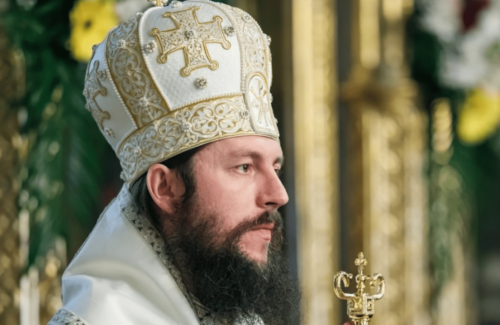 Bishop Damascin
On Sunday morning, I awakened in Sihastria Putna to a fresh blanket of snow everywhere. The big monastery church was full of worshipers, as many men as women, and everyone — from old people to children — remained on their knees, on the hard floor, for the entire long liturgy. This is unusual in Orthodoxy; people usually stand during the liturgy. But the people of Bukovina have a reputation for pious zeal.
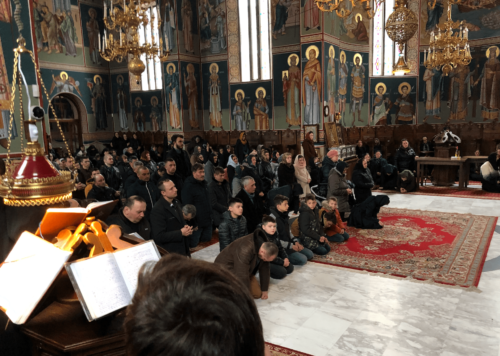
I took this shot of a young monk in the choir. It looks like a still from a Carl Th. Dreyer film of the 1920s:
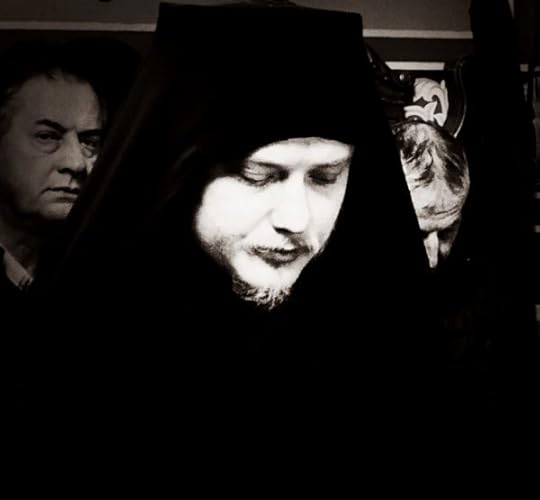
After the liturgy, Father Chrysostom and the rest of us walked over to the trapeza for lunch.
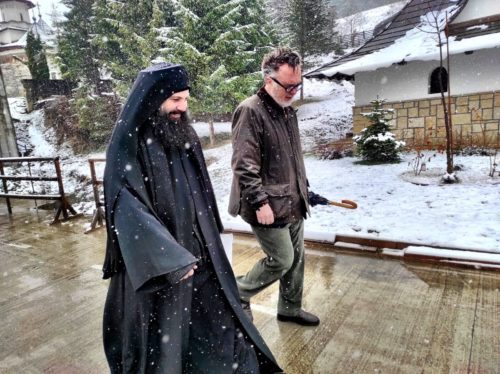
We met later with Abbot Nektarios of Sihastria Putna, and talked about spiritual things. Finally, it was time for us to leave, because we wanted to make it to Cluj by sunset. I departed Sihastria Putnei a changed man, somehow better able to shoulder the burdens of the present and the time to come — because these monks all believe the times are darkening — in part because I know now that I have powerful intercessors in my new monastic friends.
The first part of the drive to Cluj was through the Carpathian mountain. Look at this image I shot through my car window:

In Cluj, we had a late dinner with some friends of one of my traveling companions. Then the next morning, we drove out to a small women’s monastery in a Transylvania valley to meet with Father Seraphim, an old monk who serves as that monastery’s elder (the nuns need someone there who can say the Divine Liturgy for them), and who is a spiritual father to local people. He was a dear old man, twinkling with joy. In interviewed him for my book, but I haven’t yet transcribed it, so I can only tell you here that the thing I remember most from our conversation was how he spoke of love, and the challenges of loving sacrificially.
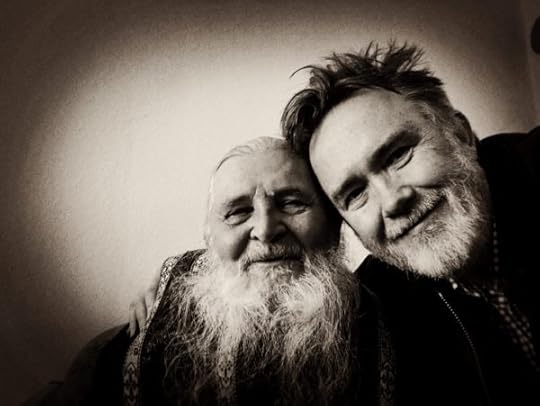
The old monk invited us to stay for a Lenten lunch, which we did. I got a View From Your Table shot; that’s Father Seraphim in the back, getting more food from the nun in the kitchen:

That night, I gave a talk about The Benedict Option and Live Not By Lies to a full house at the museum of the archdiocese of Cluj. The Metropolitan himself came to hear me, which was an enormous honor. A man named Teo who carves wooden crosses for a living gave me this. When I first glanced at it, I thought it was smooth. But then I looked closer:

Isn’t that incredible? Each arm of the cross is only two inches long — but Teo put so much detail into it. I’m wearing it now, and always will.
At the end of the event, my last in Romania, we stood for the Metropolitan to pray and dismiss us. When I turned around, I saw this statue of St. Stefan the Great, the Moldavian king who founded the monasteries I had visited:
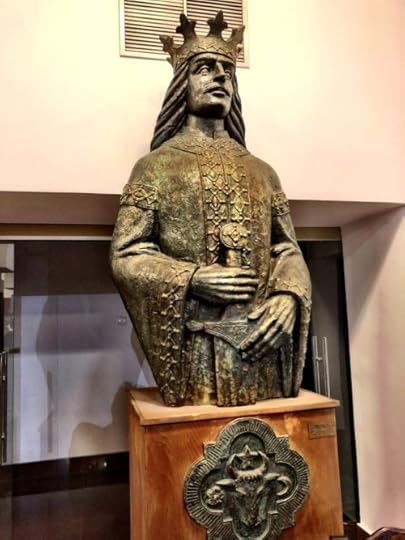
I nearly gasped when I saw this. Why? Because for the past few years, I have been following a mystery that arrived in my life in 2018, when an artist in Genoa approached me after a talk, and said that he had been praying in his studio that afternoon, and the Holy Spirit told him to come hear the American speak tonight, and to give him this. This is an engraving the artist made of a medieval saint named Galgano:

Longtime readers know this story, so I won’t drag it out; you can find the whole thing here. In short, though, I didn’t know who Galgano was. Turns out he was a passionate nobleman who was a great sinner. His mother prayed for him to return to the faith. He had a vision of St. Michael the Archangel, telling him to put his sword down and serve Christ. He resisted. Then he had a vision on top of a hill in Tuscany, in which the call was again made. Galgano said to God that it would be easier for him to put his sword into this rock at his side than to do as God says. He brought the sword down … and it went into the rock. He instantly converted, and spent the rest of his life living in a hut next to the sword in the stone. After his canonization in 1187, only three years after his death, the local bishop built a church just like the one Galgano had seen in his vision. At the center of the church was the sword in the stone.
Get this: in the year 2000, Italian scientists examined the artifact, which is still visible (though covered by thick plexiglass). They X-rayed it, and found that the blade does indeed pierce the rock, inexplicably. And they tested the metal of the sword: it is from the 12th century, consistent with the story.
I still didn’t know what this had to do with me, until 2020, when, in the depths of a particular despair, I stumbled across the Tarkovsky movie Nostalghia. It spoke powerfully to me in my situation. There is a particular scene, a dream sequence in which the protagonist, a troubled writer named Andrei, walks through a ruined church, brooding. The Virgin Mary addresses God, and asks him to show himself to Andrei, who is so lost. God replies that He does show himself to Andrei, all the time, but Andrei is so lost in his head that he can’t see.
I thought: that’s me. I have to change.
After the movie ended, I looked up the amazing church where that sequence took place. It was the Abbey of St. Galgano!
Last fall, at the end of my book tour in Italy, I made a pilgrimage to pray before the sword in the stone:
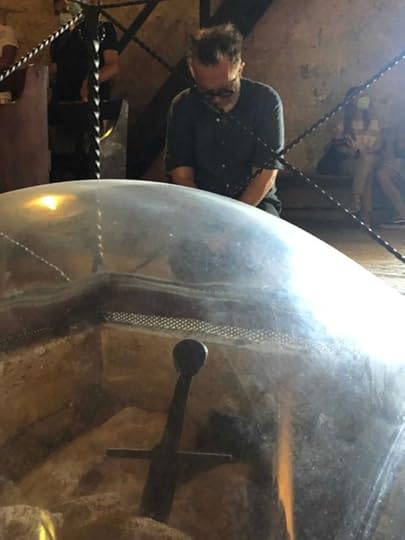
I was (am) convinced that God is calling me to live sacrificially, though I’m not sure what that means. One thing it does mean, I am sure, is that I need to set aside my brooding over what is lost, and irrecoverable, and to focus on whatever mission He has for me. But this is really hard, and I have done a poor job of it. I am always stuck in my head, replaying events from the past over and over, unable to reconcile myself to them. The distraction, and brooding over it, is affecting everything in my life. My sense is that this is what God is asking of me: to stop dwelling on, and in, the past, and to ready myself for the future He plans for me, whatever that is.
It would be easier for me to put my sword in a stone than to do that! But with God, all things are possible. At the monastery this past weekend, I received several confirmations that this is what God wants me to do with my vocation. I left the monastery feeling so much hope and confidence. The road ahead is going to be difficult — sacrificially difficult — but I have the gift of confidence that I am following God’s will for me, and the gift of spiritual friendship from these holy monks. And I am more dedicated now to this re-enchantment book than to any book I’ve ever written — a book about signs and wonders, and how to open our eyes to the presence of God.
So, when I reached the last event in my trip, and after delivering my speech turned around and saw St. Stefan the Great, with his sword in a stone, I was startled, and then delighted. St. Stefan was a worldly conqueror, but he is remembered today not so much for the deeds he did with his sword, but for what he accomplished without the sword: the founding of the monasteries that form the heart of Romanian Orthodoxy.
This was a sign for me. I am sure of it.
Say, readers, soon I will be in the Philadelphia area giving some talks at an Anglican conference. I will be talking about Live Not By Lies, but now I will also be sharing the good news I received from the monks. The Anglicans asked me to post this for you all:
The Anglican Diocese of the Living Word (ACNA) is thrilled to host Rod Dreher at its 2022 Missions Conference and Synod on May 5-7 in Souderton Pennsylvania. In this special time set aside annually for renewal, worship, and teaching we look forward to Dreher’s visionary insight on the matter of living out the faith once and all delivered to the saints while paradoxically also sojourning as exiles and pilgrims. ADLW wants this event, titled “Rediscovering the Sacred: Finding Sanctuary in Exile,” to be accessible to Rod’s followers so that they too can hear him speak in person.Rod’s followers have a special code available to them that will give them a 10% discount on the registration.Register at this link: https://www.adlw.org/2022-missions-conference-synodEnter code DREHERPA on check-out for your discount.We look forward to greeting you all in the name of Christ.I hope to see you there. We have a lot to talk about.
The post A Time Of Gifts appeared first on The American Conservative.
April 13, 2022
Building Trans America
This is horrifying:

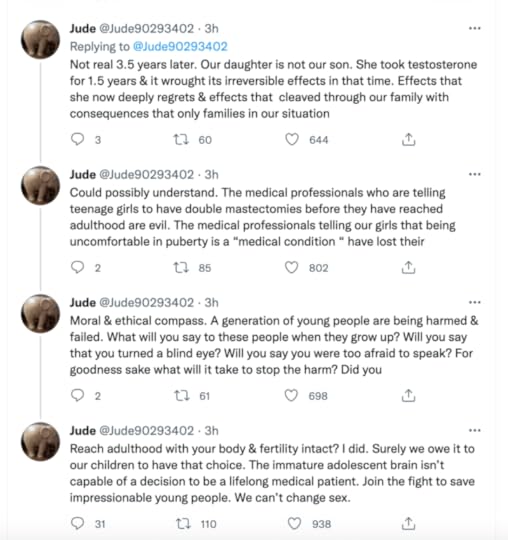
We are in a fight with naked evil. So many powerful people push this evil. So many people who know better are too afraid to stand up and call it what it is. This is not a matter of diversity of opinion; this is Evil.
Mickey Mouse pushes this stuff. The President of the United States, and his party, push this stuff. Far too few Republicans push back at all.
It has infiltrated many churches; many more refuse to say anything about it because they want to avoid controversy. Look at what’s going on with the Catholic Church in Germany, via Edward Pentin’s invaluable reporting in the National Catholic Register. Excerpts:
More:
“The focus is too much on homosexual men!” said Eric Tilch at a panel discussion in Frankfurt last Wednesday hosted by the Diocese of Limburg — the bishopric headed by Bishop Georg Bätzing, president of the German Catholic bishops’ conference.
But Tilch, a Church youth education officer, wasn’t protesting against the homosexual agenda or seeking to uphold the Church’s teaching on marriage and the family. Rather he was proposing the Church accept “other forms of love that are still in the dark,” according to an article on the panel posted on the diocesan website.
“I worry that the Church is too attached to a family photograph from the 1950s, i.e., father, mother, child,” said Tilch. “There is so much more than that, for example hybrid families, changing relationships, polyamorous love [multiple sexual partners].” He also wanted transsexual and intersexual people to be given more attention in public discussions.
The panel discussion was called “Out in Church” after a recent initiative of the same name in which 125 homosexual priests and employees of the Catholic Church in Germany called for more LGBT rights in the Church and complained about discrimination and other experiences in the Church. The initiative was made public Jan. 24 in a documentary, also called Out in Church, broadcast on ARD, one of Germany’s main television channels.
All the panel’s speakers said much had happened since the documentary aired, but they wanted more changes.
Diefenbach called for revisions to the Catechism of the Catholic Church, while acknowledging that such a goal would be a challenge. Weitzel asked that children of kindergarten age be “taken seriously if they make it clear early on that their feelings don’t match their biological sex.”
There is no avoiding this fight. It will find you, and your church. It will find your kids, and their school. We are quickly moving to a time when anyone who objects to this will be treated by the State as an enemy. It will be here faster than you think.
Meanwhile, here is the rarest thing: a column in a mainstream newspaper (the Washington Post) by a transgendered person who says something other than that transgenderism is the greatest thing ever. It’s actually quite a brave, sad piece by a male-to-female transgendered person named Corinna Cohn. Excerpts:
When I was 19, I had surgery for sex reassignment, or what is now called gender affirmation surgery. The callow young man who was obsessed with transitioning to womanhood could not have imagined reaching middle age. But now I’m closer to 50, keeping a watchful eye on my 401(k), and dieting and exercising in the hope that I’ll have a healthy retirement.
In terms of my priorities and interests today, that younger incarnation of myself might as well have been a different person — yet that was the person who committed me to a lifetime set apart from my peers.
There is much debate today about transgender treatment, especially for young people. Others might feel differently about their choices, but I know now that I wasn’t old enough to make that decision. Given the strong cultural forces today casting a benign light on these matters, I thought it might be helpful for young people, and their parents, to hear what I wish I had known.
Cohn had his testicles and penis removed, and now has to spend the rest of his life on drugs and hormones. More:
What was I seeking for my sacrifice? A feeling of wholeness and perfection. I was still a virgin when I went in for surgery. I mistakenly believed that this made my choice more serious and authentic. I chose an irreversible change before I’d even begun to understand my sexuality. The surgeon deemed my operation a good outcome, but intercourse never became pleasurable. When I tell friends, they’re saddened by the loss, but it’s abstract to me — I cannot grieve the absence of a thing I’ve never had.
One more excerpt:
Where were my parents in all this? They were aware of what I was doing, but by that point, I had pushed them out of my life. I didn’t need parents questioning me or establishing realistic expectations — especially when I found all I needed online. In the early 1990s, something called Internet Relay Chat, a rudimentary online forum, allowed me to meet like-minded strangers who offered an inexhaustible source of validation and acceptance.
I shudder to think of how distorting today’s social media is for confused teenagers. I’m also alarmed by how readily authority figures facilitate transition. I had to persuade two therapists, an endocrinologist and a surgeon to give me what I wanted. None of them were under crushing professional pressure, as they now would be, to “affirm” my choice.
Read it all. Cohn doesn’t say outright that he regrets transition, but he does say that at nineteen, he was too young and inexperienced to make such a radical choice. He should have waited until he was older, he now admits.
All these anxious and confused young people are being devoured by this evil cult. This is what America has become. This is what some countries in the world are desperate to prevent themselves from becoming. This is the American Way Of Life .
.
Look at that image above. There are companies that make prosthetic genitalia for small children. When I speak to audiences here in Central Europe, and tell them things like this, I can see them struggling to believe that this is what America now accepts. That this is what America now is. I tell them that they have the benefit of time to understand what is coming their way from our sick American culture, and to prepare to fight it.
I think I was radicalized a little bit by this trip to Romania, and talking to people there about Live Not By Lies, and what’s coming to them. I had forgotten what it was like to be with mothers and fathers who are innocent of this stuff. These people look up to America. That makes them vulnerable.
Last summer in Budapest, when a young woman I asked for her opinion of politics, she told me that she was concerned about what she perceives as government corruption under Fidesz party rule. But she told me she planned to vote Fidesz anyway, because she saw the party of Viktor Orban as the only hope Hungary has to keep gender ideology away. She explained that gender ideology is a form of corruption that is far, far worse. She’s right. Look at that photo. Read the Twitter thread above. Some of you tell me that you hate seeing these photos. I’m sorry, but people need to see them, to understand exactly what this is — and, in this case, what a perverted theft of innocence is going on here, and is praised by our media, academic, and government elites.
UPDATE: The reader who posts under the name Secular Misanthropist, and who has been on this blog for so long as a commenter that I’m near tears after reading this, writes:
I haven’t wanted to post this comment, but I knew that I eventually would. A year ago my 19 year old son went to Planned Parenthood near his college and got on HRT with informed consent only. No therapy, no in depth screening, nothing.
He’s likely on the autistic spectrum and is looking for a reason to explain why he doesn’t fit in with others. Instead of helping him with this problem our society is making his problems worse.
My wife and I found out about it because he was clumsy about covering his tracks. We tried to talk him out of it, but he’s convinced this is his solution. My wife is a psychologist and started researching the ROGD phenomenon and the lose standards of medicalization and was appalled. Since then she’s been a vocal advocate to her peers that this social contagion is doing lasting harm to children, young adults, and families.
I have told my wife that we should withhold a college education until he stops. That the college is part of the problem because they are normalizing his behavior. For example he now lives with a natal female in a coed dorm. Moreover his behavior is profoundly disrespectful. We have had many fights about this and I would not wish the past year on anyone.
Both my wife and daughter have been canceled by him on more than one occasion for not seeing him as a “woman”. They usually patch things up enough to be speaking terms.
He and I no longer speak as I told him that he was not, nor could he ever be a woman. This and several other awful discussions have made this the worst year of my life. My relationship with him is probably at an end.
I have been utterly black pilled about our society and since the Democrats have been normalizing this I hope they utterly and completely lose in November. It won’t fix my broken heart, but at least misery loves company.
I am not kidding about any of this.
I hate these people. All of them. All of them that have brought this misery to this poor family. And all of them who sit back and make excuses for why we as a society should tolerate this bullshit.
The post Building Trans America appeared first on The American Conservative.
April 12, 2022
About Scalia: ‘He Wasn’t Wrong’
I made it back from Romania yesterday afternoon. It was a life-changing trip; I’ll tell you more about it later today. It was so intense, and so exhausting, that I fell into bed at five pm yesterday for a little nap, and didn’t wake up until 5:30 this morning. That tells me how much this trip took out of me … but the people I met and the things I saw made this one of the most important long weekends of my life. Like I said, more later.
This morning I see that Vogue magazine is hailing the end of monogamy (“Inside Love’s Sharing Economy”). Remember, social change generally starts with elites … like the kind of people who read Vogue. Excerpts:
Opening their relationship sparked a stream of existential questions for the Bhatias, according to Megan: “Whose life are we living? What do we want?” Entrenched systems were equally open to debate. “We are in a time of questioning institutional structures like health care, education, and, yes, monogamy,” she says, referencing the rise of a vocal, progressive political movement demanding sweeping structural change. The swelling impulse to challenge the status quo, from systemic racism and criminal justice to #MeToo’s reckoning on sexist abuse, had crept into her sex life and relationship style: “I think people are disillusioned with life right now and really starting to write their own rules,” Megan says.
So began the Bhatias’ winding path into consensual non-monogamy or “CNM,” the modern umbrella term for the practice of mutually and ethically agreeing to open an exclusive relationship to other sexual experiences, and in some cases, serious romantic partners. As “conscious uncoupling” was to divorce, consensual non-monogamy—sometimes called “ethical non-monogamy”—is to open relationships. In contrast to the free love of the ’60s or suburban key-party ethos of the ’70s, consensual non-monogamy in 2022 is a thoughtfully considered, typically therapized practice, complete with tidy acronym. CNM is rooted in open relationships that aspire to be “honest, moral, and trustworthy,” says Jessica Wood, Ph.D., a sexuality and relationships researcher at the Sex Information & Education Council of Canada (SIECCAN), who has studied CNM since 2018.
The Bhatias are not alone: In a national survey conducted by data analytics firm YouGov in 2020, only 56 percent cited complete monogamy as their ideal relationship style, a 5 percent drop from 2016. An estimated 23 percent of respondents said their relationships were already non-monogamous, echoing breakthrough 2017 research published in the Journal of Sex & Marital Therapy, which found that more than one in five single Americans in their study had tried consensual non-monogamy. “You could go to the grocery store, close your eyes, point at someone, and as long as there’s at least five people in that grocery store, one of them is probably engaged in non-monogamy,” says one of the study’s authors, Amy Moors, Ph.D., an assistant professor of psychology at Chapman University and research fellow at the Kinsey Institute at Indiana University. At a minimum, the CNM community is “as large as the LGBTQ population in the United States,” Kimberly Rhoten, a founding member of the Polyamory Legal Advocacy Coalition, tells me.
Nor is aspiring to monogamy any longer the societal default: When asked about their relationship ideal, from completely open to completely monogamous, the number of people who replied “I don’t know” more than doubled in the 2020 YouGov study, leaping from 5 percent in 2016 to 12 percent. “More people are starting to question,” says Zhana Vrangalova, Ph.D., an adjunct professor of human sexuality at New York University, who researches non-monogamy. “There are a couple of cultural shifts that are really making monogamy—complete, strict, lifelong monogamy—a very difficult thing to pull off.”
More:
Megan considers herself a better parent now that she’s polyamorous, saying she’s a more loving person in general. She and Marty give their son and daughter an age-appropriate explanation of their unconventional relationship structure or “polycule” (CNM is only the beginning of a seemingly endless glossary of terms). “At one point, when we lived in New Zealand and Kyle lived with us for about six months, they knew I might be in Kyle’s bedroom or I might be in Daddy’s bedroom,” Megan said. “We talk about ‘Mommy loves Kyle and Daddy,’ and ‘Daddy loves Mommy and Daddy loves his partner’…and they don’t know it’s not normal yet.” She likens it to the kids’ simply accepting the Bhatias’ gay friends.
And:
It took five more years, but in June 2020, the liberal city of Somerville, Massachusetts, just outside Boston, passed what was believed to be the country’s first municipal ordinance recognizing polyamorous relationships of three of more people, granting them the same legal rights as married, monogamous couples. The neighboring cities of Cambridge and Arlington followed suit in March and April 2021. Moors cites late Supreme Court Justice Antonin Scalia’s “slippery slope” argument that striking down anti-sodomy laws could lead to queer marriage and legal unions between multiple people. She laughs a little: “He wasn’t wrong.”
Let’s revisit Justice Scalia’s dissent in Lawrence v. Texas, the one referenced here. Excerpts:
State laws against bigamy, same-sex marriage, adult incest, prostitution, masturbation, adultery, fornication, bestiality, and obscenity are likewise sustainable only in light of Bowers’ validation of laws based on moral choices. Every single one of these laws is called into question by today’s decision; the Court makes no effort to cabin the scope of its decision to exclude them from its holding. See ante, at 11 (noting “an emerging awareness that liberty gives substantial protection to adult persons in deciding how to conduct their private lives in matters pertaining to sex” (emphasis added)). The impossibility of distinguishing homosexuality from other traditional “morals” offenses is precisely why Bowers rejected the rational-basis challenge. “The law,” it said, “is constantly based on notions of morality, and if all laws representing essentially moral choices are to be invalidated under the Due Process Clause, the courts will be very busy indeed.” 478 U.S., at 196.
What a massive disruption of the current social order, therefore, the overruling of Bowers entails.
More:
I turn now to the ground on which the Court squarely rests its holding: the contention that there is no rational basis for the law here under attack. This proposition is so out of accord with our jurisprudence–indeed, with the jurisprudence of any society we know–that it requires little discussion.
The Texas statute undeniably seeks to further the belief of its citizens that certain forms of sexual behavior are “immoral and unacceptable,” Bowers, supra, at 196–the same interest furthered by criminal laws against fornication, bigamy, adultery, adult incest, bestiality, and obscenity. Bowers held that this was a legitimate state interest. The Court today reaches the opposite conclusion. The Texas statute, it says, “furthers no legitimate state interest which can justify its intrusion into the personal and private life of the individual,” ante, at 18 (emphasis addded). The Court embraces instead Justice Stevens’ declaration in his Bowers dissent, that “the fact that the governing majority in a State has traditionally viewed a particular practice as immoral is not a sufficient reason for upholding a law prohibiting the practice,” ante, at 17. This effectively decrees the end of all morals legislation. If, as the Court asserts, the promotion of majoritarian sexual morality is not even a legitimate state interest, none of the above-mentioned laws can survive rational-basis review.
And:
Let me be clear that I have nothing against homosexuals, or any other group, promoting their agenda through normal democratic means. Social perceptions of sexual and other morality change over time, and every group has the right to persuade its fellow citizens that its view of such matters is the best. That homosexuals have achieved some success in that enterprise is attested to by the fact that Texas is one of the few remaining States that criminalize private, consensual homosexual acts. But persuading one’s fellow citizens is one thing, and imposing one’s views in absence of democratic majority will is something else. I would no more require a State to criminalize homosexual acts–or, for that matter, display any moral disapprobation of them–than I would forbid it to do so. What Texas has chosen to do is well within the range of traditional democratic action, and its hand should not be stayed through the invention of a brand-new “constitutional right” by a Court that is impatient of democratic change. It is indeed true that “later generations can see that laws once thought necessary and proper in fact serve only to oppress,” ante, at 18; and when that happens, later generations can repeal those laws. But it is the premise of our system that those judgments are to be made by the people, and not imposed by a governing caste that knows best.
To recap: in the 2003 decision overturning anti-sodomy laws, Justice Antonin Scalia warned that the Court’s ruling negated any basis in law for regulating consensual sexual behavior or relationships.
In 2022, the polyamorist chuckles, “He wasn’t wrong.”
I recall that several Trump nominees to the federal bench were roasted for their stated beliefs that (in effect) Justice Scalia wasn’t wrong. The Scalia codicil to the Law of Merited Impossibility: Justice Scalia is wrong, and when he is proven right, you bigots will deserve it.
Back in 2003, I supported the overturning of anti-sodomy laws on privacy grounds, but via legislation — NOT via the court solution. I was certain that Scalia was right. Now, of course, we see that he was. The law is a teacher. If the law does not privilege marriage as one man plus one woman, exclusively, why should society?
To be sure, I do believe that same-sex marriage became a possibility in the minds of many because of the way the heterosexual majority had come to think about what marriage is, in the wake of the Sexual Revolution. That is, if the straight majority had come to believe that marriage is nothing more than a civil contract made between two people, to ratify in law their emotional feelings for each other, and that the marriage (and the law that provides for it) is not grounded in anything beyond the desires of the partners to the contract, then what sense does it make to restrict that to opposite-sex couples? And if you give it to same-sex couples, by what rational standard do you keep it from consensual polyamorists?
This is the answer to the simple-minded question one often heard back in the pre-Obergefell days: “How does my gay neighbors’ marriage hurt mine?” The answer many of us gave was that the kind of tectonic social and cultural change it took to make same-sex marriage conceivable, and then finally a legal fact, would have the effect of wrecking the stable ideal of marriage, upon which our civilization was based. Nobody wanted to hear it. When Scalia said so, he was denounced as a crotchety old bigot.
But: “He wasn’t wrong.”
It’s also important to consider how this process has brought us to the transgender moment. Strictly speaking, it need not have done. Scalia laid out the legal logic by which we would get to same-sex marriage, and then legal recognition of polyamory, but he didn’t include transgenderism there, because the legal process he’s talking about related only to sex, not gender.
But as we now know, there is no clear line between the concepts of sexual orientation and gender identity. This is why activists attach the “T” to the “LGB”. What’s the connection? It’s philosophical: the individual and his desires are sovereign in matters having to do with sexual desire, of which gender is felt to be a subset. In Lawrence, the court majority justified its decision by citing “an emerging awareness that liberty gives substantial protection to adult persons in deciding how to conduct their private lives in matters pertaining to sex.” The SCOTUS majority also found that the Texas anti-sodomy law “furthers no legitimate state interest which can justify its intrusion into the personal and private life of the individual.”
By that logic, how can SCOTUS fail to endorse transgender claims? I believe there is an obvious legitimate state interest in discouraging transgenderism. But I don’t believe that is at all obvious to an emerging majority of Americans, who have been acculturated to radical permissiveness on all matters sexual.
I just spent a few days in Romania. It was striking to me to observe, as I often do when speaking to audiences in Central European countries, how uncomprehending these people are when I tell them about how far gender totalitarianism — that is, the mandatory acceptance of gender ideology, including trans and gender fluidity — has gone in the United States. They visibly cannot understand what I am talking about. I warn them that they had better not be under the illusion that their traditions and their common sense will make this stuff stop at the borders. Sooner or later, this is coming for them and their kids — and they had better use the time they have now to prepare to fight: to fight for the natural family, to fight for their children, and to fight for the future of their society, and civilization.
Thinking about it this morning, in light of Scalia’s prophetic warning, it occurred to me that in looking out over these Romanian audiences, I was looking at middle Americans circa 1998. If you were able to travel back in time from 2022 and tell an audience in, say, Cape Girardeau, Missouri, what was perfectly normal with regard to sexual orientation and gender identity, they would have found it hard to believe you — just as hard as it is for people in this part of the world to believe in 2022. But it’s true! We have lived through an astonishing revolution, such that even things that were unthinkable a generation ago are not only thinkable, but you will soon be compelled to think of them as normal, and what was once indisputably normal as evil.
This stuff has been forcibly normalized in law and popular culture, and it is leading many of us to normalize it internally. This is how totalitarianism works: you don’t need the state or other institutions to force it on you once you have normalized the ideology, and police yourself for crimethink.
The United States, like much of the West, is in an advanced state of decadence. I was talking last week to a Hungarian, who, speaking of Viktor Orban, said to me, “He looks at the West, and sees no future. He sees it falling apart.” Well, he’s right. I return from Romania even more convinced of the need for the Benedict Option. We don’t have forever to build these arks within which we and our families and communities can ride out the deluge. Remember your Alasdair MacIntyre:
A crucial turning point in that earlier history occurred when men and women of good will turned aside from the task of shoring up the Roman imperium and ceased to identify the continuation of civility and moral community with the maintenance of that imperium. What they set themselves to achieve instead–often not recognizing fully what they were doing–was the construction of new forms of community within which the moral life could be sustained so that both morality and civility might survive the coming ages of barbarism and darkness. If my account of our moral condition, we ought also to conclude that for some time now we too have reached that turning point. What matters at this stage is the construction of local forms of community within which civility and the intellectual and moral life can be sustained through the new dark ages which are already upon us.
The day is coming, and is in fact almost here, when the State, as well as normative institutions in American and Western society, will consider social and religious conservatives who reject the Sexual Revolution (as well as the racialized form of wokeness) to be enemies of the State. That’s when the hard persecution will begin. We are not there yet. But it’s coming. I remind you of the Biden administration’s new HHS document on “gender-affirming care” for so-called trans youth, which I wrote about here. This paragraph in particular:
There is no scientifically sound research showing negative impacts from providing gender-affirming care. The decision for the child welfare system to become involved in the lives of families, potentially to the extent of removing children from their families and homes, should be wielded with the utmost care, grounded in evidence, and always prioritizing the well-being of children and preservation of families.
The administration is laying the groundwork for the seizing of minors from parents who object to medically transitioning their children to the opposite sex. Not even Scalia saw that coming. The usual suspects will say that we who can see this for what it is are being paranoid, and probably bigoted, that it would never happen. I remind you: they said the same thing about Justice Scalia in 2003. I know; I was there.
The post About Scalia: ‘He Wasn’t Wrong’ appeared first on The American Conservative.
Rod Dreher's Blog

- Rod Dreher's profile
- 508 followers