Barbara Sjoholm's Blog, page 5
June 20, 2019
Clearing Out Book Release and Interview Helene Uri
 Read the Interview with Helene Uri Here
Just out from the University of Minnesota Press
Inspired by Helene Uri’s own journey into her family’s ancestry, Clearing Out, an emotionally resonant novel by one of Norway’s most celebrated authors, tells two intertwining stories. A novelist, named Helene, is living in Oslo with her husband and children and contemplating her new protagonist, Ellinor Smidt—a language researcher, divorced and in her late thirties, with a doctorate but no steady job.
[image error] An unexpected call from a distant relative reveals that Helene’s grandfather, Nicolai Nilsen, was the son of a coastal (sjø) Sami fisherman—something no one in her family ever talked about. Uncertain how to weave this new knowledge into who she believes she is, Helene continues to write her novel, in which her heroine Ellinor travels to Finnmark in the far north to study the dying languages of the Sami families there. What Ellinor finds among the Sami people she meets is a culture little known in her own world; she discovers history richer and more alluring than rumor and a connection charged with mystery and promise.


April 22, 2019
Robert Macfarlane and By the Fire: Lit Hub review
It's EARTH DAY!
Lit Hub, the always-worth-reading online source for essays, reviews, and all things literary, has just published an interesting piece by Andrew Ervin about Robert Macfarlane's upcoming book, Underland , and By the Fire that ties them together under the comprehensive topic of threats to the North from climate change.
As a fan of Macfarlane's visionary prose about landscape and history in the British Isles, I was honored to see my translation reviewed with his book. Can't wait until June when I can add Underland to his earlier book, The Old Ways, about paths, journeys, and memories.
Lit Hub, the always-worth-reading online source for essays, reviews, and all things literary, has just published an interesting piece by Andrew Ervin about Robert Macfarlane's upcoming book, Underland , and By the Fire that ties them together under the comprehensive topic of threats to the North from climate change.
As a fan of Macfarlane's visionary prose about landscape and history in the British Isles, I was honored to see my translation reviewed with his book. Can't wait until June when I can add Underland to his earlier book, The Old Ways, about paths, journeys, and memories.
April 12, 2019
Here They Can Still Tell Stories: Two Sami Folktales in the Norwegian American
The
In the current issue you'll find my
 Linocut from By the Fire, by Emilie Demant Hatt, translated by Barbara Sjoholm, University of Minnesota Press, 2019
April 6, 2019
Histories: Three generations of Sámi artists at the Queen Sonja Art Stable, Oslo
On show this year in central Oslo, in the former Royal Stables of the palace, an important art exhibition is taking place until the end of August 2019.
Historiesis a wide-ranging exhibition presenting 61 works by three generations of Sámi artists from Norway, Sweden and Finland. Included are such long-established and influential artists as Iver Jåks (1932–2007), the post-war sculptor, craft artist, and painter. Two artists who began their careers in the 1970s, Norwegian Sami Synnøve Persen and Swedish Sami Britta Marakatt-Labba, are also well-represented, along with a number of younger Sami artists from different fields.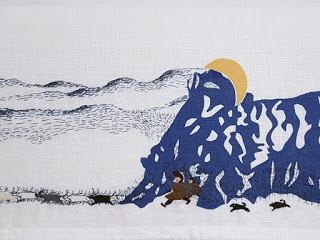 Detail, History (tapestry), Britta Marakatt-Labba Some years ago I had the pleasure of viewing Marakatt-Labba’s tapestry, titled History, imposing in size (20 meters long), but also captivating in its embroidered figures and landscapes from Sami history in on a long wall at the Arctic University of Tromsø. This is the tapestry’s first exhibition in Oslo, though it’s also been shown in New York and Europe.
For more details, see the exhibition’s brochure (PDF).
Historiesis a wide-ranging exhibition presenting 61 works by three generations of Sámi artists from Norway, Sweden and Finland. Included are such long-established and influential artists as Iver Jåks (1932–2007), the post-war sculptor, craft artist, and painter. Two artists who began their careers in the 1970s, Norwegian Sami Synnøve Persen and Swedish Sami Britta Marakatt-Labba, are also well-represented, along with a number of younger Sami artists from different fields.
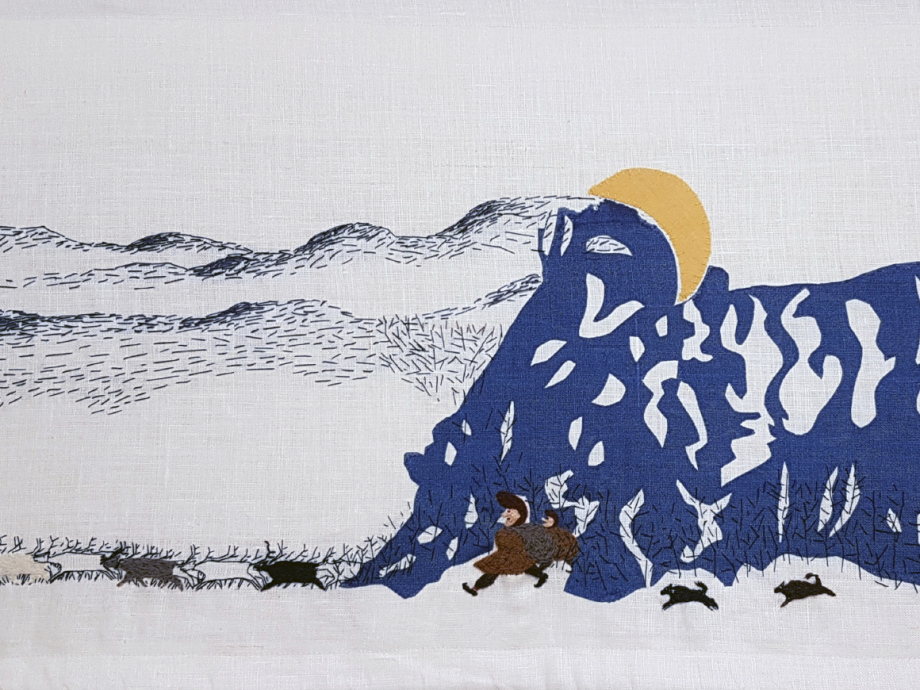 Detail, History (tapestry), Britta Marakatt-Labba Some years ago I had the pleasure of viewing Marakatt-Labba’s tapestry, titled History, imposing in size (20 meters long), but also captivating in its embroidered figures and landscapes from Sami history in on a long wall at the Arctic University of Tromsø. This is the tapestry’s first exhibition in Oslo, though it’s also been shown in New York and Europe.
For more details, see the exhibition’s brochure (PDF).
March 28, 2019
By the Fire: Sami Folktales and Legends, collected and illustrated by Emilie Demant Hatt
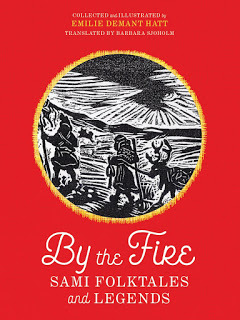 Although Lappish wizards and magical reindeer are found in European folktale collections, stories told by the indigenous Nordic Sami themselves are less known in world literature. The sixty-odd tales in By the Fire, gathered first-hand by the Danish artist and ethnographer Emilie Demant Hatt (1873-1958) and originally published in 1922 in Denmark, are an exception. Between 1907 and 1916 Demant Hatt traveled through the mountains of Swedish Sápmi and occasionally Norway, recording tales of magic animals, otherworldly girls who marry Sami men, and cannibalistic ogres or Stallos. Many of her storytellers were women, and some of the most memorable tales in this collection tell of plucky girls and women who outfox their attackers—whether Russian bandits, mysterious Dog-Turks, or Swedish farmers—and save their people.
 By the Fire is shortly to come out from the University of Minnesota Press and will be available in bookstores and online around mid-April. The hardcover edition includes Demant Hatt’s original linoleum prints and an afterword by me.
It's been my pleasure to translate from Danish these stories collected and illustrated by Emilie Demant Hatt, as an addition to other titles I've published by and about this remarkable woman. But it's also been important to me to identify her original storytellers, to tell something of their lives, and to add their distinctive voices to Nordic folklore. I was able to research women like Anni Rasti from Karesuando and Margreta Bengtsson from Pite Sápmi, and to learn more about Sami resistance to colonization in South Sápmi in the folklore archives in Uppsala, Sweden, and at the Nordiska Museum in Stockholm, which holds Demant Hatt's field journals. These typed journals have a wealth of information on her sources as well as the originals of the folktales.
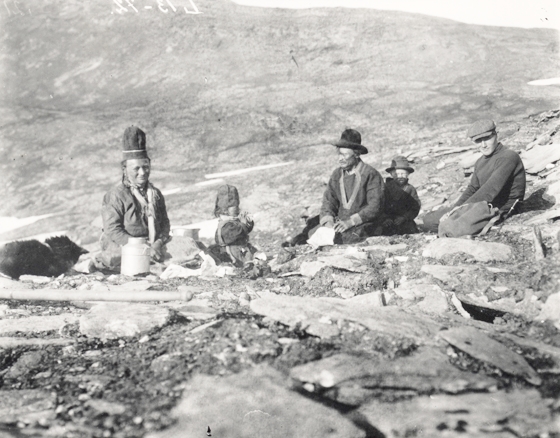 Margreta Bengtsson (left) with her family, 1916 photo: EDHIn April and May I'll be doing events in the Midwest and Pacific Northwest. In some places (Duluth, Minneapolis, Seattle so far), I'll be joined by one or two members of local Sami-American communities who will also read aloud stories from the collection. I hope some of you can join us!
April 14, 20191 PM Daughters of Norway, Scout Cabin, Discovery Road, Port Townsend
May 01, 2019
6:00 PM to 7:30 PM A Room of One's Own, 315 W Gorham St., Madison, WI 53703
May 06, 20196:30 PM to 8:00 PMScout & Morgan BooksIsanti County Historical Society, 33525 Flanders St. NE, Cambridge, MN 55008
May 07, 20197:00 PM to 9:00 PM Spirit of the North Theatre at Fitgers Bookstore, Duluth, MNCo-sponsored by the Sami Cultural Center of North AmericaWith Laurel Sanders
May 08, 2019
6:00 PM to 08:00 PM American Swedish Institute, Larson Hall, 2600 Park Ave., Minneapolis, MN 55407 With Tanley Lego
May 12, 20192:00 PM to 4:00 PM Nordic Museum, 2655 NW Market St., Seattle, WA 98107 Co-sponsored by Pacific Sámi SearviWith Julie Whitehorn and Mary Brandt
June 01, 20194:00 PM-5:30 PMVillage Books, 1200 11th Street, Bellingham, WA 98225
June 16, 20191:30 PM to 3:30 PMScandinavian Cultural Center, PLU, TacomaCo-sponsored by Pacific Sámi Searvi
November 2, 2018
Pictures of Longing
 Available now from the University of Minnesota PressJUST OUT: A BEAUTIFUL AND TIMELY BOOK ABOUT IMMIGRATION
 Haunting and revealing photographs sent home by Norwegian immigrants in America as visual document and collective expression of the emigrant experience.
Sigrid Lien brings more than 250 America–photographs into focus as a moving account of Norwegian migration in the nineteenth and early-twentieth centuries, conceived of and crafted by its photographer-authors to shape and reshape their story. Reading these photographs alongside letters from Norwegian immigrants, Lien provides the first comprehensive account of this collective photographic practice involving “the voice of the many.”
As the translator of this book, I'm very pleased to see Sigrid Lien's research into Norwegian immigration via the photographs taken by new arrivals to the Midwest and Plains states made available in this country. The photographs are amusing, touching, and always illuminating, and the book also sheds light on a time when Scandinavian immigrants were not invariably welcomed with open arms, but seen, like the Germans and Irish and Poles, as threats to the social order.
This exhaustively researched book, written in a highly readable style, presents a gold-mine of material for anyone interested in Scandinavian-American history, immigrant history, history of the Midwest, Norwegian history, and the history of American photography. Developments in photographic technology and distribution at the turn of the last century made it possible for the great wave of Norwegians arriving in the United States at that time to keep up contact with their homeland and present detailed records of their encounter with a new country. This excellent study brings these people and the experience of immigration to life. — Linda Haverty Rugg, University of California, Berkeley
October 29, 2017
How I Came to Write Black Fox
The University of Wisconsin Press publishes many fine books and encourages authors to write about their own projects on publication date. Here's the link to mine about Black Fox: A Life of Emilie Demant Hatt, which came out earlier this month, along with the text below.
It was more than idle curiosity to begin with, but not much more.
 Up in the far north of Norway, on a lamp-lit day in December, 2001, the Norwegian writer Laila Stien told me the story of Emilie Demant Hatt and Johan Turi. Or at least the little that was known then of their story:
In the early twentieth century, a Danish woman artist had visited Lapland and encountered a Sami wolf-hunter, by chance, on a train. Later she inspired and helped this man write a book—Muitalus sámiid birra (An Account of the Sami)––now considered the first classic work of Sami literature.
I immediately had questions, but for a long time, few answers. Who was this woman, Emilie Demant Hatt? How did she end up in Lapland, or Sápmi, as the region is now called? What kind of artist was she? And what was her relationship with Johan Turi?
I read her engaging travel narrative in Danish, With the Lapps in the High Mountains, from 1913, and Turi’s equally marvelous book in its 1931 English translation, Turi’s Book of Lapland. And I included what I knew about the pair in my own travel narrative, The Palace of the Snow Queen: Winter Travels in Lapland. Each time I went to Scandinavia I made time to do more investigation. I visited the museum in Skive, Denmark that owned some of Demant Hatt’s artworks, and the Nordic Museum in Stockholm, which held a collection of fifty Expressionist canvases of Sápmi, all painted when she was in her sixties and seventies. The Nordic Museum archives also possessed many of her papers, including intimate letters from Turi, and her field journals from the ethnographic trips she made to Scandinavia in 1907-1916. In Copenhagen I visited the Ethnographic Collection at the National Museum, and pored through eight boxes of letters, sketchbooks, and photo albums. But not until 2008, after the Danish State Archives had put records of their holdings online, did I realize how much more there was: several dozen boxes of material by and about Demant Hatt were available. I’d suspected the woman was something of a packrat, and now I knew that for certain.
By the time I realized the extent of Demant Hatt’s archives, it was too late for me to feel properly frightened or inadequate. I was enthralled. Each challenge—deciphering her handwriting in letters and journals, learning all I could about Sami history, and culture, meeting scholars in many fields, walking the same streets Demant Hatt had walked––led me further. I translated her book With the Lapps and wrote an introduction. Then, because I was deeply fascinated with another of her relationships, an adolescent romance with the composer Carl Nielsen, I wrote a novel, Fossil Island, and a sequel, The Former World. Eventually I felt I knew enough to begin a full-length biography, a project that would lead me deeper into the same questions I began with years ago––Who was this woman, Emilie Demant Hatt? How did she end up in Sápmi?––but which grew increasingly complex:
Who was Johan Turi, as a writer and artist? How did Demant Hatt represent him and promote him as an indigenous author? Was their work together ethnographic collaboration or something else? How was Demant Hatt affected by the racial biology movement, much of it directed against the Sami, in Scandinavia? How did her year in the United States with her husband Gudmund Hatt, in 1914-15, and their contacts with Franz Boas and other Americanists shape her ethnographic thinking? Why is her pioneering fieldwork among Sami women and children and her folktale collecting so little acknowledged? What was the impact of Sápmi on her visual art and how were her Expressionist paintings and graphic work received in Scandinavia?
Every life has its mysteries and one of the roles of the biographer is to dig them out through the careful reading of letters and the charting of personal connections with other historical figures. But even more important in writing a person’s life, especially a life that is both significant and neglected, is a biographical approach that looks at the context of the subject. Demant Hatt, born in 1873 in a rural village in Denmark, traveled widely in her lifetime, not only to Northern Scandinavia, but to Greenland and the Caribbean. She was a self-identified New Woman, one of the generation of women artists allowed to study at the Royal Academy of Art, who took advantage of changing times to travel alone, far off the beaten path, and to marry a much younger man. She lived through two World Wars, including the occupation of Denmark by Germany. Her historical time period, particularly as it relates to changes in Sápmi, is a crucial aspect of her life. She came to know Sami nomadic herders during a time of transition, and she bears important witness to the injustices the Sami suffered from their neighbors and respective states and to their efforts to claim agency over their lives.
Demant Hatt didn’t live outside her era and some of her attitudes may strike us now as patronizing. She was both insider and outsider in Sápmi. Her friendship with Johan Turi was both loving and conflicted. Yet it’s also possible to understand how unwaveringly admiring and actively supportive she was of the Sami. In lively, insightful narratives, in fieldwork notes, in folktale collection, and in her paintings, she’s left an important record of a nomadic people and a northern world that continues to educate and enchant.
October 1, 2017
Upcoming October talks about Emilie Demant Hatt and Johan Turi as artists
In connection with the publication of Black Fox, the biography of Emilie Demant Hatt, in October, I'll be doing two slideshows and talks in the Pacific Northwest:
Seattle: Nordic Heritage Museum, Wednesday, Oct 18, 7 p.m.https://nordicmuseum.org/events/139123Nordic Heritage Museum
3014 Northwest 67th Street
Seattle, WA 98117
Port Townsend: PT library, Tuesday, October 24, 7 p.m. http://engagedpatrons.org/Events.cfm?SiteID=6359&BranchID=1220 Lawrence St Port Townsend, WA 98368
"In the early twentieth century, the Danish artist Emilie Demant Hatt and Johan Turi, a Swedish Sami hunter and would-be writer and artist, formed an unlikely bond. She edited and translated his classic work, An Account of the Sami, which included his drawings. He introduced her to the world of nomadic reindeer herders. Back in Denmark, Demant Hatt wrote her own narrative, With the Lapps in the High Mountains. Author Barbara Sjoholm has been studying the lives of Demant Hatt and Turi for many years and presents a talk and slide show about their mutual influence and how Sápmi is reflected in their writings and artwork."
Seattle: Nordic Heritage Museum, Wednesday, Oct 18, 7 p.m.https://nordicmuseum.org/events/139123Nordic Heritage Museum
3014 Northwest 67th Street
Seattle, WA 98117
Port Townsend: PT library, Tuesday, October 24, 7 p.m. http://engagedpatrons.org/Events.cfm?SiteID=6359&BranchID=1220 Lawrence St Port Townsend, WA 98368
"In the early twentieth century, the Danish artist Emilie Demant Hatt and Johan Turi, a Swedish Sami hunter and would-be writer and artist, formed an unlikely bond. She edited and translated his classic work, An Account of the Sami, which included his drawings. He introduced her to the world of nomadic reindeer herders. Back in Denmark, Demant Hatt wrote her own narrative, With the Lapps in the High Mountains. Author Barbara Sjoholm has been studying the lives of Demant Hatt and Turi for many years and presents a talk and slide show about their mutual influence and how Sápmi is reflected in their writings and artwork."
June 7, 2017
Black Fox: A Life of Emilie Demant Hatt, Artist and Ethnographer
In October 2017 the University of Wisconsin Press will publish my biography of Emilie Demant Hatt. Here's a preview of the cover and some ordering information:
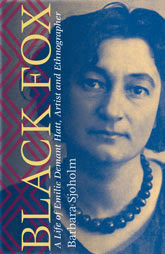
In 1904 a young Danish woman met a Sami wolf hunter on a train in Sweden. This chance encounter transformed the lives of artist Emilie Demant and the hunter, Johan Turi. In 1907–8 Demant went to live with Sami families in their tents and on migrations, later writing a lively account of her experiences. She collaborated with Turi on his book about his people. On her own and later with her husband Gudmund Hatt, she roamed on foot through Sami regions as an ethnographer and folklorist. As an artist, she created many striking paintings with Sami motifs. Her exceptional life and relationships come alive in this first English-language biography.
“A fascinating story of a talented woman's unconventional career at the outset of the twentieth century. Through Sjoholm's meticulous archival investigation, Emilie Demant Hatt emerges as a woman of tremendous energy, insight, and vision, unafraid to cross the various academic, artistic, and cultural barriers of her time.”
—Thomas A. DuBois, translator of Johan Turi's An Account of the Sámi
“Emilie Demant Hatt's contributions to Sami ethnography deserve wide recognition, and this biography provides an absorbing account of her achievements as an ethnographer as well as an artist.”
—Trude Fonneland, author of Contemporary Shamanisms in Norway
https://uwpress.wisc.edu/books/5610.htm
In 1904 a young Danish woman met a Sami wolf hunter on a train in Sweden. This chance encounter transformed the lives of artist Emilie Demant and the hunter, Johan Turi. In 1907–8 Demant went to live with Sami families in their tents and on migrations, later writing a lively account of her experiences. She collaborated with Turi on his book about his people. On her own and later with her husband Gudmund Hatt, she roamed on foot through Sami regions as an ethnographer and folklorist. As an artist, she created many striking paintings with Sami motifs. Her exceptional life and relationships come alive in this first English-language biography.
“A fascinating story of a talented woman's unconventional career at the outset of the twentieth century. Through Sjoholm's meticulous archival investigation, Emilie Demant Hatt emerges as a woman of tremendous energy, insight, and vision, unafraid to cross the various academic, artistic, and cultural barriers of her time.”
—Thomas A. DuBois, translator of Johan Turi's An Account of the Sámi
“Emilie Demant Hatt's contributions to Sami ethnography deserve wide recognition, and this biography provides an absorbing account of her achievements as an ethnographer as well as an artist.”
—Trude Fonneland, author of Contemporary Shamanisms in Norway
https://uwpress.wisc.edu/books/5610.htm
April 25, 2017
New Museum of Failure in Sweden
Coming up in June, the world's first Museum of Failure is set to open in the Swedish city of Helsingborg. Focusing on innovations that didn't quite make as saleable products (Bic for Her),
 and on ideas that were before or behind their time (Google Glass), the museum has 51 objects so far, says its founder, Samuel West, with more arriving every day.
These "floppar" are meant to be both funny, horrifying, and instructive. Apparently we learn from our mistakes.
Though in the case of this board game below, it seems that failure was only a spur to hugher and greater failures to come:
 Trump: The Game. Photo: Björn LindgrenFor more on the Museum of Failure that "showcases flop products."