N.E. White's Blog, page 17
January 26, 2016
Carbo Load
When I was younger, I cycled.
A lot.
I was on the UC Davis cycling team for a couple of years. After I graduated, I stopped racing but I didn’t stop cycling. My husband and I completed several centuries a year until we got a dog and had to switch to mountain biking.
Cycling huge mileage (100 to 200 miles) is an endeavor one doesn’t do on the spur of the moment unless you’re young and stupid. Months, or at least weeks, of preparation will ensure successfully completing a “century” in one piece.
And on the night before this big event, cyclists of all abilities do one thing to stave off the ginormous energetic drain that cycling all day can do:
 Via Pixabay (Creative Commons license).
Carbo Load.
Obviously, I don’t expect you to eat a huge pasta meal the night before NewNoWriMo. But writing every day for 29 days will drain your mental and creative energy. You won’t be able to make it past the first week unless you do the equivalent of carbo loading – now.
And just what is the equivalent of carbo loading?
Reading.
That’s right, reading. You need to fuel your inner muse by reading (or watching your favorite TV show will do, too). So, today, after you have made sure all your pencils are sharpened, your laptop is fully charged, and that you’ve staked out the perfect desk at the library, re-read a favorite book. Or pick up a new-to-you novel by one of your favorite authors. Or maybe you don’t want to start a novel less than a week before Feb 1st. Instead, get a short story anthology (maybe this one). Short stories are often full of creative ideas that can fuel your muse and get you through a month of creation.
Until the start of NewNoWriMo, read.
By the way, for those who have opted to join in officially (by adding your name here, also please comment on any of these posts so that I get your email address), we have prizes!
For those who complete their goals (I’ll need to see proof!), I’ll randomly pick your name from a hat and you can win one of the following:
A book cover designed and produced by a graphic artist! – Joe Bailey, my writing buddy and professional graphic artist (he produced this cover and our NewNoWriMo logos) has generously offered to design and create a book cover for you. Woohoo!
A $50 Amazon gift card! – Delivered to your email inbox. Go wild and buy a bunch of books after you spend all that time writing one.
A box of chocolates! – I’ll need your shipping address for this one, but if you don’t want the calories, I can swap this out for a $25 Amazon gift card.
Now, if the idea of seeing your magus opus finished can’t inspire you to write every day in February, maybe one of the above prizes will.
Filed under: NewNoWriMo, writing Tagged: NEWNoWriMo, writing, writing preparation


January 19, 2016
All We Have Is Time
When you think about it, there’s really only one thing we have in this universe we can claim as our own: Time.
Everything else is fickle and transitory. One day a pauper, the next a king. You never know what tomorrow will bring except, you guessed it, more time.
But how to manage it?
In order to realize your NewNoWriMo goals, taking a few minutes of your precious time today to schedule your writing in February can be critical.
Since last week’s NewNoWriMo article was so long, I’m going to keep this one short and easy. Here’s a list of time management tips I use. I’ve also gleaned some of the best from the internet. Try a few or all of them.
Write during your most productive time of the day. If that happens to be at 4am, set yourself up so you can do that.
Put it on your calendar – with a pen. Block out an hour or two on your daily calendar for your writing, like you would for a class or doctor’s appointment.
Share your time commitments with close family members so they know you are busy during those times.
Put up a “DO NOT DISTURB” sign, if needed.
Ignore your phone and email. Answer the phone/emails outside of your writing time.
Disconnect from the internet. You can do it. Just pull the cable out of your desktop or turn off the WiFi on your laptop.
If you find yourself distracted during your allotted time slot, consider using a timer to keep you on task.
In case you were wondering, here’s what my weekly, writing schedule will look like in February, 2016:
Sunday – 4 hours, anytime
Monday – off
Tuesday – 2 hours, 7am to 9am
Wednesday – 1 hour, 8am to 9am
Thursday 2 hours, 7am to 9am
Friday – off
Saturday – 2 hours, anytime
That’s a total of 11 hours a week! If I manage to crank out 500 words an hour, that’s 5,500 per week or close to 22,000 words for the month. If I can do it, you can do it.
Until next week, write well.
Posts on NewNoWriMo:
The NEW NaNoWriMo
Get Ready for NewNoWriMo
Do you know where your story is?
Filed under: NewNoWriMo, writing Tagged: NEWNoWriMo, time management, writing, writing schedule


January 12, 2016
Do you know where your story is?
Remember that?
Back in the day, at around 11pm, on the network television channels, a public service announcer would say:
“It’s 11 o’clock. Do you know where your children are?”
Three weeks prior to NewNoWriMo, I’m asking you:
“Do you know where your story is?”
(If you don’t know what NewNoWriMo is, check out this post.)

Here’s our unofficial-official NewNoWriMo badge. Wear it on your blog with pride. (Graphic courtesy of the most awesome Joe Bailey.)
So, again, three weeks prior to a month dedicated to writing, have you got your character sketches completed? Have you plotted out your main story arc? Got your scene list and beats?
Or are you just gonna wing it?
Even if you do decide to allow your muse to take over, it is nice to have a well-thought out idea of who (or what) you are going to write about. Otherwise, you might get halfway through the month and hit a wall.
We don’t want to do that. The goal is to finish your story (or whatever goal you set out for yourself), and planning out the steps needed to make it to your goal gives you (and me) a better chance of reaching it.
As many writers there are in the world, there are as many ways to write a book (or novella or short story). Some even say that each book is written in its own way. Very few writers follow the same course for every book they write. But there are a few guidelines one can use to help get started.
Below I’ll present different ways you can go about planning your novel. These are just ideas. I’m not trying to tell you how to write, but for those who struggle with the planning phase of any project, the methods presented below may help. Feel free to mix and match techniques.
For those of you with more experience, in the comment section, let us know how you have successfully completed a novel.
From a spark to a universe
My writing coach once told me that all writing should serve dual purpose. Actually, far more than just two, but two is the minimum. A line of dialogue should not only convey crucial story information, but it should also give us a sense of who the speaker is (i.e., their word choice and cadence should reveal their education and emotional state). So, too, for all the writing, or meta-writing, you do for your story.
One method of outlining can do double-duty by providing your story’s theme, a tag line, a query pitch, your back-cover blurb, one-page synopsis, two-page synopsis, etc. Get the picture? First come up with all that meta-writing before you start writing.
This is probably the most intensive of all the outlining methods and requires in-depth knowledge of your story, the plot, character motivations and background, the setting/world-building, etc. All of which you should write about first.
That’s a lot to think about.
Doing it this way is a detail-oriented person’s dream. There’s no end to the amount of outlining or summarizing you can do before you actually write the story. So, if your friends always rely on you to plan the night’s activities, get at it. Now is the time to write about what you are going to write.
The downside to this method is that sometimes, all the creative, fun stuff happens while you’re outlining and you lose the drive to, you know, actually write the story. :(
Similar to this is the snowflake method. (Or maybe it is the snowflake method.)
Three-Acts
Borrowed from plays and screenwriting, the three-act structure has, like you would expect, three parts.
Act 1 is considered the “status quo” or the “normal world”. Taking up about 25% of your story length (so, for a 50,000 word novella, Act 1 would come in at around 12,500 words), this is where you introduce your protagonist and all the major characters. Near the end of Act 1, some extraordinary incident occurs, catapulting your main character into a new world (for them) and introducing the main problem they have to solve.
Act 2 is the bulk of your story. With our 50,000-word story example, this part will end up at 50% of your word count, or 25,000 words. In this section, things heat up for your protagonist. Not only does your heroine have to save the world, but our villain has upped the stakes by making it personal – the bastard has kidnapped Aunt Em, threatening to make her suffer for eternity if our hero doesn’t get out of their way. Or something like that. The idea is that the stakes are raised and story complications increase in Act 2 until we think there’s no possible way our heroine is gonna make it.
Act 3 is the end, of course. In the last quarter of the story, in about 12,500 words, the story is resolved. Our protagonist figures out how to stop the villain AND save Aunt Em (or maybe not, if this is a tragedy).
As you can see, this method is fairly loosey-goosey. You can mix story and plot elements within the three-act structure, but the bones are what makes this “outline” work for just about every movie and screenplay out there.
Here are a couple of resources on the three-act structure:
Wikipedia
The Script Lab
The upside to this method is that it is fairly straight forward, giving you some guidelines along the way, but overall allows one to just go for it.
However, for those of you who want more detail, and still want to use the three-act structure – no problem!
For Act 1, you can include a Hook (a compelling plot event that gets the reader involved in both plot and story), the Backstory or world setting (introduce the protagonist and lay the groundwork for plot and story), and a Trigger (an intense event that propels the protagonist into some sort of crisis).
Then in Act 2, you can include a Crisis (your protagonist suffers from their emotional crisis caused by the trigger because of her character flaw), then her Struggle (against ever-increasing obstacles), and finally her Epiphany (when your protagonist realizes her flaw and overcomes it).
In Act 3, your protagonist can now formulate a Plan (that she couldn’t do before her epiphany), include the grand finale in a Climax (where your protagonist is thrust against her antagonist), and finally Ending the story with plot and story conflicts resolved.
Character = Story, Story = Character
There’s a long-standing debate regarding character versus plot driven stories.
We’re not going there.
But suffice to say that for some writers, plot (the physical events in a story and their sequence) is meaningless. For them, their character (and why and what they do) is the story. If that’s the case for you, then sit down and ask yourself these questions:
What’s your main character’s history? Where did they grow up and with whom? What events made them who they are today (when the story begins)?
How do they talk? Do they have a low or high voice? Do they like to use big words or short phrases?
What do they look like? How do they dress? The idea is for you, the writer, to know this. You might never actually describe your character in your novel, but you should know what they look like and how other characters might react to how they look.
What sort of friends does your main character have? Do they visit their parents or other family members a lot? Are they social, reclusive?
What is the passion of their life? An environmentalist? A pro-lifer? What are they trying to do in this story? What is their internal (unstated) need?
What’s wrong with your character? Everyone has something wrong them. Quick to anger. Lazy. Self-centered. What’s your character’s flaw and how is it keeping them back?
We all have internal dialogue. All. The. Time. What’s it like in your character’s head?
Are there any physical or mental weaknesses your character has to overcome to reach their goal?
Answering these questions can often reveal your character’s story, essentially having your main character write the novel for you.
Adapted from this Writer’s Digest article.
Scene and Sequel
Ah, now we are getting to the nitty-gritty of writing!
Not really an outline method, but a method of writing that helps guide you through a story. If you subscribe to this way of thinking, a novel is made up of connected (or semi-connected) scenes where stuff happens, with narration (a chance for your characters to react) in between.
Scenes are what drives the story forward and is where all the conflict and action occur. You have to have a goal (your character wants a drink of water), conflict (the sink is so far), then a disaster occurs (when she gets there, she discovers the plumbing isn’t working).
In the sequels, your protagonist gets to respond to the disaster by showing her emotion (disappointed there’s no water, she’s so thirsty), then she has a thought about how she got to that point (her good-for-nothing ex-boyfriend followed through on his threat to break her water main). After that, she has to make a decision about what to do (she can’t let that mofo get away with it) and that naturally leads to some action (she goes and gets her Smith and Wesson).
The object of last the action, then becomes the next scene’s goal. So on and so forth.
Again, this method of writing with scene and sequels isn’t really an outline method, but if you’re a pantster, this might be a good way to keep your narrative focused and on task.
Here’s a slightly different, but very similar take on scene and sequel. (Remember, everyone does it differently.)
A Pantster’s Dream
If all that is too much structure for you, you can just wing it the whole way. However, that may only get you a few pages in before you run out of steam, and we want to make it through an entire month (or 29 days).
There are several ways you can keep the narrative going by using techniques that keep the story interesting to you as a writer and moves the narrative forward. Basically, the idea is that every action has a reaction (physics – yay!). When something happens in your story, it is for a reason. If your character wakes up in the morning, it’s because they have to go to work, or school, or meet a spy for lunch so they can plot the king’s demise. If you get stuck between scenes, you can always fall back on this – there’s always a reaction.
Another way to think of this is that every action has a reaction but not necessarily the reaction your character wants. So, my character wants to meet that spy to plan an assassination, but when he gets to the meeting spot, his partner is dead. Therefore, he must either do it alone or get someone else to help him, but there are four burly women at the end of the alley watching his every move and he may be dead soon too. Therefore, he goes on the run, but…
You get the picture. You simply keep going, throwing obstacles in front of your protagonist.
This is the “but-or-therefore” method (read about this in more detail here).
Start at the End
Lastly, you can start at the end and build your outline from there – backwards. Maybe you know your main character is going to die at the end, their death the result of saving a planet or a loved one. How did they get there? Why are they there? Who’s this person they sacrificed their life for?
Answering those questions can help you find the main points in your story so you can build a compelling narrative.
That’s it from me.
I only skimmed the surface of all the methods I presented above. This post is not meant to exhaust all the ways you can plan and prepare to write your story. There are many many more ways. (And I didn’t even go into other stylistic choices you can make like point of view and tense.) If none of the ideas presented above spark your interest, try these:
How I Plot a Novel in 5 Steps (Rachel Aaron)
Composing a Rough Draft in 2 Weeks (Lindsay Buroker)
7 Steps to Creating a Flexible Outline for Any Story
6 Secrets to Writing a Novel Without an Outline
Good luck! Next week I’ll post my schedule for NewNoWriMo. I hope it inspires you to pencil in writing time on your calendar.

Our full banner. If you plan on participating, feel free to use this on your blog. (Thanks to the very talented Joe Bailey!)
Filed under: NewNoWriMo, writing Tagged: NEWNoWriMo, writing preparation, writing process



January 5, 2016
Get Ready for NewNoWriMo
A few days after the shock of the new year has worn off, and if you haven’t already, it is time to think of what you want to accomplish in 2016.
Here on my blog, we are gearing up for a NaNoWriMo-like challenge in the month of February 2016. We’re calling it NewNoWriMo.
The goal for February 2016 is to capture some of that collective energy so prevalent during National Novel Writing Month and apply it to a month of the year that doesn’t include a major holiday.
Yes, I’m aware that regardless of family obligations during Thanksgiving, many people still find the time to type out 50,000 words. More power to them.
But, for those of us who find November a challenging time of year in and of itself, well then, NewNoWriMo is for you.
How To NewNoWriMo
It it quite simple, really. It’s just a matter of setting a goal for yourself, committing to work towards that goal every single day in February and then following through.
Here are the steps that will set you up for a stellar writing year.
1. Decide what you want to finish in 29 days.
Yes, February 2016 only has 29 days, not 30 like in November. Quit griping. It could have been only 28 days.
29 days is still a lot. If you write a 1,000 words a day, that’ll be about a third of a novel, a very chunky novella, or an excellent series of shorts. In either case, it’s a sizable chunk. But if 1,000 words seems too daunting, go for something more manageable. Maybe 500 words per day is more your speed. Or maybe 2,000 words. Whatever it is you are trying to do, set it down so you have a target to aim at.
In my case, I want to finish the third episode of a series I’m writing about ghosts. The first two episodes came in at 15,000 and 17,000 words, respectively. So my goal for NewNoWriMo is to write another episode of that length. So that’s about 586 words a day. I’ll round that out to 600 words a day just to be on the safe side.
2. Sign up by listing your name and a quantifiable goal…
…in this document (sorry, I’m not a programmer, we’ll have to make do with Google Documents).
You don’t have to do this part. You can secretly participate in NewNoWriMo and bask in your own, lonely glory at the end of the month when you hit 75,000 words. But then you won’t be eligible to win our grand prize.
(Yes, there will be prizes! More details on these later.)
3. Take time now to prepare to write
Each week this month, I’ll post an article I hope will help you prepare for NewNoWriMo. The first will list a few strategies for planning your story. Whether you outline or write from the seat of your pants (pantsters), you’ll need to at least get the core of your story idea down to ensure you don’t falter half-way through February. The second will detail how I’ll manage my time and writing resources during February so that I have a schedule that will help me meet my goals. I hope this will inspire you to schedule in writing time so you too succeed. And they’ll be more posts as we get closer to February 1st.
So, if you haven’t already, subscribe to this blog by hitting the FOLLOW button or signing up by email (both should be available to the right of this text near the top). You can sign up for my newsletter, if you want, but I won’t be announcing any NewNoWriMo activities via my newsletter. It’s all happening on this here blog.
We have 26 days until February. Are you ready to join me for a month of writing?
Filed under: NewNoWriMo, writing Tagged: NEWNoWriMo, writing, writing goals



December 31, 2015
2015 in review
Here’s my WordPress.com year in review (link below).
Thanks for all the views and to those who commented! I appreciate your attention and I hope to see you all again in 2016. :)
Happy New Year!
Here’s an excerpt:
A San Francisco cable car holds 60 people. This blog was viewed about 2,800 times in 2015. If it were a cable car, it would take about 47 trips to carry that many people.
Click here to see the complete report.
Filed under: writing


December 28, 2015
On the Kindle
Sometimes the holidays bring free time. Sometimes not. But here’s what is on my Kindle right now. Hopefully, I’ll get through it all before the new year. Feel free to share your own list either by commenting on this post, or posting your own list and linking back to mine.
The Dragon’s Hoard*
* That’s my Kindle’s name.
 Body Work
(Chapter 5 in the Peter Grant series GRAPHIC NOVEL) by Ben Aaronvitch
Body Work
(Chapter 5 in the Peter Grant series GRAPHIC NOVEL) by Ben AaronvitchThis series is one of my favorites, but I made a mistake. I bought one in the series of the graphic novel adaptation instead of the next novel. I had meant to pre-order The Hanging Tree (#6), but I got it wrong. I really enjoy (okay, maybe I’m smitten with) the main character, Peter Grant. He’s funny, charming, and clever. Plus, he’s good to Toby, the magic-sniffing dog. So, I’m going to give the graphic novel a go. I’m jumping in mid-stream (pun intended) but that’s okay. I know the story well. This will be my VERY first graphic novel and I plan to review it for SFFWorld.com.
 The Grace of Kings
by Ken Liu
The Grace of Kings
by Ken LiuI’ve read a few short stories by Ken Liu but none of the works he has translated nor any of his novels. I’ve heard both good and bad things about this book. We’ll see if it is to my liking. If so, I’ll probably review it, but no promises. The cover is enchanting and I like epic fantasy so as long as it doesn’t completely bore me, I think I’ll get through it this week.
 Beacon 23
(the complete novel) by Hugh Howey
Beacon 23
(the complete novel) by Hugh HoweyAnother Science Fiction series by Hugh Howey, I started this when the compilation came out and I quickly put it away. It starts well and I knew I would want to read this straight through. It’s the type of story I think Hugh does really well. He likes to pit lone characters in realistic, but terrifying situations and then make something go horribly wrong. Hugh never fails to write informative and emotive novels. I’m looking forward to this.
But I’m waiting for an uninterrupted six hours to get through it.
One thing that I both like and dislike about the serial is that many times each episode leaves us with a cliff hanger. That’s okay, so long as I have the next one immediately available!
Maybe the day after New Year’s Eve I’ll get those six hours? It’s a date! This will also be reviewed for SFFWorld.com.
 Dark Matters: Absences by Andrew Leon Hudson
My editing/writing partner has published a series of short stories. I’ve read a couple, specifically his weird westerns, but this volume (and this series) is dedicated to…the dark side (not a Star Wars reference – but I did just see it, have you?).
Anyway, I’m not a huge fan of horror so I’ve put off reading these, but this one is supposed to feature the apocalypse. So long as there aren’t too many zombies, we’ll see how far I get before it induces nightmares.
 The Masked Songbird (Shrike #1) by Emmie Mears
I’m actually just about done with this one.
I know Emmie Mears. A fellow blogger, I had the honor of launching her debut novel here on this very blog, but at the time, I never got around to reading it. To be honest, the original cover did not entice me – at all. Recently, I noticed Emmie re-released this (along with the second book) with new covers (which I think are great, better than the original). And the second book in the series just came out. And while there are things in The Masked Songbird I’m not entirely convinced by, this is a series I intend to keep reading. The protagonist is fun and the world setting is intriguing. Check it out. I’ll be reviewing it soon for SFFWorld.com.
 Half-resurrection Blues (Bone Street Rumba #1) by Daniel José Older
I started this one earlier this year and got about half way through it. The plot sort of loses its way. I do like the characters, so if I have time this week, I’ll finish it. But it is near the bottom of my list. Still, it is worth checking out. The writing is good, the cast is diverse, and the world setting is intriguing. If you don’t mind rambling plots, then this might be work for you.
 The Death of Dulgath (The Riyria Chronicles #3) by Michael J. Sullivan
I’m so disappointed with this book. I’m about three-quarters of the way through, and though I intend on finishing, the novel did not live up to my expectations. It’s too bad I’m not entirely happy with it because I even have a hardback edition I got via Mr. Sullivan’s Kickstarter campaign.
Maybe the end will turn it all around for me and I’ll think this is the best thing since sliced bread, but right now, I’m not feeling it. If you’ve read all his other books in the Riyria world setting, then you probably want to get this. Hadrian and Royce are great together and the writing is stellar, so this is still a good read. It just didn’t meet my expectations. I’ll be reviewing this for SFFWorld.com.
 Abendau’s Heir (Inheritance Trilogy #1) by Jo Zebedee
This is another one that just loses its plot about midway through. The writing is fine and I enjoy most of the characters, but unfortunately, the main character is not as sympathetic as I would like. It starts out really well though. Not sure if the ending makes up for the blah middle, but I do intend to try to finish this over the weekend. If I do, then I’ll be reviewing it for SFFWorld.com.
 Spire City (not sure which episode is next…) by Daniel Ausema
I started this series sometime in early 2015 (I think). Anyway, I really like it. A fantastically, secondary world setting, the cast is diverse and the characters are very sympathetic. You will cry and cheer for them. Unfortunately, Daniel’s original small publisher went under and I can’t figure out what I’ve read and not read! I’m pretty sure I’m on the third season, but the one I have on my kindle doesn’t actually say what season it is from. So, I think I might have gotten the wrong one (see Body Work above). I’ll probably just go straight to the author and get it all sorted out over the weekend. However, because of this, I won’t get to it until late in January.
 Fortune’s Pawn (Paradox #1) by Rachel Bach
I’ve meant to try Rachel Bach/Rachel Aaron’s work for some time now. So I finally bought this one but just haven’t gotten around to reading it. It’s gotten a lot of good ratings over on Goodreads so I trust I’ll like it, but I’ve also heard it’s got a bit a romance. I’m not completely adverse to romance, but if the romance tends to over-shadow the plot, I tend to shy away.
My review buddy, Rob Bedford, seems to enjoy Ms. Bach’s work so I hope I do, too.
 Ash & Flame Episode Three by Wilson Geiger
This is an apocalyptic serial by another writing buddy of mine. I enjoyed the first two episodes, but I got into the third just when I started traveling a lot (traveling and reading do not mix well for me). I plan on finishing this episode this week and starting up the next one.
2016 Reading List
Here are the books I’m looking forward to reading later in 2016 (not necessarily published in 2016).
The Fifth Season by N.K. Jemisin
Drake by Pete McLean
Assassin’s Fate by Robin Hobb
Beautiful Intelligence by Stephan Palmer
Fools Errant by Matthew Hughes
What are you hanging out to read?
Filed under: Reading Tagged: reading list


December 16, 2015
The NEW NaNoWriMo
The end is near, my friends, so I thought I should wrap up a few loose ends and announce an exciting new challenge.
NaNoWriMo
Did you complete the challenge? All 50,000 words of it?
I did not.
I managed about 13,000 words which amounted to an almost complete second episode of my ghost stories series. Woohoo! I’m definitely happy about that progress, but I fell short of my goal (a completed episode). I plan to finish up this month, and move forward on the next episode at the beginning of next year. My ultimate goal is to self-publish four to five episodes by Halloween 2016.
And I know I can do it. If nothing else, that’s what NaNoWriMo teaches us. That even if we say we don’t have time to write, the reality is we do. The key is making writing a priority and following through.
Somehow, during NaNoWriMo, the collective energy of thousands of other novelist going at it permeates the ether, traveling with the mighty trade winds around the world. If you reach up, that electric charge can inspire you to action.
So let’s do it again.
NEWNoWriMo
In February 2016, join me and my writing buddy, Joe Bailey, on another writing challenge. We’re calling it the NEWNoWriMo.
(Get it? My initials (N.E.W.) along with the Novel Writing Month moniker?)
Rather than go for 50,000 words, however, we’ll be going for a more modest word count. For me, it will be 15,000. For Joe, it will be an accomplishment just to see him open up the word processor!
And you can, too.
What will be your NEWNoWriMo?
Join us as we attempt to capture some of that NaNoWriMo magic and become productive writers for a month other than November. We’ll have badges to share and we’ll be able to track our collective progress via a public Google Document. In addition, you’ll get daily quotes and encouragement from me in the form of blog posts.
I’ll give more guidance and information as we near the start date. Until then, check out Writer’s Digest How to Prepare for NaNoWriMo.
P.S. There will be prizes! Lots of prizes!!!
Filed under: Wednesday Writer, writing Tagged: goals, NaNoWriMo, NEWNoWriMo, writing, writing goals



December 14, 2015
Ecotour Wrap-up
This is coming to you a little late, but better than never, right?
Thank you to all who contributed to the Kickstarter campaign for Ecotones, an anthology of fantasy and science fiction stories with an ecological bent.
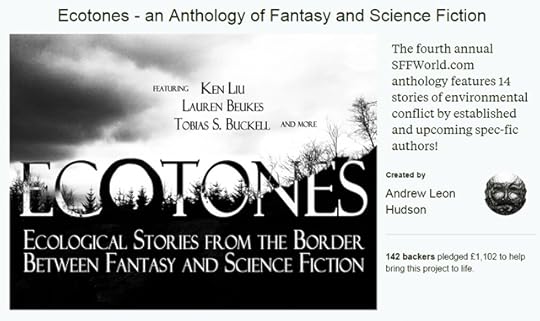
The campaign was successful, which means all our up-front costs have been covered and 142 very awesome folks will be receiving the anthology soon. In addition, some will also get our past anthologies. I hope everyone is happy with the stories. I know I’ve enjoyed them all.
I am sad to announce that no one took us up on our $10 gift certificate drawing. All one had to do was tweet one of our Ecotour blog posts. Sadly, other than the contributing authors, no one did. Maybe I should give the gift certificate to one of them?
Regardless, here are the links to the stops on our Ecotour:
Victor Espinosa , hosted by N. E. White
N. E. White , hosted by Jon Laidlow
Rebecca Schwarz , hosted by Victor Espinosa
Daniel Ausema , hosted by Rebecca Schwarz
Jon Laidlow , hosted by Daniel Ausema
Igor Ljubuncic , hosted by Andrew Leon Hudson
Kurt Hunt , hosted by Igor Ljubuncic
Andrew Leon Hudson , hosted by SFFWorld
I urge you to visit each Ecotour stop. There’s some fun and poignant reading to be had at each one. I’m always interested in what inspires folks to write for a particular anthology; the answers are always surprising and may be a bit inspirational themselves.
Thanks again to all who participated, shared, and contributed to this year’s anthology.
Until next year, enjoy.
RELATED POSTS:
Blog Tour Rundown
Don’t Kickstart what you can’t Kickfinish!
Filed under: Monday Minutes Tagged: Ecotones, ecotour, kickstarter


December 2, 2015
My Dog is Dying
Egads, what a terrible headline, huh?
I should be ashamed of myself for using it, but it’s true. My dog is dying. Just as we all are. Every second after we are born brings us closer to our eventual last moment.
Alby (full name: Albert Fucking-Einstein) is around 17 years old. We are not exactly sure of his age because we got him from the pound. We’ve had him for 16 years and he hasn’t gotten any bigger, so we figure he’s somewhere around 17. But he could be older.
 Earlier this year
Yup. You read that right. In human-equivalent years, he’s around 100 years old.
And he is finally starting to show it.
He has lost a bit of his hearing. I don’t call or whistle for him anymore because it just doesn’t work. I’m developing a habit of walking back to get him when he goes astray or I walk him on a leash.
 Are you talking to me?
His eyes have clouded over probably due to cataract formation so he’s going a little blind, too. He bumps into me on our pre-dawn walks and movement close to him scares him more than usual. Honestly, I haven’t asked our dog’s veterinarian to check his eyes out. That would cost more money. We’ve already spent over $5,000 on him in the past year and a half, we are not doing anything more unless it is necessary.
 Stop moving so quickly
His digestive tract is hit and miss. Sometimes he can eat, sometimes he can’t. Sometimes he throws up his food, sometimes it’s just bile and blood. But when he does eat and it stays down, he enjoys every bit of tofu I give him.
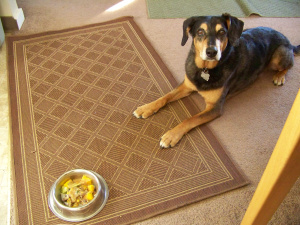
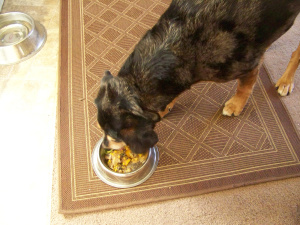
A few years ago, I started a blog for Ably. The idea was to write like it was Alby’s diary. He was going to spill it all. But I took on more than I could chew with that project and I abandoned it soon after. But now that Alby has turned to his final years, I may revive it.
Filed under: Dog Tagged: dog, senior dog



November 30, 2015
The Rainbow
When the sun comes up and a mist is in the air and the whole sky is brilliant, then from a natural fountain the rainbow is born, stretching forth in an enormous arc.
But it fears the people of earth; their faces are much too lively, and it draws itself back though the sky like a braided rope of many colors.
There were once some little boys who set out to find its feet. But its toes are made of crystal and it always hides them. So the little boys were unable to find what they were looking for and they threw stones at the rainbow.
When the rainbow enters the body of a man or woman, then the person becomes gravely ill. But the sick person will be cured if he unravels a ball of yarn made of seven colors.
~ From Black Rainbow – Legends of the Incas and Myths of Ancient Peru edited/translated by John Bierhorst
I went to the library the other day and got some books. Lots of books actually, one from which the story above is transcribed. That one is called Black Rainbow – Legends of the Incas and Myths of Ancient Peru, edited and translated by John Bierhosrst.
After thumbing through Black Rainbow, and the tales presented therein, I have come away with a foul-taste.
Humanity is amazingly sexist and racist. I had a hard time finding a tale in Black Rainbow that didn’t offend me. Even the one above has a line that had me do a double take.
So the little boys were unable to find what they were looking for and they threw stones at the rainbow.
The kids threw rocks! Because they didn’t get their way, because they were denied the rainbow’s feet.
And you think your kids are spoiled?
Like folklore found throughout the world, our inherent bias shine through our stories. We can not hide our selfishness, bitterness, and outright ignorance.
But there is also truth.
Whether I like it or not, a rainbow is tantalizing. And had I chased a rainbow only to be disappointed time after time, I probably would have thrown rocks, too.
One thing that struck me about The Rainbow is that it has toes made of crystals. Like the pot of gold at the end of the rainbow in Irish tales, so too had the native Peruvians a notion that rainbows held some sort of treasure.
I suppose, we all want to think there is a hidden cache of wealth somewhere there isn’t.
Are there aspects to this simple tale that appeals to you? Does it remind you of other myths or legends about rainbows?
Filed under: American Stories Tagged: Inca mythology, inspiration, mythology, Peru