Eoghann Irving's Blog, page 5
February 2, 2023
The Doctor as Mythological Trickster, a Different Framework for Viewing Doctor Who
Doctor Who famously does not have a canon and its continuity is riddled with contradictions and inconsistencies. This creates a lot of consternation, in part because traditional fandoms tend to spend a lot of time cataloguing and categorizing things and it’s a lot harder to do that when there is no objective truth. Beyond that though it also challenges what a modern audience expects from a tv show which is primarily a beginning, middle and end with a both character and story arcs that fit into this structure.
Doctor Who, though, comes from a different era of tv, one where each story was expected to largely stand on its own, one where there was no access to older episodes so detailed knowledge of what came before was an unreasonable expectation. Doctor Who is a show that is all middle. It’s beginning is not the origin of the character and given its structure it should have no end.
The invention of regeneration has given Who the ability to create character arcs to some degree as you can have mini-climaxes to stories, but attempting to create or impose a consistent through line across 60 years of TV stories, comic books, audio stories and books, well… that way madness lies! And yet people try.
Beyond the challenge of cataloging the inconsistent, there’s another problem with applying normal story structures to Doctor Who. No one character can sustain that amount of storytelling and remain believable. The sheer number of people encountered, tragedies survived, deaths experienced makes any sort of credible character absurd. They would be completely non-functional. It’s one of those things that works while your zoomed out, but on closer inspection just falls apart. You can hack together an explanation about how regeneration affects memories etc. but in doing that you undermine that larger character arc you were trying to create.
There is however a completely different lens which we can view Doctor Who stories through. It’s not a modern approach to story telling, instead it’s an ancient one.
The Trickster ArchetypeTricksters are part of the many different folklores, religious and storytelling traditions. Whether it’s Anansi, Loki, Kitsune or Coyote, you can find them throughout history. And while there’s a lot of variation, certain elements are common.
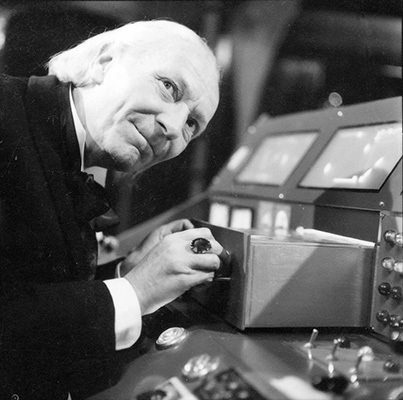
In mythology and the study of folklore and religion, a trickster is a character in a story (god, goddess, spirit, human or anthropomorphisation) who exhibits a great degree of intellect or secret knowledge and uses it to play tricks or otherwise disobey normal rules and defy conventional behavior
Wikipedia
Sound familiar? Of course it does, because the Doctor is a Trickster. Their main weapon is intelligence, they leave chaos behind them whenever they depart, usually having overthrown or destabilized the local power structure during their visit.
This isn’t even a later addition to Doctor Who like many details are, right from the beginning we have William Hartnell’s impish expressions and laughter as he meddles and outwits his opponents. In his first episode he kidnaps two humans, in his second story he overthrows an evil alien race, but he only stumbles into it to answer his own burning curiosity.
The Many Faces and Facets of the TricksterThere are many examples of trickster like characters in modern movies and stories, but the examples I gave before are not humans, they are eternal beings of a sort. Ones who change their faces. Ones who have many stories told about them. Stories that do not all line up neatly next to each other.
This is a framework that can be easily applied to Doctor Who. Instead of desperately trying to cram the whole into a tiny little jar just so we can put a label on it and put it on a shelf, set it free and let each thing go where it wants.
There are hundreds (or more) stories about Thor and Loki and there are dozens of different versions of Thor and Loki because the myth is larger than the individual stories. Doctor Who has the potential to reach the same level if we stop trying to artificially limit it.
Certain elements will always come through (TimeLord, TARDIS etc.) but the details will fluctuate and with that comes fresh new ideas rather than a format and character that gets ever more limited by what has come before. The strong ideas get reused and enhanced, the weak ones fade away.
In truth there has never been a consistent Whoniverse because world building has never been a priority for the show, and one of the reasons it’s been difficult to create successful spinoffs for the show is that outside of the Doctor and the TARDIS there are so few consistently recognizable elements.
But, But… Continuity!Now, before everyone panics this does not mean that chaos is unleashed and nothing matters any more. Weighted continuity handles this sort of thing perfectly.
Within the confines of a specific story continuity as absolute. It should have a beginning, a middle and an end and there would be clear character arcsAcross a season (whether that’s 4 episodes or 26) most continuity still largely applies but most of the individual story details are ignored in favor of the through line of the seasonEach season offers the chance of a minor reset and re-focusingRegeneration brings us back to basics and only the most firmly established elements of continuity may surviveThis allows for meaningful stories to be told without requiring an explanation for how it fits in with every single other tale that has ever been told about the ancient, possibly immortal, trickster.
Wait, Isn’t That What the Show Already Does?Yes.
That’s the point, I’m not asking for the show to be different, I’m asking the fans to look at it through a different lens. One that fits the show better than trying to force the entirety of Doctor Who into a narrow modern story structure. Doctor Who isn’t a Sci-Fi show, Doctor Who is a mythology.
Set the show free. Set yourself free.


Dawn Spreads Over Harpers Ferry
The view from outside the derelict Hilltop House hotel is quite spectacular but it’s also a surprisingly difficult one to capture on camera. You can see the two rivers, the Potomac and the Shenandoah meeting and carve a path through the surrounding mountains. In person it is both impressive and wonderfully relaxing, but representing what the human eye sees is not just a matter of matching the field of view.
Not only is the human brain very good and de-focussing irrelevant elements, but it also uses additional sense inputs to color your perceptions. So it’s not just what I see when I’m standing there, it’s the sound of the wind and the birds, the smells, the temperature. All of these things together create the image that my eyes “see”. How then to replicate that in camera?

I have struggled with that at this location for years. Even the simple act of composing the shot is limited by the geography. What you can’t tell from this image is that there’s a steep slope right next to where I’m standing, so I can’t easily step a little bit to the left to change the angle of my shot. And although I’m high up compared to the rivers, there are lot of rapidly growing trees right below me that encroach on the shot… maybe I should take a stepladder with me next time…
Sometimes I zoom in to avoid that, but I really wanted to capture the whole vista so I didn’t do that this time. I was hoping that the rock outcropping in the bottom right part of the image would be more of a foreground interest, but that didn’t really pan out. What I was able to bring out in the edits though was the warmth of the sun as it crept around and over the mountains.
January 30, 2023
Review S11E02 – The Ghost Monument
Let me start by saying that I absolutely love this era’s title sequence. From that deep rumbling bass to the eerie time vortex effect, it all just works perfectly. Both suitably and familiarly alien and also distinctly different from the previous ones. All in all I’d say it’s my favorite since the show came back. I only have one negative thing to say about it, it’s too short.
Picking Up Where We Left OffThis and the previous episode are the closest that Season 11 comes to having a two part story. While this does tell its own story it’s still very much setting the stage for the era and getting the remaining pieces (TARDIS and Fam) in place. Plus, of course, it picks up right where we left off with the previous episode.
The Doctor and company are hanging around in space suffocating (presumably) but, fortunately for them and us, a couple of spaceships show up and bring them on board. I suppose you could argue that this is a co-out but for me it’s a classic cliffhanger and resolution, something we saw a lot of in Classic Who but due to the structure of modern Doctor Who it’s not that common any more.
The justification for this rescue is a hoary old sci-fi cliché, the “space race”. It’s not even the first time that Doctor Who has used that one, but in reality this time it’s mostly just an excuse to get everyone onto the planet. While the race remains a part of the story in a technical sense, it ceases to drive the plot as soon as the Doctor discovers what the Ghost Monument really is. To that extent it’s a bit of a wasted opportunity because it’s so anemically developed. Angstrom and Epzo (two of only three additional characters to feature in this episode) argue a bit about who is going to win but we’re given no reason to invest in how that turns out.

While the opening minutes of the episode are fast paced, rapid fire with things constantly in motion, once everyone is on the planet things slow down a lot. We’re introduced to the third (and final) character to feature in the story and we get an explanation of what the race is all about and why it matters. The thing is, it doesn’t matter. The resolution of the race is essentially irrelevant and none of these three characters do anything that makes a difference and not only does it take time away from the more interesting aspects of the story, but it messes with the flow.
Which is unfortunate because there are some really good character focused interactions in this episode and it I like how low key they are. The melodrama that we tend to get with Doctor Who is dialed all the way down, and that is very different, but those scenes aren’t able to build on each other effectively because of the inconsistent pacing.
Chekov’s CigarThere’s a lot of bits and pieces in this story, some of them I like a lot, but very few of them are really developed to mean anything. We learn that the Stenza are behind the state of this planet, but they’re not present and honestly I’m left wondering if they were only used because having just featured in the previous episode they required no explanation to the audience and it was just an easy way to make a connection between the characters. It doesn’t really matter because the connection doesn’t go anywhere.
The robots are cool and provide some peril to keep the story moving but again they don’t really matter beyond giving the Doctor an opportunity to show why she prefers brains to guns, which is at least a nice character moment. Ryan’s “Call of Duty” moment was never supposed to be a good idea, he’s supposed to fail miserably which. of course. he does. It’s illustrative of both characters in that regard.
Similarly the Remnants (the cloth strips) are very creepy and effective and of course they do give us the first reference to the Timeless Child but they’re just an obstacle to overcome. They could as easily be a fence for all their narrative function. However, let’s at least give credit for the clever use of the cigar. Epzo is constantly banging on about his special cigar and I’m sure there were a lot of people like me (breaking my own rule about letting the story tell itself) who said to themselves “well, he’s never going to get to smoke that is he, he’s gonna die!”. This was a much more inventive use for it.
Reunion of Old Friends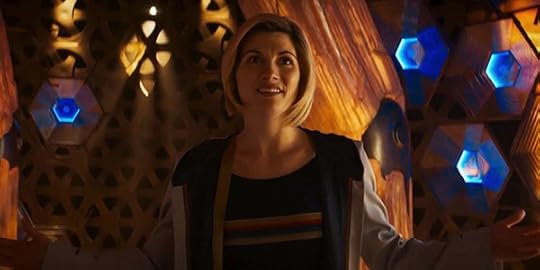
Absolutely my favorite and most emotionally poignant moment of the whole episode is the end. First the Doctor really thinks she’s failed. I can’t remember the last time we’ve seen the Doctor hit this type of emotional range. They do angry and shouty and weepy but this was quiet despair. Jodie Whittaker is a phenomenal actress and anyone who says otherwise is an ignorant fool. Watch her face as she delivers the lines, her body language. At the beginning of the episode she’s talking a mile a minute, she’s taking charge, she’s being Doctory (I know it’s not a word). But here, without any big speeches and with no scenery chewing she gives as a Doctor who doesn’t know what to do next.
And what happens? Her companions are there for her. No co-dependency BS, no one is taking advantage or manipulating. We don’t get yet another take on how bad the Doctor is for everyone they meet. Instead a group of people she doesn’t know that well but who have formed a bond see she needs support and they give it. It’s a wonderful moment.
A moment that can only be topped the look on her face when the TARDIS arrives and she enters it. Her happiness to be reunited with the TARDIS is infinitely stronger to me than the anthropomorphism that the show sometimes indulges in.
We’re Not in Kansas AnymoreAs with the previous episode this looks different to what we’ve had before. Part of that is the new cameras and the filming style that comes with it (anamorphic lenses and a wide-screen aspect ratio leading to a cinematic look), but also in this case it’s the location. This is very obviously not some part of the UK pretending to be another planet and that makes it look more alien. The landscapes are gorgeous. It looks big, it looks dramatic. There’s an ambition here that is admirable.
I also want to specifically call out that scene where the TARDIS is revealed to us. Clearly there are issues with this particular set and its design that are far from ideal ,and we’ll see that impacting later episodes, but right here it looks amazing. Once again they use light and shadow to great effect with the dim lighting allowing the glow from the console to really color the scene. It doesn’t hurt that this TARDIS design is visually striking and radically different to previous ones. The first impression is a good one.
Let’s Talk About RyanThe character focus in this episode is really on the Doctor and Ryan. Graham gets a little bit due to his connection with Ryan’s storyline, Yaz much less so. I’m not someone who thinks that every character has to get equal attention in every episode, so for where we are in the season now I have no real issues with that. We’ll address how, or if, it evens out as the season runs its course.
Tosin Cole’s performance as Ryan though may be criminally underrated. In the show Ryan is a 19 year old black teenager who has just lost his mother figure and has a strained relationship with someone who wants to be a father figure, but who he isn’t entirely comfortable with. He’s proud and defensive and desperate to assert his independence despite being faced by an alien planet on top of his grief. They even manage to weave his dyspraxia in quite discretely.
Tosin plays this so convincingly, Ryan’s reactions tend to be muted (mustn’t show you’re too impressed) but there are sparks of anger and defiance scattered amongst that. A moment impetuous foolishness but then later a moment of weakness and vulnerability. It would have been so easy to have made this character to a walking stereotype but to this point they’ve completely avoided that.
It’s also interesting to note that this is a character that’s being built up largely by conversations and acting. Chibnall’s Who is often criticized for doing a lot of telling, and at times it does (the scene in the tent for example) but this is a clear example that it’s not due to inability on Chibnall’s part which raises the possibility this is a deliberate stylistic choice.
Less Than The Sum of Its PartsI’ve said some nice things about various elements in this episode but I think it’s fairly clear that it doesn’t really work for me as a whole. Given that it’s written by Chibnall and follows on so directly from The Woman Who Fell to Earth I almost feel like it would have been better if instead of telling a standalone story here they’d just taken the key elements and put them in an extended first episode. However, I’m not a fan of putting a story up against one I just created in my head because it’s a fundamentally unfair comparison that doesn’t require me to write dialogue, cast, act or direct the story. The things in my head are perfect, actual tv production is compromise. Suffice to say that The Ghost Monument doesn’t work for me as a story in its own right.
It also feels like this is a show that wants to take itself a bit more seriously than modern Doctor Who has to this point, but those serious and subdued character interactions sit a little awkwardly next to the fast paced action that people expect from this show. If this Doctor Who wants to grow up and present like an adult, maybe it has to grapple with the fact that a lot of Who’s appeal is it’s childish nature. It’s hard to be both and by trying to be too many things at once and it seems unable to quite be any of them.
And yet, while it is uneven and not entirely successful there is so much I like, about this Doctor, about these companions and how they interact with her, that I find it hard to really hold the failings against the story even while recognizing they are failings. The individual moments are sometimes joyous, plus that scene at the end with the TARDIS makes up for an awful lot.
Rating: Why are you looking for a number instead of reading what I wrote?
January 29, 2023
Dawn At the Monument
The Lincoln Monument provides an excellent of the Washington Monument at dawn. Not only do you get the monument silhouetted by the sun and a red sky (if you’re lucky) you also get the reflection of the moment in the appropriately named reflecting pool. You can also use the Lincoln Monument as I did here to create a frame for your photo.
I did a little bit of editing work in Lightroom to make the image pop more. Rather than using the auto settings for white balance I used Daylight which pumps up the orange in the sky nicely. I didn’t want to completely remove the blue from the sky though so I added a Linear Gradient but applied a Luminance Range with it so that the lightest part of the sky got an added blue tint to it.
I made two other smaller edits as well. The first was to very slightly lighten up the reflection of the monument in the water so that the silhouette of the person didn’t merge into it and the second was to clone out an ugly spotlight that drew the eyes and distracted from the image.
The History of Science Fiction and Fantasy Part 2: The Nineteenth Century
It was the second half of the 19th century when science fiction really began to emerge as a recognizable genre. And very early on it even established two of the cornerstone sub-genres of science fiction in the form of time travel stories and apocalyptic fiction.
There are two names that everyone is familiar with, whether they are a fan of science fiction or not. Jules Verne and H. G. Wells are recognized as both pioneers and giants of the genre. There were other authors as well though. Some familiar names, others largely unknown today.
One of the earliest science fiction books was A Voyage To The Moon by George Tucker, which was published in 1827. The book which is a satire, was published under the pseudonym Joseph Atterley. Tucker was one of Edgar Allan Poe’s instructors at University. The novel features one of the first uses of anti-gravity technology.
Poe is commonly known as a writer of gothic stories, however he also published a number of science fiction stories and was perhaps the first writer to tackle two sub-genres.
The Unparalleled Adventure of One Hans Pfaall was a short story published in the June 1835 issue of Southern Literary Messenger. The story which was written as a hoax story and purports to be a manuscript that details how Pfaall intended to reach the moon using a new balloon and a device that would compress the vacuum of space into breathable air. As such it is one of the earliest examples of a scientific approach to space flight in fiction.
In 1839, Burton’s Gentleman’s Magazine published The Conversation of Eiros And Charmion and it may be the first apocalyptic science fiction story. In it Eiros describes to Charmion (both dead) how the world ended due to loss of nitrogen from the atmosphere.
Apocalyptic fiction wasn’t the only sub-genre that Edgar Allan Poe helped to create. A Tale of the Ragged Mountains was published in Godey’s Lady’s Book in 1944 (and later included in Poe’s collection Tales in 1845). The story may be the first example of physical time travel in science fiction.
With these and several other stories, Poe made a major contribution to the birth of modern science fiction, a contribution which seems to be largely overlooked, perhaps due to the lasting impact of his horror work.
Jules Verne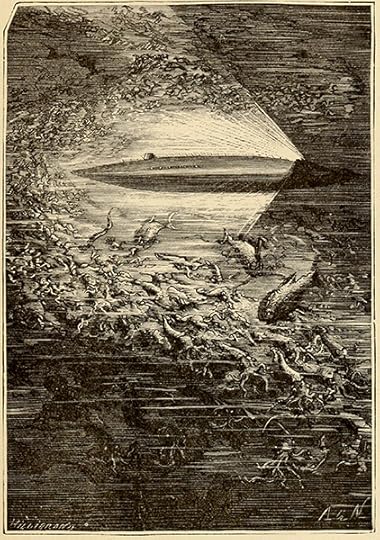
By the second half of the 19th century, modern science fiction had definitely arrived. One of the most significant and biggest names is Jules Verne. Verne himself acknowledged that some of his work was influenced by the earlier tales of Edgar Allan Poe. During the 1860s, Verne published two of the most influential science fiction books of all time.
In 1864 Journey to the Center of the Earth presents us with a fantastical interior of the planet. On the surface then this is not so much science fiction as fantasy. However, we have to consider the scientific knowledge available at the time of writing and the nature of the story itself. The protagonist is a professor in search of scientific knowledge.
Journey to the Center of the Earth has captured the public imagination ever since it’s original publication and has been adapted to television and film on multiple occasions. Some more faithful than others.
From the Earth to the Moon, published in 1865 is a lesser known tale from Verne that is another early example of space flight. The story is particularly significant because it presents an almost credible method of travel in the form of a projectile fired from a giant cannon. Verne actually attempted to calculate the requirements for such a cannon. This is a perfect example of modern science fiction.
Verne’s other well known science fiction tale is 20,000 Leagues Under The Sea which was published in 1869. As is common with Jules Verne’s work, the protagonists are scientists and he has some remarkably prophetic ideas about what submarines might be capable of.
Sword and Planet Science FictionIn 1880 Percy Greg wrote Across the Zodiac: The Story of a Wrecked Record which is the original “sword and planet” story (a sub-genre that seems to have largely died out). Edgar Rice Burroughs would become the most famous author of this type of story, but his work would not be published until the next century.
The Genre WidensFlatland: A Romance of Many Dimensions by Edwin A. Abbott which was published in 1884 showed the breadth which science fiction could encompass. Set in a two dimensional world referred to as Flatland, the story is a satire on the rigid social hierarchy of Victorian society.
What makes it science fiction is the way it represents dimensions as a three dimensional being visits a resident of Flatland. Ironically the Flatlander is able to acknowledge the possibility of four or more dimensions, while the three dimensional being seems unable to.
Robert Louis Stephenson is well known for his adventure fiction, but one of his most unique stories is The Strange Case of Dr. Jekyll and Mr. Hyde which was first published in 1886. Often referenced as a horror story, it is actually a exploration of mental illness and split personalities. Science Fiction was no longer limited purely to the “hard” sciences.
Another early example of time travel stories is Mark Twain’s A Connecticut Yankee in King Arthur’s Court which was published in 1889. However there is no scientific explanation for the time travelling so it probably sits more on the fantasy end of the genre. At this point fantasy was really not separated in any obvious way from science fiction.
H. G. Wells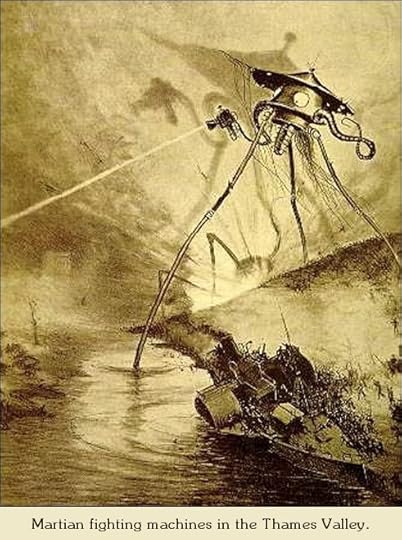
In the 1890s Wells published a series of science fiction stories that made him perhaps the best known science fiction writer of all time.
The Time Machine in 1895 was a novella that used time travel as a method to explore social change and the social fears of the time. The slow evolution of the human race was apparently inspired by Charles Darwin’s Origin of the Species.
In The Island of Doctor Moreau (1896) , Wells again tackled a topical issue as the notion of animal rights was emerging. Rather than presenting us with purely fantastical talking creatures, Wells instead gave us a Doctor who experimented on humans creating human/animal hybrids. It’s a theme that still resonates today.
1897’s The Invisible Man gives us a scientific basis for the invisibility of the central character. The notion is that by changing a body’s refractive index to that of air, it will become invisible. More interesting though is Well’s exploration of the effect this would have on a human psyche. Wells consistently took a scientific concept and used it to explore its impact on society.
Alien invasion is the subject matter of The War of the Worlds (1898). But unlike modern films, the solution does not involve massive explosions. Rather a simple virus brings the aliens to their knees.
When the Sleeper Awakes (1899) is a lesser known H G Wells story about a man who sleeps for two centuries and awakes as the richest man in the world. But London has changed radically while he slept. Wells actually re-wrote this story substantially and republished it as The Sleeper Wakes in 1910.
Alien PlanetsIn 1897 German author Kurd Lasswitz published Two Planets which is about a group of explorers who find a Martian base in the Arctic. The book references the “canals” on Mars which were the result of a mis-translation of the work of astronomer Giovanni Schiaparelli and of course became stuck in society’s collective memory.
In Edison’s Conquest of Mars (1898) Garrett P. Servis wrote an unauthorized sequel to H. G. Wells The War of the Worlds. The book featured Thomas Edison as its hero and was in fact endorsed by Edison. In the book Edison travels to Mars and helps Earth to destroy the Martian’s ability to make war. Perhaps the first example of the Space Opera sub-genre, it is not at all in the spirit of Wells original story. It’s also a very early example of the habit of re-working or producing sequels to early science fiction stories.
Interestingly the book does include space suits, but does not feature any form of radio even though radio experiments were occurring by this time. Instead the spaceships communicate by flags or lights much like naval ships did. We do however get the first examples of Aliens building the Pyramids and disintegrator guns.
Fantasy in the 19th CenturyWhile elements of fantasy can be found in many tales including fairytales there is relatively little prior to the twentieth century that would be recognizable to the modern fantasy genre. The likes of William Makepeace Thackery and Hans Christian Andersen continued to evolve the fairytale tradition but it has been suggested that The Princess and the Goblin (1872) and Phantastes (1859) by George MacDonald might be the closest to the origin of modern fantasy with Phantastes in particular claimed to be the first fantasy novel written for adults.
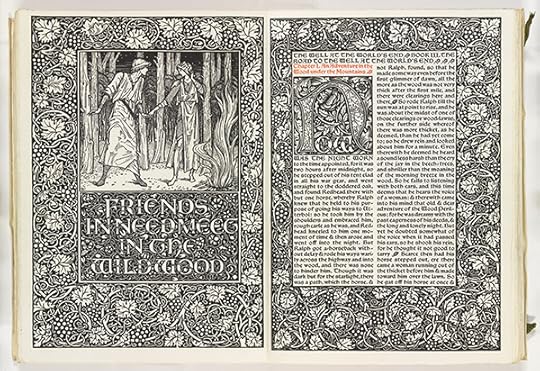 William Morris (British, Walthamstow, London 1834–1896 Hammersmith, London) The Well at the World’s End, 1896 British, Woodcut; http://www.metmuseum.org/Collections/search-the-collections/354288
The Well at the World’s End (1896) Morris is another fantasy story of note during this period. Amongst other significant elements this story is set in an invented fantasy world, perhaps a first and a significant step for the genre. It is speculated that both J.R.R. Tolkien and C.S. Lewis were inspired by Morris. Lewis is known to have written an essay on the author and it is notable that Morris was particularly interested in the Middle Ages and used an archaic style for his work because that, something that would appeal to Tolkien.
Lewis Caroll’s Alice’s Adventures in Wonderland (1865) is perhaps more typical of a fantasy of the period, albeit a defining one. Aimed primarily at children it is set in what is clearly implied to be a dream world that reflects the real one in a warped fashion.
Also worthy of note is the author H. Rider Haggard whose work formed the basis of the Lost World sub-genre with stories like She (1887). These stories while set in the “real” world were in locations that the reading audience of the time would be largely unfamiliar with allowing for the inclusion of many fantasy elements.
January 22, 2023
Review: S11E01 – The Woman Who Fell To Earth
A lot of weight falls on this episode being the beginning of both Chris Chibnall’s run and Jodie Whitaker’s first appearance as the Doctor. Not only should it set the tone and the standard for the show going forward, but obviously it would hope to capitalize on the publicity to attract a new audience and convince them to keep watching. We all know how the viewing figures progressed, but they did start strong.
Change, My DearIt’s one of those things that gets said so often it barely means anything anymore but it’s true that Doctor Who is a uniquely adaptable show. New locations, new companions, new Doctor, new look. The show isn’t even beholden to its own past much of the time due the absence of an official canon and a laissez-faire approach to continuity which I refer to as weighted continuity (more on that later). While there are a handful of common elements that exist throughout the life of the show, it does provide a remarkable amount of room for reinvention and change is almost a constant.
Naturally a new Doctor and new showrunner at the same time is when we see the biggest changes in the show and that’s certainly true again with this episode. Not only do we get our first female Doctor but this looks and feels different to what has come before. I’m no expert on cinematography, still photography is more my scene, and I’ve seen both positive and negative opinions on the camerawork for this season but it is visually distinct to the seasons that preceded it. Overall it has a look that lines up with more modern shows and one thing I particularly noticed in this episode was the way shadows and light were used to add to the atmosphere in a way that previous episodes rarely managed to achieve.
The show also looks different in another way. I’m going to use the D word, yes this is the most diverse that Doctor Who has been to date and that’s a great thing. We don’t just have one or two token people of color, we have a wide variety in both major and minor roles. I think some people understand the intention behind diversity. It’s not to have one example of everything on screen, nor is it to provide idealized versions of each ethnicity. It’s to have enough variety that you can treat those people just like other characters. “Bury your Gays” for example is much less of a problem when you have a multitude of such characters and the death of one is no longer the death of what they had been chosen to singularly represent.
This episode also feels different. It’s less witty and less zany than previous seasons. It’s not that nothing funny ever happens or is said, but the overall tone seems more serious to me and the dialogue between characters is to my ear more naturalistic which can come across as flat at times.
The FamI mostly wrote that heading because I know it will irritate some people. Is it something that I personally would say? Nope, but it does fit well with this particular Doctor I think.
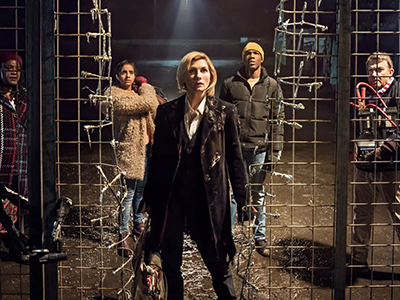
One thing that stuck out to me re-watching the episode is that the Doctor’s new companions are very much of this location. It’s not just that the show starts its new era outside London (Shefield to be specific) and gives us a torrent of regional accents, though I very much appreciated that, it’s that they are clearly living lives here, not just existing. The essence of those lives is shown to us in the first few minutes of the show before our new Doctor has even shown up. Where very often Companions feel like a character designed for the Doctor to interact with (how many fans play “spot the new companion?”), these felt to me like people who get swept up in the Doctor’s wake. They haven’t been waiting for someone like the Doctor to enter their lives and they probably wouldn’t have gone with her if not for the accident at the end of the episode.
Everything you need to know about the core of Graham, Ryan and Yaz characters is right there in the first 12 minutes of this episode, it’s a very efficient and effective bit of writing. Unfortunately it does then rather hit you on the head with people telling you most of the same information in case you missed it. I have a theory, which we’ll keep an eye on as I watch future episodes, that this is not accidental, but it can be annoying.
Ryan’s dyspraxia is threaded throughout the story with some skill, neither ignored nor completely defining him as a character. Near the end where we see him continue to try to ride a bike it is far more important that he fails and keeps trying than that we would see him succeed. To be clear, I’m talking about this episode. I don’t think it’s always handled this well and I’ll touch back on it in later reviews.
Plot and PacingThis episode moves fast. It doesn’t let up for most of its running time, really not until the funeral. We’ve become used to Doctor Who being a fast paced show and on the evidence of this episode there were no plans to change that. The longer running time does help a little in that we do get a chance to have a slower and more reflective moment near the end though.
As far as the plot of this episode is concerned it’s pretty basic, but that is true of a lot of regeneration stories as the focus gets split by the need to establish a new Doctor. You could equally argue that Rose, The Eleventh Hour or Deep Breath are all small scale stories too and I wouldn’t disagree. Compared directly to those I think The Woman Who Fell to Earth holds up while giving enough of a storyline to keep the viewer entertained while getting all the other balls in motion. At its core we’ve got a nasty alien bent on killing a few people for personal glory. Nothing to fancy but enough to engage with. One huge plus though is that due to the temporary memory loss we’re spared yet another Doctor Speech which is something that had become terribly overused.
The alien “Tim Shaw” has a wonderfully creepy look to him, but he does seem to have that common flaw of villains where he explains all the details of his plan so that everyone (including the audience) knows what’s going on. Not ideal from my perspective as I think I’d have preferred it if some of the plan was worked out by our team.
One thing that I do like is that even minor victims get a moment to show personality and give us some reason to care about their inevitable demise. It may only be a few seconds or a minute, but they have a little life and agency to them. Yes in the end they are redshirts but the history of Doctor Who is full of redshirt characters.
Another interesting aspect of this episode is how much time there is after the plot has been resolved. We don’t often see the Doctor stay in one place and almost never see her involved in normal life. It’s a fascinating choice that gives Jodie Whittaker time to do some very subtle acting and it does lead to an excellent cliffhanger.
As I mentioned earlier there’s less funny here than we’ve become used to. This is more serious and less knowingly clever than we’d been used to. One of my pet theories is that Chibnall had an intention to move the show in a different direction than we’d had previously. I think this episode supports that, but whether the remaining episodes do, well, we’ll see when we get to reviewing them.
FridgingTo address the elephant in the script, by definition Grace’s death is a fridging. Her death, and indeed her character, is only there to further Graham and Ryan’s plot and propel them into the TARDIS, so that’s pretty much a dictionary definition. I’m going to argue though that like many of these terms (Bechdel Test comes to mind) the issue is not with the death but with the overuse of the device and the type of characters who it gets used on. So I’d refer back to what I wrote earlier about the importance of diversity and the difference that makes. While there are still some problems with the black female being killed to further the plot, I don’t think it’s nearly as egregious as it would have been if only white males were receiving the benefits of this plot device.
The DoctorWhen the Doctor is first introduced we’re given some very familiar traits to hook on to. She talks fast, she’s quirky, quick witted, takes charge and rapidly resolves the immediate threat. This is what we have come to expect from a modern version of the Doctor and so it’s reassuring to the viewer. Of course that is a primary function of any regeneration story, make sure there’s enough familiarity that you don’t scare the audience away even as you set up the new status quo.

As the episode goes on it starts to define some differences between the 13th Doctor and her predecessors. She seems more hesitant and uncertain at times than her recent predecessors and in this regard amongst others reminds me of the Fifth Doctor. In the end though it feels to me that we’re coloring in the lines of what has already been established as a modern Doctor archetype and an opportunity was missed to go in a radically new direction. In this episode her practical skills in making the Sonic Screwdriver were great to see but I don’t recall that being a focus point throughout the season so I’ll watch with interest to see if I’ve forgotten something.
She’s also much more inclined towards narrating what she’s doing which I suspect is part of a deliberate intent on Chibnall’s part as I mentioned earlier. If you watch Classic Doctor Who you’ll see a lot of this type of dialogue which is basically intended to fill in the gaps for anything the viewer hadn’t understood. In this first episode it did not bother me much, at other times it may seem more blatant.
MoralityVery early on this doctor takes a firm stance against weapons, not just guns but knives as well. The message is clear, she sees them as a lazy shortcut and something that encourages people to jump to a violent solution before giving other options a chance. This isn’t something radically new to the Doctor’s character but she takes a more vocal stance on it. The Doctor can be quite hypocritical on this topic, as most people are, but that line of thinking matches up with a lot of old-school Who.
Her stand off with “Tim Shaw” shows another central part of her morality. Individuals matter to her regardless of their status. As she mentions, Tim Shaw does this to himself, she gives him a choice and it’s his own rejection that “kills” him. Her anger with Karl is because he didn’t give Tim Shaw a choice and he wasn’t acting in self defense. That difference matters to her and I appreciate the level of subtlety at play there in her morality.
SummaryI’ve alluded a few times to my belief that certain things are a deliberate decision on Chibnall’s part, I also think we’re going to see some outside factors come into play as well, but I’m going to hold off on really diving into that for later episodes when we have more evidence to work with.
For my money this was a strong regeneration episode. It established our new Doctor and her dynamic with her companions while giving me an entertaining story of the week. It stands up well to re-watching too, which can’t be said of all regeneration stories. I’m not sure that I’d put it up there with Power of the Daleks of Spearhead from Space, but a polished outing nonetheless.
I came away from the episode really liking this Doctor. Her enthusiasm, her positivity and her uncertainty all appeal to me. I’m on the fence about the more serious tone, but visually I really like it.
Rating: I don’t do ratings, I think they’re stupid.May 30, 2020
Going Self Hosted
Simple as that. I’ve decided to move this and other blogs off WordPress.com and over to a self-hosted WordPress. Please follow me at: photography.eoghannirving.com
The site design is mostly the same and I’m still using WordPress plus Jetpack so you’ll be able to follow me just as you have up to now.
May 28, 2020
How to Improve Your Photography – Moving Off Auto
Modern cameras are remarkably good at taking photos. Point it at the target, hold the shutter button half-way down to focus then click to take the photo, and 9 times out of 10 you’ll get an acceptable image, assuming you remembered to take the lens cap off. But, Bu won’t learn very much from doing that. If you want to learn or improve the photographic skills you need to get your camera off the auto modes.
That doesn’t necessarily mean going full manual, at least not initially. Your camera offers two semi-automatic modes although the names may vary slightly from manufacturer to manufacturer. If you haven’t read my article about the Exposure Triangle, I strongly recommend that you do that first before continuing with this article. Things will make more sense that way.
Shutter PriorityIn this semi-automatic mode, the camera will prioritize shutter speed over the Aperture. This can be very useful in situations where there’s a lot of fast movement. Aperture PriorityWith this mode, the camera is going to keep your camera on a set depth of field (f-stop) and will adjust the Shutter Speed to compensateAuto ISONot technically a priority mode but worth mentioning is that most modern cameras have an option to automatically adjust ISO to give you a decent exposure. This mode can be combined with either of the other two or with the Manual setting if you wish.
These modes have a number of uses and a lot of professional photographers will utilize them in specific situations. When you’re learning photography they make a great first step away from relying on full auto. As you dial in the Shutter Speed or Aperture, watch to see what the impact is on the other settings and learn from that. They are also very useful when you are still learning a camera and not that comfortable or quick with the settings since you’re only setting one value to get your exposure you can do it much more quickly and will be less likely to miss your shot.
Going Full Manual
Eventually, the goal is to know your camera well enough and be able to dial in the settings quickly enough that you can take your shots on a fully manual setting. Again modern cameras actually make this pretty easy. For a start, there’s always a little indicator on the screen to give you a sense of how over or under-exposed your image will be and most cameras will go beyond that providing you with histograms and flashing parts of the shot that are overexposed.
The biggest challenge with manual mode really is it takes a little time to dial in the settings to just where you want them, at least until you’ve learned your camera and are comfortable with the standard settings. That can be very frustrating if you’re trying to take a photo of a bird and it flies away just as you finally get the settings right.
There’s also the annoying thing where you forget to readjust your settings and as a result, get a whole bunch of over-exposed images. Which of course, never, ever, happens to me…
So let’s take a look at a few common scenarios and how you might want to adjust your settings to expose the shot well while keeping it sharp and in focus. Now keep in mind that when I talk about each of these scenarios I’m going to be generalizing. Photography is an art, not a science and there are ties when you should break the rules. You just need to know the rules before you can break them.
Landscape Photography
When it comes to landscape photography you can probably safely assume two things.
There’s nothing movingAs much of the image should be in focus as possible
So with that in mind, the best combination is usually a higher f-stop for more depth of field, low ISO to minimize noise and longer shutter speed to compensate. If you’re hand-holding you still don’t want to be going below 1/100th of a second unless you have a very steady hand, but if you have a tripod you can easily get away with much longer shutter speeds. Really long shutter speeds can actually give some really pleasing effects with cloud or water movement but that’s a whole other article.
Pictures of the Kids (or Sports)
With kids or sports, you’re going to be dealing with lots of movement which makes Shutter Speed the absolute king. Your depth of field shouldn’t be too narrow either just in case you are slightly off in your focus but don’t go crazy here there’s no need to go very high. So this is one of the cases where you may want to crank up the ISO a bit and sacrifice a little noise in return for a sharp image. At the end of the day, a sharp image is going to be more important than anything else. There are ways to reduce noise either via editing or simply by reducing the size of the image, but there’s really no good way to fix an out of focus or blurred picture.
Wildlife Photography
[image error]
Wildlife photography combines a couple of different challenges. For one thing you are often dealing with animals that can move quickly and for another if it is wild animals you’re shooting from a long distance away which introduces much more noticeable camera shake as a result of using a telephoto lens.
Ideally, you would be using a tripod to solve the camera shake problem, but if you’re just taking photos while out on a walk you probably don’t have one with you. In this scenario then using Shutter Priority and setting your shutter speed as fast as possible (1/500 of a second or faster if it’s a sunny day) is your best bet. So long as your shutter speed is over 1/150th of a second you should try and keep your ISO low though to minimize the amount of noise in the image. That’s because unless you have a really big telephoto lens you’re going to want to crop your image quite a bit to make the wildlife take up the bulk of it.
Portrait Photography
[image error]
When we’re considering portrait photography we have a lot of flexibility in our exposure settings. If you’re dealing with adults then they can generally be coaxed to stand still enough that you don’t have to have the shutter speed cranked up really high and if you’re indoors then you also have some control over the lighting. As a starting point, I would suggest using Aperture Priority and setting your depth of field quite low. Careful dialing it all the way down though or you may end up with only a portion of the person’s face in focus.
The low depth of field will give a nice blurred background, keeping the viewers focus firmly on the subject. At a minimum make sure that your subject’s eyes are in focus. Assuming you have a cooperative subject the shutter speed can be quite low, maybe even as little as 1/60th of a second assuming you have a) steady hands, b) a camera with image stabilization, or c) a tripod. As always keep your ISO at the lowest possible value.
Just a Starting Point
Now that was just a quick high-level discussion of a handful of scenarios. There are a million more that will require slightly different combinations to get your ideal photo. But my aim here wasn’t to give you definitive answers, it was just to illustrate how these settings interact with each other and what your thought process should be before you start taking your photos.
May 27, 2020
Cat be Catting
This is Jaws. Jaws likes to come and sit on my computer, regardless of whether it open or closed and then just stare. Sometimes she stares at me, sometimes she stares at the window. Most of the time she has what I can only describe as a confused look on her face. Jaws is not a smart cat. Jaws is easily the stupidest cat to ever choose to occupy the same space as me. But she does know that if she sits on my computer then eventually food will appear in the magic bowl nearby. She always sits very upright too, a bit like a gargoyle really, which amuses me.
I don’t have the greatest range of lenses for indoors where the light levels are significantly lower and obviously if I got up to turn the ceiling light on the cat would inevitably move. So once again I turned to my trusty 25mm f1.7 lens. Converting from Micro Four Thirds to 35mm standard that would be a 50mm lens which isn’t perfect for this type of portrait but it isn’t horrible either and being a fast prime I was able to minimize noise in the image while maintaining an acceptable shutter speed.
[image error]
I tried a few variations on this shot, some including more of the cat and some including less, but in the end this was my favorite composition. The eyes line up nicely with the upper third line and you see enough of her body to get a sense of her posture without the rather cluttered background (it’s the living room of a family with two teenage boys, tidy isn’t really a thing we do) distracting the viewers eye and minimizing the impact of the image. The focal point of course was the cat’s eye and everything leads out from there.
My editing on this one was very basic. I did tweak the white balance a little, but not much as the grey walls allowed the camera to do a pretty good job on this. I darkened the background a bit with a radial filter and bumped the texture slider up a touch on another radial filter to bring out the texture of the cat’s fur a bit. That’s about it, nothing fancy going on here just a solid composition speaking for itself.
May 26, 2020
How to Create the Orton Effect in Photoshop
The Orton Effect is named after a process used by photographer Michael Orton in the 1980s which is particularly popular among landscape photographers because of the dreamlike glow that it gives to images. When Orton created the process he was using film so the effect was achieved by using three transparencies of the same shot where one slide is overexposed, another is correctly exposed and the third is out of focus and overexposed. Of course these days in the world of digital photography it is a little easier.
How to Create the Orton Effect in Photoshop
[image error]
Photoshop makes applying the Orton Effect very easy, but the same basic steps should work in other photo editing apps as well. I recommend recording the steps as an action and then making small adjustments to each application of it. I’ve seen many variations on this method so as with most things in Photography I’d strongly recommend experimentation once you’ve got the basics.
[image error]
Load your chosen image into Photoshop then right click on the Layer in the Layers panel and select Duplicate LayerFrom the Filter menu select Blur -> Gaussian Blur and set the Blur radius to something like 15. You can adjust this until you have a pleasing level of blur to your eyesGoing back to the Layers panel set the layer mode to ScreenAdjust the Opacity slider down. The exact amount you want will depend on the image but I’d suggest dropping it down to 10% and tweaking from there.
While the Orton Effect can be very pleasing to the eye, it’s important to realize that it can be easily overdone so this is often a case where less is more. In fact the effect often works best when applied to portions of the image rather than the whole thing.
Selective Application of the Orton Effect
There are many different ways that you can selectively apply the Orton Effect including using layer masks or simply using the Eraser tool on the layer to remove it from portions of the image. However, my favorite and one of the simplest ways to do a selective application is to use Blending.
[image error]
Right click on the blurred layer and select Blending OptionsThere are three values here to play with. The first is Opacity which sets the overall level that our blur layer will impact your image. Less is almost always more with this.The other two are sliders for the underlying layer and they control what parts of the image are affected by the layer. The first slider controls the dark parts of the image and the second the light.
There really isn’t a right answer to how to set these sliders. Some images will work best when the dark parts of the image have the effect applied to them while others will be more impactful when the lighter parts are affected.
How to Create the Orton Effect in Lightroom
Since Lightroom doesn’t have layers capability it’s not possible to do a pure Orton Effect but you can achieve a similar result just by adjusting a few sliders.
Adjust the Clarity slider into the negativesIncrease either the Contrast Slider or Texture Slider (or both) upwards to restore some detailIf you increase contrast then you will usually want to decrease Vibrance a little bit to stop the colors from becoming to harsh
While there are no layers, Lightroom does allow you to apply selective edits by using the Radial Filter in combination with a Luminence Range Mask which works very similarly to the Blending options discussed for Photoshop.