Eoghann Irving's Blog, page 2
February 19, 2023
Weighted Continuity in Doctor Who: Part 2 – Canon vs. Continuity
It has become increasingly common to use the words canon and continuity interchangeably but they’re not the same thing. That might seem like an unimportant technicality but it’s not, because Doctor Who categorically does not have a canon for example, but it clearly does have a continuity, if a rather messy one and the reason that is true is precisely because of the difference between the two words.
Canon, That Weird Fan ObsessionFans talk a lot about canon. Is it canon? That’s not canon! If I seem dismissive it’s because at times it feels to me like people are more interested in talking about canon than talking about the show they love. In part I think that is because the value placed in a fictional creation is a very personal and subjective thing. The temptation to try and make that personal opinion objective in some fashion by referencing “facts” is one that’s hard to resist, and canon is a way that people feel they can do that. They’re wrong though
What is CanonThe origin of the modern usage of canon is from the bible where it defined the official and definitive set of scriptures. I believe it was popularized in fan circles by it’s use for Star Wars where due to the large number of licensed stories being produced they established layers of canon as a method for keeping their universe consistent, the goal was not to tell the fans what did or didn’t count, it was for the writers.
Canon is decreed by a force outside of the story. For a book that would be the author and for most tv series it takes the form of some sort of series bible and would be controlled by the show runners or the IP owners. It is an out of universe structure, entirely distinct from story continuity which happens “in universe”
Doctor Who, is an exception to just about any modern genre show in that it does not have any codified canon. It wasn’t a thing that was done in the 1960s and it’s never been done since. No one at the BBC including any of the three showrunners of modern Doctor Who have attempted to establish one and no one outside of the BBC can. Now, I assume that if a comic writer decided to make the Doctor a mass murderer, the BBC would step in at that point so you could probably argue that there is an unwritten canon but if so it would be a minimal one.
The significance of Doctor Who having no formal canon is that it becomes much easier to deviate from continuity because no central authority is keeping things in check. Does the TARDIs always have to look like a police box? Nope. Can the Doctor be half human? Yep. Can the Loch Ness monster have multiple origin stories? Sure. Are there multiple versions of Atlantis? You betcha!
From my perspective then fandom’s interest in canon is a problematic thing. It can serve a valuable function in trying to keep the multiple writers and directors on the same page so that what emerges isn’t completely inconsistent and that is certainly a good thing. In larger shared universes that have spin-offs in other media it also helps to impose at least some semblance of order across the whole universe. But it is a production tool, not a measure of story quality.
Unfortunately, far too often fans start to weigh Canonicity as a factor in the quality and worth of a story. But canonicity is just adherence to an arbitrary bible, it does not make a story better or worse, nor does it make a story less important if it is not canon, and yet far too often discussion of stories gets reduced to arguments about whether something is “canon or not”. Instead of being a framework for building stories, canon becomes weaponized.
Head CanonBy definition Head Canon does not carry the weight of canon because it is imposed internally not by an external authority. It is an effort by a fan to say this is how I choose to interpret something and how I weigh its importance regardless of what is said officially. In fact, by definition, head canon isn’t actually canon at all. It has far more in common with weighted continuity than actual canon
I think it says something about how discussion of canonicity has affected the way we discuss stories that people feel the need to establish a head canon or express it in those terms. Fundamentally if you were to say “My head canon is that the Doctor loved Sarah Jane” what you are actually saying is “This isn’t official, but it is how I interpret those stories.”
Anyone who has had even the most elementary education in English should be aware of the concept of interpretation. There is what is on the page, what the author intended but may not have explicitly said and what the reader gets from the text which is partly informed by their own experiences. I’m not sure that I can state that all interpretations are valid, but most interpretations have validity to them if they are based honestly on the reader/viewer’s reactions. When it comes to interpretation, canon should be irrelevant.
Unfortunately there is an inclination once the concept of canon has been introduced to the conversation to assume there is a correct answer and people will cite canon to prove it. Thus we have “head canon”, a term with an implicit built in defense against the canonicity argument.
Not Canon, ContinuitySo, you’ve likely gathered I’m not in favor of how fandom uses canonicity in conversations. I think the concept itself has value, but I think it’s been misappropriated. I have a feeling that if anyone is still reading at this point several of them will be quite flustered by that position. They want some consistency in their shows. You can’t just wave away canon, things have to mean something! Well, look at what canon actually is, it has nothing to do with meaning inside a story at all. That’s what continuity is for!
ContinuityThis is consistency within the Universe of the stories. How tightly do the stories and plot follow on from each other and to what extent do they compliment or contradict each other? If a story is completely lacking in continuity then nothing matters and nothing has weight because everything could change within a few seconds. Continuity gives us a story and characters that build on themselves until we reach a denouement. When talking about a story and its meaning and what happened, continuity matters far more than canonicity.
What can be a little more challenging though is defining the scope of continuity. There is for example in-scene continuity; in episode continuity; in story continuity (if the story covers more than one episode); in season continuity, in series and finally in universe continuity (accounting for spin-offs sequels etc.). The requirements for each of these are a little different. If the Doctor changes jackets mid-scene then we should see that happening, if it happens between scenes during an episode it may just need to be mentioned and if it happens between stories it can just be assumed that he changed and no explanation is required because changing jackets is a thing that people do.
Similarly if a character was angry in the previous scene, the viewer is definitely going to need a reason why that character is no longer angry just a short time later. They would likely expect an explanation if the character was calm in the following episode, even if that explanation is simply that this is several weeks later. On the other hand if it’s 10 episodes later, unless those 10 episodes all happen in the space of a few days, there is an implicit understanding that people don’t maintain the same mood for weeks or months at a time.
This approach to continuity works very well in a serial with a beginning, middle and end and can also be adapted effectively for shows that run multiple seasons. However, it does start to fall apart when you’re talking about shows that have been on the air for a decade or more though because of the sheer amount of continuity to consider. A problem which much smarter people that me have found ways to address.
Sliding ContinuityIn a long running multi-author universe continuity often has to be adjusted to accommodate things that were not anticipated when the universe started. The most famous example I can think of is Marvel Comics sliding timescale. Roughly speaking everything that has happened within Marvel Comics since the publication of Fantastic Four #1 has occurred within a 10-15 year period and this means that while that comic was published in 1961, the events depicted in it now occurred in roughly 2007-2010. Other elements get similarly compressed so that Iron Man’s origin was based around the Vietnam war, but most recently I think it has been Afghanistan and no doubt soon it will be Ukraine.
While this does create some problems as the years get really crowded, and you really don’t want to contemplate how many things Spider-man has experienced in just 15 years, or how he could possibly still be sane. However, it allows Marvel to keep their core characters within a certain age range and continue telling the type of stories that their audience wants. If they did not slide the timescale then Peter Parker would be in his 70s now. And while there is certainly a portion of the audience that would enjoy that progression, it creates far too many problems to be worth doing. These types of characters don’t have permanent endings because then there are no more stories and Marvel doesn’t intent to stop publishing comics anytime soon.
CrisisAnother option available when your the continuity of your universe gets out of control is to do what Marvel’s long time rivals DC Comics did, and continue to do. First with the Crisis on Infinite Earths, and then several more times after that, in which they effectively hit the reset button on their whole universe. It’s an extreme approach to the problem and, as shown by the fact they’ve done it repeatedly, it can often create more continuity messes than it solves.
Weighted ContinuityThat brings us finally to what I refer to as Weighted Continuity. I’m not personally aware of any series other than Doctor Who which uses this approach, but there probably are some. Instead of rearranging timescales or universe spanning events to justify continuity changes the show simply fades up or down the importance of various events. Almost nothing is explicitly eliminated even if it is later contradicted.
So how does this work? Who decides what weight any particular bit of continuity has in Doctor Who? I’d say there are two major forces at work shaping weighted continuity but their function, influence and engagement are each very different:
The ShowrunnerWhen it comes to shaping Doctor Who and thus influencing weighted continuity the showrunner is simply the most significant person. The fact that they are commissioning scripts, writing scripts and shaping the season arc makes them both the most influential person and the one with the most engagement with the show. As a storyteller their interest in continuity generally relates more to how it would impact the story they are trying to tell than an interest in the minutia though as they are also often fans, they may care about that too.
The AudienceThe general audience is of course the least directly involved of these forces but their influence is substantial since they are the bulk of the people watching the show. I believe they are considerably less worried about many types of continuity for the simple reason they’re not aware of them. They know the broad strokes but may or may not remember that the Doctor has previously met Shakespeare and if they do remember may or may not care.
A Delicate Balance of InterestsIt is the interaction of these two forces and their competing interests which creates the weighted continuity that drives Doctor Who. At a fundamental level the show and its showrunner cannot stray too far from how the casual audience views the show. They know it’s about this alien who travels through time and space getting into scrapes and fixing them. They know the TARDIS is a police box. These sorts of things are close to immutable because everybody knows them and so they carry more weight, they become anchor points
As you move further away from the things that “everyone” knows about the show, things become less definitive. At this point the influence of the showrunner becomes paramount. Whatever their particular “head canon” is influences the show and as those elements are highlighted in episodes they become more widely known increasing their weight, at least temporarily. So the more often the show references something the more weight it gets and the longer the show goes without referencing something the less it weighs. This effect is particularly strong if the episodes in question are popular and well received as they get talked about more and watched more.
But What About the Fans?You may notice I haven’t really talked about the fans in this process and that’s because quite frankly they aren’t that significant. I’m sure people won’t like to hear that but as a percentage of the watching audience they are pretty small and also they are fans so they’ll probably watch anyway regardless of the direction the show goes in.
The only time fan influence seems to shape the show is when you have a showrunner who takes a particular interest in fans (JNT) or is themselves a fan (RTD, Moffat, Chibnall) and in that case it’s still only impacting because they are the showrunner. Since the revival the fact that all three showrunners have themselves been fans has had an impact, but in each of those cases what we’ve seen on screen has been driven by their personal fandom, not fandom in general.
It Only Matters If It’s RememberedSo that’s really the secret of weighted continuity. Continuity only actually matters if people remember it. Almost everyone is going to remember what has happened in the episode they are watching. An overwhelming majority of people will remember what has happened in the season they are watching. Most people will remember the larger elements of what has happened in the last 3+ seasons and likely only fans will remember specifics from further back than that.
Weighted continuity relies on the show referencing elements again and again, over time what elements get referenced change and so the continuity morphs. The Doctor was probably human at the start, but then he wasn’t and people forgot about it. The Time Lords were powerful, effective and godlike and then they became corrupt and inefficient but people didn’t mind because they didn’t remember the previous version anyway. Fans minded and complained at the time, but corrupt and inefficient is a version of them which got repeated a lot and so it has stuck.
Doctor Who isn’t a single story about the life of a rogue Time Lord. It’s a series of stories. Continuity within those stories is of critical importance. Continuity between stories becomes increasingly less significant.


February 18, 2023
Solid as a Rock
Another photo from that beach. This time I went with a long shutter speed to capture the motion of the water retreating back to the ocean. I think that worked rather well but the image isn’t as sharp as I would have liked and that’s probably partially to do with the shutter speed too but I think I may have been a little off on my focus as well.
I also used a gradient to cool the top half of the image a bit, emphasizing the contrast between sky and beach.
Weighted Continuity in Doctor Who: Part 1 – Why Everything and Nothing is True
Warning, this is going to be long and I don’t expect many people will have the patience and/or interest to read all of it. At first, I thought I would streamline it, but some things can’t be accurately conveyed in a soundbite, so I’m just leaning into it. The short version is:
Doctor Who does not have an official canon nor is it held to a tight continuity, instead it operates under what I like to refer to as weighted continuity.
Well that sounds simple enough but, what does it mean and why does it matter? To answer that we’re going to have to dig quite a bit deeper. Doctor Who is unusual and perhaps unique amongst genre TV shows in its approach to both continuity and canon. Modern sci-fi and fantasy shows have given fans the expectation that a series will tell a story from start to finish over the course of its run and that it will do so in a cohesive world. That hasn’t always been the case however, older shows were far more episodic than the (semi)serialized formats that we’ve become accustomed to over the last twenty five years.
Of course Doctor Who is not a modern shown. Even the relaunch is now eighteen years old putting it near the beginning of the evolution towards serialized story telling. The elements it did bring with it, such as story arcs and character arcs, have been grafted onto a show whose format dates back close to sixty years and an entirely different era of tv. So what we have is a show with 39 seasons spread over 59 years and on top of that we have novelizations, comic books and audio plays, all dreamt up by hundreds of different people.
How Did We Get Here?It is well known that the BBC routinely junked many early episodes of Doctor Who and the historical significance of that loss is thoroughly documented, but the reasoning behind the junking had an impact on how the show was perceived and written. TV in general in the 1960s was ephemeral, disposable entertainment that would be seen once and never again. Even novelizations were rare, only three stories were novelized during the 60s and the popular Target range did not begin until 1972.
VHS tapes didn’t exist and while some eager fans did record the audio off the tv there was basically no expectation that the audience would have detailed memories of what came before and so the show made reference to things they thought people might remember like the Daleks, but it didn’t worry too much about consistency on all the details, no one would know anyway.
They also had no long term plans for the show, and actor contracts were often quite short so plans changed frequently. Originally the Doctor was probably a human from the future although they stayed vague on the specifics. Arguably he did not become definitively alien until The War Games, certainly that’s the first time he was a Time Lord. At least as late as Evil of the Daleks the implication is that the Doctor is a human of some sort. This isn’t a case of the canny producers hiding something from their audience for a surprise reveal, it just literally hadn’t been thought out. Core elements of the Doctor’s back story did not exist until the end of Season 6 of the show. Think about that for a moment.
A good example of how this lack of long term planning created continuity issues is the Doctor’s two hearts, which were first mentioned in Spearhead From Space. There are multiple times during earlier incarnations where the Doctor seems to only have one heart. In Edge of Destruction Ian says his heart is normal. In Wheel In Space he is inspected by a human doctor and no comment is made about the extra heart. And yes, because I know someone is itching to, there are ways you can explain away these and other inconsistencies, but you’re adding an explanation, there’s nothing in the show addressing it. Also, we’ll get to head canon later.
As I mentioned Doctor Who as a show did attempt some basic level of continuity in its early years (when the Doctor meets the Daleks or Cybermen again previous encounters are mentioned), however, it was not looking ahead to any particular destination and as a result there are multiple smaller continuity errors. No one spent much energy worrying about such errors because the focus was on telling an entertaining story right now, not setting things up for the future or worrying too much about what came before.
This wasn’t in any way unusual for British tv shows in the 60s and 70s. While they certainly aired serials with a beginning, middle and end it was also common to have episodic shows where each episode largely stood on its own and you had a new case the next week. Continuity in say, The Avengers is pretty minimal too. But most shows didn’t run for 10 years, never mind 26.
So there were no repeats, no video tapes, no show bible and even the Target novelizations when they arrived weren’t entirely faithful to the episodes that had aired. As the show ran for more and more years, the writers themselves ran into a problem which is that they didn’t have access to the original material. The big stuff was known but the little details got lost forgotten or muddled up as the number of stories, producers and writers piled up. And so inevitably the number of contradictions grew.
The fans knew of course because fans are obsessive like that, but the show wasn’t being run or written by fans. They did start to have more influence in the 80s but by that point the pattern for how the show worked was set. References were popular but writers didn’t have to make everything line up perfectly, just hit the major points, weighted continuity did the rest.
The Expanded Universe, 90s and BeyondIf continuity in Classic Who was messy then things only got worse when it went off the air. Suddenly the major source of new stories was the Virgin New Adventures, Virgin Missing Adventures and Doctor Who Magazine comics. These were predominantly written by fans of the show and took a greater interest in continuity than the show had frequently filling in gaps, linking things together or attempting to fix continuity issues. But, they weren’t all consistent with each other so the result was, even more of a mess than before. And that’s before you throw in the tv movie with its Eye of Harmony in the TARDIS and half-human Doctor…
Again, a reminder that the point here isn’t to fix all these continuity issues, it’s to demonstrate that Doctor Who has simply never had a consistent continuity and has functioned successfully despite that. It doesn’t matter if you’ve come up with a clever theory that will make this all make sense, that is at most an ad-hoc patch applied after the fact, and it’s one that isn’t even happening in the show.
Things did change a little when the show was revived. When the show went off air in the 80s, production of the show was extremely outdated. In 2005 Russell T Davies had the opportunity to jump things forward and modernize the whole thing. Production, scriptwriting everything was approached in line with other shows being aired in the 2000s, a radical change from what we had last seen.
Where Classic Who was structured in a serial format with each story spanning multiple episodes but being almost entirely self-contained and assuming minimal if any prior knowledge, Nu Who used the now much more common season arc structure with tighter continuity between episodes and a story threading through them leading to some sort of season finale.
Despite that increased focus on in season continuity there are only a handful of times in the first three seasons of the revived show where knowledge of anything that came before is significant to what you are watching. But this wasn’t a reboot, it was explicitly a continuation. RTD kept everything and used the concept of a Time War to hand wave away dealing with a lot of the baggage. Still, every single, conflicting thing that had ever aired in the tv show remained and the status of all that expanded universe material was deliberately left unclarified. The things that RTD was interested in were openly restated and everything else sat out there available for someone to use if they wanted to. It was probably the most extreme example we’ve ever had of weighted continuity in action.
This Can’t Possibly Work Can It?Under normal circumstances anything with that much backstory would either find itself buried under the weight of its own history and unable to tell an interesting story without contradicting itself and what has already happened. The central character would be so weighed down with PTSD and the sheer magnitude of everything they’ve gone through to be able to function credibly. There are solutions to that problem of course, Star Wars jettisoned a whole chunk of its canon and DC Comics has wholesale rebooted its continuity multiple times now in an effort to streamline things (we’ll talk more about that later).
Doctor Who hasn’t done either of those things though and yet manages to stay relatively unencumbered by what has happened before. It achieves this partly due to the nature of the show being a time travel one, which gives a fallback excuse to explain almost any contradiction and also through the concept of regeneration which allows for essentially a complete character reset for the Doctor at regular intervals. In essence Doctor Who never actually rejects anything that has come before, it just doesn’t feel bound by it.
Only a handful of elements stay with the show throughout its entire run, even the Time Lord concept wasn’t there at the beginning. and a slightly larger number have accumulated and stuck as the series continued. The more something is referenced in the show (Time Lords have two hearts) the more likely that detail is to stick and become used in future stories.
In broad strokes then everything that has happened previously is true and yet none of it has to be true. The show exists in a perpetual Schrodinger state and it has worked for almost 60 years. To understand why it works though we’re going to have to take a closer look at… Canon vs. Continuity – Coming soon
February 17, 2023
How to Improve your Photography: Learning Your Camera
Over the course of this series of articles I hope to talk about lots of techniques and tricks to improve your photography skills. However, referring back to my first post, those skills won’t be of much use without practice.
Learning Your CameraIt would be nice if there was some sort of standard interface for cameras, and there are certainly common elements, but it seems that every manufacturer does things just a little bit differently. So the very first thing you need to do is something no one ever wants to do. You must… read the manual.
 My Camera has buttons and dials on the front
As dull and tedious as that sounds, you will almost certainly learn some interesting features of your camera that you didn’t even know existed.
Now obviously you aren’t going to memorize every single function of your camera in one go so you want to focus on the basics first. In fact you don’t even need to know what they purpose of all these features is yet, just where to find them when you do eventually need them.
Where is the shutter button?How do you adjust shutter speed?Where are the ISO settings?Can you set Shutter Priority Mode?Usually marked with either TV or S on your cameraCan you set Aperture Priority Mode?Marked as AV or A on your cameraDoes it let you configure custom modesCan your camera take bracketed shots?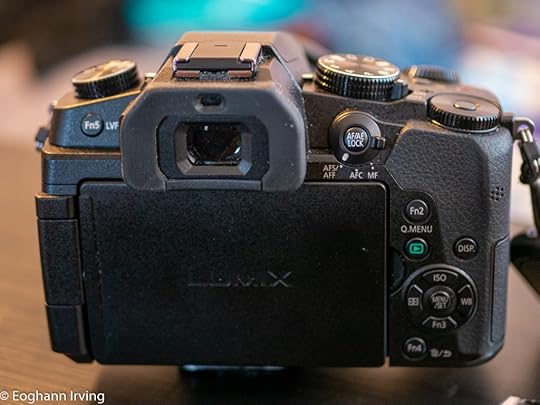 And even more dials and buttons on the back
These are just a few of the potentially useful functions that your camera can perform. So study your camera manual. Read it multiple times and even more importantly follow the steps. Repeat them until you’ve built up some muscle memory.
I realize that this is about the least interesting thing that anyone could possibly think of doing and you’re just itching to actually take, you know, photos. But it is very important and by establishing a solid foundation like this you’ll be in a much better place to improve your photography skills.
Today’s Assignment Is…Read and re-read your camera manual. Practice each function as you do so. Turn the actions you are reading into muscle memory so you can adjust the settings on your camera without having to think about it. You don’t even need to leave your chair to do this, you can’t keep practicing as you watch tv.
February 16, 2023
Part 3: Like A Thief In The Night
The route to Shepherdstown is very dark at night. I mention it because all those twists and turns I talked about earlier are particularly fun when you can’t see them coming. So my second trip to the town took significantly longer than the first.
Not that I was in that much of a hurry. I mean, I was about to break into an apartment (for the second time that day) and hunt for a book about werewolves in a town where werewolves apparently resided. Who wouldn’t be in a hurry to get started on that.
When I finally got there I parked my car in the same spot as before and walked casually to Naomi’s apartment. Once I was within a block of the apartment I reached into my pocket and squeezed the twenty sided die in my hand, activating my camouflage spell. To my eyes everything seemed exactly the same, but I’ve done this particular type of magic often enough to have faith that it works.
The lock was just as easily persuaded as before and I entered the apartment as quietly as I could. Everything looked the same, except darker, so it didn’t seem like anyone had visited since I left. But I wasn’t going to turn the lights on to confirm that. My camouflage spell was definitely not that strong. Instead I pulled out my flashlight. A little thing but surprisingly powerful. Easily enough for this job anyway.
I suppose that sounds a bit dull, a wizard using a flashlight. But magic isn’t free. It takes an effort just like everything else. And it’s never made much sense to me wasting energy on something where there’s a perfectly good gadget available that will fulfill the same task.
I don’t know if you’ve ever tried looking for something in a dark room with only a flashlight but it’s a massive pain in the ass. You get shadows all over the place and your brain is constantly inventing things to see. After a few frustrating moments, I decided that a little discovery spell was in order.
Everything leaves a trail. Think of it like a scent. Most trails aren’t visible. Well, not to humans at least. But they do exist if you know how to bring them out. If there had been any werewolves in the apartment, before or after Naomi’s disappearance then I should be able to find that scent.
After a moment’s investigation I found a container of salt in a kitchen cabinet and sprinkled some over the living room carpet. Then, calming myself into the lightest of trance states, I concentrated on the room’s auras. I know how that sounds, but they exist. When you tune yourself into them you sense a swirling mixture of colors and feelings. Now I tried to hone in on the one aura I was interested in. The one with a wolfish scent to it.
I smiled in satisfaction as soon as I felt it. There was definitely something present. Time to get a few answers! Concentrating harder, I linked the salt particles to the aura in my mind, locking the two concepts together. And then I opened my eyes and looked down at the carpet, only to blink in surprise.
The result was not what I had expected. The spell had worked perfectly. It had done exactly what I wanted. I just hadn’t expected nearly so many results. All across the floor, the salt had gathered into neat piles taking on the shape of footprints. But there had to be dozens of them and of different sizes at that.
Just how many wolves had been in this apartment? What exactly had Naomi stumbled into? With a little work I could probably refine the spell to give me an idea of how recent all the tracks were. Surely they hadn’t all been made at once. But that would take time and I could feel my palms start to itch.
If there was an entire pack of werewolves involved in this then surely they would still be watching the apartment. Had they seen me enter? I was confident about my camouflage spell against human eyes. But what about a wolf’s nose? I needed to get out of here quickly. But I wasn’t going to leave without the book.
Which, it turned out, was quite easy to find. Where else would you keep a book but right on your nightstand for easy bedtime reading. Obviously Naomi hadn’t felt this was something you need to hide. Well not in her own apartment anyway. If I had thought to look there in the first place, the whole trip could have been avoided. Sometimes I’m too clever for my own good. Or too stupid. It’s often hard to tell them apart.
The title told me exactly what to expect even before I opened the book to look inside. On Lycanthropy by Armann Flosason. So she had been studying werewolves. Which might explain their interest in her. But what was her interest in them?
Curiosity got the better of me and I opened the book. I had done little more than flick through the first few pages when something big and solid slammed into me and knocked me flying. My head hit the ground hard and I was out cold in seconds.
I can’t have been unconscious for very long, but it was long enough for all hell to break loose. When I came round I was still in the apartment, lying on the floor. I struggled to my feet, wincing at the almost blinding pain in my head and almost walked straight into a rather overweight police officer.
I froze and held my breath. The camouflage spell was still working. The police hadn’t notice me, yet. Which did raise the question of why it hadn’t worked on my assailant earlier, but there would be time to figure that out later.
Right now I had to maneuver my way out of the apartment before someone tripped over me. I was pretty sure at that point they would notice. Escape was going to be a challenge though because here were two more policemen, both of whom had clearly eaten too many donuts, blocking the door. I guess policing a university town doesn’t usually require a lot of physical exertion.
Discretion being, as my father always liked to tell me, the better part of valor, I edged myself to the corner of the room where at least no one in this swarm of legal activity was likely to bump into me. I was pondering the question of who had called them and how they were connected to the person who had attacked me when I realized that the book was missing.
I may not be a detective, but I can put clues together when someone attaches giant neon signs to them. It was way too big a coincidence to think that my attacker just happened to break in at exactly the same time I had and just happened to be looking for exactly the same book.
No, clearly someone didn’t want me to have that book. Which had me wondering just what was in it? Fortunately even a crack to the skull wasn’t going to shake such an unusual name from my mind. Once I got out of here I would ask Mercedes to find out all there was to know about a gentleman named Armann Flosason. Somehow I doubted there would be too many false leads to chase down.
It seemed the book was the only thing my attacker was after. The rest of the apartment was, as far as I could tell, untouched. Well except where the police were tramping all over things. Feeling increasingly confident about the power of my camouflage spell, I leant back against the wall for some support and watched them stumbling about.
I couldn’t tell what it was they were looking for exactly. Even assuming that they knew there had been a break in, there was no one here now. And it seemed highly unlikely anyone was going to return with all the lights and uniforms everywhere. Mainly I just wanted them to go home so I could get back to my car and take an ibuprofen.
Finally the police came to the same conclusion about the intruders. Which was just as well because I wasn’t feeling too good. As the police started to depart I kept my eyes firmly on the door, waiting for an opportunity to leave before they taped everything off and locked up again.
Which was when I noticed the blonde. The same girl I’d spoken to earlier. She was peering out from her apartment across the hall, hand nervously fidgeting with her hair. Had she called the cops I wondered? She certainly seemed to take a lot of interest in Naomi and this apartment. And she was equally interested in what the police were up to.
It was yet another question with no clear answer on this long and painful night. My vision blurred a little and I realized I had to get out of here or risk passing out again. It wasn’t as though I was going to get any more answers here anyway.
At the first opportunity I slipped past the chatting police and walked away as fast as a man can without making a huge amount of noise. I didn’t remove the camouflage spell until I was sitting in the drivers seat of my car. My head ached, my body felt drained from the prolonged use of magic and I had at best five hours until my next shift at Supermart 13.
To think I once thought that wizarding would be fun…
The Lonely Beach 2
Another black and white shot of the same beach, but this time a panorama and shot from the other side of the pier. Different morning but again the beach is almost deserted. This time rather than focus on the sea, I wanted to show how empty the beach is so there’s a long expanse of it, visually that’s not the most exciting but the border between sea and sand creates a leading line taking you diagonally into the picture from bird, to rocks to fisherman to pier.
February 15, 2023
Terror of the Zygons Review
Terror of the Zygons is a significant story for a number of reasons, not least of which being it was the last regular appearance of both the Brigadier and Harry Sullivan. Personally I consider it the send off for UNIT as a whole, although I suppose you could argue for The Android Invasion, if you must. It also features Zygons for the first time and it’s surprising to me that they didn’t appear again in Classic Who being such a distinctive design and having so much potential.
You can always tell when 70s Who is supposed to be set outside of the home counties and London because we’re suddenly subjected to a morass of local yokels and stereotypes. In the first episode alone we get the Doctor wearing tartan, the bagpipes playing and everyone laughing at the Brigadier wearing a kilt because… man wearing a dress! The 70s were not an enlightened time, be glad if you did not have to live through them like I did. Its also really obvious that this story did not actually set foot in Scotland for filming, budgets no doubt. The Welsh were treated no better with The Green Death though so I guess it’s not personal. And the English wonder why we hate them.
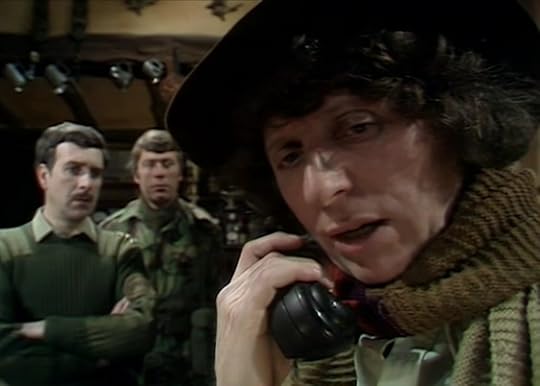
Let’s put that aside though and look at the story. By the standards of 70s Who this one is pretty tightly paced without too much egregious filler. Each episode advances the overall story with some efficiency and the Zygon’s shape changing ability is used to good effect. I wouldn’t claim that it really breaks any new ground, but it takes the classic elements of a Doctor Who story and gives me something that keeps my attention.
It’s interesting to watch the Brigadier and UNIT interact with the Fourth Doctor as it happens so few times. You might think that a structure created for a previous Doctor would struggle when faced with a very different personality, but it works just as well. Which makes sense if you think that UNIT and the Brigadier were originally created to work with the 2nd Doctor, not the 3rd. It’s a flexible set up which is why it has endured for so long.
I suppose I should talk about the Skarasen a little. Certainly by modern standards it doesn’t look great, the initial sequences are several steps up from the Dinosaurs in Invasion of the Dinosaurs, but the stop motion is pretty jerky and the integration into the rest of the scenes is jarring. Unfortunately the depiction of it in the final part of the story is right back to Invasion of the Dinosaurs puppet level. Also, is it just me or with those big eyes is the Skarasen more cute than terrifying? In the end, as with most old Doctor Who, you have to be willing to go along with the story rather than obsess over visual fidelity.
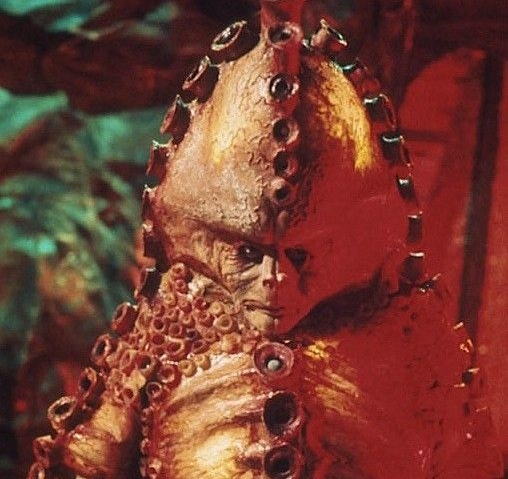
The real villains of course are the Zygons and what a wonderful design they are. Yes, it’s still a man in a rubber suit and yes at times those suits seem a little unwieldy, but it’s a really good design and very memorable. It works particularly well in closeup as the merging of the actor’s face and the suit is good and the actors are able to get some evil expressions on their faces. Additionally, a lot of thought seems to have gone into the Zygon’s biological machinery and interfaces. That’s an idea you see a lot more now, but was pretty unusual 50 years ago.
There aren’t too many twists and turns in this story as the villain of the piece mostly lays out his plan early on and then it takes a while for the Doctor and UNIT to catch up and respond to it but it is nice to see so many characters behaving competently. During the Pertwee era for example the Brigadier’s character became increasingly buffoonish, stubbornly refusing to believe in things that clearly by this point he ought to just accept. However, in his final regular appearance we get the old, competent, Brigadier again. One who largely trusts the Doctor even if he expresses reservations and who’s tactical behavior makes sense in the situation. While I wish we’d seen more of the UNIT family, this was a strong way to go out.
Harry and Sarah Jane for the most part behave quite sensibly too and the whole story has a satisfying and consistent internal logic to it, even when at points it is obvious that things are happening mainly to set up a 4 part episode structure. I do question why the Zygons keep a self-destruct system on their ship that is so easily accessible though!
To call this well done but not challenging Doctor Who seems like damning with faint praise, but it’s also fairly accurate. I could probably spin you a story about how the Zygons and their shape changing represent societal pressure to fit in and how people rebel against that, but I don’t believe that was really a read that was intended for the story. It’s just fun, and fun is undervalued. I’d definitely put this one in the comfort watch category.
February 14, 2023
Matrix Data Node: The First Cyberman
Orbit 802, Phase 3
Archived Data of First Cyberman Appearance in PublicThis image pulled from Mondas’ archived news coverage shows the first public appearance of the CBE Suit. Developed by Professor Lucius Koren and his team developed the Cybernetic Biological Enhancement Suit with a goal of improving the quality of life of people who had survived major injury including loss of limb and severe burns. The patient (name lost from records), who was dismissively referred to as the Cyberman, created an uproar when unveiled.
Crowds gathered to protest what they saw as man tampering with nature, warning of what might follow if this was allowed uncontrolled. The unnatural look of what they saw, something barely human to outward appearances only added to the hostility and fear.
It’s the eyes. I can’t look it in the eyes.
Unnamed Observer, Orbit 802, Phase 3
Professor Koren, a visionary, driven by personal loss and a desire to improve the human race through technology argued that upgrading human bodies with cybernetic enhancements was the way to achieve this goal. Advocating strongly in favor of his experiments in national media, Koren pointed out that the patient in question would be dead without the CBE Suit and that thousands of lives could be saved through the application of this technology and further upgrades.
Despite resistance from a vocal and substantial minority the program is rapidly expanded with hundreds of volunteers for the treatment. CBE Suit facilities are established on all continents of Mondas and Koren is hailed as a genius.
Lucius Koren’s death at the age of 57 during Orbit 803, Phase 7 is shrouded in mystery, as records from this time period are scarce. It is said that Koren renounced his support for cybernetic enhancements following a traumatic event in Orbit 802, Phase 19, First Update, and refused to wear a CBE Suit. The period leading up to Cyber Conversion during Orbit 804, Phase 9 is mostly undocumented, but full records are available afterwards.
AI Driven Story PromptsI wrote a post the other day about using the AI Text to Image Tool Midjourney to drive creativity and the above piece is a small example of that in action. The featured image on this post is something that Midjourney spat out when I was just playing around. Originally I was just looking for some DOctor Who imagery to use on some non-review posts, but then a notion popped into my head and that notion was quite simply “the first Cyberman”.
The first Cyberman, in a tense confrontation with a group of human protesters, who are calling for its destruction. The background is a public square, with a large crowd gathered to witness the event. The focus is on the Cyberman's unwavering determination, as it stands its ground in the face of opposition. Dark, intense, photorealistic, hyperrealistic, extremely detailed, depth of field, beautiful lighting, cinematic --ar 16:9This prompt relies on Midjourney already knowing what a Cyberman looks like, which given Doctor Who’s presence on the internet, it does, although of course they have looked very different over the years. I deliberately did not give it a detailed description because this is supposed to be the very first Cyberman ever. The resulting image was really just an idle fancy on my part but the slightly misshapen nature of the Cyberman plus the “archival footage” nature of the final image set my mind to pondering. How exactly did the Cybermen come about? Broadly we know that Cybermen evolved on Mondas (or at least that’s one of their origins because, surprise, Doctor Who is contradictory on this point), but we don’t really know the details of what happened and I wanted to come up with one possible explanation. But I needed more raw data to work with.
So, I turned to ChatGPT and asked it to come up with a name for me (Lucius Koren) and to invent a calendar for Mondas. Yes Orbits and Phases are made up but they aren’t purely random:
This calendar system was called the "Mondasian Cycle." The Mondasian Cycle was divided into 400 "Orbits," each lasting approximately 870 Earth days.The Mondasians also had a unique way of counting the days within each Orbit. Instead of using a decimal system like Earth, they used a base-20 system, with each Orbit being divided into 20 "Phases." Each Phase lasted for approximately 43 Earth days.In addition to the Mondasian Cycle, the Mondasians also marked important dates in their history, such as the "First Upgrade" and the "Day of Conversion," which were celebrated as significant events in the development of the Cybermen.This calendar system would provide a unique and distinct cultural element for the Cybermen and their home planet, adding to the richness and depth of the "Doctor Who" universe.Thanks ChatGPT! Now what I needed to do was weave this raw information into a scene. I chose the “Matrix Data Node” format because I wanted to leave a lot to the imagination here, giving just enough character and scene to, I hope, drive the readers imagination. What exactly happened that turned Koren against his own creations? Why are there no records of the period between First Update and Cyber Conversion, clearly the upheaval was bad. Even before then I wanted to tap in to human’s traditional fear and nervousness around major technological change (Hi again ChatGPT and Midjourney!) I didn’t want to actually give an origin so much as raise more questions about their origin, because the really interesting stuff is between the facts.
Did it work? You tell me.
Lonely Beach
An early morning shot of the beach and pier at Ocean City, MD. It was a warm, summer morning but the sky was quite bland so I converted this one to black and white and amped up the contrast to emphasize the emptiness of the beach at that time in the morning and the texture in the water.
I did also “cheat” a little bit here and used Lightroom’s de-haze function to add some haze into the background. I think it adds a little depth to the photo.
February 13, 2023
S11E04 – Arachnids in the UK
Yes, I know, there’s really only one thing anyone wants to talk about when it comes to this episode and we will get to both of them in due course, because what I have to say about it seems a little different to most of the criticism I’ve read. But just focusing on two aspects of the episode does the whole thing a disservice, so have a little patience while I work my way up to the major issue.
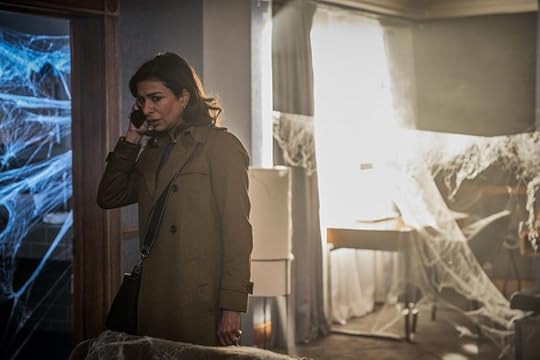
I like the camerawork in this one, they are clearly playing off horror expectations right from the beginning by having the camera low to the ground making you think of spiders which you’re already expecting due to the name of the episode. Similarly the scenes in the apartment are packed with tension and much like the previous episode the sound track really plays into that.
Jack Robertson is the latest in a long line of arrogant, loud mouthed, Americans in Doctor Who. The Trump parallels are pretty openly acknowledged and he’s mostly played for laughs here, more of a hissable pantomime villain than any sort of political statement. It’s not great drama but I found his over the top awfulness it funny and while it ought to feel absurd and impossible… Trump… so yeah it doesn’t.
We’re Still Telling But It’s Better IntegratedThe scene where the companions finally return home is a great example of how this era can actually do showing despite often relying on blatantly stating things in dialogue. Yaz mentions that she’s got no messages, and the look of disappointment on her face I think says a lot about her character, then the Doctor explains how almost no time has passed.
Their actions show that this is a group who have bonded together and you can see that Ryan’s relationship with Graham has evolved with him now showing concern for Graham. The expression on the Doctor’s face as their about to leave makes it obvious she wants them to stay but due to her awkwardness is unwilling or unable to just come out and say it. Fear of rejection perhaps? That reservation is a trait that will linger through her run on the show.
The same is true throughout this episode, we are definitely told a lot of things explicitly in dialogue, but to my ear they come up in a more natural fashion than in some of the previous episodes, like when we’re given some information about spiders.
Yaz’ FamilyWe spend a not insignificant amount of time with Yaz’ family in this episode and I think that how she interacts with them does a good job of showing what she’s all about. It’s clear that she is career focused and a little secretive. She keeps her private life separate from her family, is she embarrassed of one or both perhaps? I’m left with the feeling that she doesn’t find her life satisfying and wants more. But she’s clearly comfortable with her family and I recognize those sorts of interactions with siblings and parents, the dynamic works for me.

It’s also interesting to watch how the Doctor interacts here. She’s talkative, excessively so and has a quality that you see in some people on the Spectrum of blurting stuff out and not having normal social filters. I’m not saying the Doctor is autistic because you also see that trait in other people, but I do think it’s another piece of evidence that the “telling things” type of dialogue is a deliberate choice that has been made for this season. Where some incarnations might have been motor mouths due to arrogance or as a way to disarm their opponents, this Doctor talks defensively. She uses it to cover nervousness and discomfort in social situations. I like that touch.
I’m sure some people will make a great deal out of the revelation that the Doctor had sisters once. I don’t, I just see it as more confusion and uncertainty in her background not a solid fact to build things on.
Graham’s GriefRe-watching these episodes I find myself more and more baffled by people saying that these characters have no depth or arcs because to my eyes there’s so much going on with these characters in every episode. We’ve already talked about Yaz, but the scenes with Graham in his old house are so moving to me. I know I’m going to upset people with this one, but I think they are the most mature depiction of grief and loss that the show has ever given us.
This isn’t dramatic, there’s no sobbing, just sadness and memories. Because while the initial grief is usually much more intense (for most people, everyone is different), that doesn’t last so long and what we see here is how grief actually is. What lasts a very long time indeed is the loss. Just, random memories popping up in your head and the reminder of who is no longer there. A thought that you have that you turn to share with them, but you cant. Reminders everywhere that the person you loved no longer exists. And people have to just keep going on through that because life doesn’t stop. They just have to make it work and that is what Graham is doing here, finding ways to keep going.
This Week’s Reminder that Ryan is an Awesome CharacterRyan always seems to get maligned when people talk about the show so I love to point out what a great character he is. Not only do we get him having to process what his Dad means to him and how he was let down, but we get that nice indication that he does now see Graham as real family.
And then of course there’s that wonderful scene where the Doctor and company are trying to solve the spider mystery so what is Ryan doing? He’s wandering around, tapping at things and making shadow puppets! He’s a 19 year old boy, of course he doesn’t take it seriously, it’s all fun and games, when they’ve done all the boring talky stuff, he’ll pitch in! I find his character so believable.
The Doctor Takes ChargeAs with the previous episode, the Doctor wastes very little time taking charge and, equally important, her companions clearly look to her to do that. It’s shown multiple times through the episode, but then, as the show likes to do now, we’re basically told that directly as well. We’re also given a strong signal that the Doctor doesn’t want to kill the spiders and that she wants to find out what has happened to them and presumably fix it.
Part of that is the plan to trap the spiders in the panic room where we get a character, not the Doctor, saying that they deserve to die humanely and naturally. That’s an odd pairing of words because natural death is not inherently humane.
And then we get the scene with the large spider. We realize that it’s dying, effectively suffocating and we see the pain and sadness on the Doctor’s face, her compassion for these creatures who have been mistreated. Before she can do anything either to prevent its death or ease it’s passing Robertson is back with a big gun. Let’s be clear, Robertson was not conducting a mercy killing, what he did was petty revenge to try and hide his fear. He couldn’t even have known if the shot would have killed the spider, never mind instantly. We also don’t know whether the Doctor could have found another solution because she wasn’t given a chance, so her anger at Robertson is fully justified.
And Now the Doctor Fixes Things…Wait, what? Did I miss a scene, why are we back with Yaz’ family already?
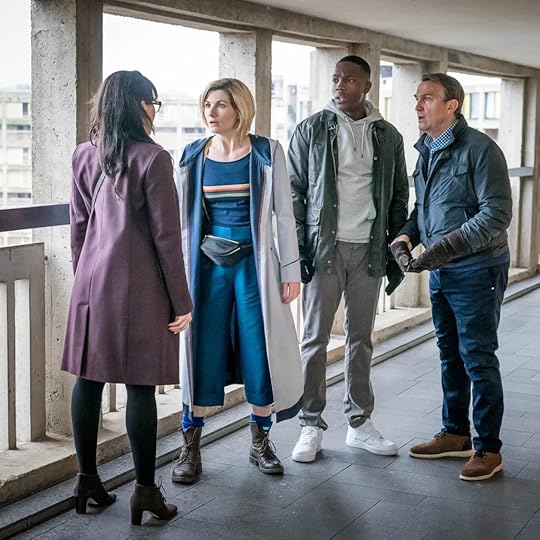
Up to this point I have absolutely loved this episode. I think it’s so entertaining, hits so many great notes. But boy does it fumble the ending.
Did they run long and have to cut a scene? Run out of budget and couldn’t shoot something? Was the script just needing one more draft? Is this the stage (3rd episode by Chibnall, 4th he had a hand in) where the scope of running the show just caught up to Chibnall? What happened?
Everything that appears on screen up to this point implies that the Doctor is looking for solutions and yet once the spiders are captured it’s just never addressed. I don’t think the intention is actually that they all just suffer because the other thing that’s never addressed is the problem of the mines and the toxic waste under the hotel. This leads me to conclude that using this as a club to beat the Doctor over their morality is unfair. Nothing about this story makes me think we’re supposed to interpret the story that way, but they failed to address the giant spider in the room so to me the failure lies entirely with the writing.
The FamThis is the first chance that the Doctor’s companions really have to make a conscious choice about travelling with the Doctor and of course they chose to. We’d have been surprised if they didn’t wouldn’t we? Having watched these four episodes again I feel that the reasons each of them has for staying with the Doctor both make perfect sense and are clearly present throughout each of the episodes. This actually feels like a group of friends in a way that many Companion/Doctor combos don’t.
So CloseI almost love this episode. It’s so strong for 90% of its running time. It’s tense and exciting when it needs to be but also gives me these character moments that I find so satisfying. And yet, as seems to be a pattern with Chibnall’s Who, there’s something that trips it up. It only needs one more scene really, but leaving the fate of the spiders and the mine hanging like that casts a pall across the whole episode. Bad endings are unfortunately harder to ignore than bad bits in the middle.
Ultimately I judge an episode by how much fun I had watching it and I had a lot of fun watching this story, but it’s flawed and that flaw is significant. The ending isn’t just weak, it’s bad, it’s missing. Leaving people hanging without any sort of resolution and an unnaturally abrupt ending is just…