
Dmitry Orlov's Blog, page 14
March 5, 2014
Chronology of the Ukrainian Coup
This is a guest post by Renée Parsons, who did a very good job of pulling together the facts. Facts are important, you know, especially in light of the rabidly anti-Russian press coverage in the US.
[Wednesday updates:
• According to a leaked EU's Ashton phone tape, the Kiev snipers, who shot both protesters and police, were hired by Ukrainian opposition leaders, did not work for overthrown Yanukovych
• It turns out that Russia has a legal right to maintain a military force of up to 25 thousand troops in Crimea in accordance with an agreement signed by Russia and Ukraine in 1997, which will remain in effect until 2043. Current Russian troop strength in Crimea is well under the legal limit. The troops are there to safeguard Russia's Black Sea fleet.
• John Kerry has pledged $1 billion in aid to Ukraine. Ukraine's natural gas bill to Russia is going to be $2 billion.]
Read more »
[Wednesday updates:
• According to a leaked EU's Ashton phone tape, the Kiev snipers, who shot both protesters and police, were hired by Ukrainian opposition leaders, did not work for overthrown Yanukovych
• It turns out that Russia has a legal right to maintain a military force of up to 25 thousand troops in Crimea in accordance with an agreement signed by Russia and Ukraine in 1997, which will remain in effect until 2043. Current Russian troop strength in Crimea is well under the legal limit. The troops are there to safeguard Russia's Black Sea fleet.
• John Kerry has pledged $1 billion in aid to Ukraine. Ukraine's natural gas bill to Russia is going to be $2 billion.]
Read more »


March 1, 2014
Reichstag Fire in Kiev
 Pawel Kuczyński[Since the situation in Ukraine is so volatile, I am once again rushing this piece out ahead of the normal schedule.]
Once upon a time I had an excellent history teacher, who has made a lasting impact on how I view the world. “It's about the dates,” he taught us; “Be sure to remember the dates, and you'll have the key to history.” You see, dates are important because most of the important historical events are, in fact, anniversaries. There is a hackneyed phrase that history does not repeat—it rhymes; but it would be a lot closer to truth to say that history has a rhythm—a rhythm based largely on multiples of the annual cycle.
Read more »
February 22, 2014
Shock over Ukraine
P { margin-bottom: 0.08in; }A:link { }
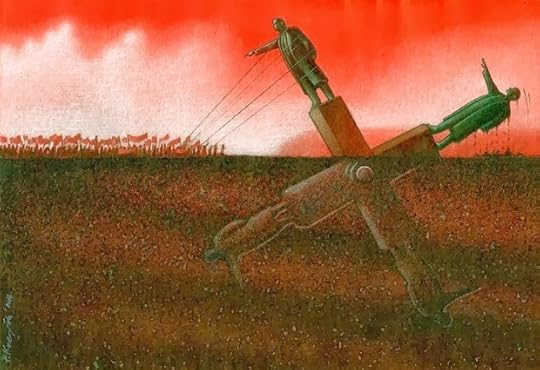 Pawel Kuczyński[Update: I am pushing this live a few days early, because the Ukrainian situation is evolving so rapidly. One political corpse (Yanukovych) is out; apparently he has fled to Russia. Another political corpse (Tymoshenko) has been hastily rehabilitated and is ready to be put on the ballot for elections in May. Question is, Will there still be a country for her to (pretend to) run? Financial reserves are down to a few days, federal structures are being dismantled throughout the country, regional governors are fleeing, and a default on some €60 billion of Ukrainian bonds, many held by Russian banks, seems likely. Could this be just the kind of financial contagion needed to finally pop the ridiculous US equities bubble? At least two Ukrainian provinces are openly talking secession; one (Crimea) wants to immediately join Russian Federation. A question for US State Dept. flunkies and EU functionaries: What does that do to your geopolitical calculus? At risk are five nuclear power plants and a lot of Russian gas that transits Ukraine on its way west. Ukraine is shaping up to be a lot like Yugoslavia, except with more than twice as many people, lots of crazed street fighters who think they now own the place, and a role critical to European energy security. If you aren't in shock about this, then you haven't been paying attention.]
I've been receiving a lot of emails asking me what I thought was happening in Ukraine. It took me a while to formulate an opinion, but what I now think is happening is this: a complete and utter failure of politics on every level. Read more »
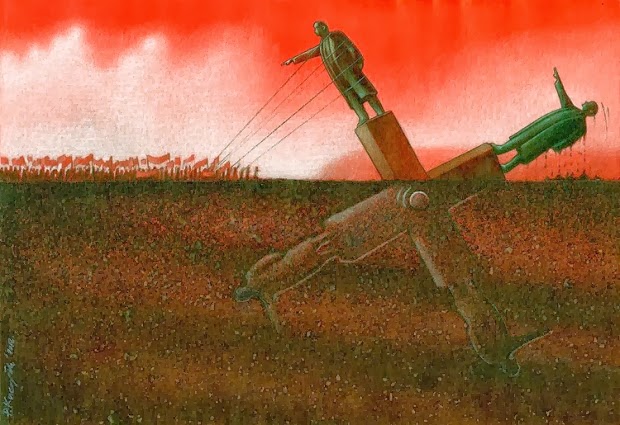 Pawel Kuczyński[Update: I am pushing this live a few days early, because the Ukrainian situation is evolving so rapidly. One political corpse (Yanukovych) is out; apparently he has fled to Russia. Another political corpse (Tymoshenko) has been hastily rehabilitated and is ready to be put on the ballot for elections in May. Question is, Will there still be a country for her to (pretend to) run? Financial reserves are down to a few days, federal structures are being dismantled throughout the country, regional governors are fleeing, and a default on some €60 billion of Ukrainian bonds, many held by Russian banks, seems likely. Could this be just the kind of financial contagion needed to finally pop the ridiculous US equities bubble? At least two Ukrainian provinces are openly talking secession; one (Crimea) wants to immediately join Russian Federation. A question for US State Dept. flunkies and EU functionaries: What does that do to your geopolitical calculus? At risk are five nuclear power plants and a lot of Russian gas that transits Ukraine on its way west. Ukraine is shaping up to be a lot like Yugoslavia, except with more than twice as many people, lots of crazed street fighters who think they now own the place, and a role critical to European energy security. If you aren't in shock about this, then you haven't been paying attention.]
I've been receiving a lot of emails asking me what I thought was happening in Ukraine. It took me a while to formulate an opinion, but what I now think is happening is this: a complete and utter failure of politics on every level. Read more »
February 17, 2014
The Good Life: Mobility, Anonymity, Freedom
 AK3DP { margin-bottom: 0.08in; }A:link { }The recent advanced in networked mobile computing has made it rather unnecessary for a large class of people—ones who use computers for work—to maintain a fixed abode: it is now possible to do all the same things, via the Internet, from any place in the world that has a wifi signal. Read more »
February 10, 2014
“American” exceptionalism
 P { margin-bottom: 0.08in; }A:link { }The term “American exceptionalism” has been receiving more than its fair share of play recently. It was pressed into service in the vapid banter that passes for political discourse in the US, with the Republicans accusing Obama of not believing in it. More recently, it surfaced as a term in international relations, when Russian president V. Putin chastised the US for believing it in a NY Times editorial, equating it with chauvinism and lack of respect for the rule of international law. It seems that it is Putin's dream to extend his cherished concept of “dictatorship of the law” to encompass even the US.
 Read more »
February 3, 2014
How To Time Collapses
 Douglas Smith
ZeusP { margin-bottom: 0.08in; }A:link { }Over the past half a decade I've made a number of detailed predictions about collapse: how it is likely to unfold, what its various manifestations are likely to be, and how it will affect various groups and categories of people. But I have remained purposefully vague about the timing of collapse and its various stages, being careful to always append “give or take half a decade” to my dire prognostications. I wasn't withholding information or being coy; I really had no way of calculating when collapse will happen—until five days ago, when, out of the blue, I received the following email from Ugo Bardi:
Read more »
January 27, 2014
Diabolics 101
P { margin-bottom: 0.08in; }A:link { }
 Troy Coulterman[Project Unspell is proceeding apace. Meanwhile, here is a guest post by Claire about her firsthand experience teaching people to read in write using the “diabolical” English orthography. Teachers like her, who have the knowledge and the skill to achieve superior results, are few and far between. The average results are abysmal: it takes upwards of eight years of formal instruction for native English speakers to achieve adequate literacy, and as many as ten for non-natives. Many of them never make it. Meanwhile, it takes a year or so to achieve the same results given almost any reasonably designed orthography. The opportunity cost to society of English spelling is absolutely staggering. But help is on the way: Unspell is specifically designed to be learnable “by osmosis.”]
Twelve years ago I was shocked to find I had no idea how to teach anyone to read and write. For most people this would be no reason to panic. But it was for me because I was in my final year of teacher training. Incredibly, I’d spent nearly four years in the education faculty of an Australian university and no one had mentioned the mechanics of the English writing system, where it originated and how to teach it. This omission seemed even more bizarre when I later discovered that English is one of the hardest languages to learn to read and write.
So instead of being taught something useful, I had to read scores of academic articles about how to create a language-rich classroom in which to immerse my students. All this richness and immersion was somehow meant to help children “emerge into literacy” provided they were “exposed” to truckloads of print. In other words, learning to read and write would occur via osmosis with little or no instruction from me.
Despite this ludicrous premise, it didn’t immediately occur to me that this osmosis theory is bonkers. So I went along with the charade until it hit me that our writing system is a human invention that needs to be taught. Like driving, for instance. A car is a human contrivance in need of a driver to navigate it around the landscape. Yet no one seriously expects a learner driver to “emerge into driving” by standing on a street corner and being “exposed” to traffic. Learner drivers need direct instruction on how to handle a car and no one is idiotic enough to suggest otherwise.
And yet, when it comes to teaching one of the world’s most fearsome orthographies, we seem to think the less instruction the better. And even when we do give instructions, they’re often wrong or misguided. This is a disastrous way to approach a complex written language and the functional illiteracy rate in English-speaking countries attests to this.
Strangely, this pedagogical boondoggle did not occur in the education faculty’s mathematics department. I have no recollection of anyone arguing that children “emerge into numeracy” provided they are “exposed” to lots of numbers. Instead, it was made clear that mathematics is a human invention that needs systematic instruction. Consequently, I was taught howto teach our number system.
Anyway, after I stopped panicking I figured that if I was going to teach children to read and write a difficult writing system, then I was going to have to do it properly. Luckily, I encountered a book by Geoffrey and Carmen McGuinness called Reading Reflex. It taught me the structure of the English written language, where it originated and how to teach it. It also confirmed what I suspected – that reading and writing need careful and systematic instruction, especially with an orthography as diabolical as ours. And the thing is, children can learn to read and write English provided those who teach them know what they’re dealing with. The trouble is, many of us don’t. Because we’re not trained to deal with it.
Here’s what we’re dealing with: A code. An alphabet code we inherited from the Romans, who, inspired by the Ancient Greeks and the Phoenicians, created it by listening to the sounds of their language and devising a symbol to represent each of these sounds. Consequently, if the sound-based nature of this alphabet code is misunderstood, then written English is not taught in the way it was designed. The result: lots and lots of people who can barely read and write.
So it makes sense to teach it well. But nothing makes much sense in our society, so the teaching of reading and writing makes little sense either. Frankly, I’m amazed anyone reads and writes at all given the poor training teachers receive and the haphazard way literacy is taught.
Something else I didn’t learn at university. A writing system like English is called an opaque alphabet code. This means we have more than one symbol for each sound and more than one way to read and write each sound. This contrasts with transparent alphabet codes like Italian, Spanish and German where there is mainly one way to read and write each sound. It’s no surprise, then, that this makes transparent codes easy to teach and learn.
And, believe it or not, English itself was once a transparent code. Here’s the sad story:
Once upon a time, English had a perfect written language. It was easy to read and easy to write. One sound equalled one way of reading and writing it. English was as near to phonetic written perfection as you can imagine. Two Dark Age luminaries were responsible for this linguistic marvel. The first was an Anglo-Saxon king and the second, an Irish bishop. Astonishingly, in the wilds of Northumbria in 635 AD, King Oswald and Bishop Aiden created a writing system we now know as Old English. Somehow it managed to survive centuries of Viking mayhem before finally meeting its Waterloo at the Battle of Hastings when the Norman-French army defeated the Anglo-Saxon King Harold II in 1066.
Old English then suffered such a calamitous decline that I’m thankful King Oswald and Bishop Aiden never lived to see its fate. This is because English has gone from a near-perfect writing system to a bizarre creature that needs to be wrestled to the ground. Where once it was delightfully easy to read and write, it is now a mad jumble of multiple spellings for the same sound and multiple ways to read the same sound.
The upshot of all this Norman invading and Viking pillaging and nerdy Latin/Greek obsession is that English ended up with no less than five languages and their orthographies layered over one another: Anglo-Saxon, Danish, Norman French, Classical Latin and Greek. No wonder modern English is so tricky to read and write.
Anyway, several years after I graduated, I felt confident enough to start my own remedial reading and spelling business. I had no shortage of pupils, all of whom were doing their best to make sense of a written language that made no sense to them whatsoever. At their first lesson, I told them about English and how it had once been easy to read and write. I then told them about King Oswald and Bishop Aiden. I also suggested that they blame at least some of their spelling woes on the Vikings and the Norman French and the medieval scholars and judges and priests.
It was at this point that their faces softened. Finally, they could relax. It wasn’t their fault. They were not stupid. They were just stuck trying to understand a writing system that had strayed a long way from King Oswald’s and Bishop Aiden’s original, magnificent creation. For theirs was a linguistic masterpiece that, had it survived, would make the lives of countless children and adults less miserable and throw people like me out of a job.
References
Reading Reflex, McGuinness, C. & McGuinness, G., Simon & Schuster, New York, 1999.
Early Reading Instruction, McGuinness, D.,The MIT Press, Cambridge, Massachusetts, 2004
 Troy Coulterman[Project Unspell is proceeding apace. Meanwhile, here is a guest post by Claire about her firsthand experience teaching people to read in write using the “diabolical” English orthography. Teachers like her, who have the knowledge and the skill to achieve superior results, are few and far between. The average results are abysmal: it takes upwards of eight years of formal instruction for native English speakers to achieve adequate literacy, and as many as ten for non-natives. Many of them never make it. Meanwhile, it takes a year or so to achieve the same results given almost any reasonably designed orthography. The opportunity cost to society of English spelling is absolutely staggering. But help is on the way: Unspell is specifically designed to be learnable “by osmosis.”]
Twelve years ago I was shocked to find I had no idea how to teach anyone to read and write. For most people this would be no reason to panic. But it was for me because I was in my final year of teacher training. Incredibly, I’d spent nearly four years in the education faculty of an Australian university and no one had mentioned the mechanics of the English writing system, where it originated and how to teach it. This omission seemed even more bizarre when I later discovered that English is one of the hardest languages to learn to read and write.
So instead of being taught something useful, I had to read scores of academic articles about how to create a language-rich classroom in which to immerse my students. All this richness and immersion was somehow meant to help children “emerge into literacy” provided they were “exposed” to truckloads of print. In other words, learning to read and write would occur via osmosis with little or no instruction from me.
Despite this ludicrous premise, it didn’t immediately occur to me that this osmosis theory is bonkers. So I went along with the charade until it hit me that our writing system is a human invention that needs to be taught. Like driving, for instance. A car is a human contrivance in need of a driver to navigate it around the landscape. Yet no one seriously expects a learner driver to “emerge into driving” by standing on a street corner and being “exposed” to traffic. Learner drivers need direct instruction on how to handle a car and no one is idiotic enough to suggest otherwise.
And yet, when it comes to teaching one of the world’s most fearsome orthographies, we seem to think the less instruction the better. And even when we do give instructions, they’re often wrong or misguided. This is a disastrous way to approach a complex written language and the functional illiteracy rate in English-speaking countries attests to this.
Strangely, this pedagogical boondoggle did not occur in the education faculty’s mathematics department. I have no recollection of anyone arguing that children “emerge into numeracy” provided they are “exposed” to lots of numbers. Instead, it was made clear that mathematics is a human invention that needs systematic instruction. Consequently, I was taught howto teach our number system.
Anyway, after I stopped panicking I figured that if I was going to teach children to read and write a difficult writing system, then I was going to have to do it properly. Luckily, I encountered a book by Geoffrey and Carmen McGuinness called Reading Reflex. It taught me the structure of the English written language, where it originated and how to teach it. It also confirmed what I suspected – that reading and writing need careful and systematic instruction, especially with an orthography as diabolical as ours. And the thing is, children can learn to read and write English provided those who teach them know what they’re dealing with. The trouble is, many of us don’t. Because we’re not trained to deal with it.
Here’s what we’re dealing with: A code. An alphabet code we inherited from the Romans, who, inspired by the Ancient Greeks and the Phoenicians, created it by listening to the sounds of their language and devising a symbol to represent each of these sounds. Consequently, if the sound-based nature of this alphabet code is misunderstood, then written English is not taught in the way it was designed. The result: lots and lots of people who can barely read and write.
So it makes sense to teach it well. But nothing makes much sense in our society, so the teaching of reading and writing makes little sense either. Frankly, I’m amazed anyone reads and writes at all given the poor training teachers receive and the haphazard way literacy is taught.
Something else I didn’t learn at university. A writing system like English is called an opaque alphabet code. This means we have more than one symbol for each sound and more than one way to read and write each sound. This contrasts with transparent alphabet codes like Italian, Spanish and German where there is mainly one way to read and write each sound. It’s no surprise, then, that this makes transparent codes easy to teach and learn.
And, believe it or not, English itself was once a transparent code. Here’s the sad story:
Once upon a time, English had a perfect written language. It was easy to read and easy to write. One sound equalled one way of reading and writing it. English was as near to phonetic written perfection as you can imagine. Two Dark Age luminaries were responsible for this linguistic marvel. The first was an Anglo-Saxon king and the second, an Irish bishop. Astonishingly, in the wilds of Northumbria in 635 AD, King Oswald and Bishop Aiden created a writing system we now know as Old English. Somehow it managed to survive centuries of Viking mayhem before finally meeting its Waterloo at the Battle of Hastings when the Norman-French army defeated the Anglo-Saxon King Harold II in 1066.
Old English then suffered such a calamitous decline that I’m thankful King Oswald and Bishop Aiden never lived to see its fate. This is because English has gone from a near-perfect writing system to a bizarre creature that needs to be wrestled to the ground. Where once it was delightfully easy to read and write, it is now a mad jumble of multiple spellings for the same sound and multiple ways to read the same sound.
The upshot of all this Norman invading and Viking pillaging and nerdy Latin/Greek obsession is that English ended up with no less than five languages and their orthographies layered over one another: Anglo-Saxon, Danish, Norman French, Classical Latin and Greek. No wonder modern English is so tricky to read and write.
Anyway, several years after I graduated, I felt confident enough to start my own remedial reading and spelling business. I had no shortage of pupils, all of whom were doing their best to make sense of a written language that made no sense to them whatsoever. At their first lesson, I told them about English and how it had once been easy to read and write. I then told them about King Oswald and Bishop Aiden. I also suggested that they blame at least some of their spelling woes on the Vikings and the Norman French and the medieval scholars and judges and priests.
It was at this point that their faces softened. Finally, they could relax. It wasn’t their fault. They were not stupid. They were just stuck trying to understand a writing system that had strayed a long way from King Oswald’s and Bishop Aiden’s original, magnificent creation. For theirs was a linguistic masterpiece that, had it survived, would make the lives of countless children and adults less miserable and throw people like me out of a job.
References
Reading Reflex, McGuinness, C. & McGuinness, G., Simon & Schuster, New York, 1999.
Early Reading Instruction, McGuinness, D.,The MIT Press, Cambridge, Massachusetts, 2004
January 23, 2014
Announcing: MassTrails 2.0
 Javier PérezMassTrails.com, the world's most complete database of maps of wild places in Massachusetts to which the public has access is now even more complete. It has also been redesigned, and the search engine overhauled. Now is not the time to venture out into the woods (unless you happen to like frostbite), but as the weather warms I hope that those of you who read this blog and who live in Massachusetts (about a thousand people) try it out. There is a good chance you'll find an interesting place to go and spend time outdoors that you otherwise wouldn't know existed. Also, please spread the word among your friends and family. Thank you. Many thanks to Will Kilburn for compiling the database, Colin Owens for the design, and me (yes, me) for writing the code.
January 20, 2014
The Peace-Violence Axis
P { margin-bottom: 0.08in; }
 Maria RubinkeAlbert's plot of thinkers has elicited some strong reactions. The vertical “Ecotopia”/“Collapse” axis seems somewhat less controversial: it seems that some people are more optimistic, some less optimistic, but that this is a personal preference that others can easily accept. But the horizontal axis, especially in his initial version, where it went from “peaceful transformation” on the left to “violent revolution” on the right, didn't sit well with many people. The new version, which goes from “transformation” to “resistance” may be more politically correct, but I feel that something is lost in eschewing the concept of violence, which I feel is omnipresent and inescapable.
Read more »
 Maria RubinkeAlbert's plot of thinkers has elicited some strong reactions. The vertical “Ecotopia”/“Collapse” axis seems somewhat less controversial: it seems that some people are more optimistic, some less optimistic, but that this is a personal preference that others can easily accept. But the horizontal axis, especially in his initial version, where it went from “peaceful transformation” on the left to “violent revolution” on the right, didn't sit well with many people. The new version, which goes from “transformation” to “resistance” may be more politically correct, but I feel that something is lost in eschewing the concept of violence, which I feel is omnipresent and inescapable.
Read more »
January 15, 2014
David Holmgren's Crash on Demand
P { margin-bottom: 0.08in; }A:link { }
 Gary LarsonThere has been a lot of reaction in recent days to David Holmgren's recent reassessment of his Future Scenarios paper of 2007. In that paper, Holmgren describes four alternative scenarios, calling them Brown Tech, Green Tech, Earth Steward and Lifeboats. In his reassessment, he notes that Peak Oil has so far failed to trigger any sort of decrease in greenhouse gas emissions, while the projected effects of rapid climate change have gone from bad to borderline lethal for human survival. Noting that previous strategies for stopping this slide to environmental destruction, such as international negotiations, mainstream climate activism, the Transition Towns movement and all the rest have had a negligible effect, he proposed a new approach:Read more »
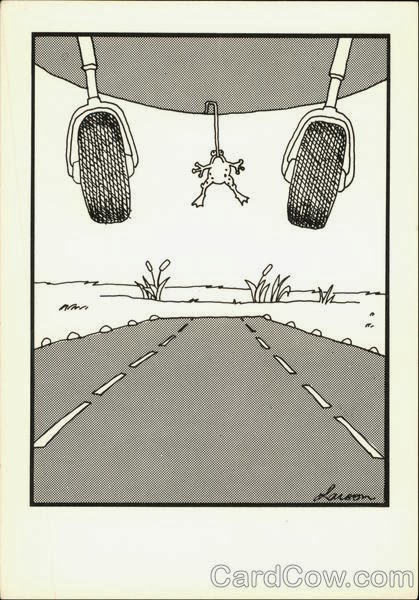 Gary LarsonThere has been a lot of reaction in recent days to David Holmgren's recent reassessment of his Future Scenarios paper of 2007. In that paper, Holmgren describes four alternative scenarios, calling them Brown Tech, Green Tech, Earth Steward and Lifeboats. In his reassessment, he notes that Peak Oil has so far failed to trigger any sort of decrease in greenhouse gas emissions, while the projected effects of rapid climate change have gone from bad to borderline lethal for human survival. Noting that previous strategies for stopping this slide to environmental destruction, such as international negotiations, mainstream climate activism, the Transition Towns movement and all the rest have had a negligible effect, he proposed a new approach:Read more »
Dmitry Orlov's Blog

- Dmitry Orlov's profile
- 48 followers
Dmitry Orlov isn't a Goodreads Author
(yet),
but they
do have a blog,
so here are some recent posts imported from
their feed.


