Rob Kitchin's Blog, page 34
August 2, 2019
Review of An Empty Death by Laura Wilson (2009, Orion)
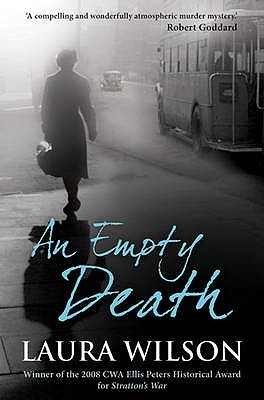 Summer, 1944. The Blitz is over but London is still being hit by doodlebugs. DI Ted Stratton and his wife Jenny head to aid those affected when one lands two streets away, Ted helping to dig Mrs Ingram from the rubble. The next day he’s called to investigate the death of a doctor from the Middlesex Hospital. He’s been found dead on a bomb site and it appears he’s been murdered. For mortuary attendant Sam Holt, Dr Reynold’s death is an opportunity to take on another identity, one he’s been working up to for years. He changes his appearance, assumes someone else’s identity and finagles his way into a job as a casualty doctor, learning the trade on the go and from books. His life is looking up, especially after he starts to date a pretty nurse. However, he hadn’t anticipated the tenacity of DI Stratton to solve the murder, or that others might see through his disguise. Having come so far, Dr Dacre is prepared to protect his new life, even if that means killing anyone trying to expose him. Meanwhile, Ted is getting tired of his wife and her sister caring for Mrs Ingram who appears to be suffering from a rare mental illness after her traumatic rescue.
 An Empty Death is the second book in the DI Ted Stratton series set in London during the Second World War. In this outing, Stratton is investigating the suspicious death of a doctor on a bomb site. His nosing around the hospital that Dr Reynold’s work at quickly ruffles feathers and spooks one doctor in particular – Dr Dacre is an imposter that has used Reynold’s death to pass himself off as a medical doctor and take over his position. Meanwhile, Jenny Stratton is helping to care for a bomb victim who is suffering from mental health issues, creating tensions at home. Wilson tells the tale as three main strands: Stratton’s investigation, Dr Dacre’s perspective, and Jenny’s care of Mrs Ingram. Wilson patiently unfolds the plot, in particular fleshing out the main characters and filling out their backstories. The pace is a little slow at times and the Ingram strand felt a little bolted on for much of the story, but eventually it comes into its own as the three strands are pulled tight. Rather than finish the story at the main climax – which is a twist with real affect – Wilson does a nice job of letting it continue to unfold to another twist and natural denouement, though this one was telegraphed from a long way out. Overall, an engaging police procedural with emotional depth.


August 1, 2019
July reviews
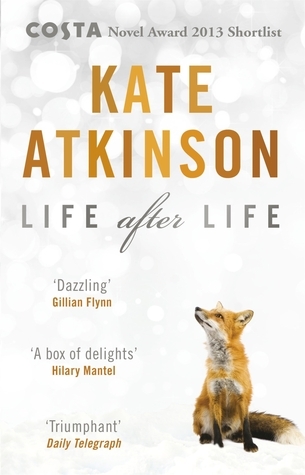 Relatively straightforward to pick a read of the month - Kate Atkinson's Life After Life, a thoughtful tale about living over and over.
The Disappearing Spoon by Sam Kean ***.5
The Missing Ones by Patricia Gibney ***
The Last Goodnight by Howard Blum ***
The Blood Spilt by Asa Larsson ****
Metropolis by Philip Kerr ****
Last Call by Paula Matter **.5
The Night Watch by Terry Pratchett ****.5
Life After Life by Kate Atkinson *****
Dead Man’s Land by Robert Ryan ****
July 31, 2019
Review of The Disappearing Spoon by Sam Kean (2010, Little Brown and Co)
 The Disappearing Spoon is a collection of essays about the development of the periodic table and the discovery of the elements and their various uses. In large part it is a history of science, but told through a series of stories relating to scientists, and their work and rivalries. But it also details the science related to the periodic table, the constituent elements, their properties and useful characteristics. Kean also mixes in other anecdotes relating to mythology, medicine, industry, war, etc.
In terms of organisation, Kean loosely structures the book into four parts and focuses each chapter on a group of related elements. It creates a somewhat jumbled arrangement (and in some ways the essays could be read in any order), but it does mean that just about every element is discussed in some fashion. It is difficult to see how else to give the book its wide scope given overlapping timelines of discovery – a straight chronology would have been difficult, but the structure does make the book feel somewhat bitty at times.
The writing can also be a bit dry and impenetrable for someone who has little chemistry, physics or biology knowledge, though Kean does a reasonable job at trying to introduce and explain various science breakthroughs that won numerous Nobel prizes, and gives it a human edge by discussing the lives of those who made the telling discovery. Nonetheless, there were passages that will mean a helluva lot more to those with a science background than the average reader.

July 28, 2019
Lazy Sunday Service
 The latest addition to the garden - a bee hotel. A lot of sawing, drilling and puzzling how best to put all the logs in. There's sawdust everywhere in the shed! A bit late for this season but we'll bring in over winter and put out again next spring. Hopefully it'll survive any strong winds between now and winter hibernation.
My posts this week
Review of The Missing Ones by Patricia Gibney
Review of The Last Goodnight by Howard Blum
You, Me, Always
July 27, 2019
You, Me, Always
‘How many times do we need to tell you? Stay away from that boy!’
‘His name’s Niall.’
‘And he’s nothing but trouble.’
‘You mean he’s a taig.’
‘I mean he’s … not for you.’
‘Dad, it’s 2001. The war’s ended.’
‘The Good Friday Agreement’s just a piece of paper. This is real life.’
‘And what we have is real love.’
‘What you have is infatuation. Lust!’
‘That’s it, I’m off out.’
‘You’ll go to your room!’
‘I’m nineteen, Dad, not nine.’
Ellie paused at the garden gate, smiled, and mouthed the words chalked on the wall opposite.
‘You, Me, Always.’
A drabble is a story of exactly 100 words.
‘His name’s Niall.’
‘And he’s nothing but trouble.’
‘You mean he’s a taig.’
‘I mean he’s … not for you.’
‘Dad, it’s 2001. The war’s ended.’
‘The Good Friday Agreement’s just a piece of paper. This is real life.’
‘And what we have is real love.’
‘What you have is infatuation. Lust!’
‘That’s it, I’m off out.’
‘You’ll go to your room!’
‘I’m nineteen, Dad, not nine.’
Ellie paused at the garden gate, smiled, and mouthed the words chalked on the wall opposite.
‘You, Me, Always.’
A drabble is a story of exactly 100 words.
July 25, 2019
Review of The Missing Ones by Patricia Gibney (2017, Sphere)
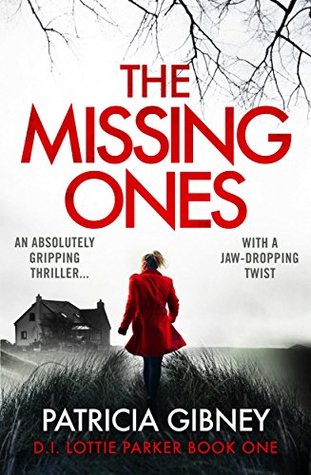 Susan Sullivan tries and fails to contact the police before heading to Ragmullin cathedral to confront her past. She’s found a few hours later at the foot of a pew strangled to death. Detective Inspector Lottie Parker is assigned as the lead investigator. Shortly after interviewing Susan’s boss, local planner James Brown, he is also found strangled at his home. Besides working together, the two victims both have identical tattoos on their inner thigh. Lottie’s investigation leads her to St Angela’s, a former children’s home that is slated to be re-developed as a hotel and golf course. A cabal of powerful interests are behind the project, and with the planning application pending they’re determined to protect their investment. But Lottie’s digging suggests that the murders are rooted as much in the past and the victim’s childhood as the present.
The Missing Ones is the first in the DI Lottie Parker series set in Ragmullin, a small Irish town. In this outing Parker tangles with two issues that have dominated Ireland’s recent history – Church scandals concerning children’s homes, child abuse and adoption, and cronyism, clientelism, and planning and development scandals. Set over a freezing winter, Parker and her team investigate the deaths of two planning officers and their links to former children’s home, St Angela’s. In so doing, she tangles with several influential people with interests in the site including a bishop, a developer, a local government manager, and a bank manager, each of whom knows her superintendent, who tries to rein in her confrontational approach. Lottie, however, is determined to get to the truth, even if that means neglecting her three teenage kids, and when a priest from Rome is found dead the pressure to bring the killer to justice mounts. Gibney’s strategy for holding the reader’s attention is to keep the pace and tension high throughout, the body count and abductions mounting, and to create as much drama in Lottie’s life as in the case itself. It works well in terms of maintaining interest and keeping the pages turning, but also works to mask the unlikeliness of much of the plot. Almost the whole of Lottie’s family are integral to the case – her son and daughter, her mother, her brother, her best friend. She’s also in an will-they-won’t they relationship with her sergeant and is jousting with her boss. Gibney uses a series of obvious plot devices to keep things on track – not answering phone calls, talking in front of suspects, idiot boss – and the denouement was somewhat contrived and over-the-top (but then that’s common enough for the genre). My one other quibble was Ragmullin was so obviously Mullingar (as the anagram denotes) why not just use the real name? As long as one suspends belief and doesn’t press too hard on conspiracy plot, or Lottie’s tangled personal connections to it, and thinks of the story as a thriller rather than realistic police procedural then it’s an engaging and entertaining read.

July 23, 2019
Review of The Last Goodnight by Howard Blum (2016, Harper)
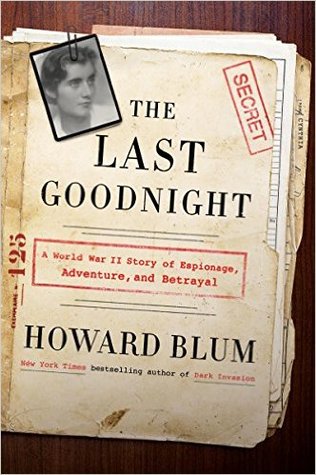 Amy Elizabeth (Betty) Thorpe was born on November 22, 1910, in Minneapolis. Her father was a career soldier and her mother a socialite and they moved around and spent time in Europe before settling in Washington DC. Betty understood her allure as a young teenager and soon discovered sex, becoming pregnant as at nineteen. She quickly latched onto Arthur Pack, a British diplomat twenty years her senior, and married him. She then moved to England to have the child, which the Packs placed into foster care before heading to Chile where Pack was newly posted. The Packs moved in vaulted company and Betty took an interest in polo, had a couple of affairs, and also had a daughter. They then moved to Spain, where again she fell in and out of bed with senior nationalist figures and first drew the attention of British intelligence services. After the civil war breaks out and she moves to France but makes forays into Spain to help extract the British embassy and also to save a lover, using her charms to ferry in medical supplies and negotiate his release from a Republican prison. Her next move is to Poland, where she is formally recruited as a spy and instructed to develop contacts with senior government officials and starts an affair with the personal assistant to the foreign minister, gathering vital information in the lead up to the outbreak of war and also took part in an operation in Czechoslovakia to steal vital documents. Next it is back to Chile where her marriage breaks down and, after a couple of adventures via boat and airplane tracking diplomatic delegations, she ends up in Washington where taking the role of a journalist she practices honey trap operations against the Italian and Vichy embassies to steal cipher books. Having successfully obtained the information she was hoping to go behind enemy lines in France, but the operation was dropped after her cover was blown. After the war she lived in France with her new husband, telling her story to a fellow former spy in 1962, dying of cancer a year later.
Blum tells the story of Betty Pack’s life, who’s work as a spy was recognized by Roosevelt and Churchill and was declared by OSS chief Bill Donovan as ‘the greatest unsung heroine of the war.’ Operating under the codename ‘Cynthia’, Betty used her charm and sex to not only gather secrets via pillow talk, but also to set-up and participate in daring thefts and aid escapes. She was so determined to succeed that she would often run great risks to repeatedly try to get what her spymasters desired, and often defied their counsel. Blum charts her various adventures and offers some speculation as to her motives and psychology. While she clearly was highly charismatic, she was also quite self-centred, bloody-minded and manipulative. She fell easily in-and-out of love and had no compunction in betraying lovers. The telling is almost like a novel, though one that is a little dry and stilted, and is told as if the narrator was present and witnessed the events, yet clearly the dialogue and much of the action is speculation based on some testimony. The book is also a little oddly organized. The biography doesn’t always run chronologically and the main narrative is interdispersed with Betty’s interactions with her biographer, a former fellow spy, and their trip to Ireland. The main purpose of this thread seems to be to reveal how her story came to light and the key source of material for Blum (Hyde, her biographer, had gathered together her testimony, many letters, and other documents depositing them in a university archive on his death). It’s as if Blum has a sense that the reader will not believe some of the story and wants to reassure the reader of its veracity (at the start and end he is keen to assert it is a true telling), but in a lot of ways it’s a distraction. Despite Blum’s statements, there is little getting around the fact that the documentary sources are somewhat sketchy and based mostly on self-testimony and the story needs framing in a more circumspect and critical way than simply asserting that it is the truth. Nonetheless, Betty Pack did live an incredible life and did make vital contributions to the Allies intelligence operations before and during the Second World War.

July 21, 2019
Lazy Sunday Service
 A nice morning talking about books. I've been persuaded to try one of Robert Macfarlane's books about place, landscape and nature. Having a quick browse, I'll probably start with Landmarks and see how I get on.
My posts this week
Review of The Blood Spilt by Asa Larsson
Review of Metropolis by Philip Kerr
Dry land
July 20, 2019
Dry land
Paul leveraged the spade into the soil.
Another year, another crop.
Except the previous two years had been fallow.
First, Cathy had died shortly after diagnosis.
Then three weeks later, he’d been made redundant.
He'd been cut adrift from his two key anchors.
Lost at sea for almost two years; bobbing around in grief and self-loathing.
He’d almost drowned in sorrows and given up hope of seeing the shore again.
But then he’d been caught in a loose net and pulled gently towards the coast.
Friends who ignored his drunken hubris.
Now the dry land was preparing to flower again.
A drabble is a story of exactly 100 words.
Another year, another crop.
Except the previous two years had been fallow.
First, Cathy had died shortly after diagnosis.
Then three weeks later, he’d been made redundant.
He'd been cut adrift from his two key anchors.
Lost at sea for almost two years; bobbing around in grief and self-loathing.
He’d almost drowned in sorrows and given up hope of seeing the shore again.
But then he’d been caught in a loose net and pulled gently towards the coast.
Friends who ignored his drunken hubris.
Now the dry land was preparing to flower again.
A drabble is a story of exactly 100 words.
July 19, 2019
Review of The Blood Spilt by Asa Larsson (2008, Penguin; 2004 Swedish)
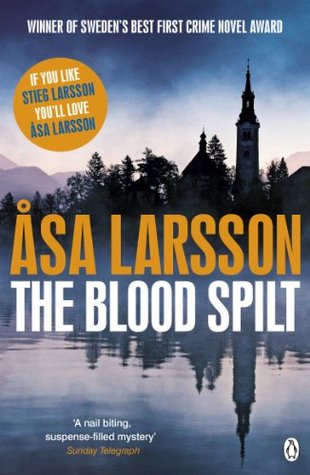 Rebecka Martinsson is still traumatised from her last visit home to Kiruna in northern Sweden when she ended up fighting for her life. Her law firm has retained her services, but has her on light duties. When the firm is approached by a set of churches in Kiruna for legal services one of the partners thinks its opportunity to aid Rebecka’s rehabilitation. She journeys home with her boss, planning to stay on for a few days after the Church business is conducted. When they arrive, however, they find the Church is reeling from the murder of one of their women priests. A staunch feminist, Mildred Nilsson had managed to polarise the community with her self-defence classes for women, an all-female Bible study group, and establishing a church fund to protect the local she-wolf from being hunted. The local police are not short of potential suspects, but they are short of any evidence. Rebecka unearths a fresh lead, handing it over to the police and hoping it’s the end of her involvement in the case.
The Blood Spilt is the second book in the Rebecka Martinsson series set in northern Sweden. Martinsson is a corporate lawyer with mental health issues after an encounter that left three people dead. In this outing, she travels back home two years after the traumatic events of the first book, still licking her wounds and trying to get her life back on track. She stays in an off-the-track bed-and-breakfast, visits her grandmother’s house, and makes friends with a teenage boy who has a mental disability. She has a bit of work to do for a local church, but that is quickly concluded. The local community is reeling from the death of female priest and Rebecka discovers some evidence and passes it on to the police, but as far as she’s concerned that’s the end of her involvement. However, she has an unfortunate habit of crossing paths with murderers. There’s a good sense of place, the characterisation well drawn, and portrayal of the complex web of connections and local rivalries is nicely done. The investigation into the death of the priest is the main thread of the story, but there are a couple of subplots relating to Rebecka’s personal life and the journey of a she-wolf. While nicely written, the latter added little to the story and was a bit of a distraction. Martinsson builds the tension well and the final section of the book has a couple of chilling climaxes, and a couple of the events made me quite annoyed (but not in negative way) in terms of how they turned out (they just had a powerful affective punch). Overall, an engaging read that left me worrying about what trauma Larsson will put Rebecka through in future books.