Jeanette Larson's Blog, page 9
October 22, 2013
Alex The Parrot No Ordinary Bird: A True Story
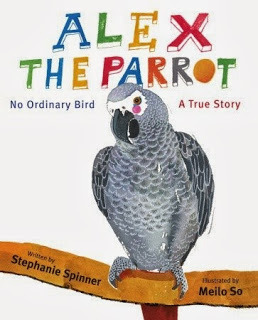
Alex the Parrot by Stephanie Spinner has been sitting on my book cart (yes, I have a personal library style book cart) for a year (almost exactly--it was released on October 9, 2012). I couldn't give it up by donating it to my local library but I hadn't found time to read it. Glad I held on to this book! It's a great example of an illustrated book for readers who are older than the "typical" picturebook set as well as a nonfiction picturebook. It's also definitely NOT a cute bedtime storybook about a parrot. Too much detail and information and a lot of fodder for discussion that would keep the kids awake. So. Who was Alex?
"One June day in 1977, Irene Pepperberg walked into a pet store looking for an African grey parrot." Of the several available, she singled out one bird to be part of an experiment--the Avian Learning Experiment--at Purdue University. Through her work with Alex, scientists learned that, far from being barely intelligent creatures, some animals, including parrots, are highly intelligent and capable of understanding the words they hear--and in the case of parrots and mynah birds--those they say.
Interestingly the genesis of Irene Pepperberg's interest in animal intelligence started in 1974 when she saw a
 television show about a new science--the study of animal language. In 1974, while an anthropology student at the University of New Mexico, I learned about the current research teaching chimps to communicate using ASL. Years later, I met one of the subjects of that research, Nim Chimpsky, at Cleveland Amory's Black Beauty Ranch in East Texas. Believe me, that chimp knew how to tell you what he wanted you to know! Studying chimps and gorillas, like Koko, or dolphins was where the grant funds went because those creatures have brains more like human brains. No one other than Irene was especially interested in "bird brains."
Alex was in many ways an ordinary parrot. He imitated noises he heard but spoke as clearly as a person, something not possible for a chimp or a dog or a dolphin. Budding scientists will appreciate following the processes and methods Irene used to teach Alex and her attempts to discover whether he really understood what he was saying. Like a petulant toddler "no" became one of his favorite words. Importantly, the book also explains why the research had to be meticulously document so that it would not be dismissed as operant conditioning like "Clever Hans," a horse who performed math problems by picking up cues from his handler. Eventually Alex could understand and say hundreds of words, many more than Washoe, a chimp who could sign 130 words, or Koko, who could sign 200 words. Alex even understood concepts like bigger or smaller and the concept of zero--something children don't grasp until they are about four or five years old. Alex even became an avian celebrity, appearing on television shows.
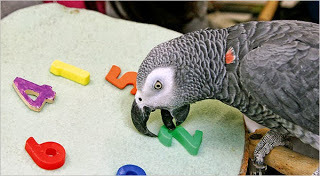 Alex at work (photo from Brandeis UniversityIn the lab Alex "ruled the roost" and started teaching a younger bird words and even would tease his young pupils. Regrettably Alex did not live the normal life span of an African grey parrot. In his short life he taught the world that being a bird brain is a good thing and his groundbreaking work, and Irene's, continues with Griffin, one of Alex's students. African Grey Parrots are known as the "Einsteins" of the parrot world. In the wild they live in the rain forests of West and Central Africa and importation of wild-caught parrots into the US has been prohibited since 1992.
The illustrations by Meilo So, who also illustrated Pale Male: Citizen Hawk of New York City, shows Alex in exquisite watercolor detail with sketchier 1970s style scenes around him. So used colored pencils and ink to provide additional illustrations. The hand-letter type uses the same shaped letters Alex used in his testing and cartoon-like bubbles show his dialogue.
Adults or teen readers who want to know more can read Alex & Me: How a Scientist and a Parrot Discovered a Hidden World of Animal Intelligence--and Formed a Deep Bond in the Process, Pepperberg's book about her life with Alex. Readers from about third grade through middle school will learn a lot about African Grey Parrots and animal intelligence and this is a great companion book for a longer fiction book like The One and Only Ivan by Katherine Applegate, about a gorilla that communicated with people.
I received a review copy of this book from the publisher, Alfred A. Knopf.
Amazon.com Widgets
"One June day in 1977, Irene Pepperberg walked into a pet store looking for an African grey parrot." Of the several available, she singled out one bird to be part of an experiment--the Avian Learning Experiment--at Purdue University. Through her work with Alex, scientists learned that, far from being barely intelligent creatures, some animals, including parrots, are highly intelligent and capable of understanding the words they hear--and in the case of parrots and mynah birds--those they say.
Interestingly the genesis of Irene Pepperberg's interest in animal intelligence started in 1974 when she saw a
 television show about a new science--the study of animal language. In 1974, while an anthropology student at the University of New Mexico, I learned about the current research teaching chimps to communicate using ASL. Years later, I met one of the subjects of that research, Nim Chimpsky, at Cleveland Amory's Black Beauty Ranch in East Texas. Believe me, that chimp knew how to tell you what he wanted you to know! Studying chimps and gorillas, like Koko, or dolphins was where the grant funds went because those creatures have brains more like human brains. No one other than Irene was especially interested in "bird brains."
Alex was in many ways an ordinary parrot. He imitated noises he heard but spoke as clearly as a person, something not possible for a chimp or a dog or a dolphin. Budding scientists will appreciate following the processes and methods Irene used to teach Alex and her attempts to discover whether he really understood what he was saying. Like a petulant toddler "no" became one of his favorite words. Importantly, the book also explains why the research had to be meticulously document so that it would not be dismissed as operant conditioning like "Clever Hans," a horse who performed math problems by picking up cues from his handler. Eventually Alex could understand and say hundreds of words, many more than Washoe, a chimp who could sign 130 words, or Koko, who could sign 200 words. Alex even understood concepts like bigger or smaller and the concept of zero--something children don't grasp until they are about four or five years old. Alex even became an avian celebrity, appearing on television shows.
 Alex at work (photo from Brandeis UniversityIn the lab Alex "ruled the roost" and started teaching a younger bird words and even would tease his young pupils. Regrettably Alex did not live the normal life span of an African grey parrot. In his short life he taught the world that being a bird brain is a good thing and his groundbreaking work, and Irene's, continues with Griffin, one of Alex's students. African Grey Parrots are known as the "Einsteins" of the parrot world. In the wild they live in the rain forests of West and Central Africa and importation of wild-caught parrots into the US has been prohibited since 1992.
The illustrations by Meilo So, who also illustrated Pale Male: Citizen Hawk of New York City, shows Alex in exquisite watercolor detail with sketchier 1970s style scenes around him. So used colored pencils and ink to provide additional illustrations. The hand-letter type uses the same shaped letters Alex used in his testing and cartoon-like bubbles show his dialogue.
Adults or teen readers who want to know more can read Alex & Me: How a Scientist and a Parrot Discovered a Hidden World of Animal Intelligence--and Formed a Deep Bond in the Process, Pepperberg's book about her life with Alex. Readers from about third grade through middle school will learn a lot about African Grey Parrots and animal intelligence and this is a great companion book for a longer fiction book like The One and Only Ivan by Katherine Applegate, about a gorilla that communicated with people.
I received a review copy of this book from the publisher, Alfred A. Knopf.
Amazon.com Widgets


October 10, 2013
Look Up!: Bird-Watching in Your Own Backyard
When I talk about birding or my book, Hummingbirds: Facts and Folklore from the Americas, I am often asked for suggestions to help young birders get going on this hobby. Unlike a lot of hobbies, birding takes little or no equipment and can be enjoyed almost anywhere (it's a little harder to bird-watch from the middle of the ocean but even there you may see a few gulls and distance flying birds).
Look Up!: Bird-watching in Your Own Backyard by Annette LeBlanc Cate provides a humorous
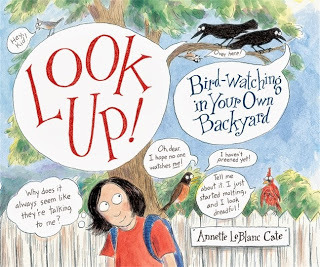 introduction to birding for young readers, approximately 8 to 12 years old. Beginning with the inside cover papers and fly leaves, the book is packed with information, facts, and trivia. Birding etiquette and advice is outlined with whimsical asides and comments ("Don't put yourself in harm's way, ever! It's only a bird. Really." Cate became interested in birding as part of doing nature sketches and encourages kids to also draw what they see outside. The focus on the book starts in your own backyard and places close to home. Even in pretty urban settings there are a lot of birds to watch!
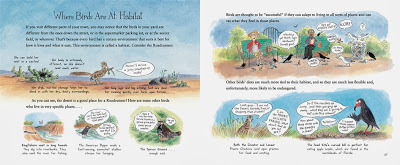 Chapters focus on color, shape, behavior, and details (field marks) that offer clues to identification. Even all those little brown birds have distinguishing characteristics! The cartoon-like illustrations and dialogue bubbles make the book fun and enjoyable as well as informative. A two-page map shows the geographic diversity of some of the more than 800 species that call North America home and the book ends with a good look at classification ("Classification Class!") and naming of birds. A bibliography suggests a number of guide books and websites to further help with identification of birds.
Sure, you can buy some fancy stuff for birding but in actuality you don't even need binoculars to start this hobby. But this book sets young birders on the right flight path.
(Note: I received a review copy of this book from the publisher, Candlewick Press.)
Amazon.com Widgets
Look Up!: Bird-watching in Your Own Backyard by Annette LeBlanc Cate provides a humorous
 introduction to birding for young readers, approximately 8 to 12 years old. Beginning with the inside cover papers and fly leaves, the book is packed with information, facts, and trivia. Birding etiquette and advice is outlined with whimsical asides and comments ("Don't put yourself in harm's way, ever! It's only a bird. Really." Cate became interested in birding as part of doing nature sketches and encourages kids to also draw what they see outside. The focus on the book starts in your own backyard and places close to home. Even in pretty urban settings there are a lot of birds to watch!
 Chapters focus on color, shape, behavior, and details (field marks) that offer clues to identification. Even all those little brown birds have distinguishing characteristics! The cartoon-like illustrations and dialogue bubbles make the book fun and enjoyable as well as informative. A two-page map shows the geographic diversity of some of the more than 800 species that call North America home and the book ends with a good look at classification ("Classification Class!") and naming of birds. A bibliography suggests a number of guide books and websites to further help with identification of birds.
Sure, you can buy some fancy stuff for birding but in actuality you don't even need binoculars to start this hobby. But this book sets young birders on the right flight path.
(Note: I received a review copy of this book from the publisher, Candlewick Press.)
Amazon.com Widgets
September 27, 2013
Birding and Business
Anyone who travels for work knows that it is not at all glamorous. You arrive, usually late at night, after a day of negotiating airports, rental car counters and shuttles, luggage carts, and hotel reservations. You eat something on the run and try to get a good night's sleep. Exhausted after working all day, you head back to the airport, rarely getting any time to see the city you are visiting.
Last week I traveled to Orlando and Central Florida. Whenever my travel arrangements are such that I have to add a day, I try to include something fun or touristy in the area. Concerned that a Sunday flight might arrive too late to allow me to drive 90 minutes north of Orlando and not be exhausted on Monday, I added a day to the trip. We've been to visit The Mouse, so I decided to schedule birding time instead of doing the usual things in Orlando.
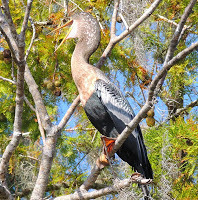 AnhingaArriving late on Saturday night, I got up early on Sunday and drove to DeLand, a small town off of Interstate 4. My destination was Blue Heron River Tours. Driving through the sub-tropical landscape along the winding river, I admit to thinking I heard echos of "Dueling Banjos" playing. After a while, and after dodging a suicidal Muscovy duck, I arrived at Hontoon's Landing. I was a little early and the captain told me he was expecting three more people so the tour would be a very small group. By 10:00 a.m. no one else had arrived so the tour was a private one. Kudos to the captain for not cancelling!
A lot of the birds were the same birds we see along the Texas coast and inland waters--herons, ibis, and such but I was able to see an Anhinga. We do have this bird, related to the cormorant in Texas but I'd so far not managed to actually see one. This one preened and posed very nicely for the camera! Some of the heron were similar but different, like this
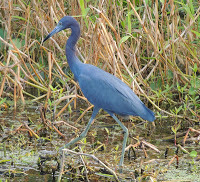 Little Blue Heron
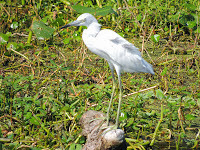 Immature Little BlueLittle Blue Heron who was so blue it was almost unreal. Young Little
Blues are white and frequently mistaken for young Snowy Egrets.
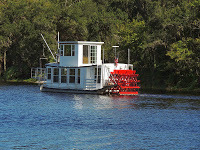
Meandering along the river, the boat actually made a big circle and we encountered an alligator basking on a tree trunk, as well as turtles and many other birds. Lazing down river was an old-style paddlewheeler. These old steamers were the only way to navigate the St. John's River in years bygone and they played an important role in the economic development of Florida.
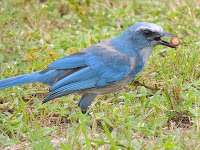 Florida Scrub Jay
 After the 2-hour cruise, I headed to Deltona and the Lyonia Preserve. This preserve is actually part of the Volusia County Regional Library where I was going to be speaking the next day. It's open on Sundays from 1:00-5:00 p.m. so the birding was not as good as I had hoped due to the later time and higher temperatures. Actually, after walking for about 30 minutes I had heard a few birds but not seen a single one! Disappointed, and sweaty, I was about to give up when this Florida Scrub Jay started dancing in front of me. I sat on a concrete wall next to the walkway and waited for this bird and a buddy to come back so I could get photos! Restricted to the rare oak scrub areas of Florida, this bird is the only Florida bird found only in Florida so it made the trip really worthwhile. One of their favorite foods is the acorn.
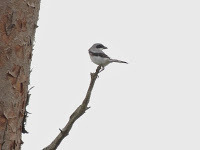 I sometimes take photos even when I'm not sure what the bird is or if the photo will even be viewable. The wonder of digital photography is that I can take 20 shots and it's okay if only one is good. Thankfully I decided to take a photo of a bird I could barely see in a tree. Turns out it is a Loggerhead Shrike. This amazing bird is small and hardly looks like a predator. Actually it is quite ruthless, hunting lizards, insects, mice, and other birds. It stabs its prey on its hooked beak and then impales the meal on thorns that hold the unfortunately creature while the shrike rips it apart. Nature is not always pretty!
There were many other birding areas in Central Florida but this was all I could fit in for one day. Thankfully, I had that day because shortly after I left the Lyonia Preserve monsoon rains started and continued through Monday. If I had not come in early, I would have missed so much beauty.
Last week I traveled to Orlando and Central Florida. Whenever my travel arrangements are such that I have to add a day, I try to include something fun or touristy in the area. Concerned that a Sunday flight might arrive too late to allow me to drive 90 minutes north of Orlando and not be exhausted on Monday, I added a day to the trip. We've been to visit The Mouse, so I decided to schedule birding time instead of doing the usual things in Orlando.
 AnhingaArriving late on Saturday night, I got up early on Sunday and drove to DeLand, a small town off of Interstate 4. My destination was Blue Heron River Tours. Driving through the sub-tropical landscape along the winding river, I admit to thinking I heard echos of "Dueling Banjos" playing. After a while, and after dodging a suicidal Muscovy duck, I arrived at Hontoon's Landing. I was a little early and the captain told me he was expecting three more people so the tour would be a very small group. By 10:00 a.m. no one else had arrived so the tour was a private one. Kudos to the captain for not cancelling!
A lot of the birds were the same birds we see along the Texas coast and inland waters--herons, ibis, and such but I was able to see an Anhinga. We do have this bird, related to the cormorant in Texas but I'd so far not managed to actually see one. This one preened and posed very nicely for the camera! Some of the heron were similar but different, like this
 Little Blue Heron
 Immature Little BlueLittle Blue Heron who was so blue it was almost unreal. Young Little
Blues are white and frequently mistaken for young Snowy Egrets.
Meandering along the river, the boat actually made a big circle and we encountered an alligator basking on a tree trunk, as well as turtles and many other birds. Lazing down river was an old-style paddlewheeler. These old steamers were the only way to navigate the St. John's River in years bygone and they played an important role in the economic development of Florida.
 Florida Scrub Jay
 After the 2-hour cruise, I headed to Deltona and the Lyonia Preserve. This preserve is actually part of the Volusia County Regional Library where I was going to be speaking the next day. It's open on Sundays from 1:00-5:00 p.m. so the birding was not as good as I had hoped due to the later time and higher temperatures. Actually, after walking for about 30 minutes I had heard a few birds but not seen a single one! Disappointed, and sweaty, I was about to give up when this Florida Scrub Jay started dancing in front of me. I sat on a concrete wall next to the walkway and waited for this bird and a buddy to come back so I could get photos! Restricted to the rare oak scrub areas of Florida, this bird is the only Florida bird found only in Florida so it made the trip really worthwhile. One of their favorite foods is the acorn.
 I sometimes take photos even when I'm not sure what the bird is or if the photo will even be viewable. The wonder of digital photography is that I can take 20 shots and it's okay if only one is good. Thankfully I decided to take a photo of a bird I could barely see in a tree. Turns out it is a Loggerhead Shrike. This amazing bird is small and hardly looks like a predator. Actually it is quite ruthless, hunting lizards, insects, mice, and other birds. It stabs its prey on its hooked beak and then impales the meal on thorns that hold the unfortunately creature while the shrike rips it apart. Nature is not always pretty!
There were many other birding areas in Central Florida but this was all I could fit in for one day. Thankfully, I had that day because shortly after I left the Lyonia Preserve monsoon rains started and continued through Monday. If I had not come in early, I would have missed so much beauty.
September 16, 2013
You Might Be a Birder If...
I've struggled about referring to myself as a "birder." And, by the way, there is a huge difference between being a birdwatcher and being a birder. Entire articles have been written about the differences and some true birders take exception to being called birdwatchers!
But you might be a birder if you get up at 5:00 a.m. to go on a birding field trip. I did that last Friday. Along with a busload of people with binoculars, scopes, cameras, and guide books, I headed out to Fennessey Ranch in Bayside, TX. The ranch offers 3,500 acres of land for birding. I had seen many photographs of the various birds and other critters on the ranch but this cool morning was not as productive. We saw some great birds but I was not able to get photographs of some of the best ones.
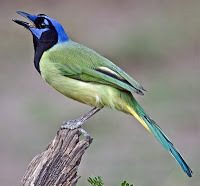 Green Jay (photo from Creative Commons)
 Black VultureThe most exciting bird we saw at Fennessey was the green jay. We saw several, or maybe it was the same bird flying back and forth. He rarely stopped long enough to focus a camera (photo from Wikipedia, licensed under Creative Commons). This was exciting because the green jay usually remains in the Mexico and South America, although it is starting to show up in Brownsville and the tip of Texas. More commonly we saw a lot of vultures, turkey vultures and black vultures. I actually kind of like vultures. They clean up dead things so disease doesn't spread. The black vultures is considered almost dapper compared to his companion, the turkey vulture, who is lanky and less elegant in flight. Both vultures were sitting on water tanks, poles, and towers around the ranch and about two dozen were circling over something that was dead or dying.
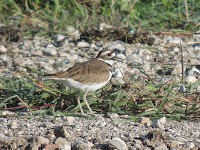 Killdeer
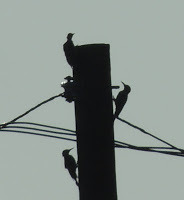 Golden-fronted WoodpeckersWe saw a number of golden-fronted woodpeckers. The light was all wrong so this is not the best photograph but take my word for it. This beautiful bird is found only in the brushland and open wooded areas of Texas and Oklahoma so it was a great catch for the trip. Less rare but still new for my photo collection was the killdeer. Killdeer are a shorebird, one of the most familiar, but they spend a lot of time away from the beach. If threatened while nesting they may feign a broken wing to lure predators away from the nests.
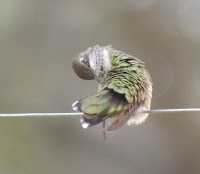 Ruby-throated HummingbirdYou might be a birder if you spend the day going from house to house looking at hummingbirds. During the Rockport HummerBird Festival people with great gardens and lots of feeders. Jim and I visited about eight homes plus a park and a hospice. The hummers were staying up north a little later so there were not the swarms but quality is more important than quantity. Many of the hummers were quite happy to pose and do acrobatics for the photographers. I got some ideas for more plantings to attract more birds at our house as well. But the best part of hopping around to hummer homes was the reports from other birders.
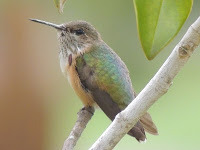 Calliope HummingbirdYou might be a birder if you drop everything to run out to a location where a calliope hummingbird was spotted. Why all the excitement for this little guy? (He is a male juvenile.) Calliopes are
rare in South Texas (and most of the US). They are the smallest bird north of Mexico and are generally only found in the mountains, preferring to be in areas above 11,000 feet, from El Paso west and north. This little guy liked to pose, and valiantly defended his magnolia tree, returning to the same spot over and over, making it pretty easy for photographers to get some good shots.
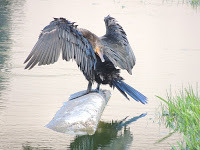 Double-crested CormorantYou might be a birder if you get excited and pull over and back up when you see birds on a golf course. In addition to the "normal" herons, ibis, roseate spoonbills, I was thrilled to see this double-crested cormorant "posing." Cormorants are a common sight in beach areas but I loved watching this one standing by the water feature, looking like he was conducting an orchestra. They pose because their wings don't have the waterproofing properties of most water birds. When the cormorant is out of the water it must dry its wings out. The double-crested is the most common cormorant in North America and the one mostly likely to be seen at freshwater spots.
Finally, you might be a birder if you plan to spend your birthday birding. The best present I could get today is finding a painted bunting.
But you might be a birder if you get up at 5:00 a.m. to go on a birding field trip. I did that last Friday. Along with a busload of people with binoculars, scopes, cameras, and guide books, I headed out to Fennessey Ranch in Bayside, TX. The ranch offers 3,500 acres of land for birding. I had seen many photographs of the various birds and other critters on the ranch but this cool morning was not as productive. We saw some great birds but I was not able to get photographs of some of the best ones.
 Green Jay (photo from Creative Commons)
 Black VultureThe most exciting bird we saw at Fennessey was the green jay. We saw several, or maybe it was the same bird flying back and forth. He rarely stopped long enough to focus a camera (photo from Wikipedia, licensed under Creative Commons). This was exciting because the green jay usually remains in the Mexico and South America, although it is starting to show up in Brownsville and the tip of Texas. More commonly we saw a lot of vultures, turkey vultures and black vultures. I actually kind of like vultures. They clean up dead things so disease doesn't spread. The black vultures is considered almost dapper compared to his companion, the turkey vulture, who is lanky and less elegant in flight. Both vultures were sitting on water tanks, poles, and towers around the ranch and about two dozen were circling over something that was dead or dying.
 Killdeer
.JPG) Golden-fronted WoodpeckersWe saw a number of golden-fronted woodpeckers. The light was all wrong so this is not the best photograph but take my word for it. This beautiful bird is found only in the brushland and open wooded areas of Texas and Oklahoma so it was a great catch for the trip. Less rare but still new for my photo collection was the killdeer. Killdeer are a shorebird, one of the most familiar, but they spend a lot of time away from the beach. If threatened while nesting they may feign a broken wing to lure predators away from the nests.
Golden-fronted WoodpeckersWe saw a number of golden-fronted woodpeckers. The light was all wrong so this is not the best photograph but take my word for it. This beautiful bird is found only in the brushland and open wooded areas of Texas and Oklahoma so it was a great catch for the trip. Less rare but still new for my photo collection was the killdeer. Killdeer are a shorebird, one of the most familiar, but they spend a lot of time away from the beach. If threatened while nesting they may feign a broken wing to lure predators away from the nests. Ruby-throated HummingbirdYou might be a birder if you spend the day going from house to house looking at hummingbirds. During the Rockport HummerBird Festival people with great gardens and lots of feeders. Jim and I visited about eight homes plus a park and a hospice. The hummers were staying up north a little later so there were not the swarms but quality is more important than quantity. Many of the hummers were quite happy to pose and do acrobatics for the photographers. I got some ideas for more plantings to attract more birds at our house as well. But the best part of hopping around to hummer homes was the reports from other birders.
 Calliope HummingbirdYou might be a birder if you drop everything to run out to a location where a calliope hummingbird was spotted. Why all the excitement for this little guy? (He is a male juvenile.) Calliopes are
 rare in South Texas (and most of the US). They are the smallest bird north of Mexico and are generally only found in the mountains, preferring to be in areas above 11,000 feet, from El Paso west and north. This little guy liked to pose, and valiantly defended his magnolia tree, returning to the same spot over and over, making it pretty easy for photographers to get some good shots.
 Double-crested CormorantYou might be a birder if you get excited and pull over and back up when you see birds on a golf course. In addition to the "normal" herons, ibis, roseate spoonbills, I was thrilled to see this double-crested cormorant "posing." Cormorants are a common sight in beach areas but I loved watching this one standing by the water feature, looking like he was conducting an orchestra. They pose because their wings don't have the waterproofing properties of most water birds. When the cormorant is out of the water it must dry its wings out. The double-crested is the most common cormorant in North America and the one mostly likely to be seen at freshwater spots.
Finally, you might be a birder if you plan to spend your birthday birding. The best present I could get today is finding a painted bunting.