Jeanette Larson's Blog, page 8
February 16, 2014
Nightingale's Nest
Magical realism is a genre where there are elements of magic in an otherwise "normal" world. I am not generally a reader of magical realism or other types of fantasy fiction but 1) I loved Nikki Loftin's first book, The Sinister Sweetness of Splendid Academy and 2) Nightingale's Nest is loosely about birds.
 Nightingale's Nest combines magic into an more traditional tween problem novel. 12-year-old Little John is helping out with his family's financial crisis by working with his father trimming trees and doing gardening work for the owner of The Emperor's Emporium, a chain of dollar-type stores. His sister died when she fell out of a tree and his mother is totally engulfed by grief, while Little John feels somewhat to blame for encouraging her to follow his lead and jump out of the tree. Family in dire straits, about to be evicted from their home, suffering loss....pretty typical problem novel.
While working with his dad, Little John hears an enchantingly beautiful voice singing. Here comes the magic...sitting in a tree, Gayle acts and talks as if she were a bird. Is she? It sure seems that way. The two kids quickly become friends and Little John tries to protect Gayle from the horrid foster family where she is living until her parents can find her. Where are her parents? They flew away after telling her that if they were ever separated Gayle should build a nest in the tree near "the Emperor's" property and wait for them to find her. The Emperor hears Gayle's singing and enlists Little John's help in getting her to allow him to record her song by offering him a lot of money. More magic. Her song has healing powers but when she is forced to sing, she loses her voice. So Little John is forced to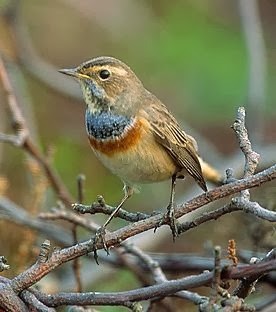 Nightingale
(Photo used under Creative Commons license)choose between betraying his friend or getting the money to save his family.
The story is loosely related to Hans Christian Andersen's "The Nightingale" but not enough to really be a modern retelling of that fairy tale. It is its own story, steeped with information about birds. Little John is interested in birds and his bedtime reading is often one of his Audubon books. Many birds are mentioned, including mockingbirds, finches, crows, and more. While readers won't find a lot of factual information, Loftin's lyrical writing often evokes images of these and other birds singing, tweeting, and flying, providing a sense of the wonder and beauty of our avian friends. And of course, the title bird, the nightingale, is not naturally found in Texas or the US. But heck, this is fiction and that is part of the magic.
For readers ages 8 and up, including adults who enjoy a good story. Readers in the Austin area might also like to attend Nikki's book launch party Saturday, February 22, 2014 at Book People.
Amazon.com Widgets (I received an advance reader copy of the book from the author, who is a friend and colleague.)
 Nightingale's Nest combines magic into an more traditional tween problem novel. 12-year-old Little John is helping out with his family's financial crisis by working with his father trimming trees and doing gardening work for the owner of The Emperor's Emporium, a chain of dollar-type stores. His sister died when she fell out of a tree and his mother is totally engulfed by grief, while Little John feels somewhat to blame for encouraging her to follow his lead and jump out of the tree. Family in dire straits, about to be evicted from their home, suffering loss....pretty typical problem novel.
 While working with his dad, Little John hears an enchantingly beautiful voice singing. Here comes the magic...sitting in a tree, Gayle acts and talks as if she were a bird. Is she? It sure seems that way. The two kids quickly become friends and Little John tries to protect Gayle from the horrid foster family where she is living until her parents can find her. Where are her parents? They flew away after telling her that if they were ever separated Gayle should build a nest in the tree near "the Emperor's" property and wait for them to find her. The Emperor hears Gayle's singing and enlists Little John's help in getting her to allow him to record her song by offering him a lot of money. More magic. Her song has healing powers but when she is forced to sing, she loses her voice. So Little John is forced to
 Nightingale
(Photo used under Creative Commons license)choose between betraying his friend or getting the money to save his family.
The story is loosely related to Hans Christian Andersen's "The Nightingale" but not enough to really be a modern retelling of that fairy tale. It is its own story, steeped with information about birds. Little John is interested in birds and his bedtime reading is often one of his Audubon books. Many birds are mentioned, including mockingbirds, finches, crows, and more. While readers won't find a lot of factual information, Loftin's lyrical writing often evokes images of these and other birds singing, tweeting, and flying, providing a sense of the wonder and beauty of our avian friends. And of course, the title bird, the nightingale, is not naturally found in Texas or the US. But heck, this is fiction and that is part of the magic.
For readers ages 8 and up, including adults who enjoy a good story. Readers in the Austin area might also like to attend Nikki's book launch party Saturday, February 22, 2014 at Book People.
Amazon.com Widgets (I received an advance reader copy of the book from the author, who is a friend and colleague.)


February 8, 2014
Festive Occasions
 Calliope Hummingbird, Rockport, TXFestivals are fun and they offer opportunities for birders to add to their life lists with the help of others who know more about birding. The festivals usually include presentations by specialists and amateurs, along with workshops and walks. Often they include exhibits or vendors, allowing us to add to our collection of whatever bird we collect, try out binoculars and scopes, or discover new types of feeders. Some festivals like the HummerBird Celebration in Rockport, which got me started on my birding adventures, include both backyard birding and "in the wild" field trips. Without festivals I would never have known about the Calliope Hummingbird that decided to come to town. Nor would I have been able
  Banding a Ruby-throat Hummingbirdto see a bander up close, allowing for this rare shot of a hummingbird hiney.
As I wind down some projects and ease a little more into "retirement," I hope to get to more festivals. To that end, I've started a list of birding festivals in the United States. It's one of the tabs at the top of the blog. I'll be adding to the list as time permits and as I find information, but feel free to share any festivals you know about. Maybe we'll spot some Green Jays or a Burrowing Owl together!
January 19, 2014
Inside a Bald Eagle's Nest
 © 2014 Schiffer Publishing, Ltd. Thank goodness the founding fathers went with the beautiful bald eagle as the symbol of our nation rather than the much less photogenic turkey! The bald eagle is truly an awe-inspiring bird but one that many of us never get to see in real life. It is only through hard work by conservationists and citizens who were determined not to allow this majestic bird to go the way of the Dodo that the bald eagle survives to nest in our nation's capital and other areas. By about 1960 eagles were rare and nearly extinct, victims of DDT, habitat changes, and hunting. Indeed I recall as a child wondering if I would ever get to see a bald eagle outside of a zoo. Legislation banned DDT and protected the remaining eagles who, miraculously, are making a huge comeback in many areas of the country, including urban and suburban areas.
Inside a Bald Eagle's Nest: A Photographic Journey Through the American Bald Eagle Nesting Season by Teena Ruark Gorrow and Craig A. Koppie is a gorgeous coffee table type of book that takes readers on a
 © 2014 Schiffer Publishing, Ltd. photographic journey through one full nesting season in suburban Washington D.C. The photographs, most taken by Koppie or Gorrow, are often amazing and even startling. As a budding photographer I can only hope that one day I have the opportunity to take a photograph half as good as these. It's hard to pick out a favorite but rarely will you get to see such an up-close shot of eaglets without being ripped to shreds by protective eagle parents!
  © 2014 Schiffer Publishing, Ltd.While it is tempting to focus entirely on the photography, that would be unfair to the book. The text is filled with interesting facts and information about the eagles. Beginning with nest preparation, we learn about mating and egg laying and nest building. We also watch as the eggs incubate (the male will sit on the eggs for brief periods of time to give the female a break) and hatch, marveling as the eaglets start to learn about life outside the nest. We also learn about current threats to the eagle. For example, wires from utility lines and towers threaten the birds and wind farms have caused the death of 68 eagles since 2008. But even with these dangers, life goes on. One of the last photographs is of two proud-looking parents surveying the area as their family moves on, hopefully to return the next year for another cycle of nesting.
 Last Chance Forever conservationist
 with young Bald EagleThanks to conservation efforts it is now possible to see bald eagles in every one of the lower 48 states, as well as Alaska. (When Jim and I visited Alaska many years ago the best place to see the eagles was at the town dump!). Closer to home for us, we've visited the eagles near Burnet and at Lake Buchanan. (Last Chance Forever brought out a young male that is being rehabilitated for release so we were able to get a very close view.) Maybe next year we'll got to Emory, TX (billed as the Eagle Capital of Texas) for the 19th Annual Eagle Festival. To find eagles near where you live or are visiting, check out the Bald Eagle Viewing Directory.
And it if you can't get a personal eagle fix, check out the webcams listed in Inside a Bald Eagle's Nest that offer readers the opportunity to view live and recorded footage from several sites. My favorite is probably the National Geographic camera that features highlights from the birds we met in the book.
Amazon.com Widgets
January 13, 2014
What's a Three-Letter Word for Bird Watcher?
Let me start by saying I should have written this article last month....December 2013 was the 100th anniversary of the crossword puzzle. I love doing crossword puzzles. For an indoor activity, nothing gives me more pleasure than being able to complete an entire puzzle without resorting to using the crossword dictionary. (My favorite is the New Comprehensive A-Z Crossword Dictionary but it hasn't been updated in 10 years so when my copy fell apart I bought The Million Word Crossword Dictionary. It's as good but the size of a small house.)
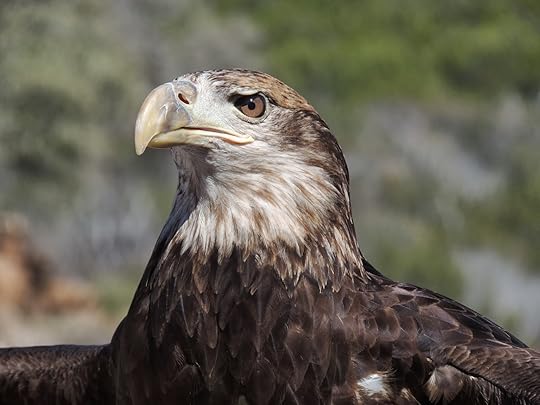 Young Bald Eagle
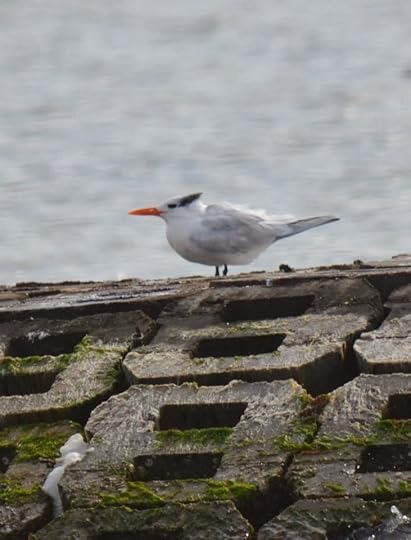 Royal Tern
So what does this have to do with birding? As I've become more obsessed with adding birds to my life list, I've started noticing birds in crossword puzzle clues. Some are obvious and almost expected. A "coastal flyer" is almost always either erne or tern. I know what a tern is but don't think I've ever seen an erne. Turns out that another clue provides more information about the erne--it's a (4-letter word for) sea-eagle (or as a 3-letter word, ern). The word is not used very frequently and doesn't show up in The Sibley Guide to Birds (Note: the 2nd edition is coming out in March!), which probably explains why most of us have never heard the word used in real life. ( "Did you notice the magnificent erne in the nest out on the highway past Burnet?") Oh, an interesting bit of trivia...a group of Steller's Sea-Eagles are collectively known as a "constellation." Wait, a minute. Sea-eagles are any of the eight large fish-eating eagles so I have seen the Bald Eagle, meaning I have seen an erne.
Some birds can only be found in the puzzles. Big extinct bird (3 letters) is Moa, a flightless bird from New Zealand. Hunted to extinction by early Polynesian people, the bird was, apparently, very slow to mature. The Dodo, or feathered has-been (4 letters), was not really stupid and was considered so mainly because it was friendly, having no enemies on the island of Mauritius until pigs and dogs were brought there in 1851.
Other birds to look for in crossword puzzles? These are just a few. Feel free to add more in the comments when you spot them in a puzzle.
Wading bird (egret, heron)Bright bird (tanager)Flightless bird (emu, dodo)Game bird (grouse, pheasant, quail)Bird of prey (falcon, kite, vulture)Insect-eating bird (vireo, gnatcatcher)Bird of peace (dove)Aquatic bird (coot, grebe, cormorant)Downy duck (eider)Red breasted thrush (robin)Talking bird (mynah and variants myna and minah; parrot)Nocturnal bird (owl)
So, my question is: Does spotting birds in crossword clues count as birding? Maybe I could do a Big Year in crossword puzzles! How many species might I find? Time to pick up my pencil and go birding. Oh, and what is a three-letter word for bird watcher? Try cat.
Amazon.com Widgets
 Young Bald Eagle
 Royal Tern
So what does this have to do with birding? As I've become more obsessed with adding birds to my life list, I've started noticing birds in crossword puzzle clues. Some are obvious and almost expected. A "coastal flyer" is almost always either erne or tern. I know what a tern is but don't think I've ever seen an erne. Turns out that another clue provides more information about the erne--it's a (4-letter word for) sea-eagle (or as a 3-letter word, ern). The word is not used very frequently and doesn't show up in The Sibley Guide to Birds (Note: the 2nd edition is coming out in March!), which probably explains why most of us have never heard the word used in real life. ( "Did you notice the magnificent erne in the nest out on the highway past Burnet?") Oh, an interesting bit of trivia...a group of Steller's Sea-Eagles are collectively known as a "constellation." Wait, a minute. Sea-eagles are any of the eight large fish-eating eagles so I have seen the Bald Eagle, meaning I have seen an erne.
Some birds can only be found in the puzzles. Big extinct bird (3 letters) is Moa, a flightless bird from New Zealand. Hunted to extinction by early Polynesian people, the bird was, apparently, very slow to mature. The Dodo, or feathered has-been (4 letters), was not really stupid and was considered so mainly because it was friendly, having no enemies on the island of Mauritius until pigs and dogs were brought there in 1851.
Other birds to look for in crossword puzzles? These are just a few. Feel free to add more in the comments when you spot them in a puzzle.
Wading bird (egret, heron)Bright bird (tanager)Flightless bird (emu, dodo)Game bird (grouse, pheasant, quail)Bird of prey (falcon, kite, vulture)Insect-eating bird (vireo, gnatcatcher)Bird of peace (dove)Aquatic bird (coot, grebe, cormorant)Downy duck (eider)Red breasted thrush (robin)Talking bird (mynah and variants myna and minah; parrot)Nocturnal bird (owl)
So, my question is: Does spotting birds in crossword clues count as birding? Maybe I could do a Big Year in crossword puzzles! How many species might I find? Time to pick up my pencil and go birding. Oh, and what is a three-letter word for bird watcher? Try cat.
Amazon.com Widgets
December 31, 2013
A Big Year
 Since I started birding, Jim keeps asking me if I plan to do a Big Year. Like every hobby, sport, or avocation birding has its own vocabulary and competitions. For birders the ultimate extreme sport is a Big Year. Casual birders and non-birders may have never heard this term, or even considered that birding could be a competitive sport--but it is.
During a Big Year, birders compete to see who can spot the most species of birds in North America during a yearlong quest that starts on January 1. The concept started in the 1930s and, while there are a few rules, the only referee is the ABA checklist (although there are often arguments among birders). Birders compete using the honor system and, according to some sources, can spend around $10,000 a month getting to birding locations to add species to their lists. This is different from life lists, the very noncompetitive activity where birders keep track of species they encounter over a lifetime.
With only 675 or so indigenous species of birds in North America, beating the record requires chasing rarities and vagrants--birds that show up where they don't belong or normally wouldn't be found. In the movie The Big Year, which stars Steve Martin, Owen Wilson, and Jack Black (and first brought the concept of extreme birding to a wider audience), it was said that winning was possible primarily because of a strong El Niño weather pattern that pushed birds off course from Asia, Europe, and South America. However it gets here, once the bird is in North America, it counts!
Because of the weather pattern, and the fierce competition of 1998, some birders thought Sandy Komito's record of 745 species would be impossible to break, but don't tell that the the 2013 competitors. Birds have to be listed on the American Birding Association's checklist of 976 accepted birds (Sandy Komito claims his record is 748 because he also recorded 3 birds that were not, at the time, on the ABA checklist but now are). The list includes species that breed in North America, regularly visit here, stray here from other regions, and introduced species that are now part of the avifauna of North America. In the ever-changing world of birds, some species have been split and a couple of species have been added to the North American lists. 2013 competitor Neil Hayward recorded 746 birds plus 3 provisional birds as of December 29. He's waiting for a definitive ruling on his Big Year but regardless of how the ABA counts, it sounds to me like he broke a 15 year record! This is a big deal in the birding world.
 Amazon Kingfisher
 (Photo used under Creative Commons license.)Not having the money, time, or "fire in the belly" to do a Big Year, I do still admit to feeling the lure of an exotic species that has shown up when I see posts on the Rare Bird Alert sites (see below). Could I rush down to the Rio Grande Valley to see the Amazon Kingfisher reported to be hanging out at a rest stop? It would only be a four hour drive each way. Gas up the car, Jim!
Then again, it's probably easier (and less expensive) to experience a Big Year vicariously by reading (or viewing) about other people's experiences. In addition to the film, a few good books include:
The Big Year stars Owen Wilson as the all-time Big Year champ who sets out to beat his own record. A retired CEO (Steve Martin) and a "everyman" techie-type (Jack Black) are just as determined to kick him out of the nest. The movie is based on The Big Year: A Tale of Man, Nature, and Fowl Obsession by Mark Obmascik.Wild America: The Record of a 30,000 Mile Journey Around the Continent by a Distinguished Naturalist and His British Colleague by Roger Tory Peterson is not, per se, a Big Year story but it may have started the challenge. During a 100-day tour of America's wildlife refugees in 1953, Peterson and a friend observed 572 species. Three years later an Englishman broke that record following the same route and the competition began. Kingbird Highway; The Story of a Natural Obsession That Got a Little Out of Hand is Kenn Kaufamn's story of his Big Year. In 1973, at the age of 19, he headed out hitchhiking around the country to try and break a birding record that had stood for 15 years.
 Two Grackles at Central Park, AustinLynn E. Barber did a big year totally in the state of Texas and was able to count 522 bird species. In Extreme Birder: One Woman's Big Year she tells the story of doing the full Big Year and finding 723 species. A Big Year starts on January 1 and birders generally try to start the year with an exotic or hard to find bird so that you are off to a good start. No one wants to start their Big Year with a grackle. Me? I'm off to see Whooping Cranes and Sandhill Cranes to start my Big New Year. Happy New Year to all!
Note: Rare birds are reported on www.narba.orgwww.narba.org. A sub-site tracks rare birds in Texas http://www.narba.org/default.aspx/MenuItemID/105/MenuGroup/Home.htm.
Amazon.com Widgets
December 21, 2013
Whoop it Up!
 Recently Jim and I splurged and chartered a boat to go out to see Whooping Cranes. I admit that although we have lived in Texas for almost 35 years and have been visiting the Gulf Coast for almost that long, I only discovered this Texas treasure a year or so ago. Wow! What an experience to see these magnificent
creatures.
 Whooper and egret
Photo by Kevin SimsNearly five feet tall, the whooping crane is the tallest bird in North America. Their wings span 7.5 feet across. (The photo by Capt. Kevin Sims shows a whooping crane with a great egret for size comparison.) They are white with reddish-rust patches on the top and back of their heads. Black areas on their primary feathers are visible only in flight. But the most amazing thing about them--well, one of the most amazing things--is the migration. These magnificent birds spend the summers in northern Canada and migrate 2,500 miles to Aransas National Wildlife Refuge near Rockport, TX for the winter. This is the only wild, self-sustaining migratory population of whooping cranes in the world! (There are occasional "vagrants" that show up elsewhere along the Texas coast. One was reported in Brazoria NWR in mid-November and caused quite a stir while he played with the sandhill cranes in the area for a few weeks before moving on.) They migrate during the day, stopping at night, so they may also be seen briefly along the migration route.
 Photo by Jim LarsonBy the 1940s the population of whooping cranes had decreased almost to extinction. There were only 15 cranes left when conservationists stepped in to try and save the cranes. A massive effort between the US and Canadian agencies led to captive breeding programs, that, with protection and conservation, have increased the population to about 600, half wild and half captive, in a couple of different locations. All of the whooping cranes alive today are the descendants of the 15 cranes that were found in the Aransas refuge in 1941. From those 15, there are currently two migrating population--the one in Texas and another in Wisconsin--and two small non-migratory populations in Florida and Louisiana. These birds are highly monitored, and in fact we saw the monitoring plane flying over Aransas National Wildlife Refuge counting cranes during our visit.
The cranes mate for life. Since the female lays 1-3 eggs and generally one chick survives, growth in the population is slow. The juveniles have a cappuccino color to them for about the first year; by the time they
 Family of whoopershead back to Canada, the juveniles are all white. The family unit stays together and requires about one square mile of territory for feeding. They are tolerant of other birds, including herons and egrets, but will fiercely fend off other whoopers. We watched a fight when a pair of whooping cranes got too close to another family unit. They are big and noisy! They survive 25 years in the wild and about ten years longer in captivity.
Visit the Aransas National Wildlife Refuge--from some of the observation areas you can see the whoopers in the distance. Or better yet, take one of the boat trips to get closer. The Jack Flash, owned by Kevin Sims, is smaller and can go right up to the edge of the refuge (we were close enough to hear the calls they make--hear a sample at Cornell's site) but you book the entire boat for up to 6 passengers. The Skimmer, out of Fulton Harbor, is a larger boat but you buy just the seats you need. We took this boat in 2012 towards the end of the whooping bird season so only saw a few. Thanks to all of the conservation efforts, we have the luxury of watching the cranes year after year and I'm looking forward to seeing them again on our next trip to Rockport.
December 6, 2013
Books Take Flight: Gift Ideas
Librarians are fond of saying that books help readers fly to new heights and explore new worlds. And I believe that is true. Books can help readers discover new worlds and new interests. They also make great holiday gifts. While books may not always garner the oohs and aahs of the latest Playstation, they last a lot longer. So consider some of these bird books for those on your holiday lists. Bird Brainz will love 'em!
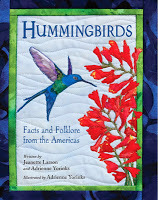
Ok, I'll start with blatant self-promotion. Hummingbirds: Facts and Folklore from the Americas has sold well as a gift not only for young people but for adults who enjoy discovering the cultural background to some of the hummer information. Folktales from cultures across the Americas are retold along side facts that relate to the stories.

Another favorite of mine is Birds of a Feather by Jane Yolen. Actually Yolen has several books about birds but this one stands out. Combined with a beautiful photograph by Yolen's son, each poem is followed by a few facts about each bird.

Although there is little or no factual material in Mr. Popper's Penguins, I can trace my fascination with penguins back to reading this classic book. This book is a chapter book for elementary aged readers, although it is also a good family read-aloud. Pair it with One Cool Friend, a picture book by Toni Buzzeo about a child who is drawn to the Magellanic penguins he sees at the aquarium.
Budding birdwatchers will appreciate Look Up!: Bird-Watching in Your Own Backyard, which I reviewed earlier this year. Pair the book with a beginner field guide like Backyard Birds (Field Guides for Young Naturalists) and your young birder will be good to go.

And just for fun, if your young reader loves the game Angry Birds, check out National Geographic Angry Birds: 50 True Stories of the Fed Up, Feathered, and Furious. The book is a hilarious look at real birds who are annoyed, testy, outraged, or furious! Mixed in with funny comments related to the game are photos and facts about real birds and the behaviors that classify them as angry.
These are just a few of my recent favorites and I have mentioned other books in this blog. I hope you will add your favorite bird books for kids in the comments. The birds--and readers--are depending on you.
Amazon.com Widgets

Ok, I'll start with blatant self-promotion. Hummingbirds: Facts and Folklore from the Americas
has sold well as a gift not only for young people but for adults who enjoy discovering the cultural background to some of the hummer information. Folktales from cultures across the Americas are retold along side facts that relate to the stories. 
Another favorite of mine is Birds of a Feather by Jane Yolen. Actually Yolen has several books about birds but this one stands out. Combined with a beautiful photograph by Yolen's son, each poem is followed by a few facts about each bird.

Although there is little or no factual material in Mr. Popper's Penguins, I can trace my fascination with penguins back to reading this classic book. This book is a chapter book for elementary aged readers, although it is also a good family read-aloud. Pair it with One Cool Friend, a picture book by Toni Buzzeo about a child who is drawn to the Magellanic penguins he sees at the aquarium.
Budding birdwatchers will appreciate Look Up!: Bird-Watching in Your Own Backyard, which I reviewed earlier this year. Pair the book with a beginner field guide like Backyard Birds (Field Guides for Young Naturalists) and your young birder will be good to go.

And just for fun, if your young reader loves the game Angry Birds, check out National Geographic Angry Birds: 50 True Stories of the Fed Up, Feathered, and Furious. The book is a hilarious look at real birds who are annoyed, testy, outraged, or furious! Mixed in with funny comments related to the game are photos and facts about real birds and the behaviors that classify them as angry.
These are just a few of my recent favorites and I have mentioned other books in this blog. I hope you will add your favorite bird books for kids in the comments. The birds--and readers--are depending on you.
Amazon.com Widgets
November 27, 2013
Parrots Over Puerto Rico
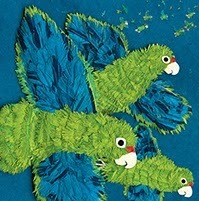 (Copyright Susan L. Roth)As birds go, parrots seem to have a very special connection with humans. We are charmed by their colors, intelligence, and voices. The broad order that includes parrots contains over 350 birds but I suspect most of us think about parrots as pets more than wild birds because they have shared our lives and been popular companion animals for centuries. Some imitate human speech and a few, like the African Gray Parrot (see the October 22, 2013 post about Alex), are so good at mimicry that they seem almost human. In the wild some birds live up to 80 years! But some wild parrots are endangered and although it is illegal to sell wild-caught parrots, the popularity of the birds continues to drive illegal trade that further decimates some populations. For example, there are fewer than 500 Blue-throated macaws, while there are less than 50 mature orange-bellied parrots in Australia. Fortunately some efforts to save parrots, like the kakapo, the world’s heaviest parrot and one that is also flightless, are working.
Parrots Over Puerto Rico by Susan L. Roth and Cindy Trumbore tells the story of the fight to save another breed of parrot. Their story is about the birds that have lived on the island of Puerto Rico for millions of years, but it is also a history of Puerto Rico and the impact that population growth has had on the birds. Also called Iquaca, the Puerto Rican parrot is the only bird unique to Puerto Rico. (Iquaca is the onomatopoeic name that mimics their flight call.)
Before the island was settled, it is estimated that hundreds of thousands of Puerto Rican parrots lived in the area. As soon as people arrived on the island, beginning with the Tainos around 800 CE, the parrots were hunted for food, to keep as pets, or to use the feathers for decoration. As sailors landed ships at the island, black rats began to take over the nesting holes and ate the parrot eggs. Since each pair of parrots usually mates for life and produced only one nest of chicks a year this took a serious toll on the parrots. By 1937 there were only about 2,000 parrots in the mountains of Puerto Rico and in 1954 only 200 parrots were left. By 1967 only twenty-four parrots remained. Unless something happened quickly the Puerto Rican parrot would be extinct.
 Puerto Rican Parrot
( USFWS Photo; licensed by Creative Commons)
This is becoming an all-too familiar story. Hunting, environment and other factors decimating a population. Sometimes scientists and concerned individuals are able to step in and help before it's too late. Fortunately this is one of those stories with hope for a happy ending.
Concerned scientists started to raise chicks raised in captivity using Hispaniolan parrots, their less rare cousins, to nurture the babies. By 1979 the first aviary-raised chick was released back into the wild. By 1999, one of the two aviaries had 54 parrots. Ten captive-bred parrots were released in 2000. People taught the birds to hide from hawks and avoid becoming prey. Dozens more birds were raised and released. Perhaps these birds will not disappear after all. An Afterword details more about the Parrot Recovery Program with photographs of the birds and the aviary staff and a look at how the history of Puerto Rico is intertwined with the history of the birds.
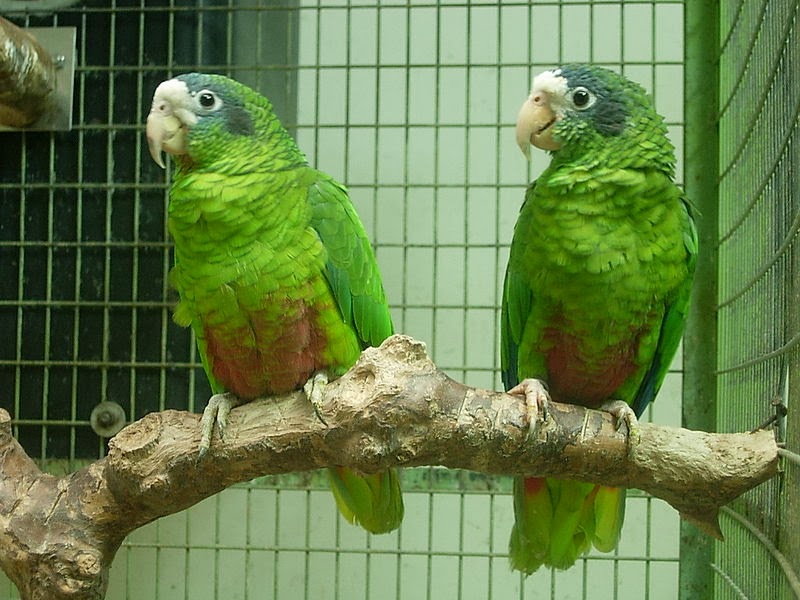 Hispanolian Parrots
(Licensed by Creative Commons)
The picture book is arranged vertically, rather than horizontally, allowing a spectacular view that runs from the ground level, high up into the tree tops. The story is beautifully illustrated in collage by Susan L. Roth. I had the opportunity in April 2013 to watch Susan work her magic. By only ripping or cutting pieces of paper, including take-away menus, into shapes, Susan forms pictures that are then positioned and held with tape and glue. She takes pride in the fact that no other media are used--no pens, pencils, paints. The book offers a great story for bird-loving young readers and will inspire them learn more about endangered birds and maybe try their hand at collage art.
A copy of the book was provided by the publisher, Lee and Low Books.
Amazon.com Widgets
November 17, 2013
May I See Your I.D.?
As an undergraduate student in anthropology, many years ago, I signed up for a primatology class. I love non-human primates and thought the class would be a blast. Then I discovered that not only were we expected to sit for hours studying the gorillas and chimps at the Albuquerque Zoo, but we had to be able to identify more than 100 different non-human primates from pictures. Not only did that sound like too much work for a last semester senior who didn't need the elective, the catch was that some were so similar looking that the only real difference was chemical. So I dropped the course faster than a monkey eating a banana.
Fast forward about 40 years and I'm facing the same issues with birds. Not only are there hundreds of "little brown birds" (LBB), but it can be nearly impossible to identify the specific species. Case in point. I was
 recently thrilled to find a little bird at Cape Valero in Rockport. Well, really I think Jim spotted the bird. It looked like "just another" LBB until I got out the binoculars. Then I started to see some yellow. I snapped a couple of photos, trying to get different angles. And then I set out to figure out what bird I'd seen. Was it a new one to add to my life list?
I posted the best of the photos to two of my Facebook birding groups, not only to share the photo and record the sighting, but also hoping someone would say, "What an amazing shot of _________________." Only no one did. They said "amazing shot" and "nice capture" but no one mentioned the type of bird.
So, pull out the field guides. I noted the small size and the short tail. I noted the field marks like yellow-orange throat and supraloral (the area between the eye and the beak). I noted the striped feathers on the flanks and belly. And of course the brownish eye stripe should help. Another shot of the bird showed me a white crown stripe. Of course I also took into consideration the area (South Texas) and the terrain (scrubby trees and grass near water). Based on the size, I started looking at wrens and sparrows. .
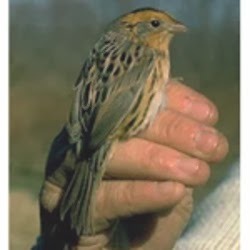 Le Conte's Sparrow (USGS photo)Ah, ah....it's a Le Conte's Sparrow! One of the most easily identifiable birds, according to Audubon. But wait, the beak is wrong. Sparrows have conical beaks while the bird I saw has a longer dagger-like beak. So I'm pretty sure this is not a Le Conte or any other sparrow. Back to the guide books.
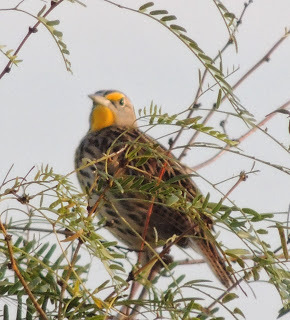 Eastern MeadowlarkWarbler's have stripes. But it's not a Pine Warbler (long-tailed). Maybe a Cactus Wren? Nope. They have rounded tails and don't have yellow. Consulting my Sibley Guide to Birds left me seeing so many different birds that I threw up my hands in despair.
Distraught, I posted the photo to Cornell Lab of Ornithology's Facebook page and begged for help. What did the experts conclude? Eastern Meadowlark. Immature.
Trying to learn, I looked at images of the Eastern Meadowlark. Field marks include a black patch or V on the breast, which if it appears on my bird is very very faint and streaked (indicating a juvenile bird). The illustrations in Sibley's are more similar to my bird than I see in the photographs on websites like WhatBird.com, where the birds look brighter and more yellow. To add further to the debate, given the region of Texas where this bird was seen, it could be a Western Meadlowlark. The only discernible difference is their song. The Eastern Meadowlark trills, "see-you-see-yer" while the Western croons "shee-oo-e-lee shee-ee-le-ee." Got it? Me neither. This isn't much better than chemical differences between monkeys!
I don't know how some birders can identify "on the fly." I'm not giving up but I have to have a photograph and even then it really would be a lot easier if the birds wore identification cards!
Amazon.com Widgets
Fast forward about 40 years and I'm facing the same issues with birds. Not only are there hundreds of "little brown birds" (LBB), but it can be nearly impossible to identify the specific species. Case in point. I was
.JPG) recently thrilled to find a little bird at Cape Valero in Rockport. Well, really I think Jim spotted the bird. It looked like "just another" LBB until I got out the binoculars. Then I started to see some yellow. I snapped a couple of photos, trying to get different angles. And then I set out to figure out what bird I'd seen. Was it a new one to add to my life list?
recently thrilled to find a little bird at Cape Valero in Rockport. Well, really I think Jim spotted the bird. It looked like "just another" LBB until I got out the binoculars. Then I started to see some yellow. I snapped a couple of photos, trying to get different angles. And then I set out to figure out what bird I'd seen. Was it a new one to add to my life list?I posted the best of the photos to two of my Facebook birding groups, not only to share the photo and record the sighting, but also hoping someone would say, "What an amazing shot of _________________." Only no one did. They said "amazing shot" and "nice capture" but no one mentioned the type of bird.
So, pull out the field guides. I noted the small size and the short tail. I noted the field marks like yellow-orange throat and supraloral (the area between the eye and the beak). I noted the striped feathers on the flanks and belly. And of course the brownish eye stripe should help. Another shot of the bird showed me a white crown stripe. Of course I also took into consideration the area (South Texas) and the terrain (scrubby trees and grass near water). Based on the size, I started looking at wrens and sparrows. .
 Le Conte's Sparrow (USGS photo)Ah, ah....it's a Le Conte's Sparrow! One of the most easily identifiable birds, according to Audubon. But wait, the beak is wrong. Sparrows have conical beaks while the bird I saw has a longer dagger-like beak. So I'm pretty sure this is not a Le Conte or any other sparrow. Back to the guide books.
.JPG) Eastern MeadowlarkWarbler's have stripes. But it's not a Pine Warbler (long-tailed). Maybe a Cactus Wren? Nope. They have rounded tails and don't have yellow. Consulting my Sibley Guide to Birds left me seeing so many different birds that I threw up my hands in despair.
Eastern MeadowlarkWarbler's have stripes. But it's not a Pine Warbler (long-tailed). Maybe a Cactus Wren? Nope. They have rounded tails and don't have yellow. Consulting my Sibley Guide to Birds left me seeing so many different birds that I threw up my hands in despair.Distraught, I posted the photo to Cornell Lab of Ornithology's Facebook page and begged for help. What did the experts conclude? Eastern Meadowlark. Immature.
Trying to learn, I looked at images of the Eastern Meadowlark. Field marks include a black patch or V on the breast, which if it appears on my bird is very very faint and streaked (indicating a juvenile bird). The illustrations in Sibley's are more similar to my bird than I see in the photographs on websites like WhatBird.com, where the birds look brighter and more yellow. To add further to the debate, given the region of Texas where this bird was seen, it could be a Western Meadlowlark. The only discernible difference is their song. The Eastern Meadowlark trills, "see-you-see-yer" while the Western croons "shee-oo-e-lee shee-ee-le-ee." Got it? Me neither. This isn't much better than chemical differences between monkeys!
I don't know how some birders can identify "on the fly." I'm not giving up but I have to have a photograph and even then it really would be a lot easier if the birds wore identification cards!
Amazon.com Widgets
November 8, 2013
Backyard Birding: Mourning Doves
When I walked out to my yard at the house in Rockport I saw a bird sitting under a bush. I
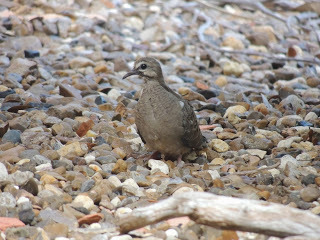 watched it, assuming it might be hurt, and also kept the dogs away from it. After getting a photograph and watching the bird, I realized it was an immature bird and could fly but was content to stay under the bush and in the rocks. The next morning the bird wasn't under the bush and I figured it had flown away. But then I walked into the far back of the yard and two birds were sitting near the tool shed. They've been hanging around for several days now, clearly feeling safe in spite of Daisy and Indigo's curious looks.
These two are mourning doves, one of the most common birds in North America. Their long pointed tails are unique among North American doves, of which there are about 15 species. The mourning dove is the only native Texas bird that occurs in all 254 counties and, interestingly, is the only dove species found in Canada, although there are 300 species world-wide. Hunted for sport, more than 20-45 million are killed annually, although they reproduce enough that they are not in danger of disappearing. More than 350 million are estimated in the US population. (I learned how scientists count birds and it's very interesting but that will be another posting.)
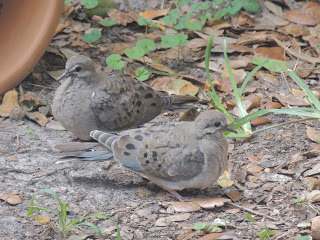 Mourning doves are sometimes confused with common ground doves, but the easiest field mark for distinguishing the two types is the beak color. Ground doves normally have an orange/pinkish beak. As mourning doves mature they also get blue "eyeshadow" on their eyes. They are fascinating to watch and are not especially skittish, remaining close even as you approach them. When they fly it can be an explosive burst and they are fast flyers, going up to 40 mph. Their name comes from the drawn out call, a soft coo-oo followed by two or three louder coos that can sound like an expression of grief.
By the way, doves and pigeons are members of the same family, Columbidae, and the terms are sometimes used interchangeably. Pigeon often is used to refer to the larger birds in the family and, in fact, the plump "pigeon" seen in city parks begging for food is really a rock dove.
Who knows how long this pair will stay in the yard. But I'm enjoying the close up look at nature while they are here.
 watched it, assuming it might be hurt, and also kept the dogs away from it. After getting a photograph and watching the bird, I realized it was an immature bird and could fly but was content to stay under the bush and in the rocks. The next morning the bird wasn't under the bush and I figured it had flown away. But then I walked into the far back of the yard and two birds were sitting near the tool shed. They've been hanging around for several days now, clearly feeling safe in spite of Daisy and Indigo's curious looks.
These two are mourning doves, one of the most common birds in North America. Their long pointed tails are unique among North American doves, of which there are about 15 species. The mourning dove is the only native Texas bird that occurs in all 254 counties and, interestingly, is the only dove species found in Canada, although there are 300 species world-wide. Hunted for sport, more than 20-45 million are killed annually, although they reproduce enough that they are not in danger of disappearing. More than 350 million are estimated in the US population. (I learned how scientists count birds and it's very interesting but that will be another posting.)
 Mourning doves are sometimes confused with common ground doves, but the easiest field mark for distinguishing the two types is the beak color. Ground doves normally have an orange/pinkish beak. As mourning doves mature they also get blue "eyeshadow" on their eyes. They are fascinating to watch and are not especially skittish, remaining close even as you approach them. When they fly it can be an explosive burst and they are fast flyers, going up to 40 mph. Their name comes from the drawn out call, a soft coo-oo followed by two or three louder coos that can sound like an expression of grief.
By the way, doves and pigeons are members of the same family, Columbidae, and the terms are sometimes used interchangeably. Pigeon often is used to refer to the larger birds in the family and, in fact, the plump "pigeon" seen in city parks begging for food is really a rock dove.
Who knows how long this pair will stay in the yard. But I'm enjoying the close up look at nature while they are here.