Jeanette Larson's Blog, page 3
March 18, 2019
Song for Papa Crow
 Many birders identify birds by their call and they use mnemonics to help them remember the calls. In Song for Papa Crow, Marit Menzin introduces the calls of about a dozen birds. Starting with the American Crow, readers learn that not all bird calls are melodious songs. The caw, caw of the crow is so irritating that it chases away the other birds. Although his papa loves his voice, the other birds don't like his singing. Wanting to help his son, Papa asks the Mockingbird to teach Crow to sing. Mockingbird can mimic the songs of other birds and is one of the only birds you will hear at night.
Little Crow wants to sing like the other birds, who make fun of his call and run away. But can Mockingbird's magic whistling seeds help? Well, in this story, the answer is yes, but Little Crow quickly learns that singing and trilling the songs of other birds also means he can't hear danger when Hawk comes calling. Worse, he can't call out to his father for help because he no longer sings his own recognizabel song. Okay, this is a kids book so all ends well when Little Crow spits out the whistling seeds and calls for a flock of crows to help him. And Little Crow learns to love his own song, even if he is singing out of tune.
Fun Facts at the end provide a little bit of information about each bird and the written vocalizations of the calls are accurate and will help young birders identify the calls. Collage illustrations are bright and colorful and clearly show important identification markings for the pictured birds.

While the onomatopoeic written sounds are accurate, readers may want to supplement their skills through some of the great on-line collections of bird songs. Cornell's Lab of Ornithology has a nice collection, along with tips on learning to identify birds by calls and songs. Just click the link: https://www.allaboutbirds.org/how-to-learn-bird-songs-and-calls/ .
FTC Disclosure: I received a free copy of this book from the author but receive no compensation for the review.


February 25, 2019
Superlative Birds
 Many of us are enthralled by trivia. As kids we pore over the Guiness Book of World Records and as adults we watch quiz games. For birders, Leslie Bulion's book, Superlative Birds, will provide fodder for Jeopardy and send readers to birding books for more information. Here we learn which bird has the loudest voice (spoiler: although several birds have loud voices, the kakapo of New Zealand has a call that can be heard for miles), which bird weighs the least (easy one; the bee hummingbird is the smallest bird in the world), which is the most gruesome hunter (the shrike is known as the "butcher bird" for a reason), and more. Each superlative is accompanied by a poem and a science note that provides details about the bird and its features. Running commentary by a chickadee answers additional questions and provides details to ponder. There is even a QR code embedded on one page that can be scanned to hear the poem about the Arctic Tern being sung. Robert Meganck's digital illustrations are whimsical, yet realistic and highlight the superlative feature being discussed.
 Shrike (used with permission)
 Shrikes are vicious hunters,
impaling insects on barbed wire
(Photo by Jeanette Larson)As Bulion notes in her final poem, every bird is a superlative bird. But with habitats changing, climate patterns shifting, and pesticides and plastics polluting the earth, the superlative birds she highlights are at risk of disappearing. Back matter includes a glossary and notes on the poetry that explain the style of each poem, and concludes with additional resources for birders. End papers have labeled sketches of the birds; the front identifies the superlatives while the back identifies the bird, allowing for a great trivia contest. With the combination of poetry and science, Superlative Birds provides classroom and curriculum uses that reach beyond birding.
FTC Disclosure: I received a complimentary review copy from the publisher. I receive no compensation for reviewing the book.
January 31, 2019
Best Bird Books of 2018
 January always signals the start of the awards season so once again I am sharing Forbes' list of the top bird books of the past year. I've only reviewed one, The Feather Thief, but will be posting about a second, Warblers and Woodpeckers by my friend Sneed B. Collard III, soon. Although I have reviewed several of his books, my review of that book has been delayed by a move from Rockport back to the Austin area. I'll also note that Forbes does not appear to consider books for young people in their review of birding books. Read some of the past year's blog posts for some great books for young people, although I would not dare try to suggest that my reviews make up a "best" list for the year. And keep reading Bird Brainz for some exciting books coming up in 2019. Click here to see the full list and the annotations about the books but the titles are:
The Ravenmaster: My Life with the Ravens at the Tower of London by Christopher Skaife The Feather Thief: Beauty, Obsession, and the Natural History Heist of the Century by Kirk Wallace JohnsonThe Ascent of Birds: How Modern Science Is Revealing Their Story by John ReillyBelonging on an Island: Birds, Extinction, and Evolution in Hawaii by Daniel LewisThe Seabird’s Cry: The Lives and Loves of the Planet’s Great Ocean Voyagers by Adam NicolsonThe Wonderful Mr Willughby: The First True Ornithologist by Tim Birkhead
 Mrs Moreau’s Warbler: How Birds Got Their Names by Stephen Moss The Delightful Horror of Family Birding: Sharing Nature with the Next Generation by Eli J. KnappWarblers & Woodpeckers: A Father-Son Big Year of Birding by Sneed B. Collard IIIBirdNote: Chirps, Quirks, and Stories of 100 Birds from the Popular Public Radio Show by BirdNote; edited by Ellen BlackstoneHentopia: Create a Hassle-Free Habitat for Happy Chickens; 21 Innovative Projects by Frank HymanThe Wall of Birds: One Planet, 243 Families, 375 Million Years by Jane Kim
 December 18, 2018
Counting Birds
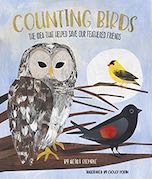 Imagine a sport where you spend Christmas day shooting as many birds as you can. Over a hundred years ago many hunters would compete to kill as many birds as they could. Birds of all kinds were considered fair game. Finally, one man proposed that that competition be changed to a bird-census. "Count them, he proposed. But don't kill them."
Heidi E.Y. Stemple tells the story of how Frank Chapman, a bird enthusiast and the publisher of Bird-Lore magazine, convinced people to work for bird conservation rather than destruction. In 1900, the first year of the Christmas Bird Count, 27 bird watchers in 25 locations across the United States counted birds. More people joined the count every year and the tradition spread to other countries. Today, over 73,000 birders in more than 2,500 circles count birds tallying, in 2016, more than 56,000,000 birds!
 (Inside spread courtesy of Quarto)
Over several pages, Stemple takes readers along for the count, starting with the early morning owlers and continuing with backyard birds who count the birds they see at feeders. At the end of the day, reports are collected and submitted to the National Audubon Society. Stemple explains the importance of these counts and how citizen scientists contribute valuable data. A note at the end provides more information about Frank Chapman and the 2016 tallies. Those interested can check 2017 and, soon, 2018 totals at Audubon's summary site.
 Bird Count CirclesThe story of an unheralded man and an increasingly popular but relatively unknown event is well told and inspiring. Illustrations by Clover Robin (great name!) in cut-paper collage are colorful and realistic and add to the reader's enthusiasm for birding. Stemple points out that anyone can participate through local birding clubs and groups and it's free! And although it is called the Christmas Bird Count, in fact, it extends beyond December 25. Audubon's 119th Christmas Bird Count will be conducted between the dates of Friday, December 14, 2018 through Saturday, January 5, 2019.
 Fulton Learning Center student
bird team members
(photo courtesy of Martha McLeod)At the end of the book Stemple notes that many of the counters are young people. In fact, students from Fulton Learning Center (in Rockport where I currently live) participate in several counts throughout the year including the Christmas Bird Count. Clubs register the circle for their counts to avoid overlap and duplication. Definitely a book for anyone interested in birding and bird conservation and essential reading for birding clubs and groups.
FTC Disclosure: I received a complimentary review copy from the publisher. I receive no compensation for reviewing the book.
November 3, 2018
Coming Home
 A plucky, determined robin travels home for Christmas to meet his mate in this charming picture book. Feeling the pull of a mysterious force, the bird swoops and darts, soaring onward and upward, on a long journey to leave the cruel snows and make it safely home where his mate is waiting. Gorgeous digitally composed illustrations vary in tone and color to reflect the various areas the robin must fly through. Over land and water, escaping danger, sometimes flying in a flock but often alone, helped along the way by a kindly sailor, the little robin is finally with the one he loves. While this is primarily a gentle story to read aloud, it is also a heartwarming holiday tale and readers will learn a bit about birds along the way.
Prefatory facts refer to the bird as a Scandinavian robin, although I don't find that there is a species with that specific name. European robins (Erithacus rubecula) are found from Siberia to Algeria and the Azores and robins from Scandinavia migrate to Great Britain and Western Europe to escape the cold winters. The same fact section explains that robins use the stars to navigate and fly up to a 1,000 feet above sea level. In contrast to American robins, which are heralded as a sign of Spring, in Britain the European robin is most associated with Christmas as they begin looking for a mate in mid-December and have, hopefully, found one by mid-January.

My only quibble with the illustrations is that there is no discernible difference shown between the male robin and his mate. The female's coloring should be muted, almost washed out, in comparison to the deep, rich colors of the male. I think it would also be helpful to have a map showing the bird's migration route.
 American robin
(photo by J. Larson)
Although the term robin is used for both European robins, members of the Old World flycatcher family, and the American robin, which is a thrush, this story is clearly about a European robin. While both birds have reddish-orange breasts, they are not related. The European robin's breast is so distinctive that it is also called robin redbreast.
The author, Michael Morpurgo, is best known for his book, War Horse, which was also made into a major motion picture. Illustrator, Kerry Hyndman, is a London-based illustrator and map-maker. Coming Home is her first children's picture book.
October 20, 2018
The Hummingbird Sings and Dances: Latin American Lullabies and Nursery Rhymes
 I requested this book and CD to review because it contains a few songs about birds, and those are rather hard to find. As a bonus, the songs are from various Latin American countries and are in Spanish, with English translations.
All of the lyrics are provided in Spanish and English in the back of the book, along with definitions of less common words, like aji, a very hot chili pepper. A map outlines Central America and identifies the countries. Also, while the book includes a CD, it also includes a code to download MP3 files for those who prefer to access the music from a computer or MP3 player.
Only four of the songs nineteen songs relate to birds, although the art frequently includes birds:
Canciones del colibri/Songs of the HummingbirdEl gallito/The Little RoosterDéjala que se vaya/Let Her Go (about a dove)Los pollitos/Little ChicksAdditional music selections, including Arroz con leche/Rice Pudding, Los esqueletos/Skeletons, and Rana Cucú/Cuckoo the Frog, make this a great choice for library and preschool storytime use. The music is lively and lyrics share fun vocabulary words like cinnamon and mango in Spanish and English. While not bird-related Los esqueletos/Skeletons teaches time as the skeletons eat at two, tumble down at four, and go for a ride at noon.
The pictures by Argentinian illustrator Mariana Ruiz Johnson are bright and folksy and Grupo Cántaro is a Mexican musical-vocal ensemble founded in 1979.
FTC Disclosure: I received a complimentary review copy from the publisher. I receive no compensation for reviewing the book.
October 16, 2018
About Woodpeckers
 Part of a series, this title looks at, well, woodpeckers. The text is simple, usually one or two sentences on a white background facing a large plate that features an illustration of an individual species. While the text is generalized, discussing basic characteristics common to most woodpeckers, seventeen of the eighteen plates look at a single type of woodpecker out of the more than two hundred species around the world. The eighteenth is a squirrel using a woodpeckers hole as its home.
The Afterword provides details, plate by plate, on specific birds. The watercolor illustrations are clear and detailed, showing features that might be harder to see in photographs, and include glimpses of the habitat. The size and length make this a great introduction for preschoolers and students through about second grade and may inspire them to look for those woodpeckers they can find in their area.
 Northern flicker
(photo by J. Larson)
Pair this with Woodpeckers: Drilling Holes & Bagging Bugs by Sneed Collard for older readers. Also helpful for teachers and parents is the publisher's guide to the series, which offers some extension ideas to use with any title in the series. Other bird titles in the series explore birds in general, parrots, hummingbirds, and penguins.
FTC Disclosure: I received a complimentary review copy from the publisher. I receive no compensation for reviewing the book.
October 7, 2018
Magnificent Birds
 Beautiful linocut illustrations of fourteen birds from around the world fill each page in Narisa Togo's Magnificent Birds. Text accompanies each double page spread to briefly describe the bird's attributes, diet, appearance, habitat, and special features. In order of appearance, the included birds are the bald eagle, Andean flamingo, greater bird of paradise, red-crowned crane, common kingfisher, toco toucan, ruby-throated hummingbird, bar-tailed godwit, wandering albatross, Australian pelican, barn owl, emperor penguin, kakapo, and the peregrine falcon. With the exception of a couple that are widespread, each is labeled for the area of the world where it is found. No mention is made of the others in a species, like the flamingo or the crane, that can be found elsewhere. The book was originally published in Great Britain by Walker Studios and many online book retailers show the British cover (which features the red-crowned crane). Although the book is short, an index or bird list would be helpful.
The illustrations are richly detailed and include a glimpse of the habitat: forests, waterways, cliff faces, and gardens. Linocut is a printmaking technique that allows for a grainy texture, with subdued colors that give the illustrations an almost retro look. Because linoleum is easy to obtain and work with, linocut is often used with children and it would be a lot of fun for them to create and print their own local birds. Easy to follow instructions are readily available at sites like Art for Small Hands.
Although I think adults will appreciate the information and illustrations, the book is intended for readers in grades 5-9. I'll be donating this review copy to our local kid birding team.
FTC Disclosure: I received a complimentary review copy from the publisher. I receive no compensation for reviewing the book.
September 28, 2018
Galápagos Girl / Galapagueña

 This is not strictly a bird or birding book but is so filled with birds that I wanted to share it. Also, one of my "bucket list" trips is to go to the Galápagos Islands. Marsha Diane Arnold tells the story of a young girl, born on the islands, a Galápagos girl, and the wonders she finds in the world around her. She plays among the delightfully funny blue-footed Boobies and dances with the island's eponymous penguins. There are 56 different species of birds on the islands, with 80% being found only there. Arnold also includes the Galápagos flamingo, Galápagos petrels, and the waved albatross.
 Valentina learns that the world she so loves is endangered, threatened by animals that don't belong on the islands and people who don't care. The young girl leaves the island to go to school but returns a biologist, dedicated to sharing her love of the Galápagos with visitors and encouraging them to leave with promises to help keep the animals safe.
An Author's Note explains how Arnold met the real Valentina Cruz and how she and her family have protected the islands. Her work will be an inspiration to other young people who care about our world. Other back matter discusses the Galápagos and provides fun facts about the various birds and other animals introduced in the book. She concludes with an extensive bibliography for further reading, most of which is for adult readers. Another important aspect of the book is that it is dual language--providing the text in both Spanish and English.
The spectacular wildlife of the area is brought to life by Angela Dominguez, the author and illustrator of several other books, including two that have won Pura Belpré honors from the American Library Association. Great illustrations, a large format, and an engaging story make this an excellent choice for read-alouds and storytimes.
FTC Disclosure: I received a complimentary review copy from the publisher. I receive no compensation for reviewing the book.
August 8, 2018
The Feather Thief: Beauty, Obsession, and the Natural History Heist of the Century
 I spotted this book in a book store and was intrigued so checked it out from my local public library. I really didn't know much about this book beyond the title until I started reading it. I knew it was a true crime story about a young man who stole dead birds from a museum collection. I didn't know why anyone would steal dead birds. Turns out there is a huge market for feathers for tying flies for fly fishing. There is, in fact, an entire subculture of people who use feathers to tie fancy flies. These flies will never be used as fishing lures because what the tiers use are expensive, often illegal, feathers from exotic, endangered, and even extinct birds.
 A drawer of Scarlet Minivets The story starts with Edwin Rist breaking into a British natural history museum in the small town of Tring. Having scoped out the museum on an earlier visit, Rist methodically pulled out drawer after drawer of specimens, dumping them into a suitcase. He often cleared a drawer of the entire collection of a species, leaving only the drab females. He then fled into the night. It would be weeks before the museum even realized there had been a break-in.
Each stolen specimen held a biodata label tied around its leg, information meticulously collected by Alfred Russel Wallace, a contemporary of Charles Darwin who did fieldwork in the Amazon and the Malay Archipelago. He collected some of the rarest birds in the world, including the almost mythical Bird of Paradise, for scientific research. And Rist just stole more than $1 million worth of them just to provide feathers to supply the "feather underground, a world of fanatical fly-tiers and plume peddlers."
 Bird of ParadiseBetween the heist and the detective work, Johnson provides background to bring the reader to current events by exploring the "feather fever" that struck during the mid- to late 19th century. During that period birds were hunted for their feathers to decorate Victorian fashions in America and Europe. Of course, Victorian ladies did not want bland feathers from common birds. To show status, ladies craved feathers from Toucans, Quetzals, Hummingbirds, and Egrets. The demand devastated populations as, for example, hunters killed a thousand "Snowy Egrets to yield a kilo of feathers." Starting in 1896 a few outraged women and the Audubon Society lobbied against using birds and feathers in fashion, as many species had been hunted to extinction or near extinction. Legislation in the early 1900s created refuges and, in 1918, the Migratory Bird Treaty Act outlawed the hunting of any migratory bird in North America. Jumping ahead to the 21st century, customs officials were no longer looking closely for feathers, as they were busy with big game trophies, like rhino horns and elephant tusks. This, and the Internet, created "a small community of obsessive mend addicted to rare and illegal feathers: practitioners of the Victorian art of salmon fly-tying." Johnson provides a surprisingly interesting overview of this practice before transitioning to the present.
 Edwin Rist
Enter Edwin Rist. Raised in a small town and homeschooled, Edwin's parents were Ivy League graduates who had fled Manhattan's Upper West Side to better nurture their children and support their multitude of interests. At a young age, Edwin became obsessed with the flute and fly-tying and he mastered both talents. His obsession with music led him to England; his obsession with fly-tying led him to crime. Ultimately, in 2009, this 20-year-old young man broke into a branch of the British Museum of Natural History, stealing millions' of dollars worth of birds and irreparably damaging scientific research.
The book is filled with serendipitous experiences, including how Johnson came to write this book. And he didn't just write the book; he spent years tracking down details of the crime and playing detective as he pursued the stolen birds and feathers. The research and investigation itself are worthy of admiration and pulls the reader into the story in ways that a straight forward retelling could not. Without going into detail, it's hard to tell if justice was served in the end, but answers to many questions were certainly found. And although I have zero interest in fly-tying, the story was both compelling and intriguing and offered a different perspective on birding. The final section of the book contains many photographs and sketches. (I read an electronic copy and it was not immediately obvious that the book contained a ton of illustrations. so be sure to check the end.)
 The Jock Scott fly
While I have no interest in fly-tying, I found it odd that the fly tiers talk so much about collecting and possessing feathers. It is illegal in the United States to possess feathers from most birds; this is something I frequently explain to friends who know about my bird rescue and rehabilitation activities and want to proudly show me a feather they found on the beach. According to the law, there is no exemption for molted feathers or those taken from road- or window-killed birds. It is legal, however, to have feathers from a few non-native birds like starlings, but those are not the feathers coveted by the tiers. Interestingly, while it is not legal to sell feathers from wild ducks and geese that have been hunted, it seems that the laws were written by a fly-tier who made an exemption for using those feathers for fly-tying so they can use them for fly fishing. To learn more about feather laws and to view their Feather Atlas, visit the U.S. Fish & Wildlife Service. The Atlas includes feather terms, scans of feathers, and identification aides, along with the laws on possessing feathers.
It was also disturbing to learn from Johnson that the biggest market for illegal feathers is eBay. In addition to selling feathers at fly-tying conventions, tiers sell through the Internet, with little or no policing done by eBay. My own recent search found feathers from many of the endangered or near-extinct birds mentioned in The Feather Thief for sale.
FTC Disclosure: I checked a copy of this book out from the public library. I receive no compensation for reviewing the book.