
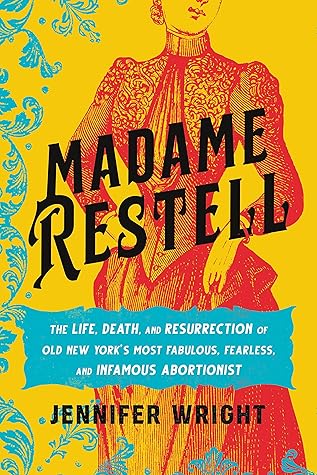
More on this book
Community


Kindle Notes & Highlights

Read between
June 10 - July 6, 2024

Her adversaries were at least as upset about the idea of a woman making that much money and consuming that much attention as they were about the very idea of abortion. Each
When the Catholic Church spoke out against her, she outbid the archbishop of New York for the land he wanted to build his house on. There, she built a mansion, and from it she doled out birth control to her many patients. She did not ask for any man’s opinion, for she was not interested in hearing it.
Restell was a businesswoman, a scofflaw, an immigrant, and an abortionist. She made men really, really mad.
She deserves a place in the pantheon of women with no f...
This highlight has been truncated due to consecutive passage length restrictions.
Until 1842, the British government did not mandate that the ships going to America provide passengers with adequate food and water. Before then, starvation on immigrant ships was not uncommon, especially if the journey was longer than expected due to bad weather. In 1836, a ship by the name of Diamond traveling from Liverpool to New
York took one hundred days to make the crossing, due to poor weather, rather than the thirty days the passengers had anticipated. As a result, seventeen of the one hundred and eighty steerage passengers starved to death onboard.
And how full—truly full—of people it was. Already New York’s population was 185,000, and it was growing rapidly. By 1840 it would be 327,000.
In 1800, 83 percent of the US labor force was in agriculture. By 1850, that number had decreased to only 55 percent.
In the new urban environment, relative anonymity gave people the freedom to be awful.
Certain bars in the Five Points offered a kind of primitive keg stand. Lacking glasses, the proprietors poured beer from the keg through a tube into a person’s mouth.
For three cents, one could have as much beer as they could drink in one swallow. People, understandably, became excellent at holding their breath.23
In an 1859 cartoon, Harper’s Weekly reported that opium served as “The Poor Child’s Nurse.” Opium, a pain reliever with effects similar to heroin, was popular among virtually all classes by the mid-1800s. While wealthy upper- and middle-class people might enjoy its effects upon their own disposition, working mothers found it to be a virtual necessity in terms of childcare.
Godfrey’s Cordial was as good as advertised at keeping infants asleep. That’s because it contained laudanum, a tincture of opium, in a sweet syrup. An 1857 article in the Brooklyn Evening Star said it could “explain away your charitable wonder that the frequent beggar women who hold out imploring hands, and roll up patient eyes at Broadway stoops, should be blessed with brats of such accommodating sleepy headedness, by showing… that those infantile objects of your admiration are brought up to scratch with laudanum—fuddled continually and permanently stupefied at last.”26
The permanent stupefaction part is important. It had
become clear by the late 1850s that in many cases, Godfrey’s Cordial was keeping children asleep forever—overdoses could kill them, and constant use weakened their healt...
This highlight has been truncated due to consecutive passage length restrictions.
about 60 percent of women working sixteen hours a day could not earn more than $1.25 a week. That equates to $39 a week today.
What Ann was doing in providing a version of an abortive pill was by no means revolutionary in itself. For as long as women have been expecting, there have been methods to end a pregnancy. The first clear written description of abortion dates back to 1550 BCE in Egypt, when women who wished to abort turned to one of the remedies described in the Ebers Papyrus, an ancient medical text, which suggested that following its protocols would “cause all to come out which is in the stomach of a woman.”
During fermentation, the acacia plant produces lactic acid, which kills sperm and is still used in spermicides today.
Pessaries rarely produced a “clean” result. They were effective precisely because they were harmful. They were not made of sanitary materials. For instance, some contained, among other things, beetles that produced a toxic substance called cantharid. Others included “a head of boiled garlic.”10 Surely the thought of inserting either beetles or boiled garlic into one’s vagina is enough to make a modern woman shudder.
Ingesting seeds from Queen Anne’s lace prevents the production of progesterone, which is necessary for pregnancy. Women in Appalachia, India, and other underserved regions still use the seeds today as an (imperfect) kind of herbal morning-after pill.13
Queen Anne’s lace isn’t the only plant with a supposed ability to prevent pregnancy. Pennyroyal served much the same purpose. Like Queen Anne’s lace, its use dated back to ancient Greece, where a play by Aristophanes, Lysistrata, describes a desirable young woman as being “trimmed and spruced with pennyroyal.”
Abortive remedies have also long been part of American society. Benjamin Franklin even included a recipe in his book of general knowledge, The Instructor. It suggested that “unmarry’d women” suffering from a “suppression of courses” (today better known as a missed period) consume pennyroyal mixed with twelve drops of spirits of hartshorn.15
Certainly, no birth control or abortifacient used in the mid-nineteenth century came near to being as effective as today’s methods. However, two hundred years from now, chemotherapy—with its array of often miserable side effects—might seem like a horribly primitive way to attempt to cure cancer. But in the absence of a better method to eliminate the disease, it does not mean that people who receive chemotherapy now are foolish or being conned.
However, the fact that these remedies were dangerous doesn’t mean the ingredients were combined without reason. Because, like ergot of rye and cantharides, the combination of turpentine and tansy oil was thought to be successful in ending a pregnancy. Sadly, these are still ingredients that women with few legal options use to induce abortions to this day.
As recently as 2006, the mother of a teen in Columbus, Ohio, was accused of forcing her daughter to drink turpentine in order to induce an abortion.
It’s a tiresome and, unfortunately, still true fact that, if men like something a woman does, they assume another man must have helped her do it. If they hate something a woman did, on the other hand, they assume a man must have made her do it.
Whatever one thinks of her actions, she deserves the dignity of autonomy so often denied to women in history.
The most remarkable aspect of Madame Restell’s practice is that, despite some accusations, there’s little evidence that any patients died in her care. The same can’t be said of Mrs. Bird. In 1841, she was found trying to clandestinely dispose of a coffin that contained the body of a seventeen-year-old patient who had died after hemorrhaging.16 Mrs. Bird would go on practicing medicine, but, unlike Madame Restell, she was never able to attract an upper-crust clientele.
Most American medical schools through the 1840s did not even require their students to go to hospitals, and only about half required students to dissect a human cadaver.
That’s because surgery, prior to the invention of anesthetic in 1846, was a positively terrifying process. Up to 50 percent of patients undergoing surgery died during their procedure—which is one reason hospitals made them pay in advance.
While many of those civilizations did employ methods of birth control and abortion, that’s not true of the Persians. In fact, they were so firmly opposed to abortion that, if a woman was found to have procured one, she would be sentenced to death, as would her sexual partner and any midwife who helped her. If a woman miscarried for any reason, she was whipped four hundred times before being made to drink cow’s urine, to “wash over the grave in the womb.”
That minor mistake aside, the article was problematic in other ways: the notion that you could employ birth control to breed a superrace of humans, for example, is an aspect of eugenics. A staggering number of Americans would go on to embrace this outlook in decades to come, but it doesn’t seem anywhere close to Restell’s intent.
Bennett immigrated to America, where he spent the next sixteen years writing, editing, and trying (and failing) to start his own newspaper. He finally succeeded with the launch of the New York Daily Herald in 1835. The paper would be shaped by Bennett’s philosophy that “the object of the modern newspaper is not to instruct, but to startle and amuse.”3
Bennett continued to fill his newspaper with deliberately provocative headlines. One story declared, “Five hundred dollars reward will be given to any handsome woman, either lovely widow or single seamstress, who will set a trap for a Presbyterian parson, and catch one of them flagrante delicto.”
Then again, it’s very easy to tell people to ignore the haters. It’s hard to manage that restraint when the hatred is directed toward you.
It was said that, in regard to why you could not cash bad checks, his “understanding was somewhat deficient.”20 Witnesses were hard-pressed to say whether he was of sound mind. One remarked, “In reply to a question of whether Dixon was non compos mentis, I consider him as being on the frontier line—sometimes on one side, and sometimes on the other, just as the breeze of fortune happens to blow.”21 So, not exactly a “yes.”
While many were likely against people having affairs—the majority of people, historically and currently, don’t approve of cheating on one’s spouse—the populace didn’t view Dixon as a deeply moral man. They viewed him as a smug busybody who kept butting into people’s private business and ruining lives.
Dixon himself was not married. Nor did he have children. Telling people that if having a child is going to bankrupt them, then they should move to a homeless shelter, where the child they’ve been forced to birth will almost certainly die, is not an especially convincing argument.
The only thing more unnatural than a woman not wanting to be a mother was a woman wanting to be paid for doing her job.
Under an inherited British law known as coverture, a married woman in North America could not own property, enter into contracts, or earn a salary.
would take until 1848 for the Married Women’s Property Act to go into effect. It was only then that the property women brought with them into marriage was not subject to their husband’s disposal and could not be seized in order to pay off his debts.
It was clear to everyone that it was Madame Restell’s carriage, not her husband’s. She had bought it. She was riding in it. Many people might have disliked the services Restell was providing, but they really hated that she was enjoying the fruits of her labor and not getting back to scrubbing. The fact that she was reveling in the money she earned spoke to a new financial independence for women that scared the hell out of certain people.
Even as the stakes grew higher, possible conviction did not deter women in seeking abortions. Modern estimates state that by the mid-nineteenth century, as many as 20 percent of pregnancies ended in abortion.23
Women might be married and “respectable,” or unmarried and desperate. One 1860 medical paper, written by the physician Edwin Hale, “safely asserted that there is not one married female in ten who has not had an abortion, or at least attempted one.” The doctor further noted that, in his own practice, he had seen women who had given birth to “eight, ten and thirteen children, and [had] at least as many abortions.” Hale was not necessarily horrified by this; he believed that “in no instance should the life, or even the health of the mother be sacrificed to save that of an impregnated ovum before
...more
Rather than stopping women from having abortions, the law passed in 1845 would merely make women more inclined to keep quiet about them.
In Germany, the postpartum period is known as Wochenbett, which translates to “week’s bed,” and corresponds with a law prohibiting new mothers from working for eight weeks after delivering a child. They receive full pay from work during this period, as well as for six weeks before giving birth. Following
In contrast, today, in the United States, insurance is required to cover only two days in the hospital after giving vaginal birth. Most people can’t afford to stay longer. We are also the only high-income nation that does not mandate maternity leave, which means that some women (according to one study, 12 percent of them9) have to return to work within only a week of delivering a child.
Men in America are supposed to be ambitious. A woman doing the same was, and still is, perceived as defying her natural supportive and maternal nature.
Robert Dale Owen.
the 1200s, the Italian philosopher Thomas Aquinas believed that a fetus became “ensouled” at the time of the quickening, and that, while an abortion performed before that time might be wrong, it was not murder.
