
More on this book


Kindle Notes & Highlights

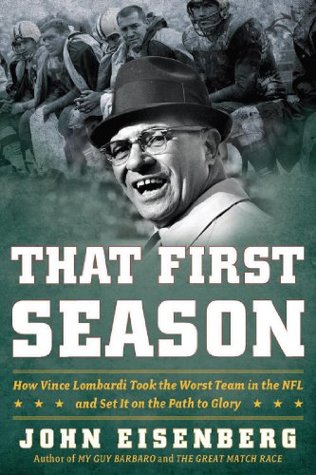
That First Season: How Vince Lombardi Took the Worst Team in the NFL and Set It on the Path to Glory

It was a cold, wet Monday night in December 1959, and the Green Bay Packers had just completed their first winning season since Harry Truman’s early years in the White House.
The Packers were like every high school football team in a small town, if on a somewhat larger scale, eliciting widespread but soft-spoken grousing when they lost and a giddy unanimity when they won.
The year before, when they had been laughingstocks, they stopped going to restaurants around town because they grew weary of being ridiculed and asked what was wrong.
A few Packers, in frazzled frustration, dreamed of stealing a sideline policeman’s gun and shooting that damn white horse, the Colts’ team mascot, which took a celebratory gallop across the field whenever Baltimore scored.
The Packers were fixtures on the bottom of the NFL pile, chronic losers who until recently had played their home games in a former high school stadium. They didn’t practice hard, didn’t mind losing, and hadn’t produced a winning season since 1947.
Their franchise’s past was as glittery as its present was miserable: the Packers had reigned during the NFL’s rough and rowdy early years, attracting loyal fans and accumulating six championships as charismatic legends Johnny Blood and Don Hutson led them to glory.
He played poker with the players on the road, didn’t enforce curfews, and failed to scold veterans who repeated mistakes.
His playbook was a four-inch-thick maze of diagrams, so complicated that Jim Taylor, the Packers’ rookie fullback, couldn’t get a handle on it and had to sit on the bench.
On the night before the game, they stayed at the Washingtonian Motel in Gaithersburg, Maryland, nearer Washington, D.C., than Baltimore. It was out of the way, but the Packers had stayed there when they came to the area to play the Washington Redskins a few weeks earlier, and the motel cut the team a deal for agreeing to stay twice. That was how the Packers traveled, always looking to save pennies.
The Packers had been so excited about his potential as a quarterback that they traded Tobin Rote, their longtime starter, who had passed for more than eleven thousand yards, and signed Hornung to a three-year contract that included a $2,500 signing bonus and a $17,500 annual salary, more than many veterans earned.
He knew more beautiful women than any one man deserved to know; his female fan mail piled so high he paid a classmate to handle it.
When the Packers played the Rams in Los Angeles in 1957, an attractive young woman approached him on the bench and asked to have her picture taken with him—during the game! Her request was audacious, but Hornung stood and posed with her, a move some teammates and fans interpreted as clear evidence of his priorities.
Although they derisively called him Heisman or Golden Dome or, worst of all, Goat, because he resembled one, being thick and strong from the waist down but narrow up top, they knew Hornung could take a joke.
In Green Bay, playing for the Packers, Hornung had a good time, but the team was unorganized, the environment unprofessional, the experience disappointing.
The stadium would be packed with raucous fans and a white pony named Dixie that had become a celebrity for crossing the field after Colt touchdowns. A sportswriter would soon call Baltimore’s crowd “the world’s largest outdoor insane asylum.”
Pro football, since its inception just after World War I, had always been among the roughest of sports, an organized brawl between rugged athletes who relished violence, many having experienced real combat in World War II or Korea. They kicked, scratched, and clubbed each other, gouged eyes, knocked out teeth, and tackled around the neck.
Scooter, who liked to alternate quarterbacks, put in Starr, an earnest third-year pro with a lamentable record. Since making the team in 1956 as a seventeenth-round draft pick, he had started a lot of losing games and drifted in and out of the lineup, keeping his job because he spent hours studying film and was always prepared to play, ideal traits for a backup.
But rather than fight, some players eased up so obviously that Green Bay Press-Gazette sports editor Art Daley, watching from the press box, was outraged. Normally supportive of the team, he would write in Monday’s paper of “an almost complete lack of effort” in the second half, and call the performance “the biggest ‘quit’ in Packer history.”
GALLOWS HUMOR PREVAILED as the Packers’ charter flight from Baltimore landed in Green Bay late Sunday night, hours after the 56–0 loss. McGee, ever the comedian, wondered if their wives and girlfriends would be at the airport to pick them up or just ignore their existence and stay home. I might need a ride, guys.
A mill town situated at the mouth of the Fox River in northeast Wisconsin, Green Bay was, in the late 1950s, predominately white, Catholic, conservatively Democratic, and, with sixty-two thousand residents, vastly smaller than America’s urban centers. But the Packers’ hometown had a lot going for it—four paper mills, three rail hubs, good schools, tidy parks, and a traffic-clogged downtown lined with restaurants, clubs, and department stores.
Pro football teams had sprouted in many such towns during the sport’s pioneer days after World War I, but the others, all of them, had long ago been elbowed out of business by big-city teams such as the New York Giants and Chicago Bears. The Packers had survived, primarily because of their community’s support. They were the local secular religion, affording Green Bay the right to call itself major league in at least one respect.
In 1958 Dominic Olejniczak, a realtor who had recently served five terms as mayor, headed the committee with the title of team president.
Prosperous and controlling, these men were heavily involved in the Packers’ day-to-day business. It wasn’t unusual to see them watching practice or traveling with the team to road games. In 1957, as the Packers’ season fell apart, some met privately with players to hear gripes, undermining Coach Lisle Blackbourn.
the second floor of the Downtowner Motel on Washington Street, where the Packers had their business offices.
the Northland Hotel for his weekly Monday lunch with the executive committee,
After those comments appeared in Tuesday’s Press-Gazette under the headline “Defeatist Veterans Must Go, Coach Says,” fifty fans showed up to watch practice, thinking they might see a veteran get cut. (Packer practices were open to the public.)
Local business leaders had always run the Packers, so it was best, Scooter believed, just to acknowledge that they were in charge.
College football was enormously popular in the aftermath of the Great War, its games drawing vast crowds and dominating newspaper headlines despite the opposition of many school presidents, aghast at its violent nature. In the Midwest, Illinois, Ohio State, Notre Dame, Wisconsin, and Minnesota fielded top teams and played before crowds of seventy-five thousand or more.
The Packers were promptly kicked out for using college players under assumed names. They had to pay twenty-five hundred dollars to rejoin, and Lambeau didn’t have the money. But the people of Green Bay liked having a team and stepped in to help. One fan sold his car and gave the proceeds to the Packers in exchange for one minute of playing time.
Seldom passing, the squads brawled in front of boozed-up fans and occasionally scored touchdowns. Gambling pervaded the stands and locker rooms.
The Packers’ star player was Johnny McNally, a handsome runner who drank, gambled, and womanized. The Hornung of his day, he had been kicked out of Notre Dame for playing semipro ball, and now played for the Packers under an assumed name, Johnny Blood. His blockers included “Iron Mike” Michalske, a rugged two-way player, and Cal Hubbard, a gentle giant who demanded a trade from the New York Giants because he preferred the small-town environment.
After clinching their first NFL title with a win over the Bears in Chicago, they were met at the Green Bay train station by ten thousand screaming fans.
The next year, the forward-thinking Lambeau, who loved passing the ball, stumbled onto a star thrower when he gave a tryout to one of the team’s towel boys, a Green Bay native named Arnie Herber. The Packers won two more titles in 1930 and 1931 with Herber heaving passes downfield to open receivers.
The NFL was deemed so second-rate in the South, where college football ruled, that Hutson believed his playing career was over after he scored two touchdowns in the 1935 Rose Bowl. But a bidding war for his services erupted between Lambeau and the Brooklyn Dodgers. Hutson signed with both teams, but Lambeau’s contract reached the league offices an hour earlier, making Hutson a Packer.
The U-shaped bleachers that surrounded the City Stadium field on three sides were filled on Sundays. A glassed-in press box was considered the best in the business. Packer games were the high point of Green Bay’s social life. Friends held Sunday-morning parties and went to the stadium together, the men wearing suits, the women dressed in hats, high heels, and furs. They promenaded before kickoff and dined at supper clubs after the game. Truthfully, City Stadium was still minor league in many respects. Kids snuck through the turnstiles and sat behind the end zone. The Packers dressed in a dark,
...more
In 1949 they staged a Thanksgiving Day doubleheader featuring an intra-squad game and an old-timers’ game just to raise enough money to pay their bills.
Fans tired of Lambeau, who, twice divorced and still handsome, spent the off-season in California frolicking with movie stars. His relationship with the Packer board of directors soured as the losses mounted. The board took away some of his power, putting new committees in charge of negotiating contracts and other important tasks. Few tears were shed in 1949 when Lambeau resigned from the team he had started three decades earlier to coach the Chicago Cardinals.
The Packers were a cheap, second-rate outfit. They held training camp in remote Stevens Point, Wisconsin, on a high school field with dim lights; punts disappeared into the sky during evening scrimmages. Other teams stayed at first-class hotels and gave players a per diem when they traveled, but the Packers frequented out-of-the-way bargain motels and ate sandwiches that management handed out. Other teams flew on newer planes, but the Packers crammed into a pair of DC-3 turboprops, with half of the team’s quarterbacks, runners, blockers, linebackers, and safeties on one plane and half on the
...more
Packer players weighed themselves on a meat scale and soaked their aches in a whirlpool that was little more than a bathtub with a hose. Their shoulder pads were stored under the City Stadium stands in an open-air enclosure with a dirt floor and chicken-wire walls. Knafelc took one look at the worn pads, called his father, and asked for the pads he had worn in a college all-star game.
The cost cutting reached a nadir in 1955 when the Packers took a train instead of flying to California to play the Rams and 49ers. Blackbourn tried to keep the players fresh by having them run through plays during a stopover at the Great Salt Lake, but after three days of nonstop eating, drinking, and playing cards, they were stale when they arrived and lost badly.
During his rookie season in 1952, Bobby Dillon lived at the YMCA for ...
This highlight has been truncated due to consecutive passage length restrictions.
When lineman John Sandusky was traded to the Packers from the powerful Cleveland Browns in 1956, he looked around on his drive in from the airport and sighed, “Ah, Green Bay, end of the earth.” The wife of Packers tackle Norm Masters, a Detroit native, wept when he told her their hometown Lions had traded him to Green Bay.
The police chief had played on the 1919 team. The fire chief had played with Johnny Blood. Two dozen former players lived nearby and attended games. Reminders of better times were everywhere.
The situation was so bad by the mid-1950s, it was whispered the league might move the Packers to Milwaukee, a larger city experiencing a sports boom.
Green Bay also had Bell’s enduring support. When the commissioner had experienced his own money problems as owner of the Philadelphia Eagles in the 1930s, the Packers helped him out. He never forgot and, upon taking charge of the entire league in 1946, pledged unfailing support.
The day the committee clipped Curly Lambeau of absolute authority in the mid-forties and substituted administration by soviet—that’s the day the team’s troubles began. There hasn’t been a winning season since. An executive committee of new blood, a new framework of administration, is almost a must. That must come first.”
poor playing and coaching obviously were problems, but mismanagement was the biggest issue.
His career in politics had prepared him to handle criticism, but on his worst day as mayor he hadn’t been subjected to the kind of savagery directed at him now, as president of the executive committee. By the end of the 1958 season he would see himself hung in effigy from a light pole outside the Packer offices.
The next week the Packers failed to sell out new City Stadium for the first time, and a crowd of 28,051 grumbled as the Rams won, 20–7, on a chilly, misty afternoon.
Normally the players dined out after home games, but now that meant confronting fans who had lost patience. On this Sunday, the wives brought food into the locker room and set up a buffet. The players arranged chairs around portable tables and ate with the only people in town who wouldn’t give them a hard time—each other.
