
More on this book


Kindle Notes & Highlights
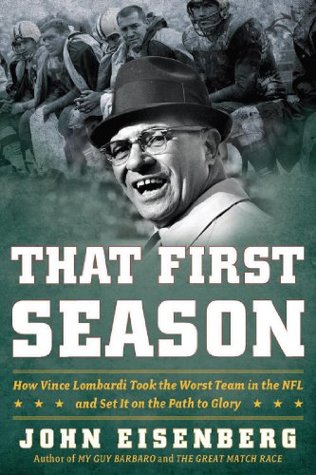
That First Season: How Vince Lombardi Took the Worst Team in the NFL and Set It on the Path to Glory

“I’m not remotely interested in being just good,” he said with an intensity that startled them all.
His playbook would be staggeringly simple, one-fourth the size of Scooter’s, totaling around forty plays.
“If you block well, execute, and eliminate mistakes, this is all you need,” Lombardi said. “It doesn’t matter that the other team knows what is coming.”
Bob Mann, a receiver, had been the first black Packer, catching passes for four seasons in the early 1950s. A quarterback, Charley Brackins, took a few snaps in 1955 before being cut for missing a curfew before a game. Nate Borden, the starting defensive end, had been the only black player on the team for the past few seasons.
And many black players believed an unwritten quota existed—teams just wouldn’t suit up too many blacks at once, fearful of offending fans. The Redskins, owned by George Preston Marshall, a virulent racist, had never suited up a black player. The Packers had moved cautiously.
Tunnell had been the first black man to play for the Giants.
The first time Tunnell wore a Giants uniform, he intercepted four passes in an exhibition game against the Packers.
During the 1950s the Packers had held camp in out-of-the-way places such as Grand Rapids, Minnesota, and Stevens Point, where rental prices for fields and dorms were cheap and players couldn’t get into much trouble.
With its dorms, cafeteria, classrooms, morning mass services, and leafy campus, St. Norbert had everything Lombardi wanted.
If watching films of the 1958 season had taught Lombardi anything, it was that the Packers needed to be in better shape. Their poor conditioning had been an embarrassment; they were out-scored by a combined 192–86 in the second halves of their games.
His first coaching commandment was that players had to be in shape. At clinics, he lectured that football was a series of brief, violent confrontations, and being in shape enabled players to hit harder for longer and win more of those battles.
There was no water on the field—its presence would soften players, the thinking went—but a trainer gave him a handful of the ice kept on hand to limit swelling on bruises and sprains.
The NFL draft lasted thirty rounds, enabling each of the twelve teams to pick up far more players than they needed. Every summer, hordes of rookies descended on training camps, scurried around for a week, got cut, and went home to anonymity, dreams dashed.
You are going to have confidence in me and my system. By being alert, you are going to make fewer mistakes than your opponents. By working harder, you are going to out-execute, out-block, and out-tackle every team that comes your way.”
As a result, several bars would now be off-limits, Lombardi said, including the Picadilly, Hornung’s and McGee’s favorite spot. And wherever they were, they had to sit at tables or booths. No standing at the bar and drinking.
The fine for getting caught standing at a bar was $150, he said.
A few days later, Lombardi went on a room check at 11 P.M. and found Jim Taylor sitting on the edge of his bed with his socks and shorts on. “What time you got, Jimmy?” Lombardi asked. “Eleven, sir,” Taylor replied. “You’re supposed to be in bed at eleven, right, Jimmy?” Lombardi asked. “Yes, sir.” “Jimmy, that’ll cost you twenty-five dollars.”
One day, after leaning over to pick up a towel in the locker room as he listened to more complaints, Vincent stood up and eyed the players. “You think you have it tough?” he said. “I have to live with him!”
“If I ever hear ‘nigger’ or ‘dago’ or anything like that, regardless of who you are, you’re through here,” he said. “You can’t play for me if you have any kind of prejudice.”
Executive committee members had attended the evening player meetings during camp when Scooter and Blackbourn were in charge, but Lombardi didn’t want them around.
Lombardi even set new rules for the reporters covering the team. Previously, they could come and go as they wanted during camp; the Milwaukee Sentinel’s Bud Lea, a Green Bay native, had stayed with his parents when he covered the Packers the year before. Lombardi didn’t want him doing that. “If you’re covering camp, you stay with us here at St. Norbert,” he told Lea.
If the players had small children, as many did, they could bring them to practice, he said, and the kids were encouraged to dash onto the field and hug their fathers after the final whistle.
One day Lombardi railed at them throughout the afternoon workout, complaining loudly about dropped passes, botched fundamentals, and forgotten assignments. Obviously in a foul mood, he picked back up during a meeting that evening, telling them they had a lot to learn. Dramatically, he held a ball aloft and said, “We’re starting at the beginning. Gentlemen, this is a football.” McGee quickly raised his hand. “Coach?” he asked. “What?” Lombardi barked, annoyed at the interruption. “Can you not go so fast?” McGee said. Lombardi couldn’t help laughing. Practice went better the next day.
Lamar McHan was astounded at how clearly he presented the material. “I’ve always had coaches who told me to do things, but didn’t tell me why. Lombardi tells you why,” McHan said.
Returning to Baton Rouge, he convinced the football coach at Istrouma High School to put players on a weightlifting program, no small feat when the football world believed lifting weights slowed players down.
played well enough in 1957 to earn an invitation to the Senior Bowl, where, playing both ways, he butted heads with Ray Nitschke, then a hard-hitting fullback-linebacker from Illinois. Nitschke’s team won, but Taylor was named the game’s MVP.
(Roy would formally introduce strength training to pro football in 1963 when the AFL’s San Diego Chargers hired him and promptly won a title.)
A charity promotion, the game would attract more than twenty-eight thousand fans, a larger throng than the Packers had drawn for any regular-season game in Milwaukee since 1956. Sports fans in Wisconsin’s largest city cared much more about their winning baseball team, the Braves, than the stumbling Packers, but the football team, with its long history, still had support, and people wanted to see if this new coach from New York could make a difference.
They were used to theater-like quiet when they watched game films; Scooter had typically just let the projector run, occasionally offering suggestions; he even fell asleep once as an assistant.
earning a small per diem, barely enough to buy lunch. Their regular salaries didn’t kick in until the regular season.
The NFL was popular enough in cities with teams, but it generated little interest in regions where it had no presence or history, such as the Southeast; when Dave Hanner left Arkansas to become a pro in 1952, some of his friends didn’t even know what a Green Bay Packer was.
The next morning the Packers flew up to Oregon and set up a camp at the University of Portland. They would stay in dorms, hold a week of open-to-the-public practices, and play the Philadelphia Eagles on Saturday night. It was a typical “spread the word” NFL exhibition, but Lombardi declined to speak to a Portland reporter on Monday, saying he had to watch film of the San Francisco game. The reporter derided him in print, calling him “film fan,” but Lombardi shrugged off the criticism; he was more concerned about his pass defense, which, if the San Francisco game was an indication, needed help.
He was surely one of the NFL’s unlikeliest stars, lacking vision in his left eye after a childhood accident. His parents wouldn’t let him play football until he was a high school senior, but he showed such potential as a speedy pass defender that the University of Texas recruited him. (He had to sign a waiver freeing the school of responsibility for further eye damage.) He made up for his lack of depth perception with an intuitive knack for knowing where quarterbacks would throw, and after joining the Packers in 1952 had recorded fifty-one interceptions in seven seasons.
Dillon would just smile and go along with the ruse, impressed by—but not quite sure what to make of—this feisty coach so intent on maintaining standards yet willing to bend them to get what he wanted.
Not wanting to turn any customers away, event organizers allowed late-arriving fans to stand right on the sidelines, on either side of the benches.
Maine had never hosted an NFL game, and Bangor city officials rented ten thousand folding chairs and situated them around tiny Garland Street Field to accommodate the crowd.
Lombardi wasn’t upset in the locker room; he tended to be in a better mood after losses, for whatever reason.
With their exhibition record now even at 2–2, the Packers barnstormed on, flying to North Carolina for their next game, against the Washington Redskins on Saturday night, September 12, at Wake Forest University in Winston-Salem. They would practice in the outfield of a Class B minor-league baseball park for a week before the game. This was the fifth straight year in which the Packers had played an exhibition game in Winston-Salem against Washington. The southern site posed no problems for the Redskins, the only NFL team with no black players, as mandated by owner George Preston Marshall. But
...more
Ray Nitschke joined the team in North Carolina after missing training camp and two-thirds of the exhibition season because of a military-service commitment.
Jack Vainisi knew he was drafting a headache when he took Nitschke in the third round in 1958, but he couldn’t pass up a young man who played a violent game so violently.
The college stadium was half-full as the game kicked off, with most of the fifteen thousand fans supporting the Redskins, the NFL’s southernmost team. A national television audience was watching on ABC, giving fans around the country their first glimpse of Lombardi’s rebuilding project.
On the charter flight back to Green Bay, Starr stared out the window, wondering if he was about to be cut. Lombardi had pledged to keep three quarterbacks, and with McHan more proven, Parilli more experienced, and Francis having a great exhibition season, Starr figured he was in trouble.
The fall semester at St. Norbert had started, so instead of returning to Green Bay, the Packers set up a final training camp near Milwaukee beginning Sunday, September 13. For the next ten days they would practice at St. John’s Academy, a military school, and room at Oakton Manor, a secluded resort on Pewaukee Lake. They would briefly leave camp for their sixth and final exhibition game, against the Pittsburgh Steelers, in Minneapolis, on September 20.
Parilli shook hands with Lombardi and walked away believing he had blown his prospects when he took a dollar off Lombardi in that golf bet at the Oneida Golf and Riding Club back in the spring.
Finally, after six games in six states and more than ten thousand travel miles, the exhibition season was over.
When he came to Green Bay he had thought he would need five years to turn the Packers around, he said, but now he could see it happening in three.
After the Minneapolis game, Lombardi brought the team back to Pewaukee Lake for a few final days of hard practices before the regular-season opener against the Bears on Sunday at City Stadium. A palpable sense of excitement coursed through the camp. Lombardi initially opened the practices to the public, but when more than one hundred fans showed up on Tuesday, the coach eyed them nervously, knowing George Halas was famous for spying on opponent practices. Fans who returned to watch the Wednesday and Thursday practices were shooed away by police.
The play call was “twenty-eight” or “forty-nine,” depending on which back carried in which direction, but either way, its identifying marker was the “pulling” of the guards, who, instead of driving forward on the snap, stepped back, pivoted in the direction of the play, and raced parallel to the line until they passed the tackle and turned upfield ahead of the back, who had taken a handoff and was just behind them, looking for openings. The goal was to create mismatches between the guards and opposing linebackers and defensive backs. For that to happen, the other Packer blockers had to keep
...more

The Power Sweep
Tim Brown fully expected to get cut when Lombardi called him in; he thought he had played well enough to earn a job, recent drops and fumbles notwithstanding, but he had probably run his mouth too much, and NFL teams just didn’t keep that many black players, especially ones who chafed at the status quo. But Lombardi stunned him. “Congratulations, Brown. You’re on the team. You had a hell of a camp,” he said.
Lombardi had delivered on his promise to shake things up, adding three rookies and eight other players who had not been with the Packers before. But still, twenty-five of the thirty-six men had played for Scooter and, in most cases, experienced at least several years of Packer misery.
