
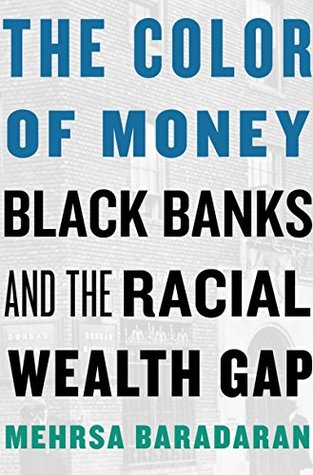
More on this book
Community


Kindle Notes & Highlights

Read between
December 31, 2022 - March 28, 2023

Presidents Carter, Reagan, Clinton, Bush, and Obama disagreed about many things, but they each sought
Presidents Carter, Reagan, Clinton, Bush, and Obama disagreed about many things, but they each sought
to promote black banks and businesses through programs called “community capitalism,” “enterprise zones,” or “minority enterprise.”
to promote black banks and businesses through programs called “community capitalism,” “enterprise zones,” or “minority enterprise.”
Blacks were poor and, due to segregated housing, their homes were worth less. What this meant for black banks was that their deposits were costlier and their loans were less stable, which created a combustible situation over time.
Blacks were poor and, due to segregated housing, their homes were worth less. What this meant for black banks was that their deposits were costlier and their loans were less stable, which created a combustible situation over time.
In fact, the dilemma faced by black banks is highlighted when contrasted with the viable banks created by Italian, Jewish, German, Irish, and Asian immigrants. Each of these immigrant groups faced discrimination and exclusion like the black population, but the key difference was that none of them was systematically, uniformly, and
In fact, the dilemma faced by black banks is highlighted when contrasted with the viable banks created by Italian, Jewish, German, Irish, and Asian immigrants. Each of these immigrant groups faced discrimination and exclusion like the black population, but the key difference was that none of them was systematically, uniformly, and
legally segregated to the extent and for the length of time the black community was.
legally segregated to the extent and for the length of time the black community was.
Many immigrants eventually left their overcrowded ghettos and settled in suburbs where, through violence, zoning restrictions, and racial covenants, blacks were barred. This divergent path is illustrated by the fates of the home loans and banks established by these various immigrant groups. One instructive example is the Bank of Italy, which formed in San Francisco to serve Italian immigrants who could not get loans from the mainstream banks. Eventually, the Bank of Italy grew and merged into the mainstream U.S. banking system—just as Italian immigrants assimilated in...
This highlight has been truncated due to consecutive passage length restrictions.
Many immigrants eventually left their overcrowded ghettos and settled in suburbs where, through violence, zoning restrictions, and racial covenants, blacks were barred. This divergent path is illustrated by the fates of the home loans and banks established by these various immigrant groups. One instructive example is the Bank of Italy, which formed in San Francisco to serve Italian immigrants who could not get loans from the mainstream banks. Eventually, the Bank of Italy grew and merged into the mainstream U.S. banking system—just as Italian immigrants assimilated into...
This highlight has been truncated due to consecutive passage length restrictions.
The bootstraps they were given were
The bootstraps they were given were
government-guaranteed mortgage loans, from which black people were excluded.
government-guaranteed mortgage loans, from which black people were excluded.
This book is a challenge to that premise and it lays bare the fact that the hand that drives black poverty is not a natural and invisible one, but rather the coercive hand of the state that has consistently excluded blacks from full participation in American capitalism.
This book is a challenge to that premise and it lays bare the fact that the hand that drives black poverty is not a natural and invisible one, but rather the coercive hand of the state that has consistently excluded blacks from full participation in American capitalism.
This is a story of economics, politics, and laws that sowed the seeds of injustice into the soil of the American economy. The weeds that grew from it did not need to be fed with racism. It used the materials available—commerce, credit, money, and segregation—to regenerate inequality. It is too simplistic to blame the racists or the loan sharks for the wealth gap. We need to identify the subterranean forces that barely make a visible ripple on the surface as they perpetuate injustice
This is a story of economics, politics, and laws that sowed the seeds of injustice into the soil of the American economy. The weeds that grew from it did not need to be fed with racism. It used the materials available—commerce, credit, money, and segregation—to regenerate inequality. It is too simplistic to blame the racists or the loan sharks for the wealth gap. We need to identify the subterranean forces that barely make a visible ripple on the surface as they perpetuate injustice
over time.
over time.
As a group, blacks are more unbanked than any other race—60 percent of the black population is unbanked or underbanked, while only 20 percent of whites are in the same category.15
As a group, blacks are more unbanked than any other race—60 percent of the black population is unbanked or underbanked, while only 20 percent of whites are in the same category.
What this means is that blacks disproportionately rely on fringe banks, leading to a debt trap. Blacks pay higher interest on mortgages and small loans. They pay more fees on basic services than ...
This highlight has been truncated due to consecutive passage length restrictions.
What this means is that blacks disproportionately rely on fringe banks, leading to a debt trap. Blacks pay higher interest on mortgages and small loans. They pay more fees on basic services than ...
This highlight has been truncated due to consecutive passage length restrictions.
disproportionately by creditors for ver...
This highlight has been truncated due to consecutive passage length restrictions.
disproportionately by creditors for ver...
This highlight has been truncated due to consecutive passage length restrictions.
As Billie Holiday sang, “Them that’s got shall get. Them that’s not shall lose.”
As Billie Holiday sang, “Them that’s got shall get. Them that’s not shall lose.”17
Historian Manning Marable has lamented that “the most striking fact about American economic history and politics is the brutal and systemic underdevelopment of black people.”18 When the Emancipation Proclamation was signed in 1863, the black community owned a total of 0.5 percent of the total wealth in the United States. This number is not surprising; slaves were forbidden to own anything, and the few freed blacks living in the North had few opportunities to accumulate wealth. What is staggering is that...
This highlight has been truncated due to consecutive passage length restrictions.
Historian Manning Marable has lamented that “the most striking fact about American economic history and politics is the brutal and systemic underdevelopment of black people.”18 When the Emancipation Proclamation was signed in 1863, the black community owned a total of 0.5 percent of the total wealth in the United States. This number is not surprising; slaves were forbidden to own anything, and the few freed blacks living in the North had few opportunities to accumulate wealth. What is staggering is that ...
This highlight has been truncated due to consecutive passage length restrictions.
When Martin Luther King stood on the steps of the Lincoln Memorial in 1963, he said that “America has given the Negro people a bad check, a check which has...
This highlight has been truncated due to consecutive passage length restrictions.
When Martin Luther King stood on the steps of the Lincoln Memorial in 1963, he said that “America has given the Negro people a bad check, a check which h...
This highlight has been truncated due to consecutive passage length restrictions.
In order for slavery to function, the slaves needed to serve as cogs in the machine and not its drivers. They were therefore not permitted to own assets or offer their labor for pay in any form. These prohibitions, which included ownership of land and trade of any kind, were often cemented in law and enforced through violence.8
In order for slavery to function, the slaves needed to serve as cogs in the machine and not its drivers. They were therefore not permitted to own assets or offer their labor for pay in any form. These prohibitions, which included ownership of land and trade of any kind, were often cemented in law and enforced through violence.
Many states legally prohibited free blacks from owning property, testifying in courts, or practicing professions or trades above menial labor.11 Black businessmen typically could not sue white debtors in courts and were often restricted from engaging in finance.
Many states legally prohibited free blacks from owning property, testifying in courts, or practicing professions or trades above menial labor.11 Black businessmen typically could not sue white debtors in courts and were often restricted from engaging in finance.
Similarly, an 1852 Maryland statute excluded blacks from membership in thrift or building and loan institutions.13 Where there were no legal barriers, there were social forces that blocked blacks from organizing banks and businesses. “A mere legal grant of a thing,” explained a black businessman, “does not mean that it will be immediately enjoyed. Public opinion is often more binding than law.”14 And public opinion relegated blacks to the lowest economic stratum.
Similarly, an 1852 Maryland statute excluded blacks from membership in thrift or building and loan institutions.13 Where there were no legal barriers, there were social forces that blocked blacks from organizing banks and businesses. “A mere legal grant of a thing,” explained a black businessman, “does not mean that it will be immediately enjoyed. Public opinion is often more binding than law.”14 And public opinion relegated blacks to the lowest economic stratum.
The collective power the black community harnessed through church membership also made black churches a target for racial hostility and social control.
The collective power the black community harnessed through church membership also made black churches a target for racial hostility and social control.
Nat Turner’s slave revolt in 1831, southern legislators passed laws forbidding blacks from preaching or congregating in their own churches. South Carolina even prohibited groups of black individuals from meeting together “for the purpose of mental instruction or religious worship.”
Nat Turner’s slave revolt in 1831, southern legislators passed laws forbidding blacks from preaching or congregating in their own churches. South Carolina even prohibited groups of black individuals from meeting together “fo...
This highlight has been truncated due to consecutive passage length restrictions.
Abram Harris, a prominent black economist in the 1930s, listed the barriers to black enterprise before the Civil War in the following order: “(1) The Difficulty
Abram Harris, a prominent black economist in the 1930s, listed the barriers to black enterprise before the Civil War in the following order: “(1) The Difficulty
of Obtaining Capital and Credit; (2) Low Wages, Competition for Jobs, and Immigration; (3) Mob Violence; (4) Occupational Restrictions; (5) Prohibitions against Owning Certain Types of Property; (6) Denial of the Right to Sue; (7) Restrictions against Settlement in the West; and (8) Civic and Educational Handicaps.” Harris emphasized that “the greatest handicap was, without a doubt, the difficulty of obtaining capital and credit.”21
of Obtaining Capital and Credit; (2) Low Wages, Competition for Jobs, and Immigration; (3) Mob Violence; (4) Occupational Restrictions; (5) Prohibitions against Owning Certain Types of Property; (6) Denial of the Right to Sue; (7) Restrictions against Settlement in the West; and (8) Civic and Educational Handicaps.” Harris emphasized that “th...
This highlight has been truncated due to consecutive passage length restrictions.
The freed slaves had to make the transition from being capital to becoming capitalists—from being chattel to owning it. They had to do this having “neither money, property nor friends,” as Frederick Douglass explained.28
The freed slaves had to make the transition from being capital to becoming capitalists—from being chattel to owning it. They had to do this having “neither money, property nor friends,” as Frederick Douglass explained.
