
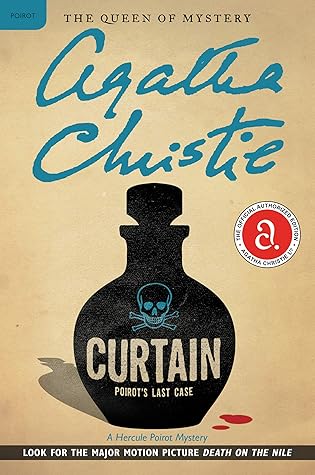
More on this book
Community


Kindle Notes & Highlights
Read between
March 31 - April 21, 2025

“Which method do you propose to try here?” “Possibly all three. The first is the most difficult.” “Why? I should have thought it the easiest.” “Yes, if you know the intended victim. But do you not realize, Hastings, that here I do not know the victim?”
Judith is tall, she holds her head high, she has level dark brows, and a very lovely line of cheek and jaw, severe in its austerity. She is grave and slightly scornful, and to my mind there has always hung about her a suggestion of tragedy.
Your middle finger it is stained with methylene blue. It is not a good thing for your husband if you take no interest in his stomach.” “I daresay I shan’t have a husband.”
He cannoned into the screen round Poirot’s chair, and half turning his head murmured “I beg your pardon” to it automatically.

The old fashioned version of running into a mannequin.
“How is Mrs. Franklin?” I asked. “The same and rather more so,” said Judith. “It’s very sad her being such an invalid,” I said. “It’s maddening for a doctor,” said Judith. “Doctors like healthy people.”
“That nurse of hers can read to her perfectly well if she wants to be read to. Personally I should loathe anyone reading aloud to me.”
“She never reads anything but the cheapest kind of novel. She takes no interest in his work. She doesn’t keep abreast of current thought. She just talks about her health to everyone who will listen.”
Aren't We judgy?
“George has returned to his family. His father is ill. I hope he will come back to me some time. In the meantime—” he smiled at the new valet—“Curtiss looks after me.” Curtiss smiled back respectfully. He was a big man with a bovine, rather stupid, face.
His whole life had been spent in tracking down crime. Would it really be surprising if, in the end, he was to fancy crimes where no crimes were?
He had selected a number of publicly reported happenings, and had read into them something that was not there—a shadowy figure behind them, a mad mass murderer.
Poirot had always persisted in the humiliating belief that I am a transparent character and that anyone can read what is passing in my mind. He tries to soften the blow sometimes by attributing it to my beautiful and honest character which abhors all form of deceit!
Accurate read.
Major Allerton I instinctively disliked. He was a good-looking man in the early forties, broad-shouldered, bronzed of face, with an easy way of talking, most of what he said holding a double implication.
Why the worst type of man can always be relied upon to please and interest the nicest of women has long been a problem beyond me.
Norton, the man I had met rushing out of the house with field glasses? It seemed unlikely. He appeared to be a pleasant fellow, rather ineffective and lacking in vitality.
I have always believed that a love of nature was essentially a healthy sign in a man.
Major Allerton now. I dwelt on him appraisingly. A nasty fellow if I ever saw one! The sort of fellow who would skin his grandmother.
Ew.
Old people, sick people, they shouldn’t have the power to hold up the lives of the young and strong. To keep them tied down, fretting, wasting their power and energy that could be used—that’s needed. It’s just selfishness.”
It was your mother who insisted you should be allowed to make your own mistakes.”
“What did Dr. Franklin think?” “Thought it served him right,” said Judith. “You know, Father, some people really ask to be murdered.”
*side eye*.
I had only met Mrs. Franklin once before. She was a woman about thirty—of what I should describe as the madonna type. Big brown eyes, hair parted in the centre, and a long gentle face.
Nurse Craven was a tall, good-looking young woman with a fine colour and a handsome head of auburn hair.
“Yes, Babs, but the trouble is I’ve got no ideas. Baths and some really comfortable chairs—that’s all I can think of. It needs a woman.”
“You’ve no idea what a lovely creature she was at seventeen. I was home from Burma—my wife died out there, you know. Don’t mind telling you I completely lost my heart to her. She married Franklin three or four years afterwards. Don’t think it’s been a happy marriage. It’s my idea that that’s what lies at the bottom of her ill health. Fellow doesn’t understand her or appreciate her. And she’s the sensitive kind.
But that damned sawbones only takes an interest in test tubes and West African natives and cultures.”
But Boyd Carrington himself was so full of vitality and life that I should have thought he would merely have been impatient with the neurotic type of invalid.
I should imagine the kind of murderer we’re after would have to be inconspicuous.”
“On the other hand,” said Poirot, “it might be better still if the murderer were already a prominent personality—that is to say, he might be the butcher. That would have the further advantage that no one notices bloodstains on a butcher!”
The mauvais sujet—always women are attracted to him.” “But why?” Poirot shrugged his shoulders. “They see something, perhaps, that we do not.” “But what?” “Danger, possibly . .
But I am sure of this—too much safety is abhorrent to the nature of a human being. Men find danger in many ways—women are reduced to finding their danger mostly in affairs of sex.
The excellent fellow who will make a good and kind husband—they pass him by.”
Which is to say that there is a very fair chance of a certain person who is known to one of these people being known to all of these people. It is also open to X to lie wherever the facts are best known.
If a clever and resourceful murderer who had already got away with five crimes—unsuspected as he thought—once awoke to the fact that someone was on his trail, then indeed there was danger for those on his track.
And see, have I not here my faithful dog to protect me also? My excellent and loyal Hastings!”
Only he would say that.
I found him a stolid individual, slow in the uptake, but trustworthy and competent. He had been with Poirot since the latter’s return from Egypt. His master’s health, he told me, was fairly good, but he occasionally had alarming heart attacks, and his heart was much weakened in the last few months. It was a case of the engine slowly failing.
But playing with his wife he made mistake after mistake without ceasing.
Mrs. Luttrell was a very good player indeed, though a rather unpleasant one to play with. She snatched every conceivable advantage, ignored the rules if her adversary was unaware of them, and enforced them immediately when they served her.
“I shall understand it if he ever takes a hatchet to her.”
Leading witness.
Judith—and Allerton. Surely Judith, my clever, cool Judith, would not be taken in by a man of that type? Surely she would see through him?
If only my dear wife were alive. She on whose judgement I had relied for so many years.
Without her I felt miserably inadequate. The responsibility for their safety and happiness was mine. Would I be equal to that task? I was not, Heaven help me, a clever man.
“I’ve never been an early bed-goer. Not when there’s sport abroad. These fine evenings aren’t made to be wasted.”
“Here you are. This is the real dope. You’ll sleep like a log—and have pleasant dreams too. Wonderful stuff Slumberyl—that’s the patent name for it.”
Yeah just take drugs from a complete stranger.
Was he a drugtaker as well? I said doubtfully: “It isn’t—dangerous?”
It’s one of the barbiturates—whose toxic dose is very near ...
This highlight has been truncated due to consecutive passage length restrictions.
“Etherington took drugs—of course—but he overdid it. One’s got to know when to stop. He didn’t.
“Funny chap. Not exactly a Sunday school character but he was good company sometimes.”
For it came to me very strongly that Allerton was almost certainly X. And I had let him see that I suspected the fact.
First of all, and very early on, there came the realization of Hercule Poirot’s infirmity and helplessness.
Let me make clear here and now that I myself have not got the scientific mind. In my account of Dr. Franklin’s work I shall probably use all the wrong terms and arouse the scorn of those properly instructed in such matters.
Judith, who tried to instruct me, was, as is customary with the earnest young, almost impossibly technical.
