
Astronomy

Astronomy is a natural science which is the study of celestial objects (such as stars, galaxies, planets, moons, and nebulae), the physics, chemistry, and evolution of such objects, and phenomena that originate outside the atmosphere of Earth, including supernovae explosions, gamma ray bursts, and cosmic microwave background radiation. A related but distinct subject, cosmology, is concerned with studying the universe as a whole.

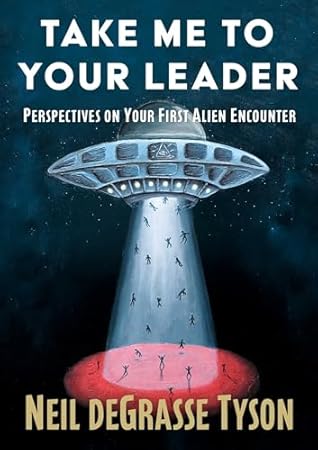
Take Me to Your Leader: Perspectives on Your First Alien Encounter
White Holes
Starry Messenger: Cosmic Perspectives on Civilization
A City on Mars: Can We Settle Space, Should We Settle Space, and Have We Really Thought This Through?
The God Equation: The Quest for a Theory of Everything
Black Holes: The Key to Understanding the Universe
The Thinning
The New Guys: The Historic Class of Astronauts That Broke Barriers and Changed the Face of Space Travel
A Brief History of the Universe (And Our Place in It)
Insomniacs After School, vol. 6
The Biggest Ideas in the Universe: Space, Time, and Motion
Gemini: Stepping Stone to the Moon—The Untold Story
Enlightenment
Our Moon: How Earth's Celestial Companion Transformed the Planet, Guided Evolution, and Made Us Who We Are
God, the Science, the Evidence
Cosmos
A Brief History of Time
Astrophysics for People in a Hurry
Pale Blue Dot: A Vision of the Human Future in Space
Death by Black Hole: And Other Cosmic Quandaries
The Universe in a Nutshell
The Elegant Universe: Superstrings, Hidden Dimensions, and the Quest for the Ultimate Theory
How I Killed Pluto and Why It Had It Coming
Origins: Fourteen Billion Years of Cosmic Evolution
The End of Everything (Astrophysically Speaking)
The Grand Design
The Fabric of the Cosmos: Space, Time, and the Texture of Reality
The Pluto Files: The Rise and Fall of America’s Favorite Planet
Brief Answers to the Big Questions
NightWatch: A Practical Guide to Viewing the Universe
NightWatch by Terence DickinsonSky & Telescope's Pocket Sky Atlas by Roger W. SinnottTurn Left at Orion by Guy ConsolmagnoThe Backyard Astronomer's Guide by Terence DickinsonUranometria 2000.0 by Wil Tirion
Amateur Astronomy
43 books — 13 voters
A Short History of Nearly Everything by Bill  BrysonA Brief History of Time by Stephen W. HawkingAlien Earths by Lisa KalteneggerThe Selfish Gene by Richard DawkinsCosmos by Carl Sagan
Get Smart!
258 books — 120 voters


Carl Sagan
At the very moment that humans discovered the scale of the universe and found that their most unconstrained fancies were in fact dwarfed by the true dimensions of even the Milky Way Galaxy, they took steps that ensured that their descendants would be unable to see the stars at all. For a million years humans had grown up with a personal daily knowledge of the vault of heaven. In the last few thousand years they began building and emigrating to the cities. In the last few decades, a major fractio ...more
Carl Sagan, Contact

Neil deGrasse Tyson
The knowledge that the atoms that comprise life on earth - the atoms that make up the human body, are traceable to the crucibles that cooked light elements into heavy elements in their core under extreme temperatures and pressures. These stars- the high mass ones among them- went unstable in their later years- they collapsed and then exploded- scattering their enriched guts across the galaxy- guts made of carbon, nitrogen, oxygen, and all the fundamental ingredients of life itself. These ingredi ...more
Neil deGrasse Tyson

More quotes...
The Exploration of Nature The whole of nature, of the cosmos is nothing short of miraculous. I draw inspiration and joy fr…more
136 members, last active 4 years ago
A Goodreads version of Cloudy Nights. Some book reviews and some astronomy and astrophotography.…more
4 members, last active 3 years ago
Astronomy and Space exploration This group is for Space lovers and and astronomy lovers .....Discussions about space and ideas a…more
301 members, last active 2 months ago
Noshe de virgenes Recomendación de libros del grupo virgo
1 member, last active 4 years ago

Tags

Tags contributing to this page include: astronomy, astronomia, and atronomy