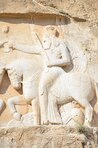
Ahura Mazda (/əˌhʊərə ˈmæzdə/;[1] Avestan: 𐬀𐬵𐬎𐬭𐬋 𐬨𐬀𐬰𐬛𐬃, romanized: Ahurō Mazdā̊; Persian: آهورا مزدا, romanized: Āhurā Mazdā),[n 1] also known as Oromasdes, Ohrmazd, Ormusd, Ahuramazda, Hoormazd, Harzoo, Hormazd, Hormaz and Hurmuz,[2] is the creator deity and god of the sky[3] in Zoroastrianism. He is the first and most frequently invoked spirit in the Yasna. The literal meaning of the word Ahura is "lord", and that of Mazda is "wisdom".
The first notable invocation of Ahura Mazda occurred during the Achaemenid period (c. 550–330 BC) with the Behistun Inscription of Darius the Great. Until the reign of Artaxerxes II (c. 405/404–358 BC), Ahura Mazda was worshipped and invoked alone in all extant royal inscriptions. With Artaxerxes II, Ahura Mazda was gathered in a triad with Mithra and Anahita. In the Achaemenid period, there are no known representations of Ahura Mazda at the royal court other than the custom for every emperor to have an empty chariot drawn by white horses to invite Ahur
[close]
Ahura Mazda (/əˌhʊərə ˈmæzdə/;[1] Avestan: 𐬀𐬵𐬎𐬭𐬋 𐬨𐬀𐬰𐬛𐬃, romanized: Ahurō Mazdā̊; Persian: آهورا مزدا, romanized: Āhurā Mazdā),[n 1] also known as Oromasdes, Ohrmazd, Ormusd, Ahuramazda, Hoormazd, Harzoo, Hormazd, Hormaz and Hurmuz,[2] is the creator deity and god of the sky[3] in Zoroastrianism. He is the first and most frequently invoked spirit in the Yasna. The literal meaning of the word Ahura is "lord", and that of Mazda is "wisdom".
The first notable invocation of Ahura Mazda occurred during the Achaemenid period (c. 550–330 BC) with the Behistun Inscription of Darius the Great. Until the reign of Artaxerxes II (c. 405/404–358 BC), Ahura Mazda was worshipped and invoked alone in all extant royal inscriptions. With Artaxerxes II, Ahura Mazda was gathered in a triad with Mithra and Anahita. In the Achaemenid period, there are no known representations of Ahura Mazda at the royal court other than the custom for every emperor to have an empty chariot drawn by white horses to invite Ahura Mazda to accompany the Persian army on battles. Images of Ahura Mazda, however, were present from the 5th century BC but were stopped and replaced with stone-carved figures in the Sassanid period and later removed altogether through an iconoclastic movement supported by the Sassanid dynasty.
Nomenclature
'Ahura' is cognate with the Vedic word 'asura', both meaning 'lord'.[4] The most likely etymology is from Proto-Indo-European *h₂ḿ̥suros, from *h₂ems- ("to engender, beget"), and therefore it is cognate with Proto-Germanic *ansuz. However, Finnish Indologist Asko Parpola traces the etymological root of Asura to *asera- of Uralic languages, where it means 'lord, prince'.[5]
'Mazda', or rather the Avestan stem-form Mazdā-, nominative Mazdå, reflects Proto-Iranian *mazdáH (a feminine noun). It is generally taken to be the proper name of the spirit, and like its Vedic cognate medhā́, means "intelligence" or "wisdom". Both the Avestan and Sanskrit words reflect Proto-Indo-Iranian *mazdʰáH, from Proto-Indo-European *mn̥sdʰh₁éh₂, literally meaning "placing (*dʰeh₁) one's mind (*mn̥-s)", hence "wise".[6]
The name was rendered as Ahuramazda (Old Persian) during the Achaemenid era, Hormazd during the Parthian era, and Ohrmazd was used during the Sassanian era.[6]
The name may be attested on cuneiform tablets of Assyrian Assurbanipal, in the form Assara Mazaš, though this interpretation is very controversial.[7]
Characteristics
Even though it is speculated that Ahura Mazda was a spirit in the Indo-Iranian religion, he had not yet been given the title of "uncreated spirit". This title was given by Zoroaster, who proclaimed Ahura Mazda as the uncreated spirit, wholly wise, benevolent, and sound, as well as the creator and upholder of Asha.
Zoroaster's revelation
According to Zoroastrian tradition, at the age of 30, Zoroaster received a revelation: while fetching water at dawn for a sacred ritual, he saw the shining figure of the Amesha Spenta, Vohu Manah, who led Zoroaster to the presence of Ahura Mazda, where he was taught the cardinal principles of the "Good Religion" later known as Zoroastrianism. As a result of this vision, Zoroaster felt that he was chosen to spread and preach the religion.[8] He stated that this source of all goodness was the Ahura, worthy of the highest worship. He further stated that Ahura Mazda created spirits known as yazatas to aid him. Zoroaster proclaimed that some Iranian gods were daevas who deserved no worship. These "bad" deities were created by Angra Mainyu, the destructive spirit. Angra Mainyu was the source of all sin and misery in the universe. Zoroaster claimed that Ahura Mazda used the aid of humans in the cosmic struggle against Angra Mainyu. Nonetheless, Ahura Mazda is Angra Mainyu's superior, not his equal. Angra Mainyu and his daevas, which attempt to attract humans away from the Path of Asha, would eventually be defeated.[9]
Plutarch
According to Plutarch,[10] Zoroaster named "Areimanios" as one of the two rivals who were the artificers of good and evil. In terms of sense perception, Oromazes was to be compared to light, and Areimanios to darkness and ignorance; between these was Mithras the Mediator. Areimanios received offerings that pertained to warding off evil and mourning.
In describing a ritual to Areimanios, Plutarch says the god was invoked as Hades[11]: 68 gives the identification as Pluto, the name of the Greek ruler of the underworld used most commonly in texts and inscriptions pertaining to the mystery religions, and in Greek dramatists and philosophers of Athens in the Classical period. Turcan[12]: 232 notes that Plutarch makes of Areimanios "a sort of tenebrous Pluto". Plutarch, however, names the Greek god as Hades, not the name Plouton used in the Eleusinian tradition[a] ("The Hidden One") and darkness.[b]
The Areimanios ritual required an otherwise-unknown plant that Plutarch calls "omomi" (Haoma or Soma), which was to be pounded in a mortar and mixed with the blood of a sacrificed wolf. The substance was then carried to a place "where the sun never shines" and cast therein. He adds that "water-rats" belong to this god, and therefore proficient rat-killers are fortunate men.
Plutarch then gives a cosmogonical myth:
Oromazes, born from the purest light, and Areimanius, born from darkness, are constantly at war with each other; and Oromazes created six gods, the first of Good Thought, the second of Truth, the third of Order, and, of the rest, one of Wisdom, one of Wealth, and one the Artificer of Pleasure in what is Honourable. But Areimanius created rivals, as it were, equal to these in number. Then Oromazes enlarged himself to thrice his former size, and removed himself as far distant from the Sun as the Sun is distant from the Earth, and adorned the heavens with stars. One star he set there before all others as a guardian and watchman, the Dog-star. Twenty-four other gods he created and placed in an egg. But those created by Areimanius, who were equal in number to the others, pierced through the egg and made their way inside; hence evils are now combined with good. But a destined time shall come when it is decreed that Areimanius, engaged in bringing on pestilence and famine, shall by these be utterly annihilated and shall disappear; and then shall the earth become a level plain, and there shall be one manner of life and one form of government for a blessed people who shall all speak one tongue. — Plutarch[13][14]: 47
Scholar Mary Boyce asserted that the passage shows a "fairly accurate" knowledge of basic Zoroastrianism.[15]
In his Life of Themistocles, Plutarch has the Persian king invoke Areimanios by name, asking the god to cause the king's enemies to behave in such a way as to drive away their own best men; de Jong (1997)[16]: 313 doubted that a Persian king would pray to his own national religion's god of evil, particularly in public.
According to Plutarch, the king then made a sacrifice and got drunk – essentially a running gag on Persian kings in Plutarch's writing,[c] and thus dubious evidence for actual behavior.[16]: 314