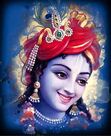
Krishna (/ˈkrɪʃnə/;[12] Sanskrit: कृष्ण, IAST: Kṛṣṇa [ˈkr̩ʂɳɐ]) is a major deity in Hinduism. He is worshipped as the eighth avatar of Vishnu and also as the Supreme God in his own right.[13] He is the god of protection, compassion, tenderness, and love;[14][1] and is one of the most popular and widely revered among Hinduism divinities.[15] Krishna's birthday is celebrated every year by Hindus on Krishna Janmashtami according to the lunisolar Hindu calendar, which falls in late August or early September of the Gregorian calendar.[16][17]
The anecdotes and narratives of Krishna's life are generally titled as Krishna Līlā. He is a central character in the Mahabharata, the Bhagavata Purana, the Brahma Vaivarta Purana, and the Bhagavad Gita, and is mentioned in many Hindu philosophical, theological, and mythological texts.[18] They portray him in various perspectives: as a god-child, a prankster, a model lover, a divine hero, and the universal supreme being.[19] His iconography reflects the
[close]
Krishna (/ˈkrɪʃnə/;[12] Sanskrit: कृष्ण, IAST: Kṛṣṇa [ˈkr̩ʂɳɐ]) is a major deity in Hinduism. He is worshipped as the eighth avatar of Vishnu and also as the Supreme God in his own right.[13] He is the god of protection, compassion, tenderness, and love;[14][1] and is one of the most popular and widely revered among Hinduism divinities.[15] Krishna's birthday is celebrated every year by Hindus on Krishna Janmashtami according to the lunisolar Hindu calendar, which falls in late August or early September of the Gregorian calendar.[16][17]
The anecdotes and narratives of Krishna's life are generally titled as Krishna Līlā. He is a central character in the Mahabharata, the Bhagavata Purana, the Brahma Vaivarta Purana, and the Bhagavad Gita, and is mentioned in many Hindu philosophical, theological, and mythological texts.[18] They portray him in various perspectives: as a god-child, a prankster, a model lover, a divine hero, and the universal supreme being.[19] His iconography reflects these legends, and shows him in different stages of his life, such as an infant eating butter, a young boy playing a flute, a young boy with Radha or surrounded by female devotees; or a friendly charioteer giving counsel to Arjuna.[20]
The name and synonyms of Krishna have been traced to 1st millennium BCE literature and cults.[21] In some sub-traditions, like Krishnaism, Krishna is worshipped as Svayam Bhagavan (the Supreme God). These sub-traditions arose in the context of the medieval era Bhakti movement.[22][23] Krishna-related literature has inspired numerous performance arts such as Bharatanatyam, Kathakali, Kuchipudi, Odissi, and Manipuri dance.[24][25] He is a pan-Hindu god, but is particularly revered in some locations, such as Vrindavan in Uttar Pradesh,[26] Dwarka and Junagadh in Gujarat; the Jagannatha aspect in Odisha, Mayapur in West Bengal;[22][27][28] in the form of Vithoba in Pandharpur, Maharashtra, Shrinathji at Nathdwara in Rajasthan,[22][29] Udupi Krishna in Karnataka,[30] Parthasarathy in Tamil Nadu and in Aranmula, Kerala, and Guruvayoorappan in Guruvayoor in Kerala.[31] Since the 1960s, the worship of Krishna has also spread to the Western world and to Africa, largely due to the work of the International Society for Krishna Consciousness (ISKCON).[32]
Names and epithets
The name "Krishna" originates from the Sanskrit word Kṛṣṇa, which is primarily an adjective meaning "black", "dark", or "dark blue".[33] The waning moon is called Krishna Krishna Paksha, relating to the adjective meaning "darkening".[33] The name is also interpreted sometimes as "all-attractive".[34]
As a name of Vishnu, Krishna is listed as the 57th name in the Vishnu Sahasranama. Based on his name, Krishna is often depicted in idols as black- or blue-skinned. Krishna is also known by various other names, epithets, and titles that reflect his many associations and attributes. Among the most common names are Mohan "enchanter"; Govinda "chief herdsman",[35] Keev "prankster", and Gopala "Protector of the 'Go'", which means "soul" or "the cows".[36][37] Some names for Krishna hold regional importance; Jagannatha, found in the Puri Hindu temple, is a popular incarnation in Odisha state and nearby regions of eastern India.[38][39][40]
Krishna may also be referred to as Vāsudeva-Krishna, Murlidhar, or Chakradhar. The honorary title "Sri" (also spelled "Shri") is often used before the name of Krishna.
https://en.wikipedia.org/wiki/Krishna