The Bare Bones of… Magic Tricks (wait, what?)
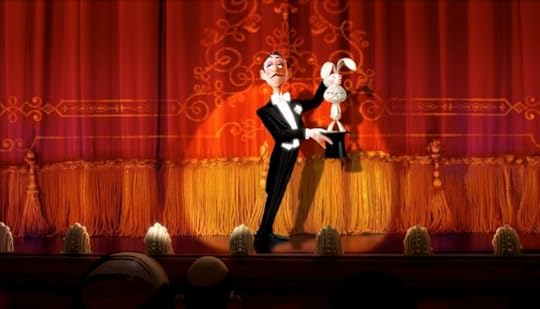
“Presto” (c) Pixar
What: Magic tricks. Yes, sleight of hand, card tricks, sawing women in half, that sort of thing. With references to the films The Usual Suspects (1995) and The Prestige (2006).
Why: Good storytellers have a lot in common with magicians, and watching magicians can teach us a lot about how stories work, as well as why they work.
Spoiler Alert: Low | Medium | HIGH!
For both movies and magic in general, all of which are enjoyed best when you know as little as possible.
Summary:
Recently my husband has taken a liking to watching youtube vids of professional stage magicians and illusionists. Not because he studies to become one (or if so, he hasn’t told me yet), but for the sheer sense of wonder, curiosity and rewinding to try and work out how they did it. And yours truly loves to join him in the puzzle.
A brief disclaimer: neither of us claims to actually know how the tricks we see are done. When a guy in a big parka makes white doves appear in his hands, odds are that those birds were hidden in his coat. You can’t see him pulling them out, but since live doves do not ‘poof’ into existence, the possible explanations are limited.
That said, I have no idea how he, after he has put the birds in a big cage, then makes the cage disappear birds and all and have a scantily clad lady appear in its stead!
Actually, The Prestige gives a rather morbid explanation of how to disappear a cage containing one canary, but I don’t think that method would work as well on six doves. At least I hope not…
In The Prestige, two young magicians living in the late 19th century spiral into a deadly rivalry as they race one another to perform the ultimate disappearance-reappearance act with a human. Both make great sacrifices in their search, and both end up paying a horrible price for their success. However, the most important scene – both to the film’s plot and to this Bare Bones’ subject – is the following:
When the two magicians are still on friendly terms, they go to see an old Chinese magician performing. On stage, this small, crooked old man in traditional Chinese robes makes a bowl full of water disappear at one end of the stage. He then waggles, as he does, to the other end of the stage, where he reappears the bowl of water. The only explanation, one of the young magicians argues with his friend, is that the old man carried the heavy bowl across the stage between his knees.
“But it is an old man,” the other counters as they watch the old Chinese guy waggle slowly out of the theatre and into a coach. “He is never strong enough to do that.”
“He is. He just gives the impression of being weak and makes us believe that. The feeble waggle is an act. But for such an illusion to work, you have to keep up the act outside the theatre as well!”
And this is exactly what the character Verbal Kint does in The Usual Suspects.
Kint is the only survivor of a band of five criminals after what the police believe is a drugs raid gone bad. Kint is also bald, emotional and both his left hand and left foot are crippled, causing him to walk with a distinct limp. By all appearances, he is the runt of the gang, only alive because the rest of his mates didn’t trust him with any important tasks during the raid.
All through his questioning by the police and the visuals of the story he tells, both the audience and the police only ever see him like that. Only at the very end, when the police have let him go and Kint limps off down the street, does the camera focus on his crooked foot straightening out and the so far useless hand being flexed. The man’s whole stance changes, and the audience realises – moments before the police receive a facial sketch confirming the audience’s suspicion – that not only is Kint the mastermind behind the raid (which was not about drugs, but about revenge), he is also the elusive master criminal known as Keyser Soze.
Kint ‘lived the act’. By posing as someone who would be physically and mentally incapable of doing the things he did, no one ever suspected him of being a crime lord. He fooled everyone on both sides of the silver screen.
Story Skeleton:
A good magician can subtly divert his audience’s attention, so they don’t notice what he is doing. His actions happen faster than expected or they happen elsewhere or at an unexpected moment. As a result, the moment when the proverbial or literal rabbit is pulled out of the hat, the audience is surprised and confounded.
A good storyteller can subtly drop a phrase, a reference, a hint, without drawing the reader’s attention to it. It fits the narrative or dialogue and seems unremarkable, being neither important nor suspiciously unimportant. Until later in the story. Then this little titbit turns out to be important after all and twists the plot with the impact of a ten-ton explosive.
But where a magician must only convince the audience that he has truly sawed his assistant in half, a storyteller must convince not only the reader, but the story’s cast as well!
The writer knows the trick – the plot device – because she devised it. But she must present the plot device in such a way that it is convincing, yet doesn’t give away too much. This is the performance.
The characters partake in that performance, but what each character knows and understands of it depends on how they interpret the performance. It is the writer’s job to see to it that all characters respond to the plot device according to their individual knowledge and understanding.
Finally, plot device, performance and character responses must come together as a whole to convince the reader of that which the writer wants him to be convinced. Which may or may not be ambiguous: remember how J.K. Rowling had her readers second-guessing Professor Snape’s loyalties for seven books? Now that is an amazing performance of cups-and-balls!
Lesson learnt:
A good story contains plot developments that gives the reader the same feeling of astonishment as a well-performed card trick. That comparison is not accidental: storytelling and stage magic have a great deal in common.
The trick of storytelling is how to make your audience think what you want them to when you want them to. This is exactly what magicians do. Understanding the basics of stage magic can help storytellers give their stories that little pinch of fairy dust!