
I Tweet, Therefore I Am
Anyone who gets updates on my blog knows that I haven’t posted anything in a while, and I’m here to say that I’m not going to post anything for a while (except for this, of course). There are three reasons for this, two practical, and one ideological. The first, more mundane reason is that very few people read these posts (and I greatly appreciate the fact that some of you do); the second is that I’ve become insanely busy. I’m teaching four classes, one of them new, as well as working on my anthology, Nietzsche and the Philosophers, as well as trying to write my own essay for that volume. In addition, I’m working on a new novel. Add to that the duties and obligations of both work and home, and I just don’t have the time or the energy to do any blogging.
The Mistake of Self-Publishing
The more serious idea has to do with my evolving attitude about a writer’s online presence. Let me begin that discussion by saying that, in my humble opinion, self-publishing is for the most part a big mistake. It encourages both those who aren’t ready to publish and those who just shouldn’t be published to glut the marketplace with material that’s mediocre at best, and often far worse. With regard to the former, instead of putting in the time and the hard work and effort (I estimate about ten years, give or take)—and leaving behind those first, weak, attempts that should’ve been aborted—these writers put them out there for all the world to see and hardly anyone to buy. It takes a great deal of time and words written in order to be able to hear your writing, to hear your mistakes. So these would-be authors can’t yet hear how crappy their prose is, and haven’t yet figured out that that their characters are shallow, etc. Instead of going through a kind of apprenticeship and putting in the effort to produce something good that either a literary agent or an independent publisher is willing to take a chance on, they self-publish. On the other hand, some of these folks just aren’t cut out to be writers; they’ll never have the chops. Their work is the equivalent of that sophomoric poetry or music we all produced in our early years. Now, instead of molding in a shoe box at the back of the closet, the stuff gets tossed, with all the other detritus, into the online literary market place.
Let me pause to note that I’m sure there are good writers who, for whatever reason, self-publish. Perhaps they enjoy the absolute autonomy of the process; perhaps they haven’t yet found an agent or a publisher, whether independent or industry, who shares their visions of things. It’s a hard path, and I don’t mean at all to denigrate their efforts. I’m talking about the majority here.
An Online Presence
The phenomenon of self-publishing has led to step A: These would-be Hemingways take to social media to hock their wares. They have no other way to market their writing, and online promoting is largely free (Twitter and Facebook) or at least cheap (a website, a blog). That then led to step B: The claim, now largely taken as Gospel, that an author must build an audience and promote him or herself, even before, and whether or not, he or she has published anything. Consequently, Twitter (for example) is full of users who call themselves writers, discuss the writing life, post platitudes about writing, either without having published a word or after having self-published a substandard piece of work. (I’ve seen posts by people online calling themselves writers that made me wonder if they were even fully literate. No joke.)
It’s true that (at least some) agents say that an author needs to have some sort of online presence. Many won’t take a writer seriously if he or she has no track record at all or is publicly invisible. But that means putting up a website or blog, perhaps posting some short stories, seeing if you can get pieces of short fiction published in print or online journals. It doesn’t mean promoting oneself as a writer, pre-marketing works that don’t yet exist.
[Of course my whole discussion here is about fiction writers who blog; it’s not about non-fiction writers whose medium is a blog, which is now a perfectly legitimate platform for nonfiction work.]

If you couple the sometimes-adolescent need to express one’s feelings (in writing), along with the sometimes-adolescent need for validation, and throw in the public format of the internet, you get the phenomena described above of a deluge of self-published crap and empty self-marketing—empty because there’s nothing yet to market. People want celebrity without actually having any talent and without having actually done anything interesting (and unfortunately, society and the media often foster that desire, rewarding some who are talentless and unproductive with fame and fortune). Some believe if they post enough pictures of themselves and tweet and blog about every minute and mundane detail of their lives, those lives will somehow matter, despite the fact that they aren’t really living, just living vicariously on the internet. The Cartesian dictum, “I think, therefore I am” is transformed in the 21st Century to “I tweet, therefore I am.”
My Current Situation
I’ve written ten or eleven novels (not sure because I’ve lost count, and at least one was aborted in the middle), one of which was published by an independent press. I had two subsequent e-publications through what my agent at the time called “agent-assisted self-publishing,” which he concocted as a kind of hybrid notion of working through an agent and self-publishing. Really, I was just self-publishing and he was helping me do it. At that point I got on the bandwagon, joined Twitter, started a blog, updated my website. I had gone through the apprenticeship, so I wasn’t putting out crap, but nonetheless I did fall under the spell of the so-called common wisdom that I had to pre-build an audience for that next real publication.
Nothing came of all this. No one bought my e-novels, and I spent precious time composing blogs and supposedly building an online audience, when I should’ve been doing the actual work of a writer: writing and getting better at writing. It’s this realization that led me to quit blogging and to cut back on my online activities until I actually have something real to promote.
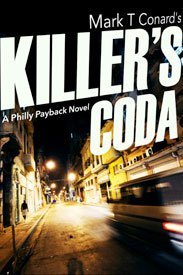
Killer’s Coda: A good book nobody bought.
I refuse ever again to self-publish, and while I have nothing at all against independent publishers—there are many fine ones who are doing excellent work—I’m dedicating myself to the traditional route of industry publishing. And that means finding an agent who has real connections, which means producing novels that an agent believes he or she can sell. Yes, I hear the voices of the nay-sayers shouting that the industry is only interested in making money, in novels that have commercial value; they’re not interested in real art, so anyone who fits into that mold is selling out, etc. I respond: First, it’s quite possible to produce something worthwhile that is also sellable by industry standards (witness Chuck Palahniuk, Cormac McCarthy, and Philip Roth); Second, Shakespeare, Dostoyevsky, and Joyce were artists (that word gets way overused these days); I’m a craftsman. I want to tell good stories that people will enjoy reading. It’s not selling out to craft those stories such that they’re marketable.
I’m pleased to say that four different agents at four different literary agencies in New York are currently reading one of my manuscripts. That doesn’t mean of course that any of them will end up representing me, but it is encouraging. (I had an offer from two independent presses to publish that same novel, but neither deal was quite what I wanted.) I’m also pleased to say that the new novel I’m working on kicks ass. I always think, when I finish a novel, “this one’s going to sell for sure!” But I have new and better reasons for thinking that’s really true of this particular story.
So, who knows, maybe soon I’ll be back blogging and promoting—because I’ll really have something to say.


