The Sticky Note Approach to Revision
I hate revision.
I’m just going to put that out there as the author of a book that went through thirteen revisions. I know there are authors out there who love it. For them, the first draft is agony. Once it’s down on paper, oooh! The fun begins. Me? The first draft is where the glory is. Everything afterwards? That just what you do because, you know, you’re an author. You gotta do it. It’s not like anyone else is going to.
When I first worked through revisions, back in my novice days (ha!), I printed out a copy of the novel in question, read through, marking in where edits belonged (sometimes bringing together feedback from two or three readers). And then I’d sit down before my computer and work through it. Easy-peasy.
Then I got serious about writing and developed a beta reading team. Yep. Team. For my novella Sunbolt, I got feedback from no less than ten beta readers in the first of two rounds of beta reading. Suddenly, working from a printout with my trusty purple pen looked like a recipe for certain failure. How was I even going to squeeze all my notes in, let alone make notes on what should be moved where? And did I really want to work through the manuscript ten times just finding where each edit belonged? Um, no.
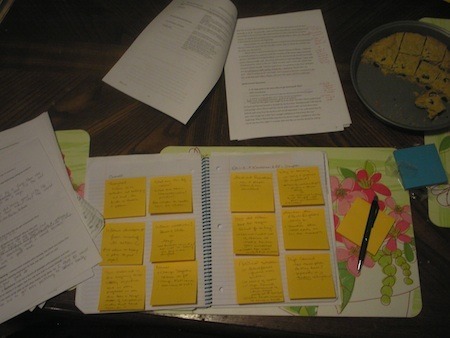
So I set off on a search for a revision method that would work for me. I tried a few different methods, all tried and true by various authors, and was beginning to despair that I’d find anything that would work for me. I’ve used Excel for everything from business accounting to event planning–but I couldn’t make it work for revision. And then I discovered … sticky notes. You know, generic, find them at the dollar store, Post-It style notes. Those things are amazing. And here’s what I did with them…
I found me a half-used notebook (yes, I’m thrifty like that) and started writing headers on the pages, by and large reflecting the chapters in the book, in order. Things like: New Chapter One, Chapter: Betrayal, etc. Sometimes, if I was expecting a lot of edits for a chapter, I left two or three blank pages open following the header. Then, as I received back edits from each of my beta readers, I jotted down what I was going to use from their feedback on the sticky notes–just one thought / edit per note, as concisely and clearly as possible. This is big-picture editing, mind you–not grammar or language-focused line-editing. And…you guessed it! Once a sticky note for an edit came to life, it got stuck to the appropriate “chapter” page.
There are a few awesome things about working with sticky notes:
You can note that a scene needs to move, and then stick it where it goes. And then, when you change your mind, move the sticky, again and again and again.
When you complete that edit, you can peel off that sticky and move it to the back of your notebook. There is no sense of success like watching the padding at the back of your notebook grow, and watching your to-do stickies thin out to a mere one or two per chapter.
You can pick what part of your book you want to work on, reorder things, re-prioritize, color code by ink or sticky note color, and generally be as organized or chaotic as your little heart wishes
Your notes are sticky! They do not fall out when, inevitably, the baby grabs the notebook! (Or, in other households, a pet / sibling / significant other.)
What methods do you use to help you work through revisions?