How To Be Grateful…For Everything (Even the Tough Stuff)
I’m giving a talk in Seattle on 12/3 as part of the Daily Stoic Live tour— grab seats and come see me ! I’ll also be in San Diego on February 5 and Phoenix on February 27. More dates will be announced soon— sign up here and we’ll let you know when I’m coming to your area.
Forgiveness is a lovely idea, it’s been said, it’s actually forgiving someone that’s hard.
Gratitude is another one of those virtues that’s easy to talk about but hard to practice.
Today is Thanksgiving in America. It’s a day that we’re supposed to center around giving thanks. The usual candidates come to mind: family, health, and the food in front of us. And rightly so. These are the cornerstones of a fortunate life, and they deserve recognition and appreciation.
It’s easy to be grateful for this stuff…because it doesn’t really ask anything of you. Of course you appreciate what is wonderful.
But what about the things we didn’t ask for?
The obstacles. The frustrations. The wrong turns. The stresses and difficulties. The people that wronged you. The bad days.
Should we be grateful for those too?
Yes, those especially.
Especially because they are hard to be grateful for.
Marcus Aurelius talks in Meditations about a period of his life where he felt like there was not much to be grateful for. And indeed, it certainly looked like the gods were out to get him. There was the Antonine plague, which would kill literally millions of people during his reign. There were wars, floods, and famines. He would bury several of his children. He was betrayed by his most trusted general in what amounted to an attempted coup. He did not meet with “the good fortune he deserved,” one ancient historian noted, “as his whole reign was a series of troubles.”
It was during all of this that he told himself that it wasn’t all unfortunate that it happened. In fact, he was fortunate that it happened to him and that he’d survived it. Perhaps someone else wouldn’t have known how to do that or what to do with it. Maybe someone else would not have been so lucky in all the senses of the word.
In another passage, he gets even more explicit (and I think you could argue, nearly superhuman):
“Convince yourself that everything is the gift of the gods, that things are good and always will be.”
Yes, even the pain and the loss and the haters and the problems.
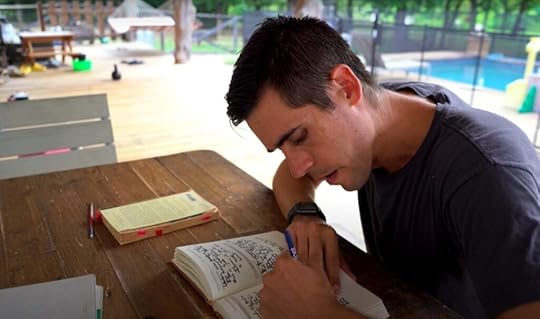
In the mornings when I sit down to journal, one of the notebooks I try to write in is a gratitude journal. When I first got it, I would fill the pages with the lineup I mentioned above—my family, my health, my career, the people and things and opportunities in my life that mean a lot to me. But after a time, this came to feel sort of pointless and rather repetitive. I was just going through the motions. I wasn’t doing any work.
What I began to do was try to find ways to express gratitude, not for the things that are easy to be grateful for, but for what is hard.
I wanted to practice seeing everything as a gift from the gods, as Marcus Aurelius wrote. Because while it’s easy to count my blessings of the good things in life, it’s much more difficult to see the bad things as gifts, too. But with this practice, I’ve learned to see they can be.
After all, don’t we eventually, inevitably come to understand that those heartbreaking or frustrating things that happened helped make us into who we are?
So I write down, in the moment, that:
I am grateful for that troublesome client—they helped me develop better boundaries.
I am grateful for that weather delay and that night spent in the airport—not only did I eventually get home safe, thanks to the pilots, but it gave me time to call my wife and have a nice, meandering conversation. I got some writing done. I got a story out of it.
I am grateful for that rejection email—it forced me to reevaluate and improve my work.
I am grateful for all the bad things people do and have done—it’s a lesson. It’s an opportunity. It gives me, it gives us, the chance to do good (by the way, we’re raising money to donate 3 million meals to hungry families with Daily Stoic. I’d love for you to help!)
I am grateful for that loss—it reminded me of what truly matters in life. I’m grateful for the time I did get with them and losing them make that clear.
And on and on.
In writing it, I am forcing myself to think it, express it, and after enough times, believe it.
Epictetus talked about how every situation has two handles. You can decide to grab onto anger or appreciation, fear or fellowship. You can look at the obstacle or get a little closer and see the opportunity. You can pick up the handle of resentment or of gratitude.
It’s so easy to miss the fact that Marcus Aurelius could not have been Marcus Aurelius without those unending series of troubles. The difficulties that shaped him, refined him, called greatness out of him. It’s also easy to miss, when we focus on all the bad breaks the guy got, all the tragedies he experienced, that on the whole, Marcus was incredibly lucky. After all, this dude was chosen to be emperor. For next to no reason at all, Hadrian selected a young boy and gifted him unlimited power and wealth and fame. Marcus had a wonderful wife, a stepfather he adored, amazing teachers and he discovered Stoicism, which guided him when he most needed it. For everything that went wrong in his life, for everything that was taken from him, the Gods actually gave him an equal number of gifts. That was the handle he constantly reminded himself to grab.
As Cicero pointed out, “You may say that deaf men miss the pleasure of hearing a lyre-player’s songs. Yes, but they also miss the squeaking of a saw being sharpened, the noise a pig makes when its throat is being cut, the roaring thunder of the sea which prevents other people from sleeping.”
See, there’s a positive to every negative!
In the chaos and dysfunction of the world, I try to notice where I have been gifted in the latter category than where I have been deprived in the former. After all, I’m still alive. It could always be worse. And I remain confident in my ability to keep going and to turn this into something good.
So, as you gather with family and friends this Thanksgiving or Christmas or any other celebration you might partake in, appreciate the obvious gifts—the food, the health, the love in the room. But as the moment fades and life returns to its usual pace, amidst the chaos and dysfunction of the world, challenge yourself to make gratitude a daily practice.
Not just for what is easy and joyful, but for what is hard. For what tested you, stretched you, humbled you.
Whatever 2025 has been for you—however difficult, however painful—be grateful for it. Give thanks for it. Think about how it shaped you. Think about the good that came of it. Think about how it could have been worse.
Write this gratitude down.
Say it out loud.
Everything is a gift.
It’s a gift you can give yourself.
***
I’m taking the stage in Seattle, WA at Town Hall Seattle NEXT WEEK on December 3rd! I would love to see you there (or at one of the other stops coming up in the new year, which you check out at dailystoiclive.com ).

Separately…Over at Daily Stoic, we’re raising money for Feeding America. This has become our annual alternative to the disgusting commercialism of Black Friday and Cyber Monday that now dominates Thanksgiving weekend.
Every year since 2019, instead of pushing sales this time of year, we fundraise to provide meals to families experiencing hunger. We donated the first $30,000 and we’d like your help in getting to our goal of $300,000—which would provide over 3 million meals for families across the country!
Just head over to dailystoic.com/feeding —every dollar provides 10 meals, even a small donation makes a big difference.