Viral Posts: The 4-Ingredient Formula for Creating Amazing Content That Builds Your AI Business
Your AI business needs viral posts.
Not just any content. Not another generic how-to guide that gets lost in the noise.
You need viral posts that establish authority and reach thousands of potential clients who need what you’re selling.
Here’s the problem: Over 600 million blogs exist worldwide. More than 7.5 million posts go live every single day.
Your content is competing against an ocean of information. Most of it mediocre. Some of it good. Very little of it actually breaks through.
So how do you make viral posts that don’t just get clicks, but build your business?
You follow a structure. A proven formula that taps into what makes people stop scrolling and start sharing.
The Anatomy of Viral Posts: 4 Ingredients That Will Magnetize Your AudienceStories that get shared follow a specific structure.
Master this, and your content gets seen by thousands more people instead of dying in obscurity.
This isn’t about luck. It’s about understanding human psychology and what makes people hit that share button.
There are four essential ingredients to viral posts. Let’s look into each one of them.
Viral Posts Ingredient #1: A Mouthwatering Hook That Stops the ScrollA hook is your opening line. The first thing people see when they encounter your content.
It’s the make-or-break moment that determines whether someone keeps reading or scrolls past. You have about three seconds to capture attention before you lose them forever.
Think of it as the headline of your story, but with more punch. More intrigue. More “I need to know what happens next.”
In your hook, you should be able to grab attention immediately. Create curiosity that makes it impossible to scroll past.
Like in this example from my own First Movers blog:
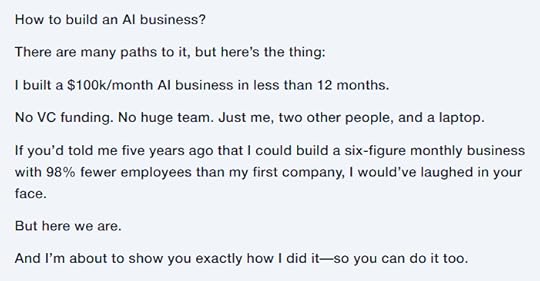
See what I’m doing here?
I’m building tension. I’m raising curiosity. I’m making readers ask, “wait…what?”
Your hook should create a gap between what people expect and what actually happened. It should make them need to know more.
Most content fails here. It starts with boring context or background nobody cares about yet.
Cut straight to the interesting part. The part that doesn’t make sense at first glance.
What Makes a Hook Actually WorkA strong hook contains surprise. It challenges assumptions.
It can be a shocking statistic. A counterintuitive truth. A transformation that seems too good to be true.
But it has to be real. People can smell manufactured drama from a mile away.
The best hooks come from your actual experience. The moments that made you stop and realize everything you thought was wrong.
Viral Posts Ingredient #2: The Raw Journey That Shows Real StruggleThe journey is the middle part of your story. It’s where you show how you got from point A to point B.
This isn’t a highlight reel. It’s the messy, uncomfortable reality of what it actually took to achieve your transformation.
Most people skip this part because it’s vulnerable. It exposes failure. It admits struggle.
But this is exactly why the journey matters. This is where connection happens.
Don’t skip the hard parts. That’s where the real value lives.
Show the challenges. The setbacks. The 3am moments when you wanted to quit and do something easier.
This is what separates viral posts from forgettable ones.
When I pivoted from Express Writers to First Movers, I didn’t just wave a magic wand and suddenly have an AI education empire. I had to unlearn everything I thought I knew about building a business.
I had to face the fact that the model I’d spent 7 years perfecting was going to be obsolete. That hurt.
I had to learn AI tools from scratch while my competitors had a head start. That was humbling.
But here’s what happened: When I started sharing those struggles, my content exploded. People related to the journey, not just the destination.
Why Vulnerability Creates ConnectionYour audience isn’t looking for perfection. They’re looking for proof that success is possible for someone like them.
They’re looking for open-hearted vulnerability.
Like in this popular post by Jon Morrow, where he fearlessly shares his not-so-polished side.
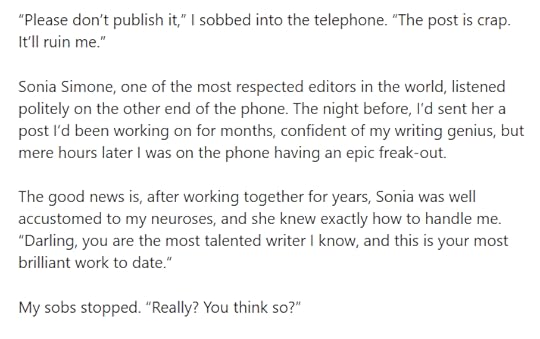
When you share only the wins, when you show only your airbrushed side…you create distance. You become someone they admire from afar but can’t relate to.
When you share the struggle, you become someone they can follow. Someone who gets it.
The journey is where trust gets built. Where people start thinking “If they faced those problems and solved them, maybe I can too.”
Viral Posts Ingredient #3: A Crystal-Clear Transformation With ProofThe transformation is your outcome. The result of everything you went through during the journey.
This is where you show what changed. What’s different now compared to where you started.
But here’s the key: vague transformations don’t work. “Things got better” doesn’t inspire anyone to share your content.
You need specifics. Numbers. Concrete details that paint a vivid picture of the change.
What changed? What’s different now?
Be specific. Give numbers. Paint the picture so clearly they can see it.
Like in my First Movers blog, How to Build an AI Business: I Hit $100k/Month in Under 12 Months:
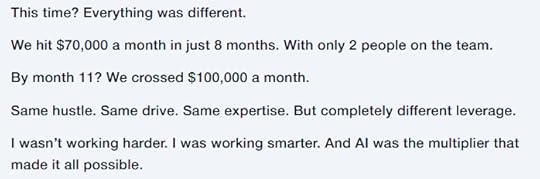
Now, you try:
Vague transformation: “Things got better.”
Powerful transformation: “I went from working 80-hour weeks managing a team of 100 to working 30-hour weeks with one assistant, while making the same revenue.”
See the difference?
Specifics make viral posts credible. They make your story feel real instead of like marketing hype.
The Numbers That MatterDon’t just share revenue numbers. Those are important, but they’re not the whole story.
Share time saved. Stress reduced. Freedom gained.
Share how many clients you helped. How many people changed their business because of what you created.
Share the metrics that prove the transformation was real and sustainable, not just a lucky break.
Viral Posts Ingredient #4: An Actionable Lesson People Can Use ImmediatelyThe lesson is what someone can take away and apply to their own situation. It’s the teachable insight from your experience.
This is what transforms your story from entertainment into value. From interesting into useful.
Without a lesson, you’ve just told a story. With a lesson, you’ve given someone a tool they can use to change their own outcome.
The best lessons are specific enough to be actionable but broad enough to apply to different situations.
What can someone do right now with what you just shared?
This is how you go from entertaining to valuable. From interesting to indispensable.
Don’t just tell a story. Give people a framework. A principle. A technique they can implement immediately.
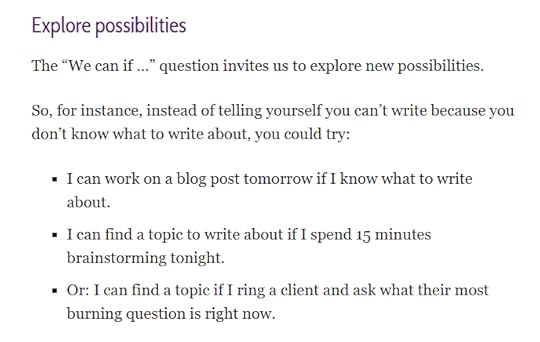 From Insight to Action
The best viral posts create a clear path from inspiration to implementation.
They make people think “I understand this” and then “I can do this.”
Break down your lesson into steps. Make it concrete. Remove the mystery so people can actually apply it.
This is what separates content that gets shared once from content that gets bookmarked and revisited.
The Secret Ingredient: Raw AuthenticityKnow what secret ingredient you should never set aside?
That’s right: authenticiy.
Be vulnerable. Share failures alongside successes.
One of my posts following this framework reached 90,000 people in under 48 hours and generated 1,500 new followers in a single day.
Why? Because I was real. I showed the struggle, not just the highlight reel.
That’s what made it viral. Not perfect execution. Honest humanity.
Why Authenticity Wins in 2025Anyone can have the same tools. Not everyone can tell your story.
Your unique experience is your competitive advantage in a world where AI can generate generic content in seconds.
The posts that break through share something AI can’t replicate: genuine human experience with all its messy complexity.
Your failures are just as valuable as your successes. Sometimes more so, because that’s where the real lessons live.
Master the Formula, Build Your BusinessCreating viral posts isn’t about getting lucky or gaming algorithms.
It’s about understanding what makes people stop, read, and share. It’s about combining structure with authenticity.
The hook grabs attention. The journey builds connection. The transformation proves possibility. The lesson delivers value.
Do this consistently, and you build more than viral posts. You build authority. You build trust. You build an audience that actually converts.
Get the Complete Blueprint for Content That ConvertsWhen you join First Movers R&D AI Labs, you get all the blueprints, courses, and guidelines on how to make content that attracts people to your AI business.
And how to use AI to cut your writing time from 7 days a week to a few hours per week. (While still keeping your authentic voice and story.)
And so much more.
Not just theory. Actual frameworks you can implement today.
You’ll learn how to use AI tools to scale your content production without sacrificing quality. How to find your unique angle in a crowded market. How to turn readers into clients.
You’ll get access to the exact systems I used to build a $100K/month business in 11 months with a team of 2.
The AI Comms Course shows you step-by-step how to create content that positions you as the obvious choice in your market.
No fluff. No outdated tactics. Just what’s working right now in 2025.
Want the details?
Common Questions About Creating Viral PostsWhat is a viral post?A viral post is content that spreads rapidly through social sharing, reaching far beyond your immediate audience. It’s measured by engagement rates, share counts, and the speed at which new people discover it.
Viral posts typically get shared because they evoke strong emotions, provide immediate value, or present information in a uniquely compelling way.
How many views does a post need to be considered viral?A viral post typically needs to reach at least 10 times your normal engagement rate. For a small business, that might be 5,000 views. For an established brand, it could be 500,000 views.
The key isn’t the absolute number. It’s the exponential growth and sharing pattern that defines viral content.
Can B2B content go viral?B2B content can absolutely go viral, though it looks different than consumer viral posts. B2B viral content spreads through LinkedIn shares, industry forums, and email forwards rather than Instagram or TikTok.
Focus on insights that challenge industry assumptions or provide frameworks that solve real business problems.
How long should viral posts be?Viral posts range from 150-word social media posts to 2,000-word blog articles. The length matters less than the value and structure.
Short posts work when they deliver a powerful insight quickly. Long posts work when they provide comprehensive value that justifies the time investment.
Do viral posts actually convert to sales?Viral posts can convert to sales when they attract your target audience and include clear next steps. Not all viral content converts, especially if it goes viral for entertainment rather than value.
The best converting viral posts attract people who have the problem you solve and position your solution as the logical next step.
How often should I try to create viral posts?Create viral posts when you have something genuinely valuable to share, not on a forced schedule. One authentic viral post per quarter beats twelve mediocre attempts.
Focus on consistent quality. Viral posts often emerge from your regular content when you hit on the right combination of timing, topic, and presentation.
What platforms are best for viral posts in AI business?LinkedIn dominates for B2B AI business viral posts. Twitter works for thought leadership. Medium reaches people actively searching for in-depth content.
Choose platforms where your target clients already spend time, not where you think viral content should live.
Can I use AI to create viral posts?You can use AI to help structure and refine viral posts, but the core story and insights must come from genuine human experience.
Use AI as a tool for efficiency, not as a replacement for your unique perspective and voice.