
Guest Post: A Call to Use Sacred Land for a Sacred Purpose
 November 11, 2025 Guest Post
Guest Post by Megan Knowles Thorne
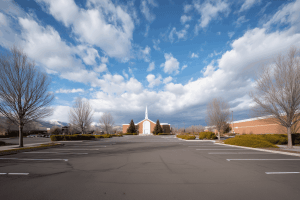
I drive past my local LDS church several times a week. Situated on the corner of a busy thoroughfare, it’s impossible to miss. Whether I’m heading to the mall, our regional park, or a friend’s house, the building is a constant presence. And yet—day or night, weekday or weekend—it’s almost always empty. Depressingly so.
Even on Sundays, even when both wards that share the building are meeting simultaneously, the massive parking lot remains largely unused. It likely always has been. It was built too large, a monument to overestimation or imagined growth that never came. And now, it sits—vacant and wasted.
Meanwhile, in California, we are in the throes of a housing crisis. The numbers are sobering: the state needs an additional 2.5 million homes to meet current demand. In San Diego County, where I live, we’re short over 170,000 housing units. Last year, fewer than 10,000 were completed. At that rate, it would take nearly two decades just to catch up—without even accounting for future growth.
The human toll of this crisis is devastating. Despite significant funding directed toward addressing homelessness, the most essential solution—more housing—remains out of reach for too many. In San Diego County alone, an estimated 187,000 individuals are experiencing homelessness. That’s not a typo.
Too often, people frame homelessness as a “mental health” or “substance abuse” problem. But that misdiagnoses the issue and has been weaponized as an excuse to avoid action. The data is clear: when people can’t afford housing, they become homeless. While mental health and substance abuse support are needed, multiple randomized trials and meta-analyses show housing first approaches produce faster exits from homelessness and far greater housing stability than “treatment-first” models.
A Matter of Land—and WillRecognizing the urgency, California has passed a flurry of legislation to accelerate housing production— striving to make it more affordable, easier to permit, and identify more available land. Cities and counties are leading the way, requiring that underutilized public land be rezoned for housing. Private landowners are being incentivized to follow suit, but we need more help.
In Los Angeles, some religious communities are stepping up in inspiring ways. Not only have non-profits and faith-based organizations taken the lead in feeding and caring for unhoused members of our community, but they have become partners in finding policy solutions.
In LA, several churches have offered up unused parking lots or older buildings no longer in need to be redeveloped into affordable housing.
Rev. Adrienne Zackery at Crossroads United Methodist in Compton, led the way for a nearly empty one-acre lot to become roughly 65 affordable apartments stacked over new worship and community space. She explains, “When the Lord’s Prayer says, ‘Thy kingdom come, thy will be done on Earth,’ it is the responsibility of the church to meet the needs of the community, which include housing.” That right there is true Christianity.
The East Whittier United Methodist Church is advancing plans for turning the back half of their four-acre campus into 60 affordable homes. There are others.
A recent state law, Senate Bill 4 (SB 4), now allows 100% affordable housing to be built “by right” on land owned by religious institutions and nonprofit colleges. That means no lengthy rezoning battles or bureaucratic red tape. If a project meets the criteria, it moves forward.
This is, quite literally, a godsend.
A Challenge to My ChurchI consider housing one of the defining moral issues of our time. Every Californian feels the weight of this crisis. Its signs are everywhere—from the tents on sidewalks to the swelling shelters and overburdened services. It affects every profession, every neighborhood, every life.
Which brings me back to the LDS Church.
Can you imagine the impact our Church could have if it chose to convert some of its vast, underutilized property into affordable housing? We own land—often empty land—in nearly every city and town across the state. There are over 600 church buildings in California alone. That doesn’t include the Church’s extensive real estate holdings—properties that could also be leveraged for good.
There is no single entity better positioned to make a meaningful dent in this crisis. We don’t lack land. We don’t lack resources. What we seem to lack is vision—and will.
This is not just a missed opportunity; it’s a moral failure. We are called to “mourn with those that mourn” and to “comfort those that stand in need of comfort.” We are meant to be the Good Samaritan, not the priest or Levite who crosses the road to avoid the wounded.
Temples Amid TentsI felt genuine relief when I heard that the Church is pausing new temple projects. Not because I’m opposed to temples—I’m not. But because the contrast between these soaring, immaculate structures and the surrounding poverty has become too stark to ignore.
Here in California you must drive or walk past our most neglected community members on your way to the temple. In Newport Beach, California, the wealth of the surrounding areas camouflages the plight of the average citizen, but in Los Angeles there is no hiding from the truth. The juxtaposition is jarring.
Inside the temple, we’re reminded that every soul is divine, that all are children of God. Outside, those same children sleep on sidewalks and under overpasses. God needs our attention and assistance here at the moment.
What Have We Done?Far, far too little.
Our service projects are often performative—occasional holiday care packages, food drives, or blanket donations. But systemic change? Institutional commitment? Real sacrifice? It’s missing.
We have turned our backs on our neighbors. We are hoarding land and wealth that could save lives, ignoring opportunities to lead with compassion and courage. And while other faith communities act, we—one of the most resource-rich churches in the world—remain largely silent.
We can and should do more. Other churches are leading by example. It’s time for us to stop watching from the sidelines.

Megan lives in Southern California and works as a city planner and urban designer.


