
IPDW2025—(Re)designing Production: An Interview with Alex McDowell
TL: Alex, thank you for sharing your time and experience in this discussion to celebrate International Production Design Week. I’d like to start by reflecting on the history and transformation of production design in the filmmaking process. Throughout your career, have you experienced much change in production design and the role of the production designer in filmmaking and screen storytelling?
AM: Hi Tara, thanks for your questions!
There have of course been huge changes in our craft since I started, but not enough to fully integrate Production Design in the opportunities of non-linear production. Rick Carter has one of my favorite quotes for all of us: “the production designer's first job is to design the production”.
This has always been true, and it's our responsibility as designers to take it on. But the context has changed radically. For over 20 years we’ve been pushing for a change in the relationship between the front end and the back end of production and since the early 2000s we developed an art department workflow that aligned closely to visual effects. But the reality was that the pre-production assets that framed the shoot tended to be discarded and then rebuilt in post.
With virtual production, non-linear production has kicked in. Now our work is to use the tools we have—and keep them up to date—to design the virtual production. Now we take responsibility to update the production design/art process to drive the full breadth of the production, which means a different make-up of the art department. Increasingly, we are working with illustrators using 3D and game platforms, engineers, designers in Rhino or Maya to drive models informed by photogrammetry scans from drones in a location, reference images to blender or rapid fabrication, etc. At this point, the design development can be distributed to any of the appropriate departments—construction, location, stunts, set dressing, DP, VFX, virtual production—and director.
The art department increasingly needs polymaths. Schools need to teach accordingly, and designers need to hire appropriately. It’s also worth saying that a lot of these processes no longer apply only to mega-productions. The smallest budget can use a drone to scan a location and a single designer to accurately add a set extension.
Across your career you have worked as a production designer on a range of different projects, including Madonna’s early music videos, The Crow (1994), The Fight Club (1999), Minority Report (2002), Charlie and the Chocolate Factory (2005), Watchman (2009), and Man of Steel (2013). How would you describe your own approach to production design and has this changed across your career?
In addition to the previous response, the only thing to add is obvious: every show has different demands. We learn from every show and apply that learning to the next. The designer probably has to adapt to the nuance and context of a script and direction more fully than almost any other department—materials change, crew skills change, vendors change, tools change, location resources change and your knowledge updates exponentially.
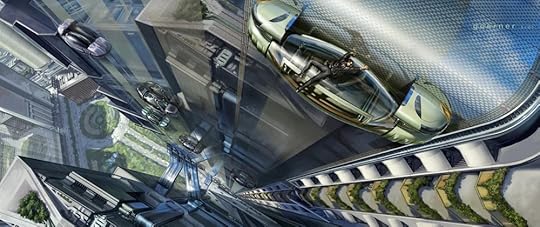
Minority report (2002)
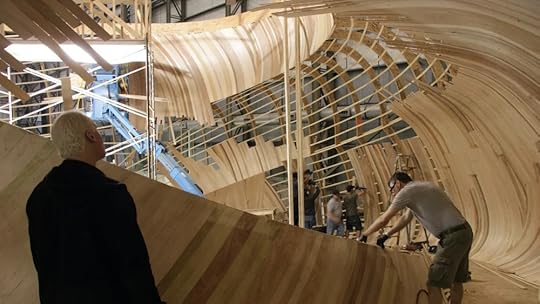
Man of steel (2013)
Your work has been instrumental in the development of a world-driven approach to storytelling, whereby the world is designed prior to and beyond the boundaries of a script. This seems to enable a stronger relationship between production design and other filmmaking crafts across the storytelling and production process. What do you see to be the role of the screenplay within this approach and how does this redefine story ideation, authorship, and collaboration in screen production?
What we have learnt simply is that non-linear production is possible when storytelling meets narrative design. Every world provides unique context and logic from which any number of story paths can evolve. Ideation, authorship, and collaboration in screen production become a single workspace for development. Production design in this context provides an immersive and adaptive container that much more closely mirrors the conditions of production start to finish for all the makers of a film and evolves accordingly.
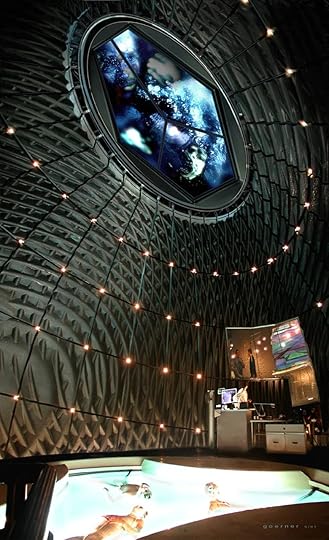
minority report (2002) ‘precogs temple’
World building requires an interdisciplinary approach to storytelling, within filmmaking departments and with experts in other fields like computer science, animation, and culture. This seems to require a reimagining or reorganization of the traditional film development and production process. Do you see evidence of this kind of reorganization happening in the industrial context? And is it possible for traditional filmmaking processes to still embrace world-building principles without a complete restructuring of the production process?
Industrial is the right word. We are finally moving from a 19th century Victorian-industrial linear production process to one of the most agile and effective non-linear practices in the world. I’ve experienced a broad range of industries outside entertainment media, and our industry can compete with any of them. But it absolutely requires a restructuring of the traditional production process. This assumes that the traditional creative skills remain and are still vital, but we all have to work with new tools as we always have. These tools speak to each other in ways that make ideation and creativity more intuitive, closer to our imagination, and we have to adapt to take advantage of that. We are biological, cellular creatures, but we’ve been forced to work with straight lines. It’s fun to see us getting closer to our intuitive selves.
Your work sits at such an interesting intersection between design, technology, and education and you have been instrumental in promoting the critical role that production design plays in world building and storytelling. Can you discuss some of the work you have been doing as part of the World Building Institute at USC, particularly the Project JUNK consortium? Why has it been so important for you to also work across education and support the development of future world builders? What has been the most rewarding part of working at the interface of industry and education?
Most rewarding and valuable continues to be the demands of the students when they see that the edges of their work are unconstrained, and when they understand that world building demands cross-disciplinary co-creation. I hope we are developing the base for new generations of polymaths, who can work across media, in industries within and outside entertainment, and in fields that do not yet exist. If we are able to focus on the need to break down the silos of disciplines and understand the power of folding together the craft skills and toolsets across media, we need to train generations that can navigate and exploit these changes as they happen.
The JUNK project is a world building program that we are now teaching globally that originated in a collaboration between USC SCA and Austral University in Buenos Aires. It is not only reaching students in entertainment media but also in trades as wide reaching as engineering, biology, anthropology, architecture and social politics. It’s a true test of how what we are learning through the intersection of the advances in media and world building can change the world.
Finally, how would you characterize the twenty-first century production designer based on creative and technological developments in screen practice and the film industries?
Our work is to stay on our toes, be aware of every change in tools and resources, interface more deeply with the full breadth of production, and increasingly demand that the technology keeps up with our imagination.
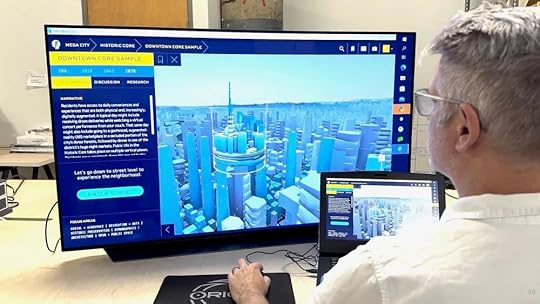
future world vision – mega city 2070 project
BiographiesAlex McDowell. Designer. Royal Designer for Industry (RDI). Creative director, production designer, professor, world builder. British citizen, US citizen, living in the US since 1986. He has been a production designer and creative director in film, game, animation, theatre and other media for over 30 years. McDowell is an advocate and originator of the narrative design system world building. His practice incorporates design and storytelling across media in education, research, institutions, corporations, and entertainment media. He is co-founder & creative director of Experimental Design, Professor of Cinematic Practice at the University of Southern California School of Cinematic Arts, Director of the USC World Building Institute & World Building Media Lab, USC William Cameron Menzies Endowed Chair in Production Design, founder of the the JUNK Consortium, Associate Professor at USC Dornsife College of Letters, Arts and Sciences, The Bridge Institute. He’s written and talked a lot about narrative design, for a long time, in many places, to many people.
Tara Lomax is an Associate Editor at Pop Junctions. She has expertise in entertainment franchising, multiplatform storytelling, and contemporary Hollywood entertainment and has published on topics such as transmedia storytelling and world building, creative licensing, seriality, virtual production and visual effects. Her work can be found in publications that include JCMS: Journal of Cinema and Media Studies, Senses of Cinema and Quarterly Review of Film and Video, and the book collections The Screens of Virtual Production (2025), Starring Tom Cruise (2021), The Supervillain Reader (2020), The Superhero Symbol (2020), The Palgrave Handbook of Screen Production (2019), and Star Wars and the History of Transmedia Storytelling (2017). She is the Discipline Lead of Screen Studies at the Australian Film Television and Radio School (AFTRS) and has a PhD in screen studies from The University of Melbourne.



Henry Jenkins's Blog

- Henry Jenkins's profile
- 184 followers

