What Is a First Mover? The Complete Guide to First-Mover Advantage in 2025
What is a first mover?
Why is this so important?
Let’s see…
Ever wonder why some brands dominate their industries while others struggle to gain traction? The answer often lies in timing – specifically, in being a first mover.
In today’s hyper-competitive business landscape, understanding the concept of first-mover advantage could be the difference between industry leadership and playing perpetual catch-up. But what exactly is a first mover, and is being first always best?
As someone who’s helped hundreds of businesses position themselves strategically in evolving markets, I’ve seen firsthand how first mover status can transform companies – and how it can sometimes backfire spectacularly.
What Is a First Mover? The Complete DefinitionWhat, exactly, is a first mover?
Here’s a first mover advantage by Corporate Finance Institute:
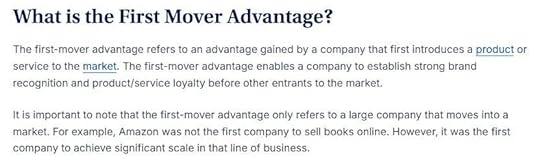
In other words, a first mover is a company or individual that gains a competitive advantage by being the first to introduce a new product, service, or business model to the market. Rather than following established patterns, first movers chart new territory, often creating entirely new market categories.
But being a first mover goes beyond simply being “first.” True first movers fundamentally change how customers think about solving a problem or fulfilling a need. They’re not just incremental improvers—they’re market revolutionaries.
First-to-Market vs. First Mover: Understanding the Critical DifferenceThere’s an important distinction that many business leaders miss when discussing first movers:
First-to-Market vs. First Mover
First-to-Market: The first company to release a specific product (technical achievement)First Mover: The company that successfully establishes the category and shapes market expectations (market achievement)Let me illustrate this with a classic example: Apple didn’t create the first smartphone (companies like BlackBerry and Palm were there years earlier), but Apple became the definitive first mover in the modern smartphone category by completely reimagining what a smartphone could be and establishing the touchscreen + app ecosystem model that now dominates the industry.
Examples of True First Movers in ActionReady for some inspiration?
Here are 4 first mover success stories to get you excited about what could be waiting in the future for you:
Amazon: Started in 1994 as an online bookstore when most people were still uncomfortable using credit cards online. Jeff Bezos didn’t just create another bookstore—he envisioned a completely new shopping experience without physical limitations. Amazon’s early innovations:
1-Click purchasing (patented in 1999)Customer reviews (revolutionary for retail at the time)Personalized recommendations based on purchase historyUnlimited virtual shelf space (vs. physical store constraints)This foundation allowed Amazon to expand into “The Everything Store” and eventually into cloud computing (AWS), streaming, and countless other categories.
Uber: Before 2009, getting a taxi meant standing on a street corner waving your arm or calling a dispatcher and waiting indefinitely. Uber completely reimagined transportation by:
Connecting riders directly with drivers through smartphonesIntroducing transparent GPS tracking and arrival estimatesCreating a frictionless payment systemImplementing a two-way rating system building trust in a stranger-based serviceThe result wasn’t just a taxi app—it was a fundamental shift in how people think about transportation, spawning an entire “Uber for X” economy.
Netflix: Founded in 1997 as a DVD-by-mail service, Netflix recognized the streaming future before broadband made it fully viable:
Created the subscription model for entertainment (vs. per-unit rental)Built sophisticated recommendation algorithmsTransitioned to streaming ahead of market demandEventually pioneered original content for streaming platformsNetflix didn’t just improve video rental—they obsoleted it and created an entirely new entertainment consumption paradigm.
Airbnb: In 2008, when most travelers would never have considered staying in a stranger’s home, Airbnb created a new lodging category by:
Building a trust framework through reviews and verificationCreating professional-quality photography standardsDeveloping secure payment infrastructureEnabling experiences impossible in traditional hotelsEach of these companies didn’t just launch first—they fundamentally changed consumer behavior and expectations, creating entirely new categories in the process. That’s the essence of being a true first mover.
5 Game-Changing Advantages of Being a First MoverLet’s cut through the theory and talk about what really matters: the concrete, transformative advantages that first movers enjoy. I’ve narrowed it down to the five most powerful benefits, illustrated with examples that show exactly how being first translates to market dominance.
1. Thriving (Not Just Surviving) Through Technological RevolutionsThe most immediate advantage of being a first mover is simple: you won’t be left behind when industry-changing technologies emerge. This is particularly crucial in today’s AI revolution.
Consider this fictional example story of Mark and Sarah:
Mark embraced AI early, integrating it across his agency’s workflow despite initial team resistance. Within six months, his agency doubled content output while maintaining quality. His team shifted from routine tasks to creative strategy and client relationships, boosting satisfaction scores by 40% and profit margins from 22% to 38%. Most importantly, his team now works 30% fewer hours while delivering better results, attracting premium clients who value their cutting-edge approach.
Sarah dismissed AI as “just another trend” and continued with traditional processes. Her team spent countless hours on tasks AI could have streamlined, leading to burnout and higher turnover. By the time she decided to explore AI tools, her business had already lost 35% of its revenue, making recovery an uphill battle.
The lesson is clear: early adopters don’t just protect their businesses—they transform them into more profitable operations with happier teams and clients.
Want to be like Mark and become a first mover in the age of AI? We have the solution for you. Check out our AI Solutions to find the exact match to your specific needs.
2. Shaping Customer Expectations in Your FavorFirst movers don’t just enter markets—they define how customers think about entire categories. This power to set expectations is perhaps the most valuable advantage of all.
When Dollar Shave Club launched in 2011, they completely rewrote customer expectations in the razor market dominated by expensive, complex products. Their approach was brilliantly simple: make simplicity a virtue, transform razors from products into subscriptions, and use authentic humor in an industry known for technical jargon.
Their 2012 launch video famously proclaimed, “Our blades are f***ing great,” generating 12,000 orders within 48 hours. By the time Gillette launched their subscription service, Dollar Shave Club had already set the standard for what razor subscriptions should be.
Unilever ultimately offered them a stunning $1 billion acquisition fee, because they had defined customer expectations, forcing giants to play by their rules. As a first mover, you don’t compete within existing parameters—you establish them yourself.
3. Capturing High-Value Early Adopters as Lifetime ChampionsEarly adopters aren’t just customers—they’re passionate advocates who drive mainstream adoption and willingly pay premium prices.
Peloton masterfully demonstrated this when they launched their connected fitness bike in 2014. Traditional fitness companies dismissed it as overpriced, missing that Peloton wasn’t selling equipment—they were creating a community of advocates.
These initial customers—largely affluent professionals—didn’t just buy bikes; they evangelized the Peloton experience on social media, hosted “Peloton parties,” and created a cultural phenomenon. By the time competitors entered the space, Peloton had already locked in the most valuable customer segment with such strong emotional investment that switching felt like betraying their community.
Even more remarkably, early adopters remained loyal despite later price reductions. They didn’t feel cheated; they took pride in discovering Peloton before it was mainstream. When you’re first to market, you capture the most valuable evangelists who will drive your growth for years.
4. Building Unmatched Market Intelligence Through Direct Customer FeedbackFirst movers gather pure customer feedback without competitive noise, creating an insight engine followers cannot replicate.
When Airbnb pioneered peer-to-peer accommodations in 2008, they entered uncharted territory. Their founders actively participated in their own marketplace, with Brian Chesky and Joe Gebbia personally photographing early New York listings and adopting a company-wide practice of staying with hosts. This hands-on approach yielded critical insights impossible to learn from focus groups: they discovered that professional photos dramatically increased bookings (leading to their professional photography program); they learned that trust was their biggest hurdle (resulting in their verification and review systems); and they found that pricing guidance was essential for hosts (prompting their pricing tools).
By the time competitors like HomeAway and VRBO pivoted toward Airbnb’s model, they had accumulated years of proprietary insights about trust-building, guest expectations, and host needs. This knowledge advantage compounds over time—first movers learn different things because they see customer behavior in its purest form, uninfluenced by alternatives.
5. Attracting Top Talent and Resources at Favorable TermsPerhaps the most underrated first-mover advantage is attracting extraordinary talent, investors, and partners who want to be part of something revolutionary.
Stripe exemplifies this perfectly. By creating a developer-friendly payment solution when existing options were notoriously difficult to implement, they positioned themselves as the future of online payments. This allowed them to recruit top engineers from tech giants who were excited by reinventing payments, attract investment from industry luminaries like Elon Musk and Peter Thiel at favorable valuations, and secure early partnerships with platforms before they became giants.
The talent advantage was crucial. By attracting engineers who could have worked anywhere, Stripe built a technical foundation competitors struggled to match. These weren’t just skilled professionals—they were true believers who worked with extraordinary dedication. Meanwhile, later entrants found themselves competing for second-tier talent or paying enormous premiums.
Why RIGHT NOW Is the Perfect Time to Be a First Mover in AIIf you’ve been watching the AI revolution unfold with a mix of fascination and trepidation, I have an urgent message for you: The window of first-mover opportunity in AI is wide open right now—but it won’t stay that way for long.
The AI Adoption Curve: Where We Actually StandDespite all the headlines, we’re still remarkably early in the AI adoption curve. According to McKinsey’s “The State of AI in 2025” report, organizations using AI has accelerated.
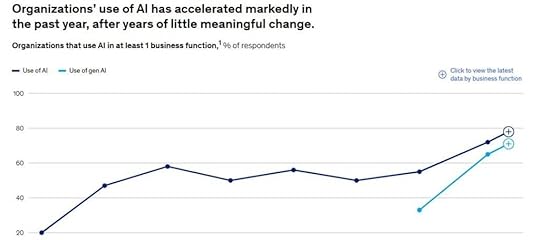
This explosive growth curve tells us something crucial: we’re witnessing mass adoption happening in real-time.
Even more revealing is Gartner’s 2024 study finding that only 23% of businesses have developed a strategy for optimizing their content and operations for AI-generated interactions. This means over three-quarters of businesses still lack a coherent approach to AI integration.
The implications are clear: despite the noise, we’re still in the early adopter phase—not the late majority.
Your Competitors Are Moving Slower Than You ThinkHere’s the reality that most businesses miss: despite all the AI hype, your competitors are likely moving much slower on meaningful AI implementation than their press releases suggest.
Recent McKinsey research reveals this gap perfectly. While 78% of organizations report using AI in at least one business function (up from 72% earlier in 2024), the depth of implementation tells a different story:
Only 21% of organizations have fundamentally redesigned any workflows around generative AILess than 20% are tracking meaningful KPIs for their AI solutionsA striking 80% of organizations aren’t seeing any tangible impact on enterprise-level earnings from their gen AI useThe research further shows that most organizations are merely experimenting with surface-level applications rather than integrating AI deeply into their operations. Consider this telling statistic: while AI usage has increased dramatically, organizations are using AI in an average of only three business functions—just a fraction of their operations.
This creates an unprecedented opportunity for decisive action. Most businesses are still in what McKinsey calls “early days for adoption,” with only 1% of executives describing their gen AI rollouts as “mature.” The businesses that move beyond experimentation to thoroughly integrate AI across their operations won’t just gain incremental advantages—they’ll create entirely new categories that leave competitors scrambling to catch up.
Even more revealing: McKinsey’s analysis shows that the redesign of workflows has the biggest effect on an organization’s ability to see bottom-line impact from AI use, yet the vast majority of companies haven’t taken this critical step. By restructuring your core operations around AI capabilities now, you’ll establish a lead that becomes increasingly difficult for followers to overcome.
Conclusion: The Time for Action Is NowThe evidence is overwhelming: we’re at a pivotal moment where being a first mover isn’t just advantageous—it’s essential for survival.
History has taught us that technological revolutions create distinct winners and losers. When the internet transformed commerce, Amazon’s first-mover approach secured their dominance while countless retailers disappeared. When smartphones redefined computing, Apple’s pioneering vision established a lead that even industry giants struggled to overcome.
The AI revolution represents an even more profound shift. The unique nature of AI—with its compounding data advantages, its ability to transform every business function, and its potential to create entirely new business models—makes the first-mover advantage particularly powerful.
But here’s what makes this moment special: we’re at the inflection point.
The technology is mature enough to deliver real business value, yet the majority of organizations are still dabbling rather than diving in. This creates the perfect window of opportunity for decisive action.
Ready to make your move and become a first mover?
We can help.
Book your strategy session with First Movers to architect your AI-driven future today.