
The Struggle for Integrity: Examining LDS Corporate Values
Members who give so much spare time and money to the LDS Church deserve transparency and accountability regarding LDS institutional goals, policies and practices. They deserve to know whether the Church operates chiefly as an ethical organization or as one driven by corruption and self-interest. Those exploring or belonging to the LDS Church deserve clarity on whether its central mission is to embody Christlike values or to pursue corporate power and material gain.
LDS Corporation Behavior
The following are some considerations for anyone evaluating the LDS Church’s corporate behavior:
Corporations seek to make money, and the LDS Church is doing that very successfully. It is currently valued about $300 billion and could be a trillion-dollar church by 2044. To become the wealthiest church on the planet, it requires its members to pay ten percent of their gross income to the church, It also encourages its members to donate generously through fast offerings to help poor members or through humanitarian donations to help suffering folks throughout the world.
To increase its revenues, the Church has systematically eliminated all custodial positions for its meetinghouses, requiring members to clean them weekly and to clean temples and other church properties after business hours. For members to become forever families, members must pay a full tithing and are told to do so even if their children are hungry or unhoused.
To further increase its profits, the Church has divested itself of its hospitals in the United States and schools outside of the United States, including schools in Mexico and New Zealand. Although its top leaders are paid a generous stipend, its 35,000 local leaders volunteer their time and often contribute financially to help their congregations, since little tithing money is returned to congregations.
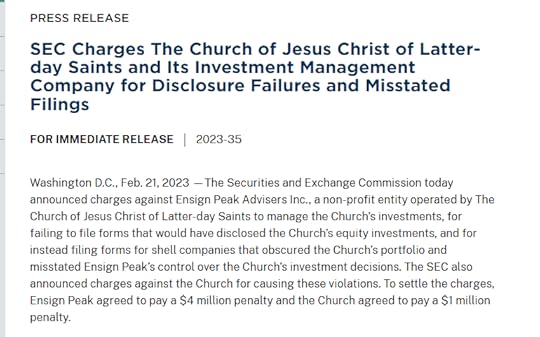
2. The LDS Church has failed to uphold ethical corporate standards, including adherence to government regulations, honesty, transparency, and accountability. Because LDS Church has failed in this regard, it was fined by the SEC for creating shell companies to hide church assets. These shell companies were created at the request and with the knowledge of top LDS leaders, who were specifically fined for this.
Australia has investigated the LDS Church for creating a shell company to hide its assets. In addition, Canadian officials have observed that LDS leaders have moved $1 billion out of Canada to fund Brigham Young University to Canada, leveraging a Canadian tax provision that allows donations to foreign institutions with certain criteria, like having Canadian students, to be tax-deductible–although few Canadian students attend that school.
The best practices for churches require them to release annual financial reports, but the LDS Church refuses to do so. Accounting scholars who have reviewed LDS financial governmental reports have observed that two-thirds of Church tithing income is placed in investment accounts, and little, if any, tithes are used for humanitarian work. The Church inflates its humanitarian reports with fast offering monies, which are used mostly for members and, hence, are not humanitarian, since humanitarian spending must be given with no regard to one’s religious affiliation.
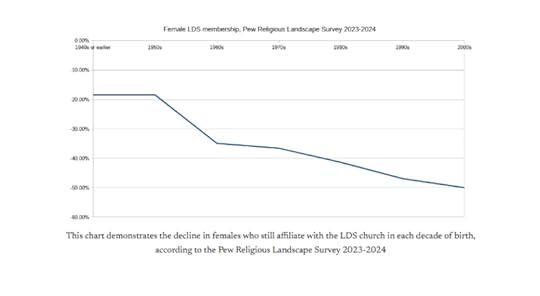
3. Successful corporations satisfy their stakeholders, but it is difficult to know how satisfied LDS members are. The LDS Church reports having a membership of over seventeen million, but statisticians suspect the real number is about 35% of that amount, about 6 million. Because missionaries quickly convert and baptize new members without fully integrating them into the church culture, the retention rate is projected to be about 25% outside of the United States.. One statistician states that “at least 145,912 records were removed in 2024—due to death, resignation, or loss of membership (formerly known as excommunication),” the highest number ever. Most alarming, Pew Research Center shows a dramatic loss of female LDS members born after 1960.
LDS Church Corporate Culture and Values
The LDS Church identifies a four-fold mission. We will evaluate the Church’s behavior concerning these four objectives.
Live the gospel of Jesus Christ. The LDS Church defines the gospel as faith in Jesus Christ, receiving the Holy Ghost, repentance, and enduring to the end. Although the Church expects members to abide by these principles, it often does not. It refuses to apologize for past mistakes, including denying temple blessings for Black members until 1978, massacre of indigenous peoples, a past policy of denying blessings and baptism to children of LGBTQ members, and a host of other discriminatory or violent practices.
Invite all to receive the gospel. In 2024, the Church reported that it had 74,000 full-time missionaries and 31,000 missionaries worldwide, so it is working hard to fulfill that goal. However, China recently closed down all LDS congregations, and the LDS church is struggling in India and has no missions in 29 Muslim countries. Although it is doing well in some African regions, other Christian missionaries have been building congregations, hospitals, schools, and medical clinics in these areas for many years before the LDS Church decided to proselytize there.
Unite families for eternity.The LDS Church places strong emphasis on temple sealings for both the living and the dead—some deceased individuals have reportedly had their ordinances repeated dozens of times. Yet only those who follow the Church’s strict requirements—tithing, abstaining from alcohol, coffee, and tea, wearing temple garments day and night, and other commandments—are allowed to enter a temple and be sealed to their families. According to LDS theology, failing to “endure to the end” can mean losing one’s eternal family. In reality, the number of active LDS families sealed in temples is minuscule compared to the total number of people who have ever lived.
Care for those in need. Although some congregations of the LDS Church are very helpful in ministering to those in need, in much of the developing world, ward members lack the resources to feed malnourished members. In Salt Lake City, the headquarters of the LDS Church, other churches and charitable organizations run food banks, open their doors to the homeless during the winter, and run refugee programs. Although LDS Church members give fast offerings to help those in need in their congregations, in the developing world their donations cannot begin to feed the many people who are starving, including malnourished children.

Photo of the City Creek Mall in Salt Lake City
In 2012, the LDS Church spent over $1.5 billion to build the luxurious City Creek Mall in Salt Lake City and has spent hundreds of billions of dollars purchasing high-end real estate and farm land throughout the world. It is one of the top five landowners in the United States. Yet, the amount that the LDS Church spends on humanitarian work is less than 1% of its tithing income.
Because of its vast financial holdings, the LDS Church is the twentieth richest corporation in the world, and it is becoming the richest church in the world as well. It devotes considerable effort to presenting a positive public image has has at times excommunicated those who openly criticize its practices. The Church’s Strengthening the Members Committee monitors media and member activity to identify individuals who may face discipline or removal.
Moving to Christlike Behavior
To move from a corrupt corporation to a Christlike church, the LDS Church needs to make the following changes:
Decide to follow the laws of the land regarding its financial transactions, reporting, and disclosures. The LDS Church should follow the standards of honesty that it expects its members to follow. It says, “If we are dishonest in our words or actions, we hurt ourselves and often hurt others as well. If we lie, steal, [or]cheat,… we lose our self-respect. We lose the guidance of the Holy Ghost.We may find that…people no longer trust us.”
Give one-tenth of its tithing income for humanitarian work. The Church currently has enough money to sustain itself for over 30 years or more; one-tenth of the Church’s income is about $3 billion.
Ensure that all malnourished children in the Church and its locations receive food supplements to prevent child wasting. The Church has the knowledge, means, and people to do this.
Release honest financial reports that show how Church donations are received and spent. If the Church has nothing to hide, it should hide nothing.
Apologize for past financial lies, historical misinformation, genocide and racism. Any institution that does not acknowledge and atone for past mistakes may repeat them.
Use the vast missionary force to collaborate with local community leaders to become a worldwide humanitarian force. This practice will teach missionaries the importance of Christlike service and will attract members to a Church that places people’s needs over the aggrandizement of wealth.
Place the value of protecting children over protecting the image of the Church. Implement stronger safeguards for the vulnerable by requiring background checks and ending private “worthiness” interviews. Avoid teaching that all leaders are divinely chosen, as some have been abusers. Provide better training and oversight for ecclesiastical leaders. Instruct bishops to report all allegations of child abuse to civil authorities, and establish a hotline staffed by trauma-informed specialists empowered to identify and address abuse within the Church.
Move from fear-based policies, practices, and curricula to love-based ones. Ensure that all family members can attend their loved one’s weddings. Include in all curricula instruction on recognizing and preventing domestic violence, child abuse, and racism.
Teach principles of Christlike love, patience, mercy, kindness, and empathy in Church lessons. For decades in Utah–which until recently was predominantly LDS–the rates of sexual abuse, rape, and domestic violence has been high. The LDS Church can and must do better to fulfill its stated goal of becoming a Zion people, of one heart and one mind, with no poor among them.
Require greater accountability of top leaders to members by the law of common consent. Give emeritus status to all leaders older than seventy and create a system where an equal number of women participate in all decision-making processes in the Church.
A recent survey indicates that post-Mormons are higher than active Mormons in virtues of kindness, nurturance, reciprocal altruism, and fairness, and lower than active Mormons in deference to authority, obedience to a purity culture, and ingroup loyalty. Since the LDS Church focuses more on temple worthiness and deference to its leaders and less on showing compassion for the marginalized, those studies may reflect a need for the Church to show greater compassion to those who suffer.
Conclusion
As the leaders of the Church prepare for the Second Coming of the Savior, it will be interesting to see how much of their vast stockpile they will use to reduce suffering and how much of it they will save to present to Jesus.
To follow Jesus, the Church will need to move from a corrupt corporate model to a compassionate church model. This will require a change of its major policies and practices. Inclusion of more women, minority groups, and people outside the United States in all levels of Church governance will help the LDS Church better reflect and understand the people whom it is commissioned to serve. At the Sunday afternoon session of General Conference, President Oaks revealed how much power the top LDS leader has to make decisions regarding the Church as he quickly ended the overbuildings of temples. Hopefully, he will have the wisdom and courage to end other harmful practices that hurt people and ignore suffering.
To become a Christ-centered Church, it needs to move from its patriarchal model of governance to a complementarian model. In a Church that is created by upper-class heterosexual white American men to protect and serve men like them, this will require compassion, equity, and integrity.
Brene Brown says it best: “When the culture of an organization mandates that it is more important to protect the reputation of a system and those in power than it is to protect the basic human dignity of individuals or communities, you can be certain that shame is systemic, money drives ethics, and accountability is dead.”
Thanks to Keith Rapier on Unsplash for the photo of City Creek Mall
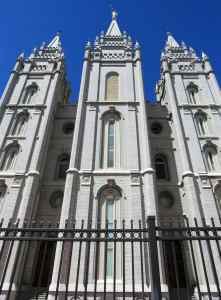
Thanks to Farragutful on WikiMedia Commons for the 2019 photo of the Salt Lake Temple


