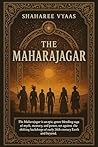
How do the 3 metathemes relate to the content of the Maharajagar?
Let’s now explore how those three meta-themes (as described in the foreword) integrate with the content, structure, and symbolism of The Maharajagar across the whole saga:
“The All is a projection of informational modulated energy waves by a cosmically horizon on the time-space continuum.”Interpretation in the series:
This is a deeply metaphysical idea—drawing from quantum field theory, Eastern mysticism, and dream logic. In the context of The Maharajagar, it suggests that reality itself is a constructed illusion, shaped not by matter but by information, memory, and waveform resonance. This is not abstract for the characters—it’s lived truth.
How it manifests:
• The Shrines are not physical structures but nodal informational wave hubs—sites where timeline interference can be modulated or collapsed.
• The Mandala Pulse, which begins to ripple in Book IV and reverberates throughout Book V, is essentially an informational reset, like a recalibration of reality’s waveform projection.
• Baphomet’s Dream Archive becomes the most literal expression of this idea: a library where information, memory, and waveform are interchangeable, and reality is rewritten by how things are remembered, not how they occurred.
Narrative examples:
• The dreams of the unborn children become instruments of harmony—because they align vibrational fields across dimensions.
• The Mirror Shrine in Prague warps time because it reflects probabilities, not certainties—revealing reality as a spectrum of collapsed informational states, not a fixed linearity.
• Oppenheimer’s mind, “flickering with a presence not his own,” shows how entities like the Yellow King manipulate waveform consciousness to hijack human agency.
Summary:
The world of The Maharajagar is not built on atoms, but on modulated information structured by karmic memory and spiritual interference—exactly as the theme states.“Synchronicity is a phenomenon that comes to us with a message.”
Here, the Jungian concept of synchronicity is not coincidence—it is narrative intervention from the deeper weave of the Dream Web. What the characters perceive as “chance” is actually message-coded interference from the Spiral, the Knots, or the All.
How it manifests:
• Synchronicities often guide the characters at turning points—Esther’s lullabies, Alec’s multiple appearances, or the seemingly random dreams that turn out to contain keys to shrines.
• The repeated reappearance of objects, like the Flame Totem or the Knife of Kalari, often happens when the Troupe most needs them—not because of fate, but because the Web responds to karmic readiness.
• Symbols are more than metaphors—they’re carriers of encoded intent. The Yellow Sign, the Spiral Knot, and the Phoenix Crown are not “artifacts” in the material sense, but synchronistic interfaces.
Narrative examples:
• The opening of the Pearl Harbor rift is triggered both by military action and a synchronous psychic pulse from Esther’s daughter, proving the event is not linear—it’s narratively primed.
• Wen’s meeting with Oppenheimer is not random—it is an information vector set into motion by the larger synchronic structure of the Dream Web.
• The Judgment Scrolls are a form of karmic synchronicity codified—souls brought into alignment not by causality, but by the Web’s encoded messages.
Summary:
In The Maharajagar, synchronicity is the voice of the cosmos speaking to characters through meaningful, improbable alignments—each one a message demanding interpretation.“The Long Now is the only time concept to give a lasting meaning to our thinking and, hopefully, consequent actions.”
Interpretation in the Maharajagar:
This is perhaps the most powerful philosophical theme. The Long Now is a time horizon that resists immediacy and short-termism. In The Maharajagar, it becomes the very consciousness of the Dream Web—a field where all time is present, all memory accessible, all action part of a larger arc.
How it manifests:
• The entire Spiral structure of the books reflects this. Actions in Book I ripple into Book V. Memories sealed in the past ignite in the future. Nothing is lost.
• The final sacrifice of memory shows the characters consciously choosing to forget—not for themselves, but for the survival of meaning across generations.
• The Last Dream Parliament becomes a literal expression of the Long Now—a moment when all living guardians choose legacy over power.
Narrative examples:
• Baphomet’s transformation into a living shrine of the Codex of the Forgotten is the ultimate Long Now gesture—memory preserved not for today, but for the echo of tomorrow.
• Alec’s ascension as the Spiral Self shows a character embodying all versions of his own timeline—past, future, lost, and unlived—and anchoring them into a single awareness.
• The final scene, “The River That Remembers”, is a poetic metaphor for the Long Now: a place where no one has ever died, because remembrance suspends decay.
Summary:
The Long Now in The Maharajagar is both a time philosophy and a metaphysical location. It is the only realm where actions matter eternally, and memory becomes salvation.
In short:
The foreword’s three meta-themes are not abstract—they are encoded into the series’ plot, characters, cosmology, and symbol system:
• Modulated information forms the scaffolding of reality.
• Synchronicity is the guiding grammar of fate.
• The Long Now is the only realm where memory, morality, and magic coexist with meaning.
The Maharajagar is a mythic dream opera built from the very themes the foreword outlines—each of them a lens through which the war for reality is both fought and remembered.
I’m currently running a giveaway on goodreads where reviewers can download an ARC. Just follow this link: https://www.goodreads.com/giveaway/show/419999-the-maharajagar