System Design for Building Agentic AI Applications — Part 1
With the rise of AI-driven applications, the concept of Agentic Applications is gaining momentum. These applications operate autonomously, make decisions, and optimize workflows by leveraging Large Language Models (LLMs), Reinforcement Learning (RL), and Multi-Agent Systems (MAS).
Designing such applications requires a robust system architecture that supports real-time processing, scalability, security, and adaptability. This article explores the key design principles, architecture, and best practices for building agentic applications.
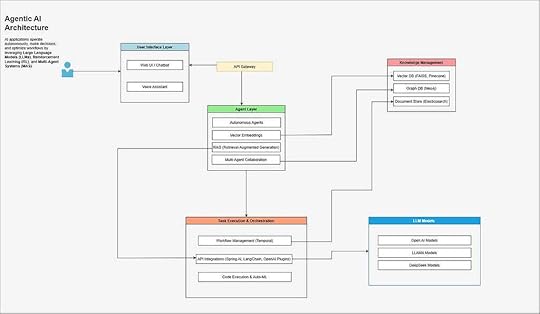 Agentic AI ArchitectureKey Characteristics of Agentic Applications
Agentic applications are distinguished by the following attributes:
Autonomy: These applications leverage Autonomous Agents that can perform tasks with minimal human intervention. By integrating Multi-Agent Collaboration, different agents can communicate, delegate tasks, and achieve a common goal efficiently.Adaptability: Using LLMs and Embeddings, agentic applications can dynamically adjust responses based on user inputs, changing environments, and new information. Reinforcement Learning (RLHF) ensures continuous learning from feedback.Multi-Agent Collaboration: These applications implement a Decentralized AI system, where agents work together through message-passing and shared memory. Technologies like Graph Databases (Neo4j) help model relationships between agents and entities.Goal-Oriented Behavior: Tasks are executed efficiently using Workflow Management (Temporal, Airflow) and Task Orchestration mechanisms. Agents prioritize tasks based on importance, dependency, and available computational resources.Context Awareness: Agentic applications leverage Vector Databases (FAISS, Pinecone) to store and retrieve relevant information efficiently. Retrieval-Augmented Generation (RAG) enhances responses by incorporating external knowledge from document stores like Elasticsearch.Observability & Feedback Loop: These applications implement Logging & Tracing (OpenTelemetry, Datadog) to ensure transparency and auditability. Monitoring & Metrics (Prometheus, Grafana) track system performance, and user feedback helps in optimizing the response generation process.
Autonomy: Agents operate with minimal human intervention.
Adaptability: They learn and evolve over time.
Multi-Agent Collaboration: Various agents communicate to accomplish tasks.
Goal-Oriented Behavior: Agents optimize for efficiency and accuracy.
Context Awareness: Understanding user intent and adapting responses accordingly.
Examples of agentic applications include AI-powered research assistants, automated financial advisors, and intelligent chatbots.
System Architecture for Agentic ApplicationsA well-designed agentic application consists of multiple interconnected layers, each responsible for specific functionalities. These layers work together to ensure efficient execution, communication, and learning.
A. Architectural OverviewA well-designed agentic application consists of multiple layers:
1. User Interface LayerWeb UI / Mobile Applications: Provides user-friendly interaction interfaces, such as dashboards, conversational interfaces, or AI-driven search engines.Voice/Chat Interfaces: Enables natural language interactions using speech-to-text and text-based chatbots, ensuring smooth user engagement.API Gateway: Acts as a secure interface for third-party services and applications to interact with the agentic system.
Web UI / Mobile Applications: For user interaction.
Voice/Chat Interfaces: Conversational AI-driven experiences.
2. Agent Layer (Core AI Processing)
API Gateway: External programmatic access.
Autonomous Agents: Independent decision-making entities.
LLM & Embeddings: Understanding and processing natural language queries.
Retrieval-Augmented Generation (RAG): Combining knowledge retrieval and generation.
Autonomous Agents: Specialized agents responsible for performing specific tasks such as query resolution, decision-making, and workflow automation.LLM & Embeddings: Uses Large Language Models (GPT-4, Claude, LLaMA, DeepSeek etc.) and semantic embeddings to process user queries and generate contextually relevant responses.Retrieval-Augmented Generation (RAG): Enhances AI-generated responses by retrieving relevant information from vector databases and document repositories.Multi-Agent Collaboration: Coordinates multiple specialized agents that work together in a decentralized manner to execute complex workflows effectively.3. Knowledge Management
Multi-Agent Collaboration: Coordinating multiple specialized agents.
Vector Databases: (FAISS, Pinecone) for efficient semantic search.
Graph Databases: (Neo4j) for relationship mapping and entity linking.
Vector Databases (FAISS, Pinecone): Store and retrieve high-dimensional embeddings for efficient semantic search and similarity comparisons.Graph Databases (Neo4j, ArangoDB): Maintain knowledge graphs that define relationships between entities, enabling context-aware AI reasoning.Document Stores (Elasticsearch, PostgreSQL): Store and index structured and unstructured text data for retrieval during query processing.4. Task Execution & Orchestration Layer
Document Stores: (Elasticsearch) for structured/unstructured data retrieval.
Workflow Management: (Temporal, Airflow) for long-running tasks.
API Integrations: (LangChain, OpenAI Plugins) for real-time data retrieval.
Workflow Management (Temporal, Airflow): Ensures seamless execution of long-running tasks, managing dependencies and state transitions efficiently.API Integrations (LangChain, OpenAI Plugins): Connects with external services, enabling AI models to access additional knowledge sources and execute API-driven tasks.Code Execution & Auto-ML: Enables agents to execute code dynamically and improve AI models using AutoML frameworks and reinforcement learning.5. Observability & Feedback Loop
Code Execution & Auto-ML: For self-improving AI agents.
Logging & Tracing: (Splunk, OpenTelemetry, Datadog) for debugging.
Monitoring & Metrics: (Prometheus, Grafana) for performance tracking.
Logging & Tracing (OpenTelemetry, Datadog): Tracks system events, errors, and AI decision-making processes to ensure transparency and debugging capabilities.Monitoring & Metrics (Prometheus, Grafana): Provides real-time performance insights and health monitoring for AI models and workflows.Model Feedback Loop: Implements user feedback mechanisms and reinforcement learning strategies to improve model performance continuously.System Design ConsiderationsA. Scalability
Model Feedback Loop: Reinforcement learning for continuous improvement.
Microservices Architecture: Independent, scalable services for different agents.
Serverless Execution: AWS Lambda, Google Cloud Functions for efficiency.
Microservices Architecture: Uses containerized microservices that allow independent scaling of different components like the UI, agent layer, and knowledge retrieval systems.Serverless Execution: Implements serverless computing with AWS Lambda, Google Cloud Functions, and Azure Functions to reduce costs and improve efficiency.Event-Driven Design: Uses Kafka, RabbitMQ, or AWS SQS for asynchronous communication between agents, ensuring high throughput in multi-agent environments.B. Performance Optimization
Event-Driven Design: Kafka, RabbitMQ for real-time communication.
Low-Latency Caching: Redis/Memcached for quick retrieval.
Model Compression & Quantization: ONNX, TensorRT for faster inference.
Low-Latency Caching: Uses Redis/Memcached to cache frequently accessed responses, improving response times for real-time applications.Model Compression & Quantization: Deploys optimized AI models using ONNX, TensorRT, or TensorFlow Lite to reduce inference time and computational load.Edge Processing: Enables real-time AI by offloading inference workloads to edge devices, reducing dependence on centralized cloud resources.C. Security & Privacy
Edge Processing: Running models on-device for real-time AI.
Zero-Trust Architecture: API security and access control.
Data Anonymization: Masking sensitive user data.
Zero-Trust Architecture: Implements strict authentication and authorization controls for all API interactions, ensuring secure data access.Data Anonymization: Uses differential privacy techniques and encryption to protect sensitive user information in logs and training data.Encrypted Model Serving: Serves AI models securely using TLS-encrypted API endpoints and private inference environments.D. Explainability & Auditing
Encrypted Model Serving: Secure API-based LLM inference.
AI Decision Logs: Storing agent reasoning for debugging and compliance.
User Feedback Mechanism: Capturing corrections to refine models.
AI Decision Logs: Stores all AI-generated outputs and decision pathways to enable transparency and debugging.User Feedback Mechanism: Allows real-time user input to fine-tune AI model responses and adapt agent behaviors.Regulatory Compliance: Ensures adherence to GDPR, HIPAA, SOC 2, and industry-specific AI governance standards.Technology StackAgent Frameworks
Regulatory Compliance: GDPR, HIPAA, SOC 2 adherence.
LangChain: LLM-based applications.
AutoGPT / BabyAGI: Autonomous agent workflows.
LangChain: Provides tools for integrating LLMs with knowledge retrieval, workflow automation, and decision-making pipelines.AutoGPT / BabyAGI: Enables autonomous agent workflows that iteratively refine tasks without human intervention.ReAct (Reasoning + Acting): Implements a framework for AI agents to reason and act dynamically based on real-world inputs.Vector & Graph Databases
ReAct (Reasoning + Acting): Decision-making agents.
FAISS, Pinecone, Weaviate: Vector stores.
FAISS, Pinecone, Weaviate: Used for efficient semantic search and retrieval of high-dimensional data embeddings.Neo4j, ArangoDB: Powers graph-based knowledge representations, aiding multi-agent collaboration and relationship mapping.LLM Providers
Neo4j, ArangoDB: Graph-based reasoning.
OpenAI (GPT-4), Claude, Mistral, LLaMA.
OpenAI (GPT-4), Claude, Mistral, LLaMA: Offers pre-trained large language models for agent-based reasoning and decision-making.Self-Hosted Models: Hugging Face models deployed on Triton Inference Server, providing flexibility and cost-effective AI inference.Orchestration & Integration
Self-Hosted: Hugging Face models on Triton Inference Server.
Ray, Temporal, Airflow: Distributed task execution.
FastAPI, gRPC: API development for agents.
Ray, Temporal, Airflow: Enables distributed task execution, agent coordination, and automated workflows.FastAPI, gRPC: Facilitates API development for inter-agent communication and external service interactions.Kafka, RabbitMQ: Supports event-driven communication between AI components, improving system responsiveness.Observability & SecurityOpenTelemetry, Datadog: Provides logging, tracing, and monitoring capabilities to ensure real-time debugging and analytics.Prometheus, Grafana: Enables system-wide monitoring, performance tracking, and real-time alerts for proactive issue resolution.Zero-Trust Security & Encryption: Implements end-to-end encryption for API interactions and model inference security compliance.Example Use Case: Autonomous Research Assistant
Kafka, RabbitMQ: Event-driven communication.
Workflow:
User Query: A researcher enters a query via text or voice.Query Understanding: The system classifies the intent (e.g., literature review, summarization).Knowledge Retrieval: Searches vector databases, graphs, and external APIs.Response Generation: Uses RAG to generate a structured answer.User Feedback: The researcher provides feedback for continuous improvement.This approach ensures real-time response generation, context awareness, and scalability.
Future EnhancementsSelf-Improving Agents: Meta-learning techniques for continuous improvement.Multi-Agent Collaboration: Decentralized AI with collective decision-making.Personalized AI Experiences: Federated learning for user-specific adaptations.ConclusionAgentic applications represent the next generation of AI-driven automation. Designing these systems requires careful consideration of architecture, scalability, security, and adaptability. By leveraging multi-agent coordination, RAG, and efficient retrieval mechanisms, developers can build highly autonomous, intelligent applications that revolutionize industries.
[image error]System Design for Building Agentic AI Applications — Part 1 was originally published in DXSYS on Medium, where people are continuing the conversation by highlighting and responding to this story.