Accommodations are not a problem
They’re solutions to accessibility and inclusion.
Every week in our bookshop we have children stop by to play with the Chelsea dolls in our shop dollhouse. We set the dolls up to show them as a mixture of half dolls with disabilities and half with no visibly accommodated disabilities. Two of the dolls have speech output devices, three wear earmuffs, one has a brace around her middle, and one is in a wheelchair. Like clockwork, little able bodied kids remove the brace, the wheelchair, the talkers, and the earmuffs. They knock the doll visual schedules on the ground, tip over the doll sensory sand onto the floor, remove the inclusive seating arrangements, and crowd the furniture into impassable arrangements. They “fix” the dolls by removing all of the accommodations for disabilities.
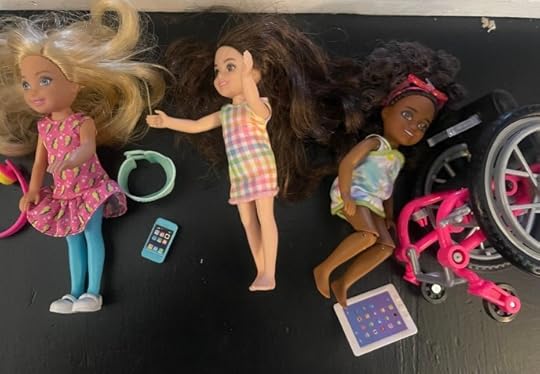 Dolls alongside accommodations that were removed (talkers, headphones, brace, wheelchair).
I sigh when I go to reset the dollhouse. Not because it’s weird for kids to rearrange or knock things over; I expect and honor creative child chaos. It’s because we live in a world where we daily fail to teach children empathy for people with disabilities, and that shows in how they play with dolls.
My own children, equally chaotic in their play, always make sure not to leave the autistic and cerebral palsy dolls without their speech output devices. They never take off the back brace for the Chelsea that needs it, and they always make sure to keep a clear path to move the wheelchair doll between rooms downstairs. (They still knock things over sometimes because it’s hard not to; they still move the sand sometimes.) The only other children who leave the doll accommodations in place are those with family members with disabilities, or a few whose moms are teachers.
I know this is not scientific data, but I am noting a pattern among generally thoughtful children who can play gently enough to not injure themselves with dollhouse furniture. These really kind, thoughtful, obviously well-meaning children see the accommodations as problems to be fixed rather than the solutions that they are in real life (for people, not dolls).
Maybe I notice this pattern so much because of how often it shows up as an obstacle in churches to the inclusion of people with disabilities. How often do you think of healing and imagine a “faith healer” telling someone to throw off their crutches or rise from their wheelchair? As I recounted in my book, Of Such is the Kingdom: A Practical Theology of Disability, the wheelchair is often the answer to prayer!
I think the disabled doll accommodations problem and the desire to force conformity to standard abilities as an expression of care are both rooted in a misunderstanding of what healing and wholeness are. When Jesus was teaching the sermon on the plain in the Gospel of Luke (parallel to the sermon on the mount in Matthew), He first healed everyone who came to Him. Then when Ge is about to start the teachings on the Beatitudes (Blessed are’s), St. Luke tells us that Jesus “lifted up His eyes on His disciples.” Y’all. The biggest takeaway for disability ministry is right there: not whether or not the people we serve are healed of all their disabilities, but that Jesus has placed Himself below His students so that He (God) is looking up to them when He teaches them. That means that He was healing alongside the people, too, not above them, but with them.
I wonder what would be different if we heard and taught about faith like that, about God humbling Himself to be below us like a servant, about God with us to heal us and to make our now and here holy and filled with the grace of His presence? Faith with disabilities means that we accommodate our weaknesses and needs the way God did by knowing us in His own flesh. Accommodating the needs of disabled bodies is how we get to each other’s level, to create a sacred environment to meet face to face (where God is; among us), and we who need a different light or a chair or headphones or talkers or Braille or captions or sign language or soft clothing or an explicit invitation to join in, can lift our eyes up to teach our abled community when we are treated with this dignity of welcome.
I have mentioned this before, and it bears repeating: the eyes of saints in sacred art are always looking up at you. The irises are painted touching the upper eyelid, so that no matter how exalted their location in a church or temple or shrine or wall, they look at you as Christ did, as humble, as one who is not here to patronize or condescend or figure you out on their own terms, but someone who already knows God and therefore already looks up to you in love.
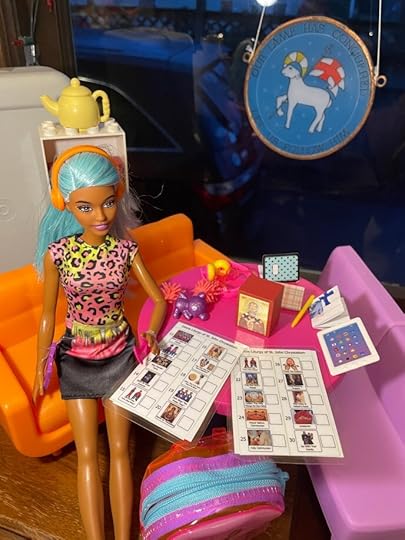
The little children who remove accommodations are welcome in our shop; I mention their patterns without resentment or offense. I hope that when they return and see the accommodations back in place over and over again that they will wonder why they are there. It’s easier to explain the accessibility aids with dolls than with people, after all. If I can show them the goodness of those dolls alongside holy imagery that shows disabled people as holy, too, even better.
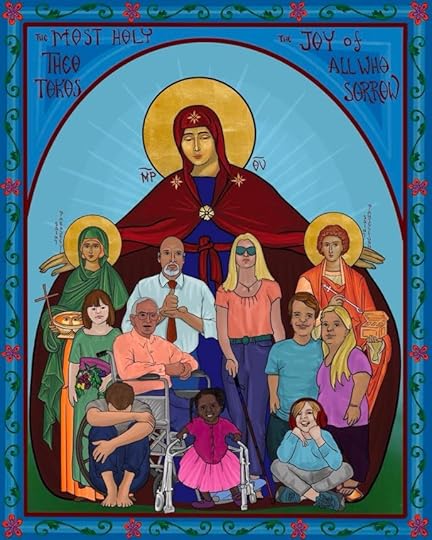 Digital icon of The Most Holy Theotokos the Joy of All Who Sorrow drawn with disabled people and saintly healers under Her protective cloak by Elina Pelikan.
I’m sharing this image I commissioned again so you can keep it with you. You can print it on a home printer for non commercial use. May our Holy Theotokos the Joy of All Who Sorrow help us to humbly approach one another with the love of her Son.
The post Accommodations are not a problem appeared first on Summer Kinard.