
Bernese Chronicles (Swiss History Part Two)

Our attempts to learn the history of Switzerland led us to a swirling eddy that is the chronicles of the city/canton of Bern.

These depict in vivid detail the Swabian and Burgundian Wars.
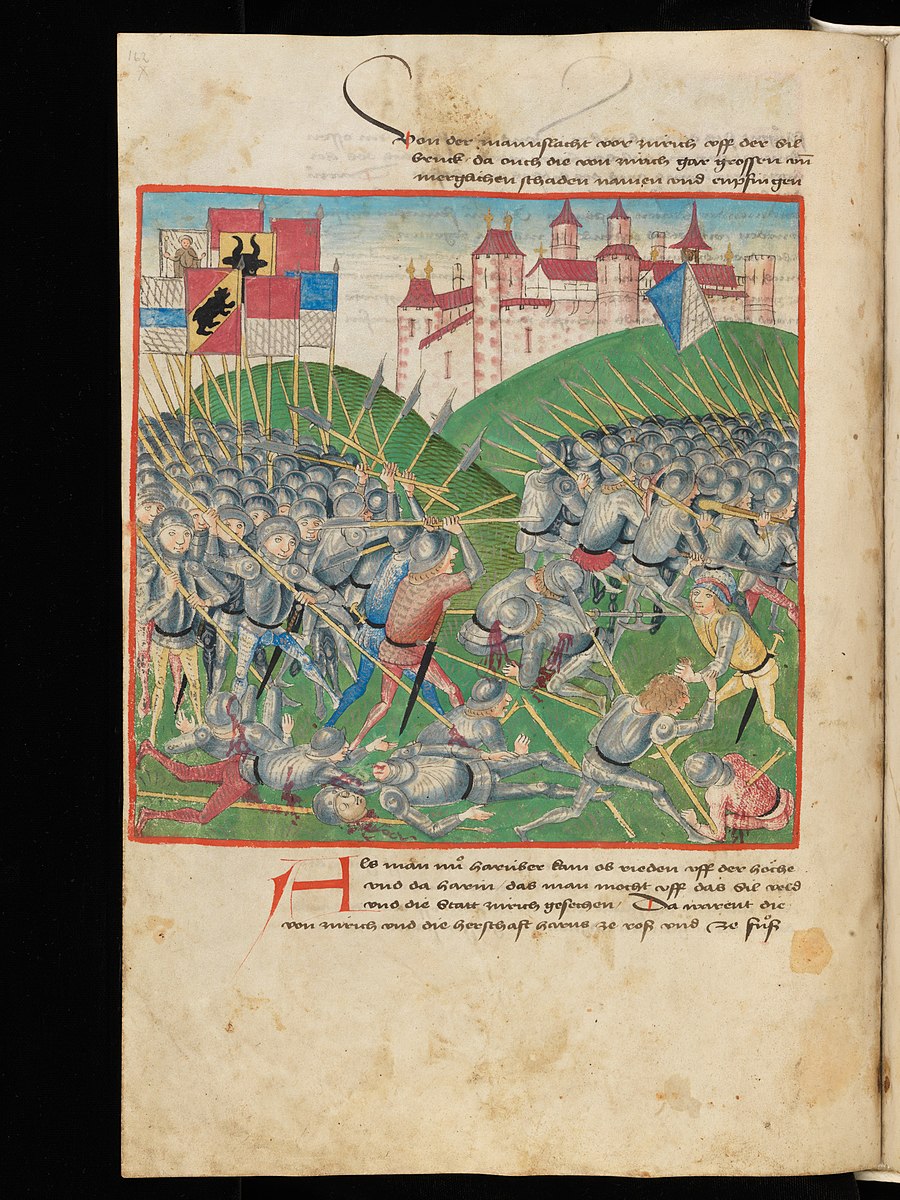
Diebold Schilling the Elder was the uncle of Diebold Schilling the Younger.

Here is the work of the Younger:

Those are rampages through the Vaud.

The battle of Dorneck.
Entire chronicles can be found online, they’re shockingly long. Even a browse through them can be numbing. It’s like the work of Henry Darger or something, obsessive numbers of battle scenes and sieges and killings. Regrettably my German is insufficient for me to read them. I suspect I get the idea.
The events depicted kept the Burgundians and Habsburgs out of Switzerland and allowed the Old Swiss Confederacy to maintain its independence.
During this period the Swiss became so good at war that they became in demand mercenaries in Italy and elsewhere (the origin of the Vatican’s Swiss Guards). Their super-weapon was the halberd, which was capable of killing a mounted knight. Defeating a guy on horseback who was armed with metal sword from your feet was a vexing fighting problem of the time. The Inca did not solve it in time.
Much praise to Ursula Kampmann for her article on Swiss historiography.

The death of the Burgundian Charles The Bold at the battle of Nancy ended the Burgundian hopes for swallowing pieces of the Swiss Confederacy:
The corpse of Charles the Bold remained concealed until three days after the battle, when it was found lying on the river, with half of his head frozen.[308] It took a group consisting of Charles’ Roman valet, his Portuguese personal physician, his chaplain, Olivier de la Marche, and two of his bastard brothers to identify the corpse through a missing tooth, ingrown toenail, and long fingernails
One cheek had been chewed away by wolves and the other embedded in frozen slime.
so said Wikipedia at one time (source for this claim?). It was a halberd that got him.
from a footnote on Charles’ Wiki page:
he word Eidgenossen is literary translated as ‘oath companion’, and was a synonym for Swiss, referring to the members of the Old Swiss Confederacy.[286] Until the Siege on Morat, most of the confederacy had not declared war on Burgundy, because Charles had yet to invade a territory officially part of one of its members. But during the siege, Charles attacked a bridge which was a part of Bernese territory, thus obligating the confederacy to join Bern in their campaign against Burgundy.
Morat:
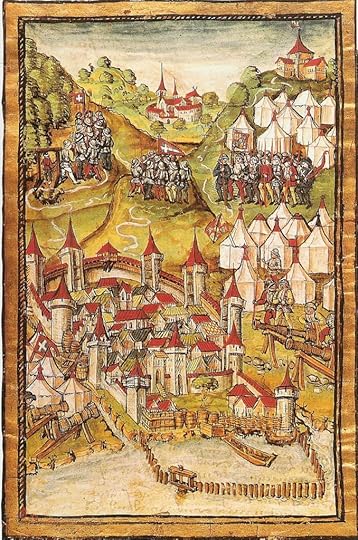

Charles’ death left Mary of Burgundy in charge. I’ve been meaning to put together something about all the depictions of her in art, but that’ll have to be another day.

And Switzerland independent.
The Swiss are not in the EU. Switzerland itself is a kind of mini EU, a union of 26 cantons, mini nations, that speak French, Italian, German, Romansh.
That’s enough for now.
I hope to visit Bern, it looks cool.

CucombreLibre from New York, NY, USA took that for Wikipedia.


