Do We No Longer Expect Ghosts to Manifest with a Purpose?
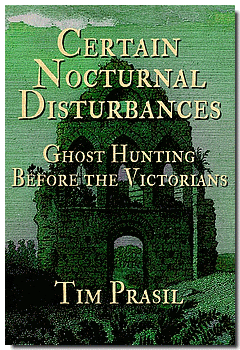
Back when I was working on Certain Nocturnal Disturbances: Ghost Hunting Before the Victorians, I came upon a 1771 investigation involving a house haunted for no clear reason. The manifestations seemed random and chaotic, even if it had been a poltergeist. My research into the case grew into a chapter titled “Purposeless Ghosts: Jervis, Bolton, and Luttrell at Hinton Ampner.” You see, pre-Victorian ghost reports typically portray spirits as returning to the physical realm with a specific goal, albeit sometimes vague enough that a ghost hunter/real-life occult detective is required to solve the mystery and resolve the unfinished business. Gradually, though, the tradition of the ghost-with-a-goal faded.
By the end of the 1800s, the likes of Eleanor Mildred Sidgwick and Andrew Lang were discussing how purposeless ghosts had eclipsed the earlier kind. I discuss that here and, with greater depth, in Certain Nocturnal Disturbances. Embarking on a brand new project, though, I’ve found a few early- and mid-Victorian mentions of this curious aspect of ghostlore.
 Two Curt Nods to Purposeless Ghosts
For instance, in an 1841 article, Robertson Noel surveys “a few of the strange and wild notions which prevailed among our forefathers, on the subject of spectral appearances.” In other words, he treats a belief in ghosts as something quaint and outdated, which was pretty common in the early 1800s. At one point, Noel relates what feels like a fairy tale about a spectral child repeatedly roaming through a house. Mustering courage to follow the spirit, a visitor helps to reveal that, in life, the child had selfishly hidden two pennies in the floor boards rather than obediently passing them along to a beggar. Once the living deliver the coins to the intended party, the guilty ghost of the naughty child is never seen again. Noel comments:
In the little story related above there was a reason assigned for the appearance; but in seven out of ten of extant ghost stories, there is so evident a want of cause that they must be classed as inventions, and not very cunningly devised.If a ghost is said to be without purpose, according to Noel, someone surely must be fibbing — and badly. Rather than give even one example of this, though, he immediately proceeds to a case of a murder victim’s ghost appearing to divulge where her body lies hidden and who her killers were, which strikes me as a very urgent reason to manifest indeed! I’m left to conclude that, while Noel recognized that most accounts of ghosts involve purposeless ones, he considered such tales a waste of ink.
By 1860, things seem to have been about the same: purposeless ghosts were glanced at but given the cold shoulder. That year, an anonymous writer arguing against the reality of ghosts makes the following observation:
Most ghost stories tell us that ghosts appear for some certain object; that there is some reason for their quitting the land of shadows to return to the place of their earthly residence; and that they have something of importance to communicate to the living. But there are numerous instances in which they are said to have appeared for no particular object, or, at all events, with no apparent reason.Rather than expand upon this point, though, the writer quickly moves on to the long history of believing in ghosts.
Handpicking Our Ghost StoriesAs I say, the late Victorians were better at grappling with purposeless ghosts. In fact, the two examples above seem to support Lang’s theory that “the old believers in the old-fashioned ghost chiefly collected and recorded the more striking and interesting cases — those in which the ghost showed a purpose (as a few modern ghosts still do).” Purposeless ghosts have been around all along, Lang suggests, but earlier ghostologists failed to preserve cases involving them, creating a false impression that ghosts had become aimless during the 1800s.
The tales we tell about ghosts — the ones we find worth repeating and those we shrug off — certainly change over time. And this has me wondering how things stand in the early 2000s. Do we interpret ghosts as having clear-cut purposes for either returning to or remaining in familiar places? Do they still manifest to ensure justice? To rectify mistakes? To plead for prayers or for some other kind of assistance from those left behind? Are they, in our psychology-savvy age, mostly about relentless trauma? Do we now classify purposeless ghosts as “residual hauntings“?
Beats me — I live in the past! With this in mind, I’ll continue to hunt historical ghosts, thank you.
— Tim