About Artificial Intelligence.
Evolutions in technology and knowledge have always provoked a conservative counter reaction by people who see their current ways of doing things and earning a living being threatened. The latest evolutions in the information technology isn’t any different in that aspect as the introduction of the printing press was for the mediaeval scribes or the industrial revolution for the artisanal textile and pottery producers.
How many among you have lately been sending out or receiving a handwritten letter? Or wear handwoven textiles and drink and eat from handmade porcelain? Does that mean that humanity stopped sending out handwritten letters or to produce artisanal textiles and pottery? No, but these activities became rare and don’t belong anymore to the mainstream of the social life. They’re banned to the private domain and are even there a rare phenomenon.
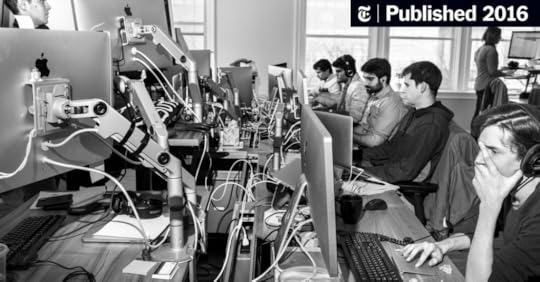
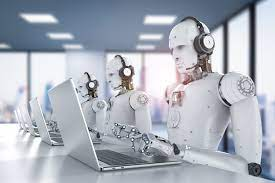
The introduction of information technology takes this trend one step higher. Machines not only taking over the mind-numbing blue-collar jobs, but also jobs that used to be performed by educated white collar workers. Accountants, librarians, engineers, secretaries, … and do it even better than their human counterparts. Currently, approximately 30% of all tasks are done by machines—and people do the rest. However, by the year 2025, the World Economic Forum believes that the balance will dramatically change to a 50-50 combination of humans and machines.
AlphaGo, the AI that defeated the Korean Go grandmaster Lee Sedol, was fed thousands of games, but no rules. It worked out how to play Go entirely by itself. As a result of losing 4 out 5 games to the AI, Lee gave up Go competition as a way to make himself a living. Lee referred to it as being “an entity that cannot be defeated.” Does that mean that Lee never plays Go anymore? No, it just means he either lives from the earnings he made during his career or sought other employment to earn a living. But I´m quite sure he still plays Go to remain mentally fit. To extrapolate on this new development on strategical thinking: AI’s have frequently outperformed human military strategists, although I doubt that there are many generals who will quit or lose their jobs because of this latest evolution. Most generals are more politicians in a uniform than soldiers, so they gladly embraced a machine that reduces the soldier part of the job.
The latest evolutionary step is where AI machines are outperforming people on a domain that was believed to be the prerogative of the human brain: creative thinking. In a recent article in the MIT Technology Review, the Harvard philosopher Sean Dorrance Kelly argued that creativity is one of the defining features of human beings and can only exist within a human context. This is surely short-sighted; there is no reason to claim that creativity belongs to humans alone.
We may be not as different as we think. Humans are mere biological machines, and conversely, a thinking, dreaming computer could be considered a silicon life-form. If we can be creative, why not computers? Computers may even become more creative than us, proposes Klingemann, a German artist who uses AI in his work. By trawling the web, they have access, potentially, to all knowledge. Our human brains are too limited to imagine how powerful machine creativity may become.
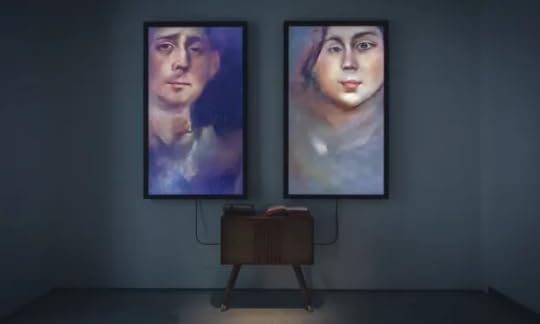 Mario Klingemann’s Memories of Passersby I is made up of a wooden console housing a computer and two screens displaying an endless stream of male and female faces. Photograph: Sotheby’s
For now, the copyright of such art belongs to the artist who owns the machine. That is fine as long the AI does not possess any self-consciousness, otherwise it would equal to slavery. Despite major advances in artificial intelligence, no computer has ever passed the Turing test. Nevertheless, in 2017, the social robot Sophia was given citizenship of Saudi Arabia. Although this was undoubtedly meant as PR stunt by the Saudis, it indicates that into their eyes an AI can already claim the status of a woman (who are anyway in this country second-degree citizens with limited civil rights). But what would happen when a country such as Switzerland would made its citizenship available for AI´s who passed the Turing test?
This thought has upset many artists who earn a living from selling their art. For the majority of the artists, making art is just a way to cope with life. In this context one has to observe that only 0,02 % of the artists worldwide are able to distillate a living from the sale of their art. Most of the income thus generated depends upon the artists’ abilities for marketing and “branding” themselves. It is also no surprise that professional artists are cataloging artificial creativity as a mere form of sophisticated copycatting, blissfully ignoring the fact that their own art roots into a long cultural tradition, supplemented with what contemporary developments are providing in style, subject, tools, and methodology.
If humankind is to survive, we will have to find a way to exist together with the machines. Machines are redefining what it is to be living, not merely human, beings. And in fact, little by little, we are merging with them – beginning with our smartphones, which have become extensions of ourselves. AI creativity could have incalculable value for humankind, opening up new cultural and scientific avenues for us to explore, creating new forms of art, literature and music, aiding medical research, and suggesting ways of dealing with our failing climate and growing ecological crisis. Soon, humanhood will go nowhere anymore where the machines have not been first: they boldly go where no human has gone before (paraphrasing the Star Trek motto here for obvious reasons).