World Building: Creating Religion
World Building
I mostly write fantasy and sci-fi books. One of the things I have to pay attention to is what things do I newly create and what things do I leave the same as people know them in this world? At the time of this blog post I'm writing in the world of Ryallon, where I base my fantasy series. Every once in a while, I'll share a little bit about the world building I do in the process.
When a person writes about something that happened in the past, it's wise to look at history books to get facts correct. When someone writes about a completely fictional world, all of the details need to be built from scratch.
World building can be fun. I'm certain there are a few would-be writers who have spent years building worlds of fantasy and magic, but have never gotten around to writing an actual book in the world. It's also very popular among D&D players.
Creating Religions
In fantasy, it is common to establish a fictional set of religions. Doing so can add great depth and definition to the characters and the people surrounding the characters. An understanding of historical theologies can greatly add to the richness and realism of these religions. It doesn't hurt to have read other novels with fictional religions either.
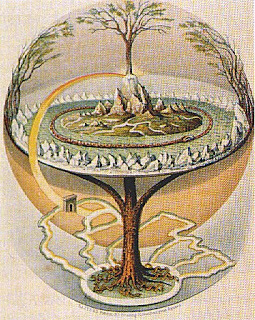
Before you begin, it's a good idea to have a general idea of how different people in your world think. There are usually many countries, though in fantasy it's possible to only have one. But do all of your people believe the same way? If you wish to have war in your worlds, multiple religions is one of the best ways to establish this.
One of the first things to consider is whether you want one god or many gods for your world. Has it been that way throughout the history of your world?
How they get their power is important. Are they powerful because they're gods? Did something give them power? One series I read, the Hawk and Fisher series by Simon R. Green, has gods gaining their power by the number of worshipers they have.
I have added the prologue of my fifth book, "Ebudae", below to give an example of how the Gods of Ryallon are set up.
An exerpt from "Ebudae"
While in thegloomy ruins of an ancient city below Dralin, Ebudae and Pelya had discovered atemple dedicated to an unknown god. Within that temple was a book most ancient. In spite of its age, the book was in perfectcondition with gold and silver-filigreed bindings.
The cover opened ofits own volition as the girls approached. Gazing upon pages that flipped before their mesmerized eyes, Ebudae andPelya understood every word with a clarity never experienced from any otherbook. Neither left until the last pagewas finished and the cover closed.
The mysterious book told how the Gods of Ryalloncame to be and a summary from it had remained sharp in the girl's minds fromthat point on:
Chaotic energies swirl around Ryallon andits moons, extending far beyond to other suns and worlds, though they do notexist everywhere. The energies give usmagic and shape the life of Ryallon, though they are not the source of life.
Those who we call Gods were once normalbeings. When those normal beings drankof the chaotic energies too deeply, they gained vast powers. There are many Gods on and around the worldof Ryallon. Some have great influenceand power while others touch few.
The most ancient Gods have existed sincebefore the beginning of humanity, but those are very odd to humans. They are called the Unreal Gods.
The earliest deities of humanity are the VanGods. The oldest and largest temples arebuilt to them in cities throughout Ryallon.
Others are new in the scheme of things, spawnedfrom people or creatures who attempt to control the chaotic energies. These are called the Crazed Gods, for when abeing absorbs vast power too quickly, it can destroy the mind. The Crazed Gods generally burn out and theirenergies spread back into the chaos. However, a few grow to power.
Less common are the Hushed Gods. It is unknown when they came to be, but manybelieve them to be as old as the Van Gods. They influence the world in subtle ways and have few followers. This does not mean their power should beunderestimated. Even Van Gods treat the Hushed Gods with great care.
And then there arethe Dragons. They are not Gods, but allGods fear them; for they are Dragons.

I mostly write fantasy and sci-fi books. One of the things I have to pay attention to is what things do I newly create and what things do I leave the same as people know them in this world? At the time of this blog post I'm writing in the world of Ryallon, where I base my fantasy series. Every once in a while, I'll share a little bit about the world building I do in the process.
When a person writes about something that happened in the past, it's wise to look at history books to get facts correct. When someone writes about a completely fictional world, all of the details need to be built from scratch.
World building can be fun. I'm certain there are a few would-be writers who have spent years building worlds of fantasy and magic, but have never gotten around to writing an actual book in the world. It's also very popular among D&D players.
Creating Religions
In fantasy, it is common to establish a fictional set of religions. Doing so can add great depth and definition to the characters and the people surrounding the characters. An understanding of historical theologies can greatly add to the richness and realism of these religions. It doesn't hurt to have read other novels with fictional religions either.

Before you begin, it's a good idea to have a general idea of how different people in your world think. There are usually many countries, though in fantasy it's possible to only have one. But do all of your people believe the same way? If you wish to have war in your worlds, multiple religions is one of the best ways to establish this.
One of the first things to consider is whether you want one god or many gods for your world. Has it been that way throughout the history of your world?
How they get their power is important. Are they powerful because they're gods? Did something give them power? One series I read, the Hawk and Fisher series by Simon R. Green, has gods gaining their power by the number of worshipers they have.
I have added the prologue of my fifth book, "Ebudae", below to give an example of how the Gods of Ryallon are set up.
An exerpt from "Ebudae"
While in thegloomy ruins of an ancient city below Dralin, Ebudae and Pelya had discovered atemple dedicated to an unknown god. Within that temple was a book most ancient. In spite of its age, the book was in perfectcondition with gold and silver-filigreed bindings.
The cover opened ofits own volition as the girls approached. Gazing upon pages that flipped before their mesmerized eyes, Ebudae andPelya understood every word with a clarity never experienced from any otherbook. Neither left until the last pagewas finished and the cover closed.
The mysterious book told how the Gods of Ryalloncame to be and a summary from it had remained sharp in the girl's minds fromthat point on:

Chaotic energies swirl around Ryallon andits moons, extending far beyond to other suns and worlds, though they do notexist everywhere. The energies give usmagic and shape the life of Ryallon, though they are not the source of life.
Those who we call Gods were once normalbeings. When those normal beings drankof the chaotic energies too deeply, they gained vast powers. There are many Gods on and around the worldof Ryallon. Some have great influenceand power while others touch few.
The most ancient Gods have existed sincebefore the beginning of humanity, but those are very odd to humans. They are called the Unreal Gods.
The earliest deities of humanity are the VanGods. The oldest and largest temples arebuilt to them in cities throughout Ryallon.
Others are new in the scheme of things, spawnedfrom people or creatures who attempt to control the chaotic energies. These are called the Crazed Gods, for when abeing absorbs vast power too quickly, it can destroy the mind. The Crazed Gods generally burn out and theirenergies spread back into the chaos. However, a few grow to power.
Less common are the Hushed Gods. It is unknown when they came to be, but manybelieve them to be as old as the Van Gods. They influence the world in subtle ways and have few followers. This does not mean their power should beunderestimated. Even Van Gods treat the Hushed Gods with great care.
And then there arethe Dragons. They are not Gods, but allGods fear them; for they are Dragons.


No comments have been added yet.