Home
My Books
Browse ▾
Recommendations
Choice Awards
Genres
Giveaways
New Releases
Lists
Explore
News & Interviews
Genres
Art
Biography
Business
Children's
Christian
Classics
Comics
Cookbooks
Ebooks
Fantasy
Fiction
Graphic Novels
Historical Fiction
History
Horror
Memoir
Music
Mystery
Nonfiction
Poetry
Psychology
Romance
Science
Science Fiction
Self Help
Sports
Thriller
Travel
Young Adult
More Genres
Community ▾
Groups
Quotes
Ask the Author
Sign In
Join
Sign up
View profile
Profile
Friends
Groups
Discussions
Comments
Reading Challenge
Kindle Notes & Highlights
Quotes
Favorite genres
Friends’ recommendations
Account settings
Help
Sign out
Home
My Books
Browse ▾
Recommendations
Choice Awards
Genres
Giveaways
New Releases
Lists
Explore
News & Interviews
Genres
Art
Biography
Business
Children's
Christian
Classics
Comics
Cookbooks
Ebooks
Fantasy
Fiction
Graphic Novels
Historical Fiction
History
Horror
Memoir
Music
Mystery
Nonfiction
Poetry
Psychology
Romance
Science
Science Fiction
Self Help
Sports
Thriller
Travel
Young Adult
More Genres
Community ▾
Groups
Quotes
Ask the Author
New blog...
A welter of parchment
Each and every thing...
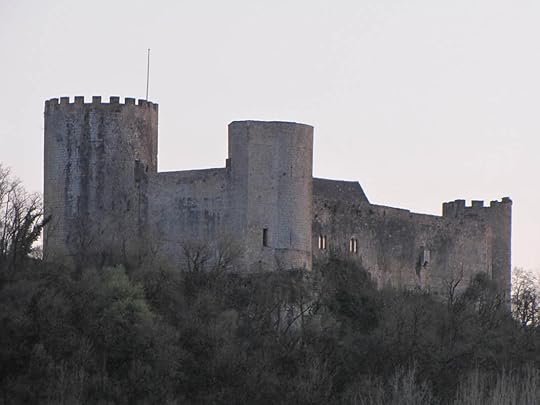
The castle of Sauveterre-la-Lemánce in the Agenais, a region of Aquitaine
The duchy of Aquitaine/Gascony The period of Edward I of England's personal rule of Aquitaine (also known as Gascony or Guienne) from 1273-94 was the most effective and forceful the duchy had ever known under an Angevin king, or would know again. Edward's actions in Aquitaine have been largely forgotten:
"Edward has often been called the English Justinian, but until recently both French and English historians tended to overlook his remarkable organizational work in the duchy. It was undertaken during his youth and the first half of his reign when he was at the height of his powers and aided by the most able of his ministers".
- Margaret Labarge, Gascony: England's first colony 1204-1453
Unlike his predecessors, Edward had spent time in Aquitaine in his youth, which gave him valuable personal experience of the region and its problems. His marriage to Eleanor of Castile in 1254, when Edward was just fifteen, was arranged by his father Henry III to reinforce the strength of the English position in the duchy. After the wedding Eleanor's father, Alfonso of Castile, formally renounced Castilian claims to Aquitaine. This removed the long-standing excuse for rebellion by ambitious vassals.
Edward succeeded his father in 1272 and first entered the duchy in August 1273 as king-duke of Aquitaine. He set about forcefully stamping his authority. One of his first actions was to impose an enquiry on the services and duties owed to him by the nobility, while the holders of fiefs were required to do homage on pain of confiscation. At the same time Edward took swift military action against Gaston, viscount of Béarn in southern Gascony, a perenially rebellious lord who had given Henry III and Simon de Montfort a deal of trouble.
After dealing with these issues, Edward sailed for England in the summer of 1274. He left one of his knights, Luke de Tany, to rule the duchy as seneschal. Unfortunately Tany proved unpopular, and was unable to control the violent and quarrelsome gentry. Nor could he prevent the Gascons from sending thirty appeals to the French king in Paris: this was a particular bone of contention, since the Treaty of Paris in 1259 had made the kings of England vassals of their brother kings of France. As Duke of Aquitaine, Edward was required to pay homage and fealty to his kinsman Philippe le Hardi, and the French king never missed an opportunity to undermine Angevin power. The use of Gascon appeals, whereby Edward's subjects appealed to Paris for justice instead of the king-duke, was an especially favoured French tactic.
In 1278 Edward was concerned enough to send Othon Grandson and Robert Burnell, his two most trusted servants, to reform abuses in Aquitaine. They removed Tany from office and replaced him with Jean de Grailly, a loyal household knight from Savoy who had defended Aquitaine against an invasion from Navarre in 1266. Grandson and Burnell did their master's work well, and finally wound up the long dispute with Gaston de Béarn by readmitting him to the king's grace.
Jean de Grailly was more capable than Tany, but the job was still too big for him. His problems multiplied in 1279, when Edward achieved the final expansion of Aquitaine under the terms of the Paris treaty of 1259. Via the Treaty of Amiens, the English gained several territories including the Agenais, a large strip of land on the northeast frontier of Aquitaine. Several years later Edward also gained the homage of Armagnac and Fezensac, expanding the borders of the duchy even further.
All this meant extra work for Grailly and his officials. It proved quite beyond them, and Grailly was soon pleading poverty. In December 1280 he wrote to the king defending himself against accusations of misconduct:
"No wonder you hear stories about me. I do not know where to turn..."
Despite being on a salary of £2000 a year, Grailly fell into the trap which snared so many officials, using his power to feather his own nest. In 1286 Edward went to Aquitaine in person to investigate, and in June the seneschal was removed from office. Grailly was not otherwise punished, but his time in the sun as a royal favourite was over.
Edward spent the next three years in his beloved duchy, implementing a complete overhaul of the administration. He created a new office, that of royal lieutenant, who would outrank the seneschal and have the powers of the king-duke so long as he held office. Edward's choice for lieutenant was his friend and cousin, Maurice de Craon, charged to complete the king-duke's reforms:
"To do every and each thing that we, if were present in the duchy, would do for the common good, and that of each person."
In his Ordinance for the governance of Aquitaine, published in 1289, Edward also reformed the functions of castellans, or constables as they were also called. These men were drawn from local knights and gentry, and in 1289 they acquired two extra technical experts to help them in their duties. There was to be an engineer to take in hand the practical supervision and upkeep of royal castles, and an 'artillator', responsible for the distribution of crossbows and quarrels, bows and lances, lances and darts.
Below the upper tiers of administration, the bureaucracy of Aquitaine was complex. Every official from the seneschal down was ordered to have his own clerk, preferably a public notary. Many of the more important clerks were heads of their own departments, comprising all the necessary people to write, classify and preserve the endless reams of government documentation. This process only accelerated in the fourteenth century: the Black Prince, for instance, bought for his officials in a single order 100 dozen parchments, four reams of paper and a two-gallon leather bottle of ink.
In his Gascon parliaments of May and June 1289, Edward placed heavy emphasis on the revamped judicial structure of Aquitaine. This included provision for a judge of appeals and an insistence on the frequent holding of assizes in all the lands of the duchy; all part of Edward's strategy to cut down on appeals to the French court and centralise royal power and authority. He was careful not to step on French toes, and carefully regulated the appointment of proctors and legal officials to deal with their French counterparts. This signalled his willingness to settle all disputes via legal means, and gave King Philip and his heirs no loophole to contrive an excuse for war.
Unless, of course, they decided to invent one. No matter how much thought and energy Edward and his officers put into the governance of Aquitaine, there was no escaping the bonds of the Treaty of Paris. This can be demonstrated in countless ways. One ongoing controversy with the French court was the dating clause in ducal charters granted in Aquitaine. The original clause had read regnante Edwardo, regie Anglie, making no mention of the French king. After months of debate a new formula was finally agreed which was acceptable to both the French and the English:
actum fuit regnantibus Phillipo rege Francie, Edwardo rege Anglie, duce Aquitanie.
This may sound trival, but it had practical consequences as the French king threatened to disregard any charters that did not include his name and regnal year. Edward's forced compliance was yet another assertion of French superiority. As a vassal of the Capetian kings of France, Edward was forever at a disadvantage. Philippe le Hardi's successor, Philippe le Bel, would exploit that disadvantage to the hilt.
View more on David Pilling's website »
Like
•
0 comments
•
flag
Published on
June 18, 2020 04:34
No comments have been added yet.
post a comment »
Add a reference:
Book
Author
Search for a book to add a reference
add:
link
cover
Author:
add:
link
photo
David Pilling's Blog
David Pilling's profile
157 followers
Welcome back. Just a moment while we sign you in to your Goodreads account.

 The castle of Sauveterre-la-Lemánce in the Agenais, a region of Aquitaine
  The duchy of Aquitaine/Gascony The period of Edward I of England's personal rule of Aquitaine (also known as Gascony or Guienne) from 1273-94 was the most effective and forceful the duchy had ever known under an Angevin king, or would know again. Edward's actions in Aquitaine have been largely forgotten: