Unintentionally Broken
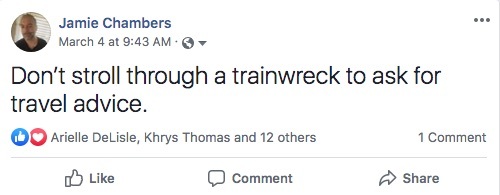
Preface: I’ve attempted, in recent years, to adopt a policy of non-vaguery. In other words: no talking about something online unless I’m willing to be specific. This post breaks that guideline, only because it’s not fair for my habit of over-sharing to hurt other people or expose things they’d prefer to keep private. Also? I hate it when people figure something out and suddenly decide they are a guru here to give advice to others. (“Here is how you begin living with intention!”) Everything I say here applies only to me. If reading this gives you pause for thought and makes you think how some of these concepts apply to your own life, that’s awesome. But in case you haven’t been paying attention, I have no idea what I’m doing. In others words: Don’t stroll through a trainwreck to ask for travel advice.
(Seriously, I am not a mental health professional nor qualified to give any kind of life advice. If you are struggling with depression or another problem, please seek help from someone qualified.)
I am so sorry… It’s not fair, you know? I think I’m just now starting to figure out how to live my life. I always loved you.
Once upon a time there was a little boy named Jamie. He had lots of potential and dreamed big. He could also be selfish, self-centered, entitled, judgmental, and wrong. Now he’s 45 years old with a list of triumphs, failures, pride, and shame, on the verge of yet another huge life change—only just now beginning to understand himself. Only just beginning to heal from self-inflicted wounds.
One phrase that I’ve seen a lot in recent years is Intentional Living. I’m one hundred percent certain I’ve rolled my eyes dozens of times when I saw or heard it. I mean, we’re all just doing our best, right? We make our plans and then adjust them as they make contact with reality. We control things we can and try to manage the stuff we can’t. But that thinking includes a few false assumptions.
In recent years I’ve become increasingly fascinated with the inner workings of the human mind. It started as research related to much-delayed writing projects. (And yes, all of my writing projects are delayed. That’s been a recurring problem. See below.) I became fascinated that one person can look at a picture of a dress and see colors completely different than another. Memory is unreliable, can be reframed and even rewritten. But probably the most crazy idea of all:
You’re not the one making your own decisions.
That sounds wild, and definitely needs clarifying. But on a basic level, we understand some version of this idea. Ever had a bad habit you couldn’t easily break? Ever said or done something and then later asked yourself, “Why the hell did I do that?” Of course, these are universal human experiences. But it gets weirder the deeper you go.
While we are still in the Stone Age when it comes to understanding the workings of the human brain, neuroscience is presenting a lot of evidence that we are completely unaware of the parts of our mind that actually make decisions and drive us into action. And from a biological point of view that idea makes sense. “Don’t think, just act” is advice given in any emergency or time-sensitive situation. If you had to consciously think about every little breath and motion you’d be paralyzed just trying to walk across the room. But beyond those split-second and automatic moments, it’s probably true that everything you do is driven by a part of your mind you have no access to whatsoever.
The conscious part of your brain is the narrator. It comes up with a story to justify the action the silent part of your mind made an instant earlier. And sometimes the story you tell yourself has very little to do with what’s really going on under the hood. Studies suggest that the intention to act happens before you are even aware of what you are about to do.
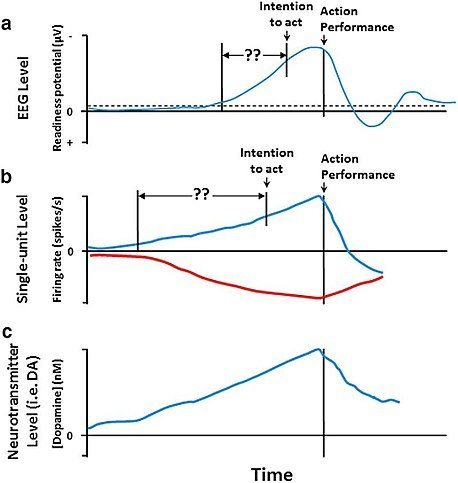
The brain “ramps up” before an action is taken.
I’ve found all of the above completely fascinating from an intellectual level and then happily did not think about how this knowledge might apply to my own life. Jamie Chambers, totally smart guy who always knows what he’s doing, didn’t stop to actually reconcile what he wants vs. what he’s doing.
Pick some of your most important personal goals and then look at how you’re spending the most irreplaceable, precious resource you have: time. Ask how you spent yesterday and find those things that are completely contrary to what you say you want. Because that pesky quiet part of your brain might be screwing you over and then the chatty part of your brain lies to you in order to justify it.
Let’s say three of your goals are lose weight, write a novel, get married. These things are genuinely important to you. But then you get that carb-heavy extra helping and maybe treat yourself with a little dessert, you decide today’s not a good day to write because the kid is home and there are too many distractions, and you pay more attention to someone outside of your relationship than the person you want to spend your life with.
Silent-Brain doesn’t really work in the realm of long-term goals. Silent-Brain lives in the moment, in a world of stimulus and reward in the short-term. Silent-Brain can be a real asshole.
Chatty-Brain helps out its bestie. Tells you that you’ve “been good” all day so it’s okay to indulge with that big meal and extra large glass of wine—you deserve it! Chatty-Brain reminds you of all the other stuff on your to-do list that is way more immediately important than that far-off novel that will take forever to finish anyway, best to wait until you’ve caught up on busywork and have a better environment in which to write. Chatty-Brain reminds you of that unkind thing your partner said recently and tells you that your deep and meaningful friendship with someone who’s telling you how great you are and how shitty your partner is will help you really figure things out in your life. Chatty-Brain is a filthy liar running cover for Silent.
If you learn to strip away the stimulus, the habitual responses, the short-term rewards, and really look at things you’re in for a sobering realization: You might be your own worst enemy.
Eating the cake didn’t help me reach my health goals. Reaching a self-imposed deadline with little to show for it doesn’t help my career or self-esteem. Neglecting my relationship will not end well. And yet here I am, just another hairless ape following my impulses and lying to myself as to why.
Unresolved Trauma
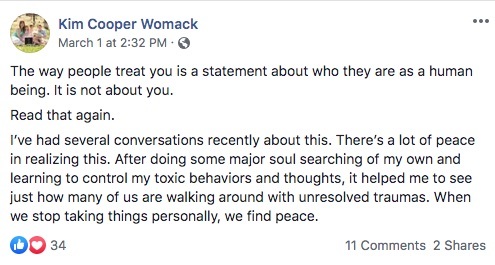
The above quote isn’t from a best-selling advice columnist or psychologist, but from a friend I’ve known most of my life. Growing up, I could throw a rock from my back door and hit her house. She’s also a registered nurse who—by one of those amazing coincidences or blessings—was working in the long-term ICU when my daughter Elizabeth was horribly sick and we didn’t know yet what was wrong. Kim pulled me to the side and prepared me to hear the words “cancer” and “leukemia.” She isn’t a doctor and couldn’t officially diagnose Liz, but she’s also good at her job and she knew what those symptoms probably meant. I cannot express how grateful I am that my friend prepared me for what was to come.
I haven’t stayed in close touch with Kim over the years, just casually and mostly through social media. But I know that she’s gone through her own life’s journey of ups and downs, and it seems like she slowed down enough to start looking inward and figuring herself out.
Me? I royally screwed things up a few years ago to the point I finally decided to take the idea of personal understanding and growth seriously. I started reading about developing a healthier body, mind, and spirit. Some of it had obvious benefits, as I figured out how my body works and I lost about 70 pounds over the course of a year. But the body is child’s play compared to the rest.
I started personal therapy a few years back. And while I instantly liked my counselor and appreciated “vent sessions” as they basically were in the beginning, I didn’t think it would ever be of any benefit other than getting frustrations off my chest. And boy was I wrong.
My counselor has sharp observations for me, sometimes, but her specialty is really giving me a structure to talk through the workings of my own mind. Most of my “oh wow” moments came after a session, as patterns became obvious or bad decisions suddenly made sense in a terrible way. Combined with personal reflection and introspection—along with a night that I can neither confirm nor deny involved psychedelic drugs—I have begun to figure out, in my mid-40s, how to see what’s going on under the hood.
And shit. I am damaged. I ignored the damage, made excuses for the damage. And in this Jamie-is-a-vehicle metaphor I’ve dropped my loved ones off in pretty awful places all while getting as far as I can from the things I say I want.
And even while I smile on the outside, my head has been filled with negative thoughts and self-hatred. I didn’t understand until somewhat recently that I’ve been depressed for over a decade.
Everyone’s been through something bad, whether it’s abuse, the loss of loved ones, a huge change in circumstances, crushing rejection, or something else on a nearly endless list. And we carry this emotional baggage with us, often unintentionally burdening the people we love.
Silent But Deadly
Remember our friend Quiet-Brain from above? Inside my skull, he’s hard at work trying to make me feel better in the moment. Quiet wants gratification to be instant, validation received with minimal effort. His best friend Chatty is on-hand to explain away any contradictions and brush aside the shame with a list of handy excuses. Unfortunately Quiet doesn’t give a damn about the things my conscious brain declares I want. It wants quick and easy results that can be enjoyed in the short-term.
Examples? Sure, let’s look at what I do versus those goals I mentioned earlier:
Putting off exercise because my back is still a little sore when I threw it out over the weekend, then eating and drinking things that will make me pack on weight.
Big writing projects are started and then abandoned in favor of scoring Likes & Shares on social media posts.
My relationship issues are neglected and get worse while I receive attention from people who don’t really know me all that well.
Obviously those aren’t the thoughts going through my head while I’m doing Quiet’s bidding. And Chatty is really good at his job, telling me…
That I don’t want to re-injure myself so I should just take it easy another day so I can really get back to it.
That I should follow those election results on Twitter and make some strong points to random people online when they disagree, oh and I should take a quote from the preface of this article and post it on Facebook real quick.
Oops.
That I should complain about some minor incident to an online friend instead of talking through it with my partner, knowing I’ll be told what a great guy I really am and how lucky she is to have me.
These two have done a really great job screwing up my life. (And let’s be clear, it’s all me. I am the one screwing up my life. This isn’t about dodging personal responsibility, but the opposite.) But I’m not helpless. If those two were the only factors, I wouldn’t be able to work on this self-indulgent article at all, I’d be too busy petting the dog who is currently desperate for my attention or eating a piece of leftover birthday cake for lunch.
I can’t get rid of Quiet & Chatty, but I can put them in their place. Understanding what’s going on is a key first step to taking back some control.
The Dangling Carrot
Pretty much every human behavior can be classified in one of two ways—attraction or aversion, risk vs. reward. We want Good things while avoiding the Bad stuff. And this basic way of categorizing the world is great for most of the simpler situations our foraging ancestors found themselves in.
Berries? Good, let’s eat! Bears? They’re terrifying, run away!
Hmm … a beehive. The honey is delicious but getting stung is the worst, gotta figure out how to deal with the bees if want the sweet, sweet treat.
Fast forward a hundred thousand years and we are still the same, biologically speaking, but we’ve created a much more complicated world to go with the mechanisms evolved to keep us safe and fed in a world of bears and bees.
My college Biology professor would gladly tell you that I’m an idiot — true story, that’s how he constantly referenced me when my ex took his class — but I’ve learned a couple of things. Dopamine is a neurotransmitter, a chemical that helps spread messages in your nervous system. According to cancer-obsessed WebMD, “Dopamine plays a role in how we feel pleasure. It’s a big part of our unique human ability to think and plan. It helps us strive, focus, and find things interesting.” In addition to its other chemical functions, it’s like this tiny hit of a free feel-good drug that kicks in to pat us on the head and say “Good Job!” whenever we receive a reward.
Eat that piece of chocolate? Enjoy a little dopamine. Finally finish level 372 of Candy Crush? Dopamine! Get a hug? Well, oxytocin — but also dopamine! Obviously, it’s more complicated than that, but realize that you’re getting a little chemical boost associated with almost any reward.
In The Power of Habit, author Charles Duhigg explores some cutting-edge science into how the human brain works when it comes to behavior. It explains just why it’s so tough to quit smoking or start an exercise routine. But more than that, it reveals how habits work even when memory does not, shows how a football team transformed their entire program by focusing on split-second habits instead of complicated plays, and how successful people transformed their lives and the entire world. Ultimately the book makes a case that the human brain is entirely hackable! We have thousands of habits (in other words, things we do almost automatically) that function as a part of our everyday lives. The only problem is there are plenty of habits that actually work against our greater interest or long-term goals, thanks to the impulses driven by Mr. Quiet.
A habit is broken down into a trigger, an action, and a reward. For example, finishing a meal might be a trigger. The action is lighting up a cigarette. And the reward would be the nicotine (and dopamine!) that floods your brain. It’s basically the same idea if a habit is bad or good. The other side of the coin would be the trigger of putting on your running shoes, the act of jogging, and the reward is the “exercise high” caused by endorphins (and dopamine!).
It only takes a few weeks to establish a habit, something I learned a few years ago when I lost the weight. I fundamentally changed the way I started each day—including hydrating with salt-lemon water first thing each morning, eating eggs for breakfast if not fasting, and drinking black coffee and water only before lunch. At first these changes took real conscious effort, but it’s been a good 24 months since I began and now I absently fumble with a water bottle, brew coffee, and make an omelet most mornings without even really thinking about it. It’s just what I do, like brushing my teeth, or washing my hands after using the restroom.
Unfortunately I have a laundry list of bad habits. But let’s take the totally random and completely hypothetical examples again:
Exercise. I never truly started the habit in the first place and Mr. Chatty is happy to remind me that I have a huge family and an endless list of work on my plate, so I should work on that some other time.
Social Media. Trigger: Opening my web browser. Action: Typing out pithy phrases or sharing a funny meme. Reward: Likes, Shares, Comments (and dopamine!).
Extra-Relationship Validation. Trigger: Sometimes it’s a message from a friend, other times a quiet moment when I’m not feeling so great about myself. Action: Sending a text, typing in a chat window, etc. Reward: Getting agreement or sympathy or validation (and dopamine!).
Simply knowing that something is bad for you doesn’t make it easy to change things—just ask any pack-a-day smoker. The longer you’ve had a habit going, the deeper those grooves and the harder it is to get un-stuck. And some of my mess goes back decades.
Many people—myself included—can live big chunks of their lives on Habit Autopilot. Once you’ve reached a certain age you’ve got situational scripts that handle most things without you having to really think about what you’re doing, and more importantly, why you are doing it. You are simply reacting to the world and other people while not making measured decisions.
In other words, you are living an unintentional life. I sure have been, and for far too long.
Sticks & Self-Deception
As mentioned above, we all love stuff that makes us feel good. But there is also an understandable urge to avoid things that are frightening, painful, or otherwise unpleasant. Good survival strategy for a hunter-gatherer, but in real life it can make us avoid the less-than-fun parts of our lives. For example …
You’re short this month and aren’t sure how you’re gonna pay the bills, so why bother opening the mail at all?
The symptoms are there, but if you go to the doctor you’re paying someone just to give you bad news, so you put it off until things are critical.
You’ve been unhappy in your relationship but you don’t want an argument, so you just don’t say anything at all.
It’s your Quiet, unintentional brain running the show here. Dealing with these unpleasant tasks will ultimately make your life better, but that’s long-term thinking. Quiet only cares about the next couple of minutes. And wants those minutes to be as low-stress as possible.
As a subcategory of my bad habits, there is plenty of avoidance in there. And there is plenty of cross-over. Writing is hard work and the payoff may be something that’s ignored or a pile of rejection letters, so one way not to fail is to never try in the first place. This, of course, is the domain of cowards everywhere. (I’m talking about me. I’m cowards.)
Don’t worry, because Chatty has you covered with excuses. Excuses so damn logical and convincing that they aren’t just for other people. This is bullshit you tell to yourself and you eat it off the spoon like it’s peanut butter straight from the jar. Self-deception comes naturally to many of us, and I had no idea until far too recently just how spectacularly good at lying to myself I can be. So you kick the can down the road and tell yourself some comforting lies so you feel like a little less of a failure.
Over time those repeated excuses become a cage you’ve trapped yourself inside but you call it home. Welcome to cognitive dissonance, my friend. You tell yourself one thing even though it’s an easily disproven lie. Your personal identity is on the line and there is way less effort in making excuses than in changing your situation. YouTuber Ian Martin explores a narrow aspect of being a creator who doesn’t create while making excuses in a video called “The Toolbox Fallacy,” that I especially recommend for creatives who are stuck.
But these self-deceptions exist everywhere, even if we creative people are especially good at lying to ourselves.
“I’m a positive person, full of love and light,” you declare, while most of what you put out into the world is negative and critical of others.
“I put family first,” you say while routinely neglecting your children for your career or social life.
“I believe in true love and soulmates,” you believe, abandoning relationships once they become challenging.
At one time I was the undefeated world heavyweight champion of self-deception. And the only reason I say “at one time” is because self-awareness and personal honesty are things I work at every single day under the advice of a mental health professional. Learning the smell of your own bullshit is a vital skill, because you can’t fix problems that you’ve literally hidden from yourself under a pile of excuses.
The Victim Trap
Validation is another one of those words that can feel over-used, but it’s something we all desperately crave as the social apes that we are. We all want to feel valued, appreciated, approved of, and at its core validation is quite healthy. Positive attention is nice, and being validated by others is a dopamine-generating method for healthy self-esteem.
For example, as a kid I started writing stories and running games of Dungeons & Dragons for my friends. And from 1983 until now, I still get a warm feeling of pride when someone offers positive feedback on my writing or when my group is having a great time at the game table. That’s the good form of validation.
But remember, that Quiet part of your brain wants things quick and easy. Writing and running six-hour long game sessions is, you know, work.
Let me get nakedly honest here. I’ve been through some rough times, been burned by my own bad decisions more than once (sometimes bouncing off someone else’s bad decisions, which makes it easier to ignore because you can downplay your own mess and focus on someone else). The first major leg of my career ended badly and I had to move back to Georgia after burying my father only to later get a divorce. Fast forward a few years after I started making a few strides in the right direction and then my daughter nearly died of acute leukemia.
Our family had a very real struggle on our hands, one that is only (knock on wood!) just easing up after four years. I had to figure out how to take care of my cancer-patient daughter full-time while keeping things going on the home front, supporting my partner, and making enough money to keep us going until I could catch back up on my business.
The outpouring of love and support from our circles of friends, gamers online, and total strangers was and is incredible. I could never repay the hundreds of gifts and favors, large and small, that helped us during a horrible and scary time in our lives.
But damn was I getting constant validation. “You are such a great father, Jamie” I was told—over and over again. We needed help, so I posted what was going on and what we needed and the support came flowing in along with the praise for my efforts. And that became a problem.
Some of you may have watched the show The Act, based on the true crime story of Gypsy Rose Blanchard. It’s about a young woman who was victimized by her mother for the majority of her young life, a mother who seems to have suffered from Munchausen syndrome by proxy—in which a parent intentionally causes health problems in a child. Dee Dee Blanchard lied about her daughter’s medical history and problems and forced her into unnecessary surgeries, medications, and severe lifestyle limitations—including making her daughter use a wheelchair even though she had no difficulty walking. Eventually Gypsy decided the only way she could be free of her life of torture was to convince a secret boyfriend to murder her mother Dee Dee. Like the rest of the audience I was horrified, but I also understood Dee Dee’s basic motivation. There are few forms of validation more gratifying than being told you’re a good parent, and if someone has felt worthless their entire life and is mentally unstable, I could see how it would be a recipe for a story like the Blanchards. And it’s highly unsettling to feel even one tiny thread of connection to something so awful.
Habit: Trigger → Action → Reward. As validation is the thing I practically live on, the necessary steps I took in the short-term in the wake of my daughter’s illness became about me instead of my daughter or my family. I never lied or misrepresented anything going on, please understand, but at the same time posting my daughter’s cancer news and promoting an item for sale or hosting a fundraiser became standard operating procedure. I started looking for health news to talk about and pictures to take of my bald kid. I became a full-time victim.
Let that sink in. I was the victim, not my daughter fighting for her life against blood cancer. She is a private person who doesn’t like a lot of attention and doesn’t like feeling obligated to strangers. But over time her illness and treatment became this strange show that I was hosting. We had an audience, I had stuff to talk about, and then I got told how amazing a parent I am even as my daughter would sometimes get upset with me for sharing something against her wishes.
I feel gross having written the previous paragraph, but that is me being candid about things I’ve come to realize through self-honesty.
It was a perfect recipe for creating a Victim Trap. I was in a bad situation (my kid has cancer) and I was given a ridiculous amount of positive attention without having to work for it like I did back in other situations. Time went by and I had an increasingly difficult time working on my writing and game projects. I lied to myself about what the real problems were because I had a box of handy excuses that most reasonable people would easily accept.
Like so many other parts of my life, I was simply reacting to outside stimulus and my own impulses and running on autopilot. I wasn’t living with intention.
Karen Alloy, a YouTuber formerly known as Spricket24, produced a video last year in which she discussed Victim Mentality and her own struggles.
One key idea for fixing things is a shift in focus. Rather than dwelling on the past or focusing on others, you look at the present moment and figure out what things—even the tiniest changes—you can implement to make sure you are really the one in charge. Not Quiet, Not Chatty. You, the one with ideas and plans and dreams. She says, “I can, right now, take control of my life and change my circumstances. I can, right now, pay attention to the thoughts in my head and help myself with better coping skills … and I can take responsibility for how I walk my walk in this world and what my story is.”
So here I am, a guy who got caught up in unhealthy habits and sought cheap forms of attention. All of the problems I had were real, but I just reacted to them when I should have been making intentional decisions and taking decided action. I leaned too hard into sympathy and praise, looking for shallow validation. Am I all bad, an unredeemable piece of shit? I hope not—depends on who you ask—but I can’t fix a problem I refuse to acknowledge.
So here are some confessions, without getting too detailed or personal because I’m not here to name people or tell anyone else’s story:
I ruined one of the most important relationships in my life, with my mentor who was like family, through a series of bad decisions and avoidance.
I hurt my children by forcing a cross-country move because I couldn’t get my act together back home.
My first marriage ended more painfully than necessary, in part because I couldn’t take responsibility for my own actions instead of owning up to my failings.
I have not taken good care of the beautiful home I’m lucky enough to live in.
My carelessness led to the death of an animal I loved.
I have neglected my relationship with my beautiful partner, looking for attention elsewhere instead of fixing things at home, being passive aggressive and hypocritically judgmental about her own coping mechanisms.
I have hurt friends who began getting much less from me than I wanted from them, and some are lost forever.
My large, extended family has suffered while my life was out of balance. They deserved far more consistency and security than they have received from me in recent years.
While it’s not easy putting this out for others to read, it was not hard to write because I already did the work here. Self-honesty is the first step. Ownership of one’s shit. Sweeping the mess under the rug just leaves you with a lumpy rug full of dirt.
I have delivered in-person and written apologies to some of the closest in my life who have suffered through years of me not properly dealing with my problems. And if I have hurt you, please know that I never meant to cause harm and I am truly working on the issues that led me to neglect the needs of the people in my life.
Forgiveness
You aren’t always going to get forgiveness from others, even if you want it desperately. Or you’ll get the words but those people can’t bring themselves to ever look at you the same way again. And that’s okay, because forgiveness is a personal choice. Also, as my mother has said many times, “Forgiveness is a gift that you give yourself.” This phrase means, if you can manage it, that you are making your own life better if you can offer forgiveness sincerely.
In the video above, Karen Alloy says “Forgiving someone doesn’t mean that what you did to me was okay … it means I have neither the want, need, or desire to hold onto this anymore. I’m letting it go.” When you actively hold onto a grudge you are giving power to someone who isn’t even in the room, allowing them into your thoughts. The forgiveness has nothing to do with being cool with whatever happened, but saying that it’s being left in the past where it belongs. It doesn’t mean you have to accept someone into your life or even speak to them again. Silent forgiveness is completely fine.
I’ll also note that forgiveness can be really hard, and I’m not judging you if you’ve dealt with something you can’t let go. I know a couple of people who likely will never forgive me for some of my mistakes. I hate it, I wish that I could make things better, but I understand. Only you can decide where your personal lines are drawn, but if you can bring yourself to err on the side of forgiveness it’s probably the best path toward personal peace.
One more word from Karen Alloy, who poses a thought exercise. If you knew you were going to die in 24 hours, would you finally be willing to forgive yourself for whatever mistakes and character flaws that you silently beat yourself up over?
It can feel like the negative inner voice is there to keep you on track, remind you of screw-ups so you won’t make those same mistakes. But in my experience what that actually does is keep you stuck in the past. Stuck thinking that you don’t deserve love, success, happiness. That you deserved to be punished. Welcome to self-sabotage!
Another nasty part about self-hatred is that when someone else reminds you of you—those traits or mistakes you flagellate yourself over—don’t be surprised if you find yourself irrationally and hypocritically angry. German novelist Hermann Hesse made this observation: “If you hate a person, you hate something in him that is part of yourself. What isn’t part of ourselves doesn’t disturb us.”
If someone triggers a negative strong reaction, it’s worth looking inward to see if we can figure out just where that emotion is coming from. We might realize it’s finding something within ourselves that we don’t like seeing out in daylight. It’s the same reason that outspoken homophobes are deeply in the closet and reacting out of unnecessary personal shame.
Last October I walked back home on a chilly evening from walking my dogs. Messages of self-forgiveness from Karen Alloy’s video and other sources must have been bouncing around my head. I was highly, um, “medicated” so I barely remember, but the next morning I looked in my journal and saw I had written a note to myself.

I read the note that I may or may not have written high as balls and I began to cry. Every couple of weeks I re-read it to reinforce the message. And it worked, mostly. While the note itself is more focused on my work and creative life, the sentiment has bled into everything else.
Nothing magic or instantaneous, but it does feel like I’ve turned a corner. By not being so negative with myself I’ve noticed it’s a lot easier to be positive when dealing with others. It’s a journey and I have a ways to go in this department, but it’s already so much better than it was. It’s very freeing, a step I highly recommend if you can get yourself there.
Let’s Get Meta: Mindfulness & Intention
“Mindfulness!” you exclaim. “I just won Hipster Bullshit Bingo!”
Yeah, I know it’s another one of those words you see on magazine covers at the supermarket, but it’s another of those simple ideas. You train yourself to become aware of the thoughts in your head, understand your frame of reference and state of mind. You take stock of what’s going on. Just practicing this in your own head can make a big difference, but you might also benefit from long-form journaling or a mood-tracking app.
You can’t make changes if you aren’t aware of what’s going on. If your focus is completely external you might just let your brain get away from you, letting Quiet & Chatty run amok.
By building a habit of taking stock of your thoughts and feelings it can help you decide if your brain is taking you in a direction you want to be going.
Intention is the action side. It’s where you take stock of your beliefs and goals and try to make choices that support them. In other words, live the life you want and make sure you are walking the walk and not just talking the talk. (You know, the thing I’ve been historically bad at!)
You will not be perfect, and that’s okay. But the more you turn your life, your effort, and your brain toward the things you want, the closer you’ll get to them. Practice makes perfect, initial success motivates you to keep going—lather, rinse, repeat. It’s work, but it gets easier and the rewards will reveal themselves over time.
Live Your Best Life
“Living my best life” has become a joke on social media—usually accompanied by an extreme indulgence that makes us laugh at the sheer cringe on display. But I admit I’ve come to like the phrase when used in its most sincere form.

You know, “Best Life.”
We’ve got at best about a hundred years on this wet rock in a 13.7 billion year old universe. Our lives are an infinitesimal blip on the scale of cosmic time, our size inconsequential in the unimaginably huge scale of the universe. You can choose whether to be comforted or upset that we will eventually be completely forgotten and any direct impact we had on the world will fade to nothing. To me that means that this moment is the one that matters. Each day is a chance to hit the reset button, to choose the person we want to be, to try again.
Space … it’s big.
Living my best life to me means achieving happiness through being kind to myself and to others, to finding meaning in relationships and journeys, to loving and forgiving, creating and appreciating. It means letting go of the past and not agonizing about the future, but rather picking my direction and focusing on each step.
So what do I want? Oh, that’s easy. I mentioned them above:
I want to be physically healthier.
I want to write a novel.
I want to marry the love of my life.
I could write a whole ‘nother article about how to turn vague goals (like being physically healthier) into something concrete and actionable (“I want to lose 20 pounds”) or how to make huge goals manageable by breaking them down into smaller steps, but we’ll save those discussions for another time. And of course, I can’t make choices for other people so that last one isn’t necessarily up to me.
But you know what I can do? I can keep eating right and start building a proper exercise habit. I can make sure I write at least a thousand words a day and get that book done. And I can try to be a person someone would want to marry by taking responsibility for my mistakes, taking stock of necessary changes, and then trying to be the kind of man that an amazing woman would want to marry.
I’ve talked the talk. Time for me to walk my walk.
But I’m not alone, and neither are you. We are all in this together.
Jamie Chambers
Canton, Georgia
Thursday, March 5, 2020
Images, video clips, and sounds in this article are believed to be used under ‘fair use’ as provided for in section 107 of the US Copyright Law, and will be removed at the request of the copyright holder. This article is intended for educational purposes.
The post Unintentionally Broken appeared first on Jamie Chambers.