My Return to Kalalau
I met the sign seven miles into my hike along the Kalalau Trail, the one needlessly warning hikers about the hazardous cliff ahead. Should the growing collection of cartoon stickers eventually overwhelm the sign, it won’t matter — everyone knows the threat looms. The ensuing quarter-mile of crumbling dirt and basalt is the most infamous stretch of trail in the Hawaiian islands. Nicknamed “Crawler’s Ledge,” the path hugs the side of a cliff some three-hundred feet above the churning Pacific. It’s rocky, uneven, narrower than a sidewalk, and not for those who’ve never before stood where a misplaced foot can spell their demise. Yes, people have crawled.
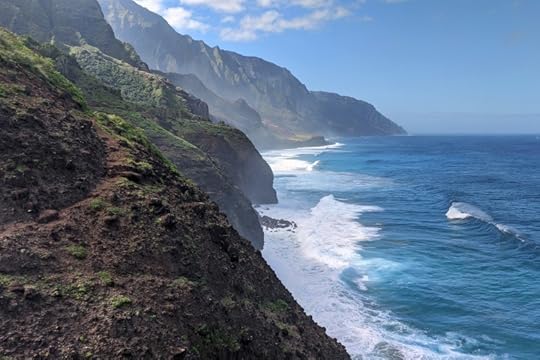
The narrowest section of “crawler’s ledge” curling around the cliffs above the Pacific with the full splendor of the Na Pali Coast on display.
National Geographic calls the Kalalau Trail one of the world’s best, the “finest coastal hike in the world,” and also one of the most dangerous. Eleven miles, point-to-point, with 3000-feet of elevation gain in the humid tropics can make for a long day, but it’s that ledge that haunts the sleep of many first-time visitors. Crawler’s Ledge is the gatekeeper to Kalalau Valley; a rite of passage for some, a monumental hurdle for acrophobic others. A hashtag for too many.
It’s hardly worth a mention.
Kalalau On My Own
Fifteen years ago, overburdened with bulky backpacking gear, a wife bordering on tears, and little experience with what, in outdoor circles, is known as “exposure,” the trail frightened me. The heat, humidity, and hills had worn us down. The knowledge that we’d have to hike back the next day made us consider turning around. We nearly paid for a boat ride out the following morning.
This time, on my own with lightweight gear and the experience of thousands of hours spent hiking and mountain biking in the Cascade Mountains, I cruised across Crawler’s Ledge, pausing only to take the photos I was too scared to capture years ago. I’d come a long way — in every way — and I had business to tend to.
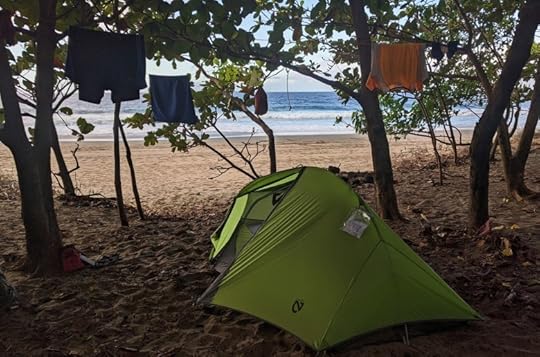
My Nemo Hornet 2P tent and clothesline set up amongst the milo trees and passionfruit vines at Kalalau Beach.
My three nights in Kalalau were no mere holiday. This was a research trip. It was my chance to record the details, sounds, and scents I aim to imbue my next novel with. This was an opportunity to fact-check what I’ve written thus far, to correct my fading memories, and inspire the scenes to come. It was on the hike out back in 2005 where I first asked myself the requisite “what if” question that gave rise to this novel. The seed has been marinating ever since.
Catastrophic floods thwarted my attempt to hike the trail in 2018, rendering my return to Kaua’i that year as little more than a sightseeing mission. Given the timing of the collapse of Prima Games and desire to write The Walkthrough, that was probably for the best. I didn’t truly begin this story until May 2019.
Then, in early 2020, I was spurred by the promise of perfect weather, fewer hikers, and a new-and-improved (thanks to plenty more bureaucracy) Kalalau Valley. The trail takes most hikers 6-10 hours to complete. I finished in five — who says CrossFit doesn’t translate to other activities? On the trail by sunrise, I had my tent pitched and was toes-in-sand with a good book shortly after noon. I wanted to get to work right away, but exploration of the vast Kalalau Valley would wait till the next day. After all, there was a sunset to prepare for.
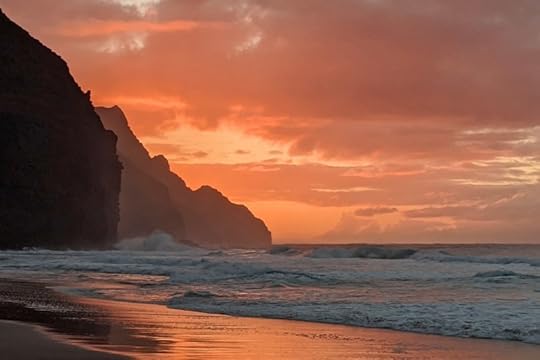
The only thing that could rival Kalalau during sunset is Kalalau at midnight, when the Milky Way lights the sky with millions of stars — and you can see every one of them.
Valley Wanderings
Fifteen years have passed since I last stood at the intersection of the two trails. To my left, the Kalalau Trail stretched eleven miles back the way I’d come. The other option headed mauka, inland, along the Kalalau Valley Trail. The valley is a Polynesian jungle two miles deep by one mile wide, ringed by emerald fluted cliffs towering three and four-thousand feet above. The Kalalau Stream, fed by several cliff-born tributaries, runs the length of the valley, pooling and plunging as it steps its way to the sea.
I crossed the first creek and abruptly overlooked a sign pointing up-valley. An obvious trail, wider and better-traveled than the one I sought, continued straight ahead. I followed it. First to a grove of noni fruit (tastes like peppered blue cheese — used in medicine) and papaya, then, upon spotting a frayed piece of rope on a tree, off into the woods to an abandoned tent, left behind from the recent clearing of the squatters who long dwelled in the valley. From there, I meandered along overgrown boot paths, emerging unexpectedly on the main trail. It wasn’t at all where I wanted to be, but was a happy accident nonetheless. A key scene in the book called for just such a hidden trail granting access to an overlook.
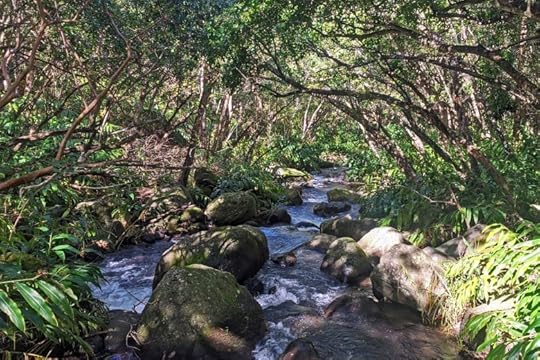
The trail’s gotta be around here somewhere. Or so I thought.
The next day, I tried again. And once again, I somehow failed to spot what I now know to be an obvious fork in the trail. But, unlike the prior day, I didn’t continue across Kalalau Stream. I recalled a map that showed the Kalalau Valley trail on the west side of the stream. So I bushwhacked. I clung to rocks, waded up the stream, and pushed through bamboo thickets. The cool, clear waters of Kalalau Stream swirled around my thighs, mud splattered my face, sweat soaked my hat. I reached the pools I’d heard about the hard way and took a swim. I found the trail leading back down valley in the most indirect way possible.
An hour later, after a heavy rain soaked the beach (the only rain of my four day trip), I led a group of five other hikers back up the valley. They asked me to take them to a swimming hole (surf on the beach was up to 20-feet and growing). I was determined to find the community garden. I told them it was a half-mile hike. Why? I have no idea. Two miles later, on the verge of a mutiny, I finally found the garden I sought. Ancient Hawaiian terraces had been planted with taro. Papaya and banana trees ringed the periphery and coffee and chili pepper plants dotted the landscape. And that was just what I could identify in-season.
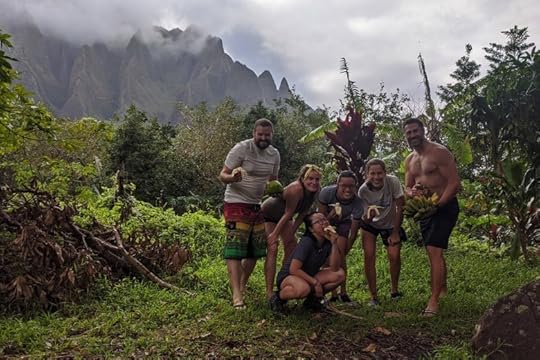
Myself (right) and five friendly hikers I befriended down on the beach. The supply of fresh bananas staved off the mutiny.
A bunch of ripe-enough bananas sat atop one of the terrace walls, awaiting our arrival, sweetening the bounty of details I was absorbing. I kicked off my “slippahs” (read: flip-flops) and walked more than two miles back to camp barefoot through the mud and rocks. Just as my characters know to do — downhill in mud is no time be wearing a shoe with a thong. Or so I learned as the shoe attempted to slice each of my feet in two.
A Visit to Kalalau Sticks With You
Back at the beach, another tasty Alpine Aire dehydrated meal awaited me, as did a shower beneath the waterfall. Bed once again came early. But not sleep. Kalalau Beach may be one of the darkest places I’d ever been — nearly as dark as the Sahara, and the night sky was unlike anything I’d seen in years. But it was too noisy to rest. I crawled from my tent to stare skyward at the confetti starlight, unable to sleep due to the sound of the two-storey tall waves crashing yards from my tent: The high water line had almost reached the milo forest.

Click for a full-size image. Pan and zoom for detail. This was taken at the water’s edge directly in front of my tentsite.
I took my time breaking camp that morning, due equally to my reluctance to leave and confidence in my ability to make my scheduled pick-up at the trailhead.
I chased away a gang of goats near camp and claimed the passionfruit that had fallen in the night before they could eat them. I filtered another three liters of water from the waterfall. I took a final sequence of photos of my temporary home. And then I left. Not by boat. Not dreading the trek ahead. I left with love in my heart for this place. For how difficult it is to reach it, for its lack of cell service and light pollution (the constant tourist helicopters are another story), and for how friendly the people are who make the journey.
The day was hotter. Humid. The trail was far more crowded, especially the final two miles where dayhikers are free to roam without a coveted backcountry permit.
I hiked my hike, took plenty more photos, and stopped at Hanakapi’ai Beach, the site of so many recent flash floods. There, I devoured the remainder of my food. I walked off the trail less than five hours after I started. I wasn’t anxious to leave, but the cross-island smell of a double cheeseburger had me chasing the barn … the inspiration of Kalalau had me racing back to the page.
Want to Know More?
Interested in learning more about my work-in-progress set in Kalalau? Then sign up now for my mailing list. Subscribers receive updates, sneak previews, and even a chance to be an advanced reader! The currently untitled book is expected to release in Spring 2021. Stay tuned!
The post My Return to Kalalau appeared first on DOUG WALSH.